

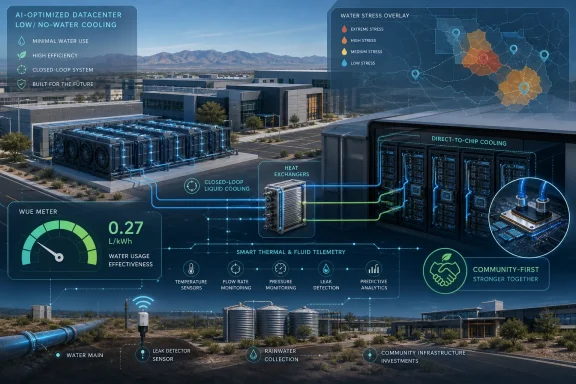
Microsoft said on June 24, 2026, that its owned datacenter fleet has cut average water use effectiveness from 2.3 liters per kilowatt-hour in the early 2000s to 0.27 L/kWh in 2025 while cloud and AI demand keeps rising. That is the clean version of a messier story: Microsoft has learned how to make each unit of computing far less thirsty, just as the total appetite for computing is exploding. The company’s new water pitch is not a victory lap so much as an attempt to prove that hyperscale growth can be made politically and environmentally tolerable. For Windows users, Azure customers, admins, and local communities, the stakes are now bigger than another sustainability metric on a corporate dashboard.
Microsoft’s latest blog post is framed as a two-decade engineering story, and the company has numbers to justify that framing. A nearly 90 percent reduction in water use effectiveness since its earliest datacenter generation is not a cosmetic improvement. It reflects a real shift in how hyperscale facilities are cooled, instrumented, and operated.
But the timing matters more than the triumphal tone. Microsoft is making this case in 2026 because the AI buildout has pushed datacenters from invisible backend plumbing into front-page civic infrastructure. Communities that once debated warehouse traffic and tax incentives are now asking about aquifers, utility capacity, wastewater systems, and whether the local public is subsidizing a global cloud business.
The company’s core argument is that water intensity and datacenter growth have been decoupled. In plain English: Microsoft says it can add more computing capacity without water use rising at the same pace. That distinction matters, because absolute water withdrawals can still grow even when intensity falls.
This is the central tension of the piece. Microsoft is right to celebrate efficiency, but efficiency does not end the debate. It changes the debate from “Are datacenters wasteful by design?” to “Can hyperscalers scale fast enough without outrunning the communities and watersheds that host them?”
Microsoft’s 2025 figure of 0.27 L/kWh for its owned fleet is therefore meaningful. It suggests that the average Microsoft-owned datacenter now requires only a fraction of the water per unit of computing that its early facilities did. The company also says it has already achieved a 25 percent reduction in datacenter water-use intensity against a 2022 baseline, putting it more than halfway toward a 40 percent improvement target by 2030.
Still, WUE is not the whole story. It does not tell a resident in Arizona, Virginia, Iowa, or Wisconsin whether their municipal system will need upgrades, whether a dry season will tighten local supply, or whether a new campus changes the political economy of water planning. A good intensity metric can show engineering progress while leaving local consequences unresolved.
That is why Microsoft’s post tries to pair fleet-wide figures with local examples. The company cites Phoenix, Quincy, Singapore, San Antonio, Leesburg, and rainwater harvesting projects across Europe and Canada. The subtext is clear: Microsoft knows global averages will not satisfy local skepticism.
That architecture helped push much of the fleet toward low- or zero-water operation. According to Microsoft, about 90 percent of its 2025 owned datacenter fleet now runs on highly efficient low- to zero-water cooling systems. That is a significant operational baseline, especially compared with the older image of datacenters as buildings that burn electricity to chill air and evaporate water around the clock.
AI changes the problem again. Dense racks of accelerators generate heat in ways traditional air-cooled datacenters were not designed to handle elegantly. The industry’s move toward liquid cooling is not a sustainability branding exercise; it is a physical necessity created by power-hungry chips packed closer together.
Microsoft’s answer is a new AI-optimized datacenter design introduced in 2024 that uses closed-loop direct-to-chip cooling and consumes zero water for cooling during operations. The phrase needs parsing. These systems may use water or other fluid inside the cooling loop, but they are designed not to evaporate water as part of day-to-day cooling.
That shift is important because it breaks the mental link between “liquid cooling” and “continuous water withdrawal.” For IT pros, it also marks a broader architectural transition. Cooling is no longer just a facilities problem; it is becoming part of the compute platform, tied directly to rack density, chip design, workload scheduling, and regional site planning.
But zero-water cooling does not erase the existing fleet. Microsoft still operates a sprawling global estate that includes facilities built across different eras, climates, designs, and ownership models. Some are owned and controlled by Microsoft; others are leased or operated through partners. Corporate sustainability claims often become harder to interpret as soon as the boundary around “our operations” expands or contracts.
That is why Microsoft’s distinction between its owned fleet and its broader datacenter footprint deserves scrutiny. The headline WUE improvement applies to the owned fleet. The company’s water positive commitment is broader, and its community-first language extends across leased facilities, but the operational levers are not identical everywhere.
There is also a scale problem. The more AI infrastructure Microsoft builds, the more absolute demand for power, land, transmission, backup systems, construction materials, and local infrastructure rises. Water-efficient cooling can reduce one pressure point, but it does not make hyperscale infrastructure frictionless.
The breakthrough is real. The danger is treating it as a rhetorical shield against every local objection.
In Phoenix, Microsoft says these operational changes produced a 23 percent year-over-year WUE improvement in FY25. Phoenix is a particularly important example because it sits in a region where water stress is not an abstraction. If Microsoft can squeeze meaningful improvements out of existing evaporatively cooled sites there, it strengthens the argument that operational discipline can matter as much as new construction.
This also speaks to a familiar IT truth: default settings are rarely optimal forever. Datacenters designed around conservative thermal margins can become inefficient if operators keep cooling to yesterday’s assumptions. Better telemetry allows facilities teams to operate closer to the actual requirements of hardware rather than the habits of the past.
For WindowsForum readers who manage infrastructure at smaller scale, the lesson is recognizable. Sustainability gains often come from the same place as reliability gains: better instrumentation, fewer assumptions, tighter feedback loops, and faster detection when something drifts out of spec. Hyperscale may be different in size, but the operational logic is familiar.
The Quincy example has long been central to Microsoft’s water story. Reuse systems can reduce pressure on drinking-water supplies while creating infrastructure that may benefit the wider community. In theory, this is the model every hyperscaler wants to present: the datacenter arrives not as a drain on public systems, but as an anchor tenant that helps fund modernization.
Yet alternative water is not magic. Recycled systems require pipes, treatment capacity, operations staff, permitting, and long-term coordination with utilities. Rainwater harvesting depends on local precipitation, storage design, and the actual gap between rainfall and operational needs. Non-potable sourcing can reduce one kind of pressure while creating new dependencies elsewhere.
Microsoft’s claim that it funds required system upgrades in full is therefore politically significant. In Leesburg, Virginia, the company says it is funding more than $25 million in water and sewer improvements so local ratepayers do not bear the cost of serving its facilities. Since 2020, it says it has invested more than $500 million in more than 75 water and wastewater infrastructure projects with community co-benefits.
That language is designed to answer one of the hardest questions in datacenter politics: who pays? If the answer is “the community pays through rates, congestion, and scarcity while the hyperscaler books the revenue,” resentment is inevitable. If the answer is “the hyperscaler funds durable public infrastructure,” the conversation changes — though it does not disappear.
Water replenishment is inherently more complicated than a simple corporate ledger. A gallon replenished through wetland restoration, leak detection, aquifer recharge, or infrastructure repair is not always interchangeable with a gallon withdrawn from a stressed local utility system. Timing, geography, watershed health, and local demand all matter.
Microsoft appears to understand that vulnerability, which is why it emphasizes local projects. In the Phoenix area and nearby Nevada communities, the company points to AI-enabled leak detection with FIDO Tech and utilities to find hidden breaks in aging systems. In the Midwest, it highlights work with The Nature Conservancy to restore oxbow wetlands that recharge groundwater, reduce flood risk, and improve habitat.
Those are credible categories of water stewardship. Leak detection is especially practical because many public systems lose large volumes of treated water before it ever reaches a tap. Wetland restoration can improve resilience in ways that do not look like a pipe or pump but still matter to a watershed.
The caution is that replenishment can become a form of corporate offsetting if it is used too loosely. The closer projects are to affected communities, the more transparent the accounting, and the more durable the local benefits, the stronger the claim. The farther the replenishment drifts from the place and time of withdrawal, the more it risks sounding like carbon offsets with a blue tint.
The company’s Datacenter Community Pledge promises to protect local watersheds, engage stakeholders, and invest in regional resilience. That is the right vocabulary for the moment. The question is whether communities experience it as partnership or as a polished narrative arriving after the siting decisions have effectively been made.
This matters because AI has changed the political visibility of datacenters. A decade ago, a cloud region was often sold as economic development and technical modernization. Today, a large AI campus may be perceived as a resource-intensive industrial facility serving global customers, not necessarily local needs. Microsoft has to convince communities that the benefits are tangible and the burdens are not being socialized.
The company’s claim that it plans ahead with local utilities and funds needed upgrades is therefore central. If substantiated project by project, it gives local officials something concrete to evaluate. If handled vaguely, it becomes another promise in a sector already crowded with sustainability commitments and executive talking points.
For admins, that means sustainability is no longer an abstract corporate value bolted onto procurement language. It is part of the operational footprint of the services they deploy. A tenant running Microsoft 365, Azure Virtual Desktop, Intune, Defender for Endpoint, and Copilot is consuming a stack whose environmental impact is mediated through Microsoft’s datacenters.
This does not mean every IT department will choose platforms based primarily on WUE. Cost, security, compliance, performance, data residency, and vendor lock-in will still dominate. But enterprise customers increasingly need defensible sustainability data for internal reporting, public commitments, and regulated disclosures.
Microsoft knows this. Its water story is also a customer story. If the company can show that AI and cloud services are becoming less water-intensive, it gives CIOs and sustainability officers a better answer when boards ask what the organization’s AI adoption is doing to its environmental footprint.
AI is especially vulnerable to this dynamic because the market is still discovering new uses for large-scale compute. Training, fine-tuning, inference, synthetic data generation, agentic workflows, search, productivity assistants, coding tools, security analysis, and business automation all compete for capacity. The industry is not merely replacing old workloads with more efficient ones; it is creating new workloads that would not have existed at this scale before.
Microsoft’s post argues that digital growth and sustainable water management can advance together. That is plausible. It is not the same as proving that every proposed datacenter campus is locally wise, every regional buildout is appropriately timed, or every AI workload is worth its infrastructure cost.
This is where the company’s transparency pledge becomes important. The more Microsoft discloses at the regional and facility level, the easier it becomes to distinguish genuine progress from averages that smooth over hotspots. Communities do not live inside global averages; they live near wells, reservoirs, treatment plants, and rate schedules.
That hierarchy is changing. Power remains the major constraint, especially as AI accelerators drive enormous electricity demand. But water is more emotionally immediate and more locally legible. A resident may not understand the difference between market-based and location-based emissions accounting, but they understand a drought, a rate increase, or a new water main.
Water also exposes the limits of global corporate accounting. A company can buy renewable energy credits or sign power deals across markets, but water is stubbornly local. Moving water, treating water, replenishing water, and protecting watersheds all depend on geography.
Microsoft’s blog implicitly acknowledges that the environmental debate has entered this local-infrastructure phase. It emphasizes non-potable water, rainwater harvesting, on-site treatment, leak detection, utility upgrades, and wetland restoration. Those are not abstract offsets; they are interventions in physical systems.
That is the right direction. It also raises the standard Microsoft will be judged against. Once a company claims to be a local infrastructure partner, communities will expect more than fleet-wide sustainability slides.
Traditional enterprise IT often treated cooling as an environmental envelope around servers. The room had an acceptable temperature and humidity range, and equipment lived inside it. Hyperscale AI is pushing cooling deeper into the stack, from rooms to rows, racks, trays, chips, and workload orchestration.
Direct-to-chip cooling is part of that shift. So are heat exchanger units, rack-level design, thermal-aware scheduling, and potentially chip-level innovations that change how heat is moved away from silicon. Microsoft’s infrastructure teams are no longer just building places for servers; they are building systems where compute, cooling, power, and software management are tightly coupled.
That matters for customers because it shapes the economics and availability of AI services. If Microsoft can cool denser racks with less water and predictable reliability, Azure can deploy more AI capacity in more places. If cooling or water constraints slow deployment, the consequences show up as higher prices, regional scarcity, delayed services, or tighter quotas.
The cooling story is therefore not separate from the AI product story. It is one of the foundations on which the AI product story rests.
 Microsoft Turns Water Efficiency Into an AI Infrastructure Argument
Microsoft’s latest blog post is framed as a two-decade engineering story, and the company has numbers to justify that framing. A nearly 90 percent reduction in water use effectiveness since its earliest datacenter generation is not a cosmetic improvement. It reflects a real shift in how hyperscale facilities are cooled, instrumented, and operated.But the timing matters more than the triumphal tone. Microsoft is making this case in 2026 because the AI buildout has pushed datacenters from invisible backend plumbing into front-page civic infrastructure. Communities that once debated warehouse traffic and tax incentives are now asking about aquifers, utility capacity, wastewater systems, and whether the local public is subsidizing a global cloud business.
The company’s core argument is that water intensity and datacenter growth have been decoupled. In plain English: Microsoft says it can add more computing capacity without water use rising at the same pace. That distinction matters, because absolute water withdrawals can still grow even when intensity falls.
This is the central tension of the piece. Microsoft is right to celebrate efficiency, but efficiency does not end the debate. It changes the debate from “Are datacenters wasteful by design?” to “Can hyperscalers scale fast enough without outrunning the communities and watersheds that host them?”
The Metric Does Real Work, but It Also Narrows the Lens
Water use effectiveness, or WUE, measures liters of water used per kilowatt-hour of IT energy consumption. It is a useful metric because it connects water use to the actual work a datacenter performs. A facility that uses more servers, pushes more workloads, and runs hotter hardware can be compared against earlier designs with some degree of fairness.Microsoft’s 2025 figure of 0.27 L/kWh for its owned fleet is therefore meaningful. It suggests that the average Microsoft-owned datacenter now requires only a fraction of the water per unit of computing that its early facilities did. The company also says it has already achieved a 25 percent reduction in datacenter water-use intensity against a 2022 baseline, putting it more than halfway toward a 40 percent improvement target by 2030.
Still, WUE is not the whole story. It does not tell a resident in Arizona, Virginia, Iowa, or Wisconsin whether their municipal system will need upgrades, whether a dry season will tighten local supply, or whether a new campus changes the political economy of water planning. A good intensity metric can show engineering progress while leaving local consequences unresolved.
That is why Microsoft’s post tries to pair fleet-wide figures with local examples. The company cites Phoenix, Quincy, Singapore, San Antonio, Leesburg, and rainwater harvesting projects across Europe and Canada. The subtext is clear: Microsoft knows global averages will not satisfy local skepticism.
The Old Datacenter Cooling Fight Has Become a New AI Cooling Fight
The cooling story begins with a relatively simple insight: not every datacenter needs to behave like an old refrigerated box. Microsoft says that as early as 2008 it adopted direct air cooling with evaporative assist as a primary fleet design. Instead of relying constantly on water-heavy cooling, those systems use outside air when conditions permit and turn to evaporative assistance only above roughly 85 degrees Fahrenheit.That architecture helped push much of the fleet toward low- or zero-water operation. According to Microsoft, about 90 percent of its 2025 owned datacenter fleet now runs on highly efficient low- to zero-water cooling systems. That is a significant operational baseline, especially compared with the older image of datacenters as buildings that burn electricity to chill air and evaporate water around the clock.
AI changes the problem again. Dense racks of accelerators generate heat in ways traditional air-cooled datacenters were not designed to handle elegantly. The industry’s move toward liquid cooling is not a sustainability branding exercise; it is a physical necessity created by power-hungry chips packed closer together.
Microsoft’s answer is a new AI-optimized datacenter design introduced in 2024 that uses closed-loop direct-to-chip cooling and consumes zero water for cooling during operations. The phrase needs parsing. These systems may use water or other fluid inside the cooling loop, but they are designed not to evaporate water as part of day-to-day cooling.
That shift is important because it breaks the mental link between “liquid cooling” and “continuous water withdrawal.” For IT pros, it also marks a broader architectural transition. Cooling is no longer just a facilities problem; it is becoming part of the compute platform, tied directly to rack density, chip design, workload scheduling, and regional site planning.
Zero-Water Cooling Is a Breakthrough, Not a Time Machine
The strongest part of Microsoft’s argument is forward-looking. New AI campuses can be designed around closed-loop cooling from the start, rather than retrofitted after the fact. If the next wave of Azure capacity runs on systems that avoid evaporative water use during normal operations, the water intensity curve should keep falling.But zero-water cooling does not erase the existing fleet. Microsoft still operates a sprawling global estate that includes facilities built across different eras, climates, designs, and ownership models. Some are owned and controlled by Microsoft; others are leased or operated through partners. Corporate sustainability claims often become harder to interpret as soon as the boundary around “our operations” expands or contracts.
That is why Microsoft’s distinction between its owned fleet and its broader datacenter footprint deserves scrutiny. The headline WUE improvement applies to the owned fleet. The company’s water positive commitment is broader, and its community-first language extends across leased facilities, but the operational levers are not identical everywhere.
There is also a scale problem. The more AI infrastructure Microsoft builds, the more absolute demand for power, land, transmission, backup systems, construction materials, and local infrastructure rises. Water-efficient cooling can reduce one pressure point, but it does not make hyperscale infrastructure frictionless.
The breakthrough is real. The danger is treating it as a rhetorical shield against every local objection.
Smarter Controls Are the Boring Part That May Matter Most
Microsoft’s post spends time on smarter controls, and that is where the datacenter story becomes less glamorous but more credible. The company says it is optimizing temperature and humidity setpoints, reducing overcooling, auditing water use, and comparing real-world operations against design expectations using weather data and analytics. That is not as flashy as direct-to-chip cooling, but it is how large infrastructure actually improves.In Phoenix, Microsoft says these operational changes produced a 23 percent year-over-year WUE improvement in FY25. Phoenix is a particularly important example because it sits in a region where water stress is not an abstraction. If Microsoft can squeeze meaningful improvements out of existing evaporatively cooled sites there, it strengthens the argument that operational discipline can matter as much as new construction.
This also speaks to a familiar IT truth: default settings are rarely optimal forever. Datacenters designed around conservative thermal margins can become inefficient if operators keep cooling to yesterday’s assumptions. Better telemetry allows facilities teams to operate closer to the actual requirements of hardware rather than the habits of the past.
For WindowsForum readers who manage infrastructure at smaller scale, the lesson is recognizable. Sustainability gains often come from the same place as reliability gains: better instrumentation, fewer assumptions, tighter feedback loops, and faster detection when something drifts out of spec. Hyperscale may be different in size, but the operational logic is familiar.
Recycled Water Is Where Engineering Meets Local Politics
Microsoft’s alternative-water strategy is the part of the story most likely to matter to communities. The company says it uses recycled, reused, or non-potable water heavily in several key locations, including 74 percent in Quincy, 99 percent in Singapore, and 79 percent in San Antonio. Those are substantial figures because they shift demand away from potable freshwater systems.The Quincy example has long been central to Microsoft’s water story. Reuse systems can reduce pressure on drinking-water supplies while creating infrastructure that may benefit the wider community. In theory, this is the model every hyperscaler wants to present: the datacenter arrives not as a drain on public systems, but as an anchor tenant that helps fund modernization.
Yet alternative water is not magic. Recycled systems require pipes, treatment capacity, operations staff, permitting, and long-term coordination with utilities. Rainwater harvesting depends on local precipitation, storage design, and the actual gap between rainfall and operational needs. Non-potable sourcing can reduce one kind of pressure while creating new dependencies elsewhere.
Microsoft’s claim that it funds required system upgrades in full is therefore politically significant. In Leesburg, Virginia, the company says it is funding more than $25 million in water and sewer improvements so local ratepayers do not bear the cost of serving its facilities. Since 2020, it says it has invested more than $500 million in more than 75 water and wastewater infrastructure projects with community co-benefits.
That language is designed to answer one of the hardest questions in datacenter politics: who pays? If the answer is “the community pays through rates, congestion, and scarcity while the hyperscaler books the revenue,” resentment is inevitable. If the answer is “the hyperscaler funds durable public infrastructure,” the conversation changes — though it does not disappear.
Water Positive Is a Promise With Accounting Built In
Microsoft says it reached an important milestone in FY25 by replenishing more water than it withdrew across global operations for the year. That sounds like the 2030 water positive goal arrived early. The more careful reading is that Microsoft has hit a milestone toward sustaining that performance over time, not that the entire issue has been solved.Water replenishment is inherently more complicated than a simple corporate ledger. A gallon replenished through wetland restoration, leak detection, aquifer recharge, or infrastructure repair is not always interchangeable with a gallon withdrawn from a stressed local utility system. Timing, geography, watershed health, and local demand all matter.
Microsoft appears to understand that vulnerability, which is why it emphasizes local projects. In the Phoenix area and nearby Nevada communities, the company points to AI-enabled leak detection with FIDO Tech and utilities to find hidden breaks in aging systems. In the Midwest, it highlights work with The Nature Conservancy to restore oxbow wetlands that recharge groundwater, reduce flood risk, and improve habitat.
Those are credible categories of water stewardship. Leak detection is especially practical because many public systems lose large volumes of treated water before it ever reaches a tap. Wetland restoration can improve resilience in ways that do not look like a pipe or pump but still matter to a watershed.
The caution is that replenishment can become a form of corporate offsetting if it is used too loosely. The closer projects are to affected communities, the more transparent the accounting, and the more durable the local benefits, the stronger the claim. The farther the replenishment drifts from the place and time of withdrawal, the more it risks sounding like carbon offsets with a blue tint.
The Community-First Pitch Is Really a License-to-Operate Strategy
Microsoft’s “Community-First AI Infrastructure” language is not just public relations. It is a recognition that datacenter expansion now depends on local legitimacy. Power availability, water planning, land-use approvals, transmission buildouts, tax arrangements, and public trust all shape how fast the cloud can grow.The company’s Datacenter Community Pledge promises to protect local watersheds, engage stakeholders, and invest in regional resilience. That is the right vocabulary for the moment. The question is whether communities experience it as partnership or as a polished narrative arriving after the siting decisions have effectively been made.
This matters because AI has changed the political visibility of datacenters. A decade ago, a cloud region was often sold as economic development and technical modernization. Today, a large AI campus may be perceived as a resource-intensive industrial facility serving global customers, not necessarily local needs. Microsoft has to convince communities that the benefits are tangible and the burdens are not being socialized.
The company’s claim that it plans ahead with local utilities and funds needed upgrades is therefore central. If substantiated project by project, it gives local officials something concrete to evaluate. If handled vaguely, it becomes another promise in a sector already crowded with sustainability commitments and executive talking points.
The Windows Angle Is Bigger Than Windows
At first glance, this may seem like an Azure infrastructure story rather than a Windows story. But the boundary between Windows and Microsoft’s cloud backend has been dissolving for years. Windows Update, Defender intelligence, Copilot features, Microsoft 365 integration, identity services, telemetry pipelines, developer tooling, and enterprise management all depend on the same cloud infrastructure story.For admins, that means sustainability is no longer an abstract corporate value bolted onto procurement language. It is part of the operational footprint of the services they deploy. A tenant running Microsoft 365, Azure Virtual Desktop, Intune, Defender for Endpoint, and Copilot is consuming a stack whose environmental impact is mediated through Microsoft’s datacenters.
This does not mean every IT department will choose platforms based primarily on WUE. Cost, security, compliance, performance, data residency, and vendor lock-in will still dominate. But enterprise customers increasingly need defensible sustainability data for internal reporting, public commitments, and regulated disclosures.
Microsoft knows this. Its water story is also a customer story. If the company can show that AI and cloud services are becoming less water-intensive, it gives CIOs and sustainability officers a better answer when boards ask what the organization’s AI adoption is doing to its environmental footprint.
Efficiency Gains Cannot Be Allowed to Hide Demand Growth
The hardest critique of Microsoft’s announcement is also the simplest: per-unit efficiency can improve while total impact grows. This is the classic problem of infrastructure scaling. If demand rises fast enough, better intensity numbers may soften the curve without reversing it.AI is especially vulnerable to this dynamic because the market is still discovering new uses for large-scale compute. Training, fine-tuning, inference, synthetic data generation, agentic workflows, search, productivity assistants, coding tools, security analysis, and business automation all compete for capacity. The industry is not merely replacing old workloads with more efficient ones; it is creating new workloads that would not have existed at this scale before.
Microsoft’s post argues that digital growth and sustainable water management can advance together. That is plausible. It is not the same as proving that every proposed datacenter campus is locally wise, every regional buildout is appropriately timed, or every AI workload is worth its infrastructure cost.
This is where the company’s transparency pledge becomes important. The more Microsoft discloses at the regional and facility level, the easier it becomes to distinguish genuine progress from averages that smooth over hotspots. Communities do not live inside global averages; they live near wells, reservoirs, treatment plants, and rate schedules.
The Cloud’s Environmental Debate Is Moving From Carbon to Constraints
For years, the sustainability debate around cloud computing focused heavily on carbon. Renewable energy procurement, power purchase agreements, grid matching, and emissions accounting dominated the conversation. Water was present, but often secondary.That hierarchy is changing. Power remains the major constraint, especially as AI accelerators drive enormous electricity demand. But water is more emotionally immediate and more locally legible. A resident may not understand the difference between market-based and location-based emissions accounting, but they understand a drought, a rate increase, or a new water main.
Water also exposes the limits of global corporate accounting. A company can buy renewable energy credits or sign power deals across markets, but water is stubbornly local. Moving water, treating water, replenishing water, and protecting watersheds all depend on geography.
Microsoft’s blog implicitly acknowledges that the environmental debate has entered this local-infrastructure phase. It emphasizes non-potable water, rainwater harvesting, on-site treatment, leak detection, utility upgrades, and wetland restoration. Those are not abstract offsets; they are interventions in physical systems.
That is the right direction. It also raises the standard Microsoft will be judged against. Once a company claims to be a local infrastructure partner, communities will expect more than fleet-wide sustainability slides.
AI Cooling Is Becoming a Platform Feature
One of the more interesting technical threads in Microsoft’s post is the mention of zonal cooling architectures. The idea is to align cooling methods more precisely with different hardware types and workload needs. That may sound like facilities jargon, but it points to a major shift in datacenter design.Traditional enterprise IT often treated cooling as an environmental envelope around servers. The room had an acceptable temperature and humidity range, and equipment lived inside it. Hyperscale AI is pushing cooling deeper into the stack, from rooms to rows, racks, trays, chips, and workload orchestration.
Direct-to-chip cooling is part of that shift. So are heat exchanger units, rack-level design, thermal-aware scheduling, and potentially chip-level innovations that change how heat is moved away from silicon. Microsoft’s infrastructure teams are no longer just building places for servers; they are building systems where compute, cooling, power, and software management are tightly coupled.
That matters for customers because it shapes the economics and availability of AI services. If Microsoft can cool denser racks with less water and predictable reliability, Azure can deploy more AI capacity in more places. If cooling or water constraints slow deployment, the consequences show up as higher prices, regional scarcity, delayed services, or tighter quotas.
The cooling story is therefore not separate from the AI product story. It is one of the foundations on which the AI product story rests.
The Numbers Microsoft Wants Readers to Remember
Microsoft’s latest water update is strongest when read as a progress report, not a declaration of victory. The company has credible engineering achievements, but the AI era will test whether those achievements scale across geography, ownership models, and community expectations.- Microsoft says its average WUE for owned datacenters improved from 2.3 L/kWh in the early 2000s to 0.27 L/kWh in 2025.
- Microsoft says it has achieved a 25 percent reduction in datacenter water-use intensity against a 2022 baseline, toward a 40 percent improvement goal by 2030.
- Microsoft says roughly 90 percent of its 2025 owned fleet operates with highly efficient low- to zero-water cooling systems.
- Microsoft’s AI-optimized datacenter design introduced in 2024 uses closed-loop direct-to-chip cooling that consumes zero water for cooling during operations.
- Microsoft says operational tuning in Phoenix produced a 23 percent year-over-year WUE improvement in FY25.
- Microsoft says it replenished more water than it withdrew across global operations in FY25, while continuing to target sustained water positive performance by 2030.
References
- Primary source: The Official Microsoft Blog
Published: Wed, 24 Jun 2026 12:04:20 GMT
Inside Microsoft’s two-decade push to cut water intensity while scaling for growth - The Official Microsoft Blog
Microsoft on advancing water stewardship in datacenters, while scaling AI and progressing toward a 2030 water positive goal.blogs.microsoft.com - Official source: microsoft.com
Sustainable by design: Next-generation datacenters consume zero water for cooling | The Microsoft Cloud Blog
Learn more about our Datacenter Community Pledge, detailing our commitment to the local economies and communities in which we operate our datacenters.www.microsoft.com - Official source: local.microsoft.com
Understanding water use at Microsoft datacenters - Microsoft Local
Datacenters enable everything from email and emergency services to hospital records, video streaming, AI, gaming, and online shopping. At Microsoft, as part of our Community‑First Infrastructure initiative, we will minimize our datacenter water use, replenish more than we consume locally...local.microsoft.com - Related coverage: techradar.com
Microsoft reveals new zero-water data center cooling design | TechRadar
Microsoft wants to reuse its cooling waterwww.techradar.com - Official source: datacenters.microsoft.com
Measuring energy and water efficiency for Microsoft datacenters - Microsoft Datacenters
Microsoft shares the latest figures on energy and water efficiency as part of our journey to meet our sustainability commitments.datacenters.microsoft.com
- Related coverage: techspot.com
Microsoft's new data center design dramatically decreases water usage | TechSpot
Microsoft's latest data centers will employ a new cooling system that doesn't draw water from the surrounding environment. The design aims to address environmental concerns as the...www.techspot.com
- Related coverage: windowscentral.com
Microsoft is in hot water for, well ... its water abuse | Windows Central
Once upon a time, Microsoft pledged to replenish more water than it consumes by 2030. Those efforts seem to have gone up in smoke.www.windowscentral.com - Related coverage: tomshardware.com
Microsoft CEO says new AI data centers use as little water annually as a restaurant — closed-loop cooling system aims to slash consumption from millions of gallons as AI infrastructure faces mounting environmental scrutiny | Tom's Hardware
Critics say the plan does not solve the consumption issue of Microsoft's over 500 existing data centerswww.tomshardware.com - Related coverage: pcgamer.com
Microsoft is resorting to laser etching AI-designed cooling channels directly into data center chips to tame their massive heat | PC Gamer
Though one teeny tiny leak and some poor technician's day will be ruined.www.pcgamer.com - Related coverage: dev.smartenergydecisions.com
