

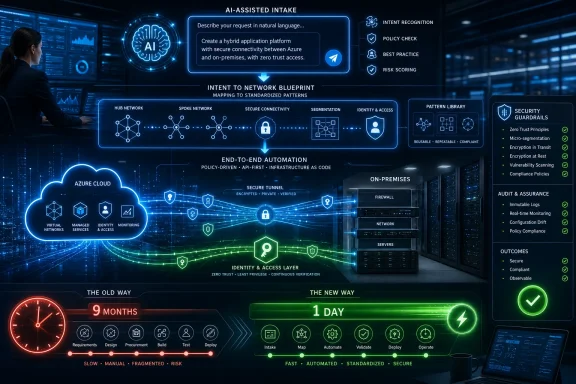
Microsoft Digital is trying to reduce Microsoft’s internal hybrid cloud integration process from as long as nine months to one day by combining AI-assisted intake, standardized network patterns, and end-to-end automation across Azure, identity, and on-premises network systems. The project matters because it attacks a problem that nearly every serious cloud adopter eventually discovers: provisioning compute is easy, but safely connecting it to the messy physical world is not. Microsoft’s lesson is not that hybrid cloud has failed. It is that hybrid cloud has finally become too important to run as artisanal infrastructure.
The old cloud pitch was elasticity. Need a development environment, a testing region, a burst of capacity, or a clean slate for an application team? Click, script, deploy, repeat. Azure made that part of the story feel routine enough that the industry stopped treating it as magic.
But the enterprise network did not become elastic at the same pace. Firewalls still have owners. Routes still have consequences. Identity boundaries still need to be designed, reviewed, and defended. The modern developer can stand up an Azure environment in hours and then wait weeks or months for the network path that makes it useful.
That is the contradiction Microsoft Digital is now trying to collapse. Inside Microsoft, the company’s IT organization has seen cloud environments become faster, more segmented, and more automated, while the connections back to on-premises labs and private networks remain burdened by handoffs, review cycles, custom routing work, and security coordination.
The interesting part is not that Microsoft wants this to be faster. Everyone wants infrastructure faster. The interesting part is that the team appears to have concluded that the bottleneck is not merely tooling, but the operating model itself.
Microsoft’s own estate is a useful reminder of why. This is not a company clinging to a datacenter because it lacks a cloud strategy. Microsoft builds Azure, runs enormous cloud services, and has every incentive to eat its own cloud-native cooking. Yet it still needs physical labs, campus networks, test rigs, conference-room systems, badge infrastructure, wireless networks, environmental controls, and recovery paths that do not depend on the very cloud platform they may need to restore.
That last point is easy to underestimate. If a company operates mission-critical cloud infrastructure, then some part of its operational nervous system must survive outside that cloud. The cloud cannot be the only ladder out of the hole.
Hybrid, in this context, is not a sign of failure. It is what happens when software, hardware, security, facilities, and global operations collide. The question is no longer whether on-premises networks will disappear. The question is whether they can be made to participate in modern engineering rather than slow it down.
That model becomes brittle once the cloud estate is no longer a small satellite. Product teams self-organize in Azure. They build segmented environments. They adopt cloud-native security controls. They automate provisioning. They create purpose-built architectures that do not resemble the flatter, older network they must eventually connect to.
At that point, the metaphor breaks. Azure is not a branch office waiting for a WAN connection. It is the operating core for whole classes of engineering work. Treating it as an appendage of the old enterprise network makes every integration feel like an exception.
This is where Microsoft Digital’s framing becomes more radical than it first appears. The team is not merely trying to automate ticket handling. It is trying to make the cloud the center of the hybrid integration model and then pull on-premises connectivity into that orbit.
That shift is subtle but important. If the cloud is the core, then the default posture becomes pattern-driven, identity-aware, policy-governed, and automation-first. If the on-premises network remains the core, then cloud integration too easily becomes a translation exercise performed by committees.
The application team knows what it wants to build but may not know how to describe the network requirement in terms that satisfy architecture, security, and operations. The cloud team understands Azure constructs but may not own the physical devices. The on-premises network team owns routers and firewalls but may not be fluent in cloud-native deployment patterns. The identity team has to think about authentication, access boundaries, and blast radius. Security reviewers have to ask what could go wrong when those worlds are joined.
Nobody in that chain is necessarily behaving badly. The process is slow because the system requires each group to rediscover the shape of the request. Requirements are translated, retranslated, challenged, clarified, and handed off. By the time implementation begins, the organization has already spent weeks proving that it can talk to itself.
That is why Microsoft Digital’s “A Customer a Day” idea is more than a slogan. A human-scale goal forces the organization to ask which parts of the process actually add safety and which parts merely preserve inherited friction. If the answer is supposed to be one day, the intake process cannot be a weeks-long social exercise.
Microsoft Digital’s proposed model has the customer describe the requirement once. AI then interprets the request, maps it to the appropriate pattern, and routes the work into the right automation path. The value is not that AI “understands networking” in some mystical sense. The value is that it can reduce the burden on humans to coordinate vocabulary across teams.
This is the sort of place where AI can be genuinely useful if bounded properly. It can classify requests, extract missing information, prompt users for specifics, compare a request with known patterns, and make the workflow less dependent on the availability of a particular program manager or architect. It can also make the paved road more visible by guiding teams toward compliant options before they invent their own.
The risk, of course, is that AI-assisted intake becomes another layer of ceremony if it is not connected to real automation. A smarter form does not help if every answer still lands in a queue for manual interpretation. The Microsoft Digital approach only becomes meaningful because intake is tied to predefined network patterns and deployment orchestration.
But most hybrid connectivity requests are not unique in the way their requesters imagine. They fall into recognizable families: lab-to-cloud access, private application connectivity, test environment integration, segmented development network access, secure administrative paths, and so on. The point of pattern work is to turn those recurring shapes into validated blueprints.
Patterns change the conversation. Instead of asking a blank-page architecture question every time, the organization asks which known pattern best matches the request. That makes security review easier, automation safer, and delivery more predictable. It also makes exceptions more visible because they stand apart from the paved path.
This is one of the underrated disciplines of mature cloud operations. Standardization is not the enemy of engineering freedom. It is the price of scaling engineering freedom without drowning in one-off support obligations.
For WindowsForum readers who live in the real world of enterprise IT, this should sound familiar. The hard part of infrastructure is not proving that a connection can be made once. It is proving that the same class of connection can be made repeatedly, safely, observably, and without relying on the one engineer who remembers the undocumented firewall rule from 2021.
That principle matters because network automation can become politically and operationally dangerous when it blurs accountability. If a central cloud team starts pushing changes into on-premises devices it does not operate, the result may be faster deployment but weaker ownership. If every device-owning team writes automation in isolation, the result may be local control but no coherent customer experience.
The middle path is orchestration with clear DevOps boundaries. The customer-facing workflow can specify what needs to happen, while the back-end service lines expose safe, owned capabilities for execution. In other words, one pipeline does not require one team to own everything. It requires every owning team to make its piece callable, reliable, and policy-aware.
That is a much more realistic model for hybrid enterprises. The network stack is rarely a clean greenfield. It is a federation of technologies, teams, hardware generations, routing domains, identity systems, and security tools. Automation has to coordinate that federation rather than pretend it does not exist.
This distinction matters. When official infrastructure takes too long, teams improvise. They create temporary tunnels, duplicate environments, over-permissive firewall rules, unmanaged identities, or shadow processes that solve the immediate delivery problem while increasing long-term risk. Slow governance does not necessarily produce better governance. Sometimes it produces less visible governance.
Microsoft’s Secure Future Initiative adds another layer to the story. The company has publicly pushed toward reducing lateral movement, tightening identity practices, and hardening systems after a series of security failures and industry criticism. More segmentation is a rational security response, but segmentation increases the operational burden of legitimate access.
That is the tradeoff every enterprise now faces. Stronger boundaries are good until they become so awkward that productivity collapses or users find unsafe shortcuts. The answer cannot be to flatten the network again. The answer has to be making secure paths easier to request, approve, deploy, and audit.
In that sense, “A Customer a Day” is not just a productivity metric. It is a security control disguised as a service-level ambition. The faster the compliant path works, the less attractive the noncompliant path becomes.
That model is increasingly obsolete. In a segmented hybrid environment, the question is not simply whether packet A can reach endpoint B. It is whether the right user, workload, device, service principal, or administrator can reach the right resource under the right conditions with the right level of assurance. Routing without identity context is an incomplete answer.
This is especially relevant in Microsoft-heavy environments where Entra ID, conditional access, privileged access controls, device compliance signals, and legacy Active Directory dependencies often coexist. The hybrid problem is not just how to bridge two networks. It is how to bridge two eras of access control.
For administrators, this creates an organizational challenge as much as a technical one. Network engineers and identity teams cannot afford to meet for the first time during implementation review. If identity is part of connectivity, then identity architecture belongs in the first design conversation.
Microsoft’s internal example is valuable because it says the quiet part out loud. Hybrid cloud projects fail or stall when the enterprise treats “can it connect?” and “should this principal be allowed?” as different projects. They are now the same project.
The same is true outside Microsoft. Manufacturers have factory floors. Hospitals have medical devices. Retailers have stores. Energy companies have field infrastructure. Universities have labs. Governments have facilities that cannot be wished into a public cloud region. Even companies that aggressively modernize applications often remain deeply hybrid at the edge.
This is why hybrid cloud integration deserves more respect as an engineering discipline. It is not merely a bridge for old workloads awaiting migration. It is the connective tissue between digital systems and physical operations.
The industry’s cloud conversation has often overvalued the clean architecture diagram and undervalued the awkward loading dock, test bench, access badge, lab device, and recovery console. Microsoft’s one-day ambition is a reminder that the awkward parts are not edge cases at scale. They are the business.
But the deeper lesson is operational. Microsoft Digital is describing an internal reform in how teams agree, standardize, and automate across boundaries. The tools matter, but the tools are downstream of an agreement that the old process cannot scale.
This is where many enterprises will struggle. Buying more automation software will not fix a disagreement about who owns the firewall rule. Adding AI will not resolve a missing service catalog. Creating a portal will not help if every request still becomes a custom negotiation. The hard prerequisite is deciding what the common patterns are and who is accountable for each part of their delivery.
Microsoft’s internal posture also contains a useful humility. The team is not claiming that 100 percent of hybrid integration can be automated. There will always be complex, sensitive, or unusual cases that require human judgment. The practical target is the large middle: the repeatable 80 percent that should not be trapped in a bespoke process.
That is a mature goal. Total automation is a fantasy in heterogeneous enterprise networks. High-confidence automation for common, well-understood paths is achievable and valuable.
That kind of target exposes hidden dependencies. If identity review takes too long, the one-day goal reveals it. If on-premises device automation is incomplete, the one-day goal reveals it. If requirements gathering is ambiguous, the one-day goal reveals it. If teams are using different definitions of connectivity, the one-day goal reveals that too.
The target also reframes the politics of change. Telling an on-premises networking team to “be more cloud-like” is a good way to trigger resistance. Asking multiple teams to help make a customer live in one day is a better way to align incentives. The former sounds like a critique. The latter sounds like a mission.
That is not just internal communications polish. In large technical organizations, language determines whether people hear a transformation effort as an attack on their domain or an invitation to solve a shared problem. Microsoft Digital appears to have found a phrase that makes the work legible across teams.
The most common failure mode will be familiar: cloud teams have modern deployment pipelines, while on-premises network changes still move through ticket queues and maintenance windows. Identity teams operate under a different planning rhythm. Security has veto power but not enough automation capacity. Developers experience the whole thing as a black box.
The result is a split-brain IT organization. One half speaks in infrastructure as code, policy definitions, and repeatable deployments. The other half speaks in change boards, device-specific configuration, and inherited topology. Both halves have valid reasons for existing, but the seam between them becomes the place where projects stall.
This is why the Microsoft Digital model is relevant beyond Microsoft. The cure is not to shame on-premises teams for being slower. The cure is to extend modern engineering practices into the hybrid boundary while respecting the operational realities of physical infrastructure.
That means documenting patterns before automating them. It means making device-owning teams producers of automation capabilities, not passive recipients of cloud demands. It means treating identity as part of the connectivity fabric. It means measuring the timeline from request to usable service, not from ticket creation to first response.
Microsoft’s one-day hybrid goal implicitly recognizes that a paved road must compete on speed. Compliance alone is not enough. If the sanctioned path takes months, the organization has created a market for unsanctioned paths.
This is especially true in AI-era software development, where teams are being pushed to prototype, integrate, and ship faster. Infrastructure processes designed for quarterly planning cycles will buckle under the expectations of AI-assisted engineering teams. If developers can generate code, tests, deployment templates, and documentation faster than the network can approve a route, the network becomes the villain whether or not that is fair.
The answer is not reckless access. It is preapproved access patterns, automated guardrails, and fast rejection when a request does not fit. A secure platform should not say yes to everything. But it should be able to say yes to common things quickly and no to dangerous things clearly.
That is the real standard Microsoft is moving toward. Not infinite flexibility. Fast, governed repeatability.
 Cloud Speed Has Exposed the Slowest Part of the Enterprise
The old cloud pitch was elasticity. Need a development environment, a testing region, a burst of capacity, or a clean slate for an application team? Click, script, deploy, repeat. Azure made that part of the story feel routine enough that the industry stopped treating it as magic.But the enterprise network did not become elastic at the same pace. Firewalls still have owners. Routes still have consequences. Identity boundaries still need to be designed, reviewed, and defended. The modern developer can stand up an Azure environment in hours and then wait weeks or months for the network path that makes it useful.
That is the contradiction Microsoft Digital is now trying to collapse. Inside Microsoft, the company’s IT organization has seen cloud environments become faster, more segmented, and more automated, while the connections back to on-premises labs and private networks remain burdened by handoffs, review cycles, custom routing work, and security coordination.
The interesting part is not that Microsoft wants this to be faster. Everyone wants infrastructure faster. The interesting part is that the team appears to have concluded that the bottleneck is not merely tooling, but the operating model itself.
Hybrid Cloud Was Never Just a Migration Phase
For years, the industry has treated hybrid cloud with a certain condescension. It has often been described as a temporary state, the awkward middle chapter before everything is rewritten, refactored, and moved into a public cloud region. That framing was always too neat.Microsoft’s own estate is a useful reminder of why. This is not a company clinging to a datacenter because it lacks a cloud strategy. Microsoft builds Azure, runs enormous cloud services, and has every incentive to eat its own cloud-native cooking. Yet it still needs physical labs, campus networks, test rigs, conference-room systems, badge infrastructure, wireless networks, environmental controls, and recovery paths that do not depend on the very cloud platform they may need to restore.
That last point is easy to underestimate. If a company operates mission-critical cloud infrastructure, then some part of its operational nervous system must survive outside that cloud. The cloud cannot be the only ladder out of the hole.
Hybrid, in this context, is not a sign of failure. It is what happens when software, hardware, security, facilities, and global operations collide. The question is no longer whether on-premises networks will disappear. The question is whether they can be made to participate in modern engineering rather than slow it down.
The Old Model Treated Azure Like a Branch Office
The architectural tension in Microsoft’s story comes from a historical assumption. In the early phase of cloud adoption, Azure could be understood as an extension of the corporate network. The cloud was a new place where workloads could run, but the on-premises network remained the center of gravity.That model becomes brittle once the cloud estate is no longer a small satellite. Product teams self-organize in Azure. They build segmented environments. They adopt cloud-native security controls. They automate provisioning. They create purpose-built architectures that do not resemble the flatter, older network they must eventually connect to.
At that point, the metaphor breaks. Azure is not a branch office waiting for a WAN connection. It is the operating core for whole classes of engineering work. Treating it as an appendage of the old enterprise network makes every integration feel like an exception.
This is where Microsoft Digital’s framing becomes more radical than it first appears. The team is not merely trying to automate ticket handling. It is trying to make the cloud the center of the hybrid integration model and then pull on-premises connectivity into that orbit.
That shift is subtle but important. If the cloud is the core, then the default posture becomes pattern-driven, identity-aware, policy-governed, and automation-first. If the on-premises network remains the core, then cloud integration too easily becomes a translation exercise performed by committees.
The Nine-Month Problem Is Really a Coordination Problem
A nine-month hybrid connectivity timeline sounds absurd until one remembers how enterprise networking actually works. The delay is rarely one person staring at a router for three quarters of a year. It is the accumulation of dependencies across teams that each have legitimate responsibilities and incompatible clocks.The application team knows what it wants to build but may not know how to describe the network requirement in terms that satisfy architecture, security, and operations. The cloud team understands Azure constructs but may not own the physical devices. The on-premises network team owns routers and firewalls but may not be fluent in cloud-native deployment patterns. The identity team has to think about authentication, access boundaries, and blast radius. Security reviewers have to ask what could go wrong when those worlds are joined.
Nobody in that chain is necessarily behaving badly. The process is slow because the system requires each group to rediscover the shape of the request. Requirements are translated, retranslated, challenged, clarified, and handed off. By the time implementation begins, the organization has already spent weeks proving that it can talk to itself.
That is why Microsoft Digital’s “A Customer a Day” idea is more than a slogan. A human-scale goal forces the organization to ask which parts of the process actually add safety and which parts merely preserve inherited friction. If the answer is supposed to be one day, the intake process cannot be a weeks-long social exercise.
AI Enters Through the Intake Door, Not the Router Console
The most plausible use of AI in this story is not some fantasy of a chatbot reconfiguring production networks on instinct. It is intake. That may sound mundane, but in enterprise infrastructure, intake is often where speed goes to die.Microsoft Digital’s proposed model has the customer describe the requirement once. AI then interprets the request, maps it to the appropriate pattern, and routes the work into the right automation path. The value is not that AI “understands networking” in some mystical sense. The value is that it can reduce the burden on humans to coordinate vocabulary across teams.
This is the sort of place where AI can be genuinely useful if bounded properly. It can classify requests, extract missing information, prompt users for specifics, compare a request with known patterns, and make the workflow less dependent on the availability of a particular program manager or architect. It can also make the paved road more visible by guiding teams toward compliant options before they invent their own.
The risk, of course, is that AI-assisted intake becomes another layer of ceremony if it is not connected to real automation. A smarter form does not help if every answer still lands in a queue for manual interpretation. The Microsoft Digital approach only becomes meaningful because intake is tied to predefined network patterns and deployment orchestration.
Patterns Are the Antidote to Bespoke Infrastructure
The second pillar of Microsoft’s approach is the least glamorous and possibly the most important: predefined network patterns. In large enterprises, the tyranny of custom work is often disguised as responsiveness. Every team has a special case. Every environment has a nuance. Every dependency can be used to justify a fresh design.But most hybrid connectivity requests are not unique in the way their requesters imagine. They fall into recognizable families: lab-to-cloud access, private application connectivity, test environment integration, segmented development network access, secure administrative paths, and so on. The point of pattern work is to turn those recurring shapes into validated blueprints.
Patterns change the conversation. Instead of asking a blank-page architecture question every time, the organization asks which known pattern best matches the request. That makes security review easier, automation safer, and delivery more predictable. It also makes exceptions more visible because they stand apart from the paved path.
This is one of the underrated disciplines of mature cloud operations. Standardization is not the enemy of engineering freedom. It is the price of scaling engineering freedom without drowning in one-off support obligations.
For WindowsForum readers who live in the real world of enterprise IT, this should sound familiar. The hard part of infrastructure is not proving that a connection can be made once. It is proving that the same class of connection can be made repeatedly, safely, observably, and without relying on the one engineer who remembers the undocumented firewall rule from 2021.
Automation Only Works When Ownership Is Honest
End-to-end automation is easy to celebrate in abstract and difficult to implement across organizational boundaries. The Microsoft Digital team’s insight is that automation has to respect ownership. Code that touches device configuration should come from the service lines that own those devices.That principle matters because network automation can become politically and operationally dangerous when it blurs accountability. If a central cloud team starts pushing changes into on-premises devices it does not operate, the result may be faster deployment but weaker ownership. If every device-owning team writes automation in isolation, the result may be local control but no coherent customer experience.
The middle path is orchestration with clear DevOps boundaries. The customer-facing workflow can specify what needs to happen, while the back-end service lines expose safe, owned capabilities for execution. In other words, one pipeline does not require one team to own everything. It requires every owning team to make its piece callable, reliable, and policy-aware.
That is a much more realistic model for hybrid enterprises. The network stack is rarely a clean greenfield. It is a federation of technologies, teams, hardware generations, routing domains, identity systems, and security tools. Automation has to coordinate that federation rather than pretend it does not exist.
Security Is the Reason for the Friction and the Reason to Remove It
There is an easy but wrong reading of this initiative: Microsoft wants to reduce security drag so developers can move faster. The better reading is that Microsoft wants to reduce process drag so developers do not route around security.This distinction matters. When official infrastructure takes too long, teams improvise. They create temporary tunnels, duplicate environments, over-permissive firewall rules, unmanaged identities, or shadow processes that solve the immediate delivery problem while increasing long-term risk. Slow governance does not necessarily produce better governance. Sometimes it produces less visible governance.
Microsoft’s Secure Future Initiative adds another layer to the story. The company has publicly pushed toward reducing lateral movement, tightening identity practices, and hardening systems after a series of security failures and industry criticism. More segmentation is a rational security response, but segmentation increases the operational burden of legitimate access.
That is the tradeoff every enterprise now faces. Stronger boundaries are good until they become so awkward that productivity collapses or users find unsafe shortcuts. The answer cannot be to flatten the network again. The answer has to be making secure paths easier to request, approve, deploy, and audit.
In that sense, “A Customer a Day” is not just a productivity metric. It is a security control disguised as a service-level ambition. The faster the compliant path works, the less attractive the noncompliant path becomes.
Identity Has Become Part of the Network
One of the most important claims in Microsoft Digital’s account is that connectivity now means network and identity together. That will sound obvious to zero-trust advocates, but many organizations still operate as though network access and identity access are parallel workstreams that can be reconciled late in the project.That model is increasingly obsolete. In a segmented hybrid environment, the question is not simply whether packet A can reach endpoint B. It is whether the right user, workload, device, service principal, or administrator can reach the right resource under the right conditions with the right level of assurance. Routing without identity context is an incomplete answer.
This is especially relevant in Microsoft-heavy environments where Entra ID, conditional access, privileged access controls, device compliance signals, and legacy Active Directory dependencies often coexist. The hybrid problem is not just how to bridge two networks. It is how to bridge two eras of access control.
For administrators, this creates an organizational challenge as much as a technical one. Network engineers and identity teams cannot afford to meet for the first time during implementation review. If identity is part of connectivity, then identity architecture belongs in the first design conversation.
Microsoft’s internal example is valuable because it says the quiet part out loud. Hybrid cloud projects fail or stall when the enterprise treats “can it connect?” and “should this principal be allowed?” as different projects. They are now the same project.
The Physical World Keeps Winning Arguments Against Cloud Purity
The more cloud-native an organization becomes, the more tempting it is to dismiss physical infrastructure as legacy residue. Microsoft’s own requirements show why that instinct is dangerous. Hardware labs, device testing, recovery networks, building systems, and operational facilities are not sentimental attachments to the past. They are part of how a technology company functions.The same is true outside Microsoft. Manufacturers have factory floors. Hospitals have medical devices. Retailers have stores. Energy companies have field infrastructure. Universities have labs. Governments have facilities that cannot be wished into a public cloud region. Even companies that aggressively modernize applications often remain deeply hybrid at the edge.
This is why hybrid cloud integration deserves more respect as an engineering discipline. It is not merely a bridge for old workloads awaiting migration. It is the connective tissue between digital systems and physical operations.
The industry’s cloud conversation has often overvalued the clean architecture diagram and undervalued the awkward loading dock, test bench, access badge, lab device, and recovery console. Microsoft’s one-day ambition is a reminder that the awkward parts are not edge cases at scale. They are the business.
The Enterprise Lesson Is Smaller Than the Marketing and Larger Than the Tooling
There is a temptation to turn Microsoft’s project into a product story. AI intake sounds like something that could become a feature. Pattern catalogs sound like something consultants can package. End-to-end orchestration sounds like a platform slide waiting to happen.But the deeper lesson is operational. Microsoft Digital is describing an internal reform in how teams agree, standardize, and automate across boundaries. The tools matter, but the tools are downstream of an agreement that the old process cannot scale.
This is where many enterprises will struggle. Buying more automation software will not fix a disagreement about who owns the firewall rule. Adding AI will not resolve a missing service catalog. Creating a portal will not help if every request still becomes a custom negotiation. The hard prerequisite is deciding what the common patterns are and who is accountable for each part of their delivery.
Microsoft’s internal posture also contains a useful humility. The team is not claiming that 100 percent of hybrid integration can be automated. There will always be complex, sensitive, or unusual cases that require human judgment. The practical target is the large middle: the repeatable 80 percent that should not be trapped in a bespoke process.
That is a mature goal. Total automation is a fantasy in heterogeneous enterprise networks. High-confidence automation for common, well-understood paths is achievable and valuable.
The One-Day Target Is a Forcing Function
“A Customer a Day” works as a phrase because it is concrete. It avoids the mushy language of digital transformation and gives teams an outcome they can test against. Either a customer can be onboarded in a day after requirements are finalized, or they cannot.That kind of target exposes hidden dependencies. If identity review takes too long, the one-day goal reveals it. If on-premises device automation is incomplete, the one-day goal reveals it. If requirements gathering is ambiguous, the one-day goal reveals it. If teams are using different definitions of connectivity, the one-day goal reveals that too.
The target also reframes the politics of change. Telling an on-premises networking team to “be more cloud-like” is a good way to trigger resistance. Asking multiple teams to help make a customer live in one day is a better way to align incentives. The former sounds like a critique. The latter sounds like a mission.
That is not just internal communications polish. In large technical organizations, language determines whether people hear a transformation effort as an attack on their domain or an invitation to solve a shared problem. Microsoft Digital appears to have found a phrase that makes the work legible across teams.
Windows Shops Should Read This as a Warning, Not a Victory Lap
For Windows-centric enterprises, Microsoft’s internal effort should be encouraging, but not comforting. If Microsoft itself can provision cloud environments quickly while struggling for months with hybrid connectivity, then the average enterprise should assume its own process debt is worse than it looks.The most common failure mode will be familiar: cloud teams have modern deployment pipelines, while on-premises network changes still move through ticket queues and maintenance windows. Identity teams operate under a different planning rhythm. Security has veto power but not enough automation capacity. Developers experience the whole thing as a black box.
The result is a split-brain IT organization. One half speaks in infrastructure as code, policy definitions, and repeatable deployments. The other half speaks in change boards, device-specific configuration, and inherited topology. Both halves have valid reasons for existing, but the seam between them becomes the place where projects stall.
This is why the Microsoft Digital model is relevant beyond Microsoft. The cure is not to shame on-premises teams for being slower. The cure is to extend modern engineering practices into the hybrid boundary while respecting the operational realities of physical infrastructure.
That means documenting patterns before automating them. It means making device-owning teams producers of automation capabilities, not passive recipients of cloud demands. It means treating identity as part of the connectivity fabric. It means measuring the timeline from request to usable service, not from ticket creation to first response.
The Paved Road Has to Be Faster Than the Shortcut
Every platform team talks about paved roads. The phrase usually means a preferred, supported, compliant way to do something. The problem is that many paved roads are well governed but poorly maintained, while the dirt path through the woods gets the developer to production by Friday.Microsoft’s one-day hybrid goal implicitly recognizes that a paved road must compete on speed. Compliance alone is not enough. If the sanctioned path takes months, the organization has created a market for unsanctioned paths.
This is especially true in AI-era software development, where teams are being pushed to prototype, integrate, and ship faster. Infrastructure processes designed for quarterly planning cycles will buckle under the expectations of AI-assisted engineering teams. If developers can generate code, tests, deployment templates, and documentation faster than the network can approve a route, the network becomes the villain whether or not that is fair.
The answer is not reckless access. It is preapproved access patterns, automated guardrails, and fast rejection when a request does not fit. A secure platform should not say yes to everything. But it should be able to say yes to common things quickly and no to dangerous things clearly.
That is the real standard Microsoft is moving toward. Not infinite flexibility. Fast, governed repeatability.
Microsoft’s Hybrid Bet Reduces to Six Practical Moves
The useful part of this story is not the promise that every organization can copy Microsoft’s internal architecture. Most cannot, and many should not try. The useful part is the sequence: measure the delay, standardize the common cases, combine identity and network design, automate across owned boundaries, and make the compliant path the fastest path.- Organizations should measure hybrid integration from the first customer request to usable connectivity, not from the moment an implementation team begins work.
- Network and identity teams should design hybrid connectivity together from the start, because access decisions now define whether a connection is safe.
- The most common hybrid scenarios should be turned into validated patterns before anyone tries to automate them end to end.
- AI-assisted intake is most useful when it maps requests to known patterns and workflows, not when it becomes a conversational front end for the same old ticket queue.
- Device-owning teams should expose reliable automation capabilities rather than surrendering operational control to a central orchestration layer.
- The compliant path must be faster than the workaround, or users will eventually choose the workaround.
References
- Primary source: Microsoft
Published: 2026-05-28T16:30:20.947614
Reinventing hybrid cloud integration at Microsoft—from months to one day - Inside Track Blog
Check out how we’re cutting our hybrid cloud to on-premises connectivity from months down to one day using AI intake, reusable patterns, and automation.www.microsoft.com - Official source: azure.microsoft.com

Microsoft Azure: The only consistent, comprehensive hybrid cloud | Microsoft Azure Blog
When we talk to our customers about their cloud strategy, we continue to hear loud and clear from many of them that a hybrid approach to cloud makes the most sense for their business.
azure.microsoft.com
- Official source: azure-int.microsoft.com
- Official source: learn.microsoft.com
Road to the cloud - Determine cloud transformation posture when moving identity and access management from Active Directory to Microsoft Entra ID - Microsoft Entra | Microsoft Learn
Determine your cloud transformation posture when planning your migration of IAM from Active Directory to Microsoft Entra ID.learn.microsoft.com - Official source: blogs.microsoft.com
Cloud trends show customers increasing investments in hybrid and multicloud - The Official Microsoft Blog
Across every industry and geography, companies are working hard to keep pace with evolving business needs and build on their existing digital investments. In my role leading the product team for the core of Azure, I spend a lot of time with customers learning what they need to be successful as...blogs.microsoft.com - Related coverage: techcrunch.com
How Microsoft Shifted from on Prem to the Cloud | TechCrunch
Recorded on October 26, 2021. Jared Spataro has been with Microsoft for over 15 years and he was a part of the shift from strictly on prem software to one that is dominated by the cloud. Today he runs one of the most successful SaaS products out there, and we’ll talk to him about how […]techcrunch.com
- Official source: download.microsoft.com
- Official source: news.microsoft.com
