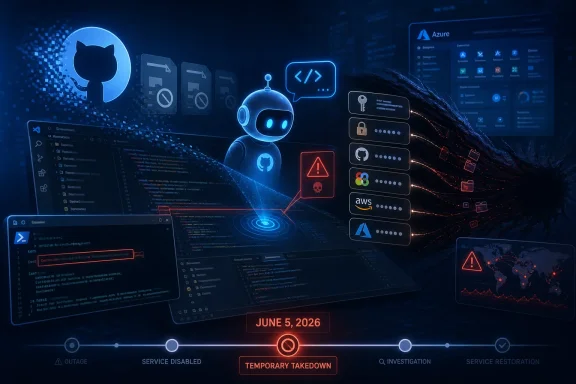
Microsoft and GitHub have temporarily disabled at least 70 Microsoft-linked open-source repositories after researchers reported that attackers planted credential-stealing malware in projects tied to Azure, Durable Task, Azure Functions, and AI developer workflows, with the latest public reporting landing on June 8, 2026. The important part is not merely that Microsoft projects were touched; it is that the attacker aimed at the place where modern software work now concentrates trust. AI coding agents, package managers, cloud credentials, and GitHub automation have become one fused surface. This incident shows how quickly that surface can turn against the people who maintain it.
The old mental model of malware starts with a careless download, a phishing attachment, or a compromised consumer app. This case is more uncomfortable because the target appears to have been the working developer environment itself: repositories, command-line tools, AI assistants, cloud SDKs, and the credential-rich laptops and workstations that sit between them. If a developer cloned or opened the wrong repository in the wrong tool, the attacker reportedly had a path to secrets.
That distinction matters. A normal end-user compromise might steal browser passwords or session cookies. A developer compromise can steal publishing tokens, cloud access keys, GitHub credentials, npm or PyPI tokens, internal source code, and deployment secrets. One compromised developer can become a bridge into dozens of projects, and one poisoned project can become a bridge into thousands of developer machines.
The reported trigger is especially modern. Security researchers say the malware was wired to run when affected repositories were opened inside AI coding tools such as Claude Code, Gemini CLI, Cursor, and VS Code, or through associated developer automation. That makes the lure less like “please run this random executable” and more like “open this source tree and get to work.”
This is the supply-chain problem after the AI assistant boom: the assistant does not just read code, it brokers execution. It installs dependencies, runs tests, interprets project instructions, shells out to tools, and sometimes operates with permissions the user would never consciously grant to an unknown script. The malware did not need to defeat the developer’s judgment if it could hide inside the workflow the developer already trusted.
But a disabled repository is not the same thing as a solved incident. Source code is copied by design. Developers clone it locally, CI systems cache it, mirrors preserve it, forks outlive upstream changes, and package artifacts may have been built from contaminated commits before the lights went out. Even if GitHub contained the visible spread quickly, no one should assume the blast radius is limited to the repositories that were disabled.
The uncertainty is the point. Public reporting so far has not established how many developers downloaded or opened affected code, how many secrets were exposed, or whether stolen credentials were used for follow-on access. In supply-chain incidents, those facts often arrive late because the first visible compromise is merely the artifact, not the original intrusion.
Microsoft’s confirmation that repositories were suspended for terms-of-service violations is therefore only the beginning of the story. The company still has to answer the harder operational questions: which accounts were abused, which credentials were rotated, which package versions or commits are unsafe, and what downstream users should do if they interacted with the projects during the exposure window. Until that guidance is complete, defenders are left doing what they always do after a supply-chain event: assume the copy they touched might be the copy that matters.
The new wave reportedly overlaps with the Durable Task ecosystem again, along with Azure Functions and other Microsoft repositories. Whether that means the same access path survived, a previously compromised contributor account was reused, or a new attacker copied the earlier playbook is still being sorted out. But for users and administrators, the distinction may feel academic: the same neighborhood of trust was hit twice in weeks.
Durable Task is not a consumer brand, but it sits in exactly the kind of plumbing attackers like. It is close to orchestration, cloud workloads, serverless infrastructure, and automation-heavy development. Poisoning that sort of component is far more valuable than poisoning a vanity library with a few hundred downloads, because the targets are likely to be builders with access to production systems.
That is why the “second time in weeks” framing is not sensationalism. It suggests either an incomplete cleanup, a broader credential compromise, or a class of weaknesses that multiple actors can exploit. None of those readings is comforting. In modern software operations, recurrence is often the signal that the underlying control plane has become too complex for the owner to reason about in real time.
Claude Code, Gemini CLI, Cursor, VS Code extensions, and related agentic workflows blur the line between reading a project and acting on it. A repository may contain configuration files, prompts, scripts, test commands, dependency hooks, editor settings, and instructions that an AI coding tool interprets as part of its working context. That makes the repository itself a behavioral object, not just a folder of text.
Attackers understand this faster than procurement departments do. A malicious project can target the agent’s assumptions: where it looks for instructions, what it executes automatically, which tools it invokes, and which secrets it can see. If the agent runs with the developer’s environment variables, SSH keys, cloud credentials, or GitHub token nearby, the attacker does not need to break into Azure first. The attacker can make the developer’s workstation ask Azure politely.
This is the uncomfortable inversion of AI-assisted development. The more capable the tool becomes, the more valuable it is as an attack surface. A model that can run tests, modify files, call shells, and debug cloud deployments is also a mechanism that can be tricked into running hostile project logic unless the surrounding sandbox is strict.
That dual role raises the bar. Microsoft cannot treat this as just another open-source compromise because its platforms form the connective tissue of the incident. GitHub hosts the code, Azure is often the deployment target, VS Code is one of the execution surfaces, and Microsoft’s own packages and organizations carry the trust that made the poisoned code attractive.
The same is true of GitHub. Disabling repositories quickly is good incident response, but GitHub is no longer merely a code-hosting site. It is a package-publishing identity layer, a CI/CD engine, a secret store, a workflow runner, a dependency graph, and a social trust system. When that trust system is abused, the question becomes whether GitHub can detect malicious behavior before researchers do.
Microsoft’s security story has improved dramatically in some places and remained painfully reactive in others. Its cloud security teams publish excellent technical research, and GitHub has invested heavily in secret scanning, provenance, and dependency tools. Yet this incident shows the gap between having security features and making the default developer experience resilient against a worm that speaks fluent GitHub.
A signed malicious package is still malicious. A release with provenance can still be poisoned if the legitimate release pipeline was hijacked. A dependency scanner can miss a repository-level payload that triggers when an AI tool opens the project. A lockfile protects against some forms of version drift, not against a trusted upstream maintainer account pushing hostile code.
This is the part administrators should take seriously. The threat is moving from “did we install a bad dependency?” to “did we let an untrusted project execute inside an environment that contains our keys?” The second question is broader, messier, and less likely to be answered by a single scanner.
For Windows-heavy shops, the habit of trusting developer workstations as semi-admin endpoints is now a liability. Many developers have local admin rights, multiple language runtimes, Docker or WSL, SSH agents, browser sessions into cloud consoles, Azure CLI tokens, GitHub CLI credentials, and editor extensions with broad access. That workstation is not just a laptop. It is a portable deployment authority.
Attackers have already exploited Claude-themed lures, fake AI tool downloads, poisoned packages, malicious VS Code extensions, and social-engineered repositories. The Microsoft incident fits that broader pattern: AI branding does not merely attract victims, it selects for victims who are likely to be developers, cloud engineers, and technical operators. That is a high-value audience.
There is also a cultural problem. Developers are trained to experiment. They clone repositories, run samples, install preview tools, test beta CLIs, and let editors recommend extensions. That curiosity is part of how software gets made, but it is also what makes the developer ecosystem unusually porous.
The answer cannot be “stop experimenting.” It has to be separation. The machine that tries a random AI tool should not be the machine holding production credentials. The container that opens an untrusted repository should not inherit the developer’s cloud environment. The AI agent that interprets a project should not begin with permission to execute everything the developer can execute.
The more immediate question is operational: what can the tool do on the endpoint? If an AI coding agent can run shell commands, install dependencies, read project files, access environment variables, and interact with GitHub or Azure through existing credentials, then it belongs in the same risk category as a build agent or privileged automation runner. It should be governed accordingly.
That means security teams need controls that many developer organizations will resist. They need disposable workspaces for untrusted code, stricter egress monitoring on developer machines, shorter-lived credentials, scoped tokens, mandatory secret scanning before execution, and logs that show what an agent ran on behalf of a user. They also need to stop pretending that “developer productivity” and “endpoint hardening” are separate conversations.
For Windows environments, this is where technologies such as Dev Drive, Windows Sandbox, WSL isolation, Defender for Endpoint, application control, and privileged access management become part of the same story. The goal is not to make development miserable. The goal is to make accidental execution less catastrophic.
Open source has always depended on social trust: maintainers, stars, download counts, organization names, package ownership, and public review. But AI-assisted development accelerates consumption faster than review can keep up. A developer can now ask an assistant to integrate a sample, install a dependency, or scaffold a project without deeply inspecting each file that arrives.
The brand becomes a shortcut. If the repository looks official, the assistant is helpful, the package manager is quiet, and the tests run, the work proceeds. Attackers do not need to forge the entire trust chain if they can compromise one trusted segment long enough for automation to do the distribution.
Microsoft’s repositories are not uniquely vulnerable because Microsoft is uniquely careless. They are vulnerable because any large, distributed, multi-language, multi-organization open-source estate contains dormant risk: old permissions, stale maintainers, inherited secrets, automation nobody wants to touch, and release processes built before AI agents became common. Scale is useful to attackers because scale hides edges.
Organizations should assume that any developer workstation, CI runner, or sandbox that opened affected code during the relevant window may have leaked environment variables, tokens, SSH keys, package registry credentials, and cloud CLI sessions. Rotating only the obvious GitHub token may not be enough. Attackers often pivot through the least glamorous secret in the pile.
This is also a good moment to audit where developer credentials are overpowered. A token that can publish packages, push to protected branches, read private repositories, and deploy to production is not a convenience; it is an incident waiting for a trigger. The same applies to Azure credentials that linger locally with broad subscription rights.
The most useful post-incident measure is not another warning banner. It is reducing the value of the next stolen secret. Short-lived credentials, hardware-backed authentication, least-privilege cloud roles, isolated build environments, and blocked secret access from untrusted workspaces are boring controls. Boring is exactly what supply-chain defense needs.
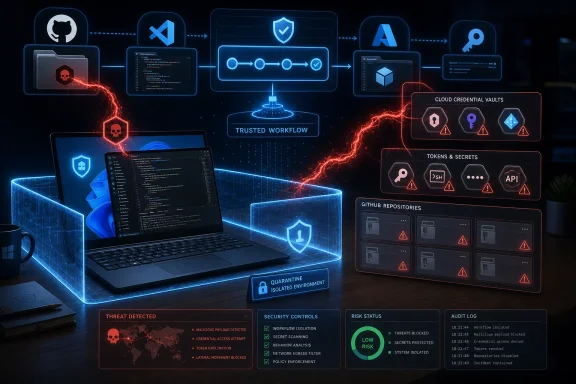
Security teams should treat untrusted repositories the way email teams treat unknown attachments. The default should be quarantine, inspection, and constrained execution. That does not mean developers must read every line by hand before doing anything; it means the first open should happen somewhere that cannot see the organization’s crown jewels.
Disposable cloud workspaces are one answer. Local containers with no inherited credentials are another. Windows Sandbox can help for quick checks, though many developer workflows require more persistent tooling. The exact implementation matters less than the principle: opening code should not automatically expose the developer’s identity, secrets, and network trust.
AI coding agents make this principle urgent. If the agent is designed to be proactive, it must be boxed in before it starts being helpful. A tool that cannot distinguish a legitimate project instruction from a malicious one should not receive the keys to the kingdom as a starting condition.
Package managers install code from strangers. CI systems execute code on behalf of maintainers. Editors run extensions. AI agents interpret project context. Cloud CLIs cache access. GitHub organizations confer legitimacy. Every one of those pieces is defensible in isolation; combined carelessly, they form a machine that can rapidly execute an attacker’s instructions with a developer’s authority.
The next wave will not necessarily use the same malware or the same repositories. It may target a popular sample project, a model integration package, a VS Code extension, a GitHub Action, a Docker image, a plugin marketplace, or an AI agent’s instruction format. The target will be whatever developers trust enough to open without thinking.
That is why this incident should be read less as a breach report and more as a product warning. The industry has built an AI-assisted software factory before it finished designing the blast doors. The productivity is real. So is the blast radius.
 The Malware Was Aimed at the Developer, Not the End User
The old mental model of malware starts with a careless download, a phishing attachment, or a compromised consumer app. This case is more uncomfortable because the target appears to have been the working developer environment itself: repositories, command-line tools, AI assistants, cloud SDKs, and the credential-rich laptops and workstations that sit between them. If a developer cloned or opened the wrong repository in the wrong tool, the attacker reportedly had a path to secrets.That distinction matters. A normal end-user compromise might steal browser passwords or session cookies. A developer compromise can steal publishing tokens, cloud access keys, GitHub credentials, npm or PyPI tokens, internal source code, and deployment secrets. One compromised developer can become a bridge into dozens of projects, and one poisoned project can become a bridge into thousands of developer machines.
The reported trigger is especially modern. Security researchers say the malware was wired to run when affected repositories were opened inside AI coding tools such as Claude Code, Gemini CLI, Cursor, and VS Code, or through associated developer automation. That makes the lure less like “please run this random executable” and more like “open this source tree and get to work.”
This is the supply-chain problem after the AI assistant boom: the assistant does not just read code, it brokers execution. It installs dependencies, runs tests, interprets project instructions, shells out to tools, and sometimes operates with permissions the user would never consciously grant to an unknown script. The malware did not need to defeat the developer’s judgment if it could hide inside the workflow the developer already trusted.
GitHub’s Fast Shutdown Was Damage Control, Not a Clean Ending
GitHub’s reported suspension of more than 70 repositories is a blunt but understandable containment measure. When a repository itself becomes a delivery vehicle, leaving it online while investigators sort out provenance is a risk to every downstream clone, fork, CI job, dependency cache, and automated agent that might touch it. Speed matters more than elegance.But a disabled repository is not the same thing as a solved incident. Source code is copied by design. Developers clone it locally, CI systems cache it, mirrors preserve it, forks outlive upstream changes, and package artifacts may have been built from contaminated commits before the lights went out. Even if GitHub contained the visible spread quickly, no one should assume the blast radius is limited to the repositories that were disabled.
The uncertainty is the point. Public reporting so far has not established how many developers downloaded or opened affected code, how many secrets were exposed, or whether stolen credentials were used for follow-on access. In supply-chain incidents, those facts often arrive late because the first visible compromise is merely the artifact, not the original intrusion.
Microsoft’s confirmation that repositories were suspended for terms-of-service violations is therefore only the beginning of the story. The company still has to answer the harder operational questions: which accounts were abused, which credentials were rotated, which package versions or commits are unsafe, and what downstream users should do if they interacted with the projects during the exposure window. Until that guidance is complete, defenders are left doing what they always do after a supply-chain event: assume the copy they touched might be the copy that matters.
Durable Task Turned a Prior Warning Into a Pattern
The timing makes this worse for Microsoft. In mid-May, researchers reported that malicious versions of Microsoft’sdurabletask Python package had been uploaded to PyPI in a short window, with behavior described as credential theft and destructive activity on Linux systems. That earlier incident already put Microsoft’s cloud-adjacent developer supply chain under a harsh light.The new wave reportedly overlaps with the Durable Task ecosystem again, along with Azure Functions and other Microsoft repositories. Whether that means the same access path survived, a previously compromised contributor account was reused, or a new attacker copied the earlier playbook is still being sorted out. But for users and administrators, the distinction may feel academic: the same neighborhood of trust was hit twice in weeks.
Durable Task is not a consumer brand, but it sits in exactly the kind of plumbing attackers like. It is close to orchestration, cloud workloads, serverless infrastructure, and automation-heavy development. Poisoning that sort of component is far more valuable than poisoning a vanity library with a few hundred downloads, because the targets are likely to be builders with access to production systems.
That is why the “second time in weeks” framing is not sensationalism. It suggests either an incomplete cleanup, a broader credential compromise, or a class of weaknesses that multiple actors can exploit. None of those readings is comforting. In modern software operations, recurrence is often the signal that the underlying control plane has become too complex for the owner to reason about in real time.
AI Coding Agents Have Become a Privileged Execution Layer
The industry has spent the past two years selling AI coding assistants as accelerators: autocomplete on steroids, junior pair programmers, tireless test writers, and command-line operators. The pitch has been productivity. The security implication is that these tools are becoming privileged execution layers inside developer environments.Claude Code, Gemini CLI, Cursor, VS Code extensions, and related agentic workflows blur the line between reading a project and acting on it. A repository may contain configuration files, prompts, scripts, test commands, dependency hooks, editor settings, and instructions that an AI coding tool interprets as part of its working context. That makes the repository itself a behavioral object, not just a folder of text.
Attackers understand this faster than procurement departments do. A malicious project can target the agent’s assumptions: where it looks for instructions, what it executes automatically, which tools it invokes, and which secrets it can see. If the agent runs with the developer’s environment variables, SSH keys, cloud credentials, or GitHub token nearby, the attacker does not need to break into Azure first. The attacker can make the developer’s workstation ask Azure politely.
This is the uncomfortable inversion of AI-assisted development. The more capable the tool becomes, the more valuable it is as an attack surface. A model that can run tests, modify files, call shells, and debug cloud deployments is also a mechanism that can be tricked into running hostile project logic unless the surrounding sandbox is strict.
Microsoft Is Both Victim and Platform Owner
It is fair to say Microsoft is a victim of the campaign. Attackers reportedly abused Microsoft-linked repositories and developer ecosystems to reach other developers. But Microsoft is also GitHub’s owner, Azure’s steward, Visual Studio Code’s maker, and one of the most aggressive vendors pushing AI into the software development lifecycle.That dual role raises the bar. Microsoft cannot treat this as just another open-source compromise because its platforms form the connective tissue of the incident. GitHub hosts the code, Azure is often the deployment target, VS Code is one of the execution surfaces, and Microsoft’s own packages and organizations carry the trust that made the poisoned code attractive.
The same is true of GitHub. Disabling repositories quickly is good incident response, but GitHub is no longer merely a code-hosting site. It is a package-publishing identity layer, a CI/CD engine, a secret store, a workflow runner, a dependency graph, and a social trust system. When that trust system is abused, the question becomes whether GitHub can detect malicious behavior before researchers do.
Microsoft’s security story has improved dramatically in some places and remained painfully reactive in others. Its cloud security teams publish excellent technical research, and GitHub has invested heavily in secret scanning, provenance, and dependency tools. Yet this incident shows the gap between having security features and making the default developer experience resilient against a worm that speaks fluent GitHub.
Supply-Chain Defenses Are Still Too Focused on the Package, Not the Workflow
The software industry has spent years telling itself that signed packages, provenance attestations, lockfiles, and dependency scanners would gradually civilize the supply chain. Those tools are useful. They are not enough when the attacker compromises the workflow that creates the trusted artifact or the developer machine that consumes it.A signed malicious package is still malicious. A release with provenance can still be poisoned if the legitimate release pipeline was hijacked. A dependency scanner can miss a repository-level payload that triggers when an AI tool opens the project. A lockfile protects against some forms of version drift, not against a trusted upstream maintainer account pushing hostile code.
This is the part administrators should take seriously. The threat is moving from “did we install a bad dependency?” to “did we let an untrusted project execute inside an environment that contains our keys?” The second question is broader, messier, and less likely to be answered by a single scanner.
For Windows-heavy shops, the habit of trusting developer workstations as semi-admin endpoints is now a liability. Many developers have local admin rights, multiple language runtimes, Docker or WSL, SSH agents, browser sessions into cloud consoles, Azure CLI tokens, GitHub CLI credentials, and editor extensions with broad access. That workstation is not just a laptop. It is a portable deployment authority.
The AI Hype Cycle Gave Attackers Better Bait
AI developer tools are ideal bait because they sit at the intersection of urgency and ambiguity. Developers are under pressure to adopt them, organizations are still writing policies around them, and the tools themselves change rapidly. A new CLI, extension, fork, plugin, wrapper, or sample repository does not automatically look suspicious because the ecosystem is genuinely moving that fast.Attackers have already exploited Claude-themed lures, fake AI tool downloads, poisoned packages, malicious VS Code extensions, and social-engineered repositories. The Microsoft incident fits that broader pattern: AI branding does not merely attract victims, it selects for victims who are likely to be developers, cloud engineers, and technical operators. That is a high-value audience.
There is also a cultural problem. Developers are trained to experiment. They clone repositories, run samples, install preview tools, test beta CLIs, and let editors recommend extensions. That curiosity is part of how software gets made, but it is also what makes the developer ecosystem unusually porous.
The answer cannot be “stop experimenting.” It has to be separation. The machine that tries a random AI tool should not be the machine holding production credentials. The container that opens an untrusted repository should not inherit the developer’s cloud environment. The AI agent that interprets a project should not begin with permission to execute everything the developer can execute.
Enterprise IT Now Has to Govern the Coding Agent
Most organizations still treat AI coding assistants as a procurement, productivity, or data-leakage issue. They ask whether source code can be sent to a model, whether prompts are retained, whether legal has approved the vendor, and whether developers are allowed to use the tool on company code. Those are valid questions, but they are no longer sufficient.The more immediate question is operational: what can the tool do on the endpoint? If an AI coding agent can run shell commands, install dependencies, read project files, access environment variables, and interact with GitHub or Azure through existing credentials, then it belongs in the same risk category as a build agent or privileged automation runner. It should be governed accordingly.
That means security teams need controls that many developer organizations will resist. They need disposable workspaces for untrusted code, stricter egress monitoring on developer machines, shorter-lived credentials, scoped tokens, mandatory secret scanning before execution, and logs that show what an agent ran on behalf of a user. They also need to stop pretending that “developer productivity” and “endpoint hardening” are separate conversations.
For Windows environments, this is where technologies such as Dev Drive, Windows Sandbox, WSL isolation, Defender for Endpoint, application control, and privileged access management become part of the same story. The goal is not to make development miserable. The goal is to make accidental execution less catastrophic.
Open Source Trust Cannot Be Outsourced to the Logo
One reason this incident is unsettling is that the affected projects carried Microsoft’s brand gravity. Developers reasonably trust repositories under Microsoft-linked organizations more than anonymous weekend experiments. That is precisely why attackers want them.Open source has always depended on social trust: maintainers, stars, download counts, organization names, package ownership, and public review. But AI-assisted development accelerates consumption faster than review can keep up. A developer can now ask an assistant to integrate a sample, install a dependency, or scaffold a project without deeply inspecting each file that arrives.
The brand becomes a shortcut. If the repository looks official, the assistant is helpful, the package manager is quiet, and the tests run, the work proceeds. Attackers do not need to forge the entire trust chain if they can compromise one trusted segment long enough for automation to do the distribution.
Microsoft’s repositories are not uniquely vulnerable because Microsoft is uniquely careless. They are vulnerable because any large, distributed, multi-language, multi-organization open-source estate contains dormant risk: old permissions, stale maintainers, inherited secrets, automation nobody wants to touch, and release processes built before AI agents became common. Scale is useful to attackers because scale hides edges.
The Practical Cleanup Starts With Secrets, Not Press Releases
The first defensive instinct after a repository compromise is to ask whether the code has been patched. That matters, but for anyone who touched affected projects, the more urgent question is whether credentials were exposed. Infostealers do not need persistence if they get durable secrets.Organizations should assume that any developer workstation, CI runner, or sandbox that opened affected code during the relevant window may have leaked environment variables, tokens, SSH keys, package registry credentials, and cloud CLI sessions. Rotating only the obvious GitHub token may not be enough. Attackers often pivot through the least glamorous secret in the pile.
This is also a good moment to audit where developer credentials are overpowered. A token that can publish packages, push to protected branches, read private repositories, and deploy to production is not a convenience; it is an incident waiting for a trigger. The same applies to Azure credentials that linger locally with broad subscription rights.
The most useful post-incident measure is not another warning banner. It is reducing the value of the next stolen secret. Short-lived credentials, hardware-backed authentication, least-privilege cloud roles, isolated build environments, and blocked secret access from untrusted workspaces are boring controls. Boring is exactly what supply-chain defense needs.
The Cloning Habit Now Needs a Quarantine Step
The developer ritual of cloning a repository and opening it in an editor is overdue for a rethink. In 2016, that action mostly meant reading code. In 2026, it may trigger editor extensions, dependency recommendations, post-install scripts, agent instructions, test runners, project hooks, and model-mediated automation.Security teams should treat untrusted repositories the way email teams treat unknown attachments. The default should be quarantine, inspection, and constrained execution. That does not mean developers must read every line by hand before doing anything; it means the first open should happen somewhere that cannot see the organization’s crown jewels.
Disposable cloud workspaces are one answer. Local containers with no inherited credentials are another. Windows Sandbox can help for quick checks, though many developer workflows require more persistent tooling. The exact implementation matters less than the principle: opening code should not automatically expose the developer’s identity, secrets, and network trust.
AI coding agents make this principle urgent. If the agent is designed to be proactive, it must be boxed in before it starts being helpful. A tool that cannot distinguish a legitimate project instruction from a malicious one should not receive the keys to the kingdom as a starting condition.
The Microsoft Incident Is a Preview of Normal, Not an Exception
It is tempting to file this as a Microsoft story because Microsoft’s repositories are named in the reports. That would be too narrow. The larger story is that the modern development stack has become an attractive malware delivery system because it is automated, credentialed, and trusted.Package managers install code from strangers. CI systems execute code on behalf of maintainers. Editors run extensions. AI agents interpret project context. Cloud CLIs cache access. GitHub organizations confer legitimacy. Every one of those pieces is defensible in isolation; combined carelessly, they form a machine that can rapidly execute an attacker’s instructions with a developer’s authority.
The next wave will not necessarily use the same malware or the same repositories. It may target a popular sample project, a model integration package, a VS Code extension, a GitHub Action, a Docker image, a plugin marketplace, or an AI agent’s instruction format. The target will be whatever developers trust enough to open without thinking.
That is why this incident should be read less as a breach report and more as a product warning. The industry has built an AI-assisted software factory before it finished designing the blast doors. The productivity is real. So is the blast radius.
The Lesson for WindowsForum Readers Is Written in the Disabled Repos
For Windows enthusiasts, sysadmins, and IT pros, the useful lesson is not panic; it is containment. The developer endpoint has become one of the most important privileged systems in the enterprise, and AI coding tools increase both its usefulness and its exposure.- Treat any machine that opened affected Microsoft-linked repositories during the exposure window as potentially compromised until credentials and logs have been reviewed.
- Rotate GitHub, Azure, package-registry, SSH, and CI/CD secrets associated with developers or runners that interacted with suspicious repositories.
- Open unfamiliar repositories first in isolated environments that do not inherit production tokens, cloud CLI sessions, browser cookies, or SSH agents.
- Restrict AI coding agents so they cannot automatically execute project scripts or shell commands without clear approval and logging.
- Review developer workstations as privileged endpoints, not ordinary laptops, especially when they hold access to source code, cloud subscriptions, and deployment systems.
- Watch for follow-up guidance from Microsoft, GitHub, and the security researchers tracking Miasma, TeamPCP, Durable Task, and related supply-chain activity.
References
- Primary source: zamin.uz
Published: 2026-06-08T20:30:13.299592
Microsoft Projects Hacked: AI Developers Targeted – Zamin.uz, 09.06.2026
Microsoft has temporarily restricted access to dozens of open-source projects on the GitHub platform. This was caused by hackers… – Zamin.uz, 09.06.2026zamin.uz - Official source: microsoft.com
Guidance for detecting, investigating, and defending against the Trivy supply chain compromise | Microsoft Security Blog
Threat actors abused trusted Trivy distribution channels to inject credential‑stealing malware into CI/CD pipelines worldwide. This analysis walks through the Trivy supply‑chain compromise, attacker techniques, and concrete steps security teams can take to detect and defend against similar attacks.www.microsoft.com - Related coverage: thehackernews.com
Miasma Worm Hits 73 Microsoft GitHub Repositories in Major Supply Chain Attack
Miasma hit 73 Microsoft repos across four GitHub orgs, forcing access disablement and exposing open-source trust risks.thehackernews.com
- Related coverage: stepsecurity.io
Miasma Worm Hits Microsoft Again: Azure Functions Action and 72 Other Repositories Disabled After Supply Chain Attack Targeting AI Coding Agents - StepSecurity
On June 5, 2026, the Miasma worm campaign reached Microsoft's Azure GitHub organizations. GitHub disabled 73 repositories across four Microsoft GitHub organizations after a malicious commit was pushed to the Azure/durabletask repository using a previously compromised contributor account...www.stepsecurity.io - Related coverage: arstechnica.com
For the 2nd time in weeks, Microsoft packages laced with credential stealer - Ars Technica
73 packages run self-replicating stealer as soon as they're opened by an AI agent.arstechnica.com - Related coverage: itpro.com
Claude users beware, hackers are using a fake website to dupe developers and deliver malware | IT Pro
'Beagle' is deployed through a Dynamic Link Library (DLL) sideloading chain, and gives attackers remote access to the systemwww.itpro.com
- Related coverage: thenextweb.com
Self-replicating Miasma worm hits 73 Microsoft GitHub repositories in supply chain attack
GitHub disabled 73 Microsoft repos after the Miasma worm exploited previously compromised credentials to plant malware targeting AI coding agents.thenextweb.com