

On June 18, 2026, Microsoft said it is rolling out an internal AI agent called Eddie to help more than 200,000 employees in over 100 countries choose, compare, order, and track new work PCs through a conversational interface. The announcement is not really about a cute bot name. It is about Microsoft turning one of the least glamorous corners of enterprise IT — device procurement — into a showcase for the agentic future it wants customers to buy. If Eddie works as described, the important lesson is not that AI can recommend a laptop; it is that AI becomes useful only after the messy operational plumbing has been standardized first.
The most revealing detail in Microsoft’s Eddie story is not the AI. It is the pre-AI mess.
For years, Microsoft’s own employee device process looked like the kind of sprawling, locally optimized system that IT departments everywhere recognize too well. More than 50 device options existed across a patchwork of regional processes, scattered data stores, manual approvals, uneven refresh cycles, and limited visibility into where a device request actually stood. That is a familiar enterprise pattern: every group solves its own immediate problem, and the company eventually inherits a maze.
Microsoft says the old model created friction, higher costs, and inconsistent outcomes for employees. That matters because this was not a small business with a loose spreadsheet and a few purchasing cards. This was Microsoft, a global company whose internal IT operation supports hundreds of thousands of employees and contractors across a vast geography.
That makes Eddie interesting in a way many AI workplace demos are not. It is not a chatbot sitting beside an unchanged process, pretending to modernize it. It is an AI layer being added after Microsoft spent years centralizing the underlying system through a program called myDevice.
The distinction is crucial. Enterprise AI often fails when companies try to staple a natural-language interface onto broken workflows. Microsoft’s own story suggests the opposite ordering: first consolidate the data, catalog, lifecycle rules, and fulfillment paths; then let an agent sit on top of the machine.
But portals are not usually the root problem. They are the visible symptom of deeper fragmentation.
A portal can be clunky and still reliable if the data behind it is clean, the choices are governed, and the fulfillment process is predictable. Conversely, the slickest chatbot in the world will only become a conversational wrapper around chaos if inventory records are incomplete, eligibility rules are inconsistent, and every geography has its own exception path.
That is why myDevice is the more consequential part of the story. Microsoft says the program, built on its internal ServiceNow platform, centralized primary-device procurement and lifecycle workflows. It created a common catalog, standardized refresh cycles, and brought order and fulfillment into a single managed experience.
This is unsexy work. It is also the work that makes the AI possible.
For Windows administrators, that should sound less like a magic trick and more like a warning. If your device estate is poorly tagged, refresh eligibility lives in someone’s inbox, purchase history is trapped in procurement tools, and hardware standards vary by business unit, an AI agent will not rescue you. It will merely expose the disorder faster.
The bill comes due later.
Microsoft says devices were sometimes purchased near the end of a fiscal cycle because money was available, not because the business had a clear requirement. That is a classic enterprise behavior. Budgets expire, managers buy ahead, and unused hardware becomes a silent tax on IT operations, finance, security, and sustainability goals.
The myDevice model tries to replace that rhythm with predictable quarterly planning. Microsoft says employees are eligible for a new PC refresh every four years, and roughly 20,000 employees per quarter automatically receive refresh invitations when budget is available. That shifts the process from “who remembered to ask?” to “who is due?”
That change has administrative consequences. It reduces the burden on local IT teams and support staff who previously had to interpret policy, chase approvals, and manually coordinate device lifecycles. It also gives procurement a stronger basis for forecasting demand.
But standardization carries politics. Reducing more than 50 device options into a governed catalog is not just an IT exercise; it is a negotiation with business units, executives, developers, designers, field workers, finance, and procurement. Everyone believes their hardware need is special, and sometimes they are right.
The trick is not to eliminate exceptions. It is to stop exceptions from becoming the operating model.
That sounds simple, which is the point.
The previous experience gave employees options but still left them with homework. They could browse available PCs, but choosing the right one required research, peer advice, and guesswork. Microsoft says the agent will recommend devices based on role, work needs, location, and other factors.
In other words, Eddie is not just answering questions. It is narrowing a decision space.
That is where AI can be genuinely useful in enterprise IT. Most employees do not want to become experts in CPU tiers, memory configurations, dock compatibility, regional availability, procurement policy, and refresh eligibility. They want to know which machine they are allowed to get and which one will do the job.
The user experience win is obvious. The governance win is subtler. If the agent channels employees toward role-aligned devices, Microsoft can reduce variance without making the process feel punitive. The employee experiences guidance; procurement gets standardization.
The agent validates eligibility, captures required inputs, offers approved choices, and initiates the request. That means the conversation is not merely informational. It is transactional. The bot is participating in a workflow where cost, access, inventory, identity, location, and lifecycle status all matter.
That raises the stakes.
A device procurement agent must know who the employee is, what role they perform, where they work, what they already have, whether they are due for refresh, what devices are approved in their region, what inventory exists, and what approvals apply. It must avoid recommending unavailable hardware, avoid bypassing policy, and avoid generating orders that humans later have to unwind.
Microsoft says Eddie uses a multi-agent architecture with specialized components for catalog browsing, comparison, recommendations, and ordering, coordinated by an orchestration layer. That is the kind of design enterprises will increasingly see: not one all-knowing bot, but a set of constrained agents operating against defined systems.
For IT pros, this is where the architectural conversation becomes serious. The agent cannot be treated as a novelty UI. It is a new front door into procurement and asset systems. That front door needs identity controls, auditability, logging, permissions, error handling, and rollback paths.
A chatbot that can execute business processes is no longer just chat.
That is a mundane example with large implications.
Primary device records sit at the intersection of asset management, endpoint security, support, compliance, finance, and user experience. If the system does not know which device belongs to which person, everything downstream gets worse. Patch reporting is less trustworthy. Support context is weaker. Refresh planning is inaccurate. Recovery from loss or theft becomes harder. Procurement forecasts drift.
Enterprises love to talk about AI transformation, but many are still struggling with asset truth. Eddie’s value depends on Microsoft having a reliable view of each employee’s primary device. myDevice was created to provide that visibility.
This is why the story should interest WindowsForum readers beyond the Microsoft bubble. Every admin has seen the difference between a device estate that exists in theory and one that exists in usable data. The latter is what lets you automate. The former is what keeps humans in ticket queues.
If Eddie can correct asset records through validation and workflow execution, it points to a broader pattern: agents may become the conversational maintenance layer for enterprise data hygiene.
This is one of those improvements that sounds minor until you have worked in support.
Lack of status visibility creates secondary work. Employees file follow-up tickets. Managers ask for updates. Help desks chase procurement. Procurement chases suppliers. Everyone spends time narrating the state of a process that should have been visible from the start.
A trackable ServiceNow reference is not revolutionary. But placing status inside the same conversational flow that created the request matters. The employee does not need to remember which portal handled the order, which ticket type was created, or which team owns the next step.
In enterprise IT, reducing “where do I go to find out?” is often as valuable as reducing the original transaction time.
This is where the agent-first narrative becomes credible. Not because chat is inherently better than a portal, but because chat can unify fragmented moments: eligibility, selection, order creation, status, correction, and follow-up. The experience feels simpler because the system boundaries are hidden.
That is not an AI feature. It is operational redesign.
It also shows why procurement transformation cannot stop at the employee interface. If Eddie helps someone pick a device instantly but the device still takes six weeks to arrive, the user’s memory of the experience will be dominated by the wait. The agent can make the front end feel modern; supply chain determines whether the promise lands.
New-hire provisioning is the sharper test. Microsoft says it currently gets devices to new employees on day one around 70 percent of the time and wants to raise that to 98 percent. For a company of Microsoft’s size, that gap is not trivial.
A delayed laptop is not merely an inconvenience. It damages onboarding, wastes manager time, creates shadow workarounds, and sends a bad first signal to the employee. In a hybrid workplace, the work PC is not office furniture. It is the workplace.
Here, AI is only one component in a broader operating model. Forecasting demand, maintaining inventory, aligning regional availability, and standardizing device choices are all part of the system. Eddie may be the face of the program, but the supply chain is the spine.
Those numbers are doing a lot of work.
The AI industry often sells productivity gains that are difficult to measure. Device procurement is different. Hardware spend, average device cost, fulfillment time, refresh volume, and unused inventory are measurable. If Microsoft can tie the new operating model to hard-dollar savings, it gives CIOs and CFOs something more concrete than “employee delight.”
Still, it is worth being precise about causality. The savings appear to come from the combination of standardization, catalog rationalization, lifecycle planning, procurement discipline, reuse, and AI-assisted experience. Eddie is part of the story, not the whole story.
That matters because vendors have an incentive to let the AI mascot absorb all the credit. The more accurate reading is that Microsoft built an enterprise procurement machine, then added an agent to make that machine easier to use.
For IT leaders, that is the more useful model. Do not begin with “we need an AI agent.” Begin with “which workflow is expensive, fragmented, measurable, and painful enough to justify redesign?” If the answer is device lifecycle management, then an agent may be the right final interface.
The ingredients are conspicuously aligned with Microsoft’s commercial stack: ServiceNow as the internal workflow backbone in this case, Copilot Studio as the agent-building environment, identity-aware employee experiences, and a broader narrative about moving from portals to conversations. It is a practical story, but it is also a market argument.
Microsoft wants customers to believe that agents are the next major interface for work. Eddie gives the company a more grounded example than many generic demos because the workflow is specific, expensive, and familiar. Every large organization buys devices. Every large organization has refresh cycles. Every large organization has employees confused by process.
That makes the case stronger. It also makes it easier to scrutinize.
Microsoft is not claiming Eddie is a general-purpose digital coworker inventing new strategy. It is describing an agent constrained to a defined business process, backed by enterprise data, and integrated into existing workflow systems. That is exactly the kind of AI deployment more likely to survive contact with reality.
The broader lesson is that enterprise agents will probably succeed first in narrow domains where the goal is not creativity but guided execution. Pick the right device. Correct the asset record. Show the order status. Trigger the approved workflow. These are not glamorous tasks, but they are abundant.
In a form-driven system, users can be confused by fields, options, and policy language. In an agent-driven system, users may be overconfident because the answer arrives in plain English. The more natural the interface, the easier it is for employees to assume the system is right.
That creates a trust burden. Eddie needs to be accurate not just in casual advice but in eligibility, catalog constraints, region-specific availability, and workflow execution. A bad recommendation could waste money. A bad order could delay onboarding. A bad asset correction could pollute inventory records. A bad permission boundary could expose procurement or employee data.
None of that means the agent model is wrong. It means enterprise AI needs traditional IT discipline around it.
Admins will want to know how recommendations are generated, what data the agent can access, how actions are logged, how exceptions are escalated, and how humans override mistakes. Procurement teams will want guardrails around approved models and budget constraints. Security teams will want assurance that the agent cannot leak sensitive asset or employee information.
The irony is that the friendlier the agent becomes, the more important the boring controls become. Eddie may be conversational, but its credibility depends on governance that users never see.
That has been true in many companies for years, but AI-guided procurement sharpens the shift. The employee does not browse a sprawling catalog and advocate for a preferred machine. The agent interprets role, work needs, eligibility, and location, then presents a narrowed set of options. The catalog becomes policy made visible.
There are benefits. Employees are less likely to choose underpowered machines, incompatible models, or devices that create support headaches. IT can standardize images, drivers, accessories, warranty processes, and lifecycle planning. Procurement can negotiate better terms around fewer models.
There are trade-offs. Power users may feel constrained. Developers, engineers, designers, and accessibility users may need exceptions that role-based models miss. Local teams may lose flexibility that previously helped them respond to unusual needs quickly.
The key is whether the system can distinguish between needless variety and legitimate specialization. A company the size of Microsoft surely has both. The success of Eddie will depend partly on how well its recommendations handle edge cases without forcing every edge case back into manual escalation.
The best version of this model does not flatten everyone into the same laptop. It makes the default path fast while preserving well-governed exceptions.
Again, the important word is if.
Sustainability in endpoint computing often breaks down because organizations lack asset accuracy and process discipline. Devices sit in drawers. Returned machines are not triaged quickly. Usable hardware is replaced because the refresh process is easier than redeployment. Local purchasing creates model sprawl that makes parts, repairs, and redeployment harder.
A standardized device catalog and predictable refresh cycle can reduce some of that waste. An agent can help by directing employees to appropriate devices and making status or return steps easier. But sustainability gains come from the operating model, not from the conversational interface alone.
This is another reminder that Eddie is the front end of a larger system. The environmental benefit is not that AI chats about laptops. It is that centralized procurement and lifecycle data can reduce unnecessary purchasing and improve the odds that existing devices are reused intelligently.
That is a narrower claim. It is also more believable.
Device procurement is a good candidate because the work is repetitive, policy-driven, measurable, and annoying. It involves enough complexity to justify guidance but not so much ambiguity that every request becomes a philosophical debate. Employees want speed and confidence. IT wants compliance and clean records. Procurement wants cost control and forecastable demand.
That alignment is rare enough to matter.
The Eddie model also suggests a practical sequencing for other enterprise workflows. First, unify data. Second, standardize policy. Third, simplify the catalog or choice set. Fourth, integrate fulfillment. Fifth, expose the experience through an agent. Reverse the order and the agent becomes theater.
This is the part of the story Microsoft customers should take seriously, whether or not they use Copilot Studio. The value is not in anthropomorphizing a workflow. The value is in reducing the number of places an employee must go, the number of decisions they must make, and the number of humans required to push a routine request across organizational seams.
 Microsoft’s PC Agent Is Really a Story About Bureaucracy
The most revealing detail in Microsoft’s Eddie story is not the AI. It is the pre-AI mess.For years, Microsoft’s own employee device process looked like the kind of sprawling, locally optimized system that IT departments everywhere recognize too well. More than 50 device options existed across a patchwork of regional processes, scattered data stores, manual approvals, uneven refresh cycles, and limited visibility into where a device request actually stood. That is a familiar enterprise pattern: every group solves its own immediate problem, and the company eventually inherits a maze.
Microsoft says the old model created friction, higher costs, and inconsistent outcomes for employees. That matters because this was not a small business with a loose spreadsheet and a few purchasing cards. This was Microsoft, a global company whose internal IT operation supports hundreds of thousands of employees and contractors across a vast geography.
That makes Eddie interesting in a way many AI workplace demos are not. It is not a chatbot sitting beside an unchanged process, pretending to modernize it. It is an AI layer being added after Microsoft spent years centralizing the underlying system through a program called myDevice.
The distinction is crucial. Enterprise AI often fails when companies try to staple a natural-language interface onto broken workflows. Microsoft’s own story suggests the opposite ordering: first consolidate the data, catalog, lifecycle rules, and fulfillment paths; then let an agent sit on top of the machine.
The Portal Was Not the Enemy; Fragmentation Was
It is tempting to describe Eddie as the death of the enterprise portal. Microsoft itself frames the long-term vision that way: employees should not need to visit a UI or navigate a system to complete a routine task. They should simply talk to an agent.But portals are not usually the root problem. They are the visible symptom of deeper fragmentation.
A portal can be clunky and still reliable if the data behind it is clean, the choices are governed, and the fulfillment process is predictable. Conversely, the slickest chatbot in the world will only become a conversational wrapper around chaos if inventory records are incomplete, eligibility rules are inconsistent, and every geography has its own exception path.
That is why myDevice is the more consequential part of the story. Microsoft says the program, built on its internal ServiceNow platform, centralized primary-device procurement and lifecycle workflows. It created a common catalog, standardized refresh cycles, and brought order and fulfillment into a single managed experience.
This is unsexy work. It is also the work that makes the AI possible.
For Windows administrators, that should sound less like a magic trick and more like a warning. If your device estate is poorly tagged, refresh eligibility lives in someone’s inbox, purchase history is trapped in procurement tools, and hardware standards vary by business unit, an AI agent will not rescue you. It will merely expose the disorder faster.
Standardization Is the Price of Automation
Microsoft’s old procurement model had one obvious advantage: local autonomy. Teams could move quickly, buy what they believed they needed, and optimize for local constraints. That is how many decentralized IT models justify themselves.The bill comes due later.
Microsoft says devices were sometimes purchased near the end of a fiscal cycle because money was available, not because the business had a clear requirement. That is a classic enterprise behavior. Budgets expire, managers buy ahead, and unused hardware becomes a silent tax on IT operations, finance, security, and sustainability goals.
The myDevice model tries to replace that rhythm with predictable quarterly planning. Microsoft says employees are eligible for a new PC refresh every four years, and roughly 20,000 employees per quarter automatically receive refresh invitations when budget is available. That shifts the process from “who remembered to ask?” to “who is due?”
That change has administrative consequences. It reduces the burden on local IT teams and support staff who previously had to interpret policy, chase approvals, and manually coordinate device lifecycles. It also gives procurement a stronger basis for forecasting demand.
But standardization carries politics. Reducing more than 50 device options into a governed catalog is not just an IT exercise; it is a negotiation with business units, executives, developers, designers, field workers, finance, and procurement. Everyone believes their hardware need is special, and sometimes they are right.
The trick is not to eliminate exceptions. It is to stop exceptions from becoming the operating model.
Eddie Arrives After the Hard Work Has Been Done
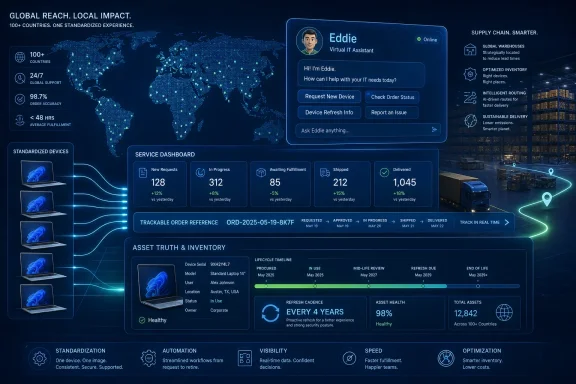
Eddie, formally the Employee Device Information agent, is built with Microsoft Copilot Studio and designed to turn device selection into a conversational experience. Employees can ask for recommendations, compare models, validate eligibility, and submit an order from chat. Once the request is confirmed, the system returns a trackable ServiceNow reference.That sounds simple, which is the point.
The previous experience gave employees options but still left them with homework. They could browse available PCs, but choosing the right one required research, peer advice, and guesswork. Microsoft says the agent will recommend devices based on role, work needs, location, and other factors.
In other words, Eddie is not just answering questions. It is narrowing a decision space.
That is where AI can be genuinely useful in enterprise IT. Most employees do not want to become experts in CPU tiers, memory configurations, dock compatibility, regional availability, procurement policy, and refresh eligibility. They want to know which machine they are allowed to get and which one will do the job.
The user experience win is obvious. The governance win is subtler. If the agent channels employees toward role-aligned devices, Microsoft can reduce variance without making the process feel punitive. The employee experiences guidance; procurement gets standardization.
The Agent Is Also a Policy Enforcement Surface
Every enterprise AI agent eventually becomes a policy interface. Eddie is no exception.The agent validates eligibility, captures required inputs, offers approved choices, and initiates the request. That means the conversation is not merely informational. It is transactional. The bot is participating in a workflow where cost, access, inventory, identity, location, and lifecycle status all matter.
That raises the stakes.
A device procurement agent must know who the employee is, what role they perform, where they work, what they already have, whether they are due for refresh, what devices are approved in their region, what inventory exists, and what approvals apply. It must avoid recommending unavailable hardware, avoid bypassing policy, and avoid generating orders that humans later have to unwind.
Microsoft says Eddie uses a multi-agent architecture with specialized components for catalog browsing, comparison, recommendations, and ordering, coordinated by an orchestration layer. That is the kind of design enterprises will increasingly see: not one all-knowing bot, but a set of constrained agents operating against defined systems.
For IT pros, this is where the architectural conversation becomes serious. The agent cannot be treated as a novelty UI. It is a new front door into procurement and asset systems. That front door needs identity controls, auditability, logging, permissions, error handling, and rollback paths.
A chatbot that can execute business processes is no longer just chat.
The Hidden Prize Is Asset Truth
Microsoft’s example of correcting primary device records may be more important than ordering a new PC. According to the company, something as basic as fixing an employee’s primary device previously required multiple tickets and human validation, and could take weeks or even months. Eddie can validate the information and, in some cases, execute the change in minutes.That is a mundane example with large implications.
Primary device records sit at the intersection of asset management, endpoint security, support, compliance, finance, and user experience. If the system does not know which device belongs to which person, everything downstream gets worse. Patch reporting is less trustworthy. Support context is weaker. Refresh planning is inaccurate. Recovery from loss or theft becomes harder. Procurement forecasts drift.
Enterprises love to talk about AI transformation, but many are still struggling with asset truth. Eddie’s value depends on Microsoft having a reliable view of each employee’s primary device. myDevice was created to provide that visibility.
This is why the story should interest WindowsForum readers beyond the Microsoft bubble. Every admin has seen the difference between a device estate that exists in theory and one that exists in usable data. The latter is what lets you automate. The former is what keeps humans in ticket queues.
If Eddie can correct asset records through validation and workflow execution, it points to a broader pattern: agents may become the conversational maintenance layer for enterprise data hygiene.
Tracking Status Is a Small Feature With Outsized Value
Microsoft also says Eddie gives employees better visibility into order status. Previously, requests could feel like they disappeared into a black hole. Now the agent can query the same data procurement sees and answer directly.This is one of those improvements that sounds minor until you have worked in support.
Lack of status visibility creates secondary work. Employees file follow-up tickets. Managers ask for updates. Help desks chase procurement. Procurement chases suppliers. Everyone spends time narrating the state of a process that should have been visible from the start.
A trackable ServiceNow reference is not revolutionary. But placing status inside the same conversational flow that created the request matters. The employee does not need to remember which portal handled the order, which ticket type was created, or which team owns the next step.
In enterprise IT, reducing “where do I go to find out?” is often as valuable as reducing the original transaction time.
This is where the agent-first narrative becomes credible. Not because chat is inherently better than a portal, but because chat can unify fragmented moments: eligibility, selection, order creation, status, correction, and follow-up. The experience feels simpler because the system boundaries are hidden.
The Supply Chain Lesson Is Bigger Than the Chatbot
One of the most practical changes Microsoft describes is the shift from build-to-order device fulfillment toward an inventory-based model. The company says it wants suppliers to maintain stockpiles of the most frequently requested PCs, based on Microsoft’s data. The goal is to reduce procurement time from four to six weeks to under two weeks.That is not an AI feature. It is operational redesign.
It also shows why procurement transformation cannot stop at the employee interface. If Eddie helps someone pick a device instantly but the device still takes six weeks to arrive, the user’s memory of the experience will be dominated by the wait. The agent can make the front end feel modern; supply chain determines whether the promise lands.
New-hire provisioning is the sharper test. Microsoft says it currently gets devices to new employees on day one around 70 percent of the time and wants to raise that to 98 percent. For a company of Microsoft’s size, that gap is not trivial.
A delayed laptop is not merely an inconvenience. It damages onboarding, wastes manager time, creates shadow workarounds, and sends a bad first signal to the employee. In a hybrid workplace, the work PC is not office furniture. It is the workplace.
Here, AI is only one component in a broader operating model. Forecasting demand, maintaining inventory, aligning regional availability, and standardizing device choices are all part of the system. Eddie may be the face of the program, but the supply chain is the spine.
Cost Savings Make the Case Executives Will Actually Hear
Microsoft says myDevice and Eddie contributed to a 23 percent reduction in primary work device spend, saving roughly $20 million annually. It also says average cost per device fell from $1,850 to $1,670, more than 50,000 employees were equipped globally in the last fiscal year, end-of-fiscal-year spending spikes were eliminated through predictable quarterly planning, and sustainability improved through increased reuse and recycling.Those numbers are doing a lot of work.
The AI industry often sells productivity gains that are difficult to measure. Device procurement is different. Hardware spend, average device cost, fulfillment time, refresh volume, and unused inventory are measurable. If Microsoft can tie the new operating model to hard-dollar savings, it gives CIOs and CFOs something more concrete than “employee delight.”
Still, it is worth being precise about causality. The savings appear to come from the combination of standardization, catalog rationalization, lifecycle planning, procurement discipline, reuse, and AI-assisted experience. Eddie is part of the story, not the whole story.
That matters because vendors have an incentive to let the AI mascot absorb all the credit. The more accurate reading is that Microsoft built an enterprise procurement machine, then added an agent to make that machine easier to use.
For IT leaders, that is the more useful model. Do not begin with “we need an AI agent.” Begin with “which workflow is expensive, fragmented, measurable, and painful enough to justify redesign?” If the answer is device lifecycle management, then an agent may be the right final interface.
Microsoft Is Practicing the Sales Pitch on Itself
Microsoft’s internal IT stories always do double duty. They describe how Microsoft runs Microsoft, and they serve as proof points for Microsoft’s product strategy. Eddie is no different.The ingredients are conspicuously aligned with Microsoft’s commercial stack: ServiceNow as the internal workflow backbone in this case, Copilot Studio as the agent-building environment, identity-aware employee experiences, and a broader narrative about moving from portals to conversations. It is a practical story, but it is also a market argument.
Microsoft wants customers to believe that agents are the next major interface for work. Eddie gives the company a more grounded example than many generic demos because the workflow is specific, expensive, and familiar. Every large organization buys devices. Every large organization has refresh cycles. Every large organization has employees confused by process.
That makes the case stronger. It also makes it easier to scrutinize.
Microsoft is not claiming Eddie is a general-purpose digital coworker inventing new strategy. It is describing an agent constrained to a defined business process, backed by enterprise data, and integrated into existing workflow systems. That is exactly the kind of AI deployment more likely to survive contact with reality.
The broader lesson is that enterprise agents will probably succeed first in narrow domains where the goal is not creativity but guided execution. Pick the right device. Correct the asset record. Show the order status. Trigger the approved workflow. These are not glamorous tasks, but they are abundant.
The Risk Moves From User Confusion to System Trust
Replacing forms with conversation changes the failure modes.In a form-driven system, users can be confused by fields, options, and policy language. In an agent-driven system, users may be overconfident because the answer arrives in plain English. The more natural the interface, the easier it is for employees to assume the system is right.
That creates a trust burden. Eddie needs to be accurate not just in casual advice but in eligibility, catalog constraints, region-specific availability, and workflow execution. A bad recommendation could waste money. A bad order could delay onboarding. A bad asset correction could pollute inventory records. A bad permission boundary could expose procurement or employee data.
None of that means the agent model is wrong. It means enterprise AI needs traditional IT discipline around it.
Admins will want to know how recommendations are generated, what data the agent can access, how actions are logged, how exceptions are escalated, and how humans override mistakes. Procurement teams will want guardrails around approved models and budget constraints. Security teams will want assurance that the agent cannot leak sensitive asset or employee information.
The irony is that the friendlier the agent becomes, the more important the boring controls become. Eddie may be conversational, but its credibility depends on governance that users never see.
Windows Hardware Becomes a Managed Experience, Not a Shopping Choice
For Windows enthusiasts, there is another angle beneath the enterprise process story: the work PC is becoming less of a personal selection and more of a managed experience.That has been true in many companies for years, but AI-guided procurement sharpens the shift. The employee does not browse a sprawling catalog and advocate for a preferred machine. The agent interprets role, work needs, eligibility, and location, then presents a narrowed set of options. The catalog becomes policy made visible.
There are benefits. Employees are less likely to choose underpowered machines, incompatible models, or devices that create support headaches. IT can standardize images, drivers, accessories, warranty processes, and lifecycle planning. Procurement can negotiate better terms around fewer models.
There are trade-offs. Power users may feel constrained. Developers, engineers, designers, and accessibility users may need exceptions that role-based models miss. Local teams may lose flexibility that previously helped them respond to unusual needs quickly.
The key is whether the system can distinguish between needless variety and legitimate specialization. A company the size of Microsoft surely has both. The success of Eddie will depend partly on how well its recommendations handle edge cases without forcing every edge case back into manual escalation.
The best version of this model does not flatten everyone into the same laptop. It makes the default path fast while preserving well-governed exceptions.
Sustainability Benefits Depend on Lifecycle Discipline
Microsoft also ties the program to improved sustainability through increased device reuse and recycling. That claim fits the logic of centralized lifecycle management: if you know what devices exist, who has them, how old they are, and when they are due for replacement, you can make better decisions about reuse, redeployment, repair, and retirement.Again, the important word is if.
Sustainability in endpoint computing often breaks down because organizations lack asset accuracy and process discipline. Devices sit in drawers. Returned machines are not triaged quickly. Usable hardware is replaced because the refresh process is easier than redeployment. Local purchasing creates model sprawl that makes parts, repairs, and redeployment harder.
A standardized device catalog and predictable refresh cycle can reduce some of that waste. An agent can help by directing employees to appropriate devices and making status or return steps easier. But sustainability gains come from the operating model, not from the conversational interface alone.
This is another reminder that Eddie is the front end of a larger system. The environmental benefit is not that AI chats about laptops. It is that centralized procurement and lifecycle data can reduce unnecessary purchasing and improve the odds that existing devices are reused intelligently.
The Eddie Playbook Is Smaller and More Useful Than the Hype
The most useful reading of Microsoft’s Eddie announcement is not “AI will replace enterprise portals.” It is “AI works best when pointed at a painful, bounded workflow that has already been standardized enough to automate.”That is a narrower claim. It is also more believable.
Device procurement is a good candidate because the work is repetitive, policy-driven, measurable, and annoying. It involves enough complexity to justify guidance but not so much ambiguity that every request becomes a philosophical debate. Employees want speed and confidence. IT wants compliance and clean records. Procurement wants cost control and forecastable demand.
That alignment is rare enough to matter.
The Eddie model also suggests a practical sequencing for other enterprise workflows. First, unify data. Second, standardize policy. Third, simplify the catalog or choice set. Fourth, integrate fulfillment. Fifth, expose the experience through an agent. Reverse the order and the agent becomes theater.
This is the part of the story Microsoft customers should take seriously, whether or not they use Copilot Studio. The value is not in anthropomorphizing a workflow. The value is in reducing the number of places an employee must go, the number of decisions they must make, and the number of humans required to push a routine request across organizational seams.
The Numbers Behind Eddie Tell IT Where to Look Next
Microsoft’s device agent is less a universal template than a diagnostic lens. It shows where AI agents may make sense first: the corners of enterprise IT where employees face too many choices, administrators perform too many manual validations, and leaders can measure whether the redesign worked.- Microsoft says Eddie will let employees choose, compare, order, and track new work PCs through a conversational AI interface.
- The agent sits on top of myDevice, a centralized procurement and lifecycle platform built after Microsoft spent years unwinding fragmented device processes.
- Microsoft reports a 23 percent reduction in primary work device spend and roughly $20 million in annual savings from the broader myDevice and EDI effort.
- The company says its device refresh model now targets a four-year PC lifecycle, with about 20,000 employees per quarter receiving automated refresh invitations when budget is available.
- Microsoft wants to improve day-one device readiness for new hires from about 70 percent to 98 percent by moving toward more inventory-based fulfillment.
- The broader lesson for IT teams is that agents need clean data, governed catalogs, workflow integration, and audit controls before they can safely execute routine business processes.
References
- Primary source: Microsoft
Published: 2026-06-18T15:50:08.833862
Meet ‘Eddie,’ our agent for putting new PCs in the hands of our employees - Inside Track Blog
Learn how we’ve moved to a centralized process at Microsoft for supplying employees with a new device, using AI to increase efficiency and reduce costs.www.microsoft.com
