

On June 3, 2026, the Browser Choice Alliance, a coalition including Google Chrome, Opera, Vivaldi, Waterfox, Wavebox, and other browser makers, sent Microsoft CEO Satya Nadella a letter accusing Microsoft of using Windows to steer users toward Edge and away from rival browsers. The complaint lands because it describes something Windows users do not need a lawyer to understand: the operating system often treats browser choice as a suggestion rather than a command. Microsoft’s defense, implicit in years of product design, is that Edge is part of a safer, more integrated Windows experience. The coalition’s answer is sharper: integration has become leverage.
The fight is not about whether Edge is a good browser. In its Chromium era, Edge is fast, compatible, and in some enterprise environments genuinely useful. It has strong PDF handling, policy controls, Microsoft account integration, and hooks into Defender, Entra, Microsoft 365, and Copilot that make sense if your workplace already lives inside Redmond’s stack.
The problem is that Windows is not merely another app competing for attention. It is the ground on which the browser market competes. When the operating system promotes its own browser at setup, during search, in widgets, in Teams flows, in Outlook-style link handling, and in default-app prompts, Microsoft is not just advertising. It is using the layer below the browser to tilt the layer above it.
That distinction matters. Chrome can nag you on Google.com. Firefox can ask to become your default. Vivaldi can pitch power-user features. But none of those browsers can redesign Windows’ default-app workflow, preinstall themselves on every new Windows PC, or make parts of the shell route through their own browser regardless of what the user selected elsewhere.
This is why the Browser Choice Alliance’s complaint has political force even with Google in the room. Yes, Google is hardly a saint in browser and search competition. But hypocrisy does not automatically make the complaint wrong. Platform power is still platform power, even when the party complaining about it has plenty of its own.
The alliance wants Microsoft to stop using Windows as a distribution moat for Edge. Its demands include fairer access to PC preinstallation deals, fewer discouraging prompts when users download rivals, a simpler system-wide default browser switch, and the ability for users to remove Edge more completely where it is not technically required. That is not a request for equal popularity. It is a request for equal contestability.
The timing is not accidental. The alliance launched in late 2024, but by 2026 the stakes around browsers have shifted. Browsers are no longer just windows onto the web; they are becoming launchpads for AI assistants, shopping tools, identity systems, passkey managers, enterprise search, and productivity agents. If Microsoft can determine which browser opens by default, it can also determine which assistant, search engine, and account system gets the first opportunity to shape a user’s behavior.
That is the real prize. Edge is not only a browser. It is a front door for Bing, Microsoft Rewards, Copilot, Microsoft account sync, enterprise policy, and cloud services. The browser war has become an AI distribution war wearing a familiar trench coat.
A user can set Chrome, Firefox, Vivaldi, Brave, or another browser as default and still encounter Edge in Windows-adjacent contexts. Search, widgets, Microsoft services, and application-specific link settings can behave differently from the main default browser setting. Some of this is architectural complexity. Some of it is product strategy. For users, the distinction is academic.
Microsoft has long argued, in various contexts, that certain integrations improve security, performance, or continuity. That argument is not frivolous. Enterprises often want predictable defaults, managed browser policies, and a supported path for legacy compatibility. Edge’s IE mode, for example, solved a real business problem for organizations still dragging old web apps through modern Windows deployments.
But consumer Windows is not a locked-down corporate image. A home user who chooses another browser is not asking Microsoft to dismantle Windows. They are asking Windows to remember what they chose. When the OS keeps presenting Edge as the favored path, user consent starts to look suspiciously temporary.
The details are different now. Edge is based on Chromium, not Microsoft’s old Trident engine. Windows is no longer the only meaningful computing platform. Smartphones, tablets, and app ecosystems have changed the terrain. Microsoft is also no longer the uncontested consumer web kingmaker it once hoped to be.
But the old lesson remains relevant: when the owner of the operating system also owns the default browser, small design decisions carry market consequences. A prompt here, a reset there, a preinstallation deal somewhere else, and soon the browser market is not being decided only by performance, privacy, extension support, or user preference. It is being decided by friction.
The most damning part of the alliance’s case is not that Edge exists. It is that Microsoft appears unable to resist using Windows to keep Edge in front of people who have already said no. That is the same corporate muscle memory that made Internet Explorer a regulatory magnet.
That changes the economics of browser choice. A default browser used to decide where links opened. Now it can decide which AI assistant summarizes pages, which search engine answers questions, which shopping tool compares prices, which account stores browsing data, and which cloud service learns the most about a user’s intent.
Google understands this because Chrome has played the same strategic role for Google Search and Google accounts. Opera, Vivaldi, Waterfox, and Wavebox understand it from the other side: without fair access to distribution, differentiated browsers become niche products no matter how inventive they are. The browser is again becoming the control point for the next interface layer.
Microsoft’s dilemma is obvious. It wants Edge and Copilot to feel native to Windows because that makes the company’s ecosystem more valuable. But the more native they feel, the more regulators can argue that Microsoft is blending product integration with exclusionary conduct. The line between convenience and coercion is where this fight will be decided.
They should resist laughing too hard. Competition law is not a morality contest in which only pure companies may complain. It is a framework for analyzing power in specific markets. Google can be dominant in search and still have a legitimate complaint about Microsoft’s control over Windows distribution. Microsoft can be right that Google uses its own surfaces to promote Chrome and still be wrong to override or erode user choices in Windows.
The smaller alliance members matter because they make the case less about Google versus Microsoft and more about the browser market as a whole. Vivaldi competes on customization and power-user control. Waterfox competes on privacy and a Firefox-derived lineage. Wavebox competes in productivity workflows. Opera competes through built-in services, AI features, and alternative interface ideas. These companies do not own Windows, Android, iOS, or the dominant search engine.
For them, defaults are oxygen. A browser can be excellent and still struggle if users must fight the operating system to install it, set it, keep it, and use it consistently. That is why this debate should not be reduced to Big Tech score-settling, even though Big Tech score-settling is plainly part of the spectacle.
That makes preinstallation enormously valuable. If Edge is always present, prominently placed, and protected by Microsoft’s commercial relationships with PC makers, rival browsers begin the race several steps behind. They can still win users, but only after users decide to search, download, ignore discouraging prompts, change defaults, and keep those defaults through future updates and app-specific settings.
Opera’s complaint in Brazil and the attention around Microsoft’s OEM programs show where regulators may focus next. If Microsoft conditions financial incentives, support, or partner benefits in ways that discourage OEMs from giving rival browsers meaningful placement, the case becomes more than user-interface annoyance. It becomes a distribution foreclosure argument.
That is where Microsoft is most vulnerable. A company can say it is improving Windows by including Edge. It has a harder time explaining why rival browsers should not be able to compete fairly for preinstallation and default placement on the same machines.
But enterprise convenience does not justify consumer coercion. Microsoft can support managed Edge deployments without making consumer defaults feel slippery. It can provide Windows components that depend on WebView2 without using that dependency as a broad excuse to keep the full Edge browser in privileged circulation. It can give administrators strong controls while giving home users a cleaner opt-out.
The distinction is important because Microsoft often wins technical arguments by pointing to real dependencies. Windows and modern apps do need web-rendering components. Some features do rely on Microsoft account services. Security prompts can protect less technical users from malicious downloads. None of that requires turning browser choice into a maze.
A mature Windows strategy would separate system plumbing from browser promotion. WebView2 can remain a runtime. Edge can remain an installable, manageable browser. Copilot can remain a Microsoft service. But a user’s browser default should mean what it says across the visible parts of the operating system.
The Browser Choice Alliance is trying to make Microsoft’s Edge conduct legible to that regulatory framework. It is not merely saying users are annoyed. It is saying Microsoft controls a gate, favors its own downstream service, and uses design choices to weaken rivals. That is exactly the kind of behavior modern digital-market rules were written to examine.
The U.S. picture is less predictable. American antitrust enforcement has become more aggressive toward platform companies, but political priorities change and litigation moves slowly. Brazil may become an important venue because Opera has pushed the issue there and CADE has shown interest. The coalition’s best bet is not one dramatic lawsuit but cumulative pressure across jurisdictions.
Microsoft knows this terrain well. It will likely emphasize security, user experience, product integration, and the availability of alternatives. It may also continue making regional concessions where required while preserving broader defaults elsewhere. That kind of fragmented compliance has become a hallmark of global tech regulation: users in one market get clearer choices while users elsewhere keep wrestling with the old design.
Microsoft could also distinguish between Edge the browser and web components required by Windows. If a user removes Edge, Windows can preserve WebView2 or other runtimes needed by applications without keeping the Edge browser as a recurring consumer-facing presence. That is not an exotic engineering challenge. It is a product priority choice.
The company’s reluctance suggests the friction is valuable. Every prompt that nudges a user back to Edge, every flow that opens Edge despite a different default, and every OEM deal that keeps Edge prominent contributes to Microsoft’s broader distribution strategy. Edge may not dominate the browser market, but it does not need to dominate to matter. It needs enough usage to strengthen Bing, Copilot, Microsoft account engagement, and enterprise stickiness.
That is why the alliance’s campaign should be judged by outcomes, not rhetoric. If Microsoft changes the visible mechanics of browser choice, the pressure worked. If it merely softens a prompt while inventing another path to Edge elsewhere, the coalition’s complaint will look less like lobbying and more like documentation.
That residue matters because trust is part of platform design. When users believe Windows is respecting their choices, they are more likely to accept integration. When they believe Windows is laundering Microsoft’s business goals through system prompts, every recommendation becomes suspect. Even useful security warnings start to look like sales copy.
Microsoft has been here before with Windows 10 upgrade prompts, Microsoft account pressure, Start menu promotions, OneDrive nudges, and Bing integration. Each individual design can be defended. Taken together, they create a sense that Windows is no longer a neutral personal-computing environment but a constantly monetized persuasion surface.
For a company trying to sell AI as a helpful companion, that is dangerous. Copilot needs trust more than Edge ever did. If users associate Microsoft’s AI ambitions with the same tactics they dislike in browser defaults, the company may win distribution while losing goodwill.
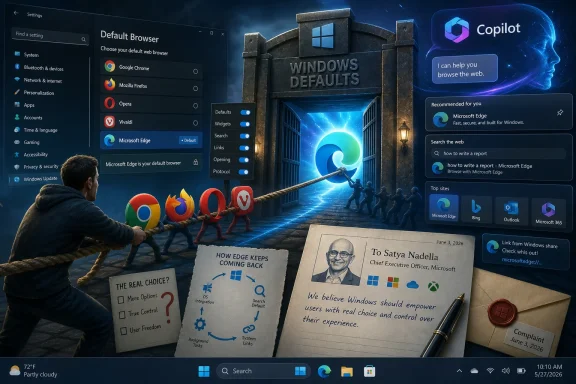 Microsoft’s Edge Problem Is Really a Windows Power Problem
The fight is not about whether Edge is a good browser. In its Chromium era, Edge is fast, compatible, and in some enterprise environments genuinely useful. It has strong PDF handling, policy controls, Microsoft account integration, and hooks into Defender, Entra, Microsoft 365, and Copilot that make sense if your workplace already lives inside Redmond’s stack.The problem is that Windows is not merely another app competing for attention. It is the ground on which the browser market competes. When the operating system promotes its own browser at setup, during search, in widgets, in Teams flows, in Outlook-style link handling, and in default-app prompts, Microsoft is not just advertising. It is using the layer below the browser to tilt the layer above it.
That distinction matters. Chrome can nag you on Google.com. Firefox can ask to become your default. Vivaldi can pitch power-user features. But none of those browsers can redesign Windows’ default-app workflow, preinstall themselves on every new Windows PC, or make parts of the shell route through their own browser regardless of what the user selected elsewhere.
This is why the Browser Choice Alliance’s complaint has political force even with Google in the room. Yes, Google is hardly a saint in browser and search competition. But hypocrisy does not automatically make the complaint wrong. Platform power is still platform power, even when the party complaining about it has plenty of its own.
The Browser Choice Alliance Turns Annoyance Into an Antitrust Theory
The coalition’s letter to Nadella is best understood as an attempt to translate everyday Windows irritation into regulatory language. Users say Edge keeps coming back. Browser makers say Microsoft is restricting, distorting, and subverting user choice. Regulators hear a familiar phrase: self-preferencing.The alliance wants Microsoft to stop using Windows as a distribution moat for Edge. Its demands include fairer access to PC preinstallation deals, fewer discouraging prompts when users download rivals, a simpler system-wide default browser switch, and the ability for users to remove Edge more completely where it is not technically required. That is not a request for equal popularity. It is a request for equal contestability.
The timing is not accidental. The alliance launched in late 2024, but by 2026 the stakes around browsers have shifted. Browsers are no longer just windows onto the web; they are becoming launchpads for AI assistants, shopping tools, identity systems, passkey managers, enterprise search, and productivity agents. If Microsoft can determine which browser opens by default, it can also determine which assistant, search engine, and account system gets the first opportunity to shape a user’s behavior.
That is the real prize. Edge is not only a browser. It is a front door for Bing, Microsoft Rewards, Copilot, Microsoft account sync, enterprise policy, and cloud services. The browser war has become an AI distribution war wearing a familiar trench coat.
Windows Defaults Still Feel Like a Negotiation
Microsoft has improved some parts of default browser handling since the worst early days of Windows 11, when switching away from Edge meant dealing with individual file and protocol associations. But the larger user experience still leaves many people feeling as if they are negotiating with the OS after making a clear choice.A user can set Chrome, Firefox, Vivaldi, Brave, or another browser as default and still encounter Edge in Windows-adjacent contexts. Search, widgets, Microsoft services, and application-specific link settings can behave differently from the main default browser setting. Some of this is architectural complexity. Some of it is product strategy. For users, the distinction is academic.
Microsoft has long argued, in various contexts, that certain integrations improve security, performance, or continuity. That argument is not frivolous. Enterprises often want predictable defaults, managed browser policies, and a supported path for legacy compatibility. Edge’s IE mode, for example, solved a real business problem for organizations still dragging old web apps through modern Windows deployments.
But consumer Windows is not a locked-down corporate image. A home user who chooses another browser is not asking Microsoft to dismantle Windows. They are asking Windows to remember what they chose. When the OS keeps presenting Edge as the favored path, user consent starts to look suspiciously temporary.
The Internet Explorer Ghost Never Really Left Redmond
Microsoft has lived this story before. In the late 1990s and early 2000s, Internet Explorer was not just a browser; it was a legal exhibit. The U.S. antitrust case against Microsoft and the European Commission’s later browser-choice remedies turned browser bundling into one of the defining competition fights of the PC era.The details are different now. Edge is based on Chromium, not Microsoft’s old Trident engine. Windows is no longer the only meaningful computing platform. Smartphones, tablets, and app ecosystems have changed the terrain. Microsoft is also no longer the uncontested consumer web kingmaker it once hoped to be.
But the old lesson remains relevant: when the owner of the operating system also owns the default browser, small design decisions carry market consequences. A prompt here, a reset there, a preinstallation deal somewhere else, and soon the browser market is not being decided only by performance, privacy, extension support, or user preference. It is being decided by friction.
The most damning part of the alliance’s case is not that Edge exists. It is that Microsoft appears unable to resist using Windows to keep Edge in front of people who have already said no. That is the same corporate muscle memory that made Internet Explorer a regulatory magnet.
Edge Is Now a Copilot Distribution Channel
The AI angle makes this dispute more than a rerun. Microsoft has spent the past several years turning Copilot into a cross-product identity layer: in Windows, in Edge, in Microsoft 365, in Bing, and increasingly in enterprise workflows. Edge is one of the cleanest ways to put Copilot in the user’s peripheral vision.That changes the economics of browser choice. A default browser used to decide where links opened. Now it can decide which AI assistant summarizes pages, which search engine answers questions, which shopping tool compares prices, which account stores browsing data, and which cloud service learns the most about a user’s intent.
Google understands this because Chrome has played the same strategic role for Google Search and Google accounts. Opera, Vivaldi, Waterfox, and Wavebox understand it from the other side: without fair access to distribution, differentiated browsers become niche products no matter how inventive they are. The browser is again becoming the control point for the next interface layer.
Microsoft’s dilemma is obvious. It wants Edge and Copilot to feel native to Windows because that makes the company’s ecosystem more valuable. But the more native they feel, the more regulators can argue that Microsoft is blending product integration with exclusionary conduct. The line between convenience and coercion is where this fight will be decided.
Google’s Presence Makes the Coalition Messier, Not Meaningless
The Browser Choice Alliance would be rhetorically cleaner without Google. Chrome is the world’s dominant browser, and Google has faced intense antitrust scrutiny over search distribution, advertising, Android defaults, and Chrome’s role in preserving its search business. It is easy for Microsoft defenders to point at Google and laugh.They should resist laughing too hard. Competition law is not a morality contest in which only pure companies may complain. It is a framework for analyzing power in specific markets. Google can be dominant in search and still have a legitimate complaint about Microsoft’s control over Windows distribution. Microsoft can be right that Google uses its own surfaces to promote Chrome and still be wrong to override or erode user choices in Windows.
The smaller alliance members matter because they make the case less about Google versus Microsoft and more about the browser market as a whole. Vivaldi competes on customization and power-user control. Waterfox competes on privacy and a Firefox-derived lineage. Wavebox competes in productivity workflows. Opera competes through built-in services, AI features, and alternative interface ideas. These companies do not own Windows, Android, iOS, or the dominant search engine.
For them, defaults are oxygen. A browser can be excellent and still struggle if users must fight the operating system to install it, set it, keep it, and use it consistently. That is why this debate should not be reduced to Big Tech score-settling, even though Big Tech score-settling is plainly part of the spectacle.
OEM Deals Are the Quiet Battlefield
The most visible part of the dispute is the nagging: prompts, warnings, Edge reappearances, and browser-choice friction. The quieter part is PC distribution. Most Windows users do not install Windows from scratch; they buy a machine from Dell, HP, Lenovo, ASUS, Acer, Microsoft, or another OEM and inherit whatever software and defaults arrive on day one.That makes preinstallation enormously valuable. If Edge is always present, prominently placed, and protected by Microsoft’s commercial relationships with PC makers, rival browsers begin the race several steps behind. They can still win users, but only after users decide to search, download, ignore discouraging prompts, change defaults, and keep those defaults through future updates and app-specific settings.
Opera’s complaint in Brazil and the attention around Microsoft’s OEM programs show where regulators may focus next. If Microsoft conditions financial incentives, support, or partner benefits in ways that discourage OEMs from giving rival browsers meaningful placement, the case becomes more than user-interface annoyance. It becomes a distribution foreclosure argument.
That is where Microsoft is most vulnerable. A company can say it is improving Windows by including Edge. It has a harder time explaining why rival browsers should not be able to compete fairly for preinstallation and default placement on the same machines.
Enterprise IT Has a Different Problem Than Home Users
For sysadmins, the Edge debate is more complicated than “Microsoft bad, rival browsers good.” Many organizations standardize on Edge because it is manageable, secure, and tightly integrated with Microsoft’s enterprise stack. Group Policy, Intune, Defender integration, identity controls, IE mode, and Microsoft 365 compatibility are not trivial benefits.But enterprise convenience does not justify consumer coercion. Microsoft can support managed Edge deployments without making consumer defaults feel slippery. It can provide Windows components that depend on WebView2 without using that dependency as a broad excuse to keep the full Edge browser in privileged circulation. It can give administrators strong controls while giving home users a cleaner opt-out.
The distinction is important because Microsoft often wins technical arguments by pointing to real dependencies. Windows and modern apps do need web-rendering components. Some features do rely on Microsoft account services. Security prompts can protect less technical users from malicious downloads. None of that requires turning browser choice into a maze.
A mature Windows strategy would separate system plumbing from browser promotion. WebView2 can remain a runtime. Edge can remain an installable, manageable browser. Copilot can remain a Microsoft service. But a user’s browser default should mean what it says across the visible parts of the operating system.
Regulators Have Learned to Watch the Defaults
The European Union’s Digital Markets Act has already changed the language of platform regulation. It asks whether dominant platforms allow users to uninstall apps, change defaults, access competing services, and avoid undue friction. Microsoft has avoided some of the most direct DMA pressure that Apple and Google face, but Windows remains too important for regulators to ignore.The Browser Choice Alliance is trying to make Microsoft’s Edge conduct legible to that regulatory framework. It is not merely saying users are annoyed. It is saying Microsoft controls a gate, favors its own downstream service, and uses design choices to weaken rivals. That is exactly the kind of behavior modern digital-market rules were written to examine.
The U.S. picture is less predictable. American antitrust enforcement has become more aggressive toward platform companies, but political priorities change and litigation moves slowly. Brazil may become an important venue because Opera has pushed the issue there and CADE has shown interest. The coalition’s best bet is not one dramatic lawsuit but cumulative pressure across jurisdictions.
Microsoft knows this terrain well. It will likely emphasize security, user experience, product integration, and the availability of alternatives. It may also continue making regional concessions where required while preserving broader defaults elsewhere. That kind of fragmented compliance has become a hallmark of global tech regulation: users in one market get clearer choices while users elsewhere keep wrestling with the old design.
The Fix Is Not Technically Hard
The most revealing thing about the Edge fight is that the obvious remedies are simple. Windows could present a neutral browser choice screen during setup. It could allow any installed browser to become the default for web links, HTML files, and relevant protocols with one action. It could make Windows Search respect that default. It could stop presenting rival-browser downloads as suspicious merely because they are rival browsers.Microsoft could also distinguish between Edge the browser and web components required by Windows. If a user removes Edge, Windows can preserve WebView2 or other runtimes needed by applications without keeping the Edge browser as a recurring consumer-facing presence. That is not an exotic engineering challenge. It is a product priority choice.
The company’s reluctance suggests the friction is valuable. Every prompt that nudges a user back to Edge, every flow that opens Edge despite a different default, and every OEM deal that keeps Edge prominent contributes to Microsoft’s broader distribution strategy. Edge may not dominate the browser market, but it does not need to dominate to matter. It needs enough usage to strengthen Bing, Copilot, Microsoft account engagement, and enterprise stickiness.
That is why the alliance’s campaign should be judged by outcomes, not rhetoric. If Microsoft changes the visible mechanics of browser choice, the pressure worked. If it merely softens a prompt while inventing another path to Edge elsewhere, the coalition’s complaint will look less like lobbying and more like documentation.
Windows Users Can Read the Room
There is a reason this story travels well among Windows enthusiasts. The average user may not know the details of antitrust law, but they know when a product will not take no for an answer. Edge’s reputation problem is not only about its features. It is about the emotional residue left by repeated nudges.That residue matters because trust is part of platform design. When users believe Windows is respecting their choices, they are more likely to accept integration. When they believe Windows is laundering Microsoft’s business goals through system prompts, every recommendation becomes suspect. Even useful security warnings start to look like sales copy.
Microsoft has been here before with Windows 10 upgrade prompts, Microsoft account pressure, Start menu promotions, OneDrive nudges, and Bing integration. Each individual design can be defended. Taken together, they create a sense that Windows is no longer a neutral personal-computing environment but a constantly monetized persuasion surface.
For a company trying to sell AI as a helpful companion, that is dangerous. Copilot needs trust more than Edge ever did. If users associate Microsoft’s AI ambitions with the same tactics they dislike in browser defaults, the company may win distribution while losing goodwill.
The Browser Fight Has Become a Test of Windows’ Good Faith
The concrete pieces of this dispute are now clear enough for users and administrators to watch what happens next.- The Browser Choice Alliance sent Satya Nadella a June 3, 2026 letter accusing Microsoft of using Windows to favor Edge through defaults, prompts, preinstallation, and system integration.
- The coalition’s core demand is not that rival browsers be guaranteed success, but that Windows stop making user choice harder to express and easier to undermine.
- Edge’s role is larger in 2026 because it connects Microsoft’s browser strategy to Bing, Copilot, Microsoft accounts, and enterprise cloud services.
- Google’s presence in the alliance complicates the politics, but it does not erase the concerns of smaller browser makers that depend on fair Windows distribution.
- The simplest remedies would be neutral setup choice, true one-click default switching, respect for defaults across Windows surfaces, and a cleaner separation between Edge and required web runtimes.
- The regulatory risk for Microsoft grows if browser friction is tied not only to prompts but also to OEM incentives and preinstallation practices.
References
- Primary source: Gadget Review
Published: 2026-06-05T18:45:12.414446
Browser Coalition Challenges Microsoft's Edge Monopoly Tactics
Browser Coalition challenges Microsoft's Edge monopoly tactics on Windows, demanding equal browser choice and removal of dark patterns that force users toward Edge.www.gadgetreview.com - Official source: learn.microsoft.com
Set Microsoft Edge as the default browser on Windows and macOS | Microsoft Learn
Learn how to set Microsoft Edge as the default browserlearn.microsoft.com - Official source: microsoft.com

Uninstall Microsoft Edge | Microsoft Edge
Trying to uninstall Microsoft Edge from Windows 10, Windows 11, or other systems? Discover the features and functionalities you’ll miss without it.
www.microsoft.com
- Related coverage: mlex.com
Microsoft's Windows operating system favors Edge, Browser Choice Alliance says | MLex | Specialist news and analysis on legal risk and regulation
MLex Summary: The Browser Choice Alliance, a coalition of web browser providers including Chrome, Vivaldi and Opera, said that Microsoft "restrict, distort and subvert user choice" of browser by promoting Edge through its Windows operating system. In a letter sent on Wednesday...www.mlex.com - Related coverage: howtogeek.com
The Browser Choice Alliance Wants to Keep Microsoft Edge in Check
Microsoft isn't giving other browsers a fair shot on Windows, says other web browsers. www.howtogeek.com
- Related coverage: techspot.com
Browser Alliance is accusing Microsoft of limiting user choice with Edge browser | TechSpot
A number of browser makers formed the Browser Choice Alliance (BCA) to raise awareness of Microsoft's wicked behavior in the browser business. The group accuses Microsoft of...www.techspot.com
- Related coverage: clubic.com
Google, Firefox et Opera s'unissent contre Microsoft
La Browser Choice Alliance, qui regroupe Google Chrome, Opera, Vivaldi, Midori et d’autres navigateurs, a adressé le 3 juin 2026 une lettre ouverte au PDG de Microsoft, Satya Nadella. Le collectif réclame que les utilisateurs Windows puissent choisir librement leur navigateur, sans manipulation... www.clubic.com
- Related coverage: pcgamer.com
'This marks a significant step towards addressing anticompetitive behaviors': Following a complaint from Opera, antitrust regulator launches an investigation into Microsoft Edge | PC Gamer
It's not over, it's just beginning.www.pcgamer.com - Related coverage: windowscentral.com
Microsoft Teams to suggest Edge as the default mobile browser | Windows Central
Microsoft is rolling out a new Teams setting to smartphones that asks users to choose a browser when opening links, but it's promoting Edge as the default.www.windowscentral.com - Related coverage: computerworld.com
How to replace Edge as the default browser in Windows — and why you shouldn’t – Computerworld
Here’s how to make Chrome, Firefox, or another browser the primary one in Windows 10 or 11. (But are you sure you want to?) www.computerworld.com
- Official source: answers.microsoft.com
Why do some links STILL open with Edge after setting my default browser to NOT edge - Microsoft Q&A
Usually web links open correctly in the default browser that I've selected under Settings > Apps > Default Apps. But some web links seem to ignore this and always open in Edge, regardless of my default browser setting. Here's an example - a weblink…answers.microsoft.com - Related coverage: tomsguide.com
Microsoft won’t stop trying to make Edge happen — now it’s coming to Teams, but there is a quick fix | Tom's Guide
Microsoft just found another way to 'encourage' you to use Edge in Teams, but there's a quick fixwww.tomsguide.com - Related coverage: windowslatest.com
Microsoft stops promoting Edge in Windows 11 or 10 when changing default settings
When they try to change their default browser, EEA users will no longer see promotional pop-ups for Edge in Windows 10 and 11. www.windowslatest.com
- Related coverage: techradar.com
Windows 11 could get a change to help banish Edge and Bing - but don't get your hopes up too high | TechRadar
Search box tweak might be in the works - and it'd be a hugely popular movewww.techradar.com - Related coverage: cloudwards.net
How to Disable Microsoft Edge in 2026 [Change Default Browser]
Not a big fan of Microsoft’s default web browser? Read our guide to learn how to disable Microsoft Edge in Windows.www.cloudwards.net - Related coverage: techyorker.com
How to Set or Remove Microsoft Edge as Default Browser - TechYorker
Setting Microsoft Edge as the default browser means telling your operating system to automatically use Edge whenever a web-related action occurs. This… techyorker.com
- Related coverage: vivaldi.com
- Related coverage: admscentre.org.au
- Related coverage: waterfox.com
BrowserWorks Is Part of the Browser Choice Alliance - Waterfox Blog
BrowserWorks joins the Browser Choice Alliance to advocate for genuine browser choice, fair competition, and user privacy on Windows. www.waterfox.com
- Related coverage: browserchoicealliance.org
The Browser Choice Alliance welcomes CADE's antitrust investigation into Microsoft's Jumpstart Program - Browser Choice Alliance
On 12 February 2026, CADE, the Brazilian competition authority, issued several formal information requests to major Windows PC manufacturers on Microsoft’s “Jumpstart Program”, which is publicly available (in Portuguese) on CADE’s website), in the context of...browserchoicealliance.org
