

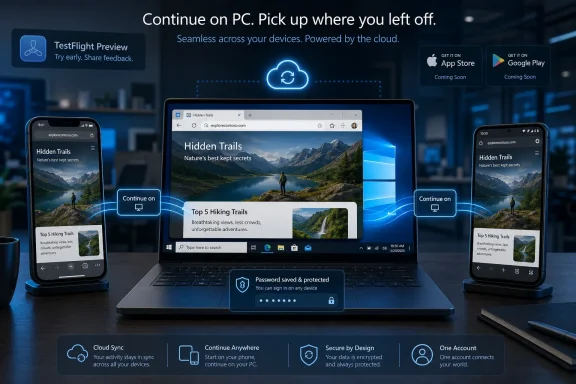
Microsoft announced on October 5, 2017 that Microsoft Edge would come to iOS and Android as preview apps, with iPhone testing through Apple’s TestFlight program immediately and Android testing to follow, giving Windows 10 users a way to sync browsing across phones and PCs. The move was less about winning the browser war overnight than admitting where the war had moved. Microsoft could no longer pretend that Windows alone was the center of personal computing. Edge on mobile was the company’s small but revealing concession that the Windows ecosystem now had to live inside someone else’s ecosystem.
The obvious joke in 2017 was that Microsoft had built a mobile browser for a desktop browser few people used. Chrome dominated PC browsing, Safari owned the privileged position on iPhone, and Android’s default gravity pulled users toward Google’s stack. Edge, born with Windows 10 in 2015 as the modern replacement for Internet Explorer, had not become the cultural reset Microsoft wanted.
But the joke missed the strategy. Edge for iOS and Android was not an attempt to make the smartphone browser market look like the Windows browser market of the 1990s. It was Microsoft trying to stitch together continuity after losing the phone.
That distinction matters. By 2017, Microsoft’s mobile operating system ambitions were effectively over as a mainstream consumer play. Windows Phone had failed to build enough user volume to keep developers invested, and Windows 10 Mobile was sliding into maintenance mode. In that world, shipping Edge on iPhone and Android was not a triumphant expansion. It was a pragmatic retreat with a product plan attached.
The company’s pitch was straightforward: if you used Edge on Windows 10, your favorites, reading list, passwords, and open pages should not stop at the edge of the PC. The headline feature, Continue on PC, allowed a user to send a page from phone to desktop, echoing Apple’s Handoff idea but aimed at people whose laptop was a Windows machine rather than a Mac. Microsoft was no longer selling the phone. It was selling the bridge.
On iOS, Microsoft faced Apple’s rules and Apple’s defaults. Third-party browsers could present different interfaces and sync services, but they still had to operate within Apple’s WebKit-based browser framework. On Android, Edge had more room but less natural advantage, because Chrome was not merely installed; it was tied to Google accounts, Google search, Google services, and Android’s own identity.
That meant Edge mobile was never going to win by rendering pages faster or by claiming a cleaner start page. Its value depended on whether a user cared enough about the Windows side of their life to install Microsoft’s browser on the phone side. That is a narrower audience than “everyone with a smartphone,” but it is not nobody.
For Windows enthusiasts and IT pros, the move was more interesting than the market-share punchline. Microsoft was trying to make Windows 10 feel less isolated in a world where the phone had become the primary device for many users. Edge was one piece of a larger pattern that included Office on iPad, Outlook on iOS and Android, OneDrive, Microsoft Launcher, and eventually deeper phone-to-PC integration through Windows itself.
A user might find a recipe, document, support page, shopping cart, or long article on a phone and want to continue on a larger screen. Apple solved that problem elegantly for users inside its own hardware world. Google solved a version of it through Chrome sync. Microsoft, lacking a successful mobile OS, needed to solve it from the outside.
That is why Edge on mobile was both modest and strategically loaded. The browser gave Microsoft a place to put identity, sync, and Windows-aware actions on devices it did not control. It could not force users into Edge the way it once bundled Internet Explorer into Windows, but it could make Edge useful enough for the subset of users who lived between a Windows PC and a non-Windows phone.
The preview also showed how much Microsoft’s platform thinking had changed under Satya Nadella. The old Microsoft tried to protect Windows by making other platforms feel incomplete. The new Microsoft tried to protect Windows by making it more useful when paired with other platforms. Edge mobile was one of the clearest consumer examples of that shift.
That created a brutal adoption problem. To use Edge on mobile, a person first had to care about Edge on Windows. Many Windows 10 users did not. Some used Chrome immediately after setting up a PC. Others stayed with Internet Explorer because of habit, enterprise compatibility, or internal web apps. Edge was stuck between the browser people remembered and the browser people installed.
This is why the “almost no one uses it” jab landed. Microsoft was trying to extend a browser ecosystem before proving that the ecosystem had meaningful pull on the desktop. Sync works best when the user already believes the product deserves to be present everywhere. Chrome had earned that. Edge had not.
Yet market-share snapshots can obscure platform positioning. Edge mobile did not need to convert the entire web to be worthwhile. It needed to give Microsoft a credible browser endpoint on the two mobile platforms that mattered, especially for users and organizations already tied to Microsoft accounts, Azure Active Directory, Office 365, and Windows management.
A company with a successful mobile OS can keep important experiences native to that OS. A company without one must distribute those experiences wherever users already are. Microsoft chose the latter path aggressively. Office, Outlook, Teams, OneDrive, Authenticator, SwiftKey, Remote Desktop, and later Copilot-era services all followed the same broad logic: Microsoft would meet users on Apple and Google platforms rather than wait for them to come back to Windows phones.
Edge fit into that pattern. It gave Microsoft a browser surface for account sync, enterprise policy, identity, search, and eventually security features. In consumer terms, that sounded like convenience. In enterprise terms, it sounded like manageability.
This is where the story becomes more important for WindowsForum readers than for casual smartphone users. A browser is not just a place to read websites. It is a policy endpoint, an authentication surface, a password manager, a PDF viewer, a phishing target, a data-loss channel, and a daily productivity shell. Once Microsoft accepted that employees would use iPhones and Android phones alongside Windows PCs, it needed Microsoft-controlled software on those devices.
That slow rollout made sense. Microsoft was not shipping a general-purpose mobile browser from a position of strength. It was testing whether Windows users wanted browser continuity badly enough to change phone habits. Preview programs are useful for bugs, but they are also useful for measuring desire.
The limited launch also let Microsoft avoid overpromising. Edge on iOS and Android could not be identical to Edge on Windows in the deepest technical sense. Apple’s platform rules and Android’s browser ecosystem meant Microsoft had to adapt the product to each OS. The promise was not “the same engine everywhere.” The promise was “the same Microsoft browsing experience where it counts.”
That difference would become even more significant later, when Microsoft rebuilt Edge around Chromium. In hindsight, the 2017 mobile preview looks like an early sign that Microsoft’s browser future would be less about defending a proprietary engine and more about owning the user experience, services layer, and enterprise control plane around the browser.
Chrome worked because it carried a Google identity across devices. Safari worked because it carried an Apple identity across hardware. Edge needed to carry a Microsoft identity across a world where Microsoft did not own the phone. That was the real premise of the mobile app.
Favorites and reading lists sound mundane, but they are sticky in aggregate. Passwords are stickier. Open tabs, history, collections, enterprise sign-in, and policy settings are stickier still. Every synced browser feature is a small argument against switching.
Microsoft’s challenge was that users had already made those choices elsewhere. A Windows user with an Android phone was likely already signed into Chrome. An iPhone user was likely already using Safari for enough tasks that adding Edge required a specific reason. Continue on PC was Microsoft’s attempt to create that reason.
The irony is that Microsoft had once been accused of using Windows to crush browser competition. Now it was trying to use a browser to keep Windows relevant in a computing life increasingly shaped by phones. The monopoly-era logic had inverted.
A company standardized on Microsoft 365 already had reasons to care. Employees were opening SharePoint links, Outlook messages, Teams resources, intranet pages, and line-of-business apps from phones. If those links opened in unmanaged browsers, IT had less control over data handling, authentication behavior, and security posture. A Microsoft browser on mobile could eventually become part of the answer.
That did not mean Edge mobile was enterprise-ready magic on day one. Preview apps are preview apps. But the direction was obvious. Microsoft wanted its browser to become a trusted endpoint across Windows, iOS, and Android, not merely the default icon on a Windows taskbar.
For administrators, the practical appeal would come later through policy, identity integration, app protection, and conditional access scenarios. But the 2017 launch laid the consumer-facing foundation. Before Microsoft could ask enterprises to standardize on Edge everywhere, Edge had to exist everywhere users actually worked.
But the framing also reflected the browser market as a popularity contest, which was only part of the story. Edge mobile was not merely a bid for browser share. It was a bid for continuity, account relevance, and Windows adjacency.
The phrase “the browser almost no one uses” worked because Edge had not won hearts on Windows. But Microsoft’s larger problem was not that Edge lacked fans. It was that Windows no longer defined the user’s whole day. The company needed software that could follow the user from desk to pocket and back again.
That is why the launch aged differently than the headline. Edge did not become a mobile juggernaut in the way Chrome is. But Microsoft’s decision to go where users were, rather than where Microsoft wished they were, became the company’s default survival strategy across consumer and enterprise software.
That thinking now feels ordinary because Microsoft has spent years reinforcing it. Phone Link, Microsoft Launcher, OneDrive camera backup, cross-device clipboard ideas, Authenticator sign-ins, and cloud-first Office workflows all rest on the same premise. Windows matters more when it cooperates with the devices people already own.
Edge was a browser, but it was also a diplomatic passport. It let Microsoft enter iOS and Android not as an operating-system rival, but as a service provider. That posture lacked the drama of Windows Phone’s old ambitions, but it was much more realistic.
The hard part was persuasion. Users do not install bridge software just because a vendor needs strategic coverage. They install it when it removes pain. Edge mobile’s fate therefore depended less on Microsoft’s need to be present and more on whether Continue on PC, sync, and later features made daily life noticeably easier.
In the old model, Windows features arrived through Windows releases. In the new model, Windows experiences increasingly depended on apps and cloud services running elsewhere. A Windows 10 PC became more useful because an iPhone or Android phone had Microsoft software installed.
That was uncomfortable for anyone raised on the idea of Windows as the center of the Microsoft universe. But it was also honest. Users had already chosen their phones. Microsoft’s choice was either to sulk outside the mobile gate or build useful tools inside it.
Edge for iOS and Android was Microsoft choosing the latter. It was not glamorous. It was not dominant. But it was strategically coherent in a way Windows Phone’s final years were not.
The launch also exposed the limits of that strategy. Cross-platform availability does not automatically create demand. Users already comfortable with Chrome or Safari needed a reason to switch, and Microsoft’s best reason was tied to Windows loyalty at a time when Windows loyalty was becoming more conditional.
Still, the preview mattered because it showed Microsoft thinking like a services company without entirely giving up on Windows. The browser became a bridge, and the bridge became the product. That idea would shape much of Microsoft’s next decade.
 Microsoft Takes Edge to the Platforms That Beat Windows
The obvious joke in 2017 was that Microsoft had built a mobile browser for a desktop browser few people used. Chrome dominated PC browsing, Safari owned the privileged position on iPhone, and Android’s default gravity pulled users toward Google’s stack. Edge, born with Windows 10 in 2015 as the modern replacement for Internet Explorer, had not become the cultural reset Microsoft wanted.But the joke missed the strategy. Edge for iOS and Android was not an attempt to make the smartphone browser market look like the Windows browser market of the 1990s. It was Microsoft trying to stitch together continuity after losing the phone.
That distinction matters. By 2017, Microsoft’s mobile operating system ambitions were effectively over as a mainstream consumer play. Windows Phone had failed to build enough user volume to keep developers invested, and Windows 10 Mobile was sliding into maintenance mode. In that world, shipping Edge on iPhone and Android was not a triumphant expansion. It was a pragmatic retreat with a product plan attached.
The company’s pitch was straightforward: if you used Edge on Windows 10, your favorites, reading list, passwords, and open pages should not stop at the edge of the PC. The headline feature, Continue on PC, allowed a user to send a page from phone to desktop, echoing Apple’s Handoff idea but aimed at people whose laptop was a Windows machine rather than a Mac. Microsoft was no longer selling the phone. It was selling the bridge.
The Browser Was the Wrong Battlefield, but the Right Signal
Mashable’s skepticism at the time was understandable. Edge’s desktop share was small, and Internet Explorer, supposedly the old browser being replaced, still had a stubborn presence on Windows PCs. Asking mobile users to add yet another browser to phones already shaped by Chrome and Safari looked like a hard sell.On iOS, Microsoft faced Apple’s rules and Apple’s defaults. Third-party browsers could present different interfaces and sync services, but they still had to operate within Apple’s WebKit-based browser framework. On Android, Edge had more room but less natural advantage, because Chrome was not merely installed; it was tied to Google accounts, Google search, Google services, and Android’s own identity.
That meant Edge mobile was never going to win by rendering pages faster or by claiming a cleaner start page. Its value depended on whether a user cared enough about the Windows side of their life to install Microsoft’s browser on the phone side. That is a narrower audience than “everyone with a smartphone,” but it is not nobody.
For Windows enthusiasts and IT pros, the move was more interesting than the market-share punchline. Microsoft was trying to make Windows 10 feel less isolated in a world where the phone had become the primary device for many users. Edge was one piece of a larger pattern that included Office on iPad, Outlook on iOS and Android, OneDrive, Microsoft Launcher, and eventually deeper phone-to-PC integration through Windows itself.
Continue on PC Was the Product, Edge Was the Wrapper
The most important feature in the preview was not a browser tab. It was the handoff. Microsoft understood that the moment of friction between phone and PC was becoming more important than the browser brand itself.A user might find a recipe, document, support page, shopping cart, or long article on a phone and want to continue on a larger screen. Apple solved that problem elegantly for users inside its own hardware world. Google solved a version of it through Chrome sync. Microsoft, lacking a successful mobile OS, needed to solve it from the outside.
That is why Edge on mobile was both modest and strategically loaded. The browser gave Microsoft a place to put identity, sync, and Windows-aware actions on devices it did not control. It could not force users into Edge the way it once bundled Internet Explorer into Windows, but it could make Edge useful enough for the subset of users who lived between a Windows PC and a non-Windows phone.
The preview also showed how much Microsoft’s platform thinking had changed under Satya Nadella. The old Microsoft tried to protect Windows by making other platforms feel incomplete. The new Microsoft tried to protect Windows by making it more useful when paired with other platforms. Edge mobile was one of the clearest consumer examples of that shift.
The Numbers Made the Launch Look Absurd
The browser market in 2017 was not kind to Microsoft. Chrome had already become the default mental model for the web: fast, synced, cross-platform, and backed by Google’s enormous services footprint. Safari had the iPhone’s home-field advantage. Firefox retained a loyal base. Edge, meanwhile, was still fighting the reputational debris left by Internet Explorer even though it was a different browser with a different engine.That created a brutal adoption problem. To use Edge on mobile, a person first had to care about Edge on Windows. Many Windows 10 users did not. Some used Chrome immediately after setting up a PC. Others stayed with Internet Explorer because of habit, enterprise compatibility, or internal web apps. Edge was stuck between the browser people remembered and the browser people installed.
This is why the “almost no one uses it” jab landed. Microsoft was trying to extend a browser ecosystem before proving that the ecosystem had meaningful pull on the desktop. Sync works best when the user already believes the product deserves to be present everywhere. Chrome had earned that. Edge had not.
Yet market-share snapshots can obscure platform positioning. Edge mobile did not need to convert the entire web to be worthwhile. It needed to give Microsoft a credible browser endpoint on the two mobile platforms that mattered, especially for users and organizations already tied to Microsoft accounts, Azure Active Directory, Office 365, and Windows management.
Microsoft’s Mobile Failure Became Its Cross-Platform Discipline
Edge for iOS and Android arrived in the shadow of Windows Phone’s defeat. That failure was not merely a consumer hardware story. It reshaped Microsoft’s software strategy.A company with a successful mobile OS can keep important experiences native to that OS. A company without one must distribute those experiences wherever users already are. Microsoft chose the latter path aggressively. Office, Outlook, Teams, OneDrive, Authenticator, SwiftKey, Remote Desktop, and later Copilot-era services all followed the same broad logic: Microsoft would meet users on Apple and Google platforms rather than wait for them to come back to Windows phones.
Edge fit into that pattern. It gave Microsoft a browser surface for account sync, enterprise policy, identity, search, and eventually security features. In consumer terms, that sounded like convenience. In enterprise terms, it sounded like manageability.
This is where the story becomes more important for WindowsForum readers than for casual smartphone users. A browser is not just a place to read websites. It is a policy endpoint, an authentication surface, a password manager, a PDF viewer, a phishing target, a data-loss channel, and a daily productivity shell. Once Microsoft accepted that employees would use iPhones and Android phones alongside Windows PCs, it needed Microsoft-controlled software on those devices.
The Preview Was Small Because the Strategic Turn Was Big
The preview launch was deliberately limited. iOS users in the Windows Insider Program could test through TestFlight, while Android users were told a preview would arrive through Google Play later. The initial experience focused on U.S. English, with broader language and regional availability to come.That slow rollout made sense. Microsoft was not shipping a general-purpose mobile browser from a position of strength. It was testing whether Windows users wanted browser continuity badly enough to change phone habits. Preview programs are useful for bugs, but they are also useful for measuring desire.
The limited launch also let Microsoft avoid overpromising. Edge on iOS and Android could not be identical to Edge on Windows in the deepest technical sense. Apple’s platform rules and Android’s browser ecosystem meant Microsoft had to adapt the product to each OS. The promise was not “the same engine everywhere.” The promise was “the same Microsoft browsing experience where it counts.”
That difference would become even more significant later, when Microsoft rebuilt Edge around Chromium. In hindsight, the 2017 mobile preview looks like an early sign that Microsoft’s browser future would be less about defending a proprietary engine and more about owning the user experience, services layer, and enterprise control plane around the browser.
The Old Browser War Was Over; the Account War Was Not
The first browser war was about default placement and web standards. The second was about speed, tabs, extensions, and search economics. By 2017, the more important fight was about accounts.Chrome worked because it carried a Google identity across devices. Safari worked because it carried an Apple identity across hardware. Edge needed to carry a Microsoft identity across a world where Microsoft did not own the phone. That was the real premise of the mobile app.
Favorites and reading lists sound mundane, but they are sticky in aggregate. Passwords are stickier. Open tabs, history, collections, enterprise sign-in, and policy settings are stickier still. Every synced browser feature is a small argument against switching.
Microsoft’s challenge was that users had already made those choices elsewhere. A Windows user with an Android phone was likely already signed into Chrome. An iPhone user was likely already using Safari for enough tasks that adding Edge required a specific reason. Continue on PC was Microsoft’s attempt to create that reason.
The irony is that Microsoft had once been accused of using Windows to crush browser competition. Now it was trying to use a browser to keep Windows relevant in a computing life increasingly shaped by phones. The monopoly-era logic had inverted.
For IT, Edge Mobile Was a Future Management Story
Consumer coverage naturally focused on whether ordinary users would download Edge. In business environments, the more interesting question was whether Microsoft could make Edge part of a managed cross-device workflow.A company standardized on Microsoft 365 already had reasons to care. Employees were opening SharePoint links, Outlook messages, Teams resources, intranet pages, and line-of-business apps from phones. If those links opened in unmanaged browsers, IT had less control over data handling, authentication behavior, and security posture. A Microsoft browser on mobile could eventually become part of the answer.
That did not mean Edge mobile was enterprise-ready magic on day one. Preview apps are preview apps. But the direction was obvious. Microsoft wanted its browser to become a trusted endpoint across Windows, iOS, and Android, not merely the default icon on a Windows taskbar.
For administrators, the practical appeal would come later through policy, identity integration, app protection, and conditional access scenarios. But the 2017 launch laid the consumer-facing foundation. Before Microsoft could ask enterprises to standardize on Edge everywhere, Edge had to exist everywhere users actually worked.
The Mashable Dunk Was Fair, but Incomplete
The Mashable piece captured the surface absurdity perfectly: Microsoft was bringing a low-share browser to mobile platforms where the incumbents were even stronger. That was a legitimate critique. Product strategy does not become good simply because it is cross-platform.But the framing also reflected the browser market as a popularity contest, which was only part of the story. Edge mobile was not merely a bid for browser share. It was a bid for continuity, account relevance, and Windows adjacency.
The phrase “the browser almost no one uses” worked because Edge had not won hearts on Windows. But Microsoft’s larger problem was not that Edge lacked fans. It was that Windows no longer defined the user’s whole day. The company needed software that could follow the user from desk to pocket and back again.
That is why the launch aged differently than the headline. Edge did not become a mobile juggernaut in the way Chrome is. But Microsoft’s decision to go where users were, rather than where Microsoft wished they were, became the company’s default survival strategy across consumer and enterprise software.
The Real Lesson Was Not About Edge at All
The Edge mobile preview was one of those launches that looked minor in the moment and more revealing in retrospect. It showed Microsoft accepting a world where the Windows PC remained important but no longer sovereign. The PC was now one screen in a constellation of screens, and Microsoft had to compete at the seams between them.That thinking now feels ordinary because Microsoft has spent years reinforcing it. Phone Link, Microsoft Launcher, OneDrive camera backup, cross-device clipboard ideas, Authenticator sign-ins, and cloud-first Office workflows all rest on the same premise. Windows matters more when it cooperates with the devices people already own.
Edge was a browser, but it was also a diplomatic passport. It let Microsoft enter iOS and Android not as an operating-system rival, but as a service provider. That posture lacked the drama of Windows Phone’s old ambitions, but it was much more realistic.
The hard part was persuasion. Users do not install bridge software just because a vendor needs strategic coverage. They install it when it removes pain. Edge mobile’s fate therefore depended less on Microsoft’s need to be present and more on whether Continue on PC, sync, and later features made daily life noticeably easier.
The Preview Marked the End of Windows as an Island
The most concrete way to understand the 2017 Edge mobile launch is to see it as a Windows feature shipped through mobile app stores. Microsoft could not update iOS or Android, but it could ship an app that made Windows feel less cut off from them. That is a subtle but important inversion.In the old model, Windows features arrived through Windows releases. In the new model, Windows experiences increasingly depended on apps and cloud services running elsewhere. A Windows 10 PC became more useful because an iPhone or Android phone had Microsoft software installed.
That was uncomfortable for anyone raised on the idea of Windows as the center of the Microsoft universe. But it was also honest. Users had already chosen their phones. Microsoft’s choice was either to sulk outside the mobile gate or build useful tools inside it.
Edge for iOS and Android was Microsoft choosing the latter. It was not glamorous. It was not dominant. But it was strategically coherent in a way Windows Phone’s final years were not.
A Small Browser Preview Carried a Large Admission
The Edge mobile preview should be remembered less as a browser launch than as a confession about platform power. Microsoft had to put Edge on iOS and Android because the phone market had moved beyond Windows, and because the browser had become one of the few practical ways to preserve continuity across devices.The launch also exposed the limits of that strategy. Cross-platform availability does not automatically create demand. Users already comfortable with Chrome or Safari needed a reason to switch, and Microsoft’s best reason was tied to Windows loyalty at a time when Windows loyalty was becoming more conditional.
Still, the preview mattered because it showed Microsoft thinking like a services company without entirely giving up on Windows. The browser became a bridge, and the bridge became the product. That idea would shape much of Microsoft’s next decade.
The Practical Read for Windows Users Is Less Cynical Than the Headline
For Windows users in 2017, the Edge mobile preview was worth viewing through a practical lens rather than a tribal browser lens.- Microsoft released the Edge mobile preview for iOS first through TestFlight on October 5, 2017, with Android preview access planned through Google Play afterward.
- The main selling point was cross-device continuity, especially the ability to send a page from phone to Windows 10 PC using Continue on PC.
- Edge mobile entered markets already dominated by Chrome on Android and Safari on iOS, so mass adoption was always an uphill fight.
- The launch made more strategic sense as part of Microsoft’s broader shift away from Windows Phone and toward first-party apps on rival mobile platforms.
- For IT departments, the long-term significance was not consumer browser share but the possibility of a managed Microsoft browsing endpoint across Windows, iOS, and Android.
- The preview foreshadowed Microsoft’s later browser strategy: compete less through a proprietary rendering engine and more through sync, identity, enterprise controls, and Windows integration.
References
- Primary source: Mashable
Published: 2026-06-09T17:20:11.969100
Microsoft launches mobile preview for Edge, the browser no one uses | Mashable
Microsoft introduces a Microsoft Edge preview app for iOS, with Android forthcoming, finally bringing the little-used browser to mobile devices.mashable.com - Official source: blogs.windows.com
Microsoft Edge now available for iOS and Android (Updated)
3/26/18, 9AM PT: iPad and Android tablet owners – we’ve got some great news for you! Microsoft Edge is now available as a free download in the Apple Store and Google Play Store. Now, you too, can experience familiar features like your Favorites (including Roaming Favorites), Reading List, New... blogs.windows.com
- Related coverage: macrumors.com
Microsoft's Edge Browser Coming to iPhone With 'Continue on PC' Feature
Microsoft today announced that its Edge web browser is coming to iOS, starting with a beta version for iPhone available today. Microsoft Edge will...www.macrumors.com - Related coverage: techspot.com
Microsoft Edge comes to Android and iOS devices for Windows Insiders | TechSpot
While Microsoft's Edge browser might be trailing well behind the likes of Chrome and Firefox in terms of overall popularity and market share, the company is still...www.techspot.com - Related coverage: techcrunch.com
Microsoft is bringing its Edge browser to Android and iOS | TechCrunch
While Microsoft is still officially working on the mobile version of Windows 10, it's no secret that the company has all but given up on building its owntechcrunch.com - Related coverage: androidcentral.com
Microsoft Edge officially launches on Android | Android Central
Following weeks of testing, Microsoft has officially launched its Microsoft Edge mobile apps for iOS and Android.www.androidcentral.com
- Related coverage: windowscentral.com
Microsoft Edge leaves beta on Android | Windows Central
Microsoft Edge for Android has dropped its "Unreleased" tag, indicating its exit from beta testing.www.windowscentral.com - Related coverage: gizmochina.com
Microsoft Edge’s iOS and Android Version Arriving Soon, Preview Version Now Available - Gizmochina
Microsoft has released a preview version of its Edge browser for iOS and Android smartphones. The preview version is now available as a beta testing program for users who have subscribed as Windows Insiders. Microsoft Edge has a cleaner interface and works fast with HTML5 content. It includes a... www.gizmochina.com
- Related coverage: axios.com
Microsoft officially surrenders on Windows Phone
A top executive says the company plans to fix bugs and security issues, but doesn't plan new features for the phone version of Windows 10.www.axios.com
- Official source: cdn-dynmedia-1.microsoft.com
- Official source: news.microsoft.com
Microsoft Connect 2016 Fact Sheet
</rdf:Alt> </dc:description> <dc:creator> <rdf:Seq> <rdf:li>Achim Dettweilernews.microsoft.com
