

Microsoft's sudden reorientation around Anthropic — and the flurry of compute commitments, co‑engineering deals and product integrations that followed — is not just another partnership announcement; it's a strategic pivot that reshapes how Microsoft intends to defend and expand its lead in enterprise AI. The company has moved quickly to embed Anthropic’s Claude family inside Azure, Microsoft Foundry and the Copilot stack while coordinating with NVIDIA on hardware optimizations and agreeing to capital and capacity commitments large enough to alter hyperscale economics. ])
Microsoft’s AI strategy has long been anchored by a major relationship with OpenAI, extensive in‑house model work, and an aggressive push to fold generative AI into Windows, Microsoft 365 and developer tools. That position looked secure until challengers like Anthropic began offering frontier models that enterprise buyers found attractive for particular tasks — long‑context reasoning, safety‑sensitive workflows and agentic automation. In response, Microsoft has broadened its sg model choice into a competitive product feature for Azure and its Copilot offerings.
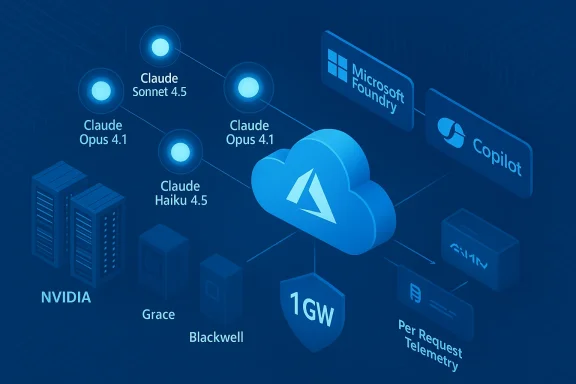
In November 2025 Microsoft, NVIDIA and Anthropic announced a multi‑layered set of arrangements: Anthropic committed to purchase large blocks of Azure compute capacity (widely reported as $30 billion in aggregate), agreed to be routable through Microsoft Foundry and Copilot surfaces, and will cooperate with NVIDIA to optimize Claude for next‑generation GPU architectures. As part of the package, NVIDIA and Microsoft announced staged investment commitments in Anthropic — reported as up to $10 billion and up to $5 billion respectively. The parties also disclosed an initial plan to contract dedicated capacity up to one gigawatt for Anthropic workloads. Those headline numbers and product placements were documented in company posts and broadly reported across the trade press.
The fundamental takeaway for WindowsForum readers is this: the enterprise AI era is entering a phase where model selection is a product feature and compute capacity is a strategic bargaining chip. Organizations that move fast to harden telemetry, DLP and governance will capture the productivity upside; those that don’t risk surprise exposures and fractured audit trails. The announcements are verifiable and significant — but they are also the opening moves of a longer game. Treat the partnership’s headline numbers as directional commitments, follow the contracts and telemetry closely, and make governance the default path to adoption.
Source: The Information Microsoft Moves to Respond to New Threats From Anthropic
 Background
Microsoft’s AI strategy has long been anchored by a major relationship with OpenAI, extensive in‑house model work, and an aggressive push to fold generative AI into Windows, Microsoft 365 and developer tools. That position looked secure until challengers like Anthropic began offering frontier models that enterprise buyers found attractive for particular tasks — long‑context reasoning, safety‑sensitive workflows and agentic automation. In response, Microsoft has broadened its sg model choice into a competitive product feature for Azure and its Copilot offerings.In November 2025 Microsoft, NVIDIA and Anthropic announced a multi‑layered set of arrangements: Anthropic committed to purchase large blocks of Azure compute capacity (widely reported as $30 billion in aggregate), agreed to be routable through Microsoft Foundry and Copilot surfaces, and will cooperate with NVIDIA to optimize Claude for next‑generation GPU architectures. As part of the package, NVIDIA and Microsoft announced staged investment commitments in Anthropic — reported as up to $10 billion and up to $5 billion respectively. The parties also disclosed an initial plan to contract dedicated capacity up to one gigawatt for Anthropic workloads. Those headline numbers and product placements were documented in company posts and broadly reported across the trade press.
What changed — the mechanics of the deal
Key, verifiable facts
- Anthropic will scale its Claude models on Microsoft Azure; Claude Sonnet 4.5, Claude Opus 4.1 and Claude Haiku 4.5 are named as initial frontier variants available through Microsoft Foundry and to be routable inside Copilot family surfaces.
- Anthropic’s compute commitment is reported at approximately $30 billion of Azure capacity, with an option to contract additional dedicated capacity up to one gigawatt. This framing—reported in company announcements and the press—captures the scale but should be read as a multi‑year procurement commitment rather than a one‑time cash transfer.
- NVIDIA will enter a co‑engineering partnership with Anthropic to optimize models for NVIDIA Grace/Blackwell and Vera Rubin systems; the chipmaker also pledged staged investment capital to Anthropic. Microsoft likewise signaled capital commitments and product distribution arrangements.
Numbers that matter — and what they actually mean
The oft‑quoted "$30 billion" figure reflects an aggregate compute purchase commitment over multiple years. It’s a procurement and capacity planning signal — giving Microsoft demand visibility, Anthropic guaranteed access to cloud resources, and NVIDIA clearer workloads to design for. The “up to one gigawatt” phrasing signals potential scale rather than immediate deployment: a gigawatt of datacenter power reserved for accelerators implies wholesale datacenter design choices, multi‑region capacity planning and long procurement lead times for racks and power infrastructure. Treat these as strategic posture statements with operational implications, not a single cash transfer.Why Microsoft moved — competitive analysis
Diversificationsoft’s single‑biggest strategic imperative in AI now is choice. Enterprises want to pick the right model for the job, backed by consistent governance, billing and identity controls. Adding Anthropic to Azure and embedding Claude in Copilot reduces single‑vendor risk and strengthens Microsoft’s pitch that Azure is the neutral, enterprise‑grade place to run “multiple frontier models.” The move is defensive and offensive: it defends Microsoft’s customers from going elsewhere for model choice, and it gives Microsoft a new lever to win customers who prefer Claude’s behavioral profile for certain tasks.
Securing capacity and supply chain leverage
Hyperscale AI is, at its core, an infrastructure race. Securing predictable demand helps Microsoft amortize the enormous upfront capital required for purpose‑built AI campuses and scale GPU procurement. For Anthropic, long‑term cloud commitments avoid the need to own all infrastructure while guaranteeing access to the specialized hardware necessary for training and inference. NVIDIA benefits too: predictable demand for its next‑gen platforms justifies R&D and supply chain commitments. The three‑way alignment reduces allocation risk in a market where demand for accelerators still exceeds supply.A tactical response to Anthropic’s momentum
Anthrs been gaining traction for enterprise use cases where safety, long‑context reasoning and tailored instruction alignment matter. For Microsoft, the risk was that Anthropic would become a preferred vendor inside enterprise stacks built on competing clouds or cause customers to fragment across multiple cloud providers. By routing Claude through Azure and Microsoft tools, Microsoft converts a potential competitive threat into an integrated option that still keeps data governance and control within the Microsoft administration surfaces. The Information’s reporting framed this as Microsoft “racing to respond” — shifting from being solely an integrator of OpenAI to a multi‑model orchestration platform.Product and developer implications
Claude inside Microsoft Foundry and Copilot
Making Claude available in Microsoft Foundry and Copilot means enterprise developers and admins will be able to deploy, govern and monitor Anthropic models without leaving the Azure/Microsoft product ecosystem. That reduces procurement friction and simplifies compliance for customers who already rely on Entra identity, Azure billing and Microsoft’s DPA comfort. For developer velocity, Anthropic’s Claude Code and Sonnet series aim to be competitive with other code‑generation agents and are being used internally at Microsoft for rapid prototyping and engineering support.Developer tooling and engineering workflows
Expect more model‑selection features in development environments and CI/CD pipelines: teams will be able to pick Claude for long‑context tasks, OpenAI models for certain completion tasks, or proprietary models for other workloads. This introduces complexity in testing, monitoring and cost attribution — enterprises will need per‑request telemetry and provenance to answer: which model handled a request, which data sources were used, and what was the latency and cost outcome? Microsoft’s enterprise documentation and early analyst guidance flag those governance requirements as top priorities.Security, privacy and compliance: the friction points
Data flows and subprocessors
Routing Anthropic models through Microsoft surfaces creates opera where inference and transient processing occur. In some implementations Anthropic may be a Microsoft subprocessor, but inference could run on Anthropic’s ore. This matters for GDPR, cross‑border transfer rules and local‑law compliance. Enterprises in the EU, EFTA and UK must external processing chain until legal contracts and data boundary assurances are crystal clear. Microsoft’s documentation and independent analys to verify DPA coverage and per‑request telemetry.Practical governance checklist for IT teams
Security and compliance teams should act on several immediate steps:- Inventory Copilot‑enabled surfaces and map which tenant data sources (mailboxes, SharePoint, OneDrive, Teams) may be routed to external models.
- Require per‑request model provenance and logs: model ID/provider, input sources, timestamps, latency and cost. Ingest these logs into SIEM for audits.
- Update DLP, classification and redaction to sanitize regulated content before model calls leave tenant boundaries.
- Validate Microsoft’s subprocessor commitments in writing for your tenant and region; escalate to account teams when answers are ambiguous.
Economic and market effects
Cost structures change
A federated model ecosystem introduces new billing patterns: model selection affects marginal inference cost, latency, and feature behavior. Finance teams should expect shifting invoices and the need to reconcile multi‑vendor charges that flow through Azure’s billing systems or Microsoft Foundry routes. Long‑term compute commitments can smooth pricing but also lock customers into supplier economics that are hard to unwind.Channel and competitive dynamics
Microsoft’s channel partners and ISVs gain the ability to resell or embed Anthropic‑powered features through Azure and the Marketplace. That broadens go‑to‑market options for software vendors, but it also means the competitive playing field shifts: companies that had built proprietary integrations with one model vendor now must manage multi‑model compatibility or risk commoditization. Microsoft positions this as an opportunity for partners to differentiate on governance and vertical‑specific integrations rather than raw model performance.Strategic risks and open questions
1) Regulatory and antitrust attention
Large strategic investments and capacity commitments across the chip‑cloud‑model triangle could trigger regulatory scrutiny in multiple jurisdictions. Investments by hyperscalers into frontier model vendors may be framed as anti‑competitive if they meaningfully restrict access for rivals or foreclose future entrants. Companies involved will need to document that multi‑cloud availability and neutral access remain preserved. This is a real but not immediate regulatory certainty; it’s a risk worth tracking.2) Dependence on third‑party hardware supply
The entire plan assumes timely delivery of next‑generation accelerators and rack‑scale systems. Supply chain disruptions, power‑purchase delays or permitting issues for data centers could slow Claude’s effective scaling on Azure, producing unmet customer SLAs. NVIDIA’s co‑engineering commitment reduces but does not eliminate that supply risk.3) Enterprise trust and auditability
Even if Claude runs on Azure, enterprises will demand auditable per‑request logs and consistent behavior. Different models produce stylistic and factual variations that can affect regulated workflows. Without strong observability, risk‑averse industries (finance, healthcare, regulated public sector) may delay adoption or require on‑premises alternatives. Microsoft documentation and independent advisories highlight the need for robust per‑request telemetry and policy enforcement.4) Product and cultural coordination inside Microsoft
Embedding an external model deeply into Microsoft product stacks creates product management and cultural friction. Engineering teams must decide where to use Claude versus internal models or OpenAI offerings. Internal usage experiments at Microsoft show Claude Code being rolled across engineering teams, suggesting active internal vetting — but broad internal adoption must be harmonized with customer messaging and long‑term product roadmaps.The broader competitive landscape
OpenAI, Google and AWS reactions
Microsoft’s partnership with Anthropic does not end rather it creates a multi‑model strategy that includes OpenAI, Anthropic, and other vendors. Google continues to push its own models and TPU hardware, with broad integration across Google Cloud and Workspace. AWS competes with Bedrock and its own chip strategy. The re hyperscalers assemble multiple model suppliers and emphasize governance, SLAs and integration as their battlegrounds — noacy. Industry reporting underscores this trend toward multi‑vendor, multi‑cloud options for enterprise customers.Is Anthropic a “threat” to Microsoft?
Anthropic is a threat in the sense that it forced Microsoft to widen its supplier set and accelerate product integration; but Anthropic is also now a partner. The real competitive tension exists between model owners (Anthropic, OpenAI, Google, Meta) and cloud providers (Microsoft, AWS, Google Cloud) racing to offer the best packaged, governed enterprise experience. Microsoft’s move converts a potential external threat into a strategic asset inside Microsoft’s commercial and engineering fold — at the cost of increased complexity and new governance responsibilities.Practical takeaways for IT leaders and WindowsForum readers
- Immediately audit Copilot and Foundry configurations in your tenants. Confirm whether Anthropic models are toggled on by default in your region and disable if you require time for legal review.
- Demand per‑request telemetry and model provenance; ingest logs into your SIEM and retention systems for compliance. sification and redaction policies to sanitize regulated content before model requests leave the tenant.
- Revisit procurement and budgeting to account for multi‑model inference costs and potential cross‑cloud egress or marketplace surcharges.
- Monitor operational capacity assurances and SLAs. Large capacity commitments can signal long procurement windows; ensure your runbook accounts for hardware or power delays.
Strengths and opportunities
- Model choice at scale: Enterprises gain practical access to multiple frontier models under unified governance — a major usability and procurement win.
- Supply visibility: Anthropic’s compute commitment gives Microsoft and NVIDIA longer sight lines for capacity planning, smoothing investment cycles.
- Faster product integration: Embedding Claude in Copilot and Foundry reduces friction for enterprises hoping to test alternative model behaviors without rearchitecting their governance stacks.
Risks and weaknesses
- Operational complexity: Multi‑model routing increases surface area for security, auditing and cost management failures.
- Regulatory exposure: Large investments and exclusive routing language could draw antitrust attention in some jurisdictions; contracts must be transparent.
- Supply chain dependency: The plan assumes timely hardware delivery and datacenter builds; delays will erode promised benefits.
Conclusion
Microsoft’s rapid pivot to embrace Anthropic — combined with NVIDIA’s hardware cooperation and the headline compute commitments — is a decisive strategic answer to a shifting model landscape. It reframes Microsoft as a multi‑model orchestration platform for enterprises, one that offers choice at the edges of its productivity stack while retaining governance and billing centrality. For IT leaders, the news promises richer tooling and competitive leverage, but it also raises immediate governance, compliance and operational challenges that must be treated as first‑class concerns.The fundamental takeaway for WindowsForum readers is this: the enterprise AI era is entering a phase where model selection is a product feature and compute capacity is a strategic bargaining chip. Organizations that move fast to harden telemetry, DLP and governance will capture the productivity upside; those that don’t risk surprise exposures and fractured audit trails. The announcements are verifiable and significant — but they are also the opening moves of a longer game. Treat the partnership’s headline numbers as directional commitments, follow the contracts and telemetry closely, and make governance the default path to adoption.
Source: The Information Microsoft Moves to Respond to New Threats From Anthropic
