

Microsoft has rolled out an Employee Self-Service Agent across more than 300,000 employees and vendors in 103 countries and regions, using Microsoft 365 Copilot and Copilot Studio to route IT, HR, and campus-services questions through a single chat-based support front door. The achievement is less interesting as a chatbot success story than as a stress test for the next enterprise operating model. Microsoft is arguing, by example, that internal support can be rebuilt around agents — but its own rollout shows that AI does not remove complexity so much as relocate it. The future of service desk automation is not a smarter prompt; it is a better-governed organization.
The pitch sounds deceptively simple. Instead of asking employees to remember whether a problem belongs in an IT portal, an HR site, a facilities request system, a benefits page, or a regional policy library, Microsoft wants them to ask one agent and let the system figure out the route.
That is the clean version of the story, and it is the one every CIO wants to hear. Support fragmentation is one of those dull enterprise problems that drains productivity precisely because nobody wants to own it. A new hire cannot find the right policy. A traveling employee needs local access guidance. A manager wants to resolve a device issue without opening a ticket and waiting in a queue.
Microsoft’s Employee Self-Service Agent is designed to collapse those moments into a conversational interface inside the Microsoft 365 Copilot ecosystem. It is built in Copilot Studio, grounded in internal knowledge sources, and configured to return content based on role, geography, and language. In Microsoft’s own deployment, the agent became the first contact point for a huge global workforce before the product moved into broader customer availability.
That last part matters. Microsoft is not merely selling an abstract agentic future to customers; it is trying to show that it has used the same medicine internally. The company’s “Customer Zero” framing is familiar, but in this case it is useful. Microsoft’s internal IT organization had to deal with the same ugly operational terrain its customers face: inconsistent knowledge articles, country-specific rules, language gaps, uneven adoption, and employees who lose trust quickly when the first answer is wrong.
The result is a case study with two readings. The optimistic reading is that AI support agents can meaningfully reduce dependence on human-run channels. The more sober reading is that agents amplify the quality — and the deficiencies — of the enterprise knowledge estate behind them.
The agent model changes that bargain. The employee types a question in natural language, and the system is expected to infer intent, retrieve the right source, and either answer the question or move the interaction toward resolution. In theory, the user no longer needs to know where support lives.
That is why Microsoft’s “front door” language is more than branding. In enterprise support, the front door determines trust. If the first interface is reliable, employees come back. If it is confidently wrong, they route around it, tell colleagues not to bother, and return to phone, email, web forms, or the one person in IT who always knows the answer.
The stakes are higher with HR and local policy than with a basic password reset. An incorrect answer about device enrollment is annoying. An incorrect answer about leave, benefits, employment rules, or workplace access in a particular country can create real operational and legal risk. Microsoft’s Europe North rollout exposed exactly that problem: when local content was missing, the agent could fall back to policies from the United States or other unrelated countries.
That is the uncomfortable lesson hiding inside the success story. Generative AI makes the support experience feel universal, but enterprise policy is stubbornly local. A global interface that cannot respect local truth is not a simplification; it is a new failure mode.
Then came Europe North, a region spanning 21 countries with different languages, labor policies, HR practices, and IT support realities. This was where the agent stopped being a demo of conversational convenience and became a test of organizational fidelity.
Smaller markets are often where enterprise systems reveal their bias. They may have fewer locally maintained knowledge articles, less polished documentation, and more exceptions hidden in the memories of regional experts. A conventional portal can obscure that problem because users already expect to dig. A conversational agent surfaces it immediately because the system appears to promise a direct answer.
Microsoft’s own account of the rollout acknowledges that the agent sometimes served geographically wrong content when the correct local material was absent or improperly tagged. That is not a model hallucination in the cartoon sense. It is a knowledge-management failure expressed through an AI interface.
The distinction matters for IT leaders. Many organizations still talk about AI accuracy as if it can be tuned primarily through model selection, prompt engineering, or stricter guardrails. Those things matter, but they do not substitute for policy hygiene. If the source material is incomplete, stale, mislabeled, or globally generic, the agent will inherit the organization’s disorder and deliver it with a smoother voice.
Microsoft says the Employee Self-Service Agent was grounded in roughly 250,000 vetted knowledge base articles and 15 to 20 internal SharePoint sites containing policies, guidelines, how-to content, and related support material. That sounds like a large corpus, but size is not the same as readiness. A quarter-million articles can be an asset or a swamp.
The Europe North remediation work focused on country-level tagging, tighter scoping of sources, correction of mismatched articles, and closure of content gaps. That is classic knowledge-management labor, not magic. It is also the part of AI transformation that executives like least because it looks less like innovation and more like cleaning the garage.
But in a support agent, this back-end work is the product. The model may provide the conversational wrapper, but the answer quality depends on whether the system retrieves the right policy, in the right language, for the right employee, in the right country, at the right moment. That requires metadata discipline, ownership, review cycles, and a way to process feedback when users flag bad answers.
This is where the agentic hype cycle runs into enterprise reality. The word agent suggests autonomy. Microsoft’s rollout suggests something more conditional: agents can act only as far as the organization has prepared the ground beneath them.
The company formed an adoption advisory team with representatives from major countries and business divisions. It used local field representatives to report where the agent was succeeding, where it was missing local context, and where language quality undermined confidence. It also gathered thousands of feedback instances from employees before treating the deployment as mature.
That model is important because support behavior is habitual. Employees do not switch from a known channel to a new one because a tool exists. They switch because the new channel solves a real problem faster, or because trusted colleagues tell them it works.
Microsoft’s internal advocates pushed the agent through Viva Engage communications, targeted readiness sessions, all-hands meetings, and scenario-led examples. One campaign used an Advent calendar format to introduce employees to practical use cases one at a time. That detail may sound quaint, but it points to a serious adoption principle: AI tools do not become useful in the abstract. They become useful when workers recognize themselves in the scenario.
The company’s own language around adoption is telling. The goal was not simply to drive usage, but to help employees understand when the agent was the right front door. That is a subtle but crucial difference. Overpromising an agent is a fast way to destroy trust; teaching its best-fit scenarios gives it room to succeed.
Those metrics still matter, but agentic support introduces a new dimension: confidence. If the first answer is good enough, the user does not open a ticket. If the first answer is incomplete but the next step is clear, the user may still trust the system. If the agent is wrong in a sensitive area, the user may never return.
Microsoft says that in Europe North, Employee Self-Service Agent usage rose to account for more than half of all support interactions after six months, while legacy chatbot usage and traditional phone, email, and web support declined. That is the kind of metric every support leader wants. It suggests the agent was not merely adding a new channel, but displacing older ones.
Still, displacement is not the same as success. A company can reduce tickets by discouraging employees from filing them, burying escalation paths, or pushing users into a dead-end bot. Microsoft’s more credible claim is that ticket reduction must be tied to a better user experience. The company’s stated ambition is to reduce human-led support tickets by 40 percent over the long term, but the meaningful benchmark is whether employees get faster, more accurate answers without feeling abandoned.
That is where escalation remains essential. Microsoft is not claiming the agent eliminates human support. If the first contact does not resolve the issue, people are still available. In a mature deployment, the AI front end should not be a wall; it should be a triage layer that preserves context and hands off gracefully.
A human-led, agent-operated support model does not remove management. It changes what management manages. Instead of supervising only queues and staff capacity, leaders must manage data quality, source authority, permission boundaries, agent behavior, feedback loops, and exception handling.
This is a substantial shift for IT departments. The service desk has often been treated as a cost center, optimized through outsourcing, scripting, deflection, and self-service portals. Agentic AI gives the support function a more strategic role because the support interface becomes a map of how well the organization understands itself.
If an employee asks about maternity leave in Denmark, device replacement in Finland, campus access in Ireland, or a role-specific internal tool in the Netherlands, the agent’s answer is a test of enterprise coherence. Does the company know which policy applies? Does the content owner keep it current? Can the identity system determine eligibility? Can the agent distinguish local guidance from global defaults?
Those are not merely technical questions. They are governance questions. Microsoft’s deployment suggests that the organizations most likely to benefit from support agents are not the ones with the flashiest AI pilots, but the ones willing to modernize the unglamorous machinery of internal knowledge.
Bad inheritance creates bad outcomes. A device gets the wrong configuration because it sits in the wrong group. A user sees the wrong app because licensing or targeting was misapplied. A help article answers the wrong question because its scope was never defined. The same principle applies to AI agents, only now the failure is wrapped in a fluent response.
Country-level tagging in Microsoft’s rollout is the AI-support equivalent of sane targeting in endpoint management. Without it, the agent’s retrieval layer can drift toward the most available or most dominant content. In a U.S.-centric company, that often means U.S. policy becomes the implicit default for everyone else.
That is why localization is not just translation. Translating the wrong policy into another language does not make it correct. The support agent must know which policy applies, which employee attributes matter, which content source is authoritative, and when the safest answer is to escalate.
Sysadmins have lived this truth for decades. Automation is wonderful when the inputs are clean and the scope is precise. Automation at global scale becomes dangerous when “everyone” secretly means “everyone except the cases we forgot to model.”
Those are necessary controls, but they are only the starting line. A support agent that touches HR, IT, and facilities sits near sensitive internal workflows. It may expose policy information, trigger requests, initiate handoffs, or guide users through troubleshooting steps that involve identity, device state, or access entitlements.
The security question is therefore not simply, “Can the agent access the data?” It is, “Should this user, in this context, receive this answer or initiate this action?” That is harder because support scenarios blend information retrieval with process automation.
Consider the difference between telling an employee how to request access and actually starting the access flow. The former is content delivery. The latter is operational authority. The more agents move from answering to doing, the more they resemble privileged enterprise applications.
Microsoft’s broader agent ecosystem is moving in that direction. Copilot Studio is no longer just a chatbot builder; it is part of a platform for creating agents that connect to business systems. That makes governance non-negotiable. The support agent must be managed like production software, not like an experimental bot hidden in a team site.
Legacy chatbots often failed because they were too rigid. They depended on predefined intents, brittle dialog flows, and users phrasing questions in just the right way. When they worked, they were efficient. When they failed, they produced the familiar loop of irrelevant suggestions and “Did this answer your question?” prompts.
Generative agents improve that interaction because they handle language more flexibly and can synthesize answers across sources. But the Microsoft case shows that flexibility alone does not solve the enterprise support problem. The agent still needed source grounding, local tagging, feedback triage, and adoption work.
The better comparison, then, is not old bot versus new bot. It is scripted deflection versus governed retrieval and action. The former tries to keep users away from humans. The latter tries to solve the user’s issue at first touch while preserving a path to human help.
That distinction will determine whether employees embrace these systems or treat them as another corporate obstacle. If the agent feels like a cost-cutting gatekeeper, users will resent it. If it feels like the fastest competent colleague in the building, they will use it.
But the labor does not disappear. It changes shape. Humans who previously answered recurring questions may now maintain the knowledge base, review flagged responses, monitor analytics, tune workflows, and handle escalations that are more complex because the easy issues were resolved earlier.
That can be a good trade. Service desk work is often burdened by repetitive, low-complexity requests that machines can handle well if the source material is trustworthy. Removing that load can make human support more meaningful.
It can also create new pressure. If leadership treats agent deployment as an excuse to cut staff before the knowledge and governance layers are mature, the system will degrade. Bad answers will accumulate. Employees will lose trust. The remaining human agents will inherit messier cases with less context and more frustration.
The durable economic case is not “replace support with AI.” It is “move routine resolution closer to the employee while investing in the machinery that keeps answers correct.” Microsoft’s internal rollout supports the second argument far more than the first.
That should temper expectations. A company cannot buy Microsoft’s internal maturity by enabling a template. It can buy a platform and a pattern. The hard work remains local.
Every organization will have its own version of Europe North. It may be a multilingual region, a unionized workforce, a regulated business unit, a recently acquired subsidiary, a split between frontline and knowledge workers, or a messy estate of old ticketing categories. The places where policy and practice diverge are where the agent will struggle first.
This is why pilots should not be designed only around friendly headquarters users. A successful pilot should include complexity on purpose. Put the agent in front of regions with different rules, departments with different jargon, and support categories where the existing content is known to be uneven. The goal is not to make the pilot look good. The goal is to find the content fractures before the whole company does.
Microsoft’s staged rollout is instructive here. Start where the surface area is manageable, expand into harder regions, collect feedback aggressively, and treat incorrect answers as signals about the knowledge system. That is slower than a big-bang launch, but it is how trust survives contact with reality.
The source article notes that the agent serves geographically relevant and role-specific content. That combination is where the promise becomes powerful. An employee should not have to decode whether a policy applies to full-time staff, vendors, managers, engineers, sales employees, or campus-based workers. The system should know enough context to narrow the answer safely.
But context is also where privacy and permission design become delicate. The more personalized the agent becomes, the more it depends on identity signals and enterprise data. Employees may accept that trade if the result is useful and transparent. They will be less forgiving if the agent appears to expose information it should not, or if it makes assumptions that feel opaque.
The best support agents will likely behave like careful administrators. They will use identity and context to narrow the answer, cite the internal source inside the experience, explain when a policy is local, and escalate when the situation depends on facts the system cannot verify. The worst will behave like overconfident generalists.
Microsoft’s emphasis on trusted, IT-approved sources and feedback loops points in the right direction. But for customers, the implementation details will decide whether the agent becomes a trusted service layer or a compliance headache.
That is why the Europe North story is more valuable than a sanitized launch announcement. It shows the agent failing in predictable ways when local content was missing and improving when Microsoft fixed the underlying content model. It shows adoption depending on field representatives and contextual communication, not just executive sponsorship. It shows ticket reduction as a user-experience outcome, not merely a financial target.
For IT leaders, the lesson is blunt: do not start with the chatbot. Start with the questions employees actually ask, the channels they currently use, the policies that vary by location, and the content nobody has touched in three years. Then decide where an agent can create a better first touch.
The companies that skip this work may still deploy agents. They may even show early usage. But usage generated by novelty is fragile. Trust generated by accurate resolution is durable.
Source: Microsoft Transforming IT support across Microsoft with the Employee Self-Service Agent - Inside Track Blog
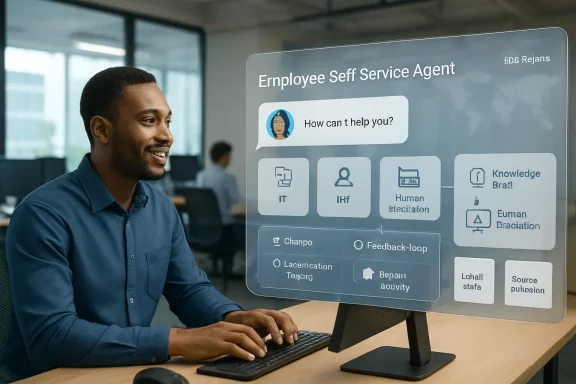 Microsoft Turns the Help Desk Into an AI Proving Ground
The pitch sounds deceptively simple. Instead of asking employees to remember whether a problem belongs in an IT portal, an HR site, a facilities request system, a benefits page, or a regional policy library, Microsoft wants them to ask one agent and let the system figure out the route.That is the clean version of the story, and it is the one every CIO wants to hear. Support fragmentation is one of those dull enterprise problems that drains productivity precisely because nobody wants to own it. A new hire cannot find the right policy. A traveling employee needs local access guidance. A manager wants to resolve a device issue without opening a ticket and waiting in a queue.
Microsoft’s Employee Self-Service Agent is designed to collapse those moments into a conversational interface inside the Microsoft 365 Copilot ecosystem. It is built in Copilot Studio, grounded in internal knowledge sources, and configured to return content based on role, geography, and language. In Microsoft’s own deployment, the agent became the first contact point for a huge global workforce before the product moved into broader customer availability.
That last part matters. Microsoft is not merely selling an abstract agentic future to customers; it is trying to show that it has used the same medicine internally. The company’s “Customer Zero” framing is familiar, but in this case it is useful. Microsoft’s internal IT organization had to deal with the same ugly operational terrain its customers face: inconsistent knowledge articles, country-specific rules, language gaps, uneven adoption, and employees who lose trust quickly when the first answer is wrong.
The result is a case study with two readings. The optimistic reading is that AI support agents can meaningfully reduce dependence on human-run channels. The more sober reading is that agents amplify the quality — and the deficiencies — of the enterprise knowledge estate behind them.
The First Door Is Now the Product
For years, digital employee support has been defined by portals. The portal era trained workers to navigate categories, forms, and escalation trees. If you knew the taxonomy, you could get help. If you did not, you became the routing engine.The agent model changes that bargain. The employee types a question in natural language, and the system is expected to infer intent, retrieve the right source, and either answer the question or move the interaction toward resolution. In theory, the user no longer needs to know where support lives.
That is why Microsoft’s “front door” language is more than branding. In enterprise support, the front door determines trust. If the first interface is reliable, employees come back. If it is confidently wrong, they route around it, tell colleagues not to bother, and return to phone, email, web forms, or the one person in IT who always knows the answer.
The stakes are higher with HR and local policy than with a basic password reset. An incorrect answer about device enrollment is annoying. An incorrect answer about leave, benefits, employment rules, or workplace access in a particular country can create real operational and legal risk. Microsoft’s Europe North rollout exposed exactly that problem: when local content was missing, the agent could fall back to policies from the United States or other unrelated countries.
That is the uncomfortable lesson hiding inside the success story. Generative AI makes the support experience feel universal, but enterprise policy is stubbornly local. A global interface that cannot respect local truth is not a simplification; it is a new failure mode.
Europe North Broke the Illusion of One Global Answer
Microsoft’s initial pilots focused on large, primarily English-speaking regions, including Canada, India, the United Kingdom, and the United States. That was a logical launch path. Large markets generate enough usage to reveal patterns, and English-language content is usually the best-maintained corpus inside a U.S.-based multinational.Then came Europe North, a region spanning 21 countries with different languages, labor policies, HR practices, and IT support realities. This was where the agent stopped being a demo of conversational convenience and became a test of organizational fidelity.
Smaller markets are often where enterprise systems reveal their bias. They may have fewer locally maintained knowledge articles, less polished documentation, and more exceptions hidden in the memories of regional experts. A conventional portal can obscure that problem because users already expect to dig. A conversational agent surfaces it immediately because the system appears to promise a direct answer.
Microsoft’s own account of the rollout acknowledges that the agent sometimes served geographically wrong content when the correct local material was absent or improperly tagged. That is not a model hallucination in the cartoon sense. It is a knowledge-management failure expressed through an AI interface.
The distinction matters for IT leaders. Many organizations still talk about AI accuracy as if it can be tuned primarily through model selection, prompt engineering, or stricter guardrails. Those things matter, but they do not substitute for policy hygiene. If the source material is incomplete, stale, mislabeled, or globally generic, the agent will inherit the organization’s disorder and deliver it with a smoother voice.
The Boring Work Became the Breakthrough
The real story in Microsoft’s deployment is not that the company built an agent. It is that it had to rebuild the support substrate around the agent.Microsoft says the Employee Self-Service Agent was grounded in roughly 250,000 vetted knowledge base articles and 15 to 20 internal SharePoint sites containing policies, guidelines, how-to content, and related support material. That sounds like a large corpus, but size is not the same as readiness. A quarter-million articles can be an asset or a swamp.
The Europe North remediation work focused on country-level tagging, tighter scoping of sources, correction of mismatched articles, and closure of content gaps. That is classic knowledge-management labor, not magic. It is also the part of AI transformation that executives like least because it looks less like innovation and more like cleaning the garage.
But in a support agent, this back-end work is the product. The model may provide the conversational wrapper, but the answer quality depends on whether the system retrieves the right policy, in the right language, for the right employee, in the right country, at the right moment. That requires metadata discipline, ownership, review cycles, and a way to process feedback when users flag bad answers.
This is where the agentic hype cycle runs into enterprise reality. The word agent suggests autonomy. Microsoft’s rollout suggests something more conditional: agents can act only as far as the organization has prepared the ground beneath them.
Adoption Was a Local Campaign, Not a Launch Email
Technology rollouts often fail because the sponsor mistakes availability for adoption. Microsoft appears to have avoided that trap by treating Europe North as a field campaign rather than a software switch-on.The company formed an adoption advisory team with representatives from major countries and business divisions. It used local field representatives to report where the agent was succeeding, where it was missing local context, and where language quality undermined confidence. It also gathered thousands of feedback instances from employees before treating the deployment as mature.
That model is important because support behavior is habitual. Employees do not switch from a known channel to a new one because a tool exists. They switch because the new channel solves a real problem faster, or because trusted colleagues tell them it works.
Microsoft’s internal advocates pushed the agent through Viva Engage communications, targeted readiness sessions, all-hands meetings, and scenario-led examples. One campaign used an Advent calendar format to introduce employees to practical use cases one at a time. That detail may sound quaint, but it points to a serious adoption principle: AI tools do not become useful in the abstract. They become useful when workers recognize themselves in the scenario.
The company’s own language around adoption is telling. The goal was not simply to drive usage, but to help employees understand when the agent was the right front door. That is a subtle but crucial difference. Overpromising an agent is a fast way to destroy trust; teaching its best-fit scenarios gives it room to succeed.
The Service Desk Is Becoming a Confidence Machine
Traditional support metrics reward volume management. How many tickets were opened? How many were closed? What was the time to resolution? How much did the channel cost?Those metrics still matter, but agentic support introduces a new dimension: confidence. If the first answer is good enough, the user does not open a ticket. If the first answer is incomplete but the next step is clear, the user may still trust the system. If the agent is wrong in a sensitive area, the user may never return.
Microsoft says that in Europe North, Employee Self-Service Agent usage rose to account for more than half of all support interactions after six months, while legacy chatbot usage and traditional phone, email, and web support declined. That is the kind of metric every support leader wants. It suggests the agent was not merely adding a new channel, but displacing older ones.
Still, displacement is not the same as success. A company can reduce tickets by discouraging employees from filing them, burying escalation paths, or pushing users into a dead-end bot. Microsoft’s more credible claim is that ticket reduction must be tied to a better user experience. The company’s stated ambition is to reduce human-led support tickets by 40 percent over the long term, but the meaningful benchmark is whether employees get faster, more accurate answers without feeling abandoned.
That is where escalation remains essential. Microsoft is not claiming the agent eliminates human support. If the first contact does not resolve the issue, people are still available. In a mature deployment, the AI front end should not be a wall; it should be a triage layer that preserves context and hands off gracefully.
Microsoft Is Selling a New Management Theory
The Employee Self-Service Agent fits into Microsoft’s larger “Frontier Firm” narrative, the company’s term for organizations that are human-led but increasingly agent-operated. That phrase can sound like marketing fog, but the support desk is one of the clearest places to see what it means in practice.A human-led, agent-operated support model does not remove management. It changes what management manages. Instead of supervising only queues and staff capacity, leaders must manage data quality, source authority, permission boundaries, agent behavior, feedback loops, and exception handling.
This is a substantial shift for IT departments. The service desk has often been treated as a cost center, optimized through outsourcing, scripting, deflection, and self-service portals. Agentic AI gives the support function a more strategic role because the support interface becomes a map of how well the organization understands itself.
If an employee asks about maternity leave in Denmark, device replacement in Finland, campus access in Ireland, or a role-specific internal tool in the Netherlands, the agent’s answer is a test of enterprise coherence. Does the company know which policy applies? Does the content owner keep it current? Can the identity system determine eligibility? Can the agent distinguish local guidance from global defaults?
Those are not merely technical questions. They are governance questions. Microsoft’s deployment suggests that the organizations most likely to benefit from support agents are not the ones with the flashiest AI pilots, but the ones willing to modernize the unglamorous machinery of internal knowledge.
The Windows Admin Lesson Is Hiding in the Metadata
For WindowsForum.com readers, the most practical implications sit below the glossy Copilot layer. This is a Microsoft 365 Copilot and Copilot Studio story, but the operational pattern will feel familiar to anyone who has maintained endpoint fleets, Group Policy sprawl, Intune profiles, SharePoint knowledge bases, or service desk categories.Bad inheritance creates bad outcomes. A device gets the wrong configuration because it sits in the wrong group. A user sees the wrong app because licensing or targeting was misapplied. A help article answers the wrong question because its scope was never defined. The same principle applies to AI agents, only now the failure is wrapped in a fluent response.
Country-level tagging in Microsoft’s rollout is the AI-support equivalent of sane targeting in endpoint management. Without it, the agent’s retrieval layer can drift toward the most available or most dominant content. In a U.S.-centric company, that often means U.S. policy becomes the implicit default for everyone else.
That is why localization is not just translation. Translating the wrong policy into another language does not make it correct. The support agent must know which policy applies, which employee attributes matter, which content source is authoritative, and when the safest answer is to escalate.
Sysadmins have lived this truth for decades. Automation is wonderful when the inputs are clean and the scope is precise. Automation at global scale becomes dangerous when “everyone” secretly means “everyone except the cases we forgot to model.”
The Security Story Is Bigger Than Permissions
Microsoft’s official documentation positions the Employee Self-Service Agent as customizable, built on Copilot Studio, and able to integrate with HRIS, ITSM, identity-management systems, and knowledge platforms through Power Platform connectors and APIs. It also emphasizes role-based access control, encrypted transmission, and secure authentication through Microsoft Entra.Those are necessary controls, but they are only the starting line. A support agent that touches HR, IT, and facilities sits near sensitive internal workflows. It may expose policy information, trigger requests, initiate handoffs, or guide users through troubleshooting steps that involve identity, device state, or access entitlements.
The security question is therefore not simply, “Can the agent access the data?” It is, “Should this user, in this context, receive this answer or initiate this action?” That is harder because support scenarios blend information retrieval with process automation.
Consider the difference between telling an employee how to request access and actually starting the access flow. The former is content delivery. The latter is operational authority. The more agents move from answering to doing, the more they resemble privileged enterprise applications.
Microsoft’s broader agent ecosystem is moving in that direction. Copilot Studio is no longer just a chatbot builder; it is part of a platform for creating agents that connect to business systems. That makes governance non-negotiable. The support agent must be managed like production software, not like an experimental bot hidden in a team site.
Legacy Bots Are the Control Group
One of the more revealing details in Microsoft’s account is the decline of its Legacy Bot as the Employee Self-Service Agent gained usage. This is the comparison that matters most. Employees were not choosing between AI and nothing; they were choosing between a newer agentic interface and older digital support channels.Legacy chatbots often failed because they were too rigid. They depended on predefined intents, brittle dialog flows, and users phrasing questions in just the right way. When they worked, they were efficient. When they failed, they produced the familiar loop of irrelevant suggestions and “Did this answer your question?” prompts.
Generative agents improve that interaction because they handle language more flexibly and can synthesize answers across sources. But the Microsoft case shows that flexibility alone does not solve the enterprise support problem. The agent still needed source grounding, local tagging, feedback triage, and adoption work.
The better comparison, then, is not old bot versus new bot. It is scripted deflection versus governed retrieval and action. The former tries to keep users away from humans. The latter tries to solve the user’s issue at first touch while preserving a path to human help.
That distinction will determine whether employees embrace these systems or treat them as another corporate obstacle. If the agent feels like a cost-cutting gatekeeper, users will resent it. If it feels like the fastest competent colleague in the building, they will use it.
The Economics Are Tempting, but the Labor Does Not Vanish
A 40 percent reduction in human-led support tickets is an attention-grabbing ambition. At Microsoft’s scale, even modest deflection can translate into enormous time savings. For smaller organizations, the appeal is just as obvious: fewer repetitive tickets, faster answers, and support staff freed for higher-value work.But the labor does not disappear. It changes shape. Humans who previously answered recurring questions may now maintain the knowledge base, review flagged responses, monitor analytics, tune workflows, and handle escalations that are more complex because the easy issues were resolved earlier.
That can be a good trade. Service desk work is often burdened by repetitive, low-complexity requests that machines can handle well if the source material is trustworthy. Removing that load can make human support more meaningful.
It can also create new pressure. If leadership treats agent deployment as an excuse to cut staff before the knowledge and governance layers are mature, the system will degrade. Bad answers will accumulate. Employees will lose trust. The remaining human agents will inherit messier cases with less context and more frustration.
The durable economic case is not “replace support with AI.” It is “move routine resolution closer to the employee while investing in the machinery that keeps answers correct.” Microsoft’s internal rollout supports the second argument far more than the first.
The Product Is General, but the Work Is Always Specific
Microsoft’s public Employee Self-Service Agent offering is designed to be customized in Copilot Studio. Organizations can install HR and IT agent starters, connect enterprise systems, publish the agent into Microsoft 365 Copilot, and make it available to pilot groups or broader populations. The documentation makes clear that the product is not a shrink-wrapped replacement for internal support operations.That should temper expectations. A company cannot buy Microsoft’s internal maturity by enabling a template. It can buy a platform and a pattern. The hard work remains local.
Every organization will have its own version of Europe North. It may be a multilingual region, a unionized workforce, a regulated business unit, a recently acquired subsidiary, a split between frontline and knowledge workers, or a messy estate of old ticketing categories. The places where policy and practice diverge are where the agent will struggle first.
This is why pilots should not be designed only around friendly headquarters users. A successful pilot should include complexity on purpose. Put the agent in front of regions with different rules, departments with different jargon, and support categories where the existing content is known to be uneven. The goal is not to make the pilot look good. The goal is to find the content fractures before the whole company does.
Microsoft’s staged rollout is instructive here. Start where the surface area is manageable, expand into harder regions, collect feedback aggressively, and treat incorrect answers as signals about the knowledge system. That is slower than a big-bang launch, but it is how trust survives contact with reality.
The Agent That Knows Where You Are Still Has to Know Who You Are
Geography was the headline problem in Microsoft’s Europe North experience, but geography is only one dimension of relevance. Role, employment type, device ownership, office location, business unit, manager status, and contract status can all affect the right answer.The source article notes that the agent serves geographically relevant and role-specific content. That combination is where the promise becomes powerful. An employee should not have to decode whether a policy applies to full-time staff, vendors, managers, engineers, sales employees, or campus-based workers. The system should know enough context to narrow the answer safely.
But context is also where privacy and permission design become delicate. The more personalized the agent becomes, the more it depends on identity signals and enterprise data. Employees may accept that trade if the result is useful and transparent. They will be less forgiving if the agent appears to expose information it should not, or if it makes assumptions that feel opaque.
The best support agents will likely behave like careful administrators. They will use identity and context to narrow the answer, cite the internal source inside the experience, explain when a policy is local, and escalate when the situation depends on facts the system cannot verify. The worst will behave like overconfident generalists.
Microsoft’s emphasis on trusted, IT-approved sources and feedback loops points in the right direction. But for customers, the implementation details will decide whether the agent becomes a trusted service layer or a compliance headache.
A Support Agent Is a Mirror With a Chat Box
The most useful way to think about Microsoft’s Employee Self-Service Agent is not as a standalone AI project. It is a mirror. It reflects the state of the company’s knowledge, identity, localization, support processes, and governance.That is why the Europe North story is more valuable than a sanitized launch announcement. It shows the agent failing in predictable ways when local content was missing and improving when Microsoft fixed the underlying content model. It shows adoption depending on field representatives and contextual communication, not just executive sponsorship. It shows ticket reduction as a user-experience outcome, not merely a financial target.
For IT leaders, the lesson is blunt: do not start with the chatbot. Start with the questions employees actually ask, the channels they currently use, the policies that vary by location, and the content nobody has touched in three years. Then decide where an agent can create a better first touch.
The companies that skip this work may still deploy agents. They may even show early usage. But usage generated by novelty is fragile. Trust generated by accurate resolution is durable.
The Real Playbook Microsoft Accidentally Wrote
Microsoft’s rollout offers a practical pattern, but not the simplistic one vendors usually prefer. The lesson is not that every company should immediately replace its help desk front end with an AI agent. The lesson is that agentic support works only when the organization is willing to operationalize accuracy.- Organizations should treat the support agent as a production service, with owners for content, identity, escalation, analytics, and user experience.
- Local policy coverage should be audited before broad deployment, especially in countries or business units where global defaults can create wrong answers.
- Pilot groups should include difficult regions and edge cases, not just headquarters users who already benefit from mature documentation.
- Feedback buttons should feed a real knowledge-management queue, not a dashboard that nobody is accountable for reviewing.
- Ticket reduction should be measured alongside employee satisfaction, first-contact resolution, escalation quality, and trust in the answer.
- Human support should remain visible and reachable, because an agent that cannot hand off gracefully becomes a wall instead of a front door.
Source: Microsoft Transforming IT support across Microsoft with the Employee Self-Service Agent - Inside Track Blog
