

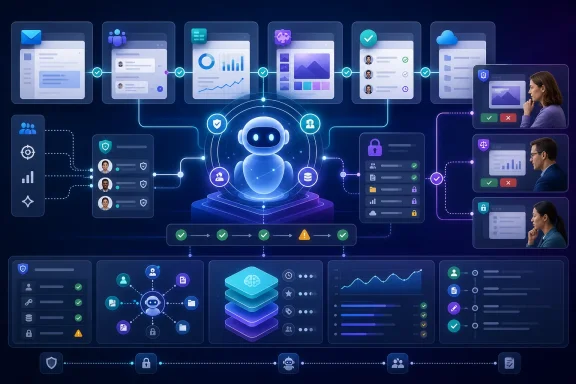
Enterprise AI is entering a more consequential phase: systems are moving beyond drafting text and answering questions toward coordinating live, multi-step work across applications, departments, and communication channels. In a TNGlobal interview published on July 21, 2026, Protaigé executive Ali Shaheen argues that the decisive enterprise advantage will not come from a model producing the most impressive isolated response, but from an agent reliably preserving context, choosing the right tools, respecting governance rules, escalating sensitive decisions, and completing work without losing control of the process.
Generative AI adoption initially centered on contained activities such as summarizing documents, producing marketing copy, writing code, and assisting customer-service teams. These deployments could generate meaningful productivity gains without giving the model extensive authority over business systems.
That boundary is now shifting. An AI assistant waits for a request and returns an answer, while an agent can interpret a goal, create a plan, call software tools, evaluate intermediate results, and continue until it completes the assignment or encounters an escalation condition.
The enterprise therefore has to evaluate the entire operating system around a model. Model intelligence remains important, but workflow architecture, identity, permissions, memory, observability, testing, and recovery controls increasingly determine whether an agent can be trusted in production.
Marketing provides an unusually demanding proving ground. A campaign may involve strategy, copy, design, legal review, localization, channel adaptation, media planning, approval chains, publication, and performance analysis, all while preserving a recognizable brand identity.
Agentic systems require a different scorecard because the final output is only one part of the result. Enterprises must also examine how the system reached that result, which data it accessed, which tools it invoked, which decisions it made, and whether it remained inside its assigned authority.
A workflow agent has to manage questions that resemble those faced by a human coordinator:
Those pauses are expensive despite rarely appearing as explicit line items. They extend campaign lead times, make context harder to preserve, and force employees to spend time checking statuses, re-explaining decisions, transferring files, and resolving version conflicts.
An orchestrating agent can potentially compress that cycle by moving immediately from one valid step to the next. The value proposition is therefore not simply faster copywriting; it is less organizational friction across the complete chain of work.
A campaign agent might misunderstand a product claim, incorporate that misunderstanding into copy, generate matching imagery, localize the message, and prepare paid-media variants. By the time a person reviews the package, the original mistake may have spread across dozens of assets.
Generative agents introduce probabilistic reasoning into that path. Two superficially similar inputs may produce different plans, and the agent may adapt its behavior based on context accumulated during the workflow.
This makes seemingly minor uncertainty more consequential. If a step has a 98 percent success rate in isolation, that figure does not guarantee a 98 percent success rate for a long chain containing many dependent decisions.
The relevant measures include:
A marketing workflow, for example, might permit autonomous drafting and resizing but require approval before using a regulated product claim, committing advertising spend, sending a customer communication, or publishing a public asset.
The objective is not to insert a person after every step. That would recreate the waiting time the agent was intended to remove. The better approach is to place risk-sensitive control points where the consequences justify intervention.
Protaigé refers to this problem as “agent amnesia.” The phrase captures several technically distinct failures that enterprises must address separately.
This creates an uncomfortable but important reality: memory can improve continuity while also creating a persistent attack and compliance surface. A poisoned or incorrect memory may influence future tool selection and decision-making long after the session in which it was created.
Strong memory systems therefore need:
This is a crucial design lesson. Capability and reliability do not always rise together.
Protaigé’s reported approach is to route tools per workflow step. Instead of allowing Maia to inspect the entire catalog, the system exposes only the small set relevant to the immediate task.
That method follows the principle of least privilege at both the technical and cognitive levels. The agent receives only the permissions it needs and only the choices it can reasonably evaluate.
Enterprise tool governance should answer several questions before deployment:
Shaheen argues that governance must accompany every output rather than sit at the end of the pipeline. Protaigé attempts to achieve this through its Brand DNA system, which reportedly encodes a company’s strategy, tone, visual identity, audience rules, and governance requirements for reuse across generated assets.
Some requirements can be expressed deterministically. An organization can prohibit publication without a campaign identifier, block access to restricted repositories, or require a legal approval token before making a regulated claim.
Other rules require contextual evaluation. Tone, cultural appropriateness, visual consistency, and audience suitability cannot always be reduced to simple conditions. These areas may use AI-based evaluators, but those evaluators must themselves be tested and monitored.
A useful record may include:
Shaheen divides the work into “inspiration” and “perspiration.” Humans remain responsible for the creative bet and emotional insight, while machines handle the production burden that follows.
Shaheen gives the example of three markets, four audience segments, and five channels producing 60 required assets. A conventional process may create dozens of briefs, revisions, and opportunities for brand drift.
Protaigé says Maia can start from one act of direction and produce distinct executions for each audience and channel. The important claim is not that the system duplicates one master asset 60 times, but that it adapts composition, text, imagery, and format while attempting to preserve the original creative intent.
Human review also remains critical for:
Shaheen argues that responsibility must remain with the user and the organization. That position requires companies to define ownership before an incident rather than after one.
The business owner should approve what the agent is meant to accomplish. The technical owner should maintain integrations and runtime health, while security, privacy, legal, and compliance teams establish controls appropriate to the risk.
Clear responsibility should cover:
Effective human review needs prioritized exceptions, clear explanations, supporting evidence, and enough time to make a real decision. Low-risk cases should be automated only after the system demonstrates reliable performance, while ambiguous or high-impact cases should receive focused attention.
Copilot Studio now supports multi-step workflows, approvals, branching logic, autonomous triggers, and connections to line-of-business systems. Microsoft’s 2026 product direction increasingly treats agents as managed enterprise entities rather than optional chatbot extensions.
A dedicated identity makes it possible to apply least-privilege access, assign ownership, restrict sensitive roles, monitor activity, and terminate access when an agent is retired. It also helps investigators distinguish an agent’s action from the actions of its sponsor or end user.
For Windows administrators, the conceptual model should feel familiar: an agent is another non-human identity that requires inventory, authentication, authorization, conditional access, and lifecycle management.
Agent 365 is positioned as a broader control plane for inventory, permissions, behavior, and activity across Microsoft and compatible third-party agents. Whether Microsoft can deliver a genuinely unified operational view will be an important test, particularly for organizations already struggling with fragmented security dashboards.
Within Microsoft environments, Teams, Outlook, SharePoint, Dynamics 365, and Microsoft 365 Copilot provide natural points of entry. The risk is that convenience may obscure the seriousness of the action being delegated, making clear identity and confirmation cues essential.
The more significant change may be organizational. Managers could spend less time transferring information between teams and more time defining objectives, resolving exceptions, and evaluating outcomes.
However, enterprises will also inherit new operating costs. Agent inventories, evaluations, logs, identity systems, memory stores, approval mechanisms, red-team exercises, and incident-response procedures all require investment.
If a marketing agent remembers customer preferences across campaigns, that memory may improve relevance. It may also intensify privacy concerns, particularly when behavioral data is combined across services or retained longer than customers expect.
Companies should disclose consequential automation clearly and provide escalation paths to a person. An autonomous system should not become a barrier that prevents customers from challenging an incorrect decision.
Enterprises should track completion rate, correction rate, human-intervention frequency, policy violations, tool-selection accuracy, cost per successful outcome, and time saved. A workflow that produces attractive outputs but regularly requires invisible cleanup may deliver negative returns.
Buyers should expect clearer service-level objectives for agentic workflows. Availability is only one dimension; enterprises also need measures for decision quality, policy compliance, tool-call correctness, and safe degradation.
The likely result is not one omnipotent corporate agent. Enterprises may deploy a portfolio of specialized agents coordinated through shared identity, policy, memory, and observability services.
The challenge will be integration rather than product availability. Administrators will expect one coherent view of ownership, access, activity, risk, cost, and lifecycle status across Microsoft-built, custom, and third-party agents.
Protaigé’s vision of an autonomous account director illustrates both the promise and the engineering burden of enterprise agentic AI. Removing handoffs can create substantial value, but only if memory remains trustworthy, tool access stays narrow, policies execute at runtime, humans retain meaningful authority, and every consequential action leaves evidence behind. The enterprises that succeed will not be those that grant AI the most autonomy first, but those that learn how to make autonomy observable, reversible, accountable, and reliable enough to become ordinary infrastructure.
 Background
Generative AI adoption initially centered on contained activities such as summarizing documents, producing marketing copy, writing code, and assisting customer-service teams. These deployments could generate meaningful productivity gains without giving the model extensive authority over business systems.That boundary is now shifting. An AI assistant waits for a request and returns an answer, while an agent can interpret a goal, create a plan, call software tools, evaluate intermediate results, and continue until it completes the assignment or encounters an escalation condition.
From chatbots to operational systems
The distinction matters because an imperfect chatbot response is usually visible to the person who requested it. An imperfect autonomous action may update a customer record, send a message, publish an asset, initiate an approval, or pass incorrect information into another automated process.The enterprise therefore has to evaluate the entire operating system around a model. Model intelligence remains important, but workflow architecture, identity, permissions, memory, observability, testing, and recovery controls increasingly determine whether an agent can be trusted in production.
Why Protaigé chose marketing
Protaigé applies this concept to marketing operations through Maia, which the company describes as an autonomous AI account director. According to Protaigé, Maia can work through familiar channels such as email, WhatsApp, and Slack while coordinating campaign execution inside its platform.Marketing provides an unusually demanding proving ground. A campaign may involve strategy, copy, design, legal review, localization, channel adaptation, media planning, approval chains, publication, and performance analysis, all while preserving a recognizable brand identity.
The Real Shift Is From Output to Execution
The first generation of enterprise generative AI was largely judged by what appeared in a response box. Buyers compared fluency, factuality, writing style, coding ability, and document-processing performance.Agentic systems require a different scorecard because the final output is only one part of the result. Enterprises must also examine how the system reached that result, which data it accessed, which tools it invoked, which decisions it made, and whether it remained inside its assigned authority.
A task ends, but a workflow persists
Shaheen characterizes the transition from a single-task agent to orchestration as the point where the engineering becomes genuinely difficult. A task agent can receive a prompt, generate an answer, and terminate without preserving meaningful operational state.A workflow agent has to manage questions that resemble those faced by a human coordinator:
- It must determine which step should happen next.
- It must select an appropriate tool or specialist agent.
- It must retain decisions made earlier in the process.
- It must recognize missing information or contradictory instructions.
- It must know when an action requires human authorization.
- It must detect when the objective has been satisfied and stop.
Eliminating handoff latency
Protaigé’s central economic argument is that the largest gain may come from eliminating delays between tasks rather than outperforming people at each individual task. In conventional campaign production, a draft may wait in an inbox, move into a design queue, return for revision, sit pending approval, and then require manual repackaging for different channels.Those pauses are expensive despite rarely appearing as explicit line items. They extend campaign lead times, make context harder to preserve, and force employees to spend time checking statuses, re-explaining decisions, transferring files, and resolving version conflicts.
An orchestrating agent can potentially compress that cycle by moving immediately from one valid step to the next. The value proposition is therefore not simply faster copywriting; it is less organizational friction across the complete chain of work.
Connected Workflows Create Connected Failures
The same integration that creates efficiency can increase the scale of an error. When steps are tightly coupled, incorrect information produced near the beginning may become an accepted input for every subsequent stage.A campaign agent might misunderstand a product claim, incorporate that misunderstanding into copy, generate matching imagery, localize the message, and prepare paid-media variants. By the time a person reviews the package, the original mistake may have spread across dozens of assets.
Error propagation changes the risk calculation
Traditional automation tends to operate through deterministic rules. It may fail because of a bad condition, broken integration, or unexpected data format, but the path is often reproducible.Generative agents introduce probabilistic reasoning into that path. Two superficially similar inputs may produce different plans, and the agent may adapt its behavior based on context accumulated during the workflow.
This makes seemingly minor uncertainty more consequential. If a step has a 98 percent success rate in isolation, that figure does not guarantee a 98 percent success rate for a long chain containing many dependent decisions.
The relevant measures include:
- Whether the system detects an incorrect intermediate result.
- Whether later steps verify rather than blindly trust earlier outputs.
- Whether important facts are grounded in controlled data sources.
- Whether the workflow can pause without losing state.
- Whether an operator can inspect, correct, and resume the process.
- Whether completed actions can be reversed safely.
Long workflows need checkpoints
Enterprises should resist treating an autonomous workflow as a single uninterrupted reasoning session. Reliability improves when the architecture creates explicit checkpoints at which the system validates inputs, records state, applies policy, and determines whether human approval is necessary.A marketing workflow, for example, might permit autonomous drafting and resizing but require approval before using a regulated product claim, committing advertising spend, sending a customer communication, or publishing a public asset.
The objective is not to insert a person after every step. That would recreate the waiting time the agent was intended to remove. The better approach is to place risk-sensitive control points where the consequences justify intervention.
Memory Is Becoming Enterprise Infrastructure
Shaheen identifies memory as one of the first capabilities to break when an agent moves from a demonstration into work lasting days, weeks, or months. A model may perform impressively in one session while contradicting itself later because it cannot reliably retrieve the decisions, constraints, and reasoning that shaped prior work.Protaigé refers to this problem as “agent amnesia.” The phrase captures several technically distinct failures that enterprises must address separately.
Working, episodic, and organizational memory
An agent coordinating a live workflow needs more than a transcript. It may require several memory layers:- Working memory retains the immediate state of the active task, including completed steps, outstanding dependencies, and current tool results.
- Episodic memory records what happened during previous projects, sessions, or customer interactions.
- Semantic memory stores relatively stable knowledge such as brand terminology, product information, organizational policies, and audience definitions.
- Decision memory preserves what was decided, who approved it, which evidence was considered, and why a particular path was selected.
- Procedural memory captures the preferred method for completing recurring work.
Memory requires curation
A production memory layer must decide what deserves to persist, how long it should remain, who may access it, and when it should be revised or deleted. It must also preserve provenance so that the agent does not treat an unsupported assertion as approved corporate knowledge.This creates an uncomfortable but important reality: memory can improve continuity while also creating a persistent attack and compliance surface. A poisoned or incorrect memory may influence future tool selection and decision-making long after the session in which it was created.
Strong memory systems therefore need:
- Source and ownership metadata.
- Retention and expiration policies.
- Sensitivity classifications.
- Conflict-resolution rules.
- User-access and correction mechanisms.
- Audit records showing when a memory affected an action.
More Tools Can Make an Agent Less Reliable
The industry often promotes large integration catalogs as evidence of platform maturity. Yet Shaheen argues that exposing an agent to hundreds of tools at once may reduce performance by increasing the number of inappropriate actions it can choose.This is a crucial design lesson. Capability and reliability do not always rise together.
Tool selection is a routing problem
An agent presented with numerous similarly described connectors may select the wrong one, call the right one with incorrect parameters, or use a powerful general-purpose tool when a safer specialized function exists.Protaigé’s reported approach is to route tools per workflow step. Instead of allowing Maia to inspect the entire catalog, the system exposes only the small set relevant to the immediate task.
That method follows the principle of least privilege at both the technical and cognitive levels. The agent receives only the permissions it needs and only the choices it can reasonably evaluate.
Every connector expands the attack surface
Tools transform model output into action. A hallucinated sentence is problematic, but a hallucinated tool call can alter a database, expose a confidential document, send an incorrect email, or create an unauthorized public post.Enterprise tool governance should answer several questions before deployment:
- What business purpose justifies the connection?
- Which specific actions may the agent perform?
- Which data fields may it read or write?
- Does a user’s authorization carry through to the agent?
- Which actions require confirmation or dual approval?
- How are credentials stored, rotated, and revoked?
- Can administrators replay or reconstruct the tool call?
- What happens when the tool returns incomplete or malicious content?
Governance Must Operate Inside the Workflow
Traditional governance often functions as a review stage after work has been produced. That model becomes too slow and too weak when an agent generates and acts continuously.Shaheen argues that governance must accompany every output rather than sit at the end of the pipeline. Protaigé attempts to achieve this through its Brand DNA system, which reportedly encodes a company’s strategy, tone, visual identity, audience rules, and governance requirements for reuse across generated assets.
Policy should be executable
A document stating that communications must follow brand and legal requirements is not enough. The agent needs machine-enforceable rules that influence retrieval, generation, tool use, and approval routing.Some requirements can be expressed deterministically. An organization can prohibit publication without a campaign identifier, block access to restricted repositories, or require a legal approval token before making a regulated claim.
Other rules require contextual evaluation. Tone, cultural appropriateness, visual consistency, and audience suitability cannot always be reduced to simple conditions. These areas may use AI-based evaluators, but those evaluators must themselves be tested and monitored.
Evidence matters as much as enforcement
An enterprise may need to demonstrate why an asset was created, what information supported it, which version of a policy applied, and who authorized publication. The audit trail should cover the whole decision chain rather than merely recording the final file.A useful record may include:
- The original business objective and approved brief.
- The model and agent version used.
- The knowledge sources retrieved.
- The tools called and permissions exercised.
- The policy checks applied at each stage.
- The intermediate outputs that materially affected the result.
- The names or identities of human approvers.
- The final publication or execution event.
Marketing Shows Where Autonomy Works
Marketing combines creative judgment with a substantial amount of repetitive execution. That mix makes it suitable for selective autonomy rather than indiscriminate end-to-end replacement.Shaheen divides the work into “inspiration” and “perspiration.” Humans remain responsible for the creative bet and emotional insight, while machines handle the production burden that follows.
High-volume execution is the immediate opportunity
Localization, formatting, versioning, channel adaptation, resizing, metadata creation, and performance-based optimization are strong candidates for increased autonomy. These activities involve real skill, but they are also repetitive, deadline-sensitive, and vulnerable to inconsistencies at scale.Shaheen gives the example of three markets, four audience segments, and five channels producing 60 required assets. A conventional process may create dozens of briefs, revisions, and opportunities for brand drift.
Protaigé says Maia can start from one act of direction and produce distinct executions for each audience and channel. The important claim is not that the system duplicates one master asset 60 times, but that it adapts composition, text, imagery, and format while attempting to preserve the original creative intent.
Human judgment remains strategically scarce
The case for autonomy weakens when the work depends on taste, emotional timing, cultural sensitivity, or a willingness to make a counterintuitive creative choice. Data can reveal what performed before, but a memorable campaign may succeed precisely because it departs from established patterns.Human review also remains critical for:
- Major brand repositioning.
- Sensitive social or political themes.
- Regulated claims and disclosures.
- Crisis communications.
- High-profile product launches.
- Humor, satire, and culturally specific messaging.
- Decisions that could materially affect customer trust.
Accountability Cannot Be Assigned to the Model
When an agent recommends an action, software executes it, and a person supervises the system, responsibility can become blurred. Organizations may be tempted to describe an unwanted result as something “the AI did,” but a model is not an accountable corporate officer.Shaheen argues that responsibility must remain with the user and the organization. That position requires companies to define ownership before an incident rather than after one.
Every agent needs an accountable sponsor
An enterprise agent should have an identifiable business owner, technical owner, security classification, approved purpose, and defined retirement process. Ownership cannot rest solely with the employee who initially assembled the workflow.The business owner should approve what the agent is meant to accomplish. The technical owner should maintain integrations and runtime health, while security, privacy, legal, and compliance teams establish controls appropriate to the risk.
Clear responsibility should cover:
- Who writes and approves decision policies.
- Who authorizes data access.
- Who owns model and workflow testing.
- Who receives operational alerts.
- Who can suspend or disable the agent.
- Who investigates incorrect actions.
- Who compensates customers or corrects records when harm occurs.
Human approval must be meaningful
A nominal human-in-the-loop control is not sufficient if the reviewer is shown hundreds of decisions with little context. Approval fatigue can turn oversight into a ritual in which people click through recommendations because checking them properly is impossible.Effective human review needs prioritized exceptions, clear explanations, supporting evidence, and enough time to make a real decision. Low-risk cases should be automated only after the system demonstrates reliable performance, while ambiguous or high-impact cases should receive focused attention.
The Windows and Microsoft 365 Connection
For WindowsForum readers, the shift toward agentic workflows is not an abstract cloud trend. Microsoft is building agent creation, identity, governance, and monitoring into the broader Microsoft 365, Power Platform, Azure, Entra, Purview, Defender, and Windows ecosystem.Copilot Studio now supports multi-step workflows, approvals, branching logic, autonomous triggers, and connections to line-of-business systems. Microsoft’s 2026 product direction increasingly treats agents as managed enterprise entities rather than optional chatbot extensions.
Identity becomes the foundation
Microsoft Entra Agent ID is intended to give agents distinct identities and lifecycle controls. This is important because enterprises cannot safely govern autonomous software if every action appears to come from a shared service account or an employee’s unrestricted credentials.A dedicated identity makes it possible to apply least-privilege access, assign ownership, restrict sensitive roles, monitor activity, and terminate access when an agent is retired. It also helps investigators distinguish an agent’s action from the actions of its sponsor or end user.
For Windows administrators, the conceptual model should feel familiar: an agent is another non-human identity that requires inventory, authentication, authorization, conditional access, and lifecycle management.
Governance is moving into the admin layer
Microsoft’s current tools emphasize agent inventories, connector policies, data-loss prevention, environment controls, testing, telemetry, and approval-based access. Copilot Studio’s governance model also encourages organizations to separate development, testing, and production environments rather than publishing experimental agents directly to the workforce.Agent 365 is positioned as a broader control plane for inventory, permissions, behavior, and activity across Microsoft and compatible third-party agents. Whether Microsoft can deliver a genuinely unified operational view will be an important test, particularly for organizations already struggling with fragmented security dashboards.
Familiar channels reduce adoption friction
Protaigé’s decision to place Maia inside email, Slack, and WhatsApp reflects a broader enterprise lesson. Employees are more likely to adopt an agent that appears within existing work habits than one requiring them to learn an entirely separate interface.Within Microsoft environments, Teams, Outlook, SharePoint, Dynamics 365, and Microsoft 365 Copilot provide natural points of entry. The risk is that convenience may obscure the seriousness of the action being delegated, making clear identity and confirmation cues essential.
Enterprise and Consumer Effects Will Differ
Agentic AI will affect organizations and individuals in different ways. Enterprises can build formal policies and monitoring structures, while consumers may encounter agents mainly through services controlled by vendors.Enterprise impact
Businesses stand to gain from faster process completion, reduced coordination overhead, and more consistent execution. Departments with high-volume workflows may scale output without proportionally increasing headcount.The more significant change may be organizational. Managers could spend less time transferring information between teams and more time defining objectives, resolving exceptions, and evaluating outcomes.
However, enterprises will also inherit new operating costs. Agent inventories, evaluations, logs, identity systems, memory stores, approval mechanisms, red-team exercises, and incident-response procedures all require investment.
Consumer impact
Customers may receive faster, more personalized communications across multiple channels. They may also struggle to determine whether a message represents a considered human decision or an automatically generated action.If a marketing agent remembers customer preferences across campaigns, that memory may improve relevance. It may also intensify privacy concerns, particularly when behavioral data is combined across services or retained longer than customers expect.
Companies should disclose consequential automation clearly and provide escalation paths to a person. An autonomous system should not become a barrier that prevents customers from challenging an incorrect decision.
Strengths and Opportunities
Agentic AI has the potential to remove operational friction that conventional assistants leave untouched. Its strongest opportunities arise where the workflow is understood, the actions are measurable, and the risks can be bounded.- Agents can reduce idle time between dependent tasks. Immediate progression can shorten campaign, service, analysis, and approval cycles even when individual task performance remains similar.
- Persistent context can reduce repeated briefing. Properly governed memory allows teams to preserve decisions, preferences, and project history across sessions.
- Automated versioning can support global scale. Domain-specific agents can adapt materials for markets, audiences, devices, and channels without requiring separate manual production chains.
- Embedded policies can improve consistency. Machine-enforced brand, security, and compliance controls may catch deviations earlier than final-stage review.
- Structured audit trails can improve accountability. A well-designed agent can record intermediate actions more systematically than a loosely coordinated human workflow.
- Specialized agents can outperform general assistants operationally. Narrow scope reduces irrelevant tools, limits permissions, and makes evaluation more practical.
- Existing communication channels can accelerate adoption. Agents embedded in Teams, Outlook, email, or messaging services reduce interface friction.
Risks and Concerns
The technology also creates failure modes that are larger and less visible than those associated with standalone generation. Autonomy amplifies both competence and error.- A mistake can propagate through the entire workflow. Connected steps may transform one incorrect assumption into many polished but invalid outputs.
- Persistent memory can preserve bad information. Poisoned, outdated, or misclassified memories may influence decisions long after their creation.
- Broad tool access can magnify damage. An agent with excessive permissions may expose data, alter records, or trigger actions beyond its intended role.
- Approval fatigue can weaken human oversight. Review controls become ineffective when people cannot realistically inspect the volume or complexity of decisions.
- Agent sprawl can recreate shadow IT. Employees may build overlapping agents without clear ownership, testing, or retirement procedures.
- Costs may become unpredictable. Long workflows can consume model capacity, connector operations, storage, and evaluation resources across many intermediate steps.
- Vendor claims may exceed production evidence. Enterprises should demand measurable reliability data rather than relying on labels such as “autonomous” or “enterprise-grade.”
- Creative automation may produce homogenized work. Optimization against historical patterns can discourage experimentation and reinforce familiar styles.
A Practical Enterprise Adoption Path
Organizations should avoid beginning with the broad goal of deploying an autonomous digital employee. They should identify a bounded workflow whose risks, inputs, outputs, and ownership are already understood.Start with process discovery
A sensible adoption sequence is:- Map the current workflow, including informal handoffs, waiting periods, data sources, exceptions, and approval points.
- Classify every action by risk, distinguishing recommendation, drafting, internal modification, external communication, financial commitment, and irreversible execution.
- Automate low-risk segments first, while retaining human authorization around sensitive actions.
- Assign a dedicated agent identity with narrowly scoped permissions and an accountable sponsor.
- Build structured memory with provenance, retention, correction, and deletion controls.
- Restrict the available tools per step instead of exposing the full integration catalog.
- Test complete trajectories, not merely final outputs, using normal, adversarial, ambiguous, and failure conditions.
- Monitor production behavior continuously and establish thresholds for pause, rollback, or shutdown.
- Expand autonomy only after evidence accumulates that the workflow remains reliable under realistic load and changing conditions.
Evaluate outcomes rather than demonstrations
A polished demonstration usually follows an ideal path. Production evaluation must include unavailable systems, expired credentials, contradictory requests, incomplete data, malicious content, localization errors, slow APIs, duplicate events, and interrupted sessions.Enterprises should track completion rate, correction rate, human-intervention frequency, policy violations, tool-selection accuracy, cost per successful outcome, and time saved. A workflow that produces attractive outputs but regularly requires invisible cleanup may deliver negative returns.
What to Watch Next
The next 12 to 24 months will likely shift enterprise competition away from raw model quality and toward the surrounding control architecture. Leading platforms will need to demonstrate that their agents can operate consistently, preserve the correct context, explain material actions, and remain governable across organizational boundaries.Reliability will become a purchasing criterion
Procurement teams will increasingly ask vendors for evidence covering task completion, failure recovery, access controls, memory safety, logging, testing, data residency, and incident response. Model benchmarks alone will not answer those questions.Buyers should expect clearer service-level objectives for agentic workflows. Availability is only one dimension; enterprises also need measures for decision quality, policy compliance, tool-call correctness, and safe degradation.
Domain agents will challenge general assistants
Shaheen’s emphasis on narrow, domain-specific agents reflects a growing industry pattern. A general assistant may offer broad flexibility, but a specialized agent can use a smaller toolset, more relevant memory, tailored evaluations, and clearer operational boundaries.The likely result is not one omnipotent corporate agent. Enterprises may deploy a portfolio of specialized agents coordinated through shared identity, policy, memory, and observability services.
Microsoft’s control-plane strategy faces a major test
Microsoft has an opportunity to make agent governance a natural extension of tools enterprises already use. Entra can govern identity, Purview can support information protection and audit, Defender can detect threats, and Copilot Studio can provide workflow construction and testing.The challenge will be integration rather than product availability. Administrators will expect one coherent view of ownership, access, activity, risk, cost, and lifecycle status across Microsoft-built, custom, and third-party agents.
Protaigé’s vision of an autonomous account director illustrates both the promise and the engineering burden of enterprise agentic AI. Removing handoffs can create substantial value, but only if memory remains trustworthy, tool access stays narrow, policies execute at runtime, humans retain meaningful authority, and every consequential action leaves evidence behind. The enterprises that succeed will not be those that grant AI the most autonomy first, but those that learn how to make autonomy observable, reversible, accountable, and reliable enough to become ordinary infrastructure.
References
- Primary source: TNGlobal
Published: 2026-07-21T10:01:06+00:00
- Related coverage: ibm.com
What Is an Agentic Enterprise? | IBM
An agentic enterprise is one that integrates AI agents across every business function, enabling agents to plan and execute multi-step tasks alongside humans. www.ibm.com
- Related coverage: newsroom.ibm.com
IBM Launches Enterprise Advantage Service to Help Businesses Scale Agentic AI
PDF documentnewsroom.ibm.com
