

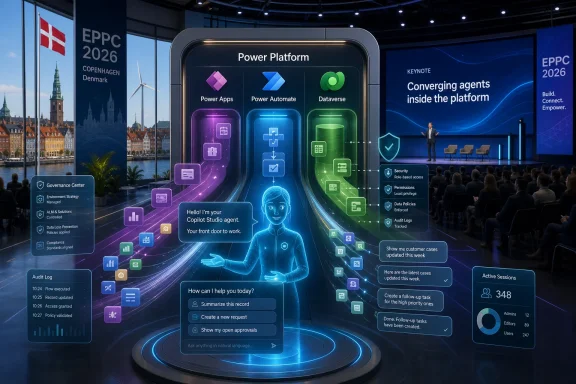
Microsoft used the opening keynote of the European Power Platform Conference 2026 in Copenhagen on June 29 to tell makers and partners that Copilot Studio, Microsoft 365 Copilot, Work IQ, and Power Platform are converging rather than replacing the apps, flows, and Dataverse systems customers already run. That reassurance is the story because it exposes Microsoft’s real challenge: not inventing another AI interface, but convincing the Power Platform community that years of low-code investment will survive the agent era. The company wants Copilot to become the front door to work, but it still needs Power Apps, Power Automate, and Dataverse to be the machinery behind the door. For enterprise IT, that makes this less a product launch than a platform succession plan.
Ryan Cunningham’s keynote message was carefully aimed at a community that has heard enough “future of work” rhetoric to know when a platform vendor is trying to move the goalposts. Microsoft’s pitch at EPPC 2026 was not that Copilot Studio and Microsoft 365 Copilot make traditional Power Platform work obsolete. It was that the new agent stack gives those existing assets more surfaces, more context, and more ways to be called from natural language.
That distinction matters. Power Platform customers have spent years building canvas apps, model-driven apps, Dataverse tables, Power Automate flows, approval chains, connectors, environment strategies, ALM processes, and governance models. If Microsoft’s AI strategy sounded like a pivot away from all that, it would risk alienating the very makers and admins it needs to operationalize Copilot inside real businesses.
So Cunningham’s reassurance was blunt: customers do not have to abandon what they have already built. The new tools are being brought “directly into the platform,” he said, and are meant to improve the skills and investments already present in Power Platform environments. In vendor language, that is continuity. In customer language, it is a promise that the bill for Microsoft’s AI ambition will not arrive as a forced rebuild.
The numbers Microsoft cited from its own internal usage were clearly chosen to make that point feel concrete: more than 800,000 Power Apps, more than 1 million Power Automate flows, and more than 700,000 agents running inside Microsoft. Those figures are not just scale theater. They are Microsoft’s argument that Power Platform is not a sidecar to Copilot, but one of the places where Copilot’s enterprise story has to prove itself.
That is why the Power Apps angle matters. Microsoft is describing a future in which Copilot works more intimately with Power Apps, sometimes doing more work inside an app and sometimes allowing an app’s capabilities to “decompose” into Copilot-facing experiences. In plain English, that means the application may stop being the only place where the process lives.
For years, Power Apps has been about packaging process into an interface. A user opens an app, navigates records, submits a form, triggers a flow, and follows a defined business path. The Copilot model bends that pattern. A user may begin in Copilot, ask for an outcome, and have the agent pull pieces of app logic, Dataverse data, and Power Automate actions into the conversation.
That is powerful, but it is also destabilizing. It changes the role of the app from a self-contained experience into a bundle of reusable capabilities. Microsoft’s challenge is to make that feel like modernization rather than disassembly.
Microsoft’s current documentation and release planning point in the same direction as the EPPC keynote. Work IQ is positioned as the intelligence layer that helps Microsoft 365 Copilot and agents understand work context, relationships, and patterns. Dataverse intelligence extends that context into structured business data, allowing agents to reason over CRM records, business tables, and process-specific information rather than just files, emails, chats, and meetings.
That is a crucial shift. Enterprise AI does not fail only because the model gives a bad answer. It fails because the system does not know which customer record is authoritative, which approval policy applies, which department owns a process, or whether a user is allowed to take an action. Dataverse gives Microsoft a way to say that Copilot can be grounded not merely in “your work,” but in the business systems that define the work.
This is where Power Platform’s legacy becomes an advantage. Customers already have Dataverse schemas, security roles, business rules, connectors, and flows. If Microsoft can expose those assets safely to agents, it can give Copilot a richer enterprise substrate than a generic AI assistant can offer.
That matters because the agent market is already crowded with tools that promise to execute work. The hard part is not making an agent call an API. The hard part is making sure the agent knows which API to call, on whose behalf, with what permissions, using what business rules, and leaving what audit trail. Work IQ is Microsoft’s answer to that problem.
The June 2026 availability of Work IQ APIs and the appearance of Work IQ MCP tooling show how aggressively Microsoft is trying to make this layer extensible. The company is not just saying Copilot will know more. It is saying developers and makers will be able to expose organizational knowledge and actions to agents in a more standardized way.
That creates opportunity for Power Platform professionals, but also a new burden. The maker who once needed to understand tables, flows, connectors, and UI logic may now need to understand agent skills, MCP servers, Copilot credits, usage-based billing, security boundaries, and model behavior. Microsoft is promising a bridge to the future, but that bridge has toll booths.
Copilot changes the bargain. Instead of asking makers to build every interface and workflow explicitly, Microsoft is asking them to define capabilities that agents can discover and invoke. That sounds like less work, and sometimes it will be. But it also moves complexity into places that are harder to see.
A button in a Power App is explicit. A Power Automate flow has triggers, conditions, actions, run history, and failure points. An agentic workflow may involve intent recognition, tool selection, context retrieval, permission evaluation, human approval, and background execution. The business outcome may look simple to the user, but the operational model is more complex.
This is why Microsoft’s reassurance at EPPC should be read carefully. The company is not promising that Power Platform work stays the same. It is promising that existing assets remain relevant as the interaction model changes. That is an important promise, but it is not the same as saying organizations can keep their current governance posture untouched.
That could solve a real adoption problem. Many business apps fail not because they are poorly designed, but because users do not want another place to go. A sales manager may not want to open a model-driven app to update an opportunity after a meeting. A technician may not want to navigate a portal to file a service note. A finance analyst may not want to switch systems just to retrieve, compare, or approve records.
If Copilot can bring the right app capability into Teams, Outlook, Excel, or a Copilot Chat session, Microsoft can reduce the friction that has haunted enterprise software for decades. The user asks for the job to be done; the app’s logic appears only when needed. That is the dream.
But decomposition also raises a design problem. Apps are not just containers for capabilities. They impose order. They show fields in context, constrain choices, reveal related records, and make process state visible. If those pieces are atomized into a conversational interface, Microsoft and its customers must ensure that context is not lost in the name of convenience.
Microsoft knows this, which is why its 2026 Power Platform wave planning emphasizes agent security, risk assessment in Copilot Studio, usage visibility, Copilot credit controls, and governance agents. The company is trying to make the case that agentic AI can be administered, not merely admired.
That is essential because Power Platform already has a history of sprawl. Citizen development can produce enormous value, but it can also produce orphaned apps, undocumented flows, connector risk, data leakage concerns, and licensing surprises. Add agents that can reason, retrieve, and act, and the stakes rise sharply.
The governance layer must therefore become more than an admin afterthought. It has to be part of the maker experience, part of deployment, and part of ongoing operations. If Microsoft gets this right, Power Platform could become one of the safer ways for enterprises to adopt agentic AI. If it gets it wrong, Copilot Studio could become another place where shadow IT learns to move faster than policy.
Still, Microsoft’s tenant is not the average customer tenant. Most enterprises do not have Microsoft’s engineering bench, product telemetry, platform expertise, or incentive alignment. They have mergers, legacy naming conventions, half-retired SharePoint sites, uneven Dataverse design, over-permissioned service accounts, and departments that treat “temporary workaround” as a lifecycle stage.
That means Microsoft’s internal proof points should be read as evidence of platform capacity, not guaranteed customer readiness. The hard work for customers will be inventorying what they have, deciding which assets are safe to expose to Copilot, and building governance that distinguishes experimentation from production.
This is where partners will find opportunity. EPPC is not only a community event; it is a market signal. Customers will need help rationalizing Power Platform estates, modernizing Dataverse models, creating reusable skills, setting up environment strategies, and explaining to executives why “agent-ready” is not the same as “turn it on.”
Copilot Studio does not have to become that. But the risk is real if Microsoft encourages fast agent creation without equally strong lifecycle management. Agents are software, even when they are described in natural language. They need ownership, testing, versioning, monitoring, permissions, cost controls, and retirement plans.
The danger is not that business users will build agents. That is the point of the platform. The danger is that organizations will treat agents as disposable prompts when they are actually operational actors. An agent that reads customer data, drafts responses, updates records, or triggers workflows is part of the business process, not a productivity toy.
Microsoft’s best defense is to make responsible agent building feel native to Copilot Studio and Power Platform, not bolted on by central IT after the fact. The company has the raw ingredients: environments, Dataverse security, connectors, managed solutions, admin centers, audit logs, and policy controls. The question is whether the agent experience will respect those structures consistently enough for enterprises to trust it.
The EPPC message that Copilot and Power Platform investments are converging is attractive. But convergence often means overlapping meters. A process that once involved a Power App and a Power Automate flow may now involve Microsoft 365 Copilot, Copilot Studio, Dataverse, Work IQ, MCP tools, premium connectors, and AI consumption charges.
That does not make the strategy wrong. It does mean customers should demand clarity before scaling prototypes into production. The economics of agentic automation are still settling, and early wins can become expensive if every “simple” task fans out into multiple billable services.
Microsoft’s best move would be transparency. Show run costs. Surface consumption at design time. Give admins caps and alerts that actually map to business units. Let makers understand the financial consequences of tool choices before the monthly bill becomes the governance mechanism.
If Microsoft 365 Copilot becomes a more capable front end for business processes, Windows PCs become less about launching individual apps and more about mediating context across Teams, Outlook, Edge, Office, Power Apps, and line-of-business systems. The operating system still matters, but the center of gravity shifts upward into identity, data, agents, and policy.
That has practical consequences for admins. Endpoint security, browser policy, identity posture, device compliance, and data loss prevention all become part of the Copilot story. An agent acting on behalf of a user is only as safe as the permissions, signals, and device context that surround that user.
This is why Microsoft’s platform convergence matters beyond the Power Platform crowd. The agent era will not be deployed as a single app. It will arrive as a mesh of capabilities across the desktop, browser, productivity suite, admin center, and low-code stack.
That trust is not automatic. Microsoft has changed product names, licensing models, admin experiences, and strategic narratives often enough that customers have learned to wait for operational proof. The Power Platform community in particular tends to be pragmatic. It likes demos, but it believes run history.
The company’s strongest argument is architectural rather than rhetorical. If Power Apps expose business capabilities, Dataverse grounds agents in structured data, Power Automate executes controlled workflows, Copilot Studio packages agents, and Work IQ supplies organizational context, then Microsoft has a coherent enterprise AI story. It is not just adding AI to apps. It is trying to turn apps into callable business capabilities.
The weakness is complexity. Each layer that makes the platform more powerful also gives customers another place to misconfigure, overspend, or misunderstand risk. Microsoft’s job now is to make the integrated story legible enough that admins can govern it and makers can use it without becoming amateur platform architects.
 Microsoft Tries to Make the Agent Era Look Like an Upgrade, Not a Migration
Ryan Cunningham’s keynote message was carefully aimed at a community that has heard enough “future of work” rhetoric to know when a platform vendor is trying to move the goalposts. Microsoft’s pitch at EPPC 2026 was not that Copilot Studio and Microsoft 365 Copilot make traditional Power Platform work obsolete. It was that the new agent stack gives those existing assets more surfaces, more context, and more ways to be called from natural language.That distinction matters. Power Platform customers have spent years building canvas apps, model-driven apps, Dataverse tables, Power Automate flows, approval chains, connectors, environment strategies, ALM processes, and governance models. If Microsoft’s AI strategy sounded like a pivot away from all that, it would risk alienating the very makers and admins it needs to operationalize Copilot inside real businesses.
So Cunningham’s reassurance was blunt: customers do not have to abandon what they have already built. The new tools are being brought “directly into the platform,” he said, and are meant to improve the skills and investments already present in Power Platform environments. In vendor language, that is continuity. In customer language, it is a promise that the bill for Microsoft’s AI ambition will not arrive as a forced rebuild.
The numbers Microsoft cited from its own internal usage were clearly chosen to make that point feel concrete: more than 800,000 Power Apps, more than 1 million Power Automate flows, and more than 700,000 agents running inside Microsoft. Those figures are not just scale theater. They are Microsoft’s argument that Power Platform is not a sidecar to Copilot, but one of the places where Copilot’s enterprise story has to prove itself.
Copilot Needs Power Platform More Than Power Platform Needs Another Chat Box
The most interesting part of Microsoft’s EPPC message is that it subtly lowers the importance of the chat interface. Microsoft 365 Copilot may be the user-facing brand, and Copilot Studio may be the maker-facing agent builder, but the actual business value depends on what these systems can do inside existing workflows. A chatbot that answers questions is useful; a system that can read business context, invoke governed actions, and update systems of record is where the enterprise money is.That is why the Power Apps angle matters. Microsoft is describing a future in which Copilot works more intimately with Power Apps, sometimes doing more work inside an app and sometimes allowing an app’s capabilities to “decompose” into Copilot-facing experiences. In plain English, that means the application may stop being the only place where the process lives.
For years, Power Apps has been about packaging process into an interface. A user opens an app, navigates records, submits a form, triggers a flow, and follows a defined business path. The Copilot model bends that pattern. A user may begin in Copilot, ask for an outcome, and have the agent pull pieces of app logic, Dataverse data, and Power Automate actions into the conversation.
That is powerful, but it is also destabilizing. It changes the role of the app from a self-contained experience into a bundle of reusable capabilities. Microsoft’s challenge is to make that feel like modernization rather than disassembly.
Dataverse Becomes the Memory Palace of Business AI
Dataverse has always been one of Power Platform’s least flashy but most important assets. It is the structured data layer that makes Power Apps and Dynamics 365 more than a collection of forms and automations. In the Copilot era, Dataverse becomes even more strategic because agents need grounding, permissions, auditability, and a shared understanding of business entities.Microsoft’s current documentation and release planning point in the same direction as the EPPC keynote. Work IQ is positioned as the intelligence layer that helps Microsoft 365 Copilot and agents understand work context, relationships, and patterns. Dataverse intelligence extends that context into structured business data, allowing agents to reason over CRM records, business tables, and process-specific information rather than just files, emails, chats, and meetings.
That is a crucial shift. Enterprise AI does not fail only because the model gives a bad answer. It fails because the system does not know which customer record is authoritative, which approval policy applies, which department owns a process, or whether a user is allowed to take an action. Dataverse gives Microsoft a way to say that Copilot can be grounded not merely in “your work,” but in the business systems that define the work.
This is where Power Platform’s legacy becomes an advantage. Customers already have Dataverse schemas, security roles, business rules, connectors, and flows. If Microsoft can expose those assets safely to agents, it can give Copilot a richer enterprise substrate than a generic AI assistant can offer.
Work IQ Is the New Context Layer Microsoft Wants Everyone to Build Around
Work IQ is the kind of Microsoft name that sounds abstract until you see where it sits in the stack. It is not simply another Copilot feature. It is Microsoft’s attempt to define the context layer for workplace AI: data, relationships, activities, business signals, and reusable skills that agents can draw on across Microsoft 365, Dynamics 365, Power Apps, and Copilot Studio.That matters because the agent market is already crowded with tools that promise to execute work. The hard part is not making an agent call an API. The hard part is making sure the agent knows which API to call, on whose behalf, with what permissions, using what business rules, and leaving what audit trail. Work IQ is Microsoft’s answer to that problem.
The June 2026 availability of Work IQ APIs and the appearance of Work IQ MCP tooling show how aggressively Microsoft is trying to make this layer extensible. The company is not just saying Copilot will know more. It is saying developers and makers will be able to expose organizational knowledge and actions to agents in a more standardized way.
That creates opportunity for Power Platform professionals, but also a new burden. The maker who once needed to understand tables, flows, connectors, and UI logic may now need to understand agent skills, MCP servers, Copilot credits, usage-based billing, security boundaries, and model behavior. Microsoft is promising a bridge to the future, but that bridge has toll booths.
The Old Low-Code Compact Is Being Rewritten
Power Platform succeeded because it offered a bargain: business users and technically inclined makers could solve local problems faster than traditional IT, while admins could impose just enough governance to keep the environment from becoming a swamp. That bargain was never perfect, but it was productive. It let organizations digitize processes that were too small, too specific, or too politically tangled for full custom development.Copilot changes the bargain. Instead of asking makers to build every interface and workflow explicitly, Microsoft is asking them to define capabilities that agents can discover and invoke. That sounds like less work, and sometimes it will be. But it also moves complexity into places that are harder to see.
A button in a Power App is explicit. A Power Automate flow has triggers, conditions, actions, run history, and failure points. An agentic workflow may involve intent recognition, tool selection, context retrieval, permission evaluation, human approval, and background execution. The business outcome may look simple to the user, but the operational model is more complex.
This is why Microsoft’s reassurance at EPPC should be read carefully. The company is not promising that Power Platform work stays the same. It is promising that existing assets remain relevant as the interaction model changes. That is an important promise, but it is not the same as saying organizations can keep their current governance posture untouched.
The “Decomposed App” Is a Radical Idea in Enterprise Clothing
The phrase “decompose” may not sound dramatic, but it may be one of the more consequential ideas in Microsoft’s Power Apps story. If apps can decompose into Copilot-accessible capabilities, then the app is no longer merely a destination. It becomes a set of skills, actions, forms, and data operations that can surface wherever the user is working.That could solve a real adoption problem. Many business apps fail not because they are poorly designed, but because users do not want another place to go. A sales manager may not want to open a model-driven app to update an opportunity after a meeting. A technician may not want to navigate a portal to file a service note. A finance analyst may not want to switch systems just to retrieve, compare, or approve records.
If Copilot can bring the right app capability into Teams, Outlook, Excel, or a Copilot Chat session, Microsoft can reduce the friction that has haunted enterprise software for decades. The user asks for the job to be done; the app’s logic appears only when needed. That is the dream.
But decomposition also raises a design problem. Apps are not just containers for capabilities. They impose order. They show fields in context, constrain choices, reveal related records, and make process state visible. If those pieces are atomized into a conversational interface, Microsoft and its customers must ensure that context is not lost in the name of convenience.
Governance Becomes the Product, Not the Fine Print
For WindowsForum’s IT pro audience, the real EPPC story is governance. Microsoft can talk about personal productivity, process efficiency, and new systems of work, but enterprise administrators will ask a narrower set of questions. Who can create agents? What can they access? What actions can they take? How are costs measured? What logs exist after something goes wrong?Microsoft knows this, which is why its 2026 Power Platform wave planning emphasizes agent security, risk assessment in Copilot Studio, usage visibility, Copilot credit controls, and governance agents. The company is trying to make the case that agentic AI can be administered, not merely admired.
That is essential because Power Platform already has a history of sprawl. Citizen development can produce enormous value, but it can also produce orphaned apps, undocumented flows, connector risk, data leakage concerns, and licensing surprises. Add agents that can reason, retrieve, and act, and the stakes rise sharply.
The governance layer must therefore become more than an admin afterthought. It has to be part of the maker experience, part of deployment, and part of ongoing operations. If Microsoft gets this right, Power Platform could become one of the safer ways for enterprises to adopt agentic AI. If it gets it wrong, Copilot Studio could become another place where shadow IT learns to move faster than policy.
Microsoft’s Own Scale Is Impressive, but Customers Live in Messier Tenants
Microsoft’s internal usage numbers are impressive, and they serve a purpose. A company running hundreds of thousands of apps and agents inside its own walls can credibly say it understands scale. It can test governance, reliability, and operational telemetry in a way smaller vendors cannot.Still, Microsoft’s tenant is not the average customer tenant. Most enterprises do not have Microsoft’s engineering bench, product telemetry, platform expertise, or incentive alignment. They have mergers, legacy naming conventions, half-retired SharePoint sites, uneven Dataverse design, over-permissioned service accounts, and departments that treat “temporary workaround” as a lifecycle stage.
That means Microsoft’s internal proof points should be read as evidence of platform capacity, not guaranteed customer readiness. The hard work for customers will be inventorying what they have, deciding which assets are safe to expose to Copilot, and building governance that distinguishes experimentation from production.
This is where partners will find opportunity. EPPC is not only a community event; it is a market signal. Customers will need help rationalizing Power Platform estates, modernizing Dataverse models, creating reusable skills, setting up environment strategies, and explaining to executives why “agent-ready” is not the same as “turn it on.”
Copilot Studio Must Avoid Becoming the New InfoPath
Every Microsoft platform community has ghosts. For Power Platform, one of them is the memory of tools that were easy to adopt, widely used, and then painful to unwind when strategy shifted. InfoPath remains the shorthand: beloved by departments, dreaded by IT, and eventually a migration problem.Copilot Studio does not have to become that. But the risk is real if Microsoft encourages fast agent creation without equally strong lifecycle management. Agents are software, even when they are described in natural language. They need ownership, testing, versioning, monitoring, permissions, cost controls, and retirement plans.
The danger is not that business users will build agents. That is the point of the platform. The danger is that organizations will treat agents as disposable prompts when they are actually operational actors. An agent that reads customer data, drafts responses, updates records, or triggers workflows is part of the business process, not a productivity toy.
Microsoft’s best defense is to make responsible agent building feel native to Copilot Studio and Power Platform, not bolted on by central IT after the fact. The company has the raw ingredients: environments, Dataverse security, connectors, managed solutions, admin centers, audit logs, and policy controls. The question is whether the agent experience will respect those structures consistently enough for enterprises to trust it.
The Licensing Conversation Will Follow the Excitement
No Power Platform story is complete without licensing, and Copilot makes that conversation even more delicate. Microsoft’s AI stack increasingly blends user licenses, capacity meters, Copilot credits, premium connectors, usage-based billing, and product-specific entitlements. That may be rational from a product accounting standpoint, but it creates uncertainty for customers trying to forecast cost.The EPPC message that Copilot and Power Platform investments are converging is attractive. But convergence often means overlapping meters. A process that once involved a Power App and a Power Automate flow may now involve Microsoft 365 Copilot, Copilot Studio, Dataverse, Work IQ, MCP tools, premium connectors, and AI consumption charges.
That does not make the strategy wrong. It does mean customers should demand clarity before scaling prototypes into production. The economics of agentic automation are still settling, and early wins can become expensive if every “simple” task fans out into multiple billable services.
Microsoft’s best move would be transparency. Show run costs. Surface consumption at design time. Give admins caps and alerts that actually map to business units. Let makers understand the financial consequences of tool choices before the monthly bill becomes the governance mechanism.
The Windows Angle Is the Work Surface, Not the Kernel
For Windows enthusiasts, it is tempting to look for the Windows-specific hook in every Copilot story. But EPPC’s significance is not about a new Windows feature. It is about where work will happen across the Microsoft estate, and Windows remains the primary surface through which many users experience that estate.If Microsoft 365 Copilot becomes a more capable front end for business processes, Windows PCs become less about launching individual apps and more about mediating context across Teams, Outlook, Edge, Office, Power Apps, and line-of-business systems. The operating system still matters, but the center of gravity shifts upward into identity, data, agents, and policy.
That has practical consequences for admins. Endpoint security, browser policy, identity posture, device compliance, and data loss prevention all become part of the Copilot story. An agent acting on behalf of a user is only as safe as the permissions, signals, and device context that surround that user.
This is why Microsoft’s platform convergence matters beyond the Power Platform crowd. The agent era will not be deployed as a single app. It will arrive as a mesh of capabilities across the desktop, browser, productivity suite, admin center, and low-code stack.
The Copenhagen Message Was Really About Trust
Microsoft’s EPPC 2026 pitch can be summarized as a trust exercise. Trust us that your existing Power Platform investments carry forward. Trust us that Copilot Studio is the next layer, not a replacement layer. Trust us that Dataverse, Work IQ, and Microsoft 365 Copilot can make agents useful without making them ungovernable.That trust is not automatic. Microsoft has changed product names, licensing models, admin experiences, and strategic narratives often enough that customers have learned to wait for operational proof. The Power Platform community in particular tends to be pragmatic. It likes demos, but it believes run history.
The company’s strongest argument is architectural rather than rhetorical. If Power Apps expose business capabilities, Dataverse grounds agents in structured data, Power Automate executes controlled workflows, Copilot Studio packages agents, and Work IQ supplies organizational context, then Microsoft has a coherent enterprise AI story. It is not just adding AI to apps. It is trying to turn apps into callable business capabilities.
The weakness is complexity. Each layer that makes the platform more powerful also gives customers another place to misconfigure, overspend, or misunderstand risk. Microsoft’s job now is to make the integrated story legible enough that admins can govern it and makers can use it without becoming amateur platform architects.
The Practical Read for Power Platform Teams Leaving EPPC
The near-term lesson from EPPC is not to freeze existing Power Platform work while waiting for the agent future to settle. It is to build with the assumption that apps, flows, data models, and skills will be surfaced in more places than their original makers expected. A well-designed Dataverse table or cleanly governed flow may become more valuable, not less, when Copilot can call it.- Organizations should inventory their Power Apps, flows, Dataverse tables, connectors, and ownership models before exposing more of the estate to Copilot-driven experiences.
- Makers should design new apps and automations as reusable business capabilities, not just as screens and button-driven workflows.
- Administrators should treat Copilot Studio agents as production software when they touch real data, trigger actions, or influence business decisions.
- Licensing and usage-based billing should be modeled early, because agentic workflows can consume services in less obvious ways than traditional apps.
- Dataverse quality will matter more as Work IQ and Copilot experiences rely on structured business data to produce trustworthy outcomes.
- The safest deployments will pair experimentation with clear environment strategy, auditability, approval patterns, and lifecycle management.
References
- Primary source: msdynamicsworld.com
Published: 2026-06-30T17:12:11.800024
EPPC 2026: Microsoft aims to balance new Copilot Studio vision with Power Platform strengths
AI plans in Copilot Studio, M365 Copilot, and elsewhere will serve all Power Platform customers, officials said.msdynamicsworld.com - Official source: techcommunity.microsoft.com
- Official source: microsoft.com
Making apps smarter with Copilot and app skills in Power Apps - Microsoft Power Platform Blog
Explore Power Apps updates that bring Copilot, app skills, and AI agents into business apps, extending intelligence to everyday processes and data.www.microsoft.com - Related coverage: techradar.com
Microsoft makes Copilot Cowork open to everyone, and wants to help you tackle even the trickiest work tasks | TechRadar
Copilot Cowork gets an upgrade as it opens to all userswww.techradar.com - Related coverage: capgemini.com
European power platform conference 2026
EventCapgemini at the European power platform conference 202629 June – 2 July 2026 | Copenhagen, Denmark FacebookLinkedin Capgemini is proud towww.capgemini.com - Related coverage: technologyrecord.com
European Power Platform Conference 2026: how to benefit...
The European Power Platform Conference (EPPC) will focus on the latest developments across Microsoft’s Power Platform stack when it takes place at...www.technologyrecord.com
- Related coverage: espc.tech
European Power Platform Conference | Denmark | Jun 29 - Jul 2 2026 - ESPC
To master the Microsoft Power Platform and Dynamics CRM, join us for the European Power Platform Conference in Copenhagen, Denmark from 29th June to 2nd July. espc.tech
- Related coverage: forwardforever.com
Forward Forever at EPPC 2026 - Forward Forever
Timo Pertilä and Mikko Koskinen from Forward Forever are taking the stage at the European Power Platform Conference (EPPC) in Copenhagen.forwardforever.com - Related coverage: linkedin.com
- Related coverage: windowscentral.com
Microsoft Copilot Wave 3 adds AI agents and E7 Frontier Suite | Windows Central
Microsoft Copilot is rolling out more agentic AI control and model support in a new subscription tier for Microsoft 365.www.windowscentral.com - Related coverage: tomsguide.com
Biggest Microsoft Build 2026 announcements — agentic AI, RTX Spark Dev Box, GitHub Copilot app, new MAI models, and more | Tom's Guide
All the big news from Microsoft's AI-focused eventwww.tomsguide.com - Official source: cdn-dynmedia-1.microsoft.com
