

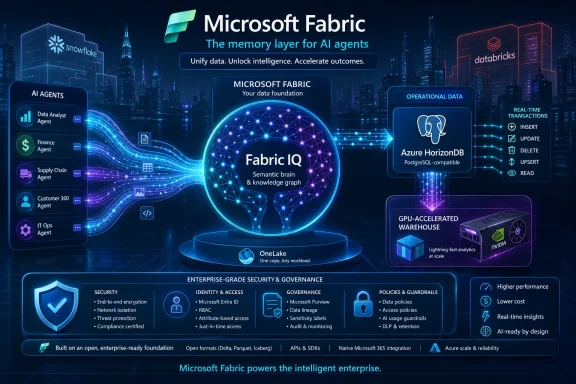
Microsoft used Build 2026 in early June to position Microsoft Fabric as the enterprise data and context platform for AI agents, announcing Azure HorizonDB, GPU-accelerated Fabric Data Warehouse, and Fabric IQ integrations aimed squarely at Snowflake, Databricks, and the growing market for agent-ready business data. The company’s argument is not subtle: models are becoming interchangeable, but the data layer that tells agents what a company knows, permits, sells, owes, and forbids is still up for grabs. If Microsoft is right, the next platform war in enterprise AI will not be won by the chatbot with the best demo, but by the system that makes agents trustworthy enough to touch production workflows.
That is why the Fabric announcements matter beyond the usual Build-season fog of previews, branding, and benchmark claims. Microsoft is trying to turn Fabric from a broad analytics suite into the memory system for the agentic enterprise. The wager is that companies do not merely need faster warehouses or friendlier dashboards; they need a governed, semantic, operationally aware substrate that lets AI act without guessing.
For much of the generative AI boom, the industry’s center of gravity has been the model. GPT, Claude, Gemini, Llama, Mistral, and a parade of specialized models have been treated as the strategic assets, while enterprise software vendors raced to wrap them in copilots and assistants. That phase is not over, but Microsoft’s Build 2026 message suggests the company thinks the most defensible layer has shifted.
The new pitch is that agents are only as useful as the context they can safely retrieve and act upon. A general-purpose model can write a memo, summarize a meeting, or generate code, but an enterprise agent that approves a discount, opens a support case, reconciles a customer record, or recommends a supply-chain adjustment needs far more than language fluency. It needs the company’s definitions, permissions, histories, exceptions, relationships, and real-time signals.
That is the niche Microsoft wants Fabric to occupy. Snowflake and Databricks built their reputations around cloud-scale analytics, lakehouse architectures, machine learning workflows, and data sharing. Microsoft is now trying to define the next category as something broader: a unified data estate where operational records, analytical history, semantic meaning, and AI governance converge.
The framing is convenient for Microsoft because Fabric already carries the company’s everything-bagel ambition. It bundles data engineering, data warehousing, real-time analytics, Power BI, data science, governance hooks, and OneLake under a single SaaS umbrella. The question has always been whether that breadth is a strength or a symptom of Microsoft packaging complexity as integration. Build 2026 gives the company a sharper answer: Fabric is not just another analytics platform; it is where enterprise agents come to understand the business.
The reported specifications are meant to impress: support for databases up to 128TB, up to 3,072 vCores, and sub-millisecond latency claims in certain configurations. Just as important is what Microsoft is bolting around the core database: vector search, AI model management, and direct connectivity into Microsoft Foundry and Fabric. In plain English, Microsoft wants HorizonDB to be a Postgres-shaped operational store that can participate natively in AI workflows instead of being treated as a separate system that agents scrape through connectors.
PostgreSQL compatibility is no accident. Postgres has become the default lingua franca for modern application data, especially among developers who do not want to be trapped in proprietary database semantics before they have proven a workload. By building HorizonDB around the Postgres ecosystem, Microsoft is lowering the psychological switching cost for teams already using Azure Database for PostgreSQL, open-source Postgres, or competing managed Postgres services.
But the more strategic move is the connection between HorizonDB and Fabric. Microsoft is implicitly saying that the old separation between operational and analytical data is becoming less tenable when agents are in the loop. An agent may need to inspect current customer state, reason over historical trends, retrieve policy definitions, and trigger a workflow within a single task. If those pieces live across disconnected systems, every agent becomes a bespoke integration project.
That does not mean HorizonDB suddenly erases decades of database specialization. Operational databases and analytical systems exist separately for good reasons: latency profiles, transaction guarantees, query patterns, cost models, and administrative boundaries differ. Microsoft’s argument is subtler and more dangerous to rivals: the seams should be managed by the platform, not by every application team building an agent.
Those numbers should be treated with the usual caution attached to vendor benchmarks. Workload selection, data shape, concurrency assumptions, warm caches, cost normalization, and tuning all matter. The history of database marketing is littered with tests that were true, narrow, and not representative of what customers actually run on Monday morning.
Still, the architectural direction is significant. GPUs have already reshaped AI training and inference, and they are increasingly being applied to database and analytics acceleration where parallelism maps well to the hardware. Microsoft’s decision to build GPU acceleration directly into Fabric Data Warehouse is a bet that AI-era analytics will not tolerate the performance envelope of traditional CPU-only cloud warehouses.
This is also an economic story. If agents begin issuing analytical queries continuously in response to business events, user requests, workflow checks, and automated planning loops, query volume could climb sharply. A human analyst might ask a dashboard for sales by region once a morning; a swarm of agents might ask variations of that question hundreds of times while preparing recommendations, validating outputs, and monitoring exceptions. Faster queries are not just a convenience in that world. They become a precondition for making agentic systems feel responsive and affordable.
Microsoft’s challenge is to prove that GPU acceleration in Fabric is not merely a premium feature for benchmark-friendly workloads. Enterprise buyers will want to know whether it improves real mixed workloads, whether costs remain predictable, whether existing warehouse designs benefit without painful refactoring, and whether GPU availability becomes another capacity-planning headache. Preview announcements do not answer those questions; production deployments do.
Fabric IQ is Microsoft’s attempt to turn structured business data into a shared semantic foundation for agents. Built on Power BI’s data definition heritage, it adds business concepts such as customers, orders, products, and their relationships, along with rules and real-time signals. The important part is not just that it gives agents more data. It gives them a governed vocabulary and a set of boundaries.
That boundary-setting function deserves more attention than the marketing phrase “context layer.” Enterprise AI is often discussed as if the only problem is giving models more information. In practice, organizations need to define what agents are allowed to infer, disclose, modify, and automate. A sales agent might be allowed to recommend a discount but not approve it. A finance agent might reconcile invoices but not override payment terms. A developer agent might inspect telemetry but not expose customer data into an issue tracker.
Fabric IQ, in theory, gives Microsoft a way to express those concepts once and reuse them across Microsoft Foundry, Microsoft 365 Copilot, Agent 365, and GitHub Copilot CLI. That is where the strategy becomes bigger than Fabric. Microsoft wants the enterprise context graph to follow users and agents across productivity apps, developer tools, business intelligence, and application platforms. If it works, the same definition of “customer risk” or “qualified pipeline” could inform a Copilot answer in Teams, a GitHub workflow, a Foundry agent, and a Power BI report.
That is a powerful vision, but it also raises the stakes for governance errors. A bad semantic layer is worse than no semantic layer because it gives wrong answers institutional authority. Fabric IQ will depend on customers doing the unglamorous work of modeling their businesses cleanly, resolving contradictory definitions, and maintaining the ontology as operations change. Microsoft can provide the platform; it cannot magically adjudicate whether sales or finance owns the truth.
Microsoft’s advantage is distribution. Fabric plugs into Power BI, Microsoft 365, Azure, Entra, Purview, Foundry, and the broader Copilot ecosystem. Many enterprises already live inside that administrative and productivity universe. If Microsoft can make Fabric the path of least resistance for grounding agents in business data, it does not need to beat Snowflake and Databricks on every technical dimension. It needs to make the integrated Microsoft route good enough, governed enough, and easier to buy.
That is why the “single platform” message matters. Snowflake and Databricks can argue, credibly, that specialized platforms provide best-of-breed capabilities for analytics, ML, governance, or data engineering. Microsoft counters with the operational reality of enterprise IT: fewer seams, fewer contracts, fewer connectors, fewer identity translations, and fewer places where agent permissions can drift.
The risk for Microsoft is that “single platform” can become “single maze.” Fabric has grown quickly and sometimes confusingly, with overlapping concepts, fast-moving previews, and product names that sound as if they were generated by a committee trapped inside a taxonomy engine. Customers may like Microsoft’s integration story while still fearing that Fabric’s breadth will create its own complexity tax.
Snowflake and Databricks will also attack from the openness angle. Microsoft’s stack is strongest when customers accept Microsoft identity, Microsoft governance, Microsoft productivity surfaces, Microsoft developer tooling, and Microsoft cloud economics as the default. In heterogeneous enterprises, that is rarely the whole story. The companies most attractive to Microsoft are also the ones most likely to run multicloud data estates, non-Microsoft analytics tools, custom agent frameworks, and regulatory segmentation that resists neat consolidation.
By tying Fabric IQ into Microsoft’s agent governance and productivity ecosystem, Microsoft is attempting to reassure enterprise buyers that agents can be managed like other corporate assets. Entra, Defender, Purview, Foundry, and Fabric all become parts of the same argument: Microsoft can help you build, ground, monitor, and govern agents without inventing a parallel control plane.
For WindowsForum’s audience, this is where the story intersects with day-to-day administration. The agent era will not arrive as a single switch. It will arrive as Copilot features in Microsoft 365, data agents in Fabric, coding agents in GitHub, workflow agents in business apps, and custom agents built by internal teams. The security model will be tested not by the keynote demo but by messy permission inheritance, stale groups, overshared SharePoint sites, ambiguous data classifications, and executives asking why the agent cannot just “do it automatically.”
Fabric IQ can help only if the underlying permissions and data definitions are sane. If a tenant already has years of unmanaged sprawl, agents will expose that sprawl faster than any compliance audit. Microsoft’s agent-control narrative is credible precisely because it maps to real IT pain, but it also makes Microsoft a convenient target when customers discover their own data estates are not ready.
This is the uncomfortable truth behind the context-layer pitch. Enterprise AI does not only require smarter software. It requires cleaner organizations. The technology can surface relationships and enforce rules, but someone still has to decide which rules reflect reality.
Fabric, HorizonDB, and Fabric IQ are all aimed at reducing the gap between “the model can talk about the business” and “the agent can safely operate within the business.” That gap is where many AI pilots have stalled. Demos thrive on curated data and clear prompts. Production systems encounter inconsistent schemas, duplicate customer records, unclear ownership, legacy databases, partial permissions, and edge cases that live in someone’s head.
Microsoft’s answer is to make context a first-class product layer. Work IQ draws from productivity signals. Fabric IQ covers structured business data. Foundry IQ helps agents use institutional knowledge and connected resources. Web IQ brings in external grounding. The branding may be overstuffed, but the architectural point is coherent: agents need multiple kinds of context, and those contexts need to be governed.
This also explains why Microsoft keeps using phrases such as “organizational memory.” The company is not just selling storage or analytics. It is selling a model of the enterprise in which past decisions, present signals, and predicted outcomes can be made available to software agents. That is an ambitious and slightly unsettling proposition.
The unsettling part should not be ignored. If agents become embedded in operational processes, they will shape how organizations perceive themselves. A semantic layer is never neutral; it encodes priorities, hierarchies, and definitions. The company that controls that layer has influence over how work gets interpreted and automated.
Trust has several layers. There is technical trust that the system performs reliably, scales predictably, and respects transactional boundaries. There is security trust that agents cannot exceed permissions, leak sensitive data, or create untraceable side effects. There is semantic trust that business definitions are accurate and maintained. There is operational trust that administrators can observe what agents did and roll back mistakes when possible.
Fabric IQ is Microsoft’s attempt to address semantic and governance trust, while HorizonDB and GPU-accelerated Fabric Data Warehouse address the operational and performance base. But customers should watch for the gaps between those layers. A fast database, a semantic model, and a governance console do not automatically produce accountable automation.
The most mature organizations will treat these tools as infrastructure for controlled experimentation. They will start with bounded agents that retrieve, explain, recommend, and draft before moving into agents that approve, modify, or transact. They will test semantic models like software, monitor agent behavior like production services, and involve domain owners rather than leaving definitions to platform teams alone.
The least mature organizations will connect agents to messy data and mistake Microsoft’s integration for their own readiness. That path leads to the familiar enterprise software hangover: a powerful platform blamed for exposing problems that were already there.
That could be especially appealing for organizations already standardizing on Azure, GitHub, and Microsoft 365. A developer building a support triage agent, a finance workflow, or an internal operations assistant might use Foundry for orchestration, HorizonDB for operational state, Fabric for analytics, and Fabric IQ for business meaning. GitHub Copilot CLI integration points toward a world where developers can query enterprise context from the terminal without leaving their workflow.
On the other hand, every abstraction becomes a dependency. If Fabric IQ becomes the canonical source of enterprise meaning, application behavior may depend on semantic models maintained outside the development team. That can be good governance, but it can also slow iteration if ownership is unclear. Developers will need to understand not just APIs, but the organizational politics encoded in the ontology.
There is also the question of portability. An agent deeply grounded in Fabric IQ, governed by Microsoft identity, monitored through Agent 365, and deployed through Foundry may be productive inside Microsoft’s ecosystem and awkward outside it. That is not necessarily a deal-breaker; enterprise platforms have always traded portability for integration. But teams should make that trade consciously rather than discovering it after the architecture has hardened.
The developer story, then, is not merely “more tools.” It is a shift in where application logic lives. Some logic that once belonged in application code may move into semantic models, policy layers, and agent orchestration. That can make systems more consistent, but it also demands new discipline around versioning, testing, and change control.
This is why Fabric’s competition with Snowflake and Databricks will be more complicated than a simple warehouse bake-off. The old buying questions were about performance, concurrency, storage, data science support, BI integration, and cost. The new questions add agent grounding, semantic consistency, operational connectivity, governance enforcement, and cross-tool context.
Microsoft’s answer is integration by gravity. If your employees use Microsoft 365, your developers use GitHub, your identity lives in Entra, your security teams use Defender and Purview, your AI builders use Foundry, and your analysts use Power BI, Fabric becomes a natural place to concentrate context. That gravity is real.
But gravity can also feel like lock-in. Customers will ask whether Microsoft’s context layer can reflect non-Microsoft systems with equal fidelity, whether governance spans external agents and frameworks cleanly, and whether Fabric can interoperate with open table formats, external catalogs, and existing data investments without turning them into second-class citizens.
The winners in this market may be the vendors that make context portable enough to satisfy architects and governed enough to satisfy CISOs. Microsoft has the advantage of reach. Snowflake and Databricks have the advantage of focus and strong positions in data teams that may distrust a Microsoft-first abstraction. The contest is not settled.
That complexity matters because AI agents amplify misconfiguration. A dashboard user who misunderstands a metric may make a bad decision. An agent that misunderstands the same metric may make that decision repeatedly, at scale, and inside a workflow. The cost of conceptual confusion rises when software becomes more autonomous.
Microsoft therefore needs more than announcements. It needs crisp product boundaries, transparent pricing, reliable documentation, strong migration paths, and administrative tooling that explains how all these layers interact. Fabric IQ in particular must become understandable to business owners, not just data engineers. If the semantic foundation cannot be governed by the people who know the business, it will become another IT artifact divorced from reality.
The company also needs to resist the temptation to rename every concept into the IQ family until the architecture becomes mush. Branding can help executives understand a story, but operators need exact nouns. Is a business definition living in Power BI, Fabric IQ, a semantic model, an ontology item, a data agent, or a Foundry resource? If the answer is “yes,” Microsoft has work to do.
This is not a fatal flaw. It is the predictable tax on Microsoft’s platform strategy. The company often wins by bundling the messy middle that competitors leave to integrators. The trick is making the bundle feel like leverage rather than sediment.
The first question is not whether Fabric can beat Snowflake or Databricks on a benchmark. It is whether your organization knows which data definitions an agent should trust. The second question is whether your permissions model can survive automation. The third is whether your data platform team, security team, and business process owners can work from the same operating model.
A Microsoft-centric shop may find Fabric increasingly difficult to ignore. Power BI’s installed base gives Fabric IQ a natural path into business semantics. Azure gives HorizonDB and Foundry a deployment surface. Microsoft 365 gives agents a workplace interface. GitHub gives developers a daily entry point. That combination is exactly what Microsoft is counting on.
A heterogeneous shop should be more cautious but not dismissive. Fabric may become valuable as a context and governance layer even if Snowflake, Databricks, Oracle, SAP, or custom systems remain central to the data estate. The key will be testing whether Microsoft treats those external systems as first-class participants or merely as sources to be absorbed into its own architecture.
That is why the Fabric announcements matter beyond the usual Build-season fog of previews, branding, and benchmark claims. Microsoft is trying to turn Fabric from a broad analytics suite into the memory system for the agentic enterprise. The wager is that companies do not merely need faster warehouses or friendlier dashboards; they need a governed, semantic, operationally aware substrate that lets AI act without guessing.
 Microsoft Moves the AI Fight Down Into the Data Layer
For much of the generative AI boom, the industry’s center of gravity has been the model. GPT, Claude, Gemini, Llama, Mistral, and a parade of specialized models have been treated as the strategic assets, while enterprise software vendors raced to wrap them in copilots and assistants. That phase is not over, but Microsoft’s Build 2026 message suggests the company thinks the most defensible layer has shifted.The new pitch is that agents are only as useful as the context they can safely retrieve and act upon. A general-purpose model can write a memo, summarize a meeting, or generate code, but an enterprise agent that approves a discount, opens a support case, reconciles a customer record, or recommends a supply-chain adjustment needs far more than language fluency. It needs the company’s definitions, permissions, histories, exceptions, relationships, and real-time signals.
That is the niche Microsoft wants Fabric to occupy. Snowflake and Databricks built their reputations around cloud-scale analytics, lakehouse architectures, machine learning workflows, and data sharing. Microsoft is now trying to define the next category as something broader: a unified data estate where operational records, analytical history, semantic meaning, and AI governance converge.
The framing is convenient for Microsoft because Fabric already carries the company’s everything-bagel ambition. It bundles data engineering, data warehousing, real-time analytics, Power BI, data science, governance hooks, and OneLake under a single SaaS umbrella. The question has always been whether that breadth is a strength or a symptom of Microsoft packaging complexity as integration. Build 2026 gives the company a sharper answer: Fabric is not just another analytics platform; it is where enterprise agents come to understand the business.
Azure HorizonDB Is Microsoft’s Operational Data Opening
Azure HorizonDB is the most direct acknowledgment that the AI-agent story cannot live entirely in a warehouse. Agents that operate on behalf of a business need to interact with operational systems, not merely query yesterday’s dashboards. Microsoft describes HorizonDB as a fully managed PostgreSQL-compatible database, now in public preview, designed for high-scale, low-latency workloads with storage and compute scaled independently.The reported specifications are meant to impress: support for databases up to 128TB, up to 3,072 vCores, and sub-millisecond latency claims in certain configurations. Just as important is what Microsoft is bolting around the core database: vector search, AI model management, and direct connectivity into Microsoft Foundry and Fabric. In plain English, Microsoft wants HorizonDB to be a Postgres-shaped operational store that can participate natively in AI workflows instead of being treated as a separate system that agents scrape through connectors.
PostgreSQL compatibility is no accident. Postgres has become the default lingua franca for modern application data, especially among developers who do not want to be trapped in proprietary database semantics before they have proven a workload. By building HorizonDB around the Postgres ecosystem, Microsoft is lowering the psychological switching cost for teams already using Azure Database for PostgreSQL, open-source Postgres, or competing managed Postgres services.
But the more strategic move is the connection between HorizonDB and Fabric. Microsoft is implicitly saying that the old separation between operational and analytical data is becoming less tenable when agents are in the loop. An agent may need to inspect current customer state, reason over historical trends, retrieve policy definitions, and trigger a workflow within a single task. If those pieces live across disconnected systems, every agent becomes a bespoke integration project.
That does not mean HorizonDB suddenly erases decades of database specialization. Operational databases and analytical systems exist separately for good reasons: latency profiles, transaction guarantees, query patterns, cost models, and administrative boundaries differ. Microsoft’s argument is subtler and more dangerous to rivals: the seams should be managed by the platform, not by every application team building an agent.
GPU Acceleration Turns Fabric’s Warehouse Into a Benchmark Weapon
The GPU-accelerated Fabric Data Warehouse announcement is the flashier piece of the Build package because it gives Microsoft a clean performance story. The company says query acceleration will enter early access preview in July 2026 and claims internal benchmarks show up to 7x faster performance than three comparable cloud data warehouse vendors for selected reporting and application workloads. Amir Netz, the CTO of Microsoft Fabric, reportedly framed the gains even more aggressively, saying GPU acceleration can deliver improvements ranging from 5x to 100x in some data-warehousing scenarios.Those numbers should be treated with the usual caution attached to vendor benchmarks. Workload selection, data shape, concurrency assumptions, warm caches, cost normalization, and tuning all matter. The history of database marketing is littered with tests that were true, narrow, and not representative of what customers actually run on Monday morning.
Still, the architectural direction is significant. GPUs have already reshaped AI training and inference, and they are increasingly being applied to database and analytics acceleration where parallelism maps well to the hardware. Microsoft’s decision to build GPU acceleration directly into Fabric Data Warehouse is a bet that AI-era analytics will not tolerate the performance envelope of traditional CPU-only cloud warehouses.
This is also an economic story. If agents begin issuing analytical queries continuously in response to business events, user requests, workflow checks, and automated planning loops, query volume could climb sharply. A human analyst might ask a dashboard for sales by region once a morning; a swarm of agents might ask variations of that question hundreds of times while preparing recommendations, validating outputs, and monitoring exceptions. Faster queries are not just a convenience in that world. They become a precondition for making agentic systems feel responsive and affordable.
Microsoft’s challenge is to prove that GPU acceleration in Fabric is not merely a premium feature for benchmark-friendly workloads. Enterprise buyers will want to know whether it improves real mixed workloads, whether costs remain predictable, whether existing warehouse designs benefit without painful refactoring, and whether GPU availability becomes another capacity-planning headache. Preview announcements do not answer those questions; production deployments do.
Fabric IQ Is the Real Centerpiece, Even If the Database Gets the Applause
The most consequential Build announcement may be Fabric IQ, because it addresses the hardest problem in enterprise AI: meaning. Raw data is not enough. A table named “customer” may mean different things to sales, finance, support, legal, and product teams. An “active account” may depend on contracts, payments, usage, compliance status, and exceptions buried in policy. An AI agent that does not understand those definitions will produce confident nonsense at enterprise scale.Fabric IQ is Microsoft’s attempt to turn structured business data into a shared semantic foundation for agents. Built on Power BI’s data definition heritage, it adds business concepts such as customers, orders, products, and their relationships, along with rules and real-time signals. The important part is not just that it gives agents more data. It gives them a governed vocabulary and a set of boundaries.
That boundary-setting function deserves more attention than the marketing phrase “context layer.” Enterprise AI is often discussed as if the only problem is giving models more information. In practice, organizations need to define what agents are allowed to infer, disclose, modify, and automate. A sales agent might be allowed to recommend a discount but not approve it. A finance agent might reconcile invoices but not override payment terms. A developer agent might inspect telemetry but not expose customer data into an issue tracker.
Fabric IQ, in theory, gives Microsoft a way to express those concepts once and reuse them across Microsoft Foundry, Microsoft 365 Copilot, Agent 365, and GitHub Copilot CLI. That is where the strategy becomes bigger than Fabric. Microsoft wants the enterprise context graph to follow users and agents across productivity apps, developer tools, business intelligence, and application platforms. If it works, the same definition of “customer risk” or “qualified pipeline” could inform a Copilot answer in Teams, a GitHub workflow, a Foundry agent, and a Power BI report.
That is a powerful vision, but it also raises the stakes for governance errors. A bad semantic layer is worse than no semantic layer because it gives wrong answers institutional authority. Fabric IQ will depend on customers doing the unglamorous work of modeling their businesses cleanly, resolving contradictory definitions, and maintaining the ontology as operations change. Microsoft can provide the platform; it cannot magically adjudicate whether sales or finance owns the truth.
The Snowflake and Databricks Comparison Is Really About Control
Microsoft’s attempt to differentiate Fabric from Snowflake and Databricks is not merely a feature checklist. It is a fight over who gets to be the enterprise data control plane in the agent era. Snowflake has pushed hard into data sharing, governance, native apps, and AI. Databricks has pushed the lakehouse, ML tooling, MosaicML, Unity Catalog, and open table formats. Both companies understand that AI workloads make data platforms more valuable, not less.Microsoft’s advantage is distribution. Fabric plugs into Power BI, Microsoft 365, Azure, Entra, Purview, Foundry, and the broader Copilot ecosystem. Many enterprises already live inside that administrative and productivity universe. If Microsoft can make Fabric the path of least resistance for grounding agents in business data, it does not need to beat Snowflake and Databricks on every technical dimension. It needs to make the integrated Microsoft route good enough, governed enough, and easier to buy.
That is why the “single platform” message matters. Snowflake and Databricks can argue, credibly, that specialized platforms provide best-of-breed capabilities for analytics, ML, governance, or data engineering. Microsoft counters with the operational reality of enterprise IT: fewer seams, fewer contracts, fewer connectors, fewer identity translations, and fewer places where agent permissions can drift.
The risk for Microsoft is that “single platform” can become “single maze.” Fabric has grown quickly and sometimes confusingly, with overlapping concepts, fast-moving previews, and product names that sound as if they were generated by a committee trapped inside a taxonomy engine. Customers may like Microsoft’s integration story while still fearing that Fabric’s breadth will create its own complexity tax.
Snowflake and Databricks will also attack from the openness angle. Microsoft’s stack is strongest when customers accept Microsoft identity, Microsoft governance, Microsoft productivity surfaces, Microsoft developer tooling, and Microsoft cloud economics as the default. In heterogeneous enterprises, that is rarely the whole story. The companies most attractive to Microsoft are also the ones most likely to run multicloud data estates, non-Microsoft analytics tools, custom agent frameworks, and regulatory segmentation that resists neat consolidation.
The Agent 365 Connection Makes This an IT Governance Story
Agent 365 is an important part of the backdrop because Microsoft is not only selling agent capability; it is selling agent administration. As agents proliferate, IT departments will need inventory, identity, permissions, observability, policy enforcement, and audit trails. The nightmare scenario is not that one chatbot hallucinates a bad answer. It is that dozens of semi-autonomous agents quietly perform actions nobody can explain after the fact.By tying Fabric IQ into Microsoft’s agent governance and productivity ecosystem, Microsoft is attempting to reassure enterprise buyers that agents can be managed like other corporate assets. Entra, Defender, Purview, Foundry, and Fabric all become parts of the same argument: Microsoft can help you build, ground, monitor, and govern agents without inventing a parallel control plane.
For WindowsForum’s audience, this is where the story intersects with day-to-day administration. The agent era will not arrive as a single switch. It will arrive as Copilot features in Microsoft 365, data agents in Fabric, coding agents in GitHub, workflow agents in business apps, and custom agents built by internal teams. The security model will be tested not by the keynote demo but by messy permission inheritance, stale groups, overshared SharePoint sites, ambiguous data classifications, and executives asking why the agent cannot just “do it automatically.”
Fabric IQ can help only if the underlying permissions and data definitions are sane. If a tenant already has years of unmanaged sprawl, agents will expose that sprawl faster than any compliance audit. Microsoft’s agent-control narrative is credible precisely because it maps to real IT pain, but it also makes Microsoft a convenient target when customers discover their own data estates are not ready.
This is the uncomfortable truth behind the context-layer pitch. Enterprise AI does not only require smarter software. It requires cleaner organizations. The technology can surface relationships and enforce rules, but someone still has to decide which rules reflect reality.
Build 2026 Shows Microsoft Has Learned From the Copilot Rollout
The first wave of enterprise copilots often felt like AI laid on top of existing products. Sometimes that was useful; sometimes it was a text box looking for a reason to exist. Build 2026 suggests Microsoft has internalized a lesson from that phase: enterprise AI becomes more compelling when the agent can perform work inside a specific business context rather than merely summarize documents.Fabric, HorizonDB, and Fabric IQ are all aimed at reducing the gap between “the model can talk about the business” and “the agent can safely operate within the business.” That gap is where many AI pilots have stalled. Demos thrive on curated data and clear prompts. Production systems encounter inconsistent schemas, duplicate customer records, unclear ownership, legacy databases, partial permissions, and edge cases that live in someone’s head.
Microsoft’s answer is to make context a first-class product layer. Work IQ draws from productivity signals. Fabric IQ covers structured business data. Foundry IQ helps agents use institutional knowledge and connected resources. Web IQ brings in external grounding. The branding may be overstuffed, but the architectural point is coherent: agents need multiple kinds of context, and those contexts need to be governed.
This also explains why Microsoft keeps using phrases such as “organizational memory.” The company is not just selling storage or analytics. It is selling a model of the enterprise in which past decisions, present signals, and predicted outcomes can be made available to software agents. That is an ambitious and slightly unsettling proposition.
The unsettling part should not be ignored. If agents become embedded in operational processes, they will shape how organizations perceive themselves. A semantic layer is never neutral; it encodes priorities, hierarchies, and definitions. The company that controls that layer has influence over how work gets interpreted and automated.
The Performance Story Will Not Matter Without Trust
Microsoft’s GPU claims and HorizonDB scale numbers are impressive, but the real adoption barrier is trust. Enterprise buyers have seen enough AI demos to know that speed can make bad automation worse. An agent that reaches the wrong answer in 50 milliseconds is not a productivity breakthrough.Trust has several layers. There is technical trust that the system performs reliably, scales predictably, and respects transactional boundaries. There is security trust that agents cannot exceed permissions, leak sensitive data, or create untraceable side effects. There is semantic trust that business definitions are accurate and maintained. There is operational trust that administrators can observe what agents did and roll back mistakes when possible.
Fabric IQ is Microsoft’s attempt to address semantic and governance trust, while HorizonDB and GPU-accelerated Fabric Data Warehouse address the operational and performance base. But customers should watch for the gaps between those layers. A fast database, a semantic model, and a governance console do not automatically produce accountable automation.
The most mature organizations will treat these tools as infrastructure for controlled experimentation. They will start with bounded agents that retrieve, explain, recommend, and draft before moving into agents that approve, modify, or transact. They will test semantic models like software, monitor agent behavior like production services, and involve domain owners rather than leaving definitions to platform teams alone.
The least mature organizations will connect agents to messy data and mistake Microsoft’s integration for their own readiness. That path leads to the familiar enterprise software hangover: a powerful platform blamed for exposing problems that were already there.
Developers Get a New Data Surface, and a New Dependency
For developers, Microsoft’s Fabric push cuts both ways. On one hand, connecting agents to structured business context through Fabric IQ and HorizonDB could reduce the amount of custom plumbing required to build useful internal applications. Instead of writing one-off retrieval logic, permission checks, semantic mappings, and data connectors for every agent, teams may be able to rely on Microsoft’s context layer.That could be especially appealing for organizations already standardizing on Azure, GitHub, and Microsoft 365. A developer building a support triage agent, a finance workflow, or an internal operations assistant might use Foundry for orchestration, HorizonDB for operational state, Fabric for analytics, and Fabric IQ for business meaning. GitHub Copilot CLI integration points toward a world where developers can query enterprise context from the terminal without leaving their workflow.
On the other hand, every abstraction becomes a dependency. If Fabric IQ becomes the canonical source of enterprise meaning, application behavior may depend on semantic models maintained outside the development team. That can be good governance, but it can also slow iteration if ownership is unclear. Developers will need to understand not just APIs, but the organizational politics encoded in the ontology.
There is also the question of portability. An agent deeply grounded in Fabric IQ, governed by Microsoft identity, monitored through Agent 365, and deployed through Foundry may be productive inside Microsoft’s ecosystem and awkward outside it. That is not necessarily a deal-breaker; enterprise platforms have always traded portability for integration. But teams should make that trade consciously rather than discovering it after the architecture has hardened.
The developer story, then, is not merely “more tools.” It is a shift in where application logic lives. Some logic that once belonged in application code may move into semantic models, policy layers, and agent orchestration. That can make systems more consistent, but it also demands new discipline around versioning, testing, and change control.
The Enterprise Data Platform Is Becoming the Agent Runtime’s Memory
The most interesting implication of Microsoft’s Build announcements is that the boundary between data platform and AI platform is dissolving. Warehouses, lakehouses, operational databases, semantic models, vector indexes, governance catalogs, and agent runtimes are being pulled into one conversation. That conversation is not about where data rests; it is about how software decides what to do.This is why Fabric’s competition with Snowflake and Databricks will be more complicated than a simple warehouse bake-off. The old buying questions were about performance, concurrency, storage, data science support, BI integration, and cost. The new questions add agent grounding, semantic consistency, operational connectivity, governance enforcement, and cross-tool context.
Microsoft’s answer is integration by gravity. If your employees use Microsoft 365, your developers use GitHub, your identity lives in Entra, your security teams use Defender and Purview, your AI builders use Foundry, and your analysts use Power BI, Fabric becomes a natural place to concentrate context. That gravity is real.
But gravity can also feel like lock-in. Customers will ask whether Microsoft’s context layer can reflect non-Microsoft systems with equal fidelity, whether governance spans external agents and frameworks cleanly, and whether Fabric can interoperate with open table formats, external catalogs, and existing data investments without turning them into second-class citizens.
The winners in this market may be the vendors that make context portable enough to satisfy architects and governed enough to satisfy CISOs. Microsoft has the advantage of reach. Snowflake and Databricks have the advantage of focus and strong positions in data teams that may distrust a Microsoft-first abstraction. The contest is not settled.
The Fabric Bet Comes With a Very Microsoft Risk
Microsoft’s greatest strength in enterprise software is also its recurring weakness: it can integrate everything with everything until customers need a map to understand what they bought. Fabric already has Lakehouse, Warehouse, Eventhouse, Data Factory, Real-Time Intelligence, Power BI, OneLake, shortcuts, semantic models, notebooks, data agents, governance integrations, and now deeper IQ branding layered into the mix. For Microsoft insiders, this may look like a unified platform. For administrators and architects, it may look like another certification path.That complexity matters because AI agents amplify misconfiguration. A dashboard user who misunderstands a metric may make a bad decision. An agent that misunderstands the same metric may make that decision repeatedly, at scale, and inside a workflow. The cost of conceptual confusion rises when software becomes more autonomous.
Microsoft therefore needs more than announcements. It needs crisp product boundaries, transparent pricing, reliable documentation, strong migration paths, and administrative tooling that explains how all these layers interact. Fabric IQ in particular must become understandable to business owners, not just data engineers. If the semantic foundation cannot be governed by the people who know the business, it will become another IT artifact divorced from reality.
The company also needs to resist the temptation to rename every concept into the IQ family until the architecture becomes mush. Branding can help executives understand a story, but operators need exact nouns. Is a business definition living in Power BI, Fabric IQ, a semantic model, an ontology item, a data agent, or a Foundry resource? If the answer is “yes,” Microsoft has work to do.
This is not a fatal flaw. It is the predictable tax on Microsoft’s platform strategy. The company often wins by bundling the messy middle that competitors leave to integrators. The trick is making the bundle feel like leverage rather than sediment.
The Practical Read for Windows and Microsoft Shops
For organizations already committed to Microsoft’s stack, the Build 2026 Fabric announcements should be read as a planning signal rather than an immediate migration order. HorizonDB is in preview, GPU acceleration is headed for early access, and Fabric IQ’s broad promise will mature through real deployments. The direction, however, is clear enough that IT leaders should start aligning data governance and agent strategy now.The first question is not whether Fabric can beat Snowflake or Databricks on a benchmark. It is whether your organization knows which data definitions an agent should trust. The second question is whether your permissions model can survive automation. The third is whether your data platform team, security team, and business process owners can work from the same operating model.
A Microsoft-centric shop may find Fabric increasingly difficult to ignore. Power BI’s installed base gives Fabric IQ a natural path into business semantics. Azure gives HorizonDB and Foundry a deployment surface. Microsoft 365 gives agents a workplace interface. GitHub gives developers a daily entry point. That combination is exactly what Microsoft is counting on.
A heterogeneous shop should be more cautious but not dismissive. Fabric may become valuable as a context and governance layer even if Snowflake, Databricks, Oracle, SAP, or custom systems remain central to the data estate. The key will be testing whether Microsoft treats those external systems as first-class participants or merely as sources to be absorbed into its own architecture.
The Agent Data Stack Starts to Look Like a Governance Project
The most concrete lesson from Build 2026 is that agent readiness is data readiness wearing a new badge. Microsoft’s announcements are ambitious, but they do not let customers skip the hard work of rationalizing identity, definitions, lineage, policy, and operational ownership. If anything, they make that work more urgent.- Azure HorizonDB gives Microsoft a Postgres-compatible operational database story that is designed to sit closer to AI workflows than traditional managed databases.
- GPU-accelerated Fabric Data Warehouse gives Microsoft a performance argument for agent-heavy analytics workloads, though real customer economics will matter more than internal benchmarks.
- Fabric IQ is the strategic center of the announcement because it tries to give agents shared business meaning, not just more data.
- Microsoft’s strongest advantage against Snowflake and Databricks is the breadth of its ecosystem across Microsoft 365, Azure, GitHub, Power BI, Entra, Purview, and Foundry.
- The biggest customer risk is assuming that Microsoft’s context layer can compensate for messy permissions, disputed business definitions, and weak data ownership.
- The near-term opportunity is to use Fabric and Microsoft IQ components for bounded, observable agent scenarios before allowing agents to modify production workflows.
References
- Primary source: 디지털투데이
Published: 2026-06-07T20:31:07.463492
Microsoft Fabric aims to be data platform for AI agents, targeting Snowflake and Databricks
Microsoft unveiled three new products at its Build 2026 conference to strengthen data infrastructure for AI agents. Fabric CTO Amir Netz said enterprise AI needs a “context layer” to operate reliably. Microsoft introduced Azure HorizonDB, a fully managed PostgreSQL-compatible database in public...www.digitaltoday.co.kr - Related coverage: windowscentral.com
"Agents are only as good as the context we give them": Microsoft IQ connects AI agents to your workspace data and the web | Windows Central
The newly unveiled Microsoft IQ data stack and Scout assistant turn generic AI into a personalized workplace tool.www.windowscentral.com - Related coverage: techradar.com
From code-first to intent-first: Microsoft Build 2026 could be the end of programming as we know it | TechRadar
Redefining what it means to be a developer with agentic AIwww.techradar.com - Official source: azure.microsoft.com
Microsoft Build 2026: Building agentic apps with Microsoft Fabric and Microsoft Databases | Microsoft Azure Blog
Microsoft Build 2026 highlights advancements in app development with Microsoft Fabric and Microsoft Databases, emphasizing a unified data and AI platform.azure.microsoft.com - Official source: blogs.microsoft.com
Microsoft Build 2026: Be yourself at work - The Official Microsoft Blog
Platforms shift when developers build. We explore, choose tools, dream, create. This platform shift comes with more information than ever, ready at your fingertips. This shift, it’s about building fast AND THEN: it’s about building, operating, optimizing and observing. Securing your...blogs.microsoft.com - Official source: learn.microsoft.com
What Is Azure HorizonDB? - Azure HorizonDB | Microsoft Learn
Learn about Azure HorizonDB, a fully managed, AI-ready database service built on PostgreSQL engineered for performance and scale.learn.microsoft.com
- Related coverage: thenewstack.io
Microsoft bets the enterprise AI race will be won on data context, not model power
At Microsoft Build 2026, Azure HorizonDB, GPU-accelerated Fabric Data Warehouse, and Fabric IQ GA aim to give enterprise AI agents shared organizational context. thenewstack.io
- Related coverage: ebisuda.net
Microsoft Build 2026:Azure HorizonDB・Foundry IQ・Claude正式採用——AIは「実験」から「本番運用」へ | ebisuda.net
Microsoft Build 2026でAzure HorizonDB・Foundry IQ・Claude正式統合を発表、AIの実験フェーズ終了と本番運用移行時代の到来を宣言。www.ebisuda.net
- Official source: devblogs.microsoft.com
What's new in Microsoft Foundry | Build Edition | Microsoft Foundry Blog
Microsoft Build 2026 brings a major set of Microsoft Foundry updates for developers building agents: hosted runtimes, Toolboxes, memory, Voice Live, Foundry IQ, new models, managed compute, and trust, evaluation, and observability tools.devblogs.microsoft.com - Related coverage: techtarget.com
Microsoft boosts Fabric to make it a foundation for AI | TechTarget
With new features that fuel agents with contextually relevant data, Microsoft is making its Fabric platform a foundation layer for AI.www.techtarget.com - Related coverage: kucoin.com
Microsoft Launches IQ Platform and Hosted Agents at Build 2026 | KuCoin
Microsoft just gave its AI agents a memory upgrade. At its Build 2026 conference on June 2 in San Francisco, the company introduced Microsoft IQ, a new intelligwww.kucoin.com - Official source: community.fabric.microsoft.com
Building the agentic analytics stack: Fabric Analy... - Microsoft Fabric Community
If you haven’t already, check out Arun Ulag’s hero blog “ Microsoft Build 2026: Building Agentic Apps with Microsoft Fabric and Microsoft Databases ”community.fabric.microsoft.com - Related coverage: tomsguide.com
Biggest Microsoft Build 2026 announcements — agentic AI, RTX Spark Dev Box, GitHub Copilot app, new MAI models, and more | Tom's Guide
All the big news from Microsoft's AI-focused eventwww.tomsguide.com - Related coverage: itpro.com
‘Fragmentation is poison’: How Microsoft is targeting disparate data to boost AI adoption | IT Pro
Amir Netz, the co-creator of Microsoft's Power BI service, tells ITPro that business context is key to effective AI deployment.www.itpro.com - Official source: cdn-dynmedia-1.microsoft.com
- Related coverage: isg.sitefinity.cloud
MSFT Blueprint 2026
Business people join puzzle pieces in office. Concept of teamwork and partnership. double exposure with light effectsisg.sitefinity.cloud
- Related coverage: convergence365.com
</rdf:Alt> </dc:title> <dc:creator> <rdf:Seq> <rdf:li>Michelle Maxwell (DYNAMIC EVENTS INC)
PDF documentconvergence365.com
- Official source: techcommunity.microsoft.com
