

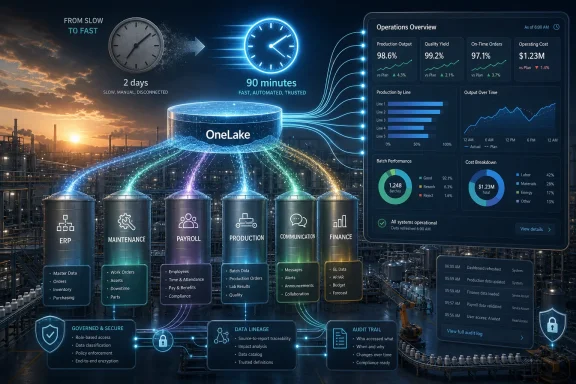
FoodPharma, a California-based contract manufacturer of functional foods, used Microsoft Fabric with implementation partner Kanerika to consolidate data from six disconnected business systems, cutting cross-functional reporting from roughly two business days to about 90 minutes after a seven-week production rollout. That is the tidy customer-story version. The more interesting version is that a mid-market manufacturer just demonstrated why Microsoft is pushing Fabric as less of a dashboard tool and more of an operating layer for companies that have outgrown spreadsheet glue. The win is not merely faster reporting; it is the conversion of fragmented operational memory into something the business can query before the decision window closes.
Every company says it wants to be data-driven until the data lives in six systems, each of which is “the source of truth” for a different department. FoodPharma’s setup will feel familiar to anyone who has spent time around manufacturing, distribution, healthcare, or regulated consumer goods. Finance lived in NetSuite. Production lived in RedZone. Manufacturing execution lived in Parity Factory. Maintenance lived in UpKeep. Payroll lived in Paychex. Communications lived in Outlook.
None of that is inherently broken. In fact, this is how modern business software usually arrives: one best-fit system at a time, selected by the team with the most urgent need and the budget to solve it. The ERP does ERP, the maintenance system does maintenance, the production platform does plant-floor reality, and the payroll system pays people correctly. The fragmentation becomes visible only when leadership asks a question that crosses those boundaries.
That is where FoodPharma’s two-day reporting lag matters. A plant manager seeing a yield dip at 9 AM was not asking an exotic analytics question. The obvious operational questions were basic: what happened on that line, who was staffed, what maintenance events preceded the dip, and what did the batch cost? The problem was not a lack of data. It was that the answer lived across four operational domains and had to be assembled by human beings after the fact.
Microsoft’s customer story frames the result as a Fabric success, and it is. But the deeper lesson is about the limits of application-by-application modernization. Once a business reaches a certain level of complexity, the question is no longer whether each system works. The question is whether the company can make decisions across them without turning analysts into full-time data couriers.
By the time a manually assembled report lands, the shift has changed, the batch has moved, the decision has been made, or the customer conversation has already happened. The business still gets a report, but it gets a report that explains yesterday’s missed opportunity instead of shaping today’s response. That is the quiet cost of siloed systems: not just analyst hours, but stale accountability.
The BI team carried that cost directly. Analysts extracted data from each platform, reconciled fields and timestamps, and rebuilt cross-functional views in spreadsheets. This is the kind of work that often gets described as “reporting,” but it is really manual integration with a prettier name. It consumes skilled people on repetitive assembly work while creating more places for version drift and interpretation errors to creep in.
The FP&A team felt the same drag from the financial side. Cost per unit, margin by product line, and labor productivity are not abstract finance metrics in a manufacturing business. They are operating signals. If those numbers require finance, production, HR, and maintenance data to be pulled together by hand, the finance function becomes slower than the business it is supposed to guide.
That distinction matters. Many enterprise data projects fail because they try to solve every governance, analytics, AI, and process problem at once. FoodPharma’s version had two practical requirements: bring the full historical record into one place, and automate daily refreshes so the platform would be useful every morning. That is less glamorous than an AI moonshot, but it is the part that determines whether an AI moonshot ever has a runway.
Microsoft Fabric’s pitch is well suited to this kind of implementation. OneLake provides the common storage layer, Data Pipelines and Dataflow Gen2 handle movement and transformation, and Power BI gives the business a familiar analytics surface. In Microsoft’s preferred telling, Fabric reduces the number of seams between ingestion, storage, modeling, analytics, governance, and AI.
The risk, of course, is that platforms promising fewer seams can become very large seams of their own. A lakehouse is not magic. It still needs source-system knowledge, data modeling discipline, access control, quality checks, and someone willing to decide what a field means when NetSuite and a production system describe reality differently. FoodPharma’s result is notable because it suggests the project stayed close enough to concrete business questions to avoid becoming architecture for architecture’s sake.
That is why the governance angle in this story deserves more attention than the headline number. Consolidating data is easy to describe and difficult to make trustworthy. The moment a plant manager, finance leader, or quality team relies on a cross-functional dashboard, the platform is no longer a convenience layer. It becomes part of how the business explains itself.
Fabric’s advantage here is not simply that Microsoft has a lakehouse. It is that Microsoft can sell the lakehouse as part of a broader governance and analytics environment that many enterprises already understand. Power BI is already embedded in many organizations. Microsoft Entra, Purview, and the wider Microsoft security model give IT departments familiar concepts for identity, access, and compliance. For companies already inside the Microsoft stack, that familiarity lowers the political and operational cost of centralizing data.
Still, trust is earned locally. A report that updates daily is only useful if the people using it believe the numbers are correct, timely, and explainable. FoodPharma’s migration of historical data matters because history gives teams context. Daily refresh matters because timeliness gives the system relevance. Traceability matters because it lets the organization defend the answer when someone asks where it came from.
But the article practically argues against the hype cycle by accident. FoodPharma did not need a chatbot to discover that reporting took too long. It needed a reliable data foundation. Before predictive maintenance comes maintenance history in the same analytical environment as production output. Before yield optimization comes consistent batch, shift, cost, and line data. Before Copilot can answer a plant manager’s question, someone has to make sure the answerable data exists.
That is the lesson many enterprise AI projects are learning the hard way. Models are the visible layer, but data readiness is the expensive layer. If the numbers disagree across systems, lineage is unclear, and refreshes depend on manual work, AI simply accelerates confusion. It gives the business faster access to uncertainty.
FoodPharma’s implementation is therefore best understood as an AI-enabling project whose immediate value came from ordinary operational discipline. The company recovered roughly 15 hours per week of manual BI work and reduced reporting time from two business days to 90 minutes. Those are not speculative gains. They are measurable reductions in friction. If AI comes later, it will be building on a platform that already pays rent.
That makes it a useful example of where Microsoft wants Fabric to fit. The product is not only a response to Snowflake, Databricks, and the modern data stack. It is also a response to the ordinary mess created by SaaS adoption. Every department bought or inherited tools that solved local problems. Now the organization needs a common plane across them.
Microsoft’s advantage is distribution. Many companies already use Power BI, Microsoft 365, Outlook, Teams, Azure, and Entra. Fabric can be positioned less as a new destination and more as a consolidation of analytics capabilities into a familiar ecosystem. For IT departments trying to reduce tool sprawl, that argument has force.
The counterargument is lock-in. Once an organization centralizes pipelines, storage, semantic models, governance, and reporting inside Fabric, moving away later is not trivial. Microsoft talks about open lakehouse architecture, and open formats help, but platform gravity is still platform gravity. The more useful Fabric becomes, the more strategic the dependency becomes.
In the old world, that meant file shares, Access databases, scheduled exports, SQL Server jobs, and Excel workbooks with mysterious macros. In the newer world, it means SaaS APIs, dataflows, lakehouses, semantic models, and dashboards. The underlying job is the same. Someone must turn departmental software into organizational intelligence.
FoodPharma’s case also illustrates why “just use the API” is not a strategy. Each system may expose data, but cross-functional reporting requires more than extraction. It requires alignment of keys, timestamps, definitions, permissions, and refresh expectations. A plant-floor event, a maintenance ticket, a payroll record, and a finance transaction are all true in their own systems. The business value appears when they can be read together.
That is where IT’s role becomes strategic. The people who understand identity, access, data movement, reliability, monitoring, and change management are the people who determine whether a platform like Fabric becomes a trusted operating layer or another dashboard graveyard. The technology stack may be cloud-native, but the operational discipline is classic systems work.
When answers can arrive before lunch, different questions become possible. A plant manager can investigate a yield dip while the shift context is still fresh. Finance can respond to a margin question in the same leadership cycle. BI analysts can spend less time reconciling extracts and more time improving models, interpreting trends, and building reusable views.
This is the part of data modernization that rarely fits neatly into an ROI spreadsheet. Faster reporting does not merely save labor. It changes the cadence of management. Meetings become less about assigning someone to go find the answer and more about deciding what to do with the answer already on screen.
That does not mean every decision becomes better. Faster access to data can also produce faster overconfidence, especially if users mistake a dashboard for a complete explanation. But the alternative — delayed, manually stitched reports that arrive after the operational moment has passed — is clearly worse. FoodPharma’s gain is that it moved closer to decision-time data without abandoning governance.
The value of a partner in these projects is not simply technical labor. It is pattern recognition. A partner that has done enough integrations knows where source systems are likely to be messy, where the API documentation is optimistic, where field definitions diverge, and where business users will later discover that “production date” means different things in different contexts.
That partner dependency is both an accelerant and a caution. A seven-week rollout is easier to believe when a specialist is doing the integration work. But it also means customers should be careful not to confuse the product purchase with the project outcome. Fabric may provide the platform, but implementation quality still determines whether the data foundation is durable.
For Microsoft, the partner ecosystem is part of the product strategy. Fabric becomes more attractive when customers believe there is a bench of integrators who can connect industry-specific systems and deliver outcomes quickly. For customers, the implication is straightforward: evaluate the implementation path as seriously as the software license.
A dashboard answers a set of known questions. A foundation layer makes new questions cheaper to ask. If the history is centralized, refreshes are automated, and lineage is trusted, then finance, operations, quality, and leadership can build new views without starting from six exports and a spreadsheet. The business gains optionality.
That optionality is what makes Fabric strategically important to Microsoft. The company does not want customers to think of analytics as a report-generation function. It wants Fabric to be the data substrate for Power BI, Copilot, real-time intelligence, machine learning, and whatever agentic workflows Microsoft brings to market next. In that strategy, today’s reporting project is tomorrow’s AI dependency.
FoodPharma’s story fits that playbook neatly. The current win is reporting speed. The next pitch is predictive maintenance, yield optimization, anomaly detection, and direct question-answering over business data. Whether those next use cases succeed will depend less on the glamour of AI than on the boring reliability of the data platform now in place.
That is the message Microsoft wants CIOs, CFOs, plant leaders, and BI managers to absorb. The value is not in replacing every operational system with one monolith. The value is in accepting that specialized systems will remain, then building a governed analytical layer that lets the organization reason across them.
For IT teams, the practical implication is that data integration has become an everyday operating requirement, not a once-a-decade warehouse project. SaaS sprawl is now normal. Cross-functional reporting is now table stakes. AI ambitions are now everywhere. The organizations that cannot establish clean, governed, routinely refreshed data foundations will find themselves trying to automate around confusion.
That is why this story matters beyond one manufacturer. It shows Fabric being used not as a science project, but as connective tissue. In a market full of grand AI claims, that is a more credible and more consequential kind of modernization.
 Microsoft Fabric Wins When the Spreadsheet Stops Being the Integration Layer
Every company says it wants to be data-driven until the data lives in six systems, each of which is “the source of truth” for a different department. FoodPharma’s setup will feel familiar to anyone who has spent time around manufacturing, distribution, healthcare, or regulated consumer goods. Finance lived in NetSuite. Production lived in RedZone. Manufacturing execution lived in Parity Factory. Maintenance lived in UpKeep. Payroll lived in Paychex. Communications lived in Outlook.None of that is inherently broken. In fact, this is how modern business software usually arrives: one best-fit system at a time, selected by the team with the most urgent need and the budget to solve it. The ERP does ERP, the maintenance system does maintenance, the production platform does plant-floor reality, and the payroll system pays people correctly. The fragmentation becomes visible only when leadership asks a question that crosses those boundaries.
That is where FoodPharma’s two-day reporting lag matters. A plant manager seeing a yield dip at 9 AM was not asking an exotic analytics question. The obvious operational questions were basic: what happened on that line, who was staffed, what maintenance events preceded the dip, and what did the batch cost? The problem was not a lack of data. It was that the answer lived across four operational domains and had to be assembled by human beings after the fact.
Microsoft’s customer story frames the result as a Fabric success, and it is. But the deeper lesson is about the limits of application-by-application modernization. Once a business reaches a certain level of complexity, the question is no longer whether each system works. The question is whether the company can make decisions across them without turning analysts into full-time data couriers.
FoodPharma’s Real Bottleneck Was Time, Not Technology
The most revealing detail in the FoodPharma case is not the number of tables migrated or even the terabyte of historical data consolidated. It is the time gap between the operational question and the operational answer. Two business days is an eternity in a plant environment, especially when the problem under investigation is yield, labor productivity, maintenance timing, or material cost.By the time a manually assembled report lands, the shift has changed, the batch has moved, the decision has been made, or the customer conversation has already happened. The business still gets a report, but it gets a report that explains yesterday’s missed opportunity instead of shaping today’s response. That is the quiet cost of siloed systems: not just analyst hours, but stale accountability.
The BI team carried that cost directly. Analysts extracted data from each platform, reconciled fields and timestamps, and rebuilt cross-functional views in spreadsheets. This is the kind of work that often gets described as “reporting,” but it is really manual integration with a prettier name. It consumes skilled people on repetitive assembly work while creating more places for version drift and interpretation errors to creep in.
The FP&A team felt the same drag from the financial side. Cost per unit, margin by product line, and labor productivity are not abstract finance metrics in a manufacturing business. They are operating signals. If those numbers require finance, production, HR, and maintenance data to be pulled together by hand, the finance function becomes slower than the business it is supposed to guide.
The Seven-Week Rollout Says as Much About Scope as It Does About Fabric
FoodPharma and Kanerika reportedly moved from a validated Proof of Value into a seven-week implementation that consolidated more than 50 tables and roughly 1 TB of historical data from the six core systems. That timeline is short enough to sound like marketing, but not so short as to be implausible. The key is that the project appears to have been scoped around a clear foundation layer rather than a grand transformation manifesto.That distinction matters. Many enterprise data projects fail because they try to solve every governance, analytics, AI, and process problem at once. FoodPharma’s version had two practical requirements: bring the full historical record into one place, and automate daily refreshes so the platform would be useful every morning. That is less glamorous than an AI moonshot, but it is the part that determines whether an AI moonshot ever has a runway.
Microsoft Fabric’s pitch is well suited to this kind of implementation. OneLake provides the common storage layer, Data Pipelines and Dataflow Gen2 handle movement and transformation, and Power BI gives the business a familiar analytics surface. In Microsoft’s preferred telling, Fabric reduces the number of seams between ingestion, storage, modeling, analytics, governance, and AI.
The risk, of course, is that platforms promising fewer seams can become very large seams of their own. A lakehouse is not magic. It still needs source-system knowledge, data modeling discipline, access control, quality checks, and someone willing to decide what a field means when NetSuite and a production system describe reality differently. FoodPharma’s result is notable because it suggests the project stayed close enough to concrete business questions to avoid becoming architecture for architecture’s sake.
OneLake Becomes Useful Only When the Business Trusts the Lineage
For a regulated manufacturer, “single source of truth” is not just a slogan. FoodPharma operates in a category where production, quality, finance, and compliance data can all become audit-relevant. If the number in a report cannot be traced back to the system that produced it, the reporting layer may be faster, but it is not necessarily safer.That is why the governance angle in this story deserves more attention than the headline number. Consolidating data is easy to describe and difficult to make trustworthy. The moment a plant manager, finance leader, or quality team relies on a cross-functional dashboard, the platform is no longer a convenience layer. It becomes part of how the business explains itself.
Fabric’s advantage here is not simply that Microsoft has a lakehouse. It is that Microsoft can sell the lakehouse as part of a broader governance and analytics environment that many enterprises already understand. Power BI is already embedded in many organizations. Microsoft Entra, Purview, and the wider Microsoft security model give IT departments familiar concepts for identity, access, and compliance. For companies already inside the Microsoft stack, that familiarity lowers the political and operational cost of centralizing data.
Still, trust is earned locally. A report that updates daily is only useful if the people using it believe the numbers are correct, timely, and explainable. FoodPharma’s migration of historical data matters because history gives teams context. Daily refresh matters because timeliness gives the system relevance. Traceability matters because it lets the organization defend the answer when someone asks where it came from.
The AI Angle Is Real, but It Is Not the First Win
Microsoft understandably wants every Fabric story to point toward AI. FoodPharma’s unified production, maintenance, labor, and financial history creates plausible paths toward predictive maintenance, yield optimization, anomaly detection, and natural-language analytics through Copilot in Fabric. Those are not far-fetched use cases. They are exactly the sorts of problems where a manufacturer with enough clean historical data can start looking for patterns that humans miss.But the article practically argues against the hype cycle by accident. FoodPharma did not need a chatbot to discover that reporting took too long. It needed a reliable data foundation. Before predictive maintenance comes maintenance history in the same analytical environment as production output. Before yield optimization comes consistent batch, shift, cost, and line data. Before Copilot can answer a plant manager’s question, someone has to make sure the answerable data exists.
That is the lesson many enterprise AI projects are learning the hard way. Models are the visible layer, but data readiness is the expensive layer. If the numbers disagree across systems, lineage is unclear, and refreshes depend on manual work, AI simply accelerates confusion. It gives the business faster access to uncertainty.
FoodPharma’s implementation is therefore best understood as an AI-enabling project whose immediate value came from ordinary operational discipline. The company recovered roughly 15 hours per week of manual BI work and reduced reporting time from two business days to 90 minutes. Those are not speculative gains. They are measurable reductions in friction. If AI comes later, it will be building on a platform that already pays rent.
Microsoft’s Fabric Strategy Is Aimed Squarely at the Mid-Market Mess
The most interesting audience for this story may not be the Fortune 100 CIO. It may be the mid-market IT leader running a business with serious operational complexity but without infinite data engineering capacity. FoodPharma is not presented as a giant global enterprise with a blank-check transformation budget. It is a specialized manufacturer with multiple systems, regulated workflows, and practical reporting pain.That makes it a useful example of where Microsoft wants Fabric to fit. The product is not only a response to Snowflake, Databricks, and the modern data stack. It is also a response to the ordinary mess created by SaaS adoption. Every department bought or inherited tools that solved local problems. Now the organization needs a common plane across them.
Microsoft’s advantage is distribution. Many companies already use Power BI, Microsoft 365, Outlook, Teams, Azure, and Entra. Fabric can be positioned less as a new destination and more as a consolidation of analytics capabilities into a familiar ecosystem. For IT departments trying to reduce tool sprawl, that argument has force.
The counterargument is lock-in. Once an organization centralizes pipelines, storage, semantic models, governance, and reporting inside Fabric, moving away later is not trivial. Microsoft talks about open lakehouse architecture, and open formats help, but platform gravity is still platform gravity. The more useful Fabric becomes, the more strategic the dependency becomes.
Windows Shops Should Read This as an Operations Story, Not Just a Cloud Story
For WindowsForum readers, the relevance is broader than Microsoft Fabric as a branded cloud service. This is the same pattern Windows administrators and IT pros have watched for decades: the business runs on a patchwork of systems, and IT is expected to make the seams disappear. The tools change, but the expectation does not.In the old world, that meant file shares, Access databases, scheduled exports, SQL Server jobs, and Excel workbooks with mysterious macros. In the newer world, it means SaaS APIs, dataflows, lakehouses, semantic models, and dashboards. The underlying job is the same. Someone must turn departmental software into organizational intelligence.
FoodPharma’s case also illustrates why “just use the API” is not a strategy. Each system may expose data, but cross-functional reporting requires more than extraction. It requires alignment of keys, timestamps, definitions, permissions, and refresh expectations. A plant-floor event, a maintenance ticket, a payroll record, and a finance transaction are all true in their own systems. The business value appears when they can be read together.
That is where IT’s role becomes strategic. The people who understand identity, access, data movement, reliability, monitoring, and change management are the people who determine whether a platform like Fabric becomes a trusted operating layer or another dashboard graveyard. The technology stack may be cloud-native, but the operational discipline is classic systems work.
The Reporting Metric Is Impressive Because It Changes Behavior
Cutting reporting time from two days to 90 minutes sounds like a productivity story, but the larger effect is behavioral. When answers take two days, people adapt by asking fewer questions, relying on intuition, or escalating only the issues that seem worth the wait. Slow reporting shapes the culture of decision-making.When answers can arrive before lunch, different questions become possible. A plant manager can investigate a yield dip while the shift context is still fresh. Finance can respond to a margin question in the same leadership cycle. BI analysts can spend less time reconciling extracts and more time improving models, interpreting trends, and building reusable views.
This is the part of data modernization that rarely fits neatly into an ROI spreadsheet. Faster reporting does not merely save labor. It changes the cadence of management. Meetings become less about assigning someone to go find the answer and more about deciding what to do with the answer already on screen.
That does not mean every decision becomes better. Faster access to data can also produce faster overconfidence, especially if users mistake a dashboard for a complete explanation. But the alternative — delayed, manually stitched reports that arrive after the operational moment has passed — is clearly worse. FoodPharma’s gain is that it moved closer to decision-time data without abandoning governance.
Kanerika’s Role Highlights the Partner Reality Behind Platform Marketing
Microsoft customer stories often make the platform look like the protagonist, but partners usually do much of the hard work that determines whether the story succeeds. In FoodPharma’s case, Kanerika handled the implementation across systems with different connection patterns and data shapes. That is not incidental plumbing. It is the work.The value of a partner in these projects is not simply technical labor. It is pattern recognition. A partner that has done enough integrations knows where source systems are likely to be messy, where the API documentation is optimistic, where field definitions diverge, and where business users will later discover that “production date” means different things in different contexts.
That partner dependency is both an accelerant and a caution. A seven-week rollout is easier to believe when a specialist is doing the integration work. But it also means customers should be careful not to confuse the product purchase with the project outcome. Fabric may provide the platform, but implementation quality still determines whether the data foundation is durable.
For Microsoft, the partner ecosystem is part of the product strategy. Fabric becomes more attractive when customers believe there is a bench of integrators who can connect industry-specific systems and deliver outcomes quickly. For customers, the implication is straightforward: evaluate the implementation path as seriously as the software license.
The Old Reporting Stack Is Being Replaced by a Daily Data Foundation
There is a subtle but important shift in the language around projects like this. FoodPharma did not just create a dashboard. It created a foundation layer. That phrase can sound like vendor fluff, but in this case it points to a real architectural change.A dashboard answers a set of known questions. A foundation layer makes new questions cheaper to ask. If the history is centralized, refreshes are automated, and lineage is trusted, then finance, operations, quality, and leadership can build new views without starting from six exports and a spreadsheet. The business gains optionality.
That optionality is what makes Fabric strategically important to Microsoft. The company does not want customers to think of analytics as a report-generation function. It wants Fabric to be the data substrate for Power BI, Copilot, real-time intelligence, machine learning, and whatever agentic workflows Microsoft brings to market next. In that strategy, today’s reporting project is tomorrow’s AI dependency.
FoodPharma’s story fits that playbook neatly. The current win is reporting speed. The next pitch is predictive maintenance, yield optimization, anomaly detection, and direct question-answering over business data. Whether those next use cases succeed will depend less on the glamour of AI than on the boring reliability of the data platform now in place.
The FoodPharma Lesson Microsoft Wants Every CIO to Notice
FoodPharma’s case is specific, but the pattern is widely reusable: a growing company accumulated capable systems, then hit the wall when business questions crossed departmental boundaries. Microsoft Fabric did not make NetSuite, RedZone, Parity Factory, UpKeep, Paychex, or Outlook less important. It made their combined data more usable.That is the message Microsoft wants CIOs, CFOs, plant leaders, and BI managers to absorb. The value is not in replacing every operational system with one monolith. The value is in accepting that specialized systems will remain, then building a governed analytical layer that lets the organization reason across them.
For IT teams, the practical implication is that data integration has become an everyday operating requirement, not a once-a-decade warehouse project. SaaS sprawl is now normal. Cross-functional reporting is now table stakes. AI ambitions are now everywhere. The organizations that cannot establish clean, governed, routinely refreshed data foundations will find themselves trying to automate around confusion.
That is why this story matters beyond one manufacturer. It shows Fabric being used not as a science project, but as connective tissue. In a market full of grand AI claims, that is a more credible and more consequential kind of modernization.
The 90-Minute Report Is the Small Number With the Big Warning
FoodPharma’s headline metric is easy to remember, but the surrounding details are what make it useful for other IT teams. The company did not start with a vague demand to “do AI.” It started with a reporting delay that everyone could feel and a data architecture that everyone could blame.- FoodPharma reduced cross-functional reporting from roughly two business days to about 90 minutes after consolidating data into Microsoft Fabric.
- The implementation brought together more than 50 tables and roughly 1 TB of historical data from six operational systems.
- Automated daily refreshes replaced a significant amount of manual extraction and reconciliation work for the BI team.
- The project’s immediate value came from faster, trusted reporting rather than speculative AI features.
- The same data foundation could support later use cases such as predictive maintenance, yield optimization, anomaly detection, and Copilot-driven analysis.
- The story is most relevant to organizations whose departmental SaaS systems work individually but fail to answer business questions collectively.
References
- Primary source: Microsoft
Published: 2026-06-09T23:12:08.697125
FoodPharma cuts reporting time from 2 days to 90 minutes with Microsoft Fabric | Microsoft Customer Stories
FoodPharma partnered with Kanerika to unify 6 systems on Microsoft Fabric and cut cross-functional reporting time from 2 days to 90 minutes.www.microsoft.com
