

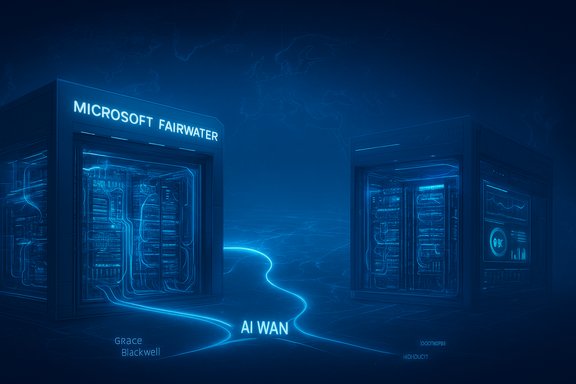
Microsoft’s announcement that Atlanta has become the second Fairwater-class Azure AI datacenter — and that it is joined to the Wisconsin site to form what the company calls a planet-scale “AI superfactory” — is a clear statement of intent: hyperscale cloud providers are now building purpose-built facilities that behave as a single, tightly coupled supercomputer for frontier AI workloads. The new site doubles down on the rack-as-accelerator model, closed-loop liquid cooling, and a dedicated AI WAN to stitch sites together into a single elastic compute plane. These are the headline claims from Microsoft’s technical post and supporting communications, and they change the operational and economic calculus for training and serving very large models.
Microsoft frames Fairwater as a departure from conventional multi-tenant cloud datacenters: instead of many independent hosts, Fairwater sites are engineered to operate as a single, densely packed compute fabric optimized for large-model training and reasoning. The Atlanta Fairwater went into production in October and is explicitly connected to the Wisconsin Fairwater through a purpose-built AI WAN, enabling combined jobs that span multiple sites and leverage hundreds of thousands of accelerators and exabytes of storage. This design is presented as a solution to the most pressing bottlenecks for frontier AI: latency, bisection bandwidth, power and cooling at megawatt scale.
What Microsoft is selling with the Fairwater concept is not merely capacity but a different topology: racks treated as pooled accelerators; NVLink-linked GPU domains for ultra-low-latency intra-rack communication; high-bandwidth scale-out fabrics for pod and cross-pod communication; and a dedicated optical backbone so distant racks behave more like local hardware for synchronous training workloads. Those claims are spelled out in Microsoft’s post and in follow-up company material.
Conclusion: Microsoft’s Fairwater program demonstrates how hyperscalers are rethinking the datacenter from the ground up to serve the needs of modern AI. The technical primitives are real and significant — NVLink rack domains, large pooled memory, dense liquid cooling and dedicated fiber backbones — and they promise to make frontier model development materially faster and more accessible via the cloud. At the same time, the approach concentrates novel operational and economic risks that enterprise customers, local communities and regulators will need to understand and manage as planet‑scale AI compute becomes a central utility of the digital economy.
Source: The Official Microsoft Blog Infinite scale: The architecture behind the Azure AI superfactory - The Official Microsoft Blog
 Background / Overview
Microsoft frames Fairwater as a departure from conventional multi-tenant cloud datacenters: instead of many independent hosts, Fairwater sites are engineered to operate as a single, densely packed compute fabric optimized for large-model training and reasoning. The Atlanta Fairwater went into production in October and is explicitly connected to the Wisconsin Fairwater through a purpose-built AI WAN, enabling combined jobs that span multiple sites and leverage hundreds of thousands of accelerators and exabytes of storage. This design is presented as a solution to the most pressing bottlenecks for frontier AI: latency, bisection bandwidth, power and cooling at megawatt scale.What Microsoft is selling with the Fairwater concept is not merely capacity but a different topology: racks treated as pooled accelerators; NVLink-linked GPU domains for ultra-low-latency intra-rack communication; high-bandwidth scale-out fabrics for pod and cross-pod communication; and a dedicated optical backbone so distant racks behave more like local hardware for synchronous training workloads. Those claims are spelled out in Microsoft’s post and in follow-up company material.
What’s new in Fairwater — the engineering summary
Purpose-built compute density
- Fairwater’s racks are designed as dense, rack-scale accelerators where every GPU in a rack participates in a single NVLink domain. Microsoft describes these racks as 72‑GPU units (an NVL72-style configuration) that behave like one accelerator to the scheduler and runtime.
- NVIDIA’s published platform documents (GB200 / GB300 NVL72 family) confirm this rack‑as‑accelerator approach: 72 Blackwell GPUs paired with Grace-class CPUs in a single NVLink domain, offering a very large pooled “fast memory” envelope and extremely high intra-rack NVLink bandwidth.
- 72 GPUs + 36 Grace CPUs in a GB300 NVL72 rack (Grace + Blackwell Ultra family).
- NVLink intra-rack aggregate bandwidth on the order of tens to hundreds of terabytes per second (NVIDIA lists ~130 TB/s for some NVL72 configurations).
- Pooled “fast memory” per rack measured in the tens of terabytes (NVIDIA GB300 NVL72 platforms document ~37–40 TB of fast memory depending on the configuration).
Cooling and density engineering
- Fairwater uses a closed‑loop liquid cooling system that is engineered to recirculate coolant and minimize make‑up water. Microsoft’s public technical messaging stresses that the initial fill of coolant is the only routine water draw; it has compared the volume to a small number of household annual usages (a claim Microsoft repeats in its press material).
- The closed-loop approach dramatically increases heat-transfer capability versus air cooling and allows for higher rack power density (Microsoft highlights rack and row-level power figures designed to push GPU utilization in steady state). The facility-level heat rejection relies on very large chillers and external heat exchangers.
Power architecture and operational tradeoffs
- Microsoft says it prioritized resilient grid power at the Atlanta site and claims an operating posture that delivers high availability at lower capital cost by forgoing some traditional on-site redundancy approaches (for example, not using large on-site generation or dual-corded distribution in the same way older designs do). This is presented as achieving “4×9 availability at 3×9 cost” in company communications — a way of saying the facility targets very high uptime while optimizing capital and operating expenditures. That language is Microsoft’s own framing and should be read as a performance/cost positioning rather than a universally standardized metric.
- Microsoft and partners have co-developed software and hardware power‑management measures to smooth grid oscillations caused by large synchronized jobs: policies that introduce lightweight supplement workloads during low‑utilization windows, GPU-level power thresholds, and on-site energy storage to mask short-term demand spikes. These are practical mitigations for grid stability as AI compute grows.
Networking at multiple scales
Fairwater is notable for treating networking as an engineering first-class citizen at three scales:- Scale‑up (intra-rack): NVLink/NVSwitch provides ultra-low-latency links among GPUs inside a rack so the rack can be treated like a single accelerator domain. This minimizes the latency penalties of sharding and helps maintain high parallel efficiency on synchronized training operations.
- Scale‑out (intra-site): Microsoft describes a two-tier, Ethernet/InfiniBand-based backend capable of supporting massive pods and clusters with 800 Gbps-class GPU-to-GPU connectivity and SONiC-based network OS for operational flexibility and cost control. Using broad Ethernet/SONiC ecosystems helps avoid vendor lock‑in and permits commodity hardware in much of the fabric.
- Planet‑scale (AI WAN): Microsoft has deployed a dedicated AI WAN — an optical backbone that connects Fairwater sites to each other and the broader Azure footprint. Microsoft publicly states it increased its fiber by roughly 120,000 miles in the last year to support this backbone and to prioritize congestion‑free traffic for synchronous training workloads. Independent reporting and Microsoft’s own Source/Official Blog messaging corroborate that the company has invested heavily in fiber to build AI‑focused backbone capacity.
Putting the hardware in context: what the vendors say
NVIDIA’s publicly documented GB200/GB300 NVL72 platforms lay out the technical primitives Microsoft uses in Fairwater: high NVLink bandwidth, large pooled fast memory per rack, and 72‑GPU NVLink domains that make large model sharding and long-context inference more efficient. NVIDIA’s product and technical pages are explicit about the scale benefits of the GB300 NVL72 family (Blackwell Ultra), including quoted figures for fast memory (tens of TB per rack) and NVLink bandwidth that align with Microsoft’s rack-level architecture. Independent technical outlets and industry press have taken Microsoft and NVIDIA’s combined claims and translated them into practical numbers (for example, public reporting on deployed clusters often references the arithmetic of “64 NVL72 racks → 4,608 GPUs” or similar rack‑to‑GPU calculations when Microsoft publishes rack counts). Those same outlets also emphasize the non‑trivial facilities, power and supply‑chain investments required to make these racks useful in production.Strengths — what Fairwater brings to Azure and customers
- Exceptional throughput for frontier models. Rack‑scale NVLink domains and pooled fast memory significantly reduce communication overhead for large-model training and long‑context inference, accelerating time to train and lowering wall‑clock job time for multitrillion‑parameter workloads. NVIDIA’s GB300 NVL72 numbers back up the scale‑up potential when paired with high‑performance fabrics.
- Fungibility across the model lifecycle. Microsoft explicitly positions Fairwater to serve pre‑training, fine‑tuning, RLHF, synthetic data generation and inference, letting customers allocate fit‑for‑purpose resources across a unified fabric instead of building multiple specialized clusters.
- Operational optimizations at scale. Co‑engineering of software, orchestration, scheduling and telemetry (including vendor tools like NVIDIA Mission Control) is designed to keep GPUs busy and reduce stragglers, which matters more than raw rack counts for practical throughput and cost efficiency.
- Network-first scale beyond a single campus. The AI WAN approach is an important architectural point: rather than forcing all training traffic through a single scale‑out fabric, Microsoft is differentiating traffic based on requirements and enabling cross‑site jobs that leverage additional land, power and redundancy. This approach spreads risk and allows capacity expansion beyond a single site’s physical limits.
- Water‑efficient liquid cooling at megawatt scale. Closed‑loop cooling minimizes evaporative water use and enables high rack densities that air cooling cannot sustain, a practical win where water or physical footprint is a constraint. Microsoft’s closed‑loop description and vendor documentation from cooling and hardware vendors indicate these techniques are already practical at hyperscale when properly engineered.
Risks, tradeoffs and unanswered questions
Despite substantial engineering progress, Fairwater represents a concentration of risk and a new set of operational tradeoffs that deserve careful scrutiny.1) Vendor and design concentration
- Fairwater is built on the NVIDIA Blackwell/GB200‑GB300 family and rack‑scale NVLink architecture. That concentration amplifies vendor risk: supply disruptions, pricing shifts, or roadmap changes at a single vendor have outsized effects when a cloud operator standardizes on a specific accelerator family and rack topology. NVIDIA’s own product pages confirm the GB300/GB200 primitives that Fairwater relies on.
2) Grid and community impacts
- Operating multi‑megawatt AI factories has genuine local grid implications. Microsoft says it coordinated with utilities and uses on-site storage and software power‑throttling to smooth demand, but the fundamental fact remains: these facilities place sustained demands on transmission and generation portfolios. The company’s claims about availability/cost tradeoffs (e.g., “4×9 at 3×9 cost”) are vendor positioning and not a standardized guarantee; they require scrutiny by independent auditors and local regulators before being treated as settled facts.
3) “Speed‑of‑light” limits and synchronous scaling
- Even with a dedicated AI WAN and short intra‑site cable runs, physics imposes a hard ceiling: latency across continental fiber routes is constrained by the speed of light in fiber. Synchronous training across widely separated sites will always suffer some efficiency loss compared with tightly collocated hardware. Microsoft’s networking and MRC protocol aim to reduce those penalties, but complete parity across distant sites is physically impossible; the tradeoff is how much software and network optimization can recover. Microsoft’s system design recognizes this and uses the AI WAN to reduce — but not eliminate — those limits.
4) Unverifiable or company‑specific claims
Certain technical claims in the announcement are either proprietary, newly introduced without public specification, or difficult to independently validate at the moment:- Multi‑Path Reliable Connected (MRC): Microsoft cites a custom networking protocol called MRC that optimizes route selection, packet trimming and telemetry for AI fabrics. At the time of writing, detailed public specifications or standards references for MRC are not widely available outside Microsoft’s announcement; this appears to be a company‑specific innovation and should be treated as such until whitepapers or interoperable specs are published. (No independent technical spec for “MRC” was found in public networking literature during validation.
- Availability phrasing (4×9 at 3×9 cost): Microsoft’s phrasing is a marketing and engineering positioning that blends availability targets and cost metrics. This is a meaningful efficiency claim, but not a standardized, independently audited availability guarantee; it requires careful contractual definition in enterprise SLAs and regulatory review if local grid impacts are a concern.
- Precise water‑use analogies: Microsoft states that the initial coolant fill equates to the annual water consumption of roughly “20 homes,” and that make‑up water is rare. That is a descriptive, operationally focused claim; it aligns with closed‑loop design intent, but the exact figure is a company assertion tied to their chosen accounting and chemistry thresholds. Independent facilities audits would be required for absolute verification.
5) Capital intensity and utilization risk
- These Fairwater builds are multibillion‑dollar capital projects. The ROI depends on sustained strong demand for frontier AI compute and high utilization across the entire lifecycle of models. If demand softens or model architectures shift dramatically (e.g., to hardware-agnostic accelerators, or techniques that reduce GPU requirements), the sunk capital could take longer to amortize.
Practical implications for enterprise IT and Azure customers
- For enterprises needing frontier training capacity (multitrillion‑parameter models, long-context inference, or high‑throughput real‑time reasoning), Fairwater-style racks expose previously inaccessible scale without requiring customers to build their own GPU megafarms.
- Microsoft’s rack-as-accelerator approach should simplify scheduling and reduce cross-host sharding complexity for very large models, potentially shortening iteration cycles and lowering total time-to-market for cutting-edge model training.
- Customers should negotiate SLAs and capacity reservation terms carefully. Microsoft’s internal efficiencies and availability claims must be translated into contractual guarantees if a workload’s business continuity depends on them.
- Organizations with sustainability goals should dig into the facility-level energy mix, firming mechanisms, and independent water/energy audits rather than relying solely on vendor sustainability claims. Microsoft’s closed-loop cooling and procurement of carbon-free energy are positive steps, but the net carbon footprint depends on the local grid and the effectiveness of renewable procurement and firming.
What to watch next
- Technical papers and whitepapers. Look for Microsoft or partner publications that publish the MRC protocol details, congestion‑control algorithms, and cross-site training telemetry. Those will clarify how much of the network efficiency is software-driven versus hardware/network topology-limited. (At the time of publication, public specs for MRC are not available.
- Independent audits of water and grid impact. As these facilities scale, third-party verification of water usage, energy sourcing, and grid stress mitigation will be important for community trust and regulatory scrutiny.
- Vendor ecosystem and supply updates. Watch GPU rack shipment volumes, availability of GB300 systems from ODMs, and NVIDIA’s supply cadence: supply constraints or vendor roadmap changes materially affect hyperscalers’ rollout speed and economics. Industry supply commentary has already signaled variability in GB200/GB300 shipment forecasts.
- Performance comparisons on real workloads. Microsoft’s claims about “10×” class performance gains are workload and metric dependent; independent benchmarking on representative training and inference jobs (tokens/sec, end‑to‑end model time) will give the market better, apples‑to‑apples comparisons.
Bottom line
Fairwater is both an engineering and strategic milestone: Microsoft has taken the rack‑as‑accelerator model and scaled it into a geographically distributed fabric that treats multiple datacenters as a single, elastic supercomputer. The combination of rack‑scale NVLink domains, closed‑loop liquid cooling, high‑density power planning, and a dedicated AI WAN addresses the primary bottlenecks that make large‑model training expensive and slow. NVIDIA’s GB200/GB300 NVL72 platform is the clear hardware foundation, and vendor documentation corroborates the rack-level performance primitives Microsoft relies on. That said, Fairwater concentrates risk: vendor dependence, capital intensity, localized grid impacts and the immutable limits of physics. Microsoft’s messaging is clear and ambitious; the technical footprint is verifiable in key areas (rack topology, NVLink domains, liquid cooling, fiber investment), while some aspects (proprietary protocols like MRC, precise availability‑cost tradeoffs, and certain numerical analogies) remain company‑specific claims that are not yet fully disclosed for independent validation. Organizations planning to leverage this infrastructure should treat Microsoft’s innovations as powerful options, but negotiate contractual clarity around SLAs, energy and water transparency, and capacity access to align their own risk and governance needs with the new reality of planet‑scale AI factories.Conclusion: Microsoft’s Fairwater program demonstrates how hyperscalers are rethinking the datacenter from the ground up to serve the needs of modern AI. The technical primitives are real and significant — NVLink rack domains, large pooled memory, dense liquid cooling and dedicated fiber backbones — and they promise to make frontier model development materially faster and more accessible via the cloud. At the same time, the approach concentrates novel operational and economic risks that enterprise customers, local communities and regulators will need to understand and manage as planet‑scale AI compute becomes a central utility of the digital economy.
Source: The Official Microsoft Blog Infinite scale: The architecture behind the Azure AI superfactory - The Official Microsoft Blog
