

Microsoft is increasingly selling not just AI features, but an operating model for how enterprises move from insight to execution. In the spring 2026 Technology Record issue, that model is described through Fabric IQ, Foundry IQ, Work IQ, and Agent365—a stack meant to reduce friction, improve decision-making, and keep autonomous work within clear guardrails. The article’s core message is that speed and responsibility are no longer competing priorities; they are becoming part of the same design requirement. That framing is echoed across Microsoft’s recent enterprise AI coverage, which treats agent governance, semantic grounding, and workflow automation as one connected system rather than separate products.
Microsoft’s latest “IQ” story did not appear in a vacuum. It builds on a wider shift in enterprise software: organizations have learned that AI pilots are easy, but production value is harder. The real bottlenecks are usually not model quality alone. They are fragmented data, ambiguous ownership, weak process design, and too many hand-offs between departments that still behave as if insights can wait in a queue. Microsoft’s answer is to make AI less like a chatbot and more like an execution layer woven into the business fabric.
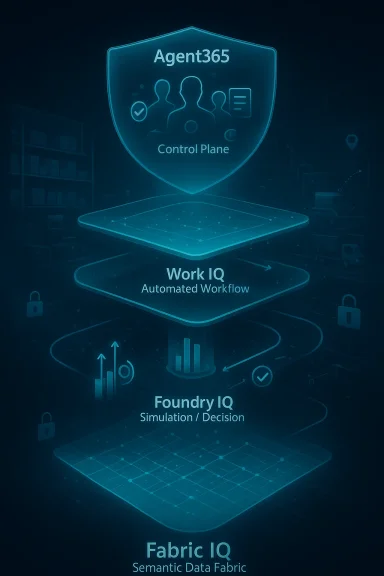
That is why the Fabric IQ / Foundry IQ / Work IQ trio matters. The point is not simply to label old ideas with new branding. It is to create a hierarchy in which data, reasoning, and workflow live in the same operating logic. Fabric IQ is positioned around semantic grounding and scenario analysis; Foundry IQ is about confidence-aware decisioning and simulation; Work IQ is about turning manual tasks into automated flows; and Agent365 is the governance layer that keeps agents within defined boundaries. In Microsoft’s own broader framing, this is what “Frontier Transformation” looks like in practice: a workplace where AI is embedded in the structure of work, not bolted onto it.
The timing is important because many enterprises have reached the same conclusion independently. They want AI to speed up research, reduce repetitive work, and support faster decisions, but they do not want to sacrifice auditability or trust. Microsoft’s recent guidance around Copilot and agent evaluation reinforces that shift toward measurable outcomes and governance. In other words, the market is moving from “Can AI do this?” to “Can AI do this reliably, safely, and at scale?” That is a subtle but decisive change in enterprise buying behavior.
The article’s use of customer examples also reflects a larger pattern in Microsoft’s enterprise AI storytelling. The company tends to pair platform claims with proof points from recognizable brands. Estée Lauder, Carlsberg, and Kraft Heinz are not being cited as novelty experiments. They are presented as evidence that AI can shorten discovery time, compress search and retrieval, and improve operational decisions in high-stakes industries. That matters because the value proposition is no longer “AI as inspiration.” It is AI as throughput.
That semantic layer is important because it reduces the need for every team to invent its own interpretation of the same operational facts. When data is fragmented, every decision becomes a negotiation. When it is unified, decisions become faster, more confident, and easier to audit. That is why Microsoft is emphasizing continuous simulation and confidence-aware decisioning rather than one-off analytics dashboards. The aim is to make business logic alive, not static.
That also explains why Microsoft keeps connecting Fabric IQ with scenario analysis and continuous simulation. In a volatile market, the best response is rarely a single prediction. It is a sequence of plausible options tested against changing conditions. A semantic layer makes those tests more reliable because it gives the system a stable picture of the business state. Without that foundation, “AI decisioning” can become little more than fast guesswork. Fast guesswork is still guesswork.
This matters because confidence in enterprise AI is not produced by one correct answer. It is produced by a system that can compare outcomes, reveal trade-offs, and show why a recommendation exists. Foundry IQ appears designed to support that more mature form of decisioning. In effect, it helps organizations ask better questions before they commit resources. That is far more valuable than asking the model for a single “best” answer.
That also makes Work IQ relevant beyond office productivity. In supply chain, manufacturing, procurement, and merchandising, many delays come from the fact that people are still acting as intermediaries between systems that should already be connected. When those intermediate tasks are automated, teams can focus on exceptions rather than routine coordination. The result is not just speed; it is capacity.
This matters especially in regulated or customer-facing environments. A retailer may be comfortable letting AI assist with a seasonal markdown recommendation, but not with a final pricing decision in isolation. A manufacturer may accept AI support for batch analysis, but not for an unreviewed quality override. Agent365 is Microsoft’s answer to that reality: a governance layer that operationalizes risk-based automation rather than treating autonomy as an all-or-nothing proposition.
The strategic value here is obvious. Beauty is a trend-sensitive business where timing matters enormously. If teams can spot demand shifts or consumer signals faster, they can react faster with product positioning, marketing, and innovation. In a category where brand relevance is fragile, speed becomes a competitive asset rather than a back-office metric. That is the sort of AI use case that gets executive attention.
The article also notes that the system was developed in just two days with guidance from Microsoft Unified and Azure cloud infrastructure. That is a telling detail because it suggests the company’s value is not just model access, but acceleration of implementation. In enterprise AI, development speed matters, but deployment speed matters even more. A two-day build is not the norm; it is a signal of how platform maturity can compress experimentation cycles.
At the same time, the risk for rivals is not just losing seats. It is being boxed out of the workflow layer where the highest-value decisions happen. If Microsoft owns the semantic model, the agent runtime, and the guardrails, third-party tools may still be useful, but they become supplementary rather than central. That is a powerful strategic position.
There are three things worth watching closely. First, whether Fabric IQ and Foundry IQ expand from conceptual architecture into repeatable deployments across industries. Second, whether Work IQ can prove it does more than automate obvious chores and instead meaningfully redesigns workflows. Third, whether Agent365 becomes the trusted control plane customers need, rather than just another governance layer in a crowded security stack.
Source: Technology Record Technology Record - Issue 40: Spring 2026
 Background
Microsoft’s latest “IQ” story did not appear in a vacuum. It builds on a wider shift in enterprise software: organizations have learned that AI pilots are easy, but production value is harder. The real bottlenecks are usually not model quality alone. They are fragmented data, ambiguous ownership, weak process design, and too many hand-offs between departments that still behave as if insights can wait in a queue. Microsoft’s answer is to make AI less like a chatbot and more like an execution layer woven into the business fabric.That is why the Fabric IQ / Foundry IQ / Work IQ trio matters. The point is not simply to label old ideas with new branding. It is to create a hierarchy in which data, reasoning, and workflow live in the same operating logic. Fabric IQ is positioned around semantic grounding and scenario analysis; Foundry IQ is about confidence-aware decisioning and simulation; Work IQ is about turning manual tasks into automated flows; and Agent365 is the governance layer that keeps agents within defined boundaries. In Microsoft’s own broader framing, this is what “Frontier Transformation” looks like in practice: a workplace where AI is embedded in the structure of work, not bolted onto it.
The timing is important because many enterprises have reached the same conclusion independently. They want AI to speed up research, reduce repetitive work, and support faster decisions, but they do not want to sacrifice auditability or trust. Microsoft’s recent guidance around Copilot and agent evaluation reinforces that shift toward measurable outcomes and governance. In other words, the market is moving from “Can AI do this?” to “Can AI do this reliably, safely, and at scale?” That is a subtle but decisive change in enterprise buying behavior.
The article’s use of customer examples also reflects a larger pattern in Microsoft’s enterprise AI storytelling. The company tends to pair platform claims with proof points from recognizable brands. Estée Lauder, Carlsberg, and Kraft Heinz are not being cited as novelty experiments. They are presented as evidence that AI can shorten discovery time, compress search and retrieval, and improve operational decisions in high-stakes industries. That matters because the value proposition is no longer “AI as inspiration.” It is AI as throughput.
What Microsoft Means by “Insight to Execution”
The phrase “insight to execution” sounds like marketing until you map it onto real enterprise pain points. Most organizations already have data. What they lack is a coherent path from data to action, especially when every department stores knowledge differently and every hand-off adds delay. Microsoft’s argument is that AI should not merely interpret information; it should close the gap between understanding and doing. That is a much more ambitious and much more useful goal.From data sprawl to decision architecture
The biggest hidden cost in many businesses is not compute, or even labor. It is latency—the time lost while teams reconcile conflicting reports, locate the right document, wait for approvals, or repeat work that should have been reusable. Fabric IQ is Microsoft’s response to that problem because it treats data as a semantic system rather than a pile of disconnected tables. In practice, that means people and agents can reason about customers, products, inventory, or production lines using business concepts instead of raw records.That semantic layer is important because it reduces the need for every team to invent its own interpretation of the same operational facts. When data is fragmented, every decision becomes a negotiation. When it is unified, decisions become faster, more confident, and easier to audit. That is why Microsoft is emphasizing continuous simulation and confidence-aware decisioning rather than one-off analytics dashboards. The aim is to make business logic alive, not static.
Why confidence matters more than speed alone
There is a temptation to think automation is always about doing things faster. In reality, the more consequential shift is the ability to know when an answer is trustworthy enough to act on. Microsoft’s messaging repeatedly leans into confidence-aware workflows, which is a useful corrective to the “just ask the model” mentality that dominated earlier AI demos. Businesses do not need more enthusiasm; they need systems that can flag uncertainty, compare scenarios, and route risky decisions to humans.- Fabric IQ helps make data interpretable across systems.
- Foundry IQ supports simulation and earlier decision-making.
- Work IQ converts repetitive coordination into automation.
- Agent365 keeps autonomy bounded by policy and risk.
Fabric IQ: The Semantic Layer Enterprises Have Been Missing
Fabric IQ is arguably the most foundational piece of the story because it addresses the oldest enterprise weakness of all: messy data. Companies often assume that if they have a warehouse, a lake, or a dashboard, they have solved the problem. They usually have not. Data is still trapped in tool-specific formats, departmental silos, and competing definitions, which makes fast decision-making painfully difficult. Fabric IQ is Microsoft’s attempt to make the enterprise data estate understandable to both humans and machines.Semantic grounding as a business advantage
The practical significance of Fabric IQ is that it gives AI a shared vocabulary for business reality. If “inventory,” “order,” “customer,” or “batch” mean different things in different systems, then every downstream recommendation becomes fragile. Semantic models reduce that ambiguity. They allow agents to reason over business entities rather than simply search for text patterns, which is a major step toward useful enterprise automation.That also explains why Microsoft keeps connecting Fabric IQ with scenario analysis and continuous simulation. In a volatile market, the best response is rarely a single prediction. It is a sequence of plausible options tested against changing conditions. A semantic layer makes those tests more reliable because it gives the system a stable picture of the business state. Without that foundation, “AI decisioning” can become little more than fast guesswork. Fast guesswork is still guesswork.
Why retailers and manufacturers care
Retailers, manufacturers, and consumer brands live or die on timing. Inventory decisions, price changes, supply interruptions, and production issues all move quickly, and the cost of delay compounds fast. That is why a semantic fabric is especially attractive in those sectors. It can help organizations model scenarios like seasonal demand shifts, stock clearances, or production anomalies without waiting for analysts to manually stitch together the evidence.- Better alignment between operational data and business language.
- Faster scenario testing across finance, supply chain, and sales.
- Less dependence on manual report building.
- Stronger support for cross-functional planning.
- Improved confidence when decisions must be made quickly.
Foundry IQ: Turning Scenario Testing into Actionable Judgment
If Fabric IQ is about understanding the business, Foundry IQ is about deciding what to do next. The article frames it as AI-driven scenario testing that helps teams make earlier, more confident decisions and adapt continuously as signals change. That is an important distinction because many organizations already perform scenario planning in spreadsheets or planning tools. The issue is that those processes are often too slow, too static, and too detached from live operational signals.Simulation as a management discipline
Microsoft’s pitch is that scenario testing should become continuous rather than occasional. That reflects how modern businesses actually operate: demand signals shift, supply chains wobble, and customer sentiment changes before the next formal planning meeting arrives. Foundry IQ is meant to bring those changes into the decision loop earlier, so that teams can adapt instead of react.This matters because confidence in enterprise AI is not produced by one correct answer. It is produced by a system that can compare outcomes, reveal trade-offs, and show why a recommendation exists. Foundry IQ appears designed to support that more mature form of decisioning. In effect, it helps organizations ask better questions before they commit resources. That is far more valuable than asking the model for a single “best” answer.
The competitive angle
There is also a competitive dynamic here. Most rivals in the AI space talk about copilots, agents, or automation, but fewer are trying to connect simulation, semantic grounding, and governance into one enterprise architecture. Microsoft’s advantage is that it can bundle those layers into systems customers already know, especially in data, productivity, and security. That creates a high-friction moat for competitors who may have stronger point solutions but weaker end-to-end integration.- Scenario testing shifts from periodic planning to continuous adaptation.
- Decision-makers can compare trade-offs before execution.
- Live signals become more useful when grounded in business semantics.
- Risk can be surfaced earlier rather than discovered after the fact.
- Planning teams gain a more dynamic operating model.
Work IQ: Automating the Hand-Offs That Slow Everyone Down
Work IQ is the layer where Microsoft’s story becomes immediately tangible. This is the part that turns manual coordination into automated workflows and reduces the friction created by cross-team hand-offs. In many organizations, those hand-offs are where productivity goes to die. A request is sent, a document is updated, an approval is pending, a status email is ignored, and the original momentum disappears. Work IQ is meant to fix that by making the workflow itself more intelligent.The hidden cost of human choreography
One reason enterprise AI adoption often disappoints is that organizations focus too much on content generation and too little on operational choreography. Drafting a memo faster is helpful, but the bigger opportunity may be routing the memo, logging the approval, updating the system of record, and triggering the next step automatically. Work IQ is clearly aimed at that deeper layer of work, where the real savings in time and error reduction live.That also makes Work IQ relevant beyond office productivity. In supply chain, manufacturing, procurement, and merchandising, many delays come from the fact that people are still acting as intermediaries between systems that should already be connected. When those intermediate tasks are automated, teams can focus on exceptions rather than routine coordination. The result is not just speed; it is capacity.
What “automation” should mean in 2026
In the current AI market, “automation” is often used too loosely. Sometimes it means a chatbot with better prompts. Sometimes it means a workflow rule with a model attached. Microsoft’s Work IQ framing is more useful because it implies that automation should be embedded in the operating model itself, with the right level of human oversight based on risk. That is a more disciplined definition, and one that enterprise buyers are increasingly demanding.- Reduces the delay caused by email-based coordination.
- Automates low-risk, repeatable steps within guardrails.
- Preserves human approval where judgment matters.
- Improves consistency across departments.
- Creates traceable paths from request to action.
Agent365 and Human-in-the-Loop Governance
No matter how strong the intelligence layers become, they still need a control plane. That is where Agent365 comes in. Microsoft’s article makes a strong case that speed and responsibility must reinforce each other, and that the best operating model is human-in-the-loop by design. Risk determines autonomy, and transparency is required at every step. That is not a limitation. It is the condition that makes enterprise adoption possible.Risk tiers are the real operating model
The most interesting part of the governance model is its tiering. Low-risk processes can be automated within defined guardrails. Medium-risk decisions can use AI for recommendations with human approval. High-risk scenarios remain human-led, with AI acting only in an advisory role. That structure is valuable because it gives enterprises a practical way to expand AI use without pretending every workflow deserves the same level of autonomy.This matters especially in regulated or customer-facing environments. A retailer may be comfortable letting AI assist with a seasonal markdown recommendation, but not with a final pricing decision in isolation. A manufacturer may accept AI support for batch analysis, but not for an unreviewed quality override. Agent365 is Microsoft’s answer to that reality: a governance layer that operationalizes risk-based automation rather than treating autonomy as an all-or-nothing proposition.
Why guardrails are becoming a product feature
What used to be discussed as policy is now being packaged as software. That is a notable shift. Enterprises no longer want a document that says, “Use AI responsibly.” They want systems that enforce responsibility automatically. Microsoft’s move to make governance a platform layer shows that the company understands how agentic AI will actually scale: through visibility, policy enforcement, and auditable controls.- Agents need identity and access boundaries.
- Sensitive actions require explicit approvals.
- Visibility is essential for audit and compliance.
- Policy should be embedded, not bolted on.
- Governance must scale as usage expands.
Customer Proof: Estée Lauder, Carlsberg, and Kraft Heinz
Microsoft’s strongest enterprise narratives usually come with customer examples, and this article is no exception. The companies highlighted here are useful because they show the same principle applied in different industries: AI is shortening the distance between a question and an operational answer. That reduction in delay is the real story, more than any individual model or interface.Estée Lauder and consumer intelligence
Estée Lauder Companies reportedly worked with Microsoft in 2025 to create ConsumerIQ, an AI agent built with Copilot Studio and Azure OpenAI Service. The tool analyzes documents, identifies trends, and provides recommendations, reducing the time needed to gather information from weeks to minutes. That is not a minor efficiency improvement; it is a structural shift in how a global consumer brand senses the market.The strategic value here is obvious. Beauty is a trend-sensitive business where timing matters enormously. If teams can spot demand shifts or consumer signals faster, they can react faster with product positioning, marketing, and innovation. In a category where brand relevance is fragile, speed becomes a competitive asset rather than a back-office metric. That is the sort of AI use case that gets executive attention.
Carlsberg and supply chain knowledge at speed
Carlsberg’s Global Brain story is perhaps even more operationally revealing. Microsoft says the company built an AI-powered knowledge assistant on Azure AI and Azure OpenAI Service in Foundry Models to support supply chain teams, enabling over 10,000 employees to retrieve information in seconds instead of 30 minutes. The speed-up is dramatic, but the more important point is that knowledge retrieval becomes embedded in the supply chain itself.The article also notes that the system was developed in just two days with guidance from Microsoft Unified and Azure cloud infrastructure. That is a telling detail because it suggests the company’s value is not just model access, but acceleration of implementation. In enterprise AI, development speed matters, but deployment speed matters even more. A two-day build is not the norm; it is a signal of how platform maturity can compress experimentation cycles.
Kraft Heinz and production analysis
Kraft Heinz adds a manufacturing angle through The Cookbook, an AI agent being piloted at a U.S. production facility for Heinz Tomato Ketchup. The system helps employees analyze production data such as batch thickness and color, improving efficiency on the shop floor. That example matters because it shows Microsoft’s story reaching beyond knowledge work into industrial operations, where small quality gains can have big commercial consequences.- Estée Lauder: faster trend analysis and recommendation cycles.
- Carlsberg: faster supply chain knowledge retrieval.
- Kraft Heinz: better analysis of production data.
- All three: shorter time from question to action.
- All three: stronger operational responsiveness.
Competitive Implications for Microsoft and Its Rivals
This release is strategically significant because it expands Microsoft’s competitive surface area. The company is no longer competing only on productivity software, or only on cloud infrastructure, or only on model access. It is trying to own the connective tissue between data, reasoning, automation, and governance. That makes the competitive map much harder for rivals to attack.The platform play gets broader
Microsoft’s advantage is that it can bundle the story across existing relationships. Customers already live in Microsoft 365, Azure, Fabric, and security tooling, so the “IQ” layers can feel like a natural extension rather than a new platform migration. That lowers adoption friction in a way standalone AI vendors often struggle to match. It also makes Microsoft’s AI strategy look less like feature competition and more like operating system design for the enterprise.At the same time, the risk for rivals is not just losing seats. It is being boxed out of the workflow layer where the highest-value decisions happen. If Microsoft owns the semantic model, the agent runtime, and the guardrails, third-party tools may still be useful, but they become supplementary rather than central. That is a powerful strategic position.
What competitors will have to prove
Competitors will need to answer a harder question than “Can your model do this?” They will need to show that they can integrate into real enterprise semantics, support continuous decisioning, and provide governance strong enough for production use. That is a much higher bar, especially for vendors that are strong on model performance but weaker on workflow integration.- Microsoft gains leverage from existing enterprise footprints.
- Rivals must compete on integration, not just intelligence.
- Governance becomes a differentiator, not a checkbox.
- Semantic grounding may prove more valuable than raw model size.
- Workflow ownership could be the decisive battleground.
Strengths and Opportunities
Microsoft’s “three IQ” model is compelling because it aligns with how real organizations operate. It does not assume perfect data, fully autonomous agents, or unlimited trust. Instead, it tries to build a usable bridge between existing enterprise messiness and the promise of faster, more intelligent execution. That is a practical, commercially powerful position.- Semantic clarity can reduce confusion across departments.
- Continuous simulation can improve decision confidence.
- Workflow automation can remove repetitive hand-offs.
- Risk-based governance can make AI safer to scale.
- Enterprise familiarity lowers adoption resistance.
- Cross-industry relevance gives the model broad appeal.
- Microsoft’s ecosystem makes integration easier for existing customers.
Risks and Concerns
The biggest risk in any enterprise AI strategy like this is overconfidence. Organizations may assume that because the tools are governed, they are automatically ready for broad deployment. That is dangerous. Microsoft’s own broader guidance keeps emphasizing permissions, evaluation, and data quality because these systems still fail when the underlying inputs are weak or when businesses automate the wrong thing.- Data fragmentation can undermine semantic reasoning.
- Poor governance can turn agents into compliance risks.
- Pilot sprawl can create duplication without business value.
- Measurement gaps can hide whether AI is actually helping.
- Integration complexity may slow enterprise rollout.
- User overreliance can erode human judgment.
- Brand confusion can make the product stack hard to follow.
Looking Ahead
The next phase of this story will be less about announcement language and more about operational proof. Microsoft has now defined a coherent enterprise AI stack, but the real question is whether customers can turn those layers into measurable improvements in cycle time, decision quality, and compliance. If they can, the “IQ” framework may become one of the most important enterprise software patterns of 2026. If they cannot, it risks becoming another elegant taxonomy that overpromises and underdelivers.There are three things worth watching closely. First, whether Fabric IQ and Foundry IQ expand from conceptual architecture into repeatable deployments across industries. Second, whether Work IQ can prove it does more than automate obvious chores and instead meaningfully redesigns workflows. Third, whether Agent365 becomes the trusted control plane customers need, rather than just another governance layer in a crowded security stack.
- Adoption depth across retail, manufacturing, and supply chain.
- Measurable cycle-time gains in live customer environments.
- Governance maturity as agents scale across business units.
- Integration quality with Microsoft 365, Fabric, and Azure.
- Competitive response from rival cloud and AI platforms.
Source: Technology Record Technology Record - Issue 40: Spring 2026
