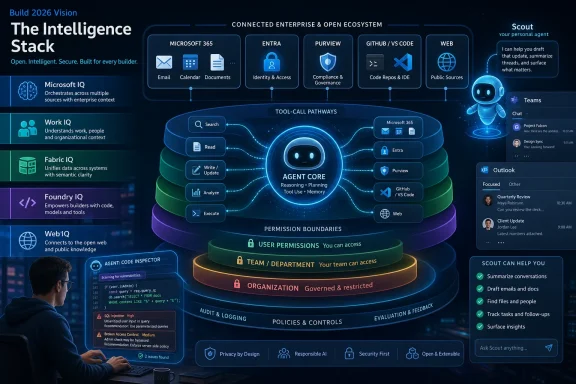
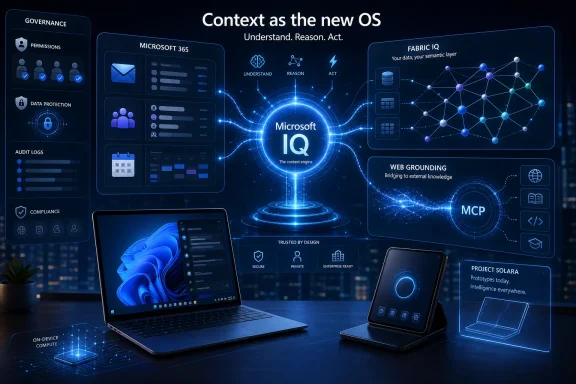
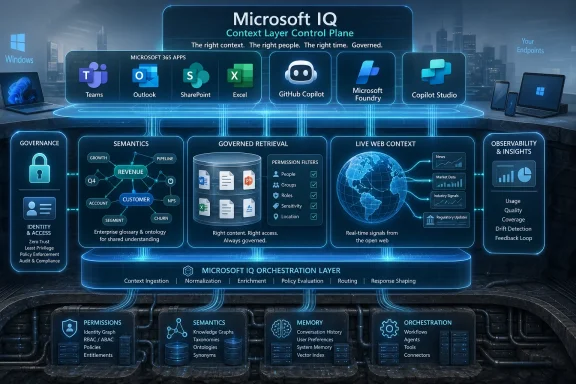
Microsoft used Build 2026 in San Francisco and online on June 2 to make Microsoft IQ generally available across GitHub Copilot, Microsoft Foundry, and Copilot Studio, positioning it as an enterprise intelligence layer for data, context, agents, and governance. The announcement is not just another Copilot feature drop. It is Microsoft’s attempt to turn the messy interior life of a company — documents, meetings, workflows, permissions, metrics, and institutional memory — into something AI systems can reason over without breaking the trust model that enterprises require. The bet is that the next phase of AI competition will be won less by chat windows and more by who can make agents understand the business they are supposed to serve.
For the last two years, the enterprise AI pitch has been easy to summarize and hard to execute: connect a model to company data, add a retrieval layer, wrap it in a chatbot, and wait for productivity to arrive. The reality has been more stubborn. Most organizations do not have one clean body of knowledge; they have SharePoint sprawl, Teams conversations, half-maintained wikis, Power BI models, CRM records, GitHub repositories, tickets, policies, calendar history, and email threads that quietly contain the real operating manual.
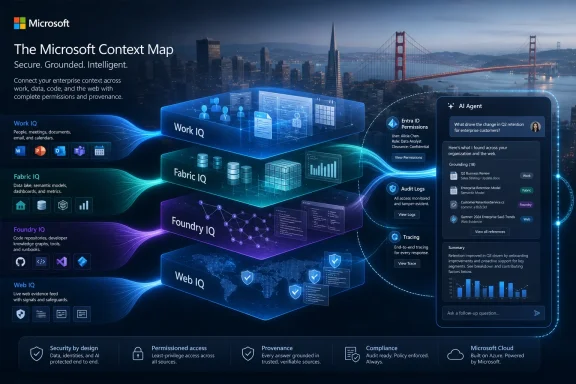
Microsoft IQ is Microsoft’s answer to that problem. It is designed to sit across the company’s AI stack, linking Copilot experiences, Microsoft Foundry, Fabric, and developer-facing APIs into a shared layer of context. In Microsoft’s telling, this lets agents understand not merely what a document says, but how a business works, who is involved, which data matters, and what constraints should apply.
That matters because the enterprise AI failure mode is not usually a model that cannot write a paragraph. It is a model that writes the wrong paragraph for the wrong department using stale data it should not have seen. If Microsoft IQ works as advertised, it becomes an attempt to replace brittle prompt-and-search patterns with an intelligence substrate that knows more about the organization’s relationships, semantics, and permissions.
The ambition is pure Microsoft: make the platform disappear into the workflow. The company does not want enterprises to think of AI as a separate destination. It wants AI to become a capability inside GitHub Copilot, Copilot Studio, Microsoft 365, Fabric, Foundry, and the administrative control planes that already define much of corporate IT.
The point is not simply that Copilot can search your inbox. Microsoft has been doing forms of that for some time. The sharper claim is that Work IQ can help agents infer how work actually happens: who approves what, which documents are canonical, what recurring meetings mean, which conversations belong to a project, and what a user is likely trying to accomplish next.
That distinction matters. A retrieval system can find a document called “Q3 Sales Plan.” An intelligence layer should know whether that document is final, whether the user has access to it, whether it has been superseded, who owns the forecast, and whether the question being asked belongs in sales operations, finance, or legal. Enterprise AI needs that kind of grounding if it is going to move from suggestion to execution.
The developer angle is equally important. Work IQ APIs, scheduled to become generally available for commercial customers on June 16, are meant to let organizations build custom assistants and automated workflows that draw on this organizational context. That gives developers a more official path into the Microsoft 365 work graph, rather than forcing every team to stitch together Graph calls, retrieval indexes, and permission checks on its own.
There is risk here, too. The more useful Work IQ becomes, the more sensitive it becomes. A system that understands work patterns, reporting relationships, documents, and meetings can be powerful, but it also demands unusually clear governance. Microsoft is effectively saying that the same tenant boundaries, identity controls, compliance tools, and audit mechanisms that made Microsoft 365 acceptable for enterprise collaboration can also make AI agents acceptable for enterprise action.
Fabric IQ aims to organize enterprise data into structures that AI can interpret accurately. That means semantic context: what a metric means, how entities relate, which data products are trusted, and how analytical definitions should be applied. This is where Microsoft’s Fabric strategy starts to intersect with agentic AI. A sales agent that cannot distinguish booked revenue from recognized revenue is not an assistant; it is a liability with a friendly interface.
Foundry IQ approaches the problem from the knowledge side. It is meant to help agents retrieve and reason over company documents, policies, stored content, and knowledge bases in a secure context. That puts it squarely in the territory often described as retrieval-augmented generation, but Microsoft’s positioning is broader: knowledge should not be a one-time lookup bolted onto a prompt. It should be a reusable layer that agents can work with across tasks.
Together, Fabric IQ and Foundry IQ reveal the shape of Microsoft’s enterprise AI thesis. Structured business data and unstructured business knowledge are not separate worlds to an agent. A support agent may need product documentation, telemetry, customer entitlement data, escalation policy, and the account team’s last meeting notes in the same chain of reasoning. Microsoft IQ is an attempt to make those pieces composable without forcing every enterprise to build a bespoke AI middleware stack.
This is also where Microsoft’s old platform instincts show through. The company is not merely selling a smarter model. It is selling an architecture: identity, data, knowledge, developer tools, model hosting, governance, and user-facing copilots, all threaded through familiar Microsoft estates. For IT leaders, that is either the appeal or the trap, depending on how much of their future they want to place inside one vendor’s conceptual model.
Web IQ is Microsoft’s attempt to provide a web search layer optimized for AI agents rather than humans typing keywords into a browser. The distinction is important. A person can skim ten links and apply judgment. An agent needs ranked, relevant, trustworthy snippets that can be incorporated into a task without polluting the answer with junk or ignoring the organization’s rules.
The challenge is that the web is adversarial, uneven, and constantly changing. Enterprise agents will need to know when external information is authoritative, when it conflicts with internal policy, and when it should be treated as uncertain. Microsoft can improve the plumbing, but it cannot make the public internet clean.
Still, Web IQ rounds out the stack in a necessary way. A model that only knows the tenant may be safe but parochial. A model that only knows the web may be current but reckless. The enterprise sweet spot is a system that can combine public and private context while preserving provenance, permissions, and administrative control.
That dual strategy has become central to Microsoft Foundry. The company wants customers to bring OpenAI models, open models, partner models, and Microsoft’s own models into one operational environment. At the same time, Microsoft is clearly not content to be only the cloud host and enterprise wrapper around other labs’ work.
The specialized models make that point more concrete. MAI-Image-2.5 targets text-to-image generation and image editing workflows. MAI-Transcribe-1.5 focuses on multilingual speech recognition. MAI-Voice-2 is aimed at richer voice output across languages. MAI-Code-1 brings a Microsoft-built coding model into environments such as GitHub Copilot and Visual Studio Code.
For WindowsForum readers, the coding model may be the most visible short-term change. GitHub Copilot and VS Code sit directly in the developer workflow, and model efficiency matters there in a way that abstract benchmark charts do not. Latency, context handling, cost, and code quality all become daily experience rather than marketing claims.
The broader implication is that Microsoft is building not just general intelligence, but a portfolio of task-specific capabilities that can be routed through Foundry and Copilot experiences. That is the practical shape of enterprise AI in 2026: not one omniscient model, but many models, tools, indexes, policies, and agents coordinated behind the scenes.
That is a necessary compromise. Developers want access to fast-moving open models, specialized inference providers, and alternative architectures. Security teams want fewer unapproved endpoints, fewer shadow AI projects, and clearer records of where company data goes. Foundry is Microsoft’s attempt to make those goals less contradictory.
This is where the Microsoft platform advantage becomes less glamorous but more valuable. Many enterprises do not primarily lack access to models. They lack a manageable way to evaluate, deploy, monitor, secure, and retire AI systems. Model choice without governance becomes chaos; governance without model choice becomes stagnation.
Foundry’s pitch is that organizations should not have to choose. They can run Microsoft models, partner models, open models, and custom-tuned models inside a framework that supports evaluation, deployment, observability, and policy. That message will resonate with enterprises that have moved past proof-of-concept demos and are now discovering the operational drag of AI at scale.
The risk is complexity. Foundry is increasingly becoming a large umbrella for model catalogs, agents, knowledge layers, tuning, evaluation, deployment targets, local runtimes, and governance hooks. Microsoft will need to make the developer experience feel coherent, not merely comprehensive. The history of enterprise platforms is full of powerful systems that became too sprawling for ordinary teams to use well.
This is also where caution is warranted. An agent that improves from enterprise context must be carefully constrained, evaluated, and audited. If the feedback loop rewards speed over accuracy, or completion over compliance, an agent can learn the wrong lesson at scale. Reinforcement learning sounds scientific; in production IT, it still needs change management.
The phrase “secure boundaries” will do a lot of work here. Enterprises will want to know exactly what data is used, where the tuning happens, whether model weights are affected, how tenant isolation is preserved, how rollback works, and how learned behavior is inspected. Microsoft’s success will depend on whether Frontier Tuning feels like a governed enterprise capability rather than a black-box experiment.
Still, the direction is logical. Every organization has its own preferences, terminology, approval chains, risk tolerance, and workflow quirks. Generic models can approximate those patterns only so far. The more AI agents are expected to act on behalf of users, the more they will need controlled adaptation to local reality.
Microsoft’s answer is to extend familiar governance tools — including Entra, Purview, and Defender — into a control plane for agents. That framing is smart because IT administrators do not want a separate security universe for every new AI capability. They want agents to fit into identity, compliance, monitoring, data loss prevention, and threat detection practices they already understand.
Local agents make this even more important. As AI runtimes move closer to devices, developer machines, edge environments, and hybrid systems, the governance boundary becomes harder to see. A cloud-only control plane is insufficient if meaningful work is happening locally. Agent 365 appears designed to keep those agents visible even when execution is distributed.
For Windows administrators, this is the part of the story to watch closely. Microsoft’s AI strategy will increasingly intersect with endpoint management, identity posture, application control, Defender telemetry, and data governance. The Windows client will not merely be a place where AI features appear; it will be one of the places where agent execution, policy, and local context collide.
The optimistic view is that Microsoft can bring order to a category that would otherwise become the next shadow IT disaster. The skeptical view is that every new control plane also brings new licensing, configuration burden, and dependency on Microsoft’s interpretation of best practice. Both can be true.
That is why the IQ announcement is best read as a governance story wrapped in an intelligence story. Work IQ, Fabric IQ, Foundry IQ, and Web IQ all attempt to solve context problems, but they also create control problems. The more an agent knows, the more it must be constrained. The more it can act, the more it must be monitored.
Microsoft has an advantage because it already owns much of the enterprise substrate: identity through Entra, collaboration through Microsoft 365, security through Defender, compliance through Purview, development through GitHub and VS Code, data through Fabric, and cloud deployment through Azure. IQ ties those assets into a more explicit AI architecture.
But that same advantage invites scrutiny. Vendor consolidation can simplify governance, but it can also narrow leverage. If Microsoft IQ becomes the preferred way to make agents enterprise-aware, customers will need to evaluate how portable their agent designs, knowledge structures, semantic models, and tuning investments really are.
This is not a reason to dismiss the strategy. It is a reason to approach it as infrastructure, not as a feature. Enterprises should treat Microsoft IQ as a potential layer of their operating model, with the same seriousness they bring to identity architecture, data governance, and endpoint security.
Microsoft IQ is targeted at that post-demo anxiety. It says: your AI projects are stalling because they lack context, governance, and integration. Microsoft’s answer is to provide the missing connective tissue across data, work, models, agents, and administrative control.
There is truth in that diagnosis. The strongest AI demos often collapse when moved into production because the surrounding system is weak. Permissions are inconsistent. Data is poorly modeled. Knowledge is stale. Users do not trust outputs. Admins cannot see what agents are doing. Developers must reinvent plumbing for every workflow.
The harder question is whether Microsoft can make its solution feel simple enough to adopt. Enterprise AI already has a vocabulary problem: agents, copilots, skills, connectors, tools, MCP servers, RAG, semantic layers, model catalogs, grounding, orchestration, evaluations, and now multiple IQs. Microsoft will need to turn that conceptual stack into implementation paths that customers can actually follow.
If it succeeds, Build 2026 may be remembered less for any single model announcement and more for the moment Microsoft consolidated its AI pieces into a more coherent enterprise platform. If it fails, Microsoft IQ risks becoming another branding layer over components that customers still have to integrate the hard way.
For organizations already deep in Microsoft’s ecosystem, the path of least resistance is becoming clearer. The same stack that manages identity, documents, collaboration, code, security, and analytics is being extended to manage AI agents. That may not be philosophically tidy, but it is operationally compelling.
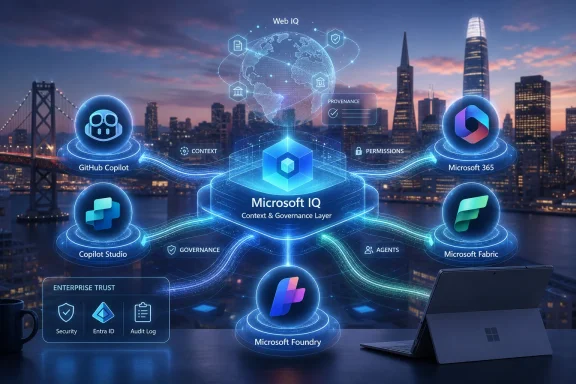 Microsoft Turns Context Into the New Platform
For the last two years, the enterprise AI pitch has been easy to summarize and hard to execute: connect a model to company data, add a retrieval layer, wrap it in a chatbot, and wait for productivity to arrive. The reality has been more stubborn. Most organizations do not have one clean body of knowledge; they have SharePoint sprawl, Teams conversations, half-maintained wikis, Power BI models, CRM records, GitHub repositories, tickets, policies, calendar history, and email threads that quietly contain the real operating manual.Microsoft IQ is Microsoft’s answer to that problem. It is designed to sit across the company’s AI stack, linking Copilot experiences, Microsoft Foundry, Fabric, and developer-facing APIs into a shared layer of context. In Microsoft’s telling, this lets agents understand not merely what a document says, but how a business works, who is involved, which data matters, and what constraints should apply.
That matters because the enterprise AI failure mode is not usually a model that cannot write a paragraph. It is a model that writes the wrong paragraph for the wrong department using stale data it should not have seen. If Microsoft IQ works as advertised, it becomes an attempt to replace brittle prompt-and-search patterns with an intelligence substrate that knows more about the organization’s relationships, semantics, and permissions.
The ambition is pure Microsoft: make the platform disappear into the workflow. The company does not want enterprises to think of AI as a separate destination. It wants AI to become a capability inside GitHub Copilot, Copilot Studio, Microsoft 365, Fabric, Foundry, and the administrative control planes that already define much of corporate IT.
Work IQ Makes the Office Graph More Agentic
The most immediately understandable part of Microsoft IQ is Work IQ, because it builds on a Microsoft advantage that competitors have long envied: the company already hosts a large portion of enterprise work. Emails, meetings, chats, files, documents, identities, calendars, and permissions all live inside the Microsoft 365 universe for millions of users. Work IQ turns that universe into context for AI systems.The point is not simply that Copilot can search your inbox. Microsoft has been doing forms of that for some time. The sharper claim is that Work IQ can help agents infer how work actually happens: who approves what, which documents are canonical, what recurring meetings mean, which conversations belong to a project, and what a user is likely trying to accomplish next.
That distinction matters. A retrieval system can find a document called “Q3 Sales Plan.” An intelligence layer should know whether that document is final, whether the user has access to it, whether it has been superseded, who owns the forecast, and whether the question being asked belongs in sales operations, finance, or legal. Enterprise AI needs that kind of grounding if it is going to move from suggestion to execution.
The developer angle is equally important. Work IQ APIs, scheduled to become generally available for commercial customers on June 16, are meant to let organizations build custom assistants and automated workflows that draw on this organizational context. That gives developers a more official path into the Microsoft 365 work graph, rather than forcing every team to stitch together Graph calls, retrieval indexes, and permission checks on its own.
There is risk here, too. The more useful Work IQ becomes, the more sensitive it becomes. A system that understands work patterns, reporting relationships, documents, and meetings can be powerful, but it also demands unusually clear governance. Microsoft is effectively saying that the same tenant boundaries, identity controls, compliance tools, and audit mechanisms that made Microsoft 365 acceptable for enterprise collaboration can also make AI agents acceptable for enterprise action.
Fabric IQ and Foundry IQ Attack the Data Mess From Opposite Ends
If Work IQ is about how people work, Fabric IQ is about how business data gains meaning. That is a more subtle problem, but for many organizations it is the harder one. Models are poor business analysts when they encounter data as a swamp of disconnected tables, duplicate metrics, inconsistent definitions, and undocumented transformations.Fabric IQ aims to organize enterprise data into structures that AI can interpret accurately. That means semantic context: what a metric means, how entities relate, which data products are trusted, and how analytical definitions should be applied. This is where Microsoft’s Fabric strategy starts to intersect with agentic AI. A sales agent that cannot distinguish booked revenue from recognized revenue is not an assistant; it is a liability with a friendly interface.
Foundry IQ approaches the problem from the knowledge side. It is meant to help agents retrieve and reason over company documents, policies, stored content, and knowledge bases in a secure context. That puts it squarely in the territory often described as retrieval-augmented generation, but Microsoft’s positioning is broader: knowledge should not be a one-time lookup bolted onto a prompt. It should be a reusable layer that agents can work with across tasks.
Together, Fabric IQ and Foundry IQ reveal the shape of Microsoft’s enterprise AI thesis. Structured business data and unstructured business knowledge are not separate worlds to an agent. A support agent may need product documentation, telemetry, customer entitlement data, escalation policy, and the account team’s last meeting notes in the same chain of reasoning. Microsoft IQ is an attempt to make those pieces composable without forcing every enterprise to build a bespoke AI middleware stack.
This is also where Microsoft’s old platform instincts show through. The company is not merely selling a smarter model. It is selling an architecture: identity, data, knowledge, developer tools, model hosting, governance, and user-facing copilots, all threaded through familiar Microsoft estates. For IT leaders, that is either the appeal or the trap, depending on how much of their future they want to place inside one vendor’s conceptual model.
Web IQ Acknowledges That No Company Knows Enough on Its Own
The addition of Web IQ is a useful admission. Even the richest enterprise context is incomplete. Agents need to understand not only internal policy and private data, but also the outside world: regulations, market changes, public documentation, supplier updates, security advisories, pricing shifts, and news.Web IQ is Microsoft’s attempt to provide a web search layer optimized for AI agents rather than humans typing keywords into a browser. The distinction is important. A person can skim ten links and apply judgment. An agent needs ranked, relevant, trustworthy snippets that can be incorporated into a task without polluting the answer with junk or ignoring the organization’s rules.
The challenge is that the web is adversarial, uneven, and constantly changing. Enterprise agents will need to know when external information is authoritative, when it conflicts with internal policy, and when it should be treated as uncertain. Microsoft can improve the plumbing, but it cannot make the public internet clean.
Still, Web IQ rounds out the stack in a necessary way. A model that only knows the tenant may be safe but parochial. A model that only knows the web may be current but reckless. The enterprise sweet spot is a system that can combine public and private context while preserving provenance, permissions, and administrative control.
Microsoft’s New Models Are a Vertical Integration Signal
Alongside Microsoft IQ, Microsoft introduced a new wave of in-house AI models, including MAI-Thinking-1, a reasoning-focused model available in limited preview through Microsoft Foundry. The emphasis on reasoning, long-context processing, coding, and licensed enterprise data is not accidental. Microsoft is trying to show that it can supply more of the AI stack itself, even while continuing to operate one of the broadest model marketplaces in the industry.That dual strategy has become central to Microsoft Foundry. The company wants customers to bring OpenAI models, open models, partner models, and Microsoft’s own models into one operational environment. At the same time, Microsoft is clearly not content to be only the cloud host and enterprise wrapper around other labs’ work.
The specialized models make that point more concrete. MAI-Image-2.5 targets text-to-image generation and image editing workflows. MAI-Transcribe-1.5 focuses on multilingual speech recognition. MAI-Voice-2 is aimed at richer voice output across languages. MAI-Code-1 brings a Microsoft-built coding model into environments such as GitHub Copilot and Visual Studio Code.
For WindowsForum readers, the coding model may be the most visible short-term change. GitHub Copilot and VS Code sit directly in the developer workflow, and model efficiency matters there in a way that abstract benchmark charts do not. Latency, context handling, cost, and code quality all become daily experience rather than marketing claims.
The broader implication is that Microsoft is building not just general intelligence, but a portfolio of task-specific capabilities that can be routed through Foundry and Copilot experiences. That is the practical shape of enterprise AI in 2026: not one omniscient model, but many models, tools, indexes, policies, and agents coordinated behind the scenes.
Foundry Becomes the Place Where Model Choice Meets Control
The Fireworks AI integration strengthens the other half of Microsoft’s model story. By bringing Fireworks AI into Microsoft Foundry, Microsoft is making a familiar enterprise promise: developers can experiment with a wider range of models while IT keeps governance, data residency, and operational controls in view.That is a necessary compromise. Developers want access to fast-moving open models, specialized inference providers, and alternative architectures. Security teams want fewer unapproved endpoints, fewer shadow AI projects, and clearer records of where company data goes. Foundry is Microsoft’s attempt to make those goals less contradictory.
This is where the Microsoft platform advantage becomes less glamorous but more valuable. Many enterprises do not primarily lack access to models. They lack a manageable way to evaluate, deploy, monitor, secure, and retire AI systems. Model choice without governance becomes chaos; governance without model choice becomes stagnation.
Foundry’s pitch is that organizations should not have to choose. They can run Microsoft models, partner models, open models, and custom-tuned models inside a framework that supports evaluation, deployment, observability, and policy. That message will resonate with enterprises that have moved past proof-of-concept demos and are now discovering the operational drag of AI at scale.
The risk is complexity. Foundry is increasingly becoming a large umbrella for model catalogs, agents, knowledge layers, tuning, evaluation, deployment targets, local runtimes, and governance hooks. Microsoft will need to make the developer experience feel coherent, not merely comprehensive. The history of enterprise platforms is full of powerful systems that became too sprawling for ordinary teams to use well.
Frontier Tuning Brings Learning Closer to the Tenant
Frontier Tuning, as described by Microsoft, uses reinforcement learning within secure boundaries so agents can improve over time using a company’s own data, workflows, and knowledge. That is one of the more consequential ideas in the announcement because it pushes enterprise AI beyond static deployment. The agent is not merely configured once; it is shaped by the organization’s actual environment.This is also where caution is warranted. An agent that improves from enterprise context must be carefully constrained, evaluated, and audited. If the feedback loop rewards speed over accuracy, or completion over compliance, an agent can learn the wrong lesson at scale. Reinforcement learning sounds scientific; in production IT, it still needs change management.
The phrase “secure boundaries” will do a lot of work here. Enterprises will want to know exactly what data is used, where the tuning happens, whether model weights are affected, how tenant isolation is preserved, how rollback works, and how learned behavior is inspected. Microsoft’s success will depend on whether Frontier Tuning feels like a governed enterprise capability rather than a black-box experiment.
Still, the direction is logical. Every organization has its own preferences, terminology, approval chains, risk tolerance, and workflow quirks. Generic models can approximate those patterns only so far. The more AI agents are expected to act on behalf of users, the more they will need controlled adaptation to local reality.
Agent 365 Is the Administrative Counterweight to AI Sprawl
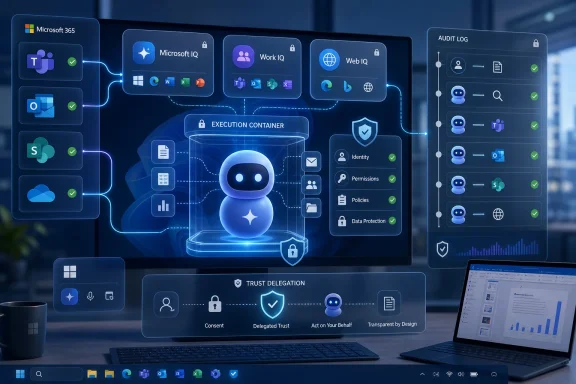
Agent 365 for local agents may sound like a back-office feature, but it addresses one of the most important problems in enterprise AI: sprawl. Once developers, departments, and vendors can create agents easily, organizations need a way to know what those agents are, what identities they use, what data they touch, and what actions they can perform.Microsoft’s answer is to extend familiar governance tools — including Entra, Purview, and Defender — into a control plane for agents. That framing is smart because IT administrators do not want a separate security universe for every new AI capability. They want agents to fit into identity, compliance, monitoring, data loss prevention, and threat detection practices they already understand.
Local agents make this even more important. As AI runtimes move closer to devices, developer machines, edge environments, and hybrid systems, the governance boundary becomes harder to see. A cloud-only control plane is insufficient if meaningful work is happening locally. Agent 365 appears designed to keep those agents visible even when execution is distributed.
For Windows administrators, this is the part of the story to watch closely. Microsoft’s AI strategy will increasingly intersect with endpoint management, identity posture, application control, Defender telemetry, and data governance. The Windows client will not merely be a place where AI features appear; it will be one of the places where agent execution, policy, and local context collide.
The optimistic view is that Microsoft can bring order to a category that would otherwise become the next shadow IT disaster. The skeptical view is that every new control plane also brings new licensing, configuration burden, and dependency on Microsoft’s interpretation of best practice. Both can be true.
The Real Product Is Trust, Not Intelligence
Microsoft’s public language around Microsoft IQ emphasizes intelligence, but the enterprise buying decision will hinge on trust. Companies are not waiting for AI to become more impressive in the abstract. They are waiting for AI to become safe enough, auditable enough, and governable enough to let it touch real work.That is why the IQ announcement is best read as a governance story wrapped in an intelligence story. Work IQ, Fabric IQ, Foundry IQ, and Web IQ all attempt to solve context problems, but they also create control problems. The more an agent knows, the more it must be constrained. The more it can act, the more it must be monitored.
Microsoft has an advantage because it already owns much of the enterprise substrate: identity through Entra, collaboration through Microsoft 365, security through Defender, compliance through Purview, development through GitHub and VS Code, data through Fabric, and cloud deployment through Azure. IQ ties those assets into a more explicit AI architecture.
But that same advantage invites scrutiny. Vendor consolidation can simplify governance, but it can also narrow leverage. If Microsoft IQ becomes the preferred way to make agents enterprise-aware, customers will need to evaluate how portable their agent designs, knowledge structures, semantic models, and tuning investments really are.
This is not a reason to dismiss the strategy. It is a reason to approach it as infrastructure, not as a feature. Enterprises should treat Microsoft IQ as a potential layer of their operating model, with the same seriousness they bring to identity architecture, data governance, and endpoint security.
The Build 2026 Message Lands Where AI Pilots Are Starting to Stall
The timing is important. Many organizations have already run AI pilots. They have experimented with copilots, built retrieval demos, tried code assistants, and allowed some teams to prototype agents. The hard question now is not whether AI can do something interesting. It is whether AI can be made repeatable, secure, measurable, and worth the organizational change.Microsoft IQ is targeted at that post-demo anxiety. It says: your AI projects are stalling because they lack context, governance, and integration. Microsoft’s answer is to provide the missing connective tissue across data, work, models, agents, and administrative control.
There is truth in that diagnosis. The strongest AI demos often collapse when moved into production because the surrounding system is weak. Permissions are inconsistent. Data is poorly modeled. Knowledge is stale. Users do not trust outputs. Admins cannot see what agents are doing. Developers must reinvent plumbing for every workflow.
The harder question is whether Microsoft can make its solution feel simple enough to adopt. Enterprise AI already has a vocabulary problem: agents, copilots, skills, connectors, tools, MCP servers, RAG, semantic layers, model catalogs, grounding, orchestration, evaluations, and now multiple IQs. Microsoft will need to turn that conceptual stack into implementation paths that customers can actually follow.
If it succeeds, Build 2026 may be remembered less for any single model announcement and more for the moment Microsoft consolidated its AI pieces into a more coherent enterprise platform. If it fails, Microsoft IQ risks becoming another branding layer over components that customers still have to integrate the hard way.
The Practical Reading for Windows and Microsoft Shops
The smartest way to read the announcement is neither as hype nor as a finished revolution. Microsoft has put a name and structure around the problem every serious AI deployment now faces: models need context, context needs governance, and governance needs to work across cloud, productivity, developer, data, and endpoint systems.For organizations already deep in Microsoft’s ecosystem, the path of least resistance is becoming clearer. The same stack that manages identity, documents, collaboration, code, security, and analytics is being extended to manage AI agents. That may not be philosophically tidy, but it is operationally compelling.
- Microsoft IQ is Microsoft’s attempt to make enterprise context a shared AI layer rather than a custom integration project for every agent.
- Work IQ APIs reaching general availability for commercial customers on June 16 will be an important test of whether developers can use organizational context without building fragile workarounds.
- Fabric IQ and Foundry IQ matter because agents need both trusted business data and secure knowledge retrieval to produce useful enterprise answers.
- Microsoft’s new MAI models show that the company wants more control over the model layer even as Foundry expands support for partner and open models.
- Fireworks AI in Foundry reinforces Microsoft’s strategy of offering model variety inside an enterprise governance wrapper.
- Agent 365 may prove as important as the models themselves if local and departmental agents begin multiplying across corporate estates.
References
- Primary source: Petri IT Knowledgebase
Published: 2026-06-02T17:50:13.649987
Organizations Can Unlock Enterprise Intelligence With Microsoft IQ
Microsoft introduces its Microsoft IQ platform along with new AI models to enhance enterprise workflows, data integration, and intelligent automation. petri.com
- Official source: azure.microsoft.com
Introducing Fireworks AI on Microsoft Foundry: Bringing high performance, low latency open model inference to Azure | Microsoft Azure Blog
Learn how you can access low latency, high throughput inferencing for open models and performance-optimized deployment of custom models with Fireworks AI on Microsoft Foundry. azure.microsoft.com
- Official source: techcommunity.microsoft.com
Announcing the IQ Series: Foundry IQ | Microsoft Community Hub
AI agents are rapidly becoming a new way to build applications. But for agents to be truly useful, they need access to the knowledge and context that helps... techcommunity.microsoft.com
- Related coverage: ebisuda.net
Microsoft Build 2026:Azure HorizonDB・Foundry IQ・Claude正式採用——AIは「実験」から「本番運用」へ | ebisuda.net
Microsoft Build 2026でAzure HorizonDB・Foundry IQ・Claude正式統合を発表、AIの実験フェーズ終了と本番運用移行時代の到来を宣言。www.ebisuda.net
- Official source: learn.microsoft.com
Microsoft Foundry docs: What's new for May 2026 - Microsoft Foundry | Microsoft Learn
Discover documentation and product updates in Microsoft Foundry for May 2026.learn.microsoft.com - Official source: developer.microsoft.com
Model Mondays - What's New In Foundry IQ? | Microsoft Reactor
Learn new skills, meet new peers, and find career mentorship. Virtual events are running around the clock so join us anytime, anywhere!developer.microsoft.com
- Official source: microsoft.com
MWC 2026: Microsoft Helps Telecoms Realize AI ROI | The Microsoft Cloud Blog
At MWC 2026, Microsoft shares new AI investments enabling telecoms to move from pilots to real return on intelligence. Read more. www.microsoft.com
- Official source: devblogs.microsoft.com
What's new in Microsoft Foundry | May 2026 | Microsoft Foundry Blog
Latest Microsoft Foundry updates for May 2026, including new models, agent skills and toolboxes, Foundry Local vision, evaluations, SDK releases, and platform improvementsdevblogs.microsoft.com - Official source: build.microsoft.com
Your home for Microsoft Build
Go deep on real code and real systems with the teams building and scaling AI at Microsoft Build, June 2–3, 2026, in San Francisco and online.build.microsoft.com - Official source: cdn-dynmedia-1.microsoft.com