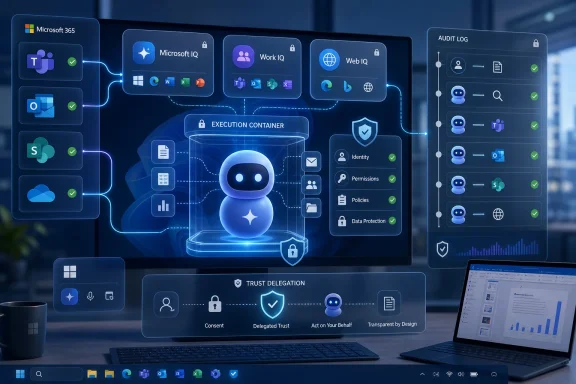
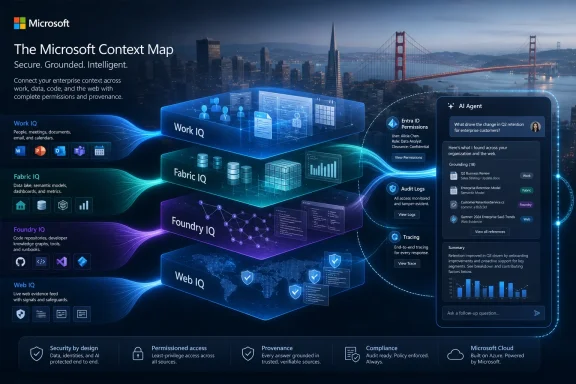
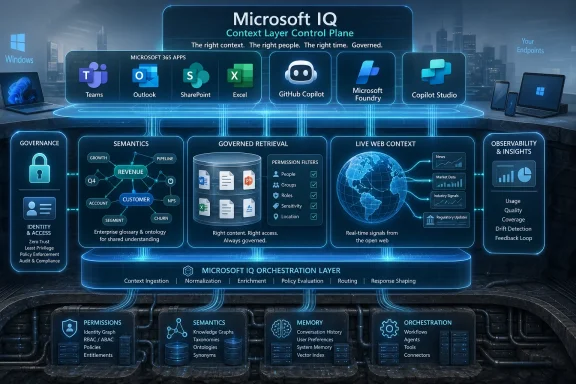
Microsoft used Build 2026 in San Francisco and online on June 2 to make Microsoft IQ generally available across GitHub Copilot, Microsoft Foundry, and Copilot Studio, positioning it as an enterprise intelligence layer for data, context, agents, and governance. The announcement is not just another Copilot feature drop. It is Microsoft’s attempt to turn the messy interior life of a company — documents, meetings, workflows, permissions, metrics, and institutional memory — into something AI systems can reason over without breaking the trust model that enterprises require. The bet is that the next phase of AI competition will be won less by chat windows and more by who can make agents understand the business they are supposed to serve.

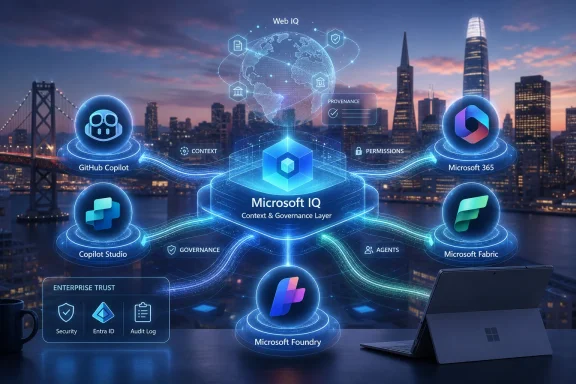
Futuristic Microsoft IQ tech diagram over a city skyline, linking services like GitHub Copilot and Fabric.Microsoft Turns Context Into the New Platform​

For the last two years, the enterprise AI pitch has been easy to summarize and hard to execute: connect a model to company data, add a retrieval layer, wrap it in a chatbot, and wait for productivity to arrive. The reality has been more stubborn. Most organizations do not have one clean body of knowledge; they have SharePoint sprawl, Teams conversations, half-maintained wikis, Power BI models, CRM records, GitHub repositories, tickets, policies, calendar history, and email threads that quietly contain the real operating manual.
Microsoft IQ is Microsoft’s answer to that problem. It is designed to sit across the company’s AI stack, linking Copilot experiences, Microsoft Foundry, Fabric, and developer-facing APIs into a shared layer of context. In Microsoft’s telling, this lets agents understand not merely what a document says, but how a business works, who is involved, which data matters, and what constraints should apply.
That matters because the enterprise AI failure mode is not usually a model that cannot write a paragraph. It is a model that writes the wrong paragraph for the wrong department using stale data it should not have seen. If Microsoft IQ works as advertised, it becomes an attempt to replace brittle prompt-and-search patterns with an intelligence substrate that knows more about the organization’s relationships, semantics, and permissions.
The ambition is pure Microsoft: make the platform disappear into the workflow. The company does not want enterprises to think of AI as a separate destination. It wants AI to become a capability inside GitHub Copilot, Copilot Studio, Microsoft 365, Fabric, Foundry, and the administrative control planes that already define much of corporate IT.

Work IQ Makes the Office Graph More Agentic​

The most immediately understandable part of Microsoft IQ is Work IQ, because it builds on a Microsoft advantage that competitors have long envied: the company already hosts a large portion of enterprise work. Emails, meetings, chats, files, documents, identities, calendars, and permissions all live inside the Microsoft 365 universe for millions of users. Work IQ turns that universe into context for AI systems.
The point is not simply that Copilot can search your inbox. Microsoft has been doing forms of that for some time. The sharper claim is that Work IQ can help agents infer how work actually happens: who approves what, which documents are canonical, what recurring meetings mean, which conversations belong to a project, and what a user is likely trying to accomplish next.
That distinction matters. A retrieval system can find a document called “Q3 Sales Plan.” An intelligence layer should know whether that document is final, whether the user has access to it, whether it has been superseded, who owns the forecast, and whether the question being asked belongs in sales operations, finance, or legal. Enterprise AI needs that kind of grounding if it is going to move from suggestion to execution.
The developer angle is equally important. Work IQ APIs, scheduled to become generally available for commercial customers on June 16, are meant to let organizations build custom assistants and automated workflows that draw on this organizational context. That gives developers a more official path into the Microsoft 365 work graph, rather than forcing every team to stitch together Graph calls, retrieval indexes, and permission checks on its own.
There is risk here, too. The more useful Work IQ becomes, the more sensitive it becomes. A system that understands work patterns, reporting relationships, documents, and meetings can be powerful, but it also demands unusually clear governance. Microsoft is effectively saying that the same tenant boundaries, identity controls, compliance tools, and audit mechanisms that made Microsoft 365 acceptable for enterprise collaboration can also make AI agents acceptable for enterprise action.

Fabric IQ and Foundry IQ Attack the Data Mess From Opposite Ends​

If Work IQ is about how people work, Fabric IQ is about how business data gains meaning. That is a more subtle problem, but for many organizations it is the harder one. Models are poor business analysts when they encounter data as a swamp of disconnected tables, duplicate metrics, inconsistent definitions, and undocumented transformations.
Fabric IQ aims to organize enterprise data into structures that AI can interpret accurately. That means semantic context: what a metric means, how entities relate, which data products are trusted, and how analytical definitions should be applied. This is where Microsoft’s Fabric strategy starts to intersect with agentic AI. A sales agent that cannot distinguish booked revenue from recognized revenue is not an assistant; it is a liability with a friendly interface.
Foundry IQ approaches the problem from the knowledge side. It is meant to help agents retrieve and reason over company documents, policies, stored content, and knowledge bases in a secure context. That puts it squarely in the territory often described as retrieval-augmented generation, but Microsoft’s positioning is broader: knowledge should not be a one-time lookup bolted onto a prompt. It should be a reusable layer that agents can work with across tasks.
Together, Fabric IQ and Foundry IQ reveal the shape of Microsoft’s enterprise AI thesis. Structured business data and unstructured business knowledge are not separate worlds to an agent. A support agent may need product documentation, telemetry, customer entitlement data, escalation policy, and the account team’s last meeting notes in the same chain of reasoning. Microsoft IQ is an attempt to make those pieces composable without forcing every enterprise to build a bespoke AI middleware stack.
This is also where Microsoft’s old platform instincts show through. The company is not merely selling a smarter model. It is selling an architecture: identity, data, knowledge, developer tools, model hosting, governance, and user-facing copilots, all threaded through familiar Microsoft estates. For IT leaders, that is either the appeal or the trap, depending on how much of their future they want to place inside one vendor’s conceptual model.

Web IQ Acknowledges That No Company Knows Enough on Its Own​

The addition of Web IQ is a useful admission. Even the richest enterprise context is incomplete. Agents need to understand not only internal policy and private data, but also the outside world: regulations, market changes, public documentation, supplier updates, security advisories, pricing shifts, and news.
Web IQ is Microsoft’s attempt to provide a web search layer optimized for AI agents rather than humans typing keywords into a browser. The distinction is important. A person can skim ten links and apply judgment. An agent needs ranked, relevant, trustworthy snippets that can be incorporated into a task without polluting the answer with junk or ignoring the organization’s rules.
The challenge is that the web is adversarial, uneven, and constantly changing. Enterprise agents will need to know when external information is authoritative, when it conflicts with internal policy, and when it should be treated as uncertain. Microsoft can improve the plumbing, but it cannot make the public internet clean.
Still, Web IQ rounds out the stack in a necessary way. A model that only knows the tenant may be safe but parochial. A model that only knows the web may be current but reckless. The enterprise sweet spot is a system that can combine public and private context while preserving provenance, permissions, and administrative control.

Microsoft’s New Models Are a Vertical Integration Signal​

Alongside Microsoft IQ, Microsoft introduced a new wave of in-house AI models, including MAI-Thinking-1, a reasoning-focused model available in limited preview through Microsoft Foundry. The emphasis on reasoning, long-context processing, coding, and licensed enterprise data is not accidental. Microsoft is trying to show that it can supply more of the AI stack itself, even while continuing to operate one of the broadest model marketplaces in the industry.
That dual strategy has become central to Microsoft Foundry. The company wants customers to bring OpenAI models, open models, partner models, and Microsoft’s own models into one operational environment. At the same time, Microsoft is clearly not content to be only the cloud host and enterprise wrapper around other labs’ work.
The specialized models make that point more concrete. MAI-Image-2.5 targets text-to-image generation and image editing workflows. MAI-Transcribe-1.5 focuses on multilingual speech recognition. MAI-Voice-2 is aimed at richer voice output across languages. MAI-Code-1 brings a Microsoft-built coding model into environments such as GitHub Copilot and Visual Studio Code.
For WindowsForum readers, the coding model may be the most visible short-term change. GitHub Copilot and VS Code sit directly in the developer workflow, and model efficiency matters there in a way that abstract benchmark charts do not. Latency, context handling, cost, and code quality all become daily experience rather than marketing claims.
The broader implication is that Microsoft is building not just general intelligence, but a portfolio of task-specific capabilities that can be routed through Foundry and Copilot experiences. That is the practical shape of enterprise AI in 2026: not one omniscient model, but many models, tools, indexes, policies, and agents coordinated behind the scenes.

Foundry Becomes the Place Where Model Choice Meets Control​

The Fireworks AI integration strengthens the other half of Microsoft’s model story. By bringing Fireworks AI into Microsoft Foundry, Microsoft is making a familiar enterprise promise: developers can experiment with a wider range of models while IT keeps governance, data residency, and operational controls in view.
That is a necessary compromise. Developers want access to fast-moving open models, specialized inference providers, and alternative architectures. Security teams want fewer unapproved endpoints, fewer shadow AI projects, and clearer records of where company data goes. Foundry is Microsoft’s attempt to make those goals less contradictory.
This is where the Microsoft platform advantage becomes less glamorous but more valuable. Many enterprises do not primarily lack access to models. They lack a manageable way to evaluate, deploy, monitor, secure, and retire AI systems. Model choice without governance becomes chaos; governance without model choice becomes stagnation.
Foundry’s pitch is that organizations should not have to choose. They can run Microsoft models, partner models, open models, and custom-tuned models inside a framework that supports evaluation, deployment, observability, and policy. That message will resonate with enterprises that have moved past proof-of-concept demos and are now discovering the operational drag of AI at scale.
The risk is complexity. Foundry is increasingly becoming a large umbrella for model catalogs, agents, knowledge layers, tuning, evaluation, deployment targets, local runtimes, and governance hooks. Microsoft will need to make the developer experience feel coherent, not merely comprehensive. The history of enterprise platforms is full of powerful systems that became too sprawling for ordinary teams to use well.

Frontier Tuning Brings Learning Closer to the Tenant​

Frontier Tuning, as described by Microsoft, uses reinforcement learning within secure boundaries so agents can improve over time using a company’s own data, workflows, and knowledge. That is one of the more consequential ideas in the announcement because it pushes enterprise AI beyond static deployment. The agent is not merely configured once; it is shaped by the organization’s actual environment.
This is also where caution is warranted. An agent that improves from enterprise context must be carefully constrained, evaluated, and audited. If the feedback loop rewards speed over accuracy, or completion over compliance, an agent can learn the wrong lesson at scale. Reinforcement learning sounds scientific; in production IT, it still needs change management.
The phrase “secure boundaries” will do a lot of work here. Enterprises will want to know exactly what data is used, where the tuning happens, whether model weights are affected, how tenant isolation is preserved, how rollback works, and how learned behavior is inspected. Microsoft’s success will depend on whether Frontier Tuning feels like a governed enterprise capability rather than a black-box experiment.
Still, the direction is logical. Every organization has its own preferences, terminology, approval chains, risk tolerance, and workflow quirks. Generic models can approximate those patterns only so far. The more AI agents are expected to act on behalf of users, the more they will need controlled adaptation to local reality.

Agent 365 Is the Administrative Counterweight to AI Sprawl​

Agent 365 for local agents may sound like a back-office feature, but it addresses one of the most important problems in enterprise AI: sprawl. Once developers, departments, and vendors can create agents easily, organizations need a way to know what those agents are, what identities they use, what data they touch, and what actions they can perform.
Microsoft’s answer is to extend familiar governance tools — including Entra, Purview, and Defender — into a control plane for agents. That framing is smart because IT administrators do not want a separate security universe for every new AI capability. They want agents to fit into identity, compliance, monitoring, data loss prevention, and threat detection practices they already understand.
Local agents make this even more important. As AI runtimes move closer to devices, developer machines, edge environments, and hybrid systems, the governance boundary becomes harder to see. A cloud-only control plane is insufficient if meaningful work is happening locally. Agent 365 appears designed to keep those agents visible even when execution is distributed.
For Windows administrators, this is the part of the story to watch closely. Microsoft’s AI strategy will increasingly intersect with endpoint management, identity posture, application control, Defender telemetry, and data governance. The Windows client will not merely be a place where AI features appear; it will be one of the places where agent execution, policy, and local context collide.
The optimistic view is that Microsoft can bring order to a category that would otherwise become the next shadow IT disaster. The skeptical view is that every new control plane also brings new licensing, configuration burden, and dependency on Microsoft’s interpretation of best practice. Both can be true.

The Real Product Is Trust, Not Intelligence​

Microsoft’s public language around Microsoft IQ emphasizes intelligence, but the enterprise buying decision will hinge on trust. Companies are not waiting for AI to become more impressive in the abstract. They are waiting for AI to become safe enough, auditable enough, and governable enough to let it touch real work.
That is why the IQ announcement is best read as a governance story wrapped in an intelligence story. Work IQ, Fabric IQ, Foundry IQ, and Web IQ all attempt to solve context problems, but they also create control problems. The more an agent knows, the more it must be constrained. The more it can act, the more it must be monitored.
Microsoft has an advantage because it already owns much of the enterprise substrate: identity through Entra, collaboration through Microsoft 365, security through Defender, compliance through Purview, development through GitHub and VS Code, data through Fabric, and cloud deployment through Azure. IQ ties those assets into a more explicit AI architecture.
But that same advantage invites scrutiny. Vendor consolidation can simplify governance, but it can also narrow leverage. If Microsoft IQ becomes the preferred way to make agents enterprise-aware, customers will need to evaluate how portable their agent designs, knowledge structures, semantic models, and tuning investments really are.
This is not a reason to dismiss the strategy. It is a reason to approach it as infrastructure, not as a feature. Enterprises should treat Microsoft IQ as a potential layer of their operating model, with the same seriousness they bring to identity architecture, data governance, and endpoint security.

The Build 2026 Message Lands Where AI Pilots Are Starting to Stall​

The timing is important. Many organizations have already run AI pilots. They have experimented with copilots, built retrieval demos, tried code assistants, and allowed some teams to prototype agents. The hard question now is not whether AI can do something interesting. It is whether AI can be made repeatable, secure, measurable, and worth the organizational change.
Microsoft IQ is targeted at that post-demo anxiety. It says: your AI projects are stalling because they lack context, governance, and integration. Microsoft’s answer is to provide the missing connective tissue across data, work, models, agents, and administrative control.
There is truth in that diagnosis. The strongest AI demos often collapse when moved into production because the surrounding system is weak. Permissions are inconsistent. Data is poorly modeled. Knowledge is stale. Users do not trust outputs. Admins cannot see what agents are doing. Developers must reinvent plumbing for every workflow.
The harder question is whether Microsoft can make its solution feel simple enough to adopt. Enterprise AI already has a vocabulary problem: agents, copilots, skills, connectors, tools, MCP servers, RAG, semantic layers, model catalogs, grounding, orchestration, evaluations, and now multiple IQs. Microsoft will need to turn that conceptual stack into implementation paths that customers can actually follow.
If it succeeds, Build 2026 may be remembered less for any single model announcement and more for the moment Microsoft consolidated its AI pieces into a more coherent enterprise platform. If it fails, Microsoft IQ risks becoming another branding layer over components that customers still have to integrate the hard way.

The Practical Reading for Windows and Microsoft Shops​

The smartest way to read the announcement is neither as hype nor as a finished revolution. Microsoft has put a name and structure around the problem every serious AI deployment now faces: models need context, context needs governance, and governance needs to work across cloud, productivity, developer, data, and endpoint systems.
For organizations already deep in Microsoft’s ecosystem, the path of least resistance is becoming clearer. The same stack that manages identity, documents, collaboration, code, security, and analytics is being extended to manage AI agents. That may not be philosophically tidy, but it is operationally compelling.
  • Microsoft IQ is Microsoft’s attempt to make enterprise context a shared AI layer rather than a custom integration project for every agent.
  • Work IQ APIs reaching general availability for commercial customers on June 16 will be an important test of whether developers can use organizational context without building fragile workarounds.
  • Fabric IQ and Foundry IQ matter because agents need both trusted business data and secure knowledge retrieval to produce useful enterprise answers.
  • Microsoft’s new MAI models show that the company wants more control over the model layer even as Foundry expands support for partner and open models.
  • Fireworks AI in Foundry reinforces Microsoft’s strategy of offering model variety inside an enterprise governance wrapper.
  • Agent 365 may prove as important as the models themselves if local and departmental agents begin multiplying across corporate estates.
Microsoft IQ is not a magic layer that will clean up bad data, resolve broken permissions, or make every agent trustworthy by default. But it is a serious attempt to define the next enterprise AI battleground around context and control rather than chat alone. For Windows shops, Microsoft-centric developers, and IT administrators, the message from Build 2026 is unmistakable: the AI platform is moving deeper into the operating fabric of the enterprise, and the next strategic decision is not whether to use agents, but how much of their intelligence and governance should live inside Microsoft’s stack.

References​

  1. Primary source: Petri IT Knowledgebase
    Published: 2026-06-02T17:50:13.649987
  2. Official source: azure.microsoft.com
  3. Official source: techcommunity.microsoft.com
  4. Related coverage: ebisuda.net
  5. Official source: learn.microsoft.com
  6. Official source: developer.microsoft.com
  1. Official source: microsoft.com
  2. Official source: devblogs.microsoft.com
  3. Official source: build.microsoft.com
  4. Official source: cdn-dynmedia-1.microsoft.com
 

Microsoft used Build 2026 in San Francisco on June 2 to announce Microsoft IQ’s general availability, add Web IQ to its enterprise intelligence stack, and preview new MAI models and agentic tools meant to help developers build context-aware AI agents. The move is not just another Copilot feature drop. It is Microsoft’s clearest attempt yet to turn its sprawling productivity, data, developer, and security platforms into the operating system for enterprise agents.
That ambition matters because the first wave of enterprise AI has run into a familiar wall: models can talk fluently, but businesses need them to know which customer, which policy, which workflow, and which permission boundary applies. Microsoft’s answer is to stop selling agents as clever chat windows and start selling the connective tissue around them. The company is betting that the winner of enterprise AI will not be the vendor with the flashiest model demo, but the one that can safely wire models into the messy reality of work.

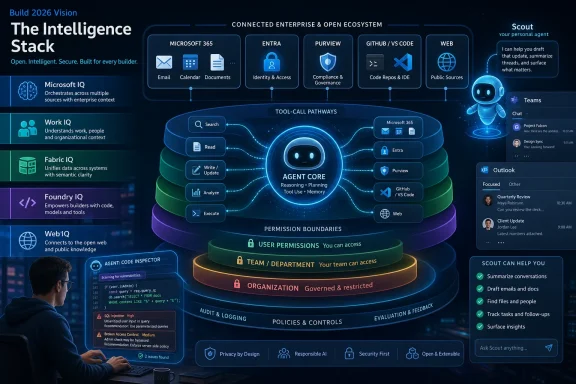
Futuristic “Intelligence Stack” diagram showing Microsoft 365, identity, agents, and permission controls for business AI.Microsoft Wants Context to Be Its New Platform Lock-In​

Microsoft IQ is the center of this announcement because it gives a name to something Microsoft has been assembling for years: the graph of work, data, documents, meetings, identities, permissions, and business semantics that already lives across Microsoft 365, Azure, Fabric, GitHub, and Windows. If Copilot was the user-facing brand for AI assistance, IQ is the plumbing Microsoft wants developers to build against.
That framing is important. A generic chatbot can summarize a document or draft an email, but an enterprise agent has to understand relationships. It needs to know that a sales forecast depends on a regional plan, that a contract clause is governed by a specific policy, that a meeting decision affects a Jira ticket, or that a finance number means something different depending on the business unit.
This is where Microsoft has a structural advantage over model-only competitors. It already sits inside the places where many companies create, store, and govern work. Microsoft 365 has the messages, files, calendars, and meetings. Entra has identity. Purview has compliance controls. Fabric has analytics and semantic models. GitHub and Visual Studio Code have developer workflows. Azure AI Foundry has the model and agent development surface.
Microsoft IQ packages those assets as an intelligence layer rather than a collection of integrations. Work IQ captures how people collaborate in Microsoft 365. Fabric IQ grounds agents in structured business data and ontologies. Foundry IQ connects agents to unstructured enterprise knowledge. Web IQ adds fast retrieval from the public web. Together, the pitch is that agents should not merely retrieve snippets; they should reason across the organization’s own map of work.
The lock-in risk is obvious, but so is the value proposition. Enterprises have spent years trying to make knowledge management systems that employees actually use. Microsoft is now arguing that the knowledge system already exists, buried inside the daily exhaust of work, and that agents can finally make it useful.

The IQ Stack Turns Retrieval Into a Governance Problem​

The most practical part of Microsoft’s announcement is also the least glamorous: Work IQ APIs are slated to give developers direct access to Microsoft 365 work context, with Microsoft emphasizing permission-aware access rather than raw data extraction. That distinction is not cosmetic. In enterprise AI, retrieval is security.
A badly designed agent does not need to be malicious to become dangerous. It only needs to retrieve the wrong document for the wrong user, summarize confidential content into a chat, or combine individually harmless facts into a sensitive inference. The more useful an agent becomes, the more likely it is to touch regulated, privileged, or commercially sensitive information.
Microsoft’s answer is to make identity and policy enforcement part of the agent substrate. Work IQ is designed to operate in the context of the signed-in user, respecting Microsoft 365 permissions and governance rules. Foundry IQ similarly emphasizes permission-aware knowledge retrieval. Fabric IQ brings business semantics into the mix, so agents can understand the meaning of data rather than treating every table or document as isolated text.
This is a shift from the early retrieval-augmented generation era, when many teams built custom vector stores, copied internal content into separate indexes, and then struggled to re-create enterprise security around the duplicated data. Microsoft’s message is that developers should not have to rebuild a shadow compliance system just to let an agent answer questions.
That message will resonate with IT departments, but it also gives Microsoft leverage. If the safest way to build enterprise agents is to keep data inside Microsoft’s trust boundaries, then Microsoft’s cloud and productivity stack becomes harder to dislodge. The company is not merely selling AI features; it is turning governance into a competitive moat.
The catch is that governance promises are only as good as their implementation. Permission trimming, sensitivity labels, auditability, and policy enforcement all sound reassuring in a keynote. They become much more complicated when agents call tools, summarize across sources, cache context, or take action on behalf of users. Microsoft is trying to make the hard parts invisible, but invisible complexity has a way of returning during audits, incidents, and procurement reviews.

Web IQ Is Microsoft’s Answer to the Agent That Needs the Outside World​

The addition of Web IQ shows that Microsoft knows enterprise context is not enough. Agents need current external information too: market data, public documentation, supplier pages, regulatory updates, security advisories, and the innumerable facts that do not live inside a tenant.
Microsoft describes Web IQ as model-agnostic and native to the Model Context Protocol, which is exactly the kind of language developers want to hear in 2026. The AI tooling world is converging around protocols that let models discover and call external tools without bespoke glue code for every integration. By aligning Web IQ with MCP, Microsoft is positioning it as a grounding service rather than a Bing-branded sidecar.
The performance claim is also telling. Microsoft says Web IQ can return relevant information blocks nearly two and a half times faster than the next best alternative. Speed matters because agentic systems often make multiple retrieval calls before producing an answer or taking an action. A slow grounding layer can turn an impressive demo into a frustrating product.
But Web IQ also widens the trust problem. Once an enterprise agent mixes internal company data with live web results, administrators need to understand provenance, freshness, and risk. Was the answer based on a corporate policy, a public blog post, a vendor page, or a stale cached result? Did the agent distinguish between authoritative documentation and SEO sludge? Did it expose internal context while querying the outside world?
Microsoft’s broader bet is that the web cannot be bolted onto agents after the fact. It has to be a governed source, just like SharePoint, OneLake, or a business ontology. That is the right architectural instinct, even if the implementation details will determine whether Web IQ becomes a trusted layer or another black box in the agent stack.

Microsoft’s In-House Models Are About Independence, Not Just Benchmarks​

The MAI model announcements are Microsoft’s most direct signal that it does not intend to remain merely the enterprise distribution channel for other companies’ models. The company’s relationship with OpenAI remains one of the most consequential partnerships in tech, but Microsoft has been steadily building its own model portfolio through the Microsoft AI organization and the Superintelligence Team.
MAI-Thinking-1 is the headline because it is Microsoft’s first reasoning model in this family. At 35 billion active parameters and a 128,000-token context window, it is being pitched as efficient enough for practical use while still capable of multi-step reasoning, long-context work, and code generation. Microsoft says independent raters preferred it to Anthropic’s Sonnet 4.6 in a blind test and that it can compete with Opus 4.6 on coding tasks in SWE Bench Pro.
Those claims should be treated as claims, not verdicts. Benchmarks and preference tests are useful signals, but the industry has learned to be skeptical of leaderboard theater. What matters for developers is not whether a model wins a carefully selected comparison, but whether it is reliable, affordable, governable, and available where they need to deploy it.
The more strategic point is that Microsoft is building a menu. MAI-Thinking-1 covers reasoning. A flash variant covers lower-latency use cases. MAI-Image-2.5 brings text-to-image and image-to-image generation into PowerPoint and OneDrive workflows. MAI-Transcribe-1.5 expands speech recognition across 43 languages. MAI-Voice-2 adds multilingual voice generation. MAI-Code-1 targets GitHub, Copilot, and Visual Studio Code.
This is not a single flagship model story. It is a platform control story. Microsoft wants to route tasks to the right model at the right price, with enough in-house capability to avoid being fully dependent on any one external provider. In a market where OpenAI, Anthropic, Google, Meta, xAI, Mistral, and others are all pushing different trade-offs, Microsoft’s best move is to become the orchestration layer that can absorb model churn.
That is also why Azure AI Foundry matters. Foundry gives Microsoft a place to expose its own models, partner models, open models, tools, evaluations, and agent services under one development umbrella. If Microsoft can make model choice feel like a configuration decision rather than a platform migration, it reduces the risk that any single model provider can pull developers away.

Coding Agents Move From Suggestion Box to Security Actor​

MAI-Code-1 and Codename MDASH push the announcement into territory WindowsForum readers should watch closely: developer automation that does not merely write code, but inspects, reasons about, and fixes it. GitHub Copilot began as autocomplete. The modern version is becoming a distributed software engineering assistant with access to repositories, issue trackers, build systems, and security context.
Codename MDASH is especially interesting because Microsoft describes it as a multimodel agentic-security system using more than 100 agents to find exploitable bugs. The name is a wink at AI-generated prose habits, but the product ambition is serious. Microsoft wants agents to reason about data flows, business logic, exploit chains, and context-aware fixes inside the Developer Portal.
That reflects a broader shift in application security. Traditional static analysis tools are good at finding known patterns, but they often struggle with business logic vulnerabilities, chained exploits, and application-specific assumptions. A capable agentic system could, in theory, follow how data moves across services, understand intent, and propose fixes that are more useful than a generic warning.
In practice, this will be one of the hardest areas to get right. Security agents that produce noisy findings will be ignored. Agents that produce plausible but wrong fixes could introduce vulnerabilities. Agents that require broad repository access will raise governance concerns. And attackers will also use agentic tools to explore codebases, generate exploits, and probe systems faster.
Still, Microsoft’s position is logical. GitHub gives it a massive surface area for developer workflows. Defender, Entra, Purview, and Azure give it security telemetry and controls. If the company can connect code intelligence with runtime and identity context, it can offer something more valuable than another linting tool.
The deeper implication is that software development is becoming a managed conversation between humans, agents, and policy systems. Developers will still own architecture and judgment, but more of the mechanical work of discovery, refactoring, test generation, and vulnerability triage will move into agent loops. The question for teams is not whether they will use these tools, but how they will review, constrain, and audit them.

Scout Shows the Productivity Agent Microsoft Really Wants to Build​

The Scout announcement brings Microsoft’s agentic ambitions back to the individual worker. Built on OpenClaw and Work IQ, Scout is described as a personal agent for frontier customers that stays attentive, learns how a user operates, and can proactively handle tasks across tools such as Teams and Outlook.
This is the version of Copilot Microsoft has been gesturing toward since the beginning: not a chatbot you summon, but an assistant that notices, prepares, nudges, schedules, summarizes, and acts. Meeting prep, scheduling conflicts, and routine task handling are mundane examples, but that is precisely why they matter. Enterprise productivity is not blocked by a lack of sci-fi demos; it is buried under small coordination costs.
The phrase “always-on” will make some users uneasy, and for good reason. A personal agent that understands routines, tools, relationships, and organizational context is useful because it is intimate. It is also risky because it is intimate. The boundary between helpful anticipation and intrusive surveillance is not technical alone; it is cultural, managerial, and legal.
Microsoft will likely emphasize local and cloud intelligence, tunable behavior, and enterprise controls. Those are necessary, but adoption will depend on trust at the user level. Employees need to know what Scout can see, what it remembers, what it acts on, and how to stop it. Administrators need to know how actions are logged, delegated, reversed, and governed.
OpenClaw’s influence is notable because it points toward agents with a persistent “heartbeat” rather than one-off prompts. That model changes expectations. A normal chatbot waits for instructions. A persistent agent monitors state, compares it against goals, and decides when to intervene. That is a more powerful paradigm, but also one that requires a much stronger theory of consent and control.
If Microsoft gets Scout right, it could make Copilot feel less like a feature and more like a layer of the operating environment. If it gets Scout wrong, it risks reinforcing the suspicion that workplace AI is just another instrument of managerial visibility wrapped in productivity language.

Windows Is the Client, but the Agent Is the New Runtime​

For Windows users and developers, the Build announcement should be read alongside Microsoft’s broader push to make Windows a trusted AI development platform. The company is investing in local models, Windows ML, developer configurations, and AI PC capabilities while also building cloud-side agent infrastructure through Foundry and Microsoft 365.
That dual strategy matters. The future Microsoft is sketching is not purely cloud-based and not purely local. Some tasks will run on device for privacy, latency, or cost reasons. Others will call cloud models, enterprise knowledge layers, and web grounding services. Still others will move fluidly between local and cloud intelligence depending on policy and hardware.
Windows becomes important not simply as the place where users click buttons, but as the managed endpoint where agents may observe context, interact with applications, and perform local work. That raises the stakes for Windows security and identity controls. An agent with access to the desktop is not just another app; it is a potential operator.
For developers, this creates an architectural puzzle. Should an agent’s memory live in Microsoft 365, a local store, an application database, or a Foundry project? Should tool calls happen through MCP, proprietary APIs, or local automation? Should sensitive workflows be constrained to on-device models? How should failures be surfaced to users?
Microsoft is trying to make its answer the default answer. Use Work IQ for work context. Use Fabric IQ for business semantics. Use Foundry IQ for knowledge. Use Web IQ for external grounding. Use Foundry for agents and model choice. Use GitHub and VS Code for coding. Use Windows as the trusted client. The completeness of that story is impressive; it is also exactly why competitors and customers will scrutinize it.

The Enterprise AI Sale Has Moved From Magic to Liability​

The first generation of AI marketing was about amazement. The next generation is about liability. Can the agent be trusted with regulated data? Can it explain why it acted? Can it avoid leaking information across permission boundaries? Can it be audited? Can it be disabled without breaking workflows? Can it respect local law, company policy, and user intent?
Microsoft’s announcements are clearly shaped by that transition. The company is no longer merely saying that AI can draft documents or answer questions. It is saying that enterprise agents need intelligence layers, ontologies, permissions, grounding, security agents, and model orchestration. In other words, AI is becoming boring in the way enterprise technology must become boring before it becomes essential.
That is good news for IT pros, who have been handed a parade of AI tools with unclear data flows and vague governance models. Microsoft is at least speaking the language of enterprise control. It understands that an agent without identity, permissions, logging, and policy is not a productivity tool; it is a breach report waiting to happen.
But the burden on administrators will still grow. Every new agent capability creates new policy questions. Which users can create agents? Which agents can call which tools? Which data sources can be grounded together? Which actions require confirmation? Which logs are retained? Which model outputs are discoverable? Which workflows are too sensitive for autonomy?
Microsoft’s advantage is that many of those controls already exist somewhere in its stack. Its challenge is making them coherent. The enterprise does not need five different admin portals, three different policy vocabularies, and a dozen overlapping agent configuration surfaces. It needs a control plane that security, compliance, developers, and business owners can all understand.

Microsoft’s Biggest Rival May Be Complexity​

The risk in Microsoft’s agentic strategy is not lack of ambition. It is over-assembly. Work IQ, Fabric IQ, Foundry IQ, Web IQ, Copilot Studio, Azure AI Foundry, Microsoft 365 Copilot, GitHub Copilot, Windows ML, Semantic Kernel, MCP tooling, security agents, local models, cloud models, and custom APIs all make sense individually. Together, they can become a maze.
This has happened before. Microsoft often wins by integrating across layers, but it also has a long history of branding and licensing complexity that makes customers wait for consultants, reference architectures, and painful product consolidation. The company can describe a unified intelligence layer; customers still have to buy, configure, secure, and operate it.
There is also the question of openness. Microsoft says Web IQ is model-agnostic and MCP-native, and Foundry has been moving toward a multi-model reality. That is the right posture. But developers will watch whether the best experience is genuinely available across models and clouds, or whether “open” quietly means “works best if everything is Microsoft.”
The agent ecosystem is still young enough that standards can matter. MCP, Agent-to-Agent patterns, open model formats, and interoperable tool schemas could prevent enterprise AI from becoming a stack of incompatible agent silos. Microsoft has enough market power to help normalize those standards. It also has enough market power to bend them toward its own platforms.
For customers, the pragmatic stance is clear: use Microsoft’s integrations where they reduce risk and operational work, but avoid building business logic that cannot be inspected, migrated, or governed outside a single vendor’s abstraction. The most expensive AI mistake may not be choosing the wrong model. It may be embedding the company’s workflows into an agent layer no one can later untangle.

The Build 2026 Message Hidden Inside the IQ Branding​

Microsoft’s announcement is easy to dismiss as another bundle of AI names, but the concrete direction is sharper than the branding suggests. The company is assembling the layers it thinks enterprise agents require: context, semantics, retrieval, models, tools, security, and user-facing autonomy.
  • Microsoft IQ is now the umbrella for giving agents organizational context across Microsoft 365, Fabric, Foundry, and the web.
  • Work IQ is the most immediately important piece for developers building agents that need Microsoft 365 context without copying enterprise data into separate systems.
  • Fabric IQ gives Microsoft a way to make agents reason over business meaning, not just raw tables, documents, and vector search results.
  • Microsoft’s MAI model family is a strategic hedge that gives the company more control over cost, latency, and capability across reasoning, coding, image, speech, and voice workloads.
  • Scout is the clearest sign that Microsoft sees agents becoming persistent workplace actors, not merely chat interfaces waiting for prompts.
  • The hardest adoption questions will be about governance, auditability, user consent, licensing, and operational complexity rather than model quality alone.
The industry has spent the past three years asking whether AI agents are real. Microsoft’s Build 2026 answer is that they will become real only when they are grounded in the systems where work already happens, constrained by the policies enterprises already depend on, and cheap enough to run continuously. That is a less magical vision than the demos that sold the AI boom, but it is also more durable. The next fight will not be over who can make an agent talk; it will be over who can make one safe, useful, and boring enough to trust.

References​

  1. Primary source: SiliconANGLE
    Published: 2026-06-02T18:50:13.660627
  2. Related coverage: techradar.com
  3. Official source: learn.microsoft.com
  4. Related coverage: techcrunch.com
  5. Official source: microsoft.com
  6. Related coverage: geekwire.com
  1. Official source: techcommunity.microsoft.com
  2. Related coverage: windowscentral.com
  3. Official source: community.fabric.microsoft.com
  4. Official source: cdn-dynmedia-1.microsoft.com
 

Microsoft used Build 2026 in San Francisco on June 2 to expand its AI model lineup, make Microsoft IQ generally available, preview deeper Work IQ access for Microsoft 365 signals, and pitch agentic infrastructure spanning cloud data, web grounding, Windows PCs, and prototype devices. The message was not subtle: Microsoft wants the next software platform to be less about apps waiting for clicks and more about agents acting across company data with permission. That ambition is powerful, but it also puts Microsoft in the position of asking enterprises to trust it with the most sensitive layer of work itself: context.

Digital infographic showing Microsoft “context engine” AI with governance, security, and cloud interfaces.Microsoft Is Selling Context as the New Operating System​

The most important Build announcement was not another model, another benchmark, or another Copilot flourish. It was Microsoft’s insistence that agents need a shared intelligence layer, and that Microsoft IQ is the place where that layer should live.
That is a classic Microsoft platform move. Windows abstracted hardware. Office abstracted documents and workflows. Azure abstracted infrastructure. Microsoft IQ is trying to abstract organizational meaning: who works with whom, what a customer relationship looks like, which business entities matter, where the authoritative data sits, and what an agent is allowed to infer from it.
For years, enterprise AI demos have failed at the same point. A chatbot can summarize a document, but it cannot reliably know whether the spreadsheet in SharePoint is more authoritative than the Power BI model, whether the sales contact in Outlook has been superseded in Dynamics, or whether a manager’s informal Teams message should shape a procurement recommendation. Microsoft’s answer is that agents should not rediscover the enterprise from scratch every time they run. They should inherit a governed map of work.
That is why Microsoft IQ matters more than its branding suggests. It is not merely another product name in the Copilot sprawl. It is Microsoft’s attempt to turn its privileged position inside Microsoft 365, Fabric, Azure, and Windows into a durable agent platform.

Work IQ Turns Microsoft 365 Into Agent Fuel​

The most immediate piece of the announcement is Work IQ, which Microsoft says will give agents access to Microsoft 365 signals through APIs beginning June 16. In plain English, that means developers will be able to build agents that understand more than files. They can work with people, meetings, email, chats, tasks, organizational relationships, and the patterns that emerge from daily work.
That is both the opportunity and the risk. Microsoft 365 is where modern office life leaves its exhaust: calendars, Teams messages, PowerPoint drafts, Word comments, Outlook threads, SharePoint permissions, and the social graph of collaboration. If agents can safely reason over that material, they can become far more useful than today’s prompt boxes.
They could brief a sales lead before a customer call, identify the people who have worked on a similar contract, assemble a project history from scattered documents, or flag that a decision appears to contradict the latest policy. These are not science-fiction tasks. They are exactly the kind of dull connective tissue that consumes hours in large organizations.
But Work IQ also forces administrators to confront a hard truth. The same signals that make an agent useful are the signals that can make it intrusive, wrong, or politically explosive. A system that understands “how work gets done” may also expose how decisions are really made, which teams are isolated, which employees are overloaded, and which informal channels carry sensitive information.
Microsoft’s pitch is that permissions, governance, and tenant boundaries will keep this sane. IT pros will hear that and immediately ask the right follow-up: whose permissions, at what moment, under which retention policy, and with what audit trail?

Fabric IQ Is the Boring Layer That Makes the Demos Possible​

If Work IQ is the workplace graph, Fabric IQ is Microsoft’s answer to the data graph. The Fabric-hosted semantic foundation is meant to act as an ontology for structured business data, giving agents a consistent way to understand entities such as customers, products, orders, assets, regions, suppliers, and risk categories.
This is the unglamorous part of agentic AI, and it may be the most important. Most enterprise data estates are not clean lakes of knowledge. They are sedimentary deposits of acquisitions, departmental databases, renamed metrics, duplicated dashboards, regional exceptions, and Excel files that outlived three reorganizations. Agents do not magically solve that fragmentation. If anything, they make it more dangerous by wrapping messy inputs in confident prose.
Microsoft’s ontology push acknowledges that a company’s data problem is not just storage or query speed. It is meaning. “Revenue” means different things to finance, sales, and operations. “Customer” may mean a billable account in one system, an end user in another, and a partner-managed relationship somewhere else. An agent that cannot distinguish those definitions is not intelligent; it is merely fluent.
Fabric IQ gives Microsoft a way to say that AI agents should reason over governed business concepts rather than raw tables. That is the right architectural instinct. The catch is that ontologies are not born from vendor dashboards. They require organizational discipline, data stewardship, political negotiation, and the slow work of deciding which definitions win.

Web Grounding Shows Microsoft Wants Agents Outside the Tenant, Too​

Microsoft also introduced a web-grounding capability described as model-agnostic and native to the Model Context Protocol. The company says it can return relevant information blocks significantly faster than alternatives, a performance claim that should be treated as vendor benchmarking until independent tests appear. Still, the direction is clear: Microsoft wants agent developers to connect internal context with external knowledge without hard-wiring every toolchain to a single model provider.
That matters because the agent stack is still fluid. Anthropic’s Model Context Protocol has become one of the few shared pieces of language in a market otherwise crowded with competing SDKs, agent frameworks, vector stores, retrieval systems, and orchestration layers. By embracing MCP, Microsoft is signaling that it does not want to fight every integration battle at the protocol level.
This is pragmatic. Enterprises will not standardize on one model family, one retrieval method, or one vendor’s agent runtime. They will use OpenAI models in some places, small local models in others, domain-specific models where regulation demands it, and third-party tools where Microsoft has no native advantage. The winning platform will be the one that can manage context, permissions, and observability across that heterogeneity.
Web grounding is also a reminder that agents need fresh information. A contract-review agent may need internal templates, but it may also need current regulatory guidance. A procurement agent may need company policy and market pricing. A security agent may need internal telemetry and public vulnerability data. Grounding is where the fantasy of autonomous agents meets the messy real world.

Project Solara Pulls the Agent Story Back Toward the Device​

The Reuters-covered Project Solara angle adds an important twist: Microsoft is not content to make agents a cloud-only story. Prototype hardware for running agents on-device points toward a future in which some AI work happens closer to sensors, peripherals, local data, and the user’s physical context.
That is strategically important for Windows, even if Solara itself remains more signal than shipping product. Microsoft has spent the past two years trying to make the AI PC feel consequential rather than decorative. Copilot+ PCs introduced neural processing units as a new selling point, but many users still struggle to name a daily workflow that justifies the hardware transition. Agent-first devices give Microsoft a more ambitious narrative: local compute is not just for faster effects or offline summaries; it is for agents that can perceive, act, and adapt at the edge.
The tension is that “agent-first hardware” can easily become another category before the use cases are ready. Enterprises do not buy platforms because a demo looks elegant. They buy them when security, manageability, lifecycle support, and application compatibility are boring enough to trust. If Solara is to matter, it will have to inherit the lessons of Windows management rather than bypass them.
The device story also complicates Microsoft’s privacy argument. On-device processing can reduce cloud exposure, but agents still need identity, policy, updates, telemetry, and often external retrieval. The privacy gain depends on architecture, not slogans. IT departments will want to know what stays local, what leaves the device, what is logged, and what happens when an agent has partial context.

The Model Expansion Is Less About Choice Than Leverage​

Microsoft’s expansion of model families fits into a broader pattern: the company wants to avoid being perceived as merely the enterprise wrapper around one frontier lab. Its partnership with OpenAI remains central, but Microsoft’s customers increasingly expect model choice. Some workloads need the most capable frontier model available. Others need cheaper inference, lower latency, regional controls, domain specialization, or local execution.
This is where model choice becomes a platform weapon. If Microsoft can make Azure AI Foundry, Copilot Studio, Windows AI Foundry, and Microsoft IQ feel like a coherent environment, then the particular model behind a workflow becomes more replaceable. The value shifts upward to orchestration, grounding, governance, identity, monitoring, and integration with existing business systems.
That is the same move cloud providers made with compute. Virtual machines mattered, then containers mattered, then managed services mattered more. In AI, the raw model will remain important, but enterprise buyers are already discovering that model capability is only one part of production deployment. The expensive work is connecting the model to reliable data, constraining its behavior, measuring its output, and proving to auditors that it did not make things up in a business-critical process.
Microsoft’s advantage is that it owns many of the places where enterprise context already lives. Its disadvantage is that customers know exactly how complex Microsoft licensing, administration, and product naming can become. The company is building a platform for agents; it must avoid making that platform feel like a scavenger hunt.

Satya Nadella’s Platform Rules Are Really a Warning​

Satya Nadella’s reported comments on new platform rules should be read as more than keynote rhetoric. Every major platform shift rewrites who gets distribution, who controls identity, who captures developer attention, and who becomes infrastructure for everyone else. Microsoft knows this because it has been on both sides of that equation.
The agent era threatens the traditional app model. If users increasingly ask agents to accomplish outcomes, they may interact less with individual apps. That creates a distribution crisis for software vendors and a control opportunity for whoever operates the agent layer. If Microsoft can make Copilot, Microsoft IQ, and its developer tools the default route through which work gets initiated, it sits above a large share of enterprise software activity.
This is why interoperability claims matter. A world of agents that can talk to many systems through open protocols is healthier than one in which every vendor builds a private assistant with private connectors and private memory. But open protocols do not automatically create open markets. The company that controls identity, policy, default placement, and user interface can still shape outcomes.
For WindowsForum readers, this is not an abstract antitrust seminar. It affects whether future Windows and Microsoft 365 experiences feel like user-controlled tools or vendor-controlled funnels. It affects whether admins can swap models, disable features, inspect agent behavior, and keep third-party applications on equal footing. The platform rules will be written in APIs, defaults, admin centers, and licensing terms as much as in speeches.

Enterprise IT Will Judge the Agents by Their Failure Modes​

The gulf between an impressive agent demo and a deployable enterprise agent is measured in failure modes. What happens when the agent cannot access a file it needs? What happens when two systems disagree? What happens when a user asks it to act outside policy? What happens when the best answer is “I do not know”?
Microsoft’s Build framing recognizes this problem, but recognition is not resolution. Agents that take action across business systems require a higher standard than chatbots that answer questions. A bad summary is embarrassing. A bad procurement action, customer communication, access change, or compliance interpretation can be expensive.
Administrators will therefore look for controls that are more granular than “on” and “off.” They will want scoped permissions, constrained tools, approval checkpoints, simulation modes, detailed logs, rollback paths, and clear separation between recommendation and execution. They will also want licensing clarity, because agent sprawl could easily become the next quiet budget shock.
Security teams will focus on prompt injection, data exfiltration, over-permissioned connectors, poisoned web content, and agents that launder untrusted information into trusted workflows. The more powerful the context layer becomes, the more valuable it becomes as a target. Microsoft’s security story must be as central as its productivity story.

The Windows Angle Is Bigger Than Copilot​

Build’s agentic announcements also place Windows in a more interesting position than the last few years of Copilot branding implied. The question is no longer whether Windows has a chatbot in the taskbar. The question is whether Windows becomes a runtime, policy surface, and local execution layer for agents that move between cloud and device.
That could make Windows newly relevant to developers. If agents need local files, device capabilities, notifications, identity, secure enclaves, NPUs, and app integration, then the operating system matters again. A browser tab is not always enough. A pure cloud agent cannot see or do everything a user expects on a managed PC.
But Microsoft must tread carefully. Users have been skeptical when AI features appear to be bolted into Windows for Microsoft’s strategic benefit rather than theirs. Recall-style features, screenshots, local indexing, and behavioral memory all raise legitimate questions about consent and control. The more agentic Windows becomes, the more Microsoft must prove that the user and the administrator remain in charge.
For developers, the opportunity is real. A mature Windows agent platform could let applications expose capabilities in standardized ways instead of relying on brittle UI automation. For admins, the concern is equally real. Standardized capability exposure is useful only if it is governed, observable, and revocable.

The Real Competition Is the Enterprise Memory Layer​

Microsoft’s rivals are not standing still. Google has Workspace and Gemini, Salesforce has Agentforce, ServiceNow has workflow depth, AWS has infrastructure reach, Anthropic has protocol momentum, and OpenAI has developer mindshare. But Microsoft’s strongest claim is that enterprise memory already lives in its estate.
That claim is partly true. Microsoft 365 contains an extraordinary amount of work context. Entra ID is deeply embedded in access control. Fabric gives Microsoft a growing data and analytics story. Windows remains the managed endpoint default in many organizations. Azure is already approved infrastructure for countless enterprises.
The danger for Microsoft is that abundance becomes complexity. Customers do not want six overlapping “IQ” concepts, three agent studios, two grounding stories, and a licensing matrix that requires a reseller séance. They want a clear architecture: where context lives, how agents access it, how permissions apply, how outputs are evaluated, and how costs scale.
This is where Microsoft’s platform discipline will be tested. The company has all the ingredients for an enterprise agent stack. It now has to make them feel less like a product portfolio and more like a coherent system.

The Build Message Lands Because the Old AI Demo Is Exhausted​

The industry is moving past the phase where summarization demos can carry a keynote. Everyone has seen the chatbot rewrite an email. Everyone has seen a slide deck generated from a document. Everyone has seen a model answer a question with impressive fluency and occasional nonsense.
The next phase is about work getting done across systems. That requires context, tools, state, memory, identity, and policy. Microsoft’s announcements are compelling because they address that deeper layer rather than merely promising smarter text generation.
They also reveal how hard the next phase will be. Enterprise AI is not failing because models are useless. It is slowing because companies do not trust the surrounding machinery yet. They do not trust the data hygiene, the permissions model, the auditability, the cost curve, or the vendor lock-in.
Microsoft is betting that it can turn those concerns into its advantage. If the agent era is messy, then the vendor with the broadest enterprise control plane has leverage. That is the Build thesis in one sentence.

The Bet Microsoft Made at Build Is Now Concrete Enough to Test​

Microsoft’s announcements are no longer just a vibe shift toward AI. They describe a testable architecture for enterprise agents: shared context, governed data meaning, model choice, web grounding, and a path from cloud to device.
  • Microsoft IQ is intended to become the shared intelligence layer that agents use to understand enterprise work and business data.
  • Work IQ APIs are expected to give agents more direct access to Microsoft 365 signals, raising both productivity potential and governance stakes.
  • Fabric IQ’s ontology approach is Microsoft’s admission that agents need trusted business meaning, not just access to tables and files.
  • Model-agnostic web grounding and MCP support show that Microsoft wants to participate in the emerging agent protocol layer rather than isolate itself from it.
  • Project Solara suggests Microsoft sees agentic computing extending beyond cloud services into managed, local, and device-specific experiences.
  • The practical success of the platform will depend less on keynote demos than on permissions, audit logs, cost controls, failure handling, and admin trust.
Microsoft’s Build 2026 story is persuasive because it identifies the real bottleneck in enterprise AI: not the lack of models, but the lack of trustworthy context around them. The company is now trying to make that context a platform, and if it succeeds, agents may become as ordinary in business software as workflows and dashboards are today. If it fails, the agent era will look familiar: another layer of expensive abstraction over data nobody quite trusts, governed by defaults nobody quite remembers enabling.

References​

  1. Primary source: Let's Data Science
    Published: Tue, 02 Jun 2026 18:20:23 GMT
  2. Related coverage: techradar.com
  3. Related coverage: tomsguide.com
  4. Related coverage: windowscentral.com
  5. Official source: microsoft.com
  6. Official source: news.microsoft.com
  1. Official source: commandline.microsoft.com
  2. Related coverage: techtarget.com
  3. Related coverage: thenextweb.com
  4. Official source: learn.microsoft.com
  5. Official source: blogs.microsoft.com
  6. Related coverage: ebisuda.net
  7. Related coverage: siliconangle.com
  8. Related coverage: itpro.com
  9. Official source: cdn-dynmedia-1.microsoft.com
 

Microsoft used Build 2026 to position Microsoft IQ, Work IQ, Scout, and Windows agent security as the connective tissue for AI agents that can act across Windows, Microsoft 365, enterprise data, and the web. The pitch is simple enough: agents are not useful because they are chatty, but because they can see enough context to do work. The risk is just as simple: the more useful an agent becomes, the closer it moves to the sensitive center of the PC and the organization. Microsoft is no longer selling AI as a side panel; it is laying tracks for AI to become an operating layer.

Digital dashboard showing Microsoft 365/Work automation, an AI “execution container,” and audit trust delegation.Microsoft Is Done Treating Copilot as a Chat Window​

For the first phase of the AI PC era, Microsoft’s consumer story was largely about visibility. Copilot got a key on keyboards, a place in Windows, and a steady stream of demos in which users asked it to summarize, rewrite, search, and explain. That was always a halfway house. A chatbot that waits for instructions is useful, but it is not the destination Microsoft has been describing.
The Build 2026 agent push makes the next step explicit. Microsoft wants software that can observe context, infer intent, retrieve the right internal knowledge, and perform actions with less manual prompting. That means the old “ask a question, get an answer” pattern gives way to something more operational: prepare for this meeting, resolve this schedule conflict, find the relevant document, summarize the unresolved thread, update the workflow, and do it without forcing the user to stitch five apps together.
Microsoft IQ is the umbrella for that ambition. It is not a single feature in the way Notepad tabs or Phone Link is a feature. It is a context layer, meant to make agents less generic by grounding them in work patterns, business data, enterprise knowledge, and web information.
That distinction matters because today’s AI tools often fail in the gap between fluency and relevance. They can sound confident while missing the organizational meaning of a phrase, the history behind a decision, or the permissions boundary around a dataset. Microsoft’s answer is not simply a better model. It is a claim that context, identity, governance, and retrieval are now product infrastructure.

The Boring Tasks Are the Beachhead​

Windows Central framed the story around boring PC tasks, and that is the right entry point. Nobody needs an agentic operating system because they want a more dramatic way to open a spreadsheet. They need one because modern work has become a lattice of small interruptions: scheduling, searching, reconciling, summarizing, filing, comparing, approving, and nudging.
That is where Microsoft’s agent strategy has a plausible wedge. A personal agent that prepares meeting briefs from Teams, Outlook, SharePoint, and business data is not science fiction; it is an extension of patterns Microsoft 365 users already experience in fragmented form. The difference is that an agent does not merely retrieve a document. It tries to understand why that document matters in the moment.
Scout, Microsoft’s personal work agent now in preview for Frontier customers, is important precisely because it is mundane. Its advertised capabilities revolve around the daily mechanics of work: preparing for meetings, handling scheduling conflicts, and acting across connected services. That is not the stuff of cinematic AI. It is the clerical substrate of office life.
The bet is that users will tolerate, and eventually expect, automation in those areas before they trust AI with higher-stakes decisions. If an agent can reliably brief you before a customer call, surface the unresolved blocker, and move a meeting without breaking etiquette or policy, it starts to earn operational trust. If it hallucinates, overreaches, or exposes confidential context, the trust collapses quickly.

Microsoft IQ Is Really a Governance Story Wearing an AI Hat​

The most revealing phrase from Microsoft’s Build messaging is that agents are only as good as the context they receive. That sounds like a developer aphorism, but it is also a governance doctrine. In enterprise AI, the hard problem is not generating text. It is deciding what the system is allowed to know, what it should consider authoritative, and what it may do with that knowledge.
Microsoft IQ breaks that problem into branded layers. Work IQ captures signals from Microsoft 365, organizational systems, and external sources. Fabric IQ gives business data a semantic foundation so agents are not guessing what “revenue,” “customer,” or “active account” means in a particular company. Foundry IQ connects enterprise knowledge and web retrieval into agent workflows. Web IQ supplies Microsoft’s AI-first search stack.
The branding is heavy, but the architecture reflects a real enterprise need. Companies have spent years building data lakes, SharePoint sites, Teams channels, Power BI models, CRM systems, ticket queues, wikis, and half-governed file shares. The result is not a clean knowledge graph waiting for AI. It is a messy institutional memory with conflicting definitions, uneven permissions, stale documents, and local exceptions.
Microsoft is trying to make that mess usable without pretending it disappears. The promise of IQ is that agents can ground themselves in company-specific knowledge while respecting policy and business meaning. The danger is that a branded context layer may make retrieval feel more settled than it really is.
A wrong answer from a public chatbot is annoying. A wrong answer that appears to be grounded in enterprise truth can become operationally dangerous. The more official the context layer looks, the more users may defer to it.

The Semantic Layer Is Where the Fight Moves Next​

Fabric IQ may be the least flashy part of the story, but it could be one of the most consequential. In many organizations, analytics problems are not caused by a lack of dashboards. They are caused by too many dashboards that disagree. Different teams define the same business term differently, and every executive meeting becomes a negotiation over whose numbers count.
Agents intensify that problem. A human analyst can sometimes explain that two reports differ because one counts booked revenue and another counts recognized revenue. An agent, unless properly grounded, may simply choose one and present it as fact. That is how automation turns ambiguity into false certainty.
A semantic layer gives Microsoft a way to argue that AI agents should reason over business concepts rather than raw tables. That is sensible. If an organization has already invested in Microsoft Fabric and Power BI, there is an obvious appeal in letting agents inherit those definitions instead of building a parallel AI data stack.
But semantic layers are political objects, not just technical ones. Someone has to decide which definition wins, which ontology maps to which system, and how exceptions are handled. Microsoft can provide the tooling, but it cannot magically resolve the organizational disputes that make enterprise data hard in the first place.
That is why the IQ strategy will likely succeed unevenly. Companies with mature identity, data governance, and Microsoft 365 hygiene may see real gains. Companies with chaotic permissions, unmanaged SharePoint sprawl, and contradictory reporting logic may simply give agents a more impressive way to be confused.

Windows Has to Become a Safer Place for Things That Act​

The Windows side of the announcement is where the story becomes more than enterprise knowledge management. If agents are going to do work on a PC, they need access to files, apps, APIs, credentials, and interface state. That changes the threat model.
Microsoft’s latest Windows agent security work centers on containment, identity, transparency, consent, and manageability. The company is advancing the idea of agent execution inside sandboxes and controlled environments, including Microsoft Execution Containers as part of the Windows platform security story. The point is to let agents act without giving them the same broad, ambient authority as the user.
That is the right instinct. An AI agent that can browse files, issue commands, use apps, and call services is not just another process. It is a delegated actor. It may misunderstand instructions, be manipulated by malicious content, or combine harmless capabilities into a harmful sequence.
Traditional app security assumes that software has defined behavior. Agent security has to assume adaptive behavior. A spreadsheet macro, a browser extension, and a local process can all be risky, but an agent introduces an additional layer: it interprets instructions and context dynamically. The attack surface is not only code; it is language, documents, prompts, permissions, and the chain of tools the agent can invoke.
That is why Microsoft’s transparency language matters. Users and administrators need to know what an agent is doing, what it has accessed, and why it is asking for more authority. A permission prompt that says “allow access to files” is not enough when the agent’s future behavior may depend on content it has not read yet.

Consent Is Necessary, but It Will Not Be Enough​

Microsoft has been moving Windows toward a consent-first story for apps and AI agents. That direction is welcome, especially after years in which users were trained to click through prompts with minimal understanding. But consent is a thin reed when the system asking for permission is complex, probabilistic, and integrated across work data.
The old security bargain was at least somewhat legible. An app asked for camera access, location access, or file access. Users could understand the category, even if they did not always understand the implications. Agents muddy that bargain because the permission is often not for a single action. It is for a class of future actions driven by context.
A meeting-prep agent might need calendar access, email access, Teams access, document access, and CRM access. Each permission may be reasonable in isolation. Together, they create a composite view of a person’s work life and the organization’s internal state. That is exactly what makes the agent useful, and exactly what makes it sensitive.
For administrators, the question becomes less “Should this app be installed?” and more “Which actions may this agent take, under which identity, against which resources, with what audit trail, and with what rollback mechanism?” That is a richer governance problem than endpoint management alone.
The best version of Microsoft’s model gives IT departments granular controls, strong logging, clear user-facing explanations, and enforceable boundaries between personal context, team context, and enterprise context. The worst version creates a new class of shadow automation: agents that appear sanctioned because they run inside Microsoft’s ecosystem, but whose actual behavior is poorly understood.

The AI PC Finally Gets a Job Description​

The AI PC narrative has often felt hardware-led. Neural processing units arrived before many users had a daily reason to care. Copilot+ PCs promised local AI experiences, but the killer workflow remained elusive for many buyers outside narrow demos such as recall, image generation, live captions, and creative tooling.
Agents give the AI PC a more coherent job description. Local compute can help with responsiveness, privacy-sensitive processing, background tasks, and model execution close to the user’s files and apps. Cloud services can provide scale, retrieval, and enterprise connectivity. Windows sits in the middle, brokering access to the device and user environment.
That hybrid shape is likely to define the next few years. Some agent work will happen locally because the latency and privacy advantages matter. Some will happen in Microsoft’s cloud because enterprise retrieval, model orchestration, and policy enforcement are easier to centralize. Most useful workflows will cross the boundary.
This is also where Microsoft has an advantage over companies building AI assistants from the outside. Windows, Microsoft 365, Entra, Defender, Fabric, GitHub, and Azure give Microsoft more surface area than almost anyone else. If agents are only as good as their context, Microsoft owns an extraordinary amount of the context in which business work already happens.
That advantage will not automatically translate to user love. Microsoft’s history is full of powerful enterprise integrations that users experience as clutter, prompts, licensing tiers, and administrative friction. The agent layer must feel like relief, not another mandatory pane wedged into the workflow.

Developers Are Being Asked to Build for an Unfinished Social Contract​

For developers, Microsoft IQ is both an opportunity and a warning. The opportunity is obvious: build agents that do not have to reinvent enterprise retrieval, identity, semantic models, and Microsoft 365 integration from scratch. If Work IQ APIs become broadly available as planned, developers get a more direct way to tap into work context with Microsoft’s blessing.
That could accelerate a wave of specialized agents. Legal review agents, sales operations agents, help desk agents, finance reconciliation agents, developer productivity agents, and compliance agents all become easier to imagine when they can access governed context through common platforms. Copilot Studio and Microsoft Foundry give Microsoft separate paths for low-code builders and professional developers.
But developers are also being asked to build atop an unfinished social contract. Users do not yet have stable expectations for what a work agent should be allowed to infer. Administrators do not yet have universal playbooks for reviewing agent behavior. Security teams are still developing models for prompt injection, tool abuse, data exfiltration, and autonomous action.
The platform may mature faster than the norms around it. That is often how Microsoft ecosystems evolve: capability first, governance later, with enterprise IT forced to fill the gap. The difference this time is that the capabilities touch judgment, memory, and delegation, not just storage or messaging.
If Microsoft wants third-party developers to trust this layer, it will need more than APIs. It will need predictable permission models, durable audit trails, clear pricing, migration paths, and frank documentation about failure modes. Agents that act on enterprise context cannot be treated like ordinary add-ins with better marketing.

The Web IQ Claim Shows Microsoft Still Wants the Search War​

Web IQ is the part of Microsoft IQ that most clearly reaches beyond internal enterprise systems. Microsoft describes it as an AI-first web search stack and claims major speed advantages over alternatives. That claim fits a broader trend: search is being absorbed into answer engines, copilots, and agents that retrieve information not as a destination but as fuel for action.
For Windows users, that shift may feel subtle at first. Search results increasingly become background infrastructure. You do not “go search the web” so much as ask an agent to solve a problem, and the agent decides when web information is needed. The browser, search engine, and assistant start to blur.
For Microsoft, this is strategically important. Bing never displaced Google as the default mental model for search, but AI agents create a new distribution point. If enterprise agents use Microsoft’s retrieval stack by default, Microsoft does not need to win every consumer search query in the traditional sense. It can win the retrieval layer inside work.
That has consequences. Web grounding can improve freshness and breadth, but it also imports the web’s volatility into enterprise workflows. A bad source, a poisoned page, or a misleading snippet can become part of an agent’s reasoning chain. When that agent is merely answering a trivia question, the damage is limited. When it is drafting a customer response, updating a workflow, or advising on a security incident, the stakes rise.
Microsoft’s challenge is to make web retrieval auditable without making it unusably slow. Users need confidence about where claims came from, while agents need to act quickly enough to be useful. That tension will define the credibility of Web IQ more than any benchmark about speed.

The Real Product Is Trust Delegation​

The phrase “personal assistant” has followed computing for decades, from Clippy jokes to smartphone voice assistants to modern copilots. What changes with agents is not the metaphor but the delegation. A user is not merely asking for an answer. The user is handing over a slice of agency.
That is why Microsoft’s agent push should not be judged only by demo quality. Demos are excellent at showing the happy path: the agent reads the meeting, finds the account history, drafts the summary, and politely reschedules the conflict. Real life supplies ambiguous emails, outdated decks, private side conversations, weird line-of-business apps, and people who do not want every signal interpreted by software.
Trust delegation has layers. The user must trust that the agent understands the task. The organization must trust that the agent respects boundaries. The administrator must trust that behavior can be monitored and controlled. The developer must trust that platform APIs behave consistently. The security team must trust that containment is real rather than decorative.
This is why the Windows sandboxing story and the Microsoft IQ story belong together. Context without containment is reckless. Containment without context is useless. Microsoft is trying to argue that it can provide both because it controls so much of the stack.
The argument is credible, but not proven. Microsoft has the pieces: Windows, Entra, Defender, Microsoft 365, Fabric, Foundry, GitHub, and Azure. What it does not yet have is years of evidence that autonomous or semi-autonomous agents can operate safely and consistently across that stack at enterprise scale.

Admins Should Hear Opportunity and Alarm at the Same Time​

For sysadmins and IT pros, the agent layer will arrive as both productivity promise and governance burden. The upside is real. Many help desk, compliance, reporting, scheduling, and knowledge-management tasks are repetitive because they require context spread across systems. Agents could reduce toil if they are constrained well.
The burden is also real. Every agent becomes an identity-adjacent entity. It needs permissions, policies, logs, lifecycle management, and incident response procedures. Organizations that struggled to manage OAuth app consent and Teams sprawl will not find agent governance magically easier.
The first practical question is inventory. Which agents exist in the tenant? Who created them? Which data sources can they access? Which actions can they perform? Which users can invoke them? Which logs prove what happened after the fact?
The second question is blast radius. If an agent is tricked by a malicious document, compromised workflow, or prompt injection in a webpage, what can it touch? Can it email externally? Can it modify records? Can it create tickets, delete files, approve expenses, or change configurations? Sandboxing helps, but only if the permissions model around the sandbox is equally disciplined.
The third question is user education. Employees are already learning to distrust some AI outputs while overtrusting others. An enterprise-branded agent grounded in Microsoft IQ may look more authoritative than it deserves. Training will need to shift from “AI can make mistakes” to “AI actions need the same scrutiny as delegated human actions, sometimes more.”

Microsoft’s Advantage Is Also Its Liability​

Microsoft’s strongest pitch is integration. The same account system, productivity suite, developer platform, data platform, endpoint OS, and security stack can cooperate around agents. That is compelling for organizations already committed to Microsoft’s ecosystem.
It is also the source of anxiety. The more Microsoft integrates the AI layer into the fabric of work, the harder it becomes for customers to separate convenience from lock-in. Context layers are sticky by design. Once an organization teaches agents its business vocabulary, workflows, and permissions, moving that intelligence elsewhere becomes harder than switching a chat model.
This does not mean the strategy is bad. Enterprises often choose integrated platforms because fragmented best-of-breed stacks create their own costs. But the agent era raises the price of dependency. The platform that knows how your company works can make your company more efficient; it can also become the place where too much institutional memory is concentrated.
Microsoft will need to be unusually transparent about interoperability. If IQ becomes a one-way funnel into Microsoft services, customers will notice. If it becomes a practical layer that can respect external systems, third-party tools, and open protocols, the platform will be harder to dismiss as another enclosure.
The reference to OpenClaw in Scout’s foundation is notable because it hints at an ecosystem that is not entirely proprietary in posture. But the decisive question is not branding around openness. It is whether customers can inspect, govern, export, and replace enough of the agent stack to avoid being trapped by their own automation.

The Agent Era Will Be Won in the Audit Log​

The most concrete way to judge Microsoft’s new AI layer is not by keynote polish. It is by what happens when something goes wrong. An agent sends the wrong file, summarizes the wrong contract clause, reschedules the wrong meeting, or acts on a poisoned webpage. At that moment, the enterprise does not need poetry about productivity. It needs an audit trail.
This is where Microsoft can separate itself from AI startups that have clever demos but shallow operational controls. Enterprise customers will want to know which model ran, which context was retrieved, which permissions were used, which policy allowed the action, which user approved it, and how to reverse or contain the result. Without that, “agentic AI” becomes a compliance headache with a friendly icon.
The Windows piece matters here because PC-level actions are often harder to reconstruct than cloud workflow actions. If an agent touches local files, interacts with apps, or runs in a sandboxed execution environment, administrators need logs that connect the local event to enterprise identity and policy. Otherwise the endpoint becomes the foggy edge of the agent system.
This is also why user-visible transparency cannot be treated as decoration. If users see what an agent is doing only after the fact, they may feel surveilled or blindsided. If they see too many prompts, they will click through blindly. The interface problem is not solved by more dialog boxes. It is solved by better explanations, sensible defaults, and clear escalation when an agent is about to cross a meaningful boundary.
Microsoft has spent years convincing enterprises that identity is the new control plane. Agents may make delegated action the next one.

The Windows Enthusiast’s Skepticism Is Earned​

For Windows enthusiasts, there is a familiar rhythm here. Microsoft announces an ambitious platform shift. The demos are polished, the branding is abstract, and the first wave of features lands unevenly across regions, SKUs, hardware, and subscriptions. Users then spend months separating the transformative from the ornamental.
Skepticism is not cynicism. It is pattern recognition. Windows users remember features that arrived half-integrated, settings that migrated without becoming simpler, and AI experiences that felt more like promotion than utility. If agents become another surface for upsells and prompts, they will be resented no matter how sophisticated the backend is.
But dismissing the agent layer outright would be a mistake. The underlying shift is real. Software is moving from tools that wait to be operated toward systems that can carry out bounded tasks. Windows cannot remain merely a launcher for apps if the center of gravity moves to cross-app workflows.
The enthusiast question is whether Microsoft can make that transition without making the PC feel less personal. An agent that helps you manage your work is welcome. An agent that seems to watch, infer, and intervene without understandable boundaries will trigger backlash. The line between assistance and intrusion is thin, and Windows lives directly on it.

Build’s IQ Stack Gives IT a New Checklist​

The practical message from Build 2026 is not that every organization should unleash agents tomorrow. It is that the groundwork is being poured now, and IT departments should start treating agent readiness as a first-class planning item. The companies that wait until users are already building and connecting agents will be governing from behind.
  • Microsoft IQ should be understood as a context and grounding layer, not merely another Copilot feature.
  • Work IQ APIs becoming generally available on June 16 creates a near-term developer path for agents that understand Microsoft 365 work context.
  • Scout shows Microsoft’s preferred direction for personal work agents: proactive, connected, and embedded in existing productivity tools.
  • Windows agent sandboxing and Microsoft Execution Containers signal that Microsoft knows agent security must live below the app layer.
  • Fabric IQ may be most valuable in organizations that already have mature semantic models and disciplined data governance.
  • The biggest operational test will be whether administrators can inspect, limit, and audit agent behavior as easily as Microsoft can demo it.
The AI layer Microsoft described at Build is not a novelty bolted onto Windows; it is an attempt to redefine the PC and Microsoft 365 as an environment where software can understand context and take constrained action. That future could remove a meaningful amount of drudgery from daily work, but only if Microsoft treats trust, auditability, and user control as core product features rather than compliance language. The next phase of Windows AI will not be judged by whether an agent can do something impressive onstage. It will be judged by whether users and administrators still feel in charge after the agent starts doing useful things on their behalf.

References​

  1. Primary source: Windows Central
    Published: Tue, 02 Jun 2026 18:11:52 GMT
  2. Official source: microsoft.com
  3. Official source: blogs.windows.com
  4. Official source: learn.microsoft.com
  5. Official source: techcommunity.microsoft.com
  6. Official source: devblogs.microsoft.com
  1. Related coverage: ebisuda.net
  2. Official source: blogs.microsoft.com
  3. Official source: community.fabric.microsoft.com
  4. Official source: azure.microsoft.com
  5. Related coverage: tomshardware.com
  6. Related coverage: pcgamer.com
  7. Related coverage: techradar.com
  8. Related coverage: isg.sitefinity.cloud
 

Microsoft introduced Microsoft IQ at Build 2026 on June 2 in San Francisco, positioning it as a generally available enterprise intelligence layer that grounds AI agents in workplace data, business systems, knowledge repositories, and live web information. The announcement is less about another chatbot feature than about Microsoft’s attempt to make agents useful inside the messy, permissioned, half-structured reality of corporate computing. If Copilot was Microsoft’s first big answer to “where does generative AI sit in Office?”, IQ is its answer to the harder question: what does an agent need to know before anyone should trust it to act?
The answer, unsurprisingly, is context. Not vibes, not a longer prompt window, and not another demo in which an assistant drafts a cheery email from three immaculate bullet points. Microsoft is trying to turn the organization itself into a computable substrate, where meetings, documents, semantic models, databases, web results, permissions, and workflows become inputs for agents that can reason and act across Microsoft 365, Foundry, Copilot Studio, GitHub Copilot, and eventually the broader developer ecosystem.

Microsoft “Context Map” graphic showing integrated Work, Fabric, Foundry, and Web IQ with AI agent and security features.Microsoft’s Real Build 2026 Product Was Context​

The AI industry has spent the last two years selling agency before it solved memory. Every vendor has a version of the same pitch: agents will file tickets, reconcile invoices, write code, summarize meetings, triage incidents, and chase down business exceptions while humans do more interesting work. The weak point has always been brutally simple. An agent that does not understand the company is just a very confident temp.
Microsoft IQ is an effort to formalize that missing layer. The company is calling it a shared intelligence foundation for enterprise AI, but the plainer description is more revealing: it is a context broker for agents. It gives them a sanctioned way to retrieve, interpret, and combine signals from the systems where work actually happens.
That matters because most enterprise AI failures are not failures of fluency. The model can already write the memo, generate the SQL, draft the policy, or summarize a call. The failure comes when it lacks the right customer contract, misreads a team’s reporting structure, misses a permission boundary, hallucinates a number, or uses public web knowledge where internal policy should have won.
Microsoft’s wager is that agents will not become enterprise software by getting more charming. They will become enterprise software by becoming more grounded, governed, auditable, and integrated with the data estates companies already pay Microsoft to manage.

The Four IQs Are Microsoft’s New Map of the Enterprise​

Microsoft IQ is packaged around four context engines: Work IQ, Fabric IQ, Foundry IQ, and Web IQ. The naming is inelegant in the way only enterprise platforms can be, but the architecture tells a coherent story. Microsoft is slicing organizational context into the main categories an agent needs: how people work, what the business knows, where enterprise knowledge lives, and what the outside world says right now.
Work IQ is the most Microsoft 365-native of the group. It draws from the signals that already power Copilot experiences: meetings, mail, calendars, chats, documents, organizational relationships, and collaboration patterns. This is the layer that lets an agent infer not merely that a file exists, but that it was used in last week’s planning meeting, edited by the project lead, and relevant to the person asking the question.
That makes Work IQ powerful and politically sensitive. Productivity telemetry is the richest source of context Microsoft has, and also the one most likely to make employees and administrators nervous if it is surfaced carelessly. The difference between “helpfully understands my work” and “creepily surveils my work” will depend on permissions, transparency, admin controls, and how consistently Microsoft keeps agents inside the boundaries users already expect.
Fabric IQ is the structured-data counterpart. It connects agents to business data through Microsoft Fabric and OneLake, the company’s analytics and data-lake foundation. In theory, this is how an agent stops guessing about revenue, inventory, churn, uptime, or financial exposure and starts querying governed enterprise data products.
That is the kind of grounding enterprises have been asking for since the first wave of Copilot pilots. Executives do not want an eloquent explanation of quarterly performance based on stale documents if the actual numbers live in a warehouse, lakehouse, semantic model, or Power BI dataset. Fabric IQ is Microsoft’s attempt to make the analytic layer legible to agents without asking every developer to hand-roll connectors and retrieval logic.
Foundry IQ sits in the middle of the developer story. It is aimed at knowledge retrieval across enterprise sources and at planning how agents retrieve information from those sources. Microsoft has been positioning Foundry as the place where production AI applications are built, evaluated, secured, and operated; Foundry IQ gives that environment a knowledge layer that can be exposed to agent frameworks and workflows.
Web IQ adds the outside world. Microsoft describes it as a fast, model-agnostic web passage retrieval API for grounding agents in live web information. That phrase sounds dry, but it is strategically important. If agents are expected to operate on current events, market data, public documentation, vendor advisories, or fast-moving security information, they need something better than whatever was baked into a model months ago.
The four-part split also reveals what Microsoft thinks the enterprise agent market will become. It is not betting on a single monolithic assistant that knows everything. It is betting on many agents, hosted in many surfaces, all drawing from a common pool of sanctioned context.

The Hosted Agent Is Where the Demo Becomes a Liability​

Alongside Microsoft IQ, the Foundry Agent Service gives developers a hosted environment for long-running, stateful agents. That word stateful deserves more attention than it usually gets in product launches. A stateless AI interaction is a conversation. A stateful agent is closer to a process.
This is where the risk profile changes. If an agent remembers what it is doing, continues across sessions, calls tools, tracks intermediate steps, waits for events, and resumes work later, it starts to resemble automation infrastructure rather than a clever chat window. It may be drafting responses today, but the architecture is intended for agents that coordinate approvals, monitor business workflows, and take action across systems.
That is why tracing and observability are not decorative features. Enterprises will want to know what an agent saw, what it retrieved, what tools it called, what assumptions it made, which policies constrained it, and why it chose one action over another. Without that, the first serious compliance review or post-incident investigation will turn “AI productivity” into “AI liability.”
Microsoft appears to understand that. Foundry Agent Service is being pitched with tracing, optimization, governance, and integration into the broader Foundry platform. The pitch is not merely that developers can deploy agents. It is that they can operate them in a way that resembles production software.
That distinction matters for WindowsForum’s IT-pro audience because most organizations are not struggling to produce AI prototypes. They are struggling to decide which prototypes can be allowed anywhere near live data, privileged actions, regulated workflows, or customer-facing systems. Hosted agents only make sense if the hosting layer gives admins enough control to sleep at night.

Microsoft Is Rebuilding the Enterprise Stack Around the Agent​

Build 2026’s agent-first language is not a branding flourish. Microsoft is slowly reorganizing its developer, productivity, data, and cloud platforms around the assumption that software will increasingly be mediated by agents. The application is no longer always the primary unit of interaction. The agent is becoming the interface, the workflow runner, and the interpreter between users and systems.
That is a profound shift for Windows and Microsoft 365 environments. For decades, enterprise IT has managed users, devices, apps, identities, files, mailboxes, databases, and policies. Agents add a new actor to that estate: a software principal that may act with delegated authority, retain task state, call APIs, read documents, retrieve web data, and generate outputs that humans may approve only after the important decisions have already been shaped.
Identity and access management therefore become central. An agent must not simply “have access” because its user does. It needs scoped access, time-bound permissions, tool-level controls, and records of what it did under whose authority. Microsoft’s advantage is that Entra ID, Purview, Defender, Microsoft 365 permissions, Fabric governance, and Azure infrastructure already sit in the middle of many enterprise environments.
The risk is that Microsoft’s advantage also becomes lock-in. If the most useful agents are the ones that understand Microsoft 365 signals, Fabric semantic models, Foundry knowledge bases, Copilot Studio workflows, and GitHub Copilot coding context, enterprises may find that “open” agent development still works best when it stays close to Microsoft’s stack. Model-agnostic retrieval and Model Context Protocol support help soften that edge, but they do not erase the gravity of the platform.
That gravity is not accidental. Microsoft has watched the AI market commoditize model access with remarkable speed. If every cloud can offer frontier models, smaller models, open models, hosted models, and developer APIs, the durable value moves upward and sideways: data, workflow, identity, governance, developer tools, observability, and distribution. Microsoft IQ is a context product, but it is also a moat.

The Web IQ Bet Is Bigger Than Search​

Web IQ may be the easiest component to underestimate. At first glance, it sounds like a retrieval API: send a query, get relevant web passages back, ground the model’s answer. Useful, yes, but not obviously transformational.
The bigger point is that Microsoft is trying to separate web grounding from any single model. In an agentic world, the retrieval layer can become as important as the model layer. Developers may swap models for cost, latency, performance, data-residency, or licensing reasons, but they still need trusted retrieval that can bring current information into the reasoning loop.
If Web IQ is fast, reliable, and easy to wire into agent frameworks, it becomes infrastructure. It could support coding agents that retrieve current documentation, security agents that monitor vendor advisories, business agents that track competitor announcements, and support agents that pull current troubleshooting guidance. That is not “search” in the consumer sense. It is web evidence as a programmable enterprise primitive.
This also helps explain why the announcement is notable in a crypto publication despite having no token or blockchain component. Microsoft is making a very different bet about the agent economy. It is betting that the key rails will be cloud APIs, identity systems, business data platforms, and compliance controls, not decentralized coordination networks.
That does not settle the argument for every possible use case. But inside the enterprise, Microsoft’s position is hard to dismiss. Most companies do not want agents improvising across untrusted protocols with ambiguous accountability. They want procurement, contracts, admin consoles, audit trails, and someone to call when the thing breaks.

MAI-Thinking-1 Is a Signal About Independence, Not Just Performance​

Microsoft also used Build 2026 to preview MAI-Thinking-1, its in-house reasoning model, alongside other Microsoft AI model work. The model’s raw benchmark position is less important than the message it sends. Microsoft wants developers and customers to see it as more than a reseller, wrapper, or distribution channel for OpenAI models.
That is a delicate balancing act. Microsoft’s OpenAI partnership remains central to its AI strategy, and Azure continues to benefit from demand for OpenAI models. But no platform company wants its most important future product category to depend entirely on another company’s roadmap, pricing, safety posture, and competitive choices.
A Microsoft reasoning model gives the company another lever. It can optimize for cost, latency, enterprise licensing, data handling, and integration with Foundry in ways that may not require matching the largest frontier models feature for feature. For many business workflows, a model that is cheaper, more controllable, and “good enough” may beat a more glamorous model that is too expensive or too opaque to deploy widely.
This is where IQ and MAI models intersect. If Microsoft can improve the context layer, the model does not always need to be the smartest possible general-purpose reasoner. A well-grounded, domain-aware agent using governed enterprise context may outperform a more powerful model that lacks access to the right facts. In the enterprise, context can substitute for raw model heroics more often than AI marketing likes to admit.
That should not be read as a claim that models no longer matter. They matter enormously. But Microsoft’s Build 2026 message was that production agent systems are not won solely in the model leaderboard. They are won in the plumbing.

Windows Pros Should Read This as an Admin Story​

For Windows administrators, the immediate temptation is to treat Microsoft IQ as a cloud and developer announcement rather than a Windows story. That would be a mistake. The agent-first enterprise will land on endpoints, identities, browsers, Office apps, Teams, developer workstations, and security consoles long before it becomes a neat architecture diagram.
The practical questions are familiar but sharper. Which data can an agent see? Which actions can it take? How does conditional access apply? What happens when a user leaves the company? Can an admin revoke an agent’s memory or inspect its trace? Are outputs retained? Are prompts and retrieved passages discoverable? Can data loss prevention policies understand what an agent is assembling before it sends it somewhere?
Microsoft’s strength is that many of the controls already exist somewhere in the stack. Purview handles data governance and compliance. Entra handles identity. Defender handles threat detection and posture. Intune manages devices. Fabric manages data estates. Foundry manages AI application development and evaluation. The problem is that agents cut across all of them.
That creates an administrative burden that Microsoft will need to reduce quickly. If every agent deployment requires a custom governance committee, bespoke red-team review, manual connector inspection, and a spreadsheet of permissions, adoption will bottleneck. If Microsoft abstracts too much away, admins will rightly distrust the black box.
The sweet spot is boring but essential: templates, policies, logs, role-based controls, sane defaults, and clear failure modes. The organizations that succeed with agents will not be the ones that let every department wire a model to every data source. They will be the ones that make context available through governed pathways.

The Context Gap Is Also a Trust Gap​

Microsoft’s phrase “context gap” is useful, but incomplete. The gap is not only between what an agent knows and what the organization knows. It is between what the user thinks the agent knows, what the agent actually retrieved, what it was allowed to retrieve, and what it inferred anyway.
That gap is where trust breaks. A user asks for a customer-risk summary. The agent produces a confident answer. Did it include the latest contract amendment? Did it know about the support escalation in Teams? Did it query the authoritative finance model or a stale spreadsheet? Did it silently skip documents the user lacked permission to access? Did it pull web commentary that conflicts with internal account notes?
Traditional software fails visibly when a query returns no rows or a permission error appears. AI systems fail more socially. They produce something plausible. That is why grounding is necessary but not sufficient. Users and admins need cues about source quality, freshness, permissions, and uncertainty.
Microsoft’s challenge is to make this legible without turning every Copilot interaction into an evidence-management exercise. Too much friction, and users will ignore the system. Too little transparency, and they will overtrust it. In regulated industries, that line is not philosophical; it is operational.
The best version of Microsoft IQ would make agents more humble. It would let them say, in effect, “I found the approved policy, the relevant meeting, the latest dataset, and the current public guidance; here is where they agree, here is where they conflict, and here is what I cannot access.” That is the kind of answer enterprises can build workflows around.

Developers Get a Platform, But Also a New Dependency Chain​

For developers, Microsoft’s Build 2026 announcements offer a tempting simplification. Instead of assembling custom retrieval pipelines, vector stores, connector logic, tool orchestration, memory, observability, and governance from scratch, they can lean on Foundry, Foundry Agent Service, Foundry IQ, Web IQ, and the Microsoft Agent Framework. That is the promise: fewer brittle integrations, more production-grade scaffolding.
The tradeoff is a new dependency chain. If a business-critical agent depends on Microsoft IQ’s interpretation of work signals, Fabric IQ’s semantic layer, Foundry IQ retrieval planning, and Web IQ passage ranking, debugging becomes a platform exercise. Developers will need to understand not only their code, but also how Microsoft’s context systems decide what to retrieve and how to present it.
This is not unique to Microsoft. Every serious agent platform will have similar abstractions. The question is whether those abstractions are inspectable enough for real engineering teams. “The agent got confused” is not a root cause. “The retrieval layer selected an outdated knowledge base because the freshness signal was misweighted” is closer to something a team can fix.
The arrival of hosted, long-running agents also changes development practices. Testing has to account for time, state, tool calls, partial failures, retries, user approvals, revoked permissions, and evolving knowledge sources. A unit test for a prompt is not enough when an agent can operate across multiple systems over several hours.
That is why Microsoft’s emphasis on tracing matters. If it works well, it could give developers the agent equivalent of distributed tracing in cloud-native applications. If it is shallow, teams will be left reading polished summaries of opaque behavior.

The Enterprise AI Race Is Moving Away From the Chat Window​

The first phase of enterprise generative AI was dominated by the chat interface. That made sense. Chat is familiar, flexible, and easy to demo. It also allowed vendors to avoid deeper integration problems by making the user responsible for supplying context and judging the answer.
Microsoft IQ points toward the next phase, where chat becomes only one surface among many. Agents will appear in Teams, Outlook, Word, Excel, PowerPoint, GitHub, Fabric, security tools, business applications, and custom portals. Some will be invoked by users. Others will run in the background, triggered by events or schedules.
That transition changes the competitive landscape. A model provider can win a benchmark. A platform provider can win the workflow. Microsoft is trying to be the latter, and its strongest asset is not any single model but the fact that so much corporate work already passes through its systems.
Google, Salesforce, ServiceNow, Atlassian, and others are making adjacent bets in their own domains. Each has context Microsoft does not fully own. But Microsoft’s breadth remains unusual: productivity, identity, endpoint management, developer tooling, analytics, cloud infrastructure, security, and business applications. IQ is an attempt to make that breadth feel like one fabric rather than a set of product silos.
The hard part is that enterprises do not experience Microsoft as one fabric. They experience licensing portals, admin centers, overlapping product names, preview flags, regional availability, compliance constraints, and documentation that changes as fast as the platform. If Microsoft wants IQ to become the agent foundation, it will need to make the operational experience less fragmented than the branding.

Security Will Decide Whether Agents Graduate From Pilot Projects​

Microsoft’s governance language at Build 2026 is not optional packaging. It is the gating factor. The more capable an agent becomes, the more it resembles a privileged automation system with natural-language inputs and probabilistic reasoning. That combination is useful and dangerous in equal measure.
Prompt injection remains a central concern, especially when agents retrieve from email, documents, web pages, tickets, and other content that may contain malicious instructions. A web-grounded agent that reads an attacker-controlled page must not treat that page as an authority over its own behavior. A workplace agent that summarizes email must not obey hidden text telling it to exfiltrate files.
Permission boundaries are equally important. If an agent can combine low-sensitivity data from many places, it may create a high-sensitivity output. If it can act through a user’s account, it may amplify a compromised identity. If it can retain state, it may preserve information beyond the context in which it was originally authorized.
None of these problems make agents unusable. They make them enterprise software. The history of Windows administration is, in part, the history of turning powerful but risky capabilities into manageable ones. Group Policy, Active Directory, Defender, Intune, conditional access, application control, and data loss prevention all came from the same basic need: let people work without pretending trust is infinite.
Agents will require the same discipline. Microsoft’s challenge is to make that discipline native to the platform rather than an expensive consulting exercise after deployment.

Microsoft’s Crypto-Free Agent Economy Is a Statement​

The source article notes that Microsoft’s announcements did not include crypto or token components, and that absence is worth more than a passing mention. For years, parts of the technology market have argued that autonomous agents would need wallets, tokens, decentralized identity, on-chain coordination, or blockchain-based settlement to interact at scale. Microsoft’s Build 2026 story points in the opposite direction.
Inside Microsoft’s worldview, agents are not primarily economic actors roaming open networks. They are enterprise actors operating inside identity systems, governed data estates, workflow platforms, and contractual cloud services. They do not need a token to query a sales forecast. They need permission, provenance, and an audit trail.
That does not mean decentralized systems have no role anywhere. It does mean Microsoft sees the near-term enterprise opportunity as an extension of software infrastructure it already sells. The agent economy, in this framing, is not a new financial layer. It is the automation of knowledge work through cloud platforms and business data.
For investors and IT buyers, that distinction matters. Microsoft is not asking enterprises to adopt a new trust model before adopting agents. It is telling them that the trust model can be built from familiar components: Entra, Microsoft 365, Fabric, Foundry, Purview, Defender, Azure, GitHub, and Copilot Studio. That is a conservative pitch wrapped in futuristic language.
It is also probably the pitch most CIOs want to hear. The board may ask about AI transformation. The security team asks who can access payroll data. Microsoft is trying to answer both without making the CIO choose between innovation theater and operational sanity.

The Microsoft IQ Era Will Be Judged by the Boring Details​

The headline version of Build 2026 is that Microsoft gave agents more memory and more context. The real test will be whether that context remains accurate, governed, explainable, and administrable when deployed across thousands of users and dozens of business systems. For all the talk of intelligence, the winning features may be the least glamorous ones: logs, permissions, connectors, latency, lifecycle management, and cost controls.
  • Microsoft IQ is best understood as a shared enterprise context layer, not as a standalone app or a single Copilot feature.
  • Work IQ, Fabric IQ, Foundry IQ, and Web IQ divide agent grounding across workplace signals, structured business data, enterprise knowledge, and current web information.
  • Foundry Agent Service moves Microsoft’s agent strategy from conversational demos toward hosted, stateful, long-running software processes.
  • The MAI-Thinking-1 preview signals that Microsoft wants more control over the model layer while still relying on context and platform integration as its larger advantage.
  • Web IQ could become important infrastructure if developers adopt it as a model-agnostic way to ground agents in current public information.
  • Administrators should treat enterprise agents as new governed actors in the environment, with identity, permissions, tracing, retention, and security controls to match.
Microsoft’s Build 2026 announcements make one thing clear: the company is no longer pitching AI as a feature sprinkled across Office, Windows, and Azure, but as a new operating layer for enterprise work. Microsoft IQ may succeed or stumble on details that will never appear in a keynote, but the direction is unmistakable. The next phase of the AI race will not be decided only by who has the smartest model; it will be decided by who can connect that model to the right context, at the right time, under the right controls, without making the enterprise regret handing agents the keys.

References​

  1. Primary source: Crypto Briefing
    Published: 2026-06-07T09:16:07.409666
  2. Related coverage: windowscentral.com
  3. Related coverage: axios.com
  4. Related coverage: techradar.com
  5. Official source: blogs.microsoft.com
  6. Official source: devblogs.microsoft.com
  1. Related coverage: techtimes.com
  2. Related coverage: tomsguide.com
  3. Related coverage: kucoin.com
  4. Official source: learn.microsoft.com
  5. Related coverage: ebisuda.net
  6. Official source: news.microsoft.com
  7. Official source: cdn-dynmedia-1.microsoft.com
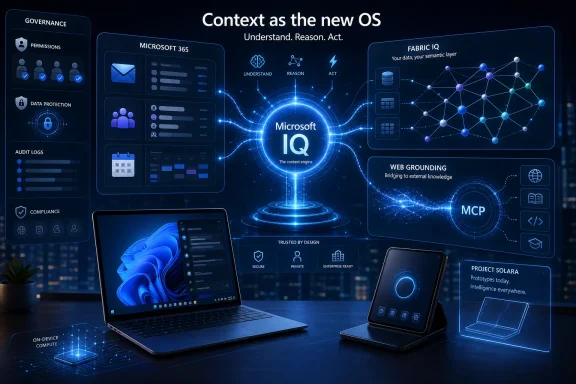
  8. Related coverage: msthesource.thesourcemediaassets.com
 

Back
Top