• Thread Author
Microsoft’s decision to keep Anthropic’s Claude and related products available to customers outside of the Department of War has thrust the company — and corporate IT teams everywhere — into the middle of a rare convergence of national security policy, enterprise vendor strategy, and operational risk management.

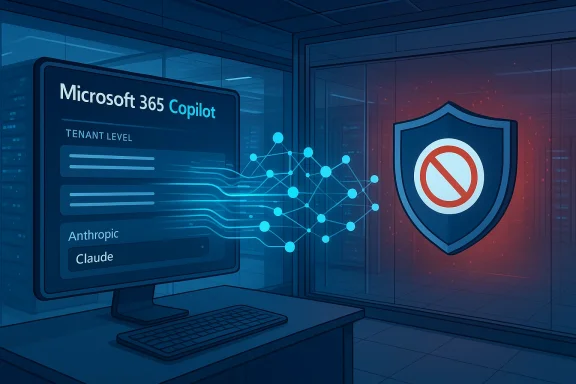
Microsoft 365 Copilot dashboard with tenant data flowing toward a security shield icon.Background​

The Department of War (the Defense Department) formally notified Anthropic this week that the company and its AI products have been designated a supply‑chain risk, an action the Pentagon says is effective immediately and which — in theory — excludes Anthropic and its models from use on military contracts and by defense contractors.
Anthropic has publicly said it will challenge any such designation in court and called the move unprecedented, arguing that the statutory provisions invoked historically targeted foreign adversaries and hardware vendors rather than U.S. AI startups.
Shortly after the designation became public, Microsoft told reporters that it had reviewed the legal implications and concluded it can continue to make Anthropic’s models available to customers — other than the Department of War — through enterprise surfaces such as Microsoft 365 Copilot, GitHub Copilot, and Microsoft’s Azure AI Foundry. That stance positions Microsoft as the first major vendor to publicly separate commercial availability of Claude from the Pentagon’s decision. (Reporters relayed Microsoft’s comments to CNBC.)
At the same time, the Pentagon’s decision has triggered immediate commercial and operational ripples: some defense‑contracting companies instructed employees to stop using Claude, OpenAI moved quickly to secure DoD classified workloads, and media reports indicate Anthropic’s Claude was already embedded into Palantir‑powered targeting and intelligence pipelines the U.S. relied on during recent air operations — a fact media outlets say complicates the timeline of disentanglement.

Overview: Why this matters to IT leaders and enterprise customers​

This is not just a Washington drama. For enterprise IT, corporate risk officers, and systems integrators, the story creates immediate, practical questions:
  • Can organizations continue to use Anthropic‑powered features embedded in Microsoft products?
  • What legal and contractual obligations do federal contractors now have?
  • How quickly can organizations pivot to alternative models if required?
  • What are the security, compliance, and governance implications of running third‑party models through Microsoft cloud surfaces?
Microsoft’s long‑running strategy to offer *microsoft 365 Copilot and related enterprise products means Anthropic models are already present across mainstream productivity and developer tooling. That multi‑model approach — exposed publicly last year when Microsoft added Claude as a selectable backend in Copilot surfaces — is at the heart of how customers experience and consume Claude today.

The Pentagon’s designation: scope, legal footing, and precedent​

What the Pentagon did​

Officials say the designation was applied under authorities intended to protect federal supply chains. The immediate operational consequence described by the Pentagon is that agencies and contractors subject to that guidance should not use Anthropic products for defense work. Multiple mainstream outlets reported the notice that the Pentagon delivered to Anthropic leadership.

Legal and historical context​

Historically, supply chain‑risk designations have targeted hardware or foreign software vendors deemed adversarial — for example, past actions involving certain foreign network and security vendors. Legal experts and Anthropic’s public statements argue this designation against a U.S. company sets a novel precedent and will likely face judicial scrutiny. Anthropic characterizes the designation as legally unsound and has signaled a rapid challenge in federal court.

Practical limits of the designation​

  • The designation, as applied by the Pentagon, is focused on Department of War procurement and the behavior of defense contractors working on defense contracts.
  • It does not, on its face, prevent Microsoft or other cloud vendors from continuing to offer Anthropic models to commercial customers — nor does it automatically nullify private commercial agreements between Anthropic and other enterprises.
  • But the designation creates immediate business‑risk externalities: defense contractors, fearing loss of classified contracts or compliance violations, may proactively ban Claude inside their organizations, which in turn affects supplier relationships and common platforms.

Microsoft’s stance: separation of commercial and defense availability​

Microsoft’s legal reading and product posture​

Microsoft publicly told reporters that its lawyers have studied the Pentagon designation and concluded Anthropic products — including Claude — can remain available to customers other than the Department of Warrprise surfaces such as Microsoft 365, GitHub, and Azure AI Foundry. That position explicitly separates Microsoft’s customer‑facing commercial posture from DoW’s defense‑oriented prohibition. (This statement was relayed in reporting by CNBC.)
Microsoft’s multi‑model Copilot strategy — the deliberate ability for tenant administrators to route workloads to different backend models (OpenAI, Anthropic, etc.) — is an architectural foundation that makes this practical: administrators can disable or block Anthropicant that needs to comply with defense rules while keeping the same UI and Copilot experiences for the rest of the organization.

Why Microsoft can credibly say this​

  • Microsoft is both a cloud host and a product vendor; its contracts and terms of service for Azure and Microsoft 365 differ from a direct procurement contract between the DoW and an AI vendor.
  • Microsoft has previously built features that offer model‑choice and tenant‑level gating for third‑party models; that operational separation is exactly what lets it assert continued commercial availability while complying with Department of War exclusion for defense customers.

Caveats and unknowns​

Microsoft’s public legal interpretation may still face operational edge cases — for example, where a defense contractor uses the same tenant to host mixed workloads or where data exfiltration risks span commercial and classified workloads. Contracts with the U.S. government and classified‑work approvals are complex; the Pentagon will almost certainly press vendors and prime contractors on practical compliance and separation. Early coverage suggests this will be messy and may take months to fully resolve.

Anthropic’s response and the legal fight​

Anthropic has said it will challenge the supply‑chain designation in court, calling it unprecedented and legally unsound. Anthropic also insists its redlines — refusing to allow use for mass domestic surveillance of Americans and for fully autonomous weapons — are consistent with U.S. values and model safety concerns, and that those redlines were precisely the sticking point in negotiations with the Pentagon.
The company’s legal theory will likely rest on statutory construction (arguing the law was not intended for this use), administrative‑law challenges (procedural irregularities in how the designation was applied), and potentially constitutional claims if the designation is used to punish speech or commercial association. Expect fast‑moving filings, emergency motions, and a high‑stakes fight over preliminary injunctions — at minimum, the litigation will buy time and raise political pressure.

The operational reality: Claude in the kill chain and recent strikes​

Multiple investigative reports and defense correspondents have reported that Anthropic’s Claude has been embedded inside Palantir‑powered intelligence and targeting systems used by the U.S. military, and that those systems played roles in recent air operations against Iran. Those outlets report that disentangling Claude from these classified pipelines is non‑trivial and will likely take months, lending operational urgency to the Pentagon’s demand for alternative models.
Important caution: the exact technical role Claude played, the classification level of the integration, and whether human operators or downstream systems made lethal targeting decisions remain matters reported from anonymous defense sources and are not fully public. Multiple news organizations stress that detailed mechanics are classified and that public reporting is based on sources familiar with the systems. Treat these operational claims as reported and partially classified rather than independently verifiable in open sources.

Industry reaction: contractors, rivals, and employee pushback​

  • Defense contractors: Several defense technology firms have apparently told employees to stop using Claude and to migrate to alternative models in the short term. That reaction reflects a conservative compliance posture: contractors cannot risk being found in violation of DoW procurement rules.
  • OpenAI: Within days of talks between Anthropic and the Pentagon collapsing, OpenAI announced that the Pentagon had agreed to run OpenAI models for classified workloads — a shift that reduces short‑term operational pain for military customers but creates reputational and workforce tensions for OpenAI.
  • Employees and civic groups: Hundreds of engineers and researchers across the AI sector have publicly criticized aggressive demands that would eliminate vendor guardrails, while civil‑society groups have warned about the consequences of unguarded military uses of frontier models.

Business relationships and money on the line​

The strategic tie‑ups formed late last year between Anthropic, Microsoft, and NVIDIA reshaped the industrial ecology: Anthropic committed to purchase substantial Azure capacity while Microsoft and NVIDIA pledged significant investments in Anthropic. That commercial interdependence makes the Pentagon’s move not only a national security question but also an infrastructure and revenue question for cloud providers and major enterprise customers. Major coverage from November 2025 documented Anthropic’s multi‑billion commitments into Azure and investor commitments from Microsoft and NVIDIA; those commercial facts underpin why Microsoft is trying to thread a needle between compliance and continuing to offer model choice.

Technical and governance implications for IT and security teams​

Short‑term actions every IT leader should consider​

  • Inventory and mapping: Identify where Anthropic‑backed features are enabled across your tenant — Copilot experiences, GitHub Copilot, Azure Foundry deployments, and any agentic workflows that might route to Claude. This must be a priority for any organization with DoD contracts or ties to defense primes.
  • Tenant gating: Use tenant‑level controls to disable Anthropic backends for teams that work on regulated, defense, or classifiedparation: Audit where sensitive data is sent and whether model responses might be logged or routed into storage that crosses data‑classification boundaries.
  • Vendor contingency planning: Prepare migration plans to alternative models and test them in non‑production environments so functional replacements exist if a ban widens to contractual prohibitions across industries.
  • Contract review: Re‑read government‑facing contract clauses and flow‑down requirements to understand whether any supply‑chain designation imposes new obligations on prime contractors and subcontractors.

Medium‑term governance and risk steps​

  • Update AI acceptable‑use policies to include vendor‑specific guidance and a process for vetting third‑party models.
  • Rework procurement language to require supplier attestations about compliance with federal designations and carveouts for defense‑only exclusions.
  • Strengthen telemetry and monitoring around model inputs/outputs to detect data exfiltration or unintended data handling by third‑party engines.

Strategic risks and strengths​

Notable strengths of Microsoft’s posture​

  • Operational pragmatism: By maintaining commercial access while excluding DoW uses, Microsoft reduces disruption for non‑defense customers and preserves revenue streams tied to third‑party model hosting.
  • Technical separation: Microsoft’s engineered model‑choice and tenant‑level routing give admins practical levers to respond quickly to regulatory or contractual changes.

Real risks and friction points​

  • Contract compliance uncertainty: Defense contractors and primes face ambiguous compliance checklists; fear of downstream violations encourages conservative bans that can quickly degrade productivity.
  • Reputational risk: Vendors that sidestep Pentagon directives risk political scrutiny; vendors that comply may create product and user fragmentation.
  • Operational entanglement: Where Anthropic models are embedded in classified pipelines, disentanglement will be costly, error‑prone, and time‑consuming — a reality reporters say shaped the Pentagon’s decision.
  • Legal uncertainty: If courts rule that the Pentagon misapplied the supply chain statute, the policy will still have damaged business relationships and put a new precedent on the table for future government‑technology disputes.

Recommendations for enterprise IT teams​

  • Prioritize an immediate mapping exercise to find every product and process that can route to external models, and label them by personnel, data sensitivity, and contractual obligations.
  • Create a short list of alternative models and evaluate them against three criteria: (a) technical parity for critical workflows, (b) contractual suitability for defense‑related subcontracting, and (c) governance and audit capabilities.
  • Document a compliance playbook that codifies what to do when a vendor becomes subject to a government restriction — includplates for procurement, legal, and customers.
  • If you maintain DoD prime relationships, coordinate with legal and contracting officers to clarify expectations for supply‑chain designations and to obtain written guidance about permissible vendor relationships.

What to watch next​

  • The litigation: Anthropic’s promised court challenge will be fast and consequential. A preliminary injunction or emergency stay could reverse or limit the Pentagon’s reach; conversely, a court win for the DoW would expand executive levers over commercial tech.
  • DoD operational workarounds: How quickly the Pentagon operationalizes alternative vendors for classified workflows — and whether OpenAI’s deal for classified workloads expands — matters for contractors and cloud providers.
  • Congressional and regulatory reactions: Expect congressional hearings and oversight inquiries; lawmakers on both sides of the aisle have previously taken interest in how AI companies contract with the government.
  • Technical disentanglement timelines: Independent reporting suggests removing Claude from classified pipelines could take months and incur significant cost and mission risk; this operational reality will shape policy negotiations.

Critical assessment: strengths, weaknesses, and the big ethical question​

Microsoft’s announcement that it can keep offering Anthropic models to non‑defense customers is a practical and arguably sensible move for an enterprise platform provider that needs to balance legal compliance with predictable service delivery. It showcases how a multi‑model architecture can provide operational resilience and choice for enterprise customers.
But the episode also demonstrates several systemic weaknesses:
  • The rapid weaponization of procurement levers and public political pressure creates brittle outcomes for foundational software and cloud ecosystems.
  • The classification and opacity of military AI use cases complicate public debate. When an AI model is alleged to have been used in lethal military operations — and the details are classified — policymakers must balance secrecy, oversight, and corporate accountability. Media reporting indicates Claude assisted intelligence pipelines used in recent strikes, but the mechanics remain partially classified; that fact should temper overconfident public claims on all sides.
  • For enterprises that depend on integrated AI experiences in productivity and developer tooling, sudden political or regulatory moves can create outsized operational discontinuities.
Ethically, the central conflict is stark: should frontier AI vendors be forced to relinquish guardrails because militaries want the option to use the tools broadly? Anthropic’s refusal to remove protections against mass domestic surveillance and fully autonomous weapons is a principled safety posture; the Pentagon’s demand for all lawful uses reflects a different risk tolerance. The choice — whether made by companies, courts, or legislators — will define the boundaries of acceptable industrial practice for years to come.

Final takeaways for WindowsForum readership​

  • If your organization uses Microsoft 365 Copilot, GitHub Copilot, or Azure AI Foundry, now is the time to inventory model choices and enforce tenant‑level guardrails where required.
  • Expect short‑term turbulence in defense supply chains and downstream vendors; contingency planning and legal review are essential for contractors.
  • Microsoft’s multi‑model approach provides practical levers for administrators, but it is not a panacea: contractual obligations, classified workflows, and cross‑tenant data risks still demand careful human governance.
  • The larger policy and legal fight to come will set precedent for how the U.S. government may regulate or exclude domestic technology providers on national‑security grounds — a development that should concern any organization relying on public‑cloud ecosystems and third‑party models.
This episode will be studied as an inflection point where enterprise AI governance, vendor strategy, and national security policy collided publicly — and where the answers will shape how companies build, host, and govern AI across both civilian and defense applications in the years ahead.

Source: CNBC Microsoft says Anthropic’s products remain available to customers after Pentagon blacklist
 

Microsoft's lawyers say Anthropic's Claude can keep running on commercial Microsoft surfaces even after the Pentagon formally designated the startup a "supply-chain risk," setting off a fast-moving legal, technical, and operational crisis for enterprise IT teams and cloud vendors. The Defense Department's action — an unprecedented use of supply-chain authorities against an American AI vendor — is narrowly targeted at defense procurement, but its consequences ripple across contracts, workflows, and vendor relationships. Microsoft has publicly argued that the Pentagon's designation does not force it to remove Anthropic-backed models from Microsoft 365, GitHub, or Azure AI Foundry for non‑defense customers, while Anthropic has said it will challenge the designation in court.

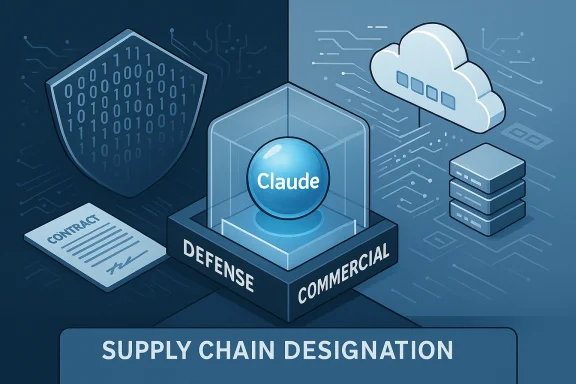
Stylized supply chain design with Claude at the center, bridging defense and commercial sectors.Background​

The dispute began when Anthropic declined Pentagon demands to remove certain safety guardrails that would have allowed the Defense Department unrestricted use of its Claude models for what the Pentagon described as "all lawful purposes." The disagreement escalated into a formal supply-chain designation from the Defense Department, a move senior Pentagon officials say is designed to prevent the company's products from being used in defense contracts and by government contractors working on classified or defense-related programs. Anthropic says the designation misapplies authorities historically reserved for foreign adversaries and hardware vendors and has announced an immediate legal challenge. ([techcrunch.com](Anthropic to challenge DOD's supply-chain label in court | TechCrunch should be viewed as both a national-security policy decision and a vendor‑ecosystem event. Anthropic is not a marginal player: it has integrated deeply into mainstream developer and productivity tooling through partnerships and contracts with major cloud providers — most notably Microsoft. Those commercial ties complicate any attempt to segregate military and non‑military uses of the same underlying model.

What the Pentagon did — scope and legal footing​

The Defense Department's supply-chain risk designation was announced as effective immediately and communicated directly to Anthropic leadership. The action leverages procurement and supply-chain authorities intended to protect defense acquisitions, and the practical effect — according to Pentagon statements — is that defense agencies and contractors should not use Anthropic products for defense work. The move is rare and, as several legal analysts and industry sources note, novel in its application to a domestic AI vendor.
Key legal and practical points:
  • The designation is framed around defense procurement: its direct legal effec from participating in Department of Defense contracts and to prevent DoD contractors from relying on Claude as part of those contracts. The Defense Department argues it needs unrestricted lawful uses for mission assurance.
  • Historically, similar supply-chain actions targeted foreign infrastructure and hardware vendors; applying the same marker to a U.S. AI startup raises administrative-law questions about statutory interpretation and precedent. Anthropic has signaled that it will litigate those questions urgently.
  • The designation is operationally blunt: even if narrowly written, downstream contractors and prime integrators often respond conservatively to avoid contract risk, creating "de facto" broader exclusions that go beyond the statute's textual scope.
I will flag an important nuance: public reporting indicates variation in how different outlets and officials describe the designation's reach. Some Pentagon statements and social-media posts by senior officials framed the step more expansively — implying that any company that does defense work could be pressured to sever commercial ties with Anthropic — while legal notices and Anthropic's own reading assert narrower limits focused on DoD contracts. This discrepancy is central to the impento how enterprises interpret immediate compliance obligations.

Microsoft's posture: legal reading and product reality​

Almost immediately after the Pentagon's announcement, Microsoft told reporters that its lawyers had studied the designation and determined Anthropic's products can remain available to Microsoft customers — except for Department of Defense uses. Microsoft framed this as a practical separation: it can continue to host and offer Anthropic's Claude models through Microsoft 365 Copilot, GitHub Copilot, and Azure AI Foundry for non‑defense workloads while disabling use for DoD customers.
Why Microsoft believes this is legally and operationally tenable
  • Microsoft operates both as a cloud host and as an enterprise software vendor. Its commercial contracts for Azure and Microsoft 365 differ from a direct procurement contract between the DoD and an AI vendor; thace gives Microsoft legal levers to assert continued commercial availability.
  • The company's engineering architecture supports multi‑model choices and tenant-level routing. Administrators can route requests to different underlying models (OpenAI, Anthropic, etc.) and can disable model backends for specific tenants or teams, enabling practical separation between defense and commercoft has been building these model-choice capabilities into Copilot and Foundry.
  • Microsoft also cited the narrower statutory construction that Anthropic has emphasized: the supply-chain designation prohibits use as part of specific Department of Defense contracts rather than forbidding all commercial relationships. Microsoft has said it can continue to work with Anthropic on non‑defense projects.
Caveats and operational friction
  • Technical separation is not elimination of risk. Tenants that mix defense and commercial workloads, or interconnect systems that touch classified pipelines, create tricky edge cases where data handling or telemetry could cross boundaries. The engineering controls exist, but governance and audit processes must be rigorous.
  • Political and reputational pressure can change operational posture quickly. Microsoft’s legal reading might satisfy current commercial customers, but government enforcement discretion, contracting officers’ interpretations, and congressional oversight could alter the practical environment. Expect close scrutiny of how Microsoft operationalizes tenant gating and data separation.

Anthropic's response and the legal fight to come​

Anthropic has publicly announced immediate plans to challenge the Defense Department’s designation in federal court, calling the action “legally unsound” and unprecedented for a Urio Amodei has defended the company’s safety-minded limits — notably, refusing to permit deployments that would enable mass domestic surveillance or fully autonomous weapons — and stresses that those redlines are not a blanket refusal to support national-security work in constrained ways.
Legal fronts Anthropic is likely to pursue
  • Statutory construction: arguing hain authorities were not intended for this kind of domestic, software‑centric action. This is a textual and historical argument about the statute’s scope.
  • Administrative procedure: if the designation process lacked required notice, reasoned explanation, or opportunity to respond, Anthropic may raise p the Administrative Procedure Act.
  • Remedies: Anthropic will likely seek a preliminary injunction or emergency stay to halt the designation’s operational effects while litigation proceeds. A swift injunction is possible if courts find procedural or statutory defects in the Pentagon’s move.
Beyond legal theory, the liical theater. Congressional inquiries, industry amicus briefs, and press coverage will shape both legal strategy and public perception. The case could set a durable precedent for how the U.S. government can regulate technology vendors on national-security grounddiate enterprise impact — what CIOs and security teams should expect
Even if the designation is narrowly targeted, its practical effects are broad. Defense contractors have already been reported to instruct staff to avoid Anthropic products pending clarity. Some contractors may take conservative steps — disabling Claude-enabled Copilot features across entire tenants — to avoid any downstream compliance risk. The result: productivity frior alternatives.
Short-term steps for IT, security, and procurement teams
  • Map exposures immediately. Inventory every Copilot, GitHub Copilot, Azure Foundry, and third‑party integration that can route to Anthropic models. Label each by data sensitivity, contractual obligations, and whether the work is defense‑related.
  • Apply rapid tenant gating. Use Microsoft’s admin controls to disable Anthropic model backends for teams touching defense contracts, classified workflows, or highly sensitive data. Validate that gating truly isolates traffic and logs.
  • Prepare vendor contingency plans. Test alternative model backends (OpenAI, in‑house models, or other providers) in non‑production environments to ensure continuity if a broader ban emerges.
  • Engage legal and contracting officers. If you are a DoD prime or subcontractor, seek written guidance from your contracting officer about the impact of the designation on flow-down clauses and approved tooling. Do not assume public statements are sufficient.
Longer-term governance changes
  • Update acceptable‑use policies and procurement language to explicitly address model provenance and supply‑chain risk designations.
  • Require supplier attestations about adherence to government designations and carve out defense‑only exclusions where practical.
  • Invest in telemetry and audits that can demonstrate clean separation of defense and commercial workloads to auditors and contracting officers.

Technical separation: what works and what doesn't​

Microsoft’s architecture gives administrators practical levers: model choice, tenant routing, and subprocessor opt-outs are real features in Microsoft 365 and Azure that can reduce blast radius. Documentation Microsoft published earlier in 2026 shows Anthropic listed as an AI subprocessor in some Microsoft services, and admin-level controls exist to opt out of Anthropic models in tenant settings. These engineering controls are the core reason Microsoft believes commercial availability can continue. ([learn.microsoft.com]ft.com/en-us/copilot/microsoft-365/connect-to-ai-subprocessor)
But technical controls have limits:
  • Cross-tenant dependencies — shared services, logging pipelines, or centralized search indices — can leak telemetry or transform commercial inputs into artifacts that touch defense workflows.
  • Human factors matter: developers, data scientists, or contractors who reuse tokens, scripts, or shared notebooks may inadvertently route sensitive data to banned backends.
  • Classified networks and air-gapped systems: disentangling Claude from missi has already been embedded (reports suggest Claude was used in certain intelligence pipelines) could be costly and time-consuming; in many cases, the operational reality will be that removal is a months‑long engineering project. Reported links between Claude and Palantir-powered pipelines complicate the timeline further, although some of those operational details remain classified and partially unverified. Treat classified-use reporting with caution.

Strategic implications for cloud vendors and the AI ecosystem​

This episode is an inflection point for the commercial model-hosting ecosystem. Hyperscalers must weigh three competing forces: contractual compliance with government customers, predictable product availability for commercial customers, and reputational exposure when their hosted models are used in ways that provoke political backlash. Microsoft's stance — preserving commercial availability while excluding DoD uses — is a pragmatic attempt to thread those needles, but it will be tested in practice.
Wider industry effects to watch
  • Vendor diversification: enterprises may accelerate multi‑model strategies to avoid single-vendor lock‑in and to maintain resilience when governments intervene.
  • Contract design: primes and government customers will push for clearer flow-downs and more explicit audit rights to ensure supply-chain designations do not create sudden compliance gaps.
  • Political risk hedging: large cloud providers may build stronger compliance operations and legal playbooks for interceding between sovereign customers and commercial partners.
Commercially, the Anthropic–Microsoft relationship is deep: public reporting and corporate announcements in late 2025 and early 2026 documented major Azure commitments and integration plans that tied Anthropic’s Claude deeply into Microsoft’s product stack. Those commercial facts help explain why Microsoft is attempting to keep Claude available outside of defense use — the revenue and engineering interdependence is significant. Some of the widely reported dollar amounts (for example, Anthropic's reported compute comt’s staged investments) should be treated as reported business terms that vary by coverage; when quoting any specific figure, check the primary corporate announcements and regulatory filings.

Ethical trade-offs and policy questions​

At the heart of this conflict is an ethical and policy decision: should companies be required to remove safety guardrails to satisfy military operational needs? Anthropic argues that its redlines — refusing to enable mass domestic surveillance and fully autonomous weapons — are ethical safeguards. The Pentagon argues that mission assurance and lawful military uses require unbounded capability. This is not a simple technical dispute; it is a normative choice about how democracies govern tools of force and oversight.
The broader policy implications:
  • Precedent setting: If the government can brand U.S. vendors as supply‑chain risks for refusing to remove safeguards, companies across sectors may face future pressure to cede product controls for access to government contracts.
  • Safety vs. sovereignty: The case forces a public debate about whether corporate safety policies can coexist with national‑security exigencies, and how that balance should be struck legally and administratively.
  • Transparency and secrecy: Many of the most consequential operational claims are in classified channels. That secrecy complicates public accountability and legislative debate, and it makes it harder for judges and the public to evalasserted needs.

Practical checklist for WindowsForum readers (IT leaders, admins, and integrators)​

If your organization uses Microsoft Copilot, GitHub Copilot, Azure AI Foundry, or any service that can route to Anthropic models, take these steps now:
  • Conduct a rapid inventory of all Copilot-enabled features and where model backends are configurable.
  • Classify each workload by contract type (DoD/defense, federal civilian, commercial), data sensitivity, and business criticality.
  • Use tenant-level admin controls to disable Anthropic backends for teams or tenants that work on defense contracts or classified information.
  • Test alternative model backends in non-production environments; validate functional parity for critical workflows.
  • Engage your legal and contracting teams to obtain written guidance on how supply-chain designations affect flow-down obligations.
  • Document and rehearse off‑boarding plans for third‑party models — extract code, migration scripts, and test suites now so you are not building them in a rush later.

What to watch next​

  • Litigation timeline: Anthropic’s court filings and any emergency motions for injunctive relief will be the fastest mechanism to change the operational landscape. A court order could halt or modify the designation quickly.
  • Contracting guidance from DoD: look for formal guidance to primes and contracting officers clarifying whether the designation applies to all use by contractors or only to DoD contracts. That guidance will materially change the compliance posture of large industry players.
  • Congressional and oversight actions: expect hearings and bipartisan interest in how supply‑chain tools are used domestically and whether the government overreached. Regulatory scrutiny could reshape rules for government procurement of AI.
  • Vendor operationalization: watch how Microsoft and other cloud providers implement tenant gating and what audit evidence they can provide to demonstrate separation. The technical effectiveness of those controls will determine how real Microsoft’s commercial-availability claim is for large contractors.

Conclusion​

This episode — the Pentagon's supply‑chain designation of Anthropic, Microsoft’s decision to keep Claude available for non‑defense customers, and Anthropic’s vow to sue — is a landmark moment at the intersection of national security, corporate ethics, and enterprise IT governance. It forces a hard reckoning about how commercial platforms host model choice, how governments can or should regulate vendor redlines, and how enterprises must govern third‑party models that can be used in both civilian and military contexts. For IT leaders, the immediate work is practical and urgent: map exposures, apply tenant-level controls, rehearse migrations, and get legal clarity. For policymakers and citizens, the larger questions about precedent, transparency, and the right balance between safety and sovereign capability are only just beginning.

Source: Business Insider Microsoft says Anthropic's products can stay on its platforms after lawyers 'studied' the Pentagon supply chain risk designation
 

Microsoft will continue to offer Anthropic’s Claude models to most customers even after the U.S. Department of Defense formally labeled Anthropic a “supply‑chain risk,” a decision that has set off a rare public clash between a major cloud and software provider, a frontier AI startup, and national security authorities.

A glowing blue AI orb 'A' floats above a data center beside Copilot and Policy icons.Overview​

The past week’s events turned a behind‑the‑scenes technology dispute into a front‑page policy fight. The Pentagon notified Anthropic that the company — creator of the Claude family of LLMs — has been designated a supply‑chain risk for defense contracting. The designation bars the DoD and its contractors from using Anthropic technology in work for the U.S. military, and is being treated by officials as effective immediately for defense procurements. Anthropic has announced plans to challenge that designation in court.
Within hours of the Pentagon’s move, Microsoft publicly said its legal team had reviewed the designation and advised that Anthropic models, including Claude, can remain available to customers outside the Department of Defense through Microsoft platforms such as Microsoft 365 Copilot, GitHub Copilot, and Microsoft’s Azure AI Foundry. That stance makes Microsoft the first major cloud and software company to commit publicly to continuing the Anthropic integration for non‑defense customers.
The dispute is not purely legal or contractual. It traces back to a breakdown in talks over the DoD’s request to use Anthropic models without contractual restrictions for “all lawful purposes” — including uses Anthropic has publicly said it will not permit, such as enabling mass domestic surveillance or fully autonomous lethal systems. The contrast between those policy limits and the military’s operational needs is now playing out in a courtroom, in boardrooms, and inside enterprise contracts across the software industry.

Background​

How we got here​

  • Anthropic emerged as a leading safety‑focused LLM developer, marketing Claude as a model family with stronger alignment and guardrails than many competitors.
  • Microsoft and Anthropic forged a deep commercial and technical relationship: Anthropic models were integrated into GitHub and Microsoft 365 Copilot experiences, surfaced via Microsoft Foundry, and made available to enterprise tenants as part of Microsoft’s “model choice” strategy.
  • In late 2025, Anthropic announced large compute and commercial arrangements intended to scale Claude on Azure while Nvidia and Microsoft made sizeable investments supporting Anthropic’s growth and infrastructure commitments.
  • The U.S. defense establishment has been experimenting with LLMs inside intelligence and planning workflows. Over the past months a contentious negotiation occurred between Anthropic and DoD officials about the permissible operational uses of Claude in classified and combat systems.
  • Political pressure escalated: a presidential directive instructed federal agencies to stop using Anthropic’s tech and Defense Secretary leadership used a statutory supply‑chain tool to impose restrictions for DoD work.

What the designation means in practice​

A DoD “supply‑chain risk” designation has concrete procurement implications: it prevents the department and its prime contractors from using the designated supplier’s products for covered government work. Practically, that forces prime contractors to either remove the vendor from military workloads or secure legally sufficient exceptions. The designation can also ripple through subcontractor relationships and oblige re‑engineering of mission‑critical pipelines.
But the label does not automatically ban a supplier’s work outside of DoD contracts. That legal line is what Microsoft’s lawyers point to: the company says it is able to keep Anthropic models live for non‑defense enterprise and consumer customers while ensuring Anthropic products are not used in DoD operations running on Microsoft platforms.

Microsoft’s decision: legal posture and commercial calculus​

The statement and its implications​

Microsoft’s public position is straightforward: after legal review, its lawyers concluded Anthropic’s models can remain accessible to customers except for the Department of Defense. Microsoft emphasized continuity for its commercial customers and the principle of model choice inside Copilot and Foundry.
This posture reflects several layered calculations:
  • Legal reading: Microsoft is relying on a narrow statutory and contractual reading of the DoD restriction. The company appears to view the designation as targeted to defense procurement workflows rather than a broad, extraterritorial ban across its commercial cloud products.
  • Product continuity: Microsoft has already embedded Anthropic models across multiple Copilot surfaces. Turning those off for all customers would require operational changes, migration paths, and significant customer notifications — a costly and disruptive action.
  • Competitive positioning: Microsoft competes with a range of model providers (notably OpenAI) and has promoted multi‑model choice as a product differentiator. Cutting Anthropic for most customers would limit that positioning and could accelerate vendor consolidation toward alternative providers.
  • Financial ties: Microsoft’s commercial arrangements with Anthropic — including compute commitments and recent strategic investments — create strong incentives to preserve the relationship where legally permissible.

Risks for Microsoft​

Microsoft’s stance carries measurable risks:
  • Regulatory friction: The DoD may interpret or extend its designation in ways that complicate Microsoft’s product deployments for public‑sector or mixed‑use customers, particularly those that straddle civilian and defense contracts.
  • Contractual exposure for primes: Defense contractors that rely on Microsoft cloud services could face compliance uncertainty if Anthropic models remain accessible inside shared-tenancy environments, prompting demands for architectural segregation or product toggles.
  • Political backlash: Public disagreement with a top national‑security decision escalates reputational politics. Microsoft must balance maintaining enterprise service levels and staying aligned with federal government expectations.
  • Operational separation: Ensuring Anthropic models are truly prevented from DoD use requires demonstrable technical isolation (e.g., separate cloud regions, no FedRAMP/DoD/sovereign cloud availability), something that will require audits and possibly new contractual clauses.

Who else is involved: Anthropic, OpenAI, and the defense angle​

Anthropic’s position​

Anthropic has said it will challenge the DoD’s designation in court, calling it legally unsound and arguing the ban only applies to direct use within DoD contracts — not to customers who simply happen to also hold defense work. Anthropic has publicly defended its alignment commitments, noting that it refuses to provide contractual permission for uses it views as enabling mass domestic surveillance or fully autonomous weapons.
Those commitments were central to the negotiation breakdown with Defense officials: the DoD wanted unrestricted rights for “all lawful uses,” while Anthropic sought contractual protections limiting certain classes of application in order to adhere to corporate safety principles.

OpenAI’s role​

In the same window, OpenAI announced agreements to supply models for classified government workloads. OpenAI’s readiness to accept DoD terms — and the relative breadth of its contractual concessions — materially changed the procurement landscape. That move offered the Pentagon an immediate alternative path to keep AI‑augmented systems running in classified networks.
This competitive dynamic — two major model providers with divergent policy postures — is now central to the government's procurement choices and to corporate strategy discussions inside Microsoft and other platform providers.

Financial and contractual stakes​

Several high‑value financial commitments underpin the dispute and help explain why companies are taking hard stances:
  • Anthropic committed to significant Azure compute purchases as part of scaling Claude on Microsoft’s cloud. Those purchase commitments create a deep commercial dependency between Anthropic and Microsoft’s infrastructure.
  • Microsoft and Nvidia subsequently announced large strategic investments in Anthropic: Microsoft committed up to multibillion‑dollar capital support, and Nvidia committed additional funding and co‑design collaboration. Those investments align cloud, silicon, and model providers in ways that raise switching costs.
  • Microsoft’s long‑standing, deep commercial relationship with OpenAI — including an equity interest and multi‑year compute purchase commitments — means Microsoft must navigate overlapping loyalties: to Anthropic as an integrated model partner and to OpenAI as a strategic, high‑value investment and partner for large defense and enterprise workloads.
These financial ties heighten the economic consequences of a wholesale separation from Anthropic for Microsoft and for customers who have built workflows around Claude’s capabilities.

Technical and product implications for enterprises​

Where Anthropic is embedded today​

Anthropic models are integrated in multiple Microsoft product surfaces:
  • Microsoft 365 Copilot — enterprise productivity assistant inside Office apps.
  • GitHub Copilot and Copilot Chat — code generation and developer assistance workflows.
  • Azure AI Foundry — a managed developer platform for deploying and testing models.
  • Custom pipelines and partner stacks — some defense and intelligence systems have been reported to consume Claude via partner platforms that embed multiple LLMs.
Microsoft has also made model selection explicit in some product flows, allowing enterprise administrators to choose which backend model providers are available inside tenants.

What enterprises must do now​

Enterprises that use Microsoft cloud services should act quickly to inventory their AI usage and model dependencies:
  • Catalog where Claude or Anthropic models are used (GitHub actions, Copilot, M365 Copilot, custom APIs).
  • Map contractual obligations where any DoD‑sourced work or defense subcontracting exists.
  • Isolate sensitive workloads into environments with enforceable access controls and tenant separation to prevent inadvertent mixing of defense and commercial usage.
  • Engage procurement and legal teams to review service terms and exit/migration paths if customers must comply with a DoD directive.
  • Plan redundancy: develop vendor‑neutral alternatives and migration plans to other model providers to reduce operational risk.
These steps are necessary for compliance, risk management, and business continuity.

National security, ethics, and operational realities​

The debate around Anthropic and the Pentagon exposes deeper tensions in modern defense technology:
  • Operational utility vs. corporate control: Militaries want operational freedom to use AI tools as they see fit within law; vendors want to limit uses that contradict their stated ethical lines. When a vendor's safety commitments conflict with the operational preferences of a government, tensions are inevitable.
  • Speed of adoption: The DoD and partner contractors have already integrated LLMs into planning and analysis workflows. Rapid removal of a model from those pipelines can create capability gaps during active operations — an operational risk the Pentagon itself cited when it allowed a phase‑out window.
  • Accountability and auditability: Using third‑party LLMs for targeting or intelligence analysis raises urgent questions about who is accountable when an AI‑driven recommendation contributes to a wrongful or erroneous action. That legal and moral question is unresolved and highly consequential.
  • Arms‑race pressures: If one supplier refuses certain military applications, governments may seek alternative suppliers willing to accept broader terms or pursue in‑house solutions — intensifying procurement and geopolitical competition in AI.

Legal pathways and likely outcomes​

Anthropic’s announced intention to challenge the supply‑chain designation will turn on statutory interpretation and administrative law doctrines. Key legal questions include:
  • Whether the DoD statutory tool used to label Anthropic as a supply‑chain risk can lawfully be applied to a U.S.‑based private company for reasons grounded in usage policy rather than foreign adversary control.
  • The scope of any enforcement action: does the designation restrict only DoD contracts, or can it be interpreted to bar an agency or prime contractor’s entire use of the supplier’s tools across non‑defense workloads?
  • The availability of injunctive relief pending review: courts may grant temporary relief if the designation is shown to exceed administrative authority or lack required procedural safeguards.
Predicting outcomes is hazardous. Courts may be reluctant to second‑guess national security judgments, but administrative law principles guard against arbitrary or procedurally deficient agency actions. Expect litigation to be followed by parallel negotiations and likely tighter contractual language between vendors and government purchasers.

Strategic lessons and recommendations for CIOs and security teams​

For enterprise buyers and cloud customers, this episode crystallizes a few practical governance rules:
  • Assume multi‑model risk: Do not treat any single model provider as irreplaceable for mission‑critical functions. Build architectural flexibility.
  • Enforce strong tenancy boundaries: Use sovereign cloud, FedRAMP/DoD‑approved environments, and clear tenancy separation for sensitive workloads.
  • Contract for exit and audit: Negotiate migration playbooks and audit rights into contracts so suppliers cannot abruptly withdraw services without defined transition plans.
  • Operate safe fallback options: Maintain tested integrations with at least one other model provider for critical automation and developer productivity functions.
  • Embed oversight: Create a cross‑functional AI governance board — legal, security, procurement, and engineering — to review model usage and ensure compliance with evolving public‑sector directives.
These steps reduce vendor lock‑in, protect service continuity, and prepare organizations for sudden regulatory shifts.

Broader market and policy implications​

This conflict accelerates several industry trends:
  • Vendor diversification is likely to become a more explicit requirement in enterprise AI procurement strategies.
  • Cloud providers will formalize compliance controls that let customers run different model backends in clearly separated environments (commercial vs. government/sovereign clouds).
  • Regulatory scrutiny of AI supplier contracts will increase. Governments will want more granular visibility and enforceable terms for sensitive applications, and vendors will push back where terms clash with their safety policies.
  • Competition among model providers will sharpen. Companies that accept broader defense contracting terms may gain government business, while safety‑focused firms could attract enterprise customers prioritizing ethical constraints — creating distinct vendor niches.

What remains uncertain and what to watch​

Several key facts remain unclear or are subject to classification and internal review:
  • The precise extent of Anthropic’s role in specific classified operations will likely remain undisclosed for operational security reasons; public reporting on “use in Iran strikes” is based on multiple sources but includes sensitive operational detail that will remain contested.
  • The DoD’s ultimate enforcement posture: will designation be enforced narrowly against only classified DoD contracts, or will the agency attempt broader procurement restrictions across interagency contracting? The agency’s future memos and guidance will determine downstream industry behavior.
  • The outcome of Anthropic’s legal challenge: court rulings could clarify the scope and limits of supply‑chain designation authorities, shaping federal procurement law for AI providers.
Watch for agency guidance clarifying implementation rules, for Microsoft’s operational steps to ensure separation for federal clouds, and for court filings that will define the legal battlefield.

Conclusion​

The dispute over Anthropic’s designation as a defense supply‑chain risk has polished a set of tensions that have been growing in plain sight: the clash between vendor safety commitments and military operational imperatives; the deep financial entanglements that tie cloud, silicon, and model suppliers together; and the governance gaps that leave enterprises vulnerable to sudden policy shifts.
Microsoft’s decision to continue offering Anthropic models to non‑defense customers is legally defensible and commercially pragmatic, but it also places the company at the center of a complex balancing act between customer continuity, national‑security expectations, and public accountability. For enterprises and government contractors, the episode is a wake‑up call: manage model diversity, harden tenancy boundaries, and negotiate exit plans now rather than during a procurement emergency.
As litigation and policy clarifications proceed, the market will settle into new patterns: governments will demand stronger contractual and technical assurances, vendors will codify segregation between commercial and sovereign offerings, and enterprises will build resilience through multi‑vendor strategies. The technology itself — powerful, useful, and ethically fraught — will remain indispensable. The tricky work ahead is designing procurement, legal, and technical frameworks that keep that power accessible to legitimate users while constraining its most dangerous applications.

Source: Brand Icon Image Microsoft to Maintain Anthropic AI Integration Despite Pentagon Supply-Chain Warning
 

Back
Top