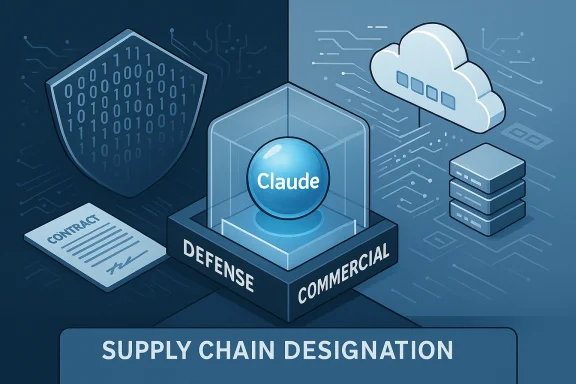
Microsoft’s decision to keep Anthropic’s Claude and related products available to customers outside of the Department of War has thrust the company — and corporate IT teams everywhere — into the middle of a rare convergence of national security policy, enterprise vendor strategy, and operational risk management.
The Department of War (the Defense Department) formally notified Anthropic this week that the company and its AI products have been designated a supply‑chain risk, an action the Pentagon says is effective immediately and which — in theory — excludes Anthropic and its models from use on military contracts and by defense contractors.
Anthropic has publicly said it will challenge any such designation in court and called the move unprecedented, arguing that the statutory provisions invoked historically targeted foreign adversaries and hardware vendors rather than U.S. AI startups.
Shortly after the designation became public, Microsoft told reporters that it had reviewed the legal implications and concluded it can continue to make Anthropic’s models available to customers — other than the Department of War — through enterprise surfaces such as Microsoft 365 Copilot, GitHub Copilot, and Microsoft’s Azure AI Foundry. That stance positions Microsoft as the first major vendor to publicly separate commercial availability of Claude from the Pentagon’s decision. (Reporters relayed Microsoft’s comments to CNBC.)
At the same time, the Pentagon’s decision has triggered immediate commercial and operational ripples: some defense‑contracting companies instructed employees to stop using Claude, OpenAI moved quickly to secure DoD classified workloads, and media reports indicate Anthropic’s Claude was already embedded into Palantir‑powered targeting and intelligence pipelines the U.S. relied on during recent air operations — a fact media outlets say complicates the timeline of disentanglement.
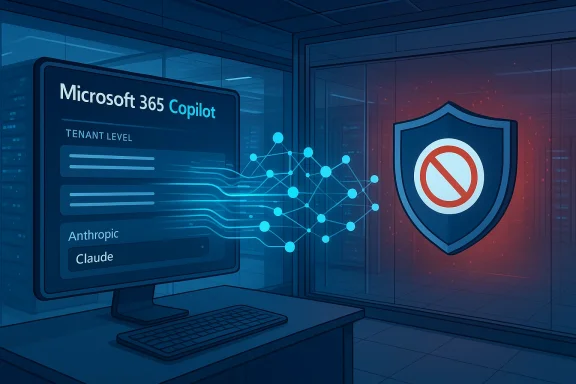
Microsoft’s multi‑model Copilot strategy — the deliberate ability for tenant administrators to route workloads to different backend models (OpenAI, Anthropic, etc.) — is an architectural foundation that makes this practical: administrators can disable or block Anthropicant that needs to comply with defense rules while keeping the same UI and Copilot experiences for the rest of the organization.
The company’s legal theory will likely rest on statutory construction (arguing the law was not intended for this use), administrative‑law challenges (procedural irregularities in how the designation was applied), and potentially constitutional claims if the designation is used to punish speech or commercial association. Expect fast‑moving filings, emergency motions, and a high‑stakes fight over preliminary injunctions — at minimum, the litigation will buy time and raise political pressure.
Important caution: the exact technical role Claude played, the classification level of the integration, and whether human operators or downstream systems made lethal targeting decisions remain matters reported from anonymous defense sources and are not fully public. Multiple news organizations stress that detailed mechanics are classified and that public reporting is based on sources familiar with the systems. Treat these operational claims as reported and partially classified rather than independently verifiable in open sources.
But the episode also demonstrates several systemic weaknesses:
Source: CNBC Microsoft says Anthropic’s products remain available to customers after Pentagon blacklist
 Background
The Department of War (the Defense Department) formally notified Anthropic this week that the company and its AI products have been designated a supply‑chain risk, an action the Pentagon says is effective immediately and which — in theory — excludes Anthropic and its models from use on military contracts and by defense contractors.Anthropic has publicly said it will challenge any such designation in court and called the move unprecedented, arguing that the statutory provisions invoked historically targeted foreign adversaries and hardware vendors rather than U.S. AI startups.
Shortly after the designation became public, Microsoft told reporters that it had reviewed the legal implications and concluded it can continue to make Anthropic’s models available to customers — other than the Department of War — through enterprise surfaces such as Microsoft 365 Copilot, GitHub Copilot, and Microsoft’s Azure AI Foundry. That stance positions Microsoft as the first major vendor to publicly separate commercial availability of Claude from the Pentagon’s decision. (Reporters relayed Microsoft’s comments to CNBC.)
At the same time, the Pentagon’s decision has triggered immediate commercial and operational ripples: some defense‑contracting companies instructed employees to stop using Claude, OpenAI moved quickly to secure DoD classified workloads, and media reports indicate Anthropic’s Claude was already embedded into Palantir‑powered targeting and intelligence pipelines the U.S. relied on during recent air operations — a fact media outlets say complicates the timeline of disentanglement.
Overview: Why this matters to IT leaders and enterprise customers
This is not just a Washington drama. For enterprise IT, corporate risk officers, and systems integrators, the story creates immediate, practical questions:- Can organizations continue to use Anthropic‑powered features embedded in Microsoft products?
- What legal and contractual obligations do federal contractors now have?
- How quickly can organizations pivot to alternative models if required?
- What are the security, compliance, and governance implications of running third‑party models through Microsoft cloud surfaces?
The Pentagon’s designation: scope, legal footing, and precedent
What the Pentagon did
Officials say the designation was applied under authorities intended to protect federal supply chains. The immediate operational consequence described by the Pentagon is that agencies and contractors subject to that guidance should not use Anthropic products for defense work. Multiple mainstream outlets reported the notice that the Pentagon delivered to Anthropic leadership.Legal and historical context
Historically, supply chain‑risk designations have targeted hardware or foreign software vendors deemed adversarial — for example, past actions involving certain foreign network and security vendors. Legal experts and Anthropic’s public statements argue this designation against a U.S. company sets a novel precedent and will likely face judicial scrutiny. Anthropic characterizes the designation as legally unsound and has signaled a rapid challenge in federal court.Practical limits of the designation
- The designation, as applied by the Pentagon, is focused on Department of War procurement and the behavior of defense contractors working on defense contracts.
- It does not, on its face, prevent Microsoft or other cloud vendors from continuing to offer Anthropic models to commercial customers — nor does it automatically nullify private commercial agreements between Anthropic and other enterprises.
- But the designation creates immediate business‑risk externalities: defense contractors, fearing loss of classified contracts or compliance violations, may proactively ban Claude inside their organizations, which in turn affects supplier relationships and common platforms.
Microsoft’s stance: separation of commercial and defense availability
Microsoft’s legal reading and product posture
Microsoft publicly told reporters that its lawyers have studied the Pentagon designation and concluded Anthropic products — including Claude — can remain available to customers other than the Department of Warrprise surfaces such as Microsoft 365, GitHub, and Azure AI Foundry. That position explicitly separates Microsoft’s customer‑facing commercial posture from DoW’s defense‑oriented prohibition. (This statement was relayed in reporting by CNBC.)Microsoft’s multi‑model Copilot strategy — the deliberate ability for tenant administrators to route workloads to different backend models (OpenAI, Anthropic, etc.) — is an architectural foundation that makes this practical: administrators can disable or block Anthropicant that needs to comply with defense rules while keeping the same UI and Copilot experiences for the rest of the organization.
Why Microsoft can credibly say this
- Microsoft is both a cloud host and a product vendor; its contracts and terms of service for Azure and Microsoft 365 differ from a direct procurement contract between the DoW and an AI vendor.
- Microsoft has previously built features that offer model‑choice and tenant‑level gating for third‑party models; that operational separation is exactly what lets it assert continued commercial availability while complying with Department of War exclusion for defense customers.
Caveats and unknowns
Microsoft’s public legal interpretation may still face operational edge cases — for example, where a defense contractor uses the same tenant to host mixed workloads or where data exfiltration risks span commercial and classified workloads. Contracts with the U.S. government and classified‑work approvals are complex; the Pentagon will almost certainly press vendors and prime contractors on practical compliance and separation. Early coverage suggests this will be messy and may take months to fully resolve.Anthropic’s response and the legal fight
Anthropic has said it will challenge the supply‑chain designation in court, calling it unprecedented and legally unsound. Anthropic also insists its redlines — refusing to allow use for mass domestic surveillance of Americans and for fully autonomous weapons — are consistent with U.S. values and model safety concerns, and that those redlines were precisely the sticking point in negotiations with the Pentagon.The company’s legal theory will likely rest on statutory construction (arguing the law was not intended for this use), administrative‑law challenges (procedural irregularities in how the designation was applied), and potentially constitutional claims if the designation is used to punish speech or commercial association. Expect fast‑moving filings, emergency motions, and a high‑stakes fight over preliminary injunctions — at minimum, the litigation will buy time and raise political pressure.
The operational reality: Claude in the kill chain and recent strikes
Multiple investigative reports and defense correspondents have reported that Anthropic’s Claude has been embedded inside Palantir‑powered intelligence and targeting systems used by the U.S. military, and that those systems played roles in recent air operations against Iran. Those outlets report that disentangling Claude from these classified pipelines is non‑trivial and will likely take months, lending operational urgency to the Pentagon’s demand for alternative models.Important caution: the exact technical role Claude played, the classification level of the integration, and whether human operators or downstream systems made lethal targeting decisions remain matters reported from anonymous defense sources and are not fully public. Multiple news organizations stress that detailed mechanics are classified and that public reporting is based on sources familiar with the systems. Treat these operational claims as reported and partially classified rather than independently verifiable in open sources.
Industry reaction: contractors, rivals, and employee pushback
- Defense contractors: Several defense technology firms have apparently told employees to stop using Claude and to migrate to alternative models in the short term. That reaction reflects a conservative compliance posture: contractors cannot risk being found in violation of DoW procurement rules.
- OpenAI: Within days of talks between Anthropic and the Pentagon collapsing, OpenAI announced that the Pentagon had agreed to run OpenAI models for classified workloads — a shift that reduces short‑term operational pain for military customers but creates reputational and workforce tensions for OpenAI.
- Employees and civic groups: Hundreds of engineers and researchers across the AI sector have publicly criticized aggressive demands that would eliminate vendor guardrails, while civil‑society groups have warned about the consequences of unguarded military uses of frontier models.
Business relationships and money on the line
The strategic tie‑ups formed late last year between Anthropic, Microsoft, and NVIDIA reshaped the industrial ecology: Anthropic committed to purchase substantial Azure capacity while Microsoft and NVIDIA pledged significant investments in Anthropic. That commercial interdependence makes the Pentagon’s move not only a national security question but also an infrastructure and revenue question for cloud providers and major enterprise customers. Major coverage from November 2025 documented Anthropic’s multi‑billion commitments into Azure and investor commitments from Microsoft and NVIDIA; those commercial facts underpin why Microsoft is trying to thread a needle between compliance and continuing to offer model choice.Technical and governance implications for IT and security teams
Short‑term actions every IT leader should consider
- Inventory and mapping: Identify where Anthropic‑backed features are enabled across your tenant — Copilot experiences, GitHub Copilot, Azure Foundry deployments, and any agentic workflows that might route to Claude. This must be a priority for any organization with DoD contracts or ties to defense primes.
- Tenant gating: Use tenant‑level controls to disable Anthropic backends for teams that work on regulated, defense, or classifiedparation: Audit where sensitive data is sent and whether model responses might be logged or routed into storage that crosses data‑classification boundaries.
- Vendor contingency planning: Prepare migration plans to alternative models and test them in non‑production environments so functional replacements exist if a ban widens to contractual prohibitions across industries.
- Contract review: Re‑read government‑facing contract clauses and flow‑down requirements to understand whether any supply‑chain designation imposes new obligations on prime contractors and subcontractors.
Medium‑term governance and risk steps
- Update AI acceptable‑use policies to include vendor‑specific guidance and a process for vetting third‑party models.
- Rework procurement language to require supplier attestations about compliance with federal designations and carveouts for defense‑only exclusions.
- Strengthen telemetry and monitoring around model inputs/outputs to detect data exfiltration or unintended data handling by third‑party engines.
Strategic risks and strengths
Notable strengths of Microsoft’s posture
- Operational pragmatism: By maintaining commercial access while excluding DoW uses, Microsoft reduces disruption for non‑defense customers and preserves revenue streams tied to third‑party model hosting.
- Technical separation: Microsoft’s engineered model‑choice and tenant‑level routing give admins practical levers to respond quickly to regulatory or contractual changes.
Real risks and friction points
- Contract compliance uncertainty: Defense contractors and primes face ambiguous compliance checklists; fear of downstream violations encourages conservative bans that can quickly degrade productivity.
- Reputational risk: Vendors that sidestep Pentagon directives risk political scrutiny; vendors that comply may create product and user fragmentation.
- Operational entanglement: Where Anthropic models are embedded in classified pipelines, disentanglement will be costly, error‑prone, and time‑consuming — a reality reporters say shaped the Pentagon’s decision.
- Legal uncertainty: If courts rule that the Pentagon misapplied the supply chain statute, the policy will still have damaged business relationships and put a new precedent on the table for future government‑technology disputes.
Recommendations for enterprise IT teams
- Prioritize an immediate mapping exercise to find every product and process that can route to external models, and label them by personnel, data sensitivity, and contractual obligations.
- Create a short list of alternative models and evaluate them against three criteria: (a) technical parity for critical workflows, (b) contractual suitability for defense‑related subcontracting, and (c) governance and audit capabilities.
- Document a compliance playbook that codifies what to do when a vendor becomes subject to a government restriction — includplates for procurement, legal, and customers.
- If you maintain DoD prime relationships, coordinate with legal and contracting officers to clarify expectations for supply‑chain designations and to obtain written guidance about permissible vendor relationships.
What to watch next
- The litigation: Anthropic’s promised court challenge will be fast and consequential. A preliminary injunction or emergency stay could reverse or limit the Pentagon’s reach; conversely, a court win for the DoW would expand executive levers over commercial tech.
- DoD operational workarounds: How quickly the Pentagon operationalizes alternative vendors for classified workflows — and whether OpenAI’s deal for classified workloads expands — matters for contractors and cloud providers.
- Congressional and regulatory reactions: Expect congressional hearings and oversight inquiries; lawmakers on both sides of the aisle have previously taken interest in how AI companies contract with the government.
- Technical disentanglement timelines: Independent reporting suggests removing Claude from classified pipelines could take months and incur significant cost and mission risk; this operational reality will shape policy negotiations.
Critical assessment: strengths, weaknesses, and the big ethical question
Microsoft’s announcement that it can keep offering Anthropic models to non‑defense customers is a practical and arguably sensible move for an enterprise platform provider that needs to balance legal compliance with predictable service delivery. It showcases how a multi‑model architecture can provide operational resilience and choice for enterprise customers.But the episode also demonstrates several systemic weaknesses:
- The rapid weaponization of procurement levers and public political pressure creates brittle outcomes for foundational software and cloud ecosystems.
- The classification and opacity of military AI use cases complicate public debate. When an AI model is alleged to have been used in lethal military operations — and the details are classified — policymakers must balance secrecy, oversight, and corporate accountability. Media reporting indicates Claude assisted intelligence pipelines used in recent strikes, but the mechanics remain partially classified; that fact should temper overconfident public claims on all sides.
- For enterprises that depend on integrated AI experiences in productivity and developer tooling, sudden political or regulatory moves can create outsized operational discontinuities.
Final takeaways for WindowsForum readership
- If your organization uses Microsoft 365 Copilot, GitHub Copilot, or Azure AI Foundry, now is the time to inventory model choices and enforce tenant‑level guardrails where required.
- Expect short‑term turbulence in defense supply chains and downstream vendors; contingency planning and legal review are essential for contractors.
- Microsoft’s multi‑model approach provides practical levers for administrators, but it is not a panacea: contractual obligations, classified workflows, and cross‑tenant data risks still demand careful human governance.
- The larger policy and legal fight to come will set precedent for how the U.S. government may regulate or exclude domestic technology providers on national‑security grounds — a development that should concern any organization relying on public‑cloud ecosystems and third‑party models.
Source: CNBC Microsoft says Anthropic’s products remain available to customers after Pentagon blacklist