

Microsoft began cutting several thousand jobs in May 2025, with the company saying the reductions would affect less than 3 percent of its global workforce across regions, levels, and business units, including LinkedIn. The math matters: with Microsoft reporting 228,000 employees at the end of June 2024, “less than 3 percent” pointed to roughly 6,000 to 6,800 roles. The deeper story is not that Microsoft suddenly became weak. It is that one of the richest software companies on earth is making human headcount the flexible line item while AI infrastructure becomes the sacred one.
The old layoff story was simple enough: revenue disappointed, demand fell, Wall Street punished the stock, and management cut costs. That is not the clean story here. Microsoft entered this round after another strong earnings cycle, with cloud, productivity software, and AI enthusiasm still keeping the company near the center of the technology economy.
That makes the cuts more revealing, not less. When a company is struggling, layoffs tell us what has gone wrong. When a company is thriving, layoffs tell us what management now values more.
Microsoft’s answer is increasingly clear. The company is rearranging itself around AI, Azure capacity, Copilot distribution, and the enormous physical infrastructure needed to make generative AI feel instant, reliable, and embedded in every product. The people losing jobs are not necessarily attached to failed businesses; they are attached to a corporate structure built for a different cost model.
That distinction matters for Windows users and IT professionals because Microsoft’s strategy is no longer just about selling software licenses or cloud seats. It is about converting the Microsoft stack into an AI consumption engine, one that requires data centers, GPUs, power contracts, and expensive platform bets before customers have fully proven how much they will pay for the result.
The correction began in earnest in early 2023, when Microsoft announced roughly 10,000 job cuts. At the time, that round could be framed as a post-pandemic reset: too much hiring, too much optimism, and too much duplication after years of cheap capital and accelerated digital transformation.
The 2025 cuts sit in a different atmosphere. Microsoft is not merely walking back pandemic excess; it is making room for a new spending regime. The company’s own AI ambitions have transformed the balance sheet logic of Big Tech. A dollar not spent on a manager, engineer, recruiter, or sales specialist can be presented as a dollar preserved for infrastructure, automation, or higher-priority AI talent.
That is why the “pandemic overhiring” explanation is only partly satisfying. It explains why large companies had room to trim. It does not explain why the trims continue while AI capital spending accelerates.
AI is not a feature layer that can be shipped like a new ribbon in Office. At hyperscale, it is an industrial project. It requires land, servers, networking gear, cooling, electricity, specialized chips, supply chain certainty, and enough cloud capacity to serve both Microsoft’s own products and customers building on Azure.
That makes Microsoft’s AI push more capital-intensive than the software businesses that made the company dominant. Windows and Office were high-margin products built on distribution leverage. AI, by contrast, pulls Microsoft toward the economics of infrastructure: enormous upfront spending, capacity constraints, uncertain utilization curves, and fierce competition for hardware.
The layoffs therefore look less like emergency surgery and more like corporate diet engineering. Microsoft is trying to keep margins attractive while funding an infrastructure buildout whose payoff is still being priced into the future. The company can tell investors it is serious about AI while also proving it has not forgotten the old discipline of cost control.
“Efficiency” once meant doing the same work with fewer meetings, fewer approvals, and fewer layers. In the AI era, it increasingly means deciding which categories of work remain human-heavy and which can be reduced, automated, consolidated, or shifted to platforms. The company does not have to say AI directly replaced a given worker for AI to be shaping the budget conversation.
This is where the layoff story becomes uncomfortable. Microsoft is selling AI tools that promise to reduce friction in coding, customer support, sales, compliance, documentation, and office work. It is also applying AI internally. Even when cuts are not explicitly described as AI-driven, the existence of those tools changes what executives believe a leaner organization can tolerate.
That does not mean every layoff is a robot replacement story. Some jobs disappear because priorities change. Some disappear because management layers are compressed. Some disappear because a product group no longer has the political gravity it once did. But AI has become the background assumption behind all of those decisions: fewer people can supposedly do more, because the tools are better.
That assumption is now weaker. Microsoft does not need fewer engineers in the abstract; it needs different engineering capacity, pointed at different priorities, working under different productivity expectations. Azure AI infrastructure, Copilot integration, security, model operations, and cloud reliability will command attention. Other work will be absorbed, deferred, or automated.
For developers, this is the unsettling part of the AI cycle. The first wave of coding assistants was sold as empowerment: fewer boilerplate tasks, faster prototyping, better autocomplete, more time for architecture. The corporate finance version is harsher. If a team can ship with fewer people, sooner or later someone will ask why the old headcount should remain.
There is still a gap between that theory and reality. AI-generated code can create review burdens, quality problems, security concerns, and maintenance debt. Experienced engineers remain essential precisely because modern software systems are complex, brittle, and full of context that a model does not truly understand. But budget processes rarely wait for philosophical certainty.
Windows is now part operating system, part advertising surface, part cloud endpoint, part security substrate, and part AI delivery vehicle. That mix already produces tension. Users who want stability and control are not always asking for the same Windows that Microsoft wants to ship as a Copilot-connected services platform.
When Microsoft reallocates toward AI, the risk is not simply that Windows gets neglected. The risk is that the priorities inside Windows tilt even further toward engagement, telemetry, cloud hooks, and AI-adjacent experiences, while long-standing grievances around settings sprawl, update reliability, local account friction, and UI inconsistency receive slower attention.
For enthusiasts, that is the familiar bargain becoming more explicit. Microsoft still needs Windows to be trusted infrastructure, especially in enterprise. But the company also needs Windows to become a distribution channel for the next era of Microsoft services. Layoffs do not create that tension, but they can make it sharper by limiting how many priorities can be pursued well at once.
When a vendor cuts jobs while pushing customers into new AI licensing and cloud architectures, IT departments should look beyond the headline count. The important questions are about support depth, product maturity, documentation quality, escalation paths, and the pace at which features are deprecated or bundled into higher-tier SKUs.
Microsoft’s enterprise sales machine remains formidable. Its partner ecosystem is enormous. Its technical documentation, while imperfect, is still one of the strongest in the industry. But customers have already lived through enough admin-center churn, licensing complexity, renamed products, and half-finished portals to know that “innovation” can create operational drag.
AI raises the stakes. A Copilot deployment is not just a software rollout; it touches identity, permissions, data governance, compliance, endpoint readiness, user training, and security posture. If Microsoft wants customers to trust AI throughout the stack, it cannot treat the human systems around deployment as expendable overhead.
Companies are still spending lavishly, but not evenly. Money is pouring into GPUs, data centers, model partnerships, energy deals, and elite AI talent. At the same time, ordinary corporate roles face a colder standard of justification. The result is not austerity in the traditional sense; it is selective abundance.
That selective abundance is politically and culturally combustible. Microsoft can tell a persuasive story about the need to invest ahead of demand, compete with Google and Amazon, and build the infrastructure layer for the next generation of computing. Employees can still reasonably ask why that future requires them to be optimized out while the company remains hugely profitable.
The answer, from Wall Street’s perspective, is brutally simple. Investors want Microsoft to fund AI without letting margins collapse. Layoffs are one way to signal that discipline. They also reassure markets that management will not allow the AI buildout to become an uncontrolled spending spree, even if the long-term returns remain uncertain.
But early narrative advantage has a cost. Once Microsoft convinced investors that AI could transform its business, it also committed itself to proving that transformation at scale. That means more infrastructure, more model access, more integration work, and more pressure to show that Copilot is not merely a marketing wrapper.
The layoffs should be read against that pressure. Microsoft is not backing away from AI. It is doubling down while trimming elsewhere. The company is acting as if the cost of underinvesting in AI is greater than the cost of internal disruption.
That may be rational. Platform shifts punish hesitation. Microsoft knows this history better than most; it missed or mishandled enough consumer shifts to understand the danger of arriving late. But rational strategy can still produce painful outcomes, especially when the people paying the short-term price are not the executives making the capital allocation call.
Yet the message may be larger because of timing. These cuts occurred during the AI investment surge, after years of profitability, and amid a broader industry pattern in which companies simultaneously praise AI-driven productivity and reduce staffing. Whether or not AI directly caused each layoff, the symbolism is impossible to miss.
The company also continued with additional reductions later in 2025, including a larger wave reported in July that affected about 9,000 workers. By 2026, reports of voluntary retirement offers to a portion of Microsoft’s U.S. workforce reinforced the sense that Microsoft’s workforce strategy had shifted from one-time correction to ongoing reshaping.
That is the point WindowsForum readers should keep in view. A single layoff round can be cyclical. Repeated rounds, buyouts, and management-layer reductions during a historic infrastructure buildout look structural. Microsoft is not just reducing headcount; it is redesigning the company around a more expensive theory of computing.
If Copilot becomes genuinely useful across Microsoft 365, if Azure capacity keeps pace with demand, if Windows becomes more coherent rather than more cluttered, and if security tooling improves without licensing chaos, Microsoft will argue that the reallocation worked. If customers instead get more upsell prompts, more preview-grade AI features, thinner support, and a faster treadmill of SKU changes, the layoffs will look less like discipline and more like extraction.
Enterprise IT should be especially skeptical of AI claims that arrive without operational clarity. A Copilot button is not a deployment plan. A productivity study is not a governance model. A demo is not evidence that the feature will behave safely inside a messy tenant with years of permissions debt.
Microsoft has earned credibility in many parts of the enterprise stack, but credibility is not a blank check. The more the company asks customers to trust AI in workflows, documents, code, meetings, and security operations, the more it must prove that the human foundations around those systems remain strong.
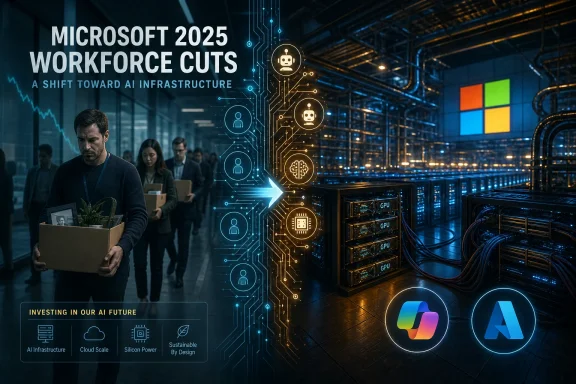 Microsoft’s Layoffs Are Not a Crisis Signal — They Are a Capital Allocation Signal
The old layoff story was simple enough: revenue disappointed, demand fell, Wall Street punished the stock, and management cut costs. That is not the clean story here. Microsoft entered this round after another strong earnings cycle, with cloud, productivity software, and AI enthusiasm still keeping the company near the center of the technology economy.That makes the cuts more revealing, not less. When a company is struggling, layoffs tell us what has gone wrong. When a company is thriving, layoffs tell us what management now values more.
Microsoft’s answer is increasingly clear. The company is rearranging itself around AI, Azure capacity, Copilot distribution, and the enormous physical infrastructure needed to make generative AI feel instant, reliable, and embedded in every product. The people losing jobs are not necessarily attached to failed businesses; they are attached to a corporate structure built for a different cost model.
That distinction matters for Windows users and IT professionals because Microsoft’s strategy is no longer just about selling software licenses or cloud seats. It is about converting the Microsoft stack into an AI consumption engine, one that requires data centers, GPUs, power contracts, and expensive platform bets before customers have fully proven how much they will pay for the result.
The Pandemic Hiring Boom Has Become the Official Alibi
Microsoft’s workforce, like those of other large technology companies, expanded sharply during the pandemic-era software boom. Remote work pulled Teams, Azure, Microsoft 365, security tools, and endpoint management deeper into the operating fabric of businesses almost overnight. Hiring followed demand, and the industry behaved as if every emergency adoption curve was permanent.The correction began in earnest in early 2023, when Microsoft announced roughly 10,000 job cuts. At the time, that round could be framed as a post-pandemic reset: too much hiring, too much optimism, and too much duplication after years of cheap capital and accelerated digital transformation.
The 2025 cuts sit in a different atmosphere. Microsoft is not merely walking back pandemic excess; it is making room for a new spending regime. The company’s own AI ambitions have transformed the balance sheet logic of Big Tech. A dollar not spent on a manager, engineer, recruiter, or sales specialist can be presented as a dollar preserved for infrastructure, automation, or higher-priority AI talent.
That is why the “pandemic overhiring” explanation is only partly satisfying. It explains why large companies had room to trim. It does not explain why the trims continue while AI capital spending accelerates.
The $80 Billion Number Is the Real Headline
Microsoft’s plan to spend around $80 billion in fiscal 2025 on AI-enabled data centers is the number that gives the layoffs their context. It dwarfs the salary savings from a few thousand roles. It also changes how investors, employees, and customers should interpret almost every Microsoft reorganization.AI is not a feature layer that can be shipped like a new ribbon in Office. At hyperscale, it is an industrial project. It requires land, servers, networking gear, cooling, electricity, specialized chips, supply chain certainty, and enough cloud capacity to serve both Microsoft’s own products and customers building on Azure.
That makes Microsoft’s AI push more capital-intensive than the software businesses that made the company dominant. Windows and Office were high-margin products built on distribution leverage. AI, by contrast, pulls Microsoft toward the economics of infrastructure: enormous upfront spending, capacity constraints, uncertain utilization curves, and fierce competition for hardware.
The layoffs therefore look less like emergency surgery and more like corporate diet engineering. Microsoft is trying to keep margins attractive while funding an infrastructure buildout whose payoff is still being priced into the future. The company can tell investors it is serious about AI while also proving it has not forgotten the old discipline of cost control.
Efficiency Has Become the Polite Word for Rewriting the Org Chart
Microsoft reportedly described the cuts as part of organizational changes needed to position the company for success in a dynamic market. That language is familiar because every large technology company now speaks in the same managerial dialect. The words are soft; the consequences are not.“Efficiency” once meant doing the same work with fewer meetings, fewer approvals, and fewer layers. In the AI era, it increasingly means deciding which categories of work remain human-heavy and which can be reduced, automated, consolidated, or shifted to platforms. The company does not have to say AI directly replaced a given worker for AI to be shaping the budget conversation.
This is where the layoff story becomes uncomfortable. Microsoft is selling AI tools that promise to reduce friction in coding, customer support, sales, compliance, documentation, and office work. It is also applying AI internally. Even when cuts are not explicitly described as AI-driven, the existence of those tools changes what executives believe a leaner organization can tolerate.
That does not mean every layoff is a robot replacement story. Some jobs disappear because priorities change. Some disappear because management layers are compressed. Some disappear because a product group no longer has the political gravity it once did. But AI has become the background assumption behind all of those decisions: fewer people can supposedly do more, because the tools are better.
Software Engineers Are No Longer Immune to the Knife
One of the more striking parts of the 2025 round was reporting that software engineering roles were hit heavily in Washington state notices. That detail landed hard because software engineers have traditionally been treated as the core asset in a software company. Sales can be trimmed, recruiting can be paused, middle management can be flattened — but coders were supposed to be the protected class.That assumption is now weaker. Microsoft does not need fewer engineers in the abstract; it needs different engineering capacity, pointed at different priorities, working under different productivity expectations. Azure AI infrastructure, Copilot integration, security, model operations, and cloud reliability will command attention. Other work will be absorbed, deferred, or automated.
For developers, this is the unsettling part of the AI cycle. The first wave of coding assistants was sold as empowerment: fewer boilerplate tasks, faster prototyping, better autocomplete, more time for architecture. The corporate finance version is harsher. If a team can ship with fewer people, sooner or later someone will ask why the old headcount should remain.
There is still a gap between that theory and reality. AI-generated code can create review burdens, quality problems, security concerns, and maintenance debt. Experienced engineers remain essential precisely because modern software systems are complex, brittle, and full of context that a model does not truly understand. But budget processes rarely wait for philosophical certainty.
Windows Users Will Feel the Strategy Indirectly
Most consumers will not notice a Microsoft layoff in the way they notice a broken Windows update. There will be no obvious dialog box saying a team was reduced. But cuts across a company of Microsoft’s scale can shape product quality, support responsiveness, release pacing, and the internal politics of what gets fixed.Windows is now part operating system, part advertising surface, part cloud endpoint, part security substrate, and part AI delivery vehicle. That mix already produces tension. Users who want stability and control are not always asking for the same Windows that Microsoft wants to ship as a Copilot-connected services platform.
When Microsoft reallocates toward AI, the risk is not simply that Windows gets neglected. The risk is that the priorities inside Windows tilt even further toward engagement, telemetry, cloud hooks, and AI-adjacent experiences, while long-standing grievances around settings sprawl, update reliability, local account friction, and UI inconsistency receive slower attention.
For enthusiasts, that is the familiar bargain becoming more explicit. Microsoft still needs Windows to be trusted infrastructure, especially in enterprise. But the company also needs Windows to become a distribution channel for the next era of Microsoft services. Layoffs do not create that tension, but they can make it sharper by limiting how many priorities can be pursued well at once.
Enterprise IT Gets a Different Kind of Uncertainty
For sysadmins and enterprise buyers, Microsoft’s layoffs intersect with a more practical question: who will support the products that organizations are being pushed to adopt? Microsoft 365, Defender, Entra, Intune, Azure, Windows Server, and Copilot are not optional experiments in many environments. They are core operating dependencies.When a vendor cuts jobs while pushing customers into new AI licensing and cloud architectures, IT departments should look beyond the headline count. The important questions are about support depth, product maturity, documentation quality, escalation paths, and the pace at which features are deprecated or bundled into higher-tier SKUs.
Microsoft’s enterprise sales machine remains formidable. Its partner ecosystem is enormous. Its technical documentation, while imperfect, is still one of the strongest in the industry. But customers have already lived through enough admin-center churn, licensing complexity, renamed products, and half-finished portals to know that “innovation” can create operational drag.
AI raises the stakes. A Copilot deployment is not just a software rollout; it touches identity, permissions, data governance, compliance, endpoint readiness, user training, and security posture. If Microsoft wants customers to trust AI throughout the stack, it cannot treat the human systems around deployment as expendable overhead.
The AI Spending Boom Is Rewriting Big Tech’s Social Contract
For years, the implicit social contract in Big Tech was that high profits funded high salaries, generous staffing, and ambitious bets. Employees accepted volatility, but the biggest platform companies still projected a sense of abundance. The AI era is replacing that with a more austere bargain.Companies are still spending lavishly, but not evenly. Money is pouring into GPUs, data centers, model partnerships, energy deals, and elite AI talent. At the same time, ordinary corporate roles face a colder standard of justification. The result is not austerity in the traditional sense; it is selective abundance.
That selective abundance is politically and culturally combustible. Microsoft can tell a persuasive story about the need to invest ahead of demand, compete with Google and Amazon, and build the infrastructure layer for the next generation of computing. Employees can still reasonably ask why that future requires them to be optimized out while the company remains hugely profitable.
The answer, from Wall Street’s perspective, is brutally simple. Investors want Microsoft to fund AI without letting margins collapse. Layoffs are one way to signal that discipline. They also reassure markets that management will not allow the AI buildout to become an uncontrolled spending spree, even if the long-term returns remain uncertain.
The OpenAI Era Changed Microsoft’s Risk Appetite
Microsoft’s partnership with OpenAI gave the company a lead in the generative AI narrative that its competitors could not ignore. Copilot became the banner under which Microsoft could repackage AI across Windows, Office, GitHub, security, and Azure. For a time, the strategy made Microsoft look unusually nimble for a company of its age and size.But early narrative advantage has a cost. Once Microsoft convinced investors that AI could transform its business, it also committed itself to proving that transformation at scale. That means more infrastructure, more model access, more integration work, and more pressure to show that Copilot is not merely a marketing wrapper.
The layoffs should be read against that pressure. Microsoft is not backing away from AI. It is doubling down while trimming elsewhere. The company is acting as if the cost of underinvesting in AI is greater than the cost of internal disruption.
That may be rational. Platform shifts punish hesitation. Microsoft knows this history better than most; it missed or mishandled enough consumer shifts to understand the danger of arriving late. But rational strategy can still produce painful outcomes, especially when the people paying the short-term price are not the executives making the capital allocation call.
The Numbers Are Smaller Than 2023, but the Message Is Larger
The 2025 cuts were smaller as a percentage of workforce than Microsoft’s 2023 round, and smaller still compared with some historic technology restructurings. That perspective matters. Microsoft is not collapsing, and the company is not abandoning its core businesses.Yet the message may be larger because of timing. These cuts occurred during the AI investment surge, after years of profitability, and amid a broader industry pattern in which companies simultaneously praise AI-driven productivity and reduce staffing. Whether or not AI directly caused each layoff, the symbolism is impossible to miss.
The company also continued with additional reductions later in 2025, including a larger wave reported in July that affected about 9,000 workers. By 2026, reports of voluntary retirement offers to a portion of Microsoft’s U.S. workforce reinforced the sense that Microsoft’s workforce strategy had shifted from one-time correction to ongoing reshaping.
That is the point WindowsForum readers should keep in view. A single layoff round can be cyclical. Repeated rounds, buyouts, and management-layer reductions during a historic infrastructure buildout look structural. Microsoft is not just reducing headcount; it is redesigning the company around a more expensive theory of computing.
Customers Should Watch the Products, Not the Press Releases
Microsoft will naturally frame the cuts as responsible management. That is what companies do. The more useful test is whether customers see better products, clearer roadmaps, faster support, and more secure platforms as the AI era unfolds.If Copilot becomes genuinely useful across Microsoft 365, if Azure capacity keeps pace with demand, if Windows becomes more coherent rather than more cluttered, and if security tooling improves without licensing chaos, Microsoft will argue that the reallocation worked. If customers instead get more upsell prompts, more preview-grade AI features, thinner support, and a faster treadmill of SKU changes, the layoffs will look less like discipline and more like extraction.
Enterprise IT should be especially skeptical of AI claims that arrive without operational clarity. A Copilot button is not a deployment plan. A productivity study is not a governance model. A demo is not evidence that the feature will behave safely inside a messy tenant with years of permissions debt.
Microsoft has earned credibility in many parts of the enterprise stack, but credibility is not a blank check. The more the company asks customers to trust AI in workflows, documents, code, meetings, and security operations, the more it must prove that the human foundations around those systems remain strong.
The Redmond Math Now Runs Through GPUs
The concrete lesson from Microsoft’s job cuts is not that AI has instantly replaced thousands of workers. It is that AI has changed the internal competition for money. Payroll, product teams, data centers, chips, and cloud capacity now sit in a more direct contest than they did five years ago.- Microsoft’s May 2025 cuts affected less than 3 percent of its global workforce, implying roughly several thousand roles based on its last reported headcount.
- The reductions came after Microsoft’s larger 2023 layoff round, making them part of a continuing post-pandemic and AI-era restructuring rather than an isolated event.
- The company’s planned $80 billion fiscal 2025 AI data center spend is the strategic backdrop that makes the layoffs more significant than the raw percentage suggests.
- Windows and Microsoft 365 users should expect AI priorities to keep shaping product design, licensing, support, and the pace of platform change.
- Enterprise customers should judge Microsoft’s strategy by product reliability, support quality, governance tooling, and licensing clarity, not by AI branding.
- The most important unresolved question is whether AI infrastructure spending will produce durable customer value fast enough to justify the human and financial disruption around it.
References
- Primary source: it-daily
Published: 2026-06-10T01:42:07.096450
Microsoft cuts thousands of jobs
The software giant Microsoft is cutting several thousand jobs. The cuts will affect less than three percent of the workforce, as the company announced.www.it-daily.net - Related coverage: bloomberg.com
- Related coverage: techspot.com
Microsoft slashes 6,000 positions globally amid AI spending spree | TechSpot
Microsoft said that is slashing three percent of its workforce across all levels, teams and geographies. The company employed around 228,000 workers as of the end of...www.techspot.com - Related coverage: techcrunch.com
Microsoft to lay off 3% of its workforce | TechCrunch
Microsoft is about to trim its worldwide workforce by 3%, CNBC reports. The company had around 228,000 employees worldwide as of June, it says, meaningtechcrunch.com - Related coverage: geekwire.com
Microsoft cuts nearly 3% of global workforce, about 6,000 jobs, in latest push for efficiency – GeekWire
Microsoft began laying off thousands of employees, targeting less than 3% of its global workforce in a move to streamline operations and reduce management layers.www.geekwire.com - Related coverage: investing.com
Microsoft planning thousands of job cuts aimed at salespeople, Bloomberg News reports By Reuters
Microsoft planning thousands of job cuts aimed at salespeople, Bloomberg News reportswww.investing.com
- Related coverage: windowscentral.com
Microsoft saved $500 million using AI amid massive layoffs | Windows Central
While AI may not be the direct cause of Microsoft’s recent layoffs, it’s already delivering impressive productivity gains — saving $500 million in the call center alone last year.www.windowscentral.com - Related coverage: axios.com
Microsoft to lay off 6,000 employees, despite strong earnings report
The most recent cuts represent Microsoft's largest round of layoffs since slashing 10,000 roles in 2023.www.axios.com
- Related coverage: tomshardware.com
Mark Zuckerberg says Meta is cutting 8,000 jobs to pay for AI infrastructure — insatiable compute demand means the company can't rule out further headcount reductions | Tom's Hardware
Compute costs are crowding out headcount at the company that just raised its 2026 capex forecast to $145 billion.www.tomshardware.com - Related coverage: time.com
AI Isn't to Blame for Microsoft, Tech Layoffs
Microsoft announced 10,000 layoffs while potentially investing $10 billion into OpenAI, exacerbating fears of job losses.time.com - Official source: microsoft.com
- Related coverage: techxplore.com
- Related coverage: theguardian.com
Microsoft and Meta announce large staff reductions as they spend big on AI | Technology | The Guardian
Meta said it would cut 10% of it employees while Microsoft will offer voluntary retirement to about 7% of workerswww.theguardian.com - Related coverage: advancedai.com
Meta and Microsoft Cut 16,500 Jobs to Fund AI | Advanced AI
Meta is eliminating 10% of its workforce (8,000 jobs) and Microsoft launched its first-ever voluntary buyout. Both companies named AI spending as the direct cause. advancedai.com
- Related coverage: semafor.com
Meta, Microsoft shrink workforce amid AI spending | Semafor
Meta and Microsoft are significantly downsizing their workforces as the US tech sector grapples with AI-fueled disruptions.www.semafor.com - Related coverage: fortune.com
Meta, Microsoft look to trim workforces amid heavy AI spending | Fortune
Meta told personnel in an internal memo on Thursday that it planned to cut 10% of workers.fortune.com
- Related coverage: washingtonpost.com

Meta slashes 8,000 jobs, or 10% of its workforce, as Microsoft offers buyouts - The Washington Post
In the latest round of tech industry job cuts, Meta is laying off about 8,000 workers and Microsoft is offering buyouts to a similar number
www.washingtonpost.com
- Related coverage: techtimes.com
Tech Layoffs Reach 142,000 in 2026: Profitable Companies Cut Jobs to Fund $700B AI Infrastructure
Tech layoffs 2026 have hit 142,000 as profitable companies including Meta, Amazon, and Oracle cut jobs to fund a combined $700 billion AI infrastructure buildout. Stanford HAI data shows softwarewww.techtimes.com - Related coverage: how2shout.com
Meta Lays Off 8,000 Workers, Microsoft Offers First-Ever Buyouts
Meta cuts 10% of workforce starting May 20. Microsoft offers voluntary retirement to 7% of US staff. Big Tech spends $650B on AI while trimming headcount.www.how2shout.com - Related coverage: techradar.com
'There’s no sign in the data that AI is costing anybody their job right now': White House National Economic Council Director says AI isn’t leading to cuts — despite widespread and well-publicized layoffs across the world | TechRadar
White House denies AI is leading to job cutswww.techradar.com - Related coverage: elpais.com
Microsoft lanza un plan de bajas voluntarias para 8.750 personas, el 7% de la plantilla de EE UU | Economía | EL PAÍS
Es el primer programa de jubilaciones anticipadas de su historiaelpais.com
