

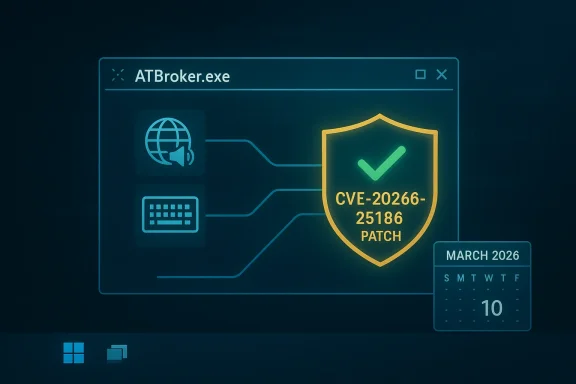
Microsoft has released fixes for a newly catalogued information-disclosure flaw in the Windows Accessibility Infrastructure — tracked as CVE-2026-25186 — that affects the ATBroker.exe helper process. The vulnerability allows a local, authenticated attacker to disclose sensitive information from the system via the Accessibility Broker, and it was published alongside Microsoft’s March 10, 2026 security updates. Administrators and endpoint teams should treat this as an important patch for Windows endpoints, prioritizing rollout and detection because accessibility components frequently run with elevated privileges and are attractive targets in post-compromise scenarios.
The Windows Accessibility Infrastructure exists to bridge assistive technologies (screen readers, on‑screen keyboards, voice control tools) with applications and the operating system. ATBroker.exe, the Accessibility Broker, is the Windows process responsible for mediating requests and coordinating privileged operations on behalf of accessibility clients. Because it must interact with many processes and provide higher‑trust services, ATBroker often runs in contexts that expose system memory, UI handles, and interprocess communication channels that are otherwise harder to access.
Over time, accessibility subsystems on major desktop platforms have become a common post‑compromise pivot and toolset for attackers. That is not because assistive technologies are insecure by design, but because the accessibility stack often needs broader privileges and integration points to work reliably — which increases its attack surface when an adversary already has access to a machine.
Microsoft’s March 10, 2026 update package included a fix for CVE-2026-25186, officially described as an information-disclosure vulnerability in Windows Accessibility Infrastructure (ATBroker.exe). Public vulnerability trackers and security vendors that catalog Microsoft Patch Tuesday content classify the issue as important with a medium CVSS base score consistent with local information disclosure risks. The high confidentiality impact assigned to the CVE reflects that successful exploitation could let an attacker read secrets or memory content that should be restricted.
Key attributes reported by public vulnerability trackers and security advisories:
Where public reporting is insufficiently granular, it is important to flag any technical claims that are not directly attributable to vendor advisories as unverified. At the time of publication, detailed exploit code or a step‑by‑step proof of concept has not been widely published. That means defenders should treat the vulnerability as real and actionable but also avoid assuming functional exploit chains until more technical artifacts appear from trusted researchers or Microsoft publishes expanded guidance.
Practical outcomes of such disclosure might include:
From a defense standpoint, this means two things:
CVE-2026-25186 is not a remote, internet‑scale zero‑day; its primary danger lies in how it amplifies the value of an existing local foothold. That combination — accessible in many real‑world breach scenarios — is why defenders must act quickly. Patch, monitor, and harden: those three steps will substantially reduce the operational window in which attackers can weaponize the accessibility broker for reconnaissance or privilege escalation.
Source: MSRC Security Update Guide - Microsoft Security Response Center
 Background
The Windows Accessibility Infrastructure exists to bridge assistive technologies (screen readers, on‑screen keyboards, voice control tools) with applications and the operating system. ATBroker.exe, the Accessibility Broker, is the Windows process responsible for mediating requests and coordinating privileged operations on behalf of accessibility clients. Because it must interact with many processes and provide higher‑trust services, ATBroker often runs in contexts that expose system memory, UI handles, and interprocess communication channels that are otherwise harder to access.Over time, accessibility subsystems on major desktop platforms have become a common post‑compromise pivot and toolset for attackers. That is not because assistive technologies are insecure by design, but because the accessibility stack often needs broader privileges and integration points to work reliably — which increases its attack surface when an adversary already has access to a machine.
Microsoft’s March 10, 2026 update package included a fix for CVE-2026-25186, officially described as an information-disclosure vulnerability in Windows Accessibility Infrastructure (ATBroker.exe). Public vulnerability trackers and security vendors that catalog Microsoft Patch Tuesday content classify the issue as important with a medium CVSS base score consistent with local information disclosure risks. The high confidentiality impact assigned to the CVE reflects that successful exploitation could let an attacker read secrets or memory content that should be restricted.
Technical overview
What type of flaw is CVE-2026-25186?
CVE-2026-25186 is an information disclosure vulnerability within ATBroker.exe. In plain terms, a vulnerable ATBroker implementation can be made to reveal data it should not disclose to an unprivileged or lesser‑privileged actor on the same machine. Available vendor summaries characterize this as a local issue — an attacker must already have an account on the host — rather than a remote network exploit.Key attributes reported by public vulnerability trackers and security advisories:
- Vulnerability class: Information disclosure (CWE category: exposure of sensitive information).
- Primary component: Windows Accessibility Infrastructure (ATBroker.exe).
- Attack vector: Local (requires local authenticated access).
- Exploitation complexity: Low to Moderate, depending on the exact preconditions (public advisories indicate no user interaction required).
- Impact: Confidentiality — High; Integrity and Availability impacts are reported as None.
Why ATBroker.exe matters (from a security perspective)
ATBroker functions as a mediator between accessibility clients and system resources. Typical responsibilities include:- Accepting and servicing requests on behalf of assistive processes.
- Opening and passing handles between processes.
- Interacting with UI automation APIs and remote procedure calls.
- Accessing or mediating sensitive objects that may contain secrets or address space details.
Confirmed and unconfirmed technical details
Microsoft’s security listing for CVE-2026-25186 identifies the issue as an information-disclosure flaw in the Accessibility Infrastructure and recommends installing the provided security update. Independent vulnerability aggregators and vendor advisories included in the March 10, 2026 patch coverage echo the same description and severity rating.Where public reporting is insufficiently granular, it is important to flag any technical claims that are not directly attributable to vendor advisories as unverified. At the time of publication, detailed exploit code or a step‑by‑step proof of concept has not been widely published. That means defenders should treat the vulnerability as real and actionable but also avoid assuming functional exploit chains until more technical artifacts appear from trusted researchers or Microsoft publishes expanded guidance.
Exploitation scenarios: how an attacker could use this
Single‑host, local discovery and exfiltration
The most straightforward exploitation model for CVE-2026-25186 is local discovery and exfiltration. An attacker who already has credentials for a user account on a target Windows machine — for example, a compromised standard user, a malicious insider, or an attacker who achieved an initial foothold via phishing — could use the flaw to read sensitive information that lives in process memory or is exposed via the accessibility broker.Practical outcomes of such disclosure might include:
- Extraction of credential artifacts or tokens resident in memory.
- Harvesting sensitive strings (API keys, secrets typed into in‑memory buffers).
- Leakage of pointers and addresses that help bypass ASLR for subsequent exploitation.
Chaining with elevation or remote access bugs
An important defensive observation: information‑disclosure vulnerabilities are often low‑effort but high‑value when chained with other flaws. For example:- An attacker obtains a local foothold (phishing, malicious installer, lateral access).
- They exploit CVE-2026-25186 to disclose memory layout, handle IDs, or other secrets.
- They use that disclosed information to exploit a second bug — such as a local elevation‑of‑privilege (EoP) vulnerability — to reach SYSTEM or otherwise elevate privileges.
Scope: who is at risk?
- Single machines in unmanaged contexts (home users, contractors) where timely patching is less certain.
- Enterprise endpoints where an attacker can gain a standard user session via phishing or malicious attachments.
- Shared or kiosk devices where multiple accounts are present and attackers might leverage local accounts.
- Any environment where accessibility services run elevated or are broadly accessible to untrusted users.
Practical mitigation and detection guidance
If you manage Windows endpoints, take the following steps immediately.1. Patch priority and deployment (what to do first)
- Deploy Microsoft’s March 10, 2026 security updates that include the CVE-2026-25186 fix as a priority for all Windows systems. Treat this as an important endpoint security update.
- Use your enterprise update tools (WSUS, SCCM/Microsoft Endpoint Configuration Manager, Microsoft Intune, Windows Update for Business) to accelerate deployment to high‑risk groups (servers hosting sensitive workloads, admin workstations, and endpoints used for privileged operations).
- Confirm patch status by scanning inventory and verifying updated OS build numbers and patch KB entries in your management console.
2. Hardening steps you can apply now
- Enforce least privilege: remove local admin rights from accounts that do not need them and avoid shared admin logins.
- Apply application allowlisting and restrict the installation of unvetted binaries on endpoints.
- Harden Remote Desktop and remote access paths; ensure MFA at sign‑on and limit interactive logins for service accounts.
- Where possible, restrict which processes can interact with ATBroker (via application control or advanced OS hardening controls).
3. Detection and hunting (EDR and SIEM guidance)
- Hunt for anomalous spawn or unusual command lines related to ATBroker.exe; track parent/child process relationships.
- Monitor for unexpected handle duplication, frequent ALPC messages to ATBroker, or unexplained increases in ATBroker interactions.
- Correlate ATBroker activity with unusual credential dumping indicators or processes that typically attempt memory scanning.
- Deploy behavioral rules to flag processes attempting to interface with accessibility services outside typical workflows.
4. For accessibility-dependent environments
- Coordinate with accessibility users before applying mitigations that might impact assistive tools.
- Test patches in a staging environment that includes accessibility software stacks that are part of your organization’s assistive ecosystem.
- Where temporary restrictions are necessary, provide alternate validated configurations and hotlines for affected users.
Risk assessment and critical analysis
Strengths of Microsoft’s response
- Microsoft published a formal vulnerability entry for CVE-2026-25186 as part of the March 10, 2026 security updates, and the company provided an update cadence that allowed enterprises to deploy fixes quickly.
- Including the fix in a broad monthly release increases the likelihood that enterprise update pipelines will pick it up as part of normal maintenance windows.
- Microsoft and several vendor trackers categorized the issue clearly as an information disclosure with a local attack vector, enabling defenders to prioritize based on realistic threat models.
Remaining risks and unanswered questions
- Public reporting so far lacks deep technical detail and confirmed proof‑of‑concept code. While this reduces near‑term public exploitation risk, it also creates uncertainty: defenders don’t yet know the precise exploitation primitives to look for, and that complicates detection rule creation.
- The accessibility stack’s integration with other components means that even if this vulnerability by itself is limited to information disclosure, its value to attackers as part of a chain is high. Multiple recent accessibility‑related EoP and information‑disclosure fixes in the same patch cycle reinforce the idea that this subsystem is a frequent target.
- Because the flaw requires local access, attackers with footholds (ransomware affiliates, initial‑access brokers) could weaponize it internally. Organizations that are slow to deploy patches or that have weak endpoint detection will be at greater risk.
Operational impact and prioritization
- Patching should be prioritized for systems that host sensitive workloads or where local access is easier to obtain (lab machines, shared kiosks, development VMs).
- For large enterprises, treat this as a mid‑priority item relative to remote code execution or confirmed zero‑day exploits but as a higher priority compared with low‑severity, non‑exploitable issues. The common attack pattern — information disclosure used to support privilege escalation — justifies swift remediation.
- Endpoint detection teams should model likely threat chains: initial access → information disclosure via ATBroker → local EoP → credential theft → lateral movement. Blocking the first two steps (robust phishing defenses, patching) is the most effective strategy.
Practical detection recipes (examples for defenders)
Below are defensive queries and telemetry signals to consider adding to your detection playbooks. These are generic, non-exploit‑specific suggestions designed to catch suspicious behavior that could indicate misuse of accessibility components.- EDR rule: alert on unexpected child processes of ATBroker.exe (e.g., scripting hosts or enumeration tools) or unusually frequent interactions with third‑party assistive programs.
- Windows Event Log: track Event IDs related to process creation where the parent or child is ATBroker.exe. Correlate with anomalous login times or lateral movement indicators.
- ALPC/Windows automation monitoring: flag processes that open or duplicate handles to GUI objects controlled by other user sessions.
- Memory scanning detection: identify processes that repeatedly read memory of other processes or open read handles to high‑privilege processes shortly after interacting with ATBroker.
- Baseline behavior: record normal ATBroker CPU, handle, and IPC patterns in your environment and alert on deviations.
Advice for different stakeholders
For IT administrators and security teams
- Apply the March 10, 2026 Windows updates as soon as possible; verify deployment with asset inventory tools.
- Prioritize systems exposed to untrusted users and machines used for privileged operations.
- Update endpoint response playbooks to include ATBroker‑related hunting steps and link them to your incident response chain.
- Review local account hygiene and reduce unnecessary local privileges.
For support teams and accessibility users
- Communicate with users who rely on assistive technologies before scheduling disruptive maintenance. Provide an accessible patch test plan.
- Reassure end users that accessibility features are important and should not be disabled permanently; patches are the correct long‑term fix.
- Offer guidance on how support teams will validate that assistive tools continue to work post‑update.
For vulnerability researchers and bug‑bounty programs
- Respect responsible disclosure norms. If you have technical details or a PoC, coordinate with vendors and MSRC before publishing.
- Share non‑exploit technical analysis that helps defenders (safe reproductions, telemetry signatures) rather than distribution‑ready exploit code.
Why this matters: a strategic view
Information‑disclosure vulnerabilities like CVE-2026-25186 are a classic example of how relatively limited flaws can have outsized strategic value in an attacker’s toolkit. On their own, disclosures do not immediately grant code execution, but they can provide the precise intelligence attackers need to defeat hardening features or successfully exploit separate, higher‑impact vulnerabilities.From a defense standpoint, this means two things:
- Fixing single issues is necessary but not sufficient; reduce your attack surface through least privilege, robust access controls, and layered detection.
- Visibility into endpoint behavior and interprocess interactions is essential. Organizations that lack deep process telemetry or handle‑level monitoring will struggle to detect the reconnaissance phase that typically precedes major intrusions.
Final recommendations and checklist
- Patch: deploy the March 10, 2026 Windows security updates that remediate CVE-2026-25186 immediately across all affected endpoints.
- Prioritize: accelerate rollout to high‑risk groups (admin workstations, servers, shared devices).
- Harden: remove unnecessary local admin rights and enforce strong account hygiene.
- Detect: add ATBroker‑focused hunts to EDR/SIEM playbooks and monitor for anomalous IPC/handle activity.
- Coordinate: inform accessibility‑dependent users about planned updates and validate assistive software in staging.
- Chain mitigation: remediate related EoP vulnerabilities in the same update cycle to reduce chaining risk.
CVE-2026-25186 is not a remote, internet‑scale zero‑day; its primary danger lies in how it amplifies the value of an existing local foothold. That combination — accessible in many real‑world breach scenarios — is why defenders must act quickly. Patch, monitor, and harden: those three steps will substantially reduce the operational window in which attackers can weaponize the accessibility broker for reconnaissance or privilege escalation.
Source: MSRC Security Update Guide - Microsoft Security Response Center
