

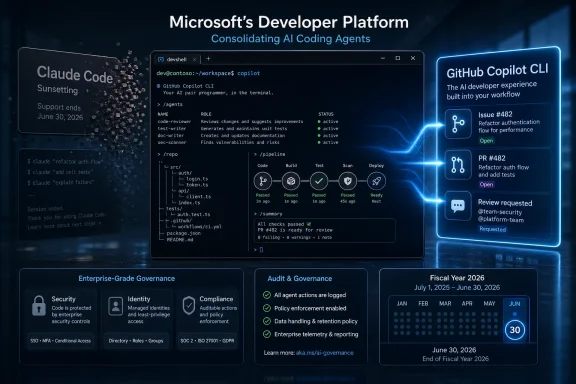
Microsoft is reportedly winding down most internal Claude Code licenses in its Experiences + Devices division by June 30, 2026, and steering many developers toward GitHub Copilot CLI instead. The move is not simply a procurement footnote; it is Microsoft choosing platform discipline over tool pluralism at the exact moment coding agents are becoming part of the software factory. Claude may still live inside Microsoft’s broader AI stack, but Claude Code appears to have become too successful, too external, and too awkward for Microsoft’s own developer tooling story.
The most revealing part of the reported shift is not that Microsoft wants its engineers using GitHub Copilot CLI. Of course it does. Microsoft owns GitHub, sells Copilot, and has spent years trying to make “Copilot” the default verb for AI assistance across Windows, Office, Azure, and developer workflows.
The revealing part is that Claude Code was apparently popular enough internally to create a problem. Microsoft reportedly licensed it broadly in late 2025, encouraged thousands of employees to try it, and let developers, project managers, designers, and other non-engineers experiment with AI-assisted prototyping. That is exactly the kind of internal trial a serious platform company should run.
But trials have consequences. If the outside tool wins hearts inside the company, the vendor has to decide whether it is buying productivity or subsidizing a competitor’s product-market fit. Microsoft’s answer, at least inside Experiences + Devices, appears to be: we learned what we needed to learn, and now the experience must come home.
Rajesh Jha’s reported internal framing makes the strategic logic plain. Claude Code helped Microsoft compare tools in real development conditions, but Copilot CLI is the product Microsoft can tune directly for its repositories, workflows, security expectations, and engineering needs. That is the language of dogfooding, but it is also the language of control.
Large enterprises do not merely adopt software because engineers like it. They renew it, meter it, audit it, route data through it, attach security reviews to it, and eventually ask whether the same capability can be purchased through an existing platform agreement. When the company asking those questions also owns the rival tool, the answer becomes easier to predict.
Claude Code’s popularity may have strengthened the case for agentic command-line development, but it may also have weakened the case for paying Anthropic directly for the interface. Microsoft can still use Claude models through approved channels while reducing dependence on Anthropic’s standalone developer product. That distinction matters.
This is the shape of the modern AI stack: the model, the agent shell, the policy layer, the workflow integration, and the billing relationship are no longer the same thing. Microsoft is not necessarily rejecting Anthropic’s models. It is reportedly rejecting Claude Code as the primary internal surface area for a major engineering organization.
That makes the command line an unusually important battleground. Developers live there when abstractions break down. Build systems, package managers, test runners, deployment scripts, Git operations, and one-off repairs all converge in the terminal. A coding agent that becomes trusted there is not just helping write code; it is becoming a mediator between the developer and the repo.
Claude Code reportedly did well in precisely that role. It gained traction not only among engineers but also among employees who wanted to prototype without traditional coding experience. That is the dream Microsoft has been selling with Copilot across its product line: natural language as a bridge into useful software work.
The problem is that Anthropic supplied the bridge. For Microsoft, that is tolerable when Claude is one model option inside a Microsoft-controlled product. It is far more complicated when Claude Code is the tool employees open before they open Microsoft’s own.
Internal mandates can create usage, but they cannot manufacture delight. Developers are notoriously good at finding the shortest path around tools that slow them down. If Copilot CLI is less capable, less predictable, or less ergonomic than Claude Code, Microsoft will hear about it from the most demanding focus group available: its own engineers working on Windows, Microsoft 365, Outlook, Teams, Surface, and the rest of Experiences + Devices.
That is also why the reported transition may ultimately improve Copilot CLI. GitHub is said to have already proposed significant changes based on Microsoft feedback, and the Experiences + Devices division is expected to be deeply involved in future product development. In other words, Microsoft is turning a procurement decision into a product acceleration mechanism.
This is classic Microsoft platform behavior. The company often tolerates competing internal experiments until the category becomes important enough to consolidate. Then the internal customer becomes a forcing function for the first-party platform.
That is the key distinction. Microsoft wants Anthropic as a model supplier and strategic option, especially where Claude performs well. It does not necessarily want Anthropic owning the developer experience through a standalone tool that competes with GitHub Copilot.
This is the same separation cloud vendors have practiced for years. AWS, Azure, and Google Cloud will happily host partner technologies while still steering customers toward native control planes. The partner is welcome inside the marketplace; the customer relationship must remain with the platform.
For WindowsForum readers, this matters because Microsoft’s AI strategy is increasingly less about a single model and more about governance of the full work surface. The model may be OpenAI, Anthropic, Microsoft’s own, or something else. The product that captures identity, permissions, telemetry, compliance, billing, and workflow is where the power sits.
A terminal agent may need to read source code, inspect configuration, invoke tools, run tests, and sometimes alter files. In a consumer setting, that is already risky. In a hyperscale software company, it touches crown-jewel intellectual property and build systems that have to satisfy internal and regulatory controls.
From that angle, Copilot CLI has an obvious advantage for Microsoft: GitHub can be tuned against Microsoft’s own policies and infrastructure. The company can define approved repositories, restrict paths, integrate with internal identity systems, shape logging requirements, and build controls that match its security model. Even if Claude Code offers strong enterprise features, it remains a third-party product with its own roadmap and operational assumptions.
Still, security should not be treated as the whole story. Security is the argument every enterprise can make when consolidating tools, and often it is true. But here it sits alongside cost, product strategy, platform ownership, and competitive optics. Microsoft can be right about the security benefits and still be acting in its own commercial interest.
In agentic coding, the wrapper matters enormously. How does the tool index the repo? How does it ask for permission before running commands? How does it recover from failed tests? How does it present diffs? How well does it understand GitHub issues, pull requests, CI failures, and code review conventions? How easy is it for an organization to define safe defaults?
That is where Copilot CLI can plausibly become more valuable to Microsoft than Claude Code even if some developers prefer Claude’s behavior today. GitHub sits at the center of the software lifecycle. A command-line agent that is deeply aware of issues, pull requests, code owners, CI status, and enterprise policy has a structural advantage inside organizations already standardized on GitHub.
Claude Code’s advantage is that Anthropic built a product developers actually wanted to use. Copilot CLI’s advantage is that Microsoft can wire it into the machinery that decides whether code ships. The next year of agentic coding will be shaped by that tension between craft experience and platform gravity.
That does not mean Windows will suddenly be written by autonomous agents. The more plausible outcome is subtler. Agents will help triage bugs, generate tests, update internal documentation, refactor subsystems, prototype UI flows, and handle repetitive repository tasks. Over time, those workflows can change what kinds of engineering work feel cheap or expensive.
For sysadmins and enterprise IT, the lesson is not that Claude Code is unsafe or Copilot CLI is automatically superior. The lesson is that AI coding tools are becoming managed enterprise infrastructure. They will be selected through the same mix of capability, compliance, vendor leverage, and cost control that governs endpoint management, identity, collaboration, and cloud spend.
Microsoft’s internal decision also foreshadows what customers may hear from their own procurement teams. A department may prefer one AI coding assistant, another may prefer a second, and security may prefer a third because it integrates with existing controls. Eventually, someone will ask why the company is paying for all of them.
If Claude Code became popular inside Microsoft, it likely did so because it passed some version of that friction test. A coding agent that feels useful becomes habit-forming very quickly. Developers start trusting it with setup scripts, test failures, and half-formed refactors because it saves mental context.
Copilot CLI now has to win that trust under less organic conditions. Being the sanctioned tool helps with access and integration, but it also raises expectations. If Microsoft tells engineers to migrate, every missing feature becomes a corporate self-own rather than a third-party limitation.
That pressure could be good for users outside Microsoft. GitHub has every incentive to turn internal complaints into product improvements it can sell broadly. If Microsoft’s own Windows and Microsoft 365 teams force Copilot CLI to become more reliable, more controllable, and more ergonomic, the public product may benefit.
The reported Claude Code cancellation shows the boundary of that openness. Model choice is acceptable when it reinforces Microsoft’s platform. Tool choice is less welcome when it fragments the developer experience, duplicates spend, or gives a rival vendor the premium interaction point.
That is not unique to Microsoft. Every major AI platform company is trying to turn models into interchangeable engines while making its own interface, agent framework, marketplace, or cloud runtime indispensable. The open question is whether customers will accept that bargain or keep demanding best-of-breed tools at each layer.
Inside Microsoft, the answer appears to be consolidation. Claude may remain available through approved Microsoft channels, but Claude Code as a separate daily driver is reportedly being phased down in at least one major division. That is a practical compromise, but it also reveals where Microsoft thinks value accrues.
That shift will hit every AI coding vendor. A tool can become popular with engineers and still lose the enterprise account if it does not fit procurement, security, data governance, and platform consolidation goals. Conversely, a first-party tool can survive early product gaps if it is embedded deeply enough in the systems companies already use.
For independent AI coding companies, Claude Code’s reported Microsoft experience is both flattering and ominous. It suggests that Anthropic built something compelling enough for Microsoft employees to embrace. It also suggests that success inside a platform giant does not guarantee long-term access when the platform giant has its own competing interface.
The same dynamic will play out in banks, manufacturers, healthcare systems, government agencies, and software firms. Developers will push for the tools that make them fastest. CIOs will push for tools they can govern. CFOs will push for tools already bundled into strategic vendor agreements. The winning product will need to satisfy all three.
Microsoft’s reported Claude Code retreat is therefore less a breakup than a boundary-setting exercise. Anthropic can remain a model partner, but Microsoft wants the command line, the repo integration, and the enterprise control plane to carry the Copilot name. If Copilot CLI improves under that pressure, Microsoft will have turned an internal embarrassment into a platform win; if it does not, its own developers will keep reminding Redmond that in software, mandated tools still have to earn the prompt.
 Microsoft Chooses the Tool It Can Shape
The most revealing part of the reported shift is not that Microsoft wants its engineers using GitHub Copilot CLI. Of course it does. Microsoft owns GitHub, sells Copilot, and has spent years trying to make “Copilot” the default verb for AI assistance across Windows, Office, Azure, and developer workflows.The revealing part is that Claude Code was apparently popular enough internally to create a problem. Microsoft reportedly licensed it broadly in late 2025, encouraged thousands of employees to try it, and let developers, project managers, designers, and other non-engineers experiment with AI-assisted prototyping. That is exactly the kind of internal trial a serious platform company should run.
But trials have consequences. If the outside tool wins hearts inside the company, the vendor has to decide whether it is buying productivity or subsidizing a competitor’s product-market fit. Microsoft’s answer, at least inside Experiences + Devices, appears to be: we learned what we needed to learn, and now the experience must come home.
Rajesh Jha’s reported internal framing makes the strategic logic plain. Claude Code helped Microsoft compare tools in real development conditions, but Copilot CLI is the product Microsoft can tune directly for its repositories, workflows, security expectations, and engineering needs. That is the language of dogfooding, but it is also the language of control.
The Fiscal Calendar Gives the Strategy a Deadline
The reported June 30 cutoff is not a random date. It lands on the final day of Microsoft’s fiscal year, which makes any license reduction look as much like budget hygiene as product strategy. That does not make the move cynical; it makes it Microsoft.Large enterprises do not merely adopt software because engineers like it. They renew it, meter it, audit it, route data through it, attach security reviews to it, and eventually ask whether the same capability can be purchased through an existing platform agreement. When the company asking those questions also owns the rival tool, the answer becomes easier to predict.
Claude Code’s popularity may have strengthened the case for agentic command-line development, but it may also have weakened the case for paying Anthropic directly for the interface. Microsoft can still use Claude models through approved channels while reducing dependence on Anthropic’s standalone developer product. That distinction matters.
This is the shape of the modern AI stack: the model, the agent shell, the policy layer, the workflow integration, and the billing relationship are no longer the same thing. Microsoft is not necessarily rejecting Anthropic’s models. It is reportedly rejecting Claude Code as the primary internal surface area for a major engineering organization.
Claude Code Became the Benchmark Microsoft Could Not Ignore
Claude Code’s rise inside Microsoft fits a wider pattern in software development. The most disruptive coding tools are no longer autocomplete widgets sitting politely in an IDE sidebar. They are terminal-native agents that inspect projects, edit files, run commands, interpret errors, and keep working across multi-step tasks.That makes the command line an unusually important battleground. Developers live there when abstractions break down. Build systems, package managers, test runners, deployment scripts, Git operations, and one-off repairs all converge in the terminal. A coding agent that becomes trusted there is not just helping write code; it is becoming a mediator between the developer and the repo.
Claude Code reportedly did well in precisely that role. It gained traction not only among engineers but also among employees who wanted to prototype without traditional coding experience. That is the dream Microsoft has been selling with Copilot across its product line: natural language as a bridge into useful software work.
The problem is that Anthropic supplied the bridge. For Microsoft, that is tolerable when Claude is one model option inside a Microsoft-controlled product. It is far more complicated when Claude Code is the tool employees open before they open Microsoft’s own.
Copilot CLI Is Now Under Pressure From Its Own Customer
The move creates a useful but uncomfortable test for GitHub. If Microsoft’s own developers preferred Claude Code in recent months, then Copilot CLI does not merely need internal distribution. It needs to close a real product gap.Internal mandates can create usage, but they cannot manufacture delight. Developers are notoriously good at finding the shortest path around tools that slow them down. If Copilot CLI is less capable, less predictable, or less ergonomic than Claude Code, Microsoft will hear about it from the most demanding focus group available: its own engineers working on Windows, Microsoft 365, Outlook, Teams, Surface, and the rest of Experiences + Devices.
That is also why the reported transition may ultimately improve Copilot CLI. GitHub is said to have already proposed significant changes based on Microsoft feedback, and the Experiences + Devices division is expected to be deeply involved in future product development. In other words, Microsoft is turning a procurement decision into a product acceleration mechanism.
This is classic Microsoft platform behavior. The company often tolerates competing internal experiments until the category becomes important enough to consolidate. Then the internal customer becomes a forcing function for the first-party platform.
The Anthropic Relationship Is Narrowing, Not Ending
It would be a mistake to read the reported Claude Code pullback as Microsoft turning away from Anthropic. The company has been moving in the opposite direction at the model layer. Anthropic models have appeared in Microsoft’s broader AI portfolio, including Copilot Studio and Microsoft Foundry, and Microsoft has positioned multi-model choice as an enterprise feature rather than a threat to Copilot.That is the key distinction. Microsoft wants Anthropic as a model supplier and strategic option, especially where Claude performs well. It does not necessarily want Anthropic owning the developer experience through a standalone tool that competes with GitHub Copilot.
This is the same separation cloud vendors have practiced for years. AWS, Azure, and Google Cloud will happily host partner technologies while still steering customers toward native control planes. The partner is welcome inside the marketplace; the customer relationship must remain with the platform.
For WindowsForum readers, this matters because Microsoft’s AI strategy is increasingly less about a single model and more about governance of the full work surface. The model may be OpenAI, Anthropic, Microsoft’s own, or something else. The product that captures identity, permissions, telemetry, compliance, billing, and workflow is where the power sits.
The Security Argument Is Convenient, But Not Fake
Microsoft’s reported internal rationale emphasizes repository customization, workflow fit, and security expectations. Those are not empty words. A coding agent with terminal access is a genuinely sensitive piece of software, particularly inside a company building operating systems, cloud services, productivity suites, collaboration platforms, and hardware.A terminal agent may need to read source code, inspect configuration, invoke tools, run tests, and sometimes alter files. In a consumer setting, that is already risky. In a hyperscale software company, it touches crown-jewel intellectual property and build systems that have to satisfy internal and regulatory controls.
From that angle, Copilot CLI has an obvious advantage for Microsoft: GitHub can be tuned against Microsoft’s own policies and infrastructure. The company can define approved repositories, restrict paths, integrate with internal identity systems, shape logging requirements, and build controls that match its security model. Even if Claude Code offers strong enterprise features, it remains a third-party product with its own roadmap and operational assumptions.
Still, security should not be treated as the whole story. Security is the argument every enterprise can make when consolidating tools, and often it is true. But here it sits alongside cost, product strategy, platform ownership, and competitive optics. Microsoft can be right about the security benefits and still be acting in its own commercial interest.
The Real Contest Is the Agent Wrapper
The AI industry spent the last few years arguing about model rankings. Developers cared whether Claude, GPT, Gemini, or another model was best at reasoning, code generation, refactoring, or long-context analysis. Those comparisons still matter, but they are becoming less decisive than they used to be.In agentic coding, the wrapper matters enormously. How does the tool index the repo? How does it ask for permission before running commands? How does it recover from failed tests? How does it present diffs? How well does it understand GitHub issues, pull requests, CI failures, and code review conventions? How easy is it for an organization to define safe defaults?
That is where Copilot CLI can plausibly become more valuable to Microsoft than Claude Code even if some developers prefer Claude’s behavior today. GitHub sits at the center of the software lifecycle. A command-line agent that is deeply aware of issues, pull requests, code owners, CI status, and enterprise policy has a structural advantage inside organizations already standardized on GitHub.
Claude Code’s advantage is that Anthropic built a product developers actually wanted to use. Copilot CLI’s advantage is that Microsoft can wire it into the machinery that decides whether code ships. The next year of agentic coding will be shaped by that tension between craft experience and platform gravity.
Windows Developers Should Watch the Internal Dogfood Loop
The Experiences + Devices division is not an abstract corporate unit. It covers products that define the daily computing environment for hundreds of millions of people: Windows, Microsoft 365, Outlook, Teams, Surface, and adjacent services. If those teams standardize on Copilot CLI, the tool’s assumptions may influence how Microsoft builds software at scale.That does not mean Windows will suddenly be written by autonomous agents. The more plausible outcome is subtler. Agents will help triage bugs, generate tests, update internal documentation, refactor subsystems, prototype UI flows, and handle repetitive repository tasks. Over time, those workflows can change what kinds of engineering work feel cheap or expensive.
For sysadmins and enterprise IT, the lesson is not that Claude Code is unsafe or Copilot CLI is automatically superior. The lesson is that AI coding tools are becoming managed enterprise infrastructure. They will be selected through the same mix of capability, compliance, vendor leverage, and cost control that governs endpoint management, identity, collaboration, and cloud spend.
Microsoft’s internal decision also foreshadows what customers may hear from their own procurement teams. A department may prefer one AI coding assistant, another may prefer a second, and security may prefer a third because it integrates with existing controls. Eventually, someone will ask why the company is paying for all of them.
Developers Will Judge the Migration by Friction
The hardest part of replacing a beloved developer tool is that developers do not evaluate tools only by feature matrix. They judge them by friction. Does it understand the task quickly? Does it break the project? Does it waste tokens on ceremony? Does it produce diffs that are easy to review? Does it ask for permission at the right moments rather than the annoying ones?If Claude Code became popular inside Microsoft, it likely did so because it passed some version of that friction test. A coding agent that feels useful becomes habit-forming very quickly. Developers start trusting it with setup scripts, test failures, and half-formed refactors because it saves mental context.
Copilot CLI now has to win that trust under less organic conditions. Being the sanctioned tool helps with access and integration, but it also raises expectations. If Microsoft tells engineers to migrate, every missing feature becomes a corporate self-own rather than a third-party limitation.
That pressure could be good for users outside Microsoft. GitHub has every incentive to turn internal complaints into product improvements it can sell broadly. If Microsoft’s own Windows and Microsoft 365 teams force Copilot CLI to become more reliable, more controllable, and more ergonomic, the public product may benefit.
The Multi-Model Promise Meets the Single-Platform Reality
Microsoft’s public AI message has increasingly emphasized model choice. Use the right model for the job. Bring OpenAI, Anthropic, and other models into the same enterprise environment. Let customers pick the reasoning engine while Microsoft provides the governance and workflow layer.The reported Claude Code cancellation shows the boundary of that openness. Model choice is acceptable when it reinforces Microsoft’s platform. Tool choice is less welcome when it fragments the developer experience, duplicates spend, or gives a rival vendor the premium interaction point.
That is not unique to Microsoft. Every major AI platform company is trying to turn models into interchangeable engines while making its own interface, agent framework, marketplace, or cloud runtime indispensable. The open question is whether customers will accept that bargain or keep demanding best-of-breed tools at each layer.
Inside Microsoft, the answer appears to be consolidation. Claude may remain available through approved Microsoft channels, but Claude Code as a separate daily driver is reportedly being phased down in at least one major division. That is a practical compromise, but it also reveals where Microsoft thinks value accrues.
The Industry Should Read This as a Warning Shot
The story is not only about Microsoft and Anthropic. It is about what happens when AI tools move from experimentation into operational budgets. During the trial phase, companies chase capability. During the standardization phase, they chase control.That shift will hit every AI coding vendor. A tool can become popular with engineers and still lose the enterprise account if it does not fit procurement, security, data governance, and platform consolidation goals. Conversely, a first-party tool can survive early product gaps if it is embedded deeply enough in the systems companies already use.
For independent AI coding companies, Claude Code’s reported Microsoft experience is both flattering and ominous. It suggests that Anthropic built something compelling enough for Microsoft employees to embrace. It also suggests that success inside a platform giant does not guarantee long-term access when the platform giant has its own competing interface.
The same dynamic will play out in banks, manufacturers, healthcare systems, government agencies, and software firms. Developers will push for the tools that make them fastest. CIOs will push for tools they can govern. CFOs will push for tools already bundled into strategic vendor agreements. The winning product will need to satisfy all three.
The Signal Hidden Inside Microsoft’s Claude Retreat
Microsoft’s reported pullback is easy to oversimplify, so the practical reading should stay narrow and concrete. The company is not abandoning Anthropic, and it is not proving that Claude Code failed. It is showing how quickly AI coding tools have become strategic infrastructure.- Microsoft is reportedly reducing most Claude Code licenses in its Experiences + Devices division by June 30, 2026.
- The replacement path is GitHub Copilot CLI, a terminal-based agent Microsoft can influence directly through GitHub.
- Claude Code’s reported internal popularity makes the move more significant, because Microsoft is consolidating despite developer preference rather than because the trial obviously failed.
- The fiscal-year timing suggests cost control is part of the story, even if product standardization and security are the official strategic frame.
- Anthropic models are expected to remain part of Microsoft’s broader AI ecosystem, which means the dispute is more about the developer interface than the underlying model family.
- The migration will put pressure on GitHub to make Copilot CLI good enough for Microsoft’s own engineers, not merely good enough for Microsoft’s sales deck.
Microsoft’s reported Claude Code retreat is therefore less a breakup than a boundary-setting exercise. Anthropic can remain a model partner, but Microsoft wants the command line, the repo integration, and the enterprise control plane to carry the Copilot name. If Copilot CLI improves under that pressure, Microsoft will have turned an internal embarrassment into a platform win; if it does not, its own developers will keep reminding Redmond that in software, mandated tools still have to earn the prompt.
References
- Primary source: GIGAZINE
Published: 2026-05-18T03:50:08.175778
Microsoft may be starting to cancel Claude Code licenses used for internal development. - GIGAZINE
Microsoft is reportedly cutting most of its licenses for Anthropic's AI coding tool, 'Claude Code,' which it has provided to its internal developers, and is migrating many developers to GitHub Copilot CLI. Claude Code was popular within Microsoft, but the company is moving to consolidate...gigazine.net - Related coverage: techradar.com
Microsoft may discontinue Claude Code internally as it looks to push users towards GitHub Copilot | TechRadar
Microsoft wants developers to use GitHub, not Claudewww.techradar.com - Related coverage: windowscentral.com
Microsoft cancels Claude Code licenses, shifting developers to GitHub Copilot CLI — a move likely driven by financial motives | Windows Central
Claude Code was popular among Microsoft engineers, but the company now wants them to shift to GitHub Copilot CLI.www.windowscentral.com - Related coverage: news.e-ink.me
Microsoft starts canceling Claude Code licenses | E-Ink News Daily
Microsoft is scaling back its internal use of Anthropic's Claude Code AI coding assistant after a six-month trial period, opting to cancel most licenses and sh…news.e-ink.me - Related coverage: letsdatascience.com
Microsoft cancels Claude Code licenses, shifts developers to Copilot CLI | Let's Data Science
According to The Verge, Microsoft has begun canceling thousands of employee **Claude Code** licenses and is encouraging developers to transition to `GitHub Copilot CLI`. The Verge reports the company's Experiences + Devices team, which covers Windows, Microsoft 365, Outlook, Teams, and... letsdatascience.com
- Related coverage: snippora.com
Microsoft revokes Claude Code licenses, pivots to GitHub Copilot — Snippora
Microsoft cancels Claude Code licenses for internal developers, shifts focus to GitHub Copilot CLI. Signals competitive shift in AI coding assistant market.www.snippora.com
- Related coverage: aitoolly.com
Microsoft Cancels Claude Code Licenses for Employees | AIToolly
Microsoft begins canceling Claude Code licenses for thousands of employees after an internal experiment with Anthropic's AI coding tool. Read the full analysis.aitoolly.com
- Related coverage: cedirates.com
Microsoft starts canceling Claude Code licenses | CediRates
Microsoft first started opening up access to Claude Code in December, inviting thousands of its own developers to use Anthropic's AI coding tool daily. It was part of an effort to get project managers, designers, and other employees to experiment with coding for the first time, and sources...cedirates.com - Official source: microsoft.com
Anthropic joins the multi-model lineup in Microsoft Copilot Studio | Microsoft Copilot Blog
In addition to default OpenAI models, Copilot Studio customers can now build agents with Anthropic models Claude Sonnet 4 and Claude Opus 4.1www.microsoft.com - Official source: learn.microsoft.com
Anthropic models in Microsoft Online Services | Microsoft Learn
Learn about Anthropic models in Microsoft Online Services.learn.microsoft.com - Related coverage: keepingupwith.ai
Microsoft Cancels Most Claude Code Licenses, Pivots Developers to GitHub Copilot CLI | keepingupwith.ai
Microsoft is canceling most of its internal Claude Code licenses by June 30, the end of its fiscal year, and redirecting developers to GitHub Copilot CLI. The move reflects both cost-cutting and a strategic preference for a tool Microsoft can directly influence — despite Claude Code being more... keepingupwith.ai
- Related coverage: aitechsuite.com
- Related coverage: axios.com
Microsoft launches AI tool that competes with Anthropic
Anthropic's product threatened to kill Microsoft's software business, then Microsoft took the name and made it a Copilot feature.www.axios.com
- Related coverage: itpro.com
Anthropic is increasing Claude Code usage limits — here’s everything you need to know | IT Pro
Anthropic is joining forces with SpaceX to increase the AI developer's compute capacity – and that means Claude Code usage limits are set for a huge boost.www.itpro.com - Related coverage: techxplore.com
- Related coverage: issuewire.com
- Official source: devblogs.microsoft.com
What's new in Microsoft Foundry | February 2026 | Microsoft Foundry Blog
Explore Microsoft Foundry February 2026 featuring Claude Opus and Sonnet models for advanced reasoning and efficiency.devblogs.microsoft.com - Official source: support.claude.com
Use Claude in Microsoft Foundry | Claude Help Center
support.claude.com
- Official source: azure.microsoft.com
Claude Opus 4.6: Anthropic's powerful model for coding, agents, and enterprise workflows is now available in Microsoft Foundry | Microsoft Azure Blog
Delegate complex tasks end-to-end and execute reliably with Claude Opus 4.6, now available in Microsoft Foundry. azure.microsoft.com
- Official source: developer.microsoft.com
Model Mondays - Hands on With Claude + Microsoft Foundry Agent | Microsoft Reactor
Learn new skills, meet new peers, and find career mentorship. Virtual events are running around the clock so join us anytime, anywhere!developer.microsoft.com - Related coverage: tomshardware.com
Anthropic's latest AI model identifies 'thousands of zero-day vulnerabilities' in 'every major operating system and every major web browser' — Claude Mythos Preview sparks race to fix critical bugs, some unpatched for decades | Tom's Hardware
Anthropic holds back its most advanced model yet to allow companies and institutions to prepare.www.tomshardware.com - Related coverage: tomsguide.com
Claude just upgraded its AI — and it can now process entire projects at once | Tom's Guide
Claude's upgraded Sonnet 4.6 brings smarter coding, powerful computer-use skills and the ability to analyze massive projects at once.www.tomsguide.com - Related coverage: newsroom.ibm.com
IBM and Anthropic Partner to Advance Enterprise Software Development with Proven Security and Governance
PDF documentnewsroom.ibm.com
- Related coverage: news.cognizant.com
