

Microsoft updated Microsoft 365 Roadmap item 172016 on June 23, 2026, saying a planned Microsoft Purview Communication Compliance “Policy insights” homepage feature for GCC, GCC High, and DoD is no longer accurate and is being removed from the roadmap. The item had already carried a “Launched” status, with preview listed for July 2025 and general availability listed for November 2025, which makes the removal more than a routine scheduling slip. For compliance teams, the story is not that one dashboard widget disappeared; it is that Microsoft’s roadmap once again shows how fragile public planning signals can be when they intersect with regulated cloud workloads. In Purview, where visibility is the product, an inaccurate visibility promise is its own kind of operational risk.
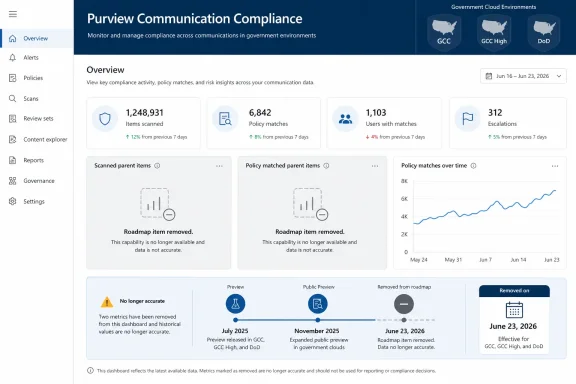
The removed item was straightforward in the way roadmap entries often are. Microsoft said the Communication Compliance homepage would show two columns designed to give administrators a quick read on policy performance: one for scanned parent items in real time, and another for parent items that met policy conditions. In plain language, it promised a small but useful status panel for people trying to understand whether their policies were doing anything, how much they were scanning, and where review-worthy activity might be appearing.
That does not sound dramatic. It is not a new AI model, a new compliance boundary, or a new retention engine. But in Microsoft Purview, small reporting surfaces matter because the job is not merely to configure controls; it is to prove that controls are working, that they are scoped correctly, and that reviewers are not flying blind.
The oddity is the status. The roadmap details supplied with the item list it as “Launched,” with preview availability in July 2025 and general availability in November 2025. Yet the June 23, 2026 update says the item “is no longer accurate” and is being removed from the roadmap. That wording is careful, but it leaves administrators with an uncomfortable question: was the feature delivered differently, replaced by another experience, never delivered as described, or simply described incorrectly for too long?
Microsoft’s apology is brief, and the explanation is thinner than the kind of postmortem enterprise customers usually need. For a consumer app, a removed roadmap tile is a nuisance. For a compliance product running in government clouds, it is a documentation event that can ripple into runbooks, training decks, procurement notes, and expectation management.
That mission creates a chronic administrative problem. Compliance teams do not just need alerts; they need to understand the machinery producing those alerts. They need to know whether messages are being scanned, whether policy conditions are too broad or too narrow, whether the review queue reflects meaningful risk, and whether changes to scope or conditions are producing expected results.
That is why the removed “Policy insights” feature had a plausible place in the product. A homepage that tells an administrator how many parent items are being scanned and how many meet policy conditions would not replace deeper reporting, but it could provide a useful operational pulse. When the dashboard says scanning is happening and matching is occurring, the compliance team can begin its day from a position of awareness rather than suspicion.
The term “parent items” also matters. In compliance systems, the distinction between an individual message, a conversation, an attachment, a thread, and a parent item can shape how counts are understood. A dashboard that reports parent-level scanning and matching is not just decorative; it defines what the administrator believes the system is measuring.
That is where the removal becomes more than cosmetic. If the promised metric was not accurate, not stable, or not aligned with the underlying data model, Microsoft was right to pull it. But a pulled metric also tells customers that the apparently simple act of counting communication compliance activity is more complex than the roadmap sentence suggested.
Communication Compliance is especially sensitive because it touches employee communications. Microsoft’s documentation emphasizes privacy-minded defaults such as pseudonymized usernames, role-based permissions, audit controls, and investigator opt-in. Those safeguards are not optional niceties. They are what make the product usable in organizations where workplace monitoring can become legally, culturally, and politically explosive.
This makes telemetry presentation a high-stakes design choice. Show too little, and administrators cannot tell whether policies are functioning. Show too much, and Microsoft risks surfacing sensitive or misleading operational signals in places where they may be misunderstood. Show the wrong metric, and the product can create false confidence — the most dangerous state in compliance.
A count of scanned parent items sounds objective, but objective-looking numbers can be treacherous. Does the count update in true real time or near real time? Does it include all workloads or only those currently supported? Does it reflect sampled review percentage, policy matching, ingestion, indexing, or final evaluation? Does it count retries, deduplicated threads, attachments, or conversations?
Those are the kinds of implementation details that turn a dashboard tile into a support burden. If Microsoft could not guarantee that the proposed columns would tell the right story across GCC, GCC High, and DoD environments, removing the item may be the responsible engineering decision. The problem is that the roadmap gave customers a promise before Microsoft had a durable public explanation for withdrawing it.
A commercial tenant may treat a Purview dashboard improvement as a convenience. A government tenant may map it to internal reporting, control validation, user acceptance testing, or evidence collection. Even if no formal compliance framework depends on a specific Microsoft homepage column, operational teams often build informal procedures around promised product behavior.
That is why the timing is awkward. The roadmap item was created in October 2023, carried preview and GA dates in 2025, and was last updated for removal in June 2026. That is a long shelf life for a feature description now deemed inaccurate. Somewhere during that interval, customers could reasonably have assumed that the planned experience was real, imminent, released, or available to validate.
Microsoft’s roadmap disclaimer has always left room for change. Roadmap dates are estimates, and feature descriptions can move, morph, or vanish. Every experienced Microsoft 365 administrator knows this. But the existence of a disclaimer does not eliminate the practical problem: enterprises still need to plan, and public roadmap items are one of the few planning instruments Microsoft gives them.
The most charitable reading is that Microsoft discovered the roadmap entry no longer matched the product reality and cleaned it up. The less charitable reading is that a “Launched” roadmap item remained public long enough to mislead the very customers who must be most careful about compliance tooling. Either way, the lesson for government cloud customers is the same: roadmap status is not evidence of feature availability.
There is nothing inherently wrong with that. Compliance products are too complex to operate purely through raw logs and hand-built reports. A good overview page can reduce fatigue and reveal trends that would otherwise stay buried. The problem is that an insight surface must earn trust differently from a configuration page.
A toggle either exists or it does not. A retention policy is either scoped to a workload or it is not. But an insight is an interpretation. It implies that Microsoft has selected the right signal, counted it correctly, refreshed it at the right cadence, and placed it in the right context. When that interpretation touches compliance risk, the vendor’s burden is higher.
The removed Communication Compliance homepage columns fit precisely into this trust boundary. They were not enforcement controls. They were not policy conditions. They were interpretive telemetry about scanning progress and possible policy matches. In other words, they were the kind of feature that could quietly shape administrator behavior without itself being the system of record.
This is why Microsoft should treat the removal as more than roadmap hygiene. If the company wants Purview to become the cockpit for compliance operations, it cannot allow cockpit instruments to appear and disappear without clear instrumentation notes. Admins do not need marketing prose; they need to know which gauges are reliable.
The Purview roadmap item lands squarely in that ambiguity. The status says “Launched,” but the update says the item is no longer accurate and is being removed. Those two facts can coexist only if “Launched” is treated as a historical state rather than a guarantee that the described experience exists in the described form.
For IT pros, that distinction is not pedantic. It affects how change advisory boards evaluate upcoming functionality, how security architects answer auditors, and how service owners communicate with legal and HR stakeholders. The more Microsoft uses roadmap labels loosely, the more customers must build their own verification layer around Microsoft’s planning signals.
That verification layer is already familiar to mature Microsoft 365 shops. They cross-check Message center posts, service health advisories, Microsoft Learn pages, tenant UI, PowerShell or Graph where available, and direct support responses. The roadmap is part of the evidence chain, not the evidence itself.
This case reinforces that discipline. A roadmap item can tell you what Microsoft intended to deliver. It cannot prove what your tenant has. It cannot prove that a compliance workflow should be rewritten. And, as this removal shows, it may not even preserve an accurate description of what the vendor thinks it delivered.
But the underlying need does not go away. Communication Compliance admins still need better operational transparency. They need to understand scanning volume, policy match volume, processing delays, sampling effects, false positives, scope gaps, and review backlog health. They need those signals in a way that distinguishes ingestion, evaluation, alerting, and review.
Microsoft already provides pieces of this puzzle through policy pages, alert investigation workflows, policy health concepts, and documentation that describes scanning cadence and policy behavior. But the lived experience for many admins remains one of triangulation. You look in one place for policy configuration, another for alerts, another for reports, another for documentation, and another for roadmap promises.
The proposed homepage columns would have helped because they suggested a simple first-order answer: “Are we scanning, and are we finding anything?” That is the first question every compliance operator asks after deploying or changing a policy. If the answer is buried or ambiguous, the product forces administrators into detective work.
A better replacement would not need to be flashy. Microsoft could publish a clear operational status model for Communication Compliance policies, explaining which counts are available, what they mean, how often they refresh, which workloads and clouds they cover, and how sampling affects them. The value would be less in the UI and more in the semantics.
Still, administrators should treat the update as a prompt to audit their own assumptions. If internal documentation says the Communication Compliance homepage provides real-time scanned parent item counts or policy-condition parent item counts, that documentation should be checked against the live Purview portal. If training materials refer to the removed roadmap item, they should be revised before reviewers rely on a missing or changed screen.
The same applies to governance language. If a control narrative says the organization uses Purview homepage insights to monitor scanning progress, the team should verify that this is actually true in the tenant and cloud instance. Auditors tend to care less about what Microsoft promised than what the organization can demonstrate.
This is especially important for GCC High and DoD environments, where feature parity and timing frequently differ from commercial Microsoft 365. A commercial-world blog post, screenshot, or roadmap item may not map cleanly to a sovereign or government cloud tenant. The safest assumption is that every compliance-relevant capability must be verified in the exact environment where it will be used.
Microsoft’s removal also argues for more modest internal commitments. Instead of writing procedures around a specific homepage widget, teams should define the operational outcome they need: confirm policy activity, monitor matches, review alerts, validate scope, and document exceptions. The UI can then change without invalidating the control.
That kind of ambiguity is survivable for a minor productivity feature. It is harder to defend in a compliance context. Microsoft does not need to publish engineering internals, but it should provide enough information for administrators to determine whether action is required.
A more useful update would have answered three basic questions. Was the homepage insight experience delivered in any form? If delivered, which part of the original description is inaccurate? If not delivered, what should customers use instead to monitor Communication Compliance policy scanning and matches?
Those questions matter because Microsoft 365 change management is already noisy. Admins are dealing with Message center posts, roadmap churn, portal migrations, licensing shifts, security defaults, Copilot governance, Teams changes, Exchange Online retirements, and Purview rebranding. Every ambiguous removal forces customers to spend time reconstructing the meaning of a change that the vendor could have explained in a paragraph.
The irony is obvious. The removed feature was meant to provide quick insight into compliance policy performance. Its removal provides a quick insight into Microsoft’s communication problem: the company is very good at announcing planned surfaces and less consistent at narrating what changed when those plans no longer map to reality.
The most useful response is procedural rather than emotional:
That makes Microsoft’s communication discipline central to the product’s credibility. Customers can tolerate delayed features. They can tolerate renamed portals, uneven rollout timing, and even canceled ideas. What they cannot easily tolerate is uncertainty around whether a compliance visibility feature exists, what it measures, and whether a public “Launched” label should have been trusted.
The removal of this roadmap item will not break Purview. It will not stop Communication Compliance policies from being created or reviewed. But it should remind every Microsoft 365 administrator that the gap between Microsoft’s roadmap language and tenant-operational truth is where many enterprise surprises are born.
Microsoft’s next move should be to replace the missing promise with clearer instrumentation, not another vague insight banner. Compliance teams do not need a prettier homepage as much as they need dependable, explainable signals about what the system is scanning, what it is matching, and what needs human attention. If Purview is to become the control tower for Microsoft 365 risk, its gauges must be boringly accurate — and when one is removed, Microsoft should say exactly why.
 Microsoft Removes a Dashboard Promise After the Calendar Had Already Spoken
The removed item was straightforward in the way roadmap entries often are. Microsoft said the Communication Compliance homepage would show two columns designed to give administrators a quick read on policy performance: one for scanned parent items in real time, and another for parent items that met policy conditions. In plain language, it promised a small but useful status panel for people trying to understand whether their policies were doing anything, how much they were scanning, and where review-worthy activity might be appearing.That does not sound dramatic. It is not a new AI model, a new compliance boundary, or a new retention engine. But in Microsoft Purview, small reporting surfaces matter because the job is not merely to configure controls; it is to prove that controls are working, that they are scoped correctly, and that reviewers are not flying blind.
The oddity is the status. The roadmap details supplied with the item list it as “Launched,” with preview availability in July 2025 and general availability in November 2025. Yet the June 23, 2026 update says the item “is no longer accurate” and is being removed from the roadmap. That wording is careful, but it leaves administrators with an uncomfortable question: was the feature delivered differently, replaced by another experience, never delivered as described, or simply described incorrectly for too long?
Microsoft’s apology is brief, and the explanation is thinner than the kind of postmortem enterprise customers usually need. For a consumer app, a removed roadmap tile is a nuisance. For a compliance product running in government clouds, it is a documentation event that can ripple into runbooks, training decks, procurement notes, and expectation management.
The Missing Feature Was Small Because the Compliance Problem Is Large
Communication Compliance sits in the uneasy middle of modern collaboration. It is meant to help organizations detect communications that may violate regulatory, legal, or business conduct policies: harassment, threats, sensitive data sharing, inappropriate content, conflicts of interest, and other patterns that companies and public-sector agencies cannot simply ignore. It does this across Microsoft 365 workloads through policies, classifiers, review queues, sampling, role-based access, and investigation workflows.That mission creates a chronic administrative problem. Compliance teams do not just need alerts; they need to understand the machinery producing those alerts. They need to know whether messages are being scanned, whether policy conditions are too broad or too narrow, whether the review queue reflects meaningful risk, and whether changes to scope or conditions are producing expected results.
That is why the removed “Policy insights” feature had a plausible place in the product. A homepage that tells an administrator how many parent items are being scanned and how many meet policy conditions would not replace deeper reporting, but it could provide a useful operational pulse. When the dashboard says scanning is happening and matching is occurring, the compliance team can begin its day from a position of awareness rather than suspicion.
The term “parent items” also matters. In compliance systems, the distinction between an individual message, a conversation, an attachment, a thread, and a parent item can shape how counts are understood. A dashboard that reports parent-level scanning and matching is not just decorative; it defines what the administrator believes the system is measuring.
That is where the removal becomes more than cosmetic. If the promised metric was not accurate, not stable, or not aligned with the underlying data model, Microsoft was right to pull it. But a pulled metric also tells customers that the apparently simple act of counting communication compliance activity is more complex than the roadmap sentence suggested.
Purview’s Real Product Is Confidence, Not Buttons
Microsoft Purview has expanded into a sprawling family of compliance, security, data governance, eDiscovery, insider risk, information protection, records management, audit, and lifecycle tooling. It is an umbrella brand over systems that historically came from different places and often still feel like they did. Admins who live in Purview know the experience: a portal that promises consolidation, but frequently exposes the seams of a platform still being rationalized.Communication Compliance is especially sensitive because it touches employee communications. Microsoft’s documentation emphasizes privacy-minded defaults such as pseudonymized usernames, role-based permissions, audit controls, and investigator opt-in. Those safeguards are not optional niceties. They are what make the product usable in organizations where workplace monitoring can become legally, culturally, and politically explosive.
This makes telemetry presentation a high-stakes design choice. Show too little, and administrators cannot tell whether policies are functioning. Show too much, and Microsoft risks surfacing sensitive or misleading operational signals in places where they may be misunderstood. Show the wrong metric, and the product can create false confidence — the most dangerous state in compliance.
A count of scanned parent items sounds objective, but objective-looking numbers can be treacherous. Does the count update in true real time or near real time? Does it include all workloads or only those currently supported? Does it reflect sampled review percentage, policy matching, ingestion, indexing, or final evaluation? Does it count retries, deduplicated threads, attachments, or conversations?
Those are the kinds of implementation details that turn a dashboard tile into a support burden. If Microsoft could not guarantee that the proposed columns would tell the right story across GCC, GCC High, and DoD environments, removing the item may be the responsible engineering decision. The problem is that the roadmap gave customers a promise before Microsoft had a durable public explanation for withdrawing it.
Government Clouds Turn Roadmap Drift Into Planning Debt
The listed cloud instances are not incidental. GCC, GCC High, and DoD customers operate under stricter requirements, slower adoption cycles, and more formalized change management than ordinary commercial tenants. They do not merely notice roadmap changes; they absorb them into governance.A commercial tenant may treat a Purview dashboard improvement as a convenience. A government tenant may map it to internal reporting, control validation, user acceptance testing, or evidence collection. Even if no formal compliance framework depends on a specific Microsoft homepage column, operational teams often build informal procedures around promised product behavior.
That is why the timing is awkward. The roadmap item was created in October 2023, carried preview and GA dates in 2025, and was last updated for removal in June 2026. That is a long shelf life for a feature description now deemed inaccurate. Somewhere during that interval, customers could reasonably have assumed that the planned experience was real, imminent, released, or available to validate.
Microsoft’s roadmap disclaimer has always left room for change. Roadmap dates are estimates, and feature descriptions can move, morph, or vanish. Every experienced Microsoft 365 administrator knows this. But the existence of a disclaimer does not eliminate the practical problem: enterprises still need to plan, and public roadmap items are one of the few planning instruments Microsoft gives them.
The most charitable reading is that Microsoft discovered the roadmap entry no longer matched the product reality and cleaned it up. The less charitable reading is that a “Launched” roadmap item remained public long enough to mislead the very customers who must be most careful about compliance tooling. Either way, the lesson for government cloud customers is the same: roadmap status is not evidence of feature availability.
The Homepage Is Where Microsoft Wants Admins to Trust the Machine
Microsoft’s broader Purview direction is clear. The company wants compliance administrators to spend less time spelunking through disconnected pages and more time acting on summarized insights, recommendations, health states, and policy-driven queues. This is a familiar Microsoft 365 pattern: take a complex backend, add a consolidated portal, surface “insights,” and nudge admins toward recommended action.There is nothing inherently wrong with that. Compliance products are too complex to operate purely through raw logs and hand-built reports. A good overview page can reduce fatigue and reveal trends that would otherwise stay buried. The problem is that an insight surface must earn trust differently from a configuration page.
A toggle either exists or it does not. A retention policy is either scoped to a workload or it is not. But an insight is an interpretation. It implies that Microsoft has selected the right signal, counted it correctly, refreshed it at the right cadence, and placed it in the right context. When that interpretation touches compliance risk, the vendor’s burden is higher.
The removed Communication Compliance homepage columns fit precisely into this trust boundary. They were not enforcement controls. They were not policy conditions. They were interpretive telemetry about scanning progress and possible policy matches. In other words, they were the kind of feature that could quietly shape administrator behavior without itself being the system of record.
This is why Microsoft should treat the removal as more than roadmap hygiene. If the company wants Purview to become the cockpit for compliance operations, it cannot allow cockpit instruments to appear and disappear without clear instrumentation notes. Admins do not need marketing prose; they need to know which gauges are reliable.
“Launched” Is Becoming the Most Ambiguous Word in Microsoft 365
Microsoft 365 administrators have learned to parse rollout language with almost theological care. “Rolling out” is not “available.” “General availability” is not “visible in my tenant.” “Launched” is not always “usable in my cloud.” A feature can be documented, hidden behind licensing, delayed by region, blocked by admin center flighting, or present in one portal while absent in another.The Purview roadmap item lands squarely in that ambiguity. The status says “Launched,” but the update says the item is no longer accurate and is being removed. Those two facts can coexist only if “Launched” is treated as a historical state rather than a guarantee that the described experience exists in the described form.
For IT pros, that distinction is not pedantic. It affects how change advisory boards evaluate upcoming functionality, how security architects answer auditors, and how service owners communicate with legal and HR stakeholders. The more Microsoft uses roadmap labels loosely, the more customers must build their own verification layer around Microsoft’s planning signals.
That verification layer is already familiar to mature Microsoft 365 shops. They cross-check Message center posts, service health advisories, Microsoft Learn pages, tenant UI, PowerShell or Graph where available, and direct support responses. The roadmap is part of the evidence chain, not the evidence itself.
This case reinforces that discipline. A roadmap item can tell you what Microsoft intended to deliver. It cannot prove what your tenant has. It cannot prove that a compliance workflow should be rewritten. And, as this removal shows, it may not even preserve an accurate description of what the vendor thinks it delivered.
Communication Compliance Needs Better Operational Transparency, Not Fewer Promises
There is an uncomfortable possibility here: Microsoft may have removed the item because the described insight experience was too hard to make consistently correct. If so, customers should not demand that Microsoft ship a misleading dashboard just to satisfy a roadmap artifact. In compliance software, a wrong number is worse than no number.But the underlying need does not go away. Communication Compliance admins still need better operational transparency. They need to understand scanning volume, policy match volume, processing delays, sampling effects, false positives, scope gaps, and review backlog health. They need those signals in a way that distinguishes ingestion, evaluation, alerting, and review.
Microsoft already provides pieces of this puzzle through policy pages, alert investigation workflows, policy health concepts, and documentation that describes scanning cadence and policy behavior. But the lived experience for many admins remains one of triangulation. You look in one place for policy configuration, another for alerts, another for reports, another for documentation, and another for roadmap promises.
The proposed homepage columns would have helped because they suggested a simple first-order answer: “Are we scanning, and are we finding anything?” That is the first question every compliance operator asks after deploying or changing a policy. If the answer is buried or ambiguous, the product forces administrators into detective work.
A better replacement would not need to be flashy. Microsoft could publish a clear operational status model for Communication Compliance policies, explaining which counts are available, what they mean, how often they refresh, which workloads and clouds they cover, and how sampling affects them. The value would be less in the UI and more in the semantics.
The Admin Burden Is to Separate Product Reality From Roadmap Memory
For WindowsForum’s IT pro audience, the practical response is not panic. No one should assume that Communication Compliance itself has been withdrawn, nor that existing policies stopped scanning because one roadmap item was removed. The update concerns a specific planned homepage insights experience, not the retirement of the Communication Compliance service.Still, administrators should treat the update as a prompt to audit their own assumptions. If internal documentation says the Communication Compliance homepage provides real-time scanned parent item counts or policy-condition parent item counts, that documentation should be checked against the live Purview portal. If training materials refer to the removed roadmap item, they should be revised before reviewers rely on a missing or changed screen.
The same applies to governance language. If a control narrative says the organization uses Purview homepage insights to monitor scanning progress, the team should verify that this is actually true in the tenant and cloud instance. Auditors tend to care less about what Microsoft promised than what the organization can demonstrate.
This is especially important for GCC High and DoD environments, where feature parity and timing frequently differ from commercial Microsoft 365. A commercial-world blog post, screenshot, or roadmap item may not map cleanly to a sovereign or government cloud tenant. The safest assumption is that every compliance-relevant capability must be verified in the exact environment where it will be used.
Microsoft’s removal also argues for more modest internal commitments. Instead of writing procedures around a specific homepage widget, teams should define the operational outcome they need: confirm policy activity, monitor matches, review alerts, validate scope, and document exceptions. The UI can then change without invalidating the control.
The Roadmap Cleanup Reveals a Documentation Gap
The phrase “This item is no longer accurate” is doing a lot of work. It does not say the feature was canceled. It does not say it was replaced. It does not say the description was wrong. It does not say whether customers who saw the experience should expect it to remain, disappear, or evolve under another name.That kind of ambiguity is survivable for a minor productivity feature. It is harder to defend in a compliance context. Microsoft does not need to publish engineering internals, but it should provide enough information for administrators to determine whether action is required.
A more useful update would have answered three basic questions. Was the homepage insight experience delivered in any form? If delivered, which part of the original description is inaccurate? If not delivered, what should customers use instead to monitor Communication Compliance policy scanning and matches?
Those questions matter because Microsoft 365 change management is already noisy. Admins are dealing with Message center posts, roadmap churn, portal migrations, licensing shifts, security defaults, Copilot governance, Teams changes, Exchange Online retirements, and Purview rebranding. Every ambiguous removal forces customers to spend time reconstructing the meaning of a change that the vendor could have explained in a paragraph.
The irony is obvious. The removed feature was meant to provide quick insight into compliance policy performance. Its removal provides a quick insight into Microsoft’s communication problem: the company is very good at announcing planned surfaces and less consistent at narrating what changed when those plans no longer map to reality.
A Small Purview Tile Leaves a Large Paper Trail
The concrete lesson from Roadmap ID 172016 is not that administrators should distrust every Microsoft roadmap item. It is that roadmap entries should be treated as planning signals, not operating evidence. That distinction sounds obvious until a “Launched” status and a removal notice collide in the same record.The most useful response is procedural rather than emotional:
- Administrators should verify whether the described Communication Compliance homepage columns exist in their own Purview portal before referencing them in runbooks, training, or control documentation.
- Government cloud tenants should assume that roadmap dates and status labels require tenant-level confirmation, particularly for GCC, GCC High, and DoD.
- Compliance teams should avoid making specific UI elements the foundation of audit narratives when the real control objective is policy monitoring and review.
- Service owners should review any internal material created between the July 2025 preview date, the November 2025 general availability date, and the June 23, 2026 removal update.
- Microsoft should provide clearer replacement guidance when removing Purview roadmap items that affect compliance visibility rather than treating them as ordinary feature cleanup.
Microsoft’s Compliance Stack Cannot Afford Fuzzy Signals
Purview is becoming more important, not less. As organizations adopt more Microsoft 365 services, more Teams workflows, more AI-assisted content generation, and more cross-tenant collaboration, the compliance plane becomes one of the few places where administrators can assert order over sprawl. Communication Compliance is part of that assertion, especially for industries where employee communications are not merely business records but regulated evidence.That makes Microsoft’s communication discipline central to the product’s credibility. Customers can tolerate delayed features. They can tolerate renamed portals, uneven rollout timing, and even canceled ideas. What they cannot easily tolerate is uncertainty around whether a compliance visibility feature exists, what it measures, and whether a public “Launched” label should have been trusted.
The removal of this roadmap item will not break Purview. It will not stop Communication Compliance policies from being created or reviewed. But it should remind every Microsoft 365 administrator that the gap between Microsoft’s roadmap language and tenant-operational truth is where many enterprise surprises are born.
Microsoft’s next move should be to replace the missing promise with clearer instrumentation, not another vague insight banner. Compliance teams do not need a prettier homepage as much as they need dependable, explainable signals about what the system is scanning, what it is matching, and what needs human attention. If Purview is to become the control tower for Microsoft 365 risk, its gauges must be boringly accurate — and when one is removed, Microsoft should say exactly why.
References
- Primary source: Microsoft 365 Roadmap
Published: 2026-06-23T23:15:39.6678540Z
Microsoft 365 Roadmap | Microsoft 365
The Microsoft 365 Roadmap lists updates that are currently planned for applicable subscribers. Check here for more information on the status of new features and updates.www.microsoft.com
- Official source: learn.microsoft.com
Manage Communication Compliance policies | Microsoft Learn
Create and manage Communication Compliance policies in Microsoft Purview to detect inappropriate content, regulatory violations, and risky communications.learn.microsoft.com - Official source: microsoft.github.io
- Official source: cdn-dynmedia-1.microsoft.com
