

Microsoft reported fiscal third-quarter 2026 earnings on April 29, 2026, with revenue of $82.9 billion, Azure and other cloud services growth of 40 percent, and an AI business annual run rate above $37 billion, but Jim Cramer’s skepticism centers on whether investors are being asked to pay today for infrastructure returns that may arrive much later. That is the right argument to have about Microsoft now, even if the television shorthand makes it sound like a simple bullish-or-bearish call. The company is not broken; in fact, operationally it remains one of the most formidable machines in enterprise technology. The problem is that the AI boom has turned Microsoft from a capital-light software compounder into something closer to a hyperscale infrastructure utility with software margins still expected by the market.
For most of the past decade, Microsoft trained investors to treat earnings beats as proof of a durable model. Azure grew, Office subscriptions compounded, Windows threw off cash, and management kept pushing more of the business into recurring cloud contracts. The Satya Nadella era became almost a template for how a mature software company could rediscover growth without losing discipline.
That is what makes the recent market reaction so important. The issue is not that Microsoft missed expectations in some catastrophic way. The issue is that the market has begun to look through the headline beat and ask a more basic question: what did Microsoft have to spend to produce it?
The AOL piece frames Cramer’s skepticism around a pattern investors cannot simply wave away. Microsoft has beaten EPS expectations repeatedly, yet the stock has often failed to reward those beats. A company can report good numbers and still disappoint if the numbers imply a less attractive future mix of growth, margins, and capital intensity.
That distinction matters for WindowsForum readers because Microsoft is not just another mega-cap ticker. Its investment cycle shapes the future of Windows, Azure, Microsoft 365, GitHub, Copilot, Xbox cloud infrastructure, enterprise identity, developer tooling, and the data-center geography that increasingly underpins modern IT. If Wall Street is souring on Microsoft’s AI spending, the question is not merely whether traders are impatient. It is whether the entire Microsoft platform is entering a more expensive phase.
That is the danger of the AI platform story. In the traditional software model, incremental revenue often arrived with extraordinary operating leverage. Once the code was written and the sales channel was built, more customers meant more margin. In the generative AI model, more customers also mean more GPUs, more power, more cooling, more networking gear, more data-center leases, and more supply-chain exposure.
Azure’s growth near the high 30s would be extraordinary for almost any business of its scale. But Microsoft is no longer being judged against ordinary cloud expectations. It is being judged against an AI spending cycle so large that even strong cloud growth can look inadequate if the market suspects the infrastructure is arriving ahead of monetization.
This is where Cramer’s skepticism has force. Microsoft’s problem is not demand; it is the timing mismatch between demand, capacity, and return on invested capital. When a company is spending tens of billions per quarter to build infrastructure, investors want confidence that utilization, pricing, and customer retention will justify the bill.
Those are not weak numbers. They are the kind of numbers that would normally end a debate. A company of Microsoft’s size growing revenue in the high teens while expanding a cloud platform at roughly 40 percent is operating at a scale few businesses in history have reached.
The Copilot data also strengthened the bull case, though the AOL summary appears to understate the latest figure. Microsoft said paid Microsoft 365 Copilot seats surpassed 20 million, not merely 15 million, and management described accelerating seat additions. That matters because Copilot is one of the clearest tests of whether generative AI can become a mainstream enterprise software SKU rather than a demo-layer novelty.
Still, the bull case did not erase the worry. It sharpened it. If Microsoft is already producing this much AI-related revenue and investors are still worried about capex, then the debate has moved from “is there demand?” to “how profitable is the demand once the full infrastructure bill arrives?”
But the same argument also reveals the core tension. If Microsoft can grow faster with more GPUs, then Wall Street should expect Microsoft to keep buying GPUs. If demand exceeds supply, the rational operational response is more capacity. The rational investor question is whether the returns on that capacity will resemble the returns Microsoft historically earned from software.
This is the uncomfortable middle ground. Hood’s explanation makes the near-term Azure number look better, but it does not automatically settle the long-term margin question. A supply-constrained business can be excellent, or it can be a business forced into an arms race where everyone spends heavily just to keep customers from going elsewhere.
For IT buyers, the capacity constraint has a practical implication. Azure AI services, Copilot features, inference workloads, and model-hosting strategies are all tied to Microsoft’s ability to bring infrastructure online. If Microsoft is capacity-limited, customers may see prioritization, regional constraints, pricing pressure, or product packaging designed to steer usage toward the most efficient parts of the fleet.
That is the difference investors often blur. A great company can be a difficult stock when expectations are already heroic. A business can compound revenue, dominate enterprise accounts, and still disappoint shareholders if the price assumes flawless execution, stable margins, and rapid AI monetization all at once.
The AOL piece points to a pattern of earnings beats followed by weak one-week stock performance. That pattern is not proof that Microsoft is in trouble. It is proof that the market has stopped treating beats as sufficient evidence. Investors are now demanding a cleaner bridge from capex to revenue, revenue to margin, and margin to free cash flow.
Cramer’s concern is therefore partly vindicated by price action. If a stock repeatedly falls after good reports, something in the narrative is not clearing the bar. The mistake would be to assume that a weak stock reaction means weak fundamentals. In Microsoft’s case, the fundamentals are strong; the valuation argument is simply harder than it used to be.
Generative AI complicates that model. The biggest AI products are not just software features; they are software features attached to expensive inference and training infrastructure. Every Copilot query, every agentic workflow, every enterprise retrieval operation, and every developer assist action consumes compute somewhere.
That does not make the model bad. It makes it less obviously magical. The old Microsoft sold licenses and subscriptions against infrastructure that was already highly optimized. The new Microsoft is selling intelligence that may require continuous hardware refreshes, vast energy commitments, and a supply chain dominated by a small number of chip and component vendors.
This is why the comparison with NVIDIA keeps appearing in investor chatter. NVIDIA sells the picks and shovels into the AI buildout. Microsoft buys those picks and shovels, then must package them into services customers will pay for repeatedly. Both can win, but their risk profiles are different.
The reported growth in paid seats is encouraging. Moving past 20 million paid seats suggests Copilot is not just a pilot program trapped in innovation labs. Microsoft has the distribution advantage every AI startup envies: it can insert AI into Outlook, Teams, Word, Excel, PowerPoint, SharePoint, Windows, Edge, Security, and GitHub without asking customers to adopt an entirely new vendor.
But paid seats are not the same as proven productivity transformation. IT departments will eventually ask whether Copilot reduces headcount needs, speeds workflows, improves compliance, enhances security operations, or merely adds another per-user charge to already crowded Microsoft renewals. Renewal cycles will be more revealing than launch momentum.
This is where Microsoft’s enterprise muscle cuts both ways. The company can bundle, discount, and platform-integrate Copilot aggressively. That may accelerate adoption, but it can also make true standalone demand harder to measure. Investors want to know whether customers are buying AI because it is indispensable, or because Microsoft has made it financially and administratively convenient.
In the AI cloud era, backlog needs more interpretation. Long-term commitments can represent durable demand, but they can also embed large infrastructure obligations. If a significant portion of the backlog is tied to AI workloads and strategic partners, investors will want to know how much capacity must be built, at what cost, and on what timeline.
This does not make the backlog suspect. It makes it less simple. Microsoft has real customer demand, but that demand exists inside a market where hyperscalers are racing to secure chips, data centers, power contracts, and model partnerships. Backlog is revenue visibility; it is not automatically margin visibility.
For sysadmins and enterprise architects, the message is more operational than financial. Microsoft’s cloud roadmap is being pulled by huge customers and AI workloads. Smaller customers may benefit from the same infrastructure buildout, but they may also find that Microsoft’s priorities increasingly reflect the economics of massive AI consumption.
Microsoft has a strategic reason to push more AI onto the device. Local inference can reduce cloud costs, improve latency, and soothe some privacy concerns. But the company also has a strategic reason to keep cloud AI central: cloud-connected services are easier to monetize, update, meter, and bind to Microsoft 365 subscriptions.
That tension will define Windows over the next several years. If cloud AI remains expensive, Microsoft will look for ways to offload appropriate workloads to NPUs on new PCs. If cloud AI becomes more efficient and profitable, Microsoft will deepen the subscription layer around Windows experiences.
This is why the capex debate is not just a Wall Street story. The economics of Microsoft’s AI infrastructure will influence which Windows features are free, which require Microsoft accounts, which are tied to commercial subscriptions, and which are reserved for newer hardware.
But the relationship also complicates the financial picture. If OpenAI-related commitments contribute meaningfully to Microsoft’s backlog and Azure demand, investors have to distinguish between broadly diversified enterprise consumption and demand concentrated around a strategic partner. Concentration is not inherently bad, especially when the partner is central to the AI ecosystem, but it does change the risk calculation.
There is also the question of bargaining power over time. OpenAI needs enormous compute. Microsoft wants privileged access to models and workloads. Both sides benefit, but both sides also have incentives to preserve flexibility. Any shift in that relationship could affect how investors interpret Microsoft’s AI revenue, capex plans, and competitive moat.
For customers, the practical issue is platform dependency. Enterprises building AI systems on Azure OpenAI services are not merely choosing a cloud region; they are buying into a layered stack of models, APIs, compliance promises, identity integration, and Microsoft’s ability to keep capacity available. That is powerful, but it is also a commitment.
The more credible skeptical case is about duration. Microsoft may be making the right investments, but the payoff period may be longer than investors want. The company may grow AI revenue quickly, but not quickly enough to prevent free cash flow pressure. Azure may remain supply constrained, but the cost of relieving that constraint may keep rising.
That kind of skepticism is not anti-Microsoft. It is a recognition that even dominant platforms must obey capital discipline. The larger the buildout becomes, the less investors can rely on vibes about AI inevitability. They need evidence that each wave of infrastructure produces profitable, recurring, defensible revenue.
Cramer’s instinct is useful here because television market commentary often compresses complex issues into blunt calls. “I’m skeptical” is not a full thesis, but in this case it points toward the right tension: Microsoft’s AI story is plausible, powerful, and expensive.
Microsoft also has multiple shots on goal. Copilot can monetize productivity. Azure can monetize infrastructure. GitHub Copilot can monetize developers. Security Copilot can monetize threat operations. Dynamics and Power Platform can monetize business process automation. Windows can become the endpoint layer for hybrid AI experiences.
That breadth matters because no single AI product has to carry the entire thesis. If some Copilot use cases disappoint but developer tools thrive, Microsoft still wins. If consumer AI remains noisy but enterprise automation matures, Microsoft still wins. If training workloads fluctuate but inference grows steadily, Azure still wins.
The question is not whether Microsoft participates in the AI economy. It already does. The question is whether participation produces returns consistent with a stock valued as one of the world’s safest growth stories.
That means Microsoft is investing into a market that is real but still forming. Demand can exceed supply today and still evolve unpredictably tomorrow. Customers may consume heavily during experimentation phases, then optimize. They may demand lower prices as model costs fall. They may split workloads across clouds, models, and local hardware.
There is also the risk that AI becomes table stakes. If every major productivity suite, CRM system, code editor, endpoint security platform, and cloud provider embeds similar AI capabilities, pricing power may be less spectacular than early demos suggested. Microsoft would still benefit from integration, but the margin premium could be competed away.
This is the nightmare scenario for a capex-heavy AI cycle: the infrastructure is necessary, but the differentiation migrates elsewhere. Microsoft is trying to prevent that by owning the platform layers above and below the model. Whether that works is the question investors are now pricing more soberly.
That is why the stock can fall even after strong results. The market is not only valuing next quarter’s earnings. It is valuing the shape of the next five years. If those five years require historically elevated infrastructure spending, the multiple should reflect that uncertainty.
Microsoft’s management wants investors to see capex as the foundation for future growth. Skeptics see it as a claim on future cash flow. Both interpretations are valid. The eventual answer will come through utilization, pricing, depreciation, gross margin trends, and whether AI revenue scales faster than the infrastructure needed to support it.
For now, the stock is caught between two identities. It is still a premium software compounder in many parts of the business. It is also increasingly a capital-intensive AI utility. The market is deciding how much of each identity belongs in the valuation.
Source: AOL.com Jim Cramer Isn’t a Fan of Microsoft After Rough Quarter. Is He Right to Be Skeptical? - AOL
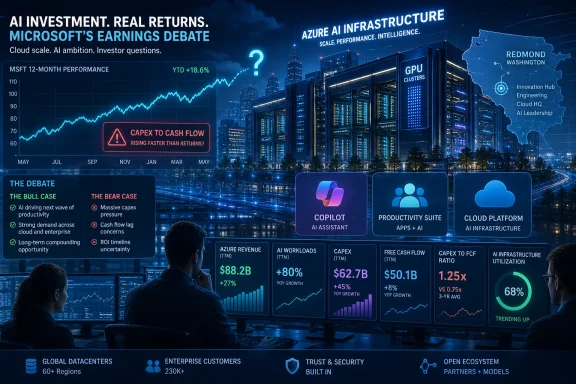 Microsoft’s Beat-and-Selloff Problem Is a Warning, Not a Verdict
For most of the past decade, Microsoft trained investors to treat earnings beats as proof of a durable model. Azure grew, Office subscriptions compounded, Windows threw off cash, and management kept pushing more of the business into recurring cloud contracts. The Satya Nadella era became almost a template for how a mature software company could rediscover growth without losing discipline.That is what makes the recent market reaction so important. The issue is not that Microsoft missed expectations in some catastrophic way. The issue is that the market has begun to look through the headline beat and ask a more basic question: what did Microsoft have to spend to produce it?
The AOL piece frames Cramer’s skepticism around a pattern investors cannot simply wave away. Microsoft has beaten EPS expectations repeatedly, yet the stock has often failed to reward those beats. A company can report good numbers and still disappoint if the numbers imply a less attractive future mix of growth, margins, and capital intensity.
That distinction matters for WindowsForum readers because Microsoft is not just another mega-cap ticker. Its investment cycle shapes the future of Windows, Azure, Microsoft 365, GitHub, Copilot, Xbox cloud infrastructure, enterprise identity, developer tooling, and the data-center geography that increasingly underpins modern IT. If Wall Street is souring on Microsoft’s AI spending, the question is not merely whether traders are impatient. It is whether the entire Microsoft platform is entering a more expensive phase.
The January Quarter Changed the Market’s Patience
The January 28 fiscal Q2 report is where the mood shifted. Microsoft delivered revenue of about $81.3 billion and adjusted earnings above consensus, but the stock’s reaction was ugly because investors focused on capital expenditures and Azure’s trajectory. The reported capex figure near $30 billion, up dramatically from the prior year, made the AI buildout feel less like optional growth spending and more like the new cost of admission.That is the danger of the AI platform story. In the traditional software model, incremental revenue often arrived with extraordinary operating leverage. Once the code was written and the sales channel was built, more customers meant more margin. In the generative AI model, more customers also mean more GPUs, more power, more cooling, more networking gear, more data-center leases, and more supply-chain exposure.
Azure’s growth near the high 30s would be extraordinary for almost any business of its scale. But Microsoft is no longer being judged against ordinary cloud expectations. It is being judged against an AI spending cycle so large that even strong cloud growth can look inadequate if the market suspects the infrastructure is arriving ahead of monetization.
This is where Cramer’s skepticism has force. Microsoft’s problem is not demand; it is the timing mismatch between demand, capacity, and return on invested capital. When a company is spending tens of billions per quarter to build infrastructure, investors want confidence that utilization, pricing, and customer retention will justify the bill.
The April Quarter Gave Bulls Better Ammunition
The fiscal Q3 results were not a capitulation. They were, in many respects, a rebuttal. Microsoft reported $82.9 billion in revenue for the quarter ended March 31, 2026, up 18 percent year over year. Microsoft Cloud revenue reached $54.5 billion, Azure and other cloud services grew 40 percent, and the company said its AI business surpassed a $37 billion annual revenue run rate, up 123 percent from a year earlier.Those are not weak numbers. They are the kind of numbers that would normally end a debate. A company of Microsoft’s size growing revenue in the high teens while expanding a cloud platform at roughly 40 percent is operating at a scale few businesses in history have reached.
The Copilot data also strengthened the bull case, though the AOL summary appears to understate the latest figure. Microsoft said paid Microsoft 365 Copilot seats surpassed 20 million, not merely 15 million, and management described accelerating seat additions. That matters because Copilot is one of the clearest tests of whether generative AI can become a mainstream enterprise software SKU rather than a demo-layer novelty.
Still, the bull case did not erase the worry. It sharpened it. If Microsoft is already producing this much AI-related revenue and investors are still worried about capex, then the debate has moved from “is there demand?” to “how profitable is the demand once the full infrastructure bill arrives?”
Amy Hood’s GPU Argument Is Both Reassuring and Revealing
CFO Amy Hood’s most important message was that supply, not demand, is constraining Azure. Management argued that if recently added GPUs had been allocated entirely to Azure, the Azure growth KPI would have exceeded 40 percent. That is a powerful defense because it implies Microsoft is not building empty temples to AI hype; it is racing to meet demand it already sees.But the same argument also reveals the core tension. If Microsoft can grow faster with more GPUs, then Wall Street should expect Microsoft to keep buying GPUs. If demand exceeds supply, the rational operational response is more capacity. The rational investor question is whether the returns on that capacity will resemble the returns Microsoft historically earned from software.
This is the uncomfortable middle ground. Hood’s explanation makes the near-term Azure number look better, but it does not automatically settle the long-term margin question. A supply-constrained business can be excellent, or it can be a business forced into an arms race where everyone spends heavily just to keep customers from going elsewhere.
For IT buyers, the capacity constraint has a practical implication. Azure AI services, Copilot features, inference workloads, and model-hosting strategies are all tied to Microsoft’s ability to bring infrastructure online. If Microsoft is capacity-limited, customers may see prioritization, regional constraints, pricing pressure, or product packaging designed to steer usage toward the most efficient parts of the fleet.
Cramer Is Right About the Stock, Less Right About the Company
Cramer’s skepticism makes more sense if treated as a stock call than as a company diagnosis. Microsoft the business remains extraordinarily strong. Microsoft the stock, at a rich forward earnings multiple after years of AI enthusiasm, has less room for ambiguity.That is the difference investors often blur. A great company can be a difficult stock when expectations are already heroic. A business can compound revenue, dominate enterprise accounts, and still disappoint shareholders if the price assumes flawless execution, stable margins, and rapid AI monetization all at once.
The AOL piece points to a pattern of earnings beats followed by weak one-week stock performance. That pattern is not proof that Microsoft is in trouble. It is proof that the market has stopped treating beats as sufficient evidence. Investors are now demanding a cleaner bridge from capex to revenue, revenue to margin, and margin to free cash flow.
Cramer’s concern is therefore partly vindicated by price action. If a stock repeatedly falls after good reports, something in the narrative is not clearing the bar. The mistake would be to assume that a weak stock reaction means weak fundamentals. In Microsoft’s case, the fundamentals are strong; the valuation argument is simply harder than it used to be.
AI Has Made Microsoft More Like the Companies It Used to Outperform
Microsoft’s great advantage in the cloud era was that it could combine infrastructure scale with software monetization. Azure brought compute, Microsoft 365 brought identity and productivity, Dynamics brought business applications, GitHub brought developers, and Windows remained the enterprise endpoint substrate. The result was a platform company with many ways to turn customer dependence into revenue.Generative AI complicates that model. The biggest AI products are not just software features; they are software features attached to expensive inference and training infrastructure. Every Copilot query, every agentic workflow, every enterprise retrieval operation, and every developer assist action consumes compute somewhere.
That does not make the model bad. It makes it less obviously magical. The old Microsoft sold licenses and subscriptions against infrastructure that was already highly optimized. The new Microsoft is selling intelligence that may require continuous hardware refreshes, vast energy commitments, and a supply chain dominated by a small number of chip and component vendors.
This is why the comparison with NVIDIA keeps appearing in investor chatter. NVIDIA sells the picks and shovels into the AI buildout. Microsoft buys those picks and shovels, then must package them into services customers will pay for repeatedly. Both can win, but their risk profiles are different.
Copilot Is the Monetization Test Wall Street Cannot Avoid
Microsoft 365 Copilot is the cleanest place to judge whether AI becomes a software-margin product. If enterprises standardize on Copilot the way they standardized on Office, Microsoft can absorb infrastructure costs through high-value subscriptions and deep workflow lock-in. If Copilot adoption stalls, or if usage costs remain high relative to seat revenue, the economics get murkier.The reported growth in paid seats is encouraging. Moving past 20 million paid seats suggests Copilot is not just a pilot program trapped in innovation labs. Microsoft has the distribution advantage every AI startup envies: it can insert AI into Outlook, Teams, Word, Excel, PowerPoint, SharePoint, Windows, Edge, Security, and GitHub without asking customers to adopt an entirely new vendor.
But paid seats are not the same as proven productivity transformation. IT departments will eventually ask whether Copilot reduces headcount needs, speeds workflows, improves compliance, enhances security operations, or merely adds another per-user charge to already crowded Microsoft renewals. Renewal cycles will be more revealing than launch momentum.
This is where Microsoft’s enterprise muscle cuts both ways. The company can bundle, discount, and platform-integrate Copilot aggressively. That may accelerate adoption, but it can also make true standalone demand harder to measure. Investors want to know whether customers are buying AI because it is indispensable, or because Microsoft has made it financially and administratively convenient.
Azure’s Backlog Is a Strength With a Footnote
Microsoft’s remaining performance obligation, reportedly above $600 billion, is a staggering number. It shows that customers are signing long-term commitments at a scale few companies can match. For a conventional software company, that kind of backlog would be almost unambiguously bullish.In the AI cloud era, backlog needs more interpretation. Long-term commitments can represent durable demand, but they can also embed large infrastructure obligations. If a significant portion of the backlog is tied to AI workloads and strategic partners, investors will want to know how much capacity must be built, at what cost, and on what timeline.
This does not make the backlog suspect. It makes it less simple. Microsoft has real customer demand, but that demand exists inside a market where hyperscalers are racing to secure chips, data centers, power contracts, and model partnerships. Backlog is revenue visibility; it is not automatically margin visibility.
For sysadmins and enterprise architects, the message is more operational than financial. Microsoft’s cloud roadmap is being pulled by huge customers and AI workloads. Smaller customers may benefit from the same infrastructure buildout, but they may also find that Microsoft’s priorities increasingly reflect the economics of massive AI consumption.
Windows Is No Longer the Center, but It Still Carries the Edge
For Windows enthusiasts, the Microsoft stock debate can feel distant until it lands on the desktop. But AI capex is already shaping the way Microsoft thinks about Windows. Copilot+ PCs, on-device NPUs, cloud-assisted productivity, Recall-style memory features, and AI-powered search all sit at the intersection of local hardware and cloud intelligence.Microsoft has a strategic reason to push more AI onto the device. Local inference can reduce cloud costs, improve latency, and soothe some privacy concerns. But the company also has a strategic reason to keep cloud AI central: cloud-connected services are easier to monetize, update, meter, and bind to Microsoft 365 subscriptions.
That tension will define Windows over the next several years. If cloud AI remains expensive, Microsoft will look for ways to offload appropriate workloads to NPUs on new PCs. If cloud AI becomes more efficient and profitable, Microsoft will deepen the subscription layer around Windows experiences.
This is why the capex debate is not just a Wall Street story. The economics of Microsoft’s AI infrastructure will influence which Windows features are free, which require Microsoft accounts, which are tied to commercial subscriptions, and which are reserved for newer hardware.
The OpenAI Relationship Adds Leverage and Uncertainty
Microsoft’s OpenAI relationship remains one of the most important strategic bets in modern technology. It gave Microsoft early access to the generative AI wave, transformed Azure into a default enterprise AI platform, and gave the company a narrative advantage over rivals that were slower to productize large language models.But the relationship also complicates the financial picture. If OpenAI-related commitments contribute meaningfully to Microsoft’s backlog and Azure demand, investors have to distinguish between broadly diversified enterprise consumption and demand concentrated around a strategic partner. Concentration is not inherently bad, especially when the partner is central to the AI ecosystem, but it does change the risk calculation.
There is also the question of bargaining power over time. OpenAI needs enormous compute. Microsoft wants privileged access to models and workloads. Both sides benefit, but both sides also have incentives to preserve flexibility. Any shift in that relationship could affect how investors interpret Microsoft’s AI revenue, capex plans, and competitive moat.
For customers, the practical issue is platform dependency. Enterprises building AI systems on Azure OpenAI services are not merely choosing a cloud region; they are buying into a layered stack of models, APIs, compliance promises, identity integration, and Microsoft’s ability to keep capacity available. That is powerful, but it is also a commitment.
The Skeptical Case Is About Duration, Not Disaster
The bearish version of the Microsoft argument often sounds too dramatic. It imagines an AI bubble, wasted data centers, disappointed customers, and collapsing multiples. That is possible in the abstract, but it is not the base case suggested by Microsoft’s current numbers.The more credible skeptical case is about duration. Microsoft may be making the right investments, but the payoff period may be longer than investors want. The company may grow AI revenue quickly, but not quickly enough to prevent free cash flow pressure. Azure may remain supply constrained, but the cost of relieving that constraint may keep rising.
That kind of skepticism is not anti-Microsoft. It is a recognition that even dominant platforms must obey capital discipline. The larger the buildout becomes, the less investors can rely on vibes about AI inevitability. They need evidence that each wave of infrastructure produces profitable, recurring, defensible revenue.
Cramer’s instinct is useful here because television market commentary often compresses complex issues into blunt calls. “I’m skeptical” is not a full thesis, but in this case it points toward the right tension: Microsoft’s AI story is plausible, powerful, and expensive.
The Bull Case Still Has the Better Business Evidence
If forced to separate business evidence from valuation discomfort, the business evidence still favors Microsoft. The company has the customers, balance sheet, distribution, developer ecosystem, security stack, productivity suite, and cloud footprint required to monetize AI at enterprise scale. Very few companies can turn a new computing paradigm into a line item on millions of corporate invoices.Microsoft also has multiple shots on goal. Copilot can monetize productivity. Azure can monetize infrastructure. GitHub Copilot can monetize developers. Security Copilot can monetize threat operations. Dynamics and Power Platform can monetize business process automation. Windows can become the endpoint layer for hybrid AI experiences.
That breadth matters because no single AI product has to carry the entire thesis. If some Copilot use cases disappoint but developer tools thrive, Microsoft still wins. If consumer AI remains noisy but enterprise automation matures, Microsoft still wins. If training workloads fluctuate but inference grows steadily, Azure still wins.
The question is not whether Microsoft participates in the AI economy. It already does. The question is whether participation produces returns consistent with a stock valued as one of the world’s safest growth stories.
The Bears Have the Better Timing Argument
The bearish timing argument is stronger than many bulls admit. AI infrastructure is being built before the industry has fully standardized pricing, governance, customer ROI measurement, or workload architecture. Enterprises are still deciding which tasks belong in general-purpose copilots, which belong in custom agents, and which should remain deterministic software workflows.That means Microsoft is investing into a market that is real but still forming. Demand can exceed supply today and still evolve unpredictably tomorrow. Customers may consume heavily during experimentation phases, then optimize. They may demand lower prices as model costs fall. They may split workloads across clouds, models, and local hardware.
There is also the risk that AI becomes table stakes. If every major productivity suite, CRM system, code editor, endpoint security platform, and cloud provider embeds similar AI capabilities, pricing power may be less spectacular than early demos suggested. Microsoft would still benefit from integration, but the margin premium could be competed away.
This is the nightmare scenario for a capex-heavy AI cycle: the infrastructure is necessary, but the differentiation migrates elsewhere. Microsoft is trying to prevent that by owning the platform layers above and below the model. Whether that works is the question investors are now pricing more soberly.
The Microsoft Multiple Now Carries an Infrastructure Asterisk
A forward earnings multiple around 30 is not absurd for Microsoft if the company can sustain high-teens revenue growth, defend margins, and convert AI demand into durable cash flow. It is much harder to defend if capex keeps resetting higher and investors cannot see when spending intensity normalizes.That is why the stock can fall even after strong results. The market is not only valuing next quarter’s earnings. It is valuing the shape of the next five years. If those five years require historically elevated infrastructure spending, the multiple should reflect that uncertainty.
Microsoft’s management wants investors to see capex as the foundation for future growth. Skeptics see it as a claim on future cash flow. Both interpretations are valid. The eventual answer will come through utilization, pricing, depreciation, gross margin trends, and whether AI revenue scales faster than the infrastructure needed to support it.
For now, the stock is caught between two identities. It is still a premium software compounder in many parts of the business. It is also increasingly a capital-intensive AI utility. The market is deciding how much of each identity belongs in the valuation.
Redmond’s AI Bill Is Now Everyone’s IT Planning Problem
The concrete lesson from Microsoft’s rough stock reaction is not that enterprises should flee the Microsoft ecosystem. It is that Microsoft’s next phase will be shaped by the economics of AI infrastructure, and customers should plan accordingly. The company’s incentives are changing as it spends more to deliver cloud intelligence at scale.- Microsoft’s latest reported quarter strengthened the operating bull case, with revenue growth, Azure growth, Copilot adoption, and AI run-rate figures all pointing to real demand.
- The AOL summary’s Q3 revenue and Copilot-seat figures appear to conflict with Microsoft’s latest reported numbers, which makes the broader skepticism more useful than some of the article’s specifics.
- Cramer’s skepticism is best understood as concern about valuation and capital intensity, not as evidence that Microsoft’s core business is deteriorating.
- Azure capacity constraints support Microsoft’s demand narrative, but they also imply that more spending may be required before investors see the full return profile.
- Enterprise IT teams should watch Copilot renewal behavior, Azure pricing, regional AI capacity, and whether Microsoft pushes more AI features into paid bundles.
- Windows users should expect the cloud-versus-device AI balance to keep shifting as Microsoft tries to manage infrastructure cost, privacy pressure, and subscription monetization.
Source: AOL.com Jim Cramer Isn’t a Fan of Microsoft After Rough Quarter. Is He Right to Be Skeptical? - AOL
