

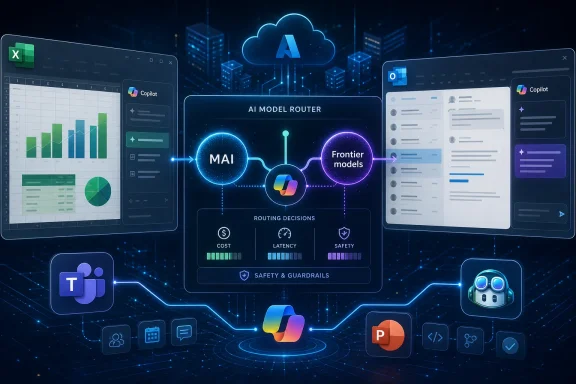
Microsoft has reportedly begun replacing some OpenAI and Anthropic models with its own Microsoft AI models inside Microsoft 365 apps such as Excel and Outlook, according to Bloomberg reporting amplified Tuesday by Thurrott, as the company tries to reduce AI costs and gain more control over its product stack. The move is not a breakup so much as a rebalancing. Microsoft is discovering that the future of Copilot is not one giant frontier model answering every prompt, but a routing layer that decides which model is good enough, cheap enough, fast enough, and safe enough for the job.
That is a quieter story than the grand “Microsoft versus OpenAI” narrative, but it is probably the more important one for WindowsForum readers. If Microsoft can move routine Office, Teams, PowerPoint, and GitHub Copilot workloads onto MAI models without users noticing a quality drop, it changes the economics of AI in Windows and Microsoft 365. It also changes the leverage in one of the defining partnerships of the AI boom.
For the past several years, Microsoft’s AI story has been easy to summarize: invest heavily in OpenAI, wire GPT-class models into everything, and sell the resulting productivity layer as Copilot. That strategy worked spectacularly as a market signal. It made Microsoft look early, decisive, and deeply embedded in the company that turned generative AI from lab demo into boardroom mandate.
But productizing AI is different from announcing it. Every Copilot button creates an inference bill. Every spreadsheet prompt, email rewrite, meeting transcript, image generation request, and code suggestion has to run somewhere, on hardware that is still expensive, power-hungry, and supply-constrained.
That is why Bloomberg’s report, as summarized by Thurrott, matters. Microsoft is reportedly using its own MAI models for a portion of prompts in Excel and Outlook, with broader internal use still small but growing. The phrase “a portion” is doing a lot of work here: this is not Microsoft ripping out OpenAI from Microsoft 365 overnight. It is a gradual substitution where Microsoft thinks the task is bounded enough to be handled by a cheaper or more specialized model.
That is exactly where enterprise AI was always headed. The industry spent two years pretending that bigger was synonymous with better. The next phase is about fit: matching the model to the task, the latency target, the data boundary, and the margin profile.
An Excel user asking Copilot to summarize a table, generate a formula, explain a pivot, classify rows, or clean up a dataset is not necessarily asking for synthetic genius. An Outlook user asking for a concise reply, thread summary, tone adjustment, or meeting follow-up is often asking for constrained language work within a familiar business context. These tasks still require accuracy and guardrails, but they do not always require the most capable general-purpose model money can buy.
That distinction is Microsoft’s opening. If MAI models can handle predictable, high-volume Office tasks at lower cost, Microsoft can reserve OpenAI, Anthropic, or other frontier systems for prompts that need deeper reasoning, broader world knowledge, or higher confidence. Users may never see the model switch. Administrators may only notice if performance, compliance paperwork, or billing changes.
The risk is that “good enough” AI can become visible at the worst possible moment. A formula suggestion that is subtly wrong, a summary that misses a legally important sentence, or an email rewrite that changes intent is not merely a bad demo. It is a workplace failure. Microsoft’s challenge is not just to make MAI cheaper; it has to make the routing layer smart enough to know when cheap is the wrong answer.
That matters because Foundry is not a toy shelf. It is Microsoft’s attempt to turn model choice into infrastructure. If Azure customers can deploy Microsoft-built models alongside partner and open models, then Microsoft’s internal product teams can do the same at Microsoft scale.
PowerPoint was an early clue. Thurrott notes that MAI-Image-2.5 was already being used in PowerPoint, a natural proving ground because generated visuals are expensive, repetitive, and relatively easy to route to a specialized image model. Microsoft does not need a full general-purpose reasoning model to generate a slide illustration or perform a bounded image edit. It needs a model that is fast, controllable, and cheap enough to appear in a mass-market subscription product.
Teams may be next in spirit, if not instantly in scale. Microsoft’s MAI-Transcribe-1.5 is already documented through Azure Speech in preview, with Microsoft describing it as a model from the MAI Superintelligence team optimized for accuracy and efficiency. Transcription is one of the clearest cases for specialization: the task is narrow, the volume is enormous, and the business value depends as much on latency and cost as on benchmark bragging rights.
That is not a contradiction. It is what every large platform company eventually does. Apple designs its own silicon while buying components from suppliers. Google builds TPUs and Gemini while still supporting a sprawling cloud ecosystem. Amazon develops chips and models while selling infrastructure to everyone. Microsoft relying permanently on OpenAI for the core intelligence layer of Windows, Office, Bing, Edge, Teams, GitHub, Azure, and Copilot was never a stable end state.
The OpenAI partnership gave Microsoft speed. In 2023 and 2024, speed was the whole game. The company could leapfrog the perception that it was a cautious enterprise vendor and instead look like the platform company most ready to commercialize generative AI.
But speed creates dependency. If every Copilot feature depends on a third-party model, Microsoft’s cost structure, latency envelope, feature roadmap, and negotiation leverage all sit partly outside Redmond. That might be acceptable during a land grab. It is less attractive once AI becomes an operating expense embedded in every seat license.
A mature Copilot stack needs to decide whether a prompt should go to MAI, OpenAI, Anthropic, Phi, a domain-specific model, a local model, a retrieval system, or a deterministic workflow. It needs to make that decision quickly, invisibly, and auditable enough for enterprise customers. It must also handle failures without exposing the seams.
This is where Microsoft has a structural advantage. The company owns the applications, the identity layer, the admin plane, the compliance story, the telemetry, the cloud, and the developer platform. It does not need to win every model benchmark to win the workflow. It needs to orchestrate models better than rivals can integrate into Microsoft’s own estate.
That is also why Anthropic’s presence in the story is important. Microsoft’s AI strategy has already become more multi-model, with Anthropic models appearing in some Microsoft 365 Copilot contexts and broader enterprise conversations. The point is not that Microsoft is swapping one dependency for another. The point is that dependency itself is being abstracted.
If Microsoft can make the model an implementation detail, it can negotiate from strength. OpenAI remains strategically crucial, especially at the frontier. Anthropic remains attractive for enterprise reasoning and safety-conscious deployments. But Microsoft’s product promise becomes Copilot, not “Copilot powered by one specific outside lab forever.”
But cost alone undersells the move. In-house models give Microsoft more control over tuning, deployment cadence, safety behavior, data residency, observability, and integration with internal systems. They also let Microsoft optimize for boring enterprise needs that frontier labs may not prioritize because they do not generate headlines.
Consider Outlook. A frontier lab may optimize for broad reasoning, creative generation, or agentic task performance. Microsoft can optimize for the ugly details of enterprise email: calendar context, tenant policy, message sensitivity, retention rules, legal hold, language tone, and compliance disclaimers. The model is only one part of that system, but owning it can make the whole system easier to shape.
The same is true in Excel. Business users do not simply want a smart model; they want a model that understands workbook structure, permissions, formula behavior, and the difference between a helpful suggestion and a destructive change. Microsoft can build guardrails around third-party models, but owning more of the model layer gives it another lever.
This is why “less sophisticated than the top external frontier models” may be beside the point. The best model for a spreadsheet assistant may not be the model that wins the most open-ended reasoning contest. It may be the one that produces consistently useful answers at a sustainable cost inside a product with strict UX and compliance constraints.
But the psychology of the partnership has changed. In the early phase, Microsoft looked like OpenAI’s indispensable cloud and commercialization partner. Now Microsoft is signaling that OpenAI is one model supplier among several, even if it remains the most important one.
That distinction matters in negotiations. If Microsoft can credibly route more workloads to MAI models, it has leverage over pricing and terms. If it can route some workloads to Anthropic, it has optionality. If it can make Foundry a neutral marketplace for enterprise model choice, it can profit even when customers choose someone else’s model.
OpenAI has its own incentives to become less dependent on Microsoft, too. As AI labs seek broader distribution, direct enterprise relationships, hardware partnerships, and potential public-market narratives, exclusivity becomes constraining. The once-simple alliance is becoming a web of overlapping interests.
That is normal in platform history. Partners become competitors, suppliers become customers, and strategic dependencies get turned into APIs. Microsoft knows this playbook because it has both benefited from it and been punished by it.
That last point is important. The economics of AI have shaped product packaging from the beginning. Microsoft has charged aggressively for Microsoft 365 Copilot because the underlying compute is expensive and because enterprise productivity budgets can bear it. If in-house models reduce cost, Microsoft gains room to bundle more AI into consumer Microsoft 365, Windows, Edge, and Teams without destroying margins.
Do not expect altruism. Lower internal costs do not automatically become lower prices. Microsoft may instead use the savings to increase usage limits, improve responsiveness, expand Copilot availability, or defend margins. Still, cost reduction is a prerequisite for AI becoming ambient rather than metered.
There is also a privacy and trust angle, though it should be handled carefully. “Microsoft model” does not automatically mean “more private,” just as “third-party model” does not automatically mean “unsafe.” Enterprise privacy depends on contracts, architecture, logging, retention, access controls, and tenant boundaries. But for some customers, reducing dependence on external model providers may simplify risk assessments.
For admins, the key question will be transparency. If Copilot output changes because Microsoft silently routes workloads among MAI, OpenAI, Anthropic, and other systems, organizations will want to know what is being used, where data is processed, and what compliance commitments apply. A model router that is invisible to users may still need to be visible to auditors.
Thurrott notes that MAI models are used with GitHub Copilot, and Microsoft’s Build-era messaging around MAI-Code-1-Flash fits the same cost-and-latency logic. A coding assistant has to feel immediate. If a model is slightly less capable on rare hard problems but dramatically cheaper and faster on common completions, it may be the better default.
Developers are also more likely than Office users to notice model personality and quality changes. They compare outputs, track regressions, and complain loudly when an assistant becomes less useful. That makes Copilot a demanding proving ground for Microsoft’s routing strategy.
The enterprise implication is bigger than code completion. If Microsoft can blend models inside GitHub, Visual Studio Code, Azure, and Microsoft 365, it can sell a coherent AI engineering environment that is not hostage to one lab’s release cycle. That is the same argument as Office, just with a more technical audience and higher tolerance for visible controls.
Windows and Microsoft 365 admins already live with the consequences of staged rollouts, A/B tests, tenant-specific features, licensing gates, preview channels, policy conflicts, and regional availability. Add dynamic model selection to that soup and the support burden could become significant. “Copilot gave a bad answer” is already hard to debug. “Copilot gave a bad answer because the workload was routed to a lower-cost model variant under conditions Microsoft does not disclose” is worse.
Microsoft will need to decide how much transparency the market gets. Consumer products can hide complexity. Enterprise products cannot hide all of it forever. Regulated industries will ask which models processed which data. Security teams will ask what logs exist. Legal teams will ask how outputs were generated and retained.
The company’s challenge is to offer meaningful controls without turning Copilot administration into a graduate seminar in model operations. If the answer is too opaque, trust suffers. If the answer is too configurable, complexity explodes. Microsoft’s history suggests it will try to solve this with policy layers, admin center toggles, service descriptions, and a lot of documentation that arrives slightly after customers ask for it.
That is why the MAI push is not merely a response to OpenAI costs. It is part of a broader effort to make AI composable across Microsoft products. Foundry exposes models to developers. Copilot consumes them inside applications. Azure hosts them. Entra governs access. Purview and Defender can be woven into the compliance and security story. Windows becomes another surface where the same intelligence layer can appear.
This is a formidable stack, but it also raises expectations. If Microsoft owns more of the model layer, it owns more of the blame when Copilot disappoints. The company cannot indefinitely point to the novelty of the technology or the complexity of third-party model behavior. In-house models make the product more Microsoft’s responsibility.
That may be healthy. The Copilot brand has sometimes raced ahead of the user experience, with Microsoft putting AI buttons into places where the value was not yet obvious. A more cost-conscious, task-specific model strategy could force discipline. Instead of asking where AI can be inserted, Microsoft may have to ask where a particular model can reliably improve a workflow.
That is the version of AI integration Windows users should want. Not a chatbot bolted onto every pane, but assistance embedded where the task is clear and the failure modes are understood.
The company’s advantage is that it has places to hide and amortize that bill. Microsoft can distribute AI costs across enterprise subscriptions, Azure consumption, premium Copilot SKUs, Windows services, GitHub plans, and developer platforms. It can also optimize internally at a scale few companies can match.
But that advantage only works if users keep finding value. If Copilot remains a feature people try once and ignore, cheaper models will not save the strategy. If Copilot becomes an everyday tool for summarizing, drafting, querying, building, and automating, then shaving inference costs becomes enormously valuable.
This is why Excel and Outlook are more important than flashier AI demos. They are daily-use applications. They sit inside the workflows where employees already spend time. If Microsoft can make AI useful there at sustainable cost, the Copilot business becomes real. If it cannot, the model supplier is a secondary problem.
That is a quieter story than the grand “Microsoft versus OpenAI” narrative, but it is probably the more important one for WindowsForum readers. If Microsoft can move routine Office, Teams, PowerPoint, and GitHub Copilot workloads onto MAI models without users noticing a quality drop, it changes the economics of AI in Windows and Microsoft 365. It also changes the leverage in one of the defining partnerships of the AI boom.
 Microsoft’s AI Strategy Is Becoming Less Romantic and More Industrial
For the past several years, Microsoft’s AI story has been easy to summarize: invest heavily in OpenAI, wire GPT-class models into everything, and sell the resulting productivity layer as Copilot. That strategy worked spectacularly as a market signal. It made Microsoft look early, decisive, and deeply embedded in the company that turned generative AI from lab demo into boardroom mandate.But productizing AI is different from announcing it. Every Copilot button creates an inference bill. Every spreadsheet prompt, email rewrite, meeting transcript, image generation request, and code suggestion has to run somewhere, on hardware that is still expensive, power-hungry, and supply-constrained.
That is why Bloomberg’s report, as summarized by Thurrott, matters. Microsoft is reportedly using its own MAI models for a portion of prompts in Excel and Outlook, with broader internal use still small but growing. The phrase “a portion” is doing a lot of work here: this is not Microsoft ripping out OpenAI from Microsoft 365 overnight. It is a gradual substitution where Microsoft thinks the task is bounded enough to be handled by a cheaper or more specialized model.
That is exactly where enterprise AI was always headed. The industry spent two years pretending that bigger was synonymous with better. The next phase is about fit: matching the model to the task, the latency target, the data boundary, and the margin profile.
Excel and Outlook Are Where the Frontier Model Myth Starts to Crack
Excel and Outlook are not trivial applications. They are two of the most important productivity tools in the world, and they carry decades of user expectations about reliability, compatibility, and predictability. But many AI tasks inside them are also more finite than the open-ended chatbot experiences that made frontier models famous.An Excel user asking Copilot to summarize a table, generate a formula, explain a pivot, classify rows, or clean up a dataset is not necessarily asking for synthetic genius. An Outlook user asking for a concise reply, thread summary, tone adjustment, or meeting follow-up is often asking for constrained language work within a familiar business context. These tasks still require accuracy and guardrails, but they do not always require the most capable general-purpose model money can buy.
That distinction is Microsoft’s opening. If MAI models can handle predictable, high-volume Office tasks at lower cost, Microsoft can reserve OpenAI, Anthropic, or other frontier systems for prompts that need deeper reasoning, broader world knowledge, or higher confidence. Users may never see the model switch. Administrators may only notice if performance, compliance paperwork, or billing changes.
The risk is that “good enough” AI can become visible at the worst possible moment. A formula suggestion that is subtly wrong, a summary that misses a legally important sentence, or an email rewrite that changes intent is not merely a bad demo. It is a workplace failure. Microsoft’s challenge is not just to make MAI cheaper; it has to make the routing layer smart enough to know when cheap is the wrong answer.
Build 2026 Was the Signal, Bloomberg Is the Consequence
The Thurrott post points back to Microsoft’s Build announcements as the moment this became visible. Microsoft introduced a broader slate of MAI models, including MAI-Thinking-1, MAI-Code-1-Flash, MAI-Image-2.5, and MAI-Transcribe-1.5. Microsoft’s own documentation now describes MAI image models in Microsoft Foundry and lists MAI-Image-2.5 and MAI-Image-2.5-Flash as preview models for text-to-image generation and image editing.That matters because Foundry is not a toy shelf. It is Microsoft’s attempt to turn model choice into infrastructure. If Azure customers can deploy Microsoft-built models alongside partner and open models, then Microsoft’s internal product teams can do the same at Microsoft scale.
PowerPoint was an early clue. Thurrott notes that MAI-Image-2.5 was already being used in PowerPoint, a natural proving ground because generated visuals are expensive, repetitive, and relatively easy to route to a specialized image model. Microsoft does not need a full general-purpose reasoning model to generate a slide illustration or perform a bounded image edit. It needs a model that is fast, controllable, and cheap enough to appear in a mass-market subscription product.
Teams may be next in spirit, if not instantly in scale. Microsoft’s MAI-Transcribe-1.5 is already documented through Azure Speech in preview, with Microsoft describing it as a model from the MAI Superintelligence team optimized for accuracy and efficiency. Transcription is one of the clearest cases for specialization: the task is narrow, the volume is enormous, and the business value depends as much on latency and cost as on benchmark bragging rights.
Mustafa Suleyman’s Assignment Was Always Independence
Microsoft AI CEO Mustafa Suleyman has not exactly hidden the ambition. Since taking over Microsoft’s consumer AI efforts, he has repeatedly framed Microsoft’s in-house model work as a path toward long-term self-sufficiency. The company can still partner aggressively while refusing to let its entire AI future depend on someone else’s model roadmap.That is not a contradiction. It is what every large platform company eventually does. Apple designs its own silicon while buying components from suppliers. Google builds TPUs and Gemini while still supporting a sprawling cloud ecosystem. Amazon develops chips and models while selling infrastructure to everyone. Microsoft relying permanently on OpenAI for the core intelligence layer of Windows, Office, Bing, Edge, Teams, GitHub, Azure, and Copilot was never a stable end state.
The OpenAI partnership gave Microsoft speed. In 2023 and 2024, speed was the whole game. The company could leapfrog the perception that it was a cautious enterprise vendor and instead look like the platform company most ready to commercialize generative AI.
But speed creates dependency. If every Copilot feature depends on a third-party model, Microsoft’s cost structure, latency envelope, feature roadmap, and negotiation leverage all sit partly outside Redmond. That might be acceptable during a land grab. It is less attractive once AI becomes an operating expense embedded in every seat license.
The Real Product Is the Router, Not the Model
The popular version of the AI race treats models like sports cars: bigger engines, faster laps, better leaderboard times. Microsoft’s reported shift suggests a different metaphor. The valuable system is less like a single car and more like air traffic control.A mature Copilot stack needs to decide whether a prompt should go to MAI, OpenAI, Anthropic, Phi, a domain-specific model, a local model, a retrieval system, or a deterministic workflow. It needs to make that decision quickly, invisibly, and auditable enough for enterprise customers. It must also handle failures without exposing the seams.
This is where Microsoft has a structural advantage. The company owns the applications, the identity layer, the admin plane, the compliance story, the telemetry, the cloud, and the developer platform. It does not need to win every model benchmark to win the workflow. It needs to orchestrate models better than rivals can integrate into Microsoft’s own estate.
That is also why Anthropic’s presence in the story is important. Microsoft’s AI strategy has already become more multi-model, with Anthropic models appearing in some Microsoft 365 Copilot contexts and broader enterprise conversations. The point is not that Microsoft is swapping one dependency for another. The point is that dependency itself is being abstracted.
If Microsoft can make the model an implementation detail, it can negotiate from strength. OpenAI remains strategically crucial, especially at the frontier. Anthropic remains attractive for enterprise reasoning and safety-conscious deployments. But Microsoft’s product promise becomes Copilot, not “Copilot powered by one specific outside lab forever.”
Cost Is the Honest Explanation, but Control Is the Bigger Prize
Bloomberg’s framing centers on cost, and that is the cleanest explanation. AI margins are uncomfortable when usage scales faster than efficiency. Microsoft has pushed Copilot into products with hundreds of millions of users, and even a small increase in active use can create huge inference demand.But cost alone undersells the move. In-house models give Microsoft more control over tuning, deployment cadence, safety behavior, data residency, observability, and integration with internal systems. They also let Microsoft optimize for boring enterprise needs that frontier labs may not prioritize because they do not generate headlines.
Consider Outlook. A frontier lab may optimize for broad reasoning, creative generation, or agentic task performance. Microsoft can optimize for the ugly details of enterprise email: calendar context, tenant policy, message sensitivity, retention rules, legal hold, language tone, and compliance disclaimers. The model is only one part of that system, but owning it can make the whole system easier to shape.
The same is true in Excel. Business users do not simply want a smart model; they want a model that understands workbook structure, permissions, formula behavior, and the difference between a helpful suggestion and a destructive change. Microsoft can build guardrails around third-party models, but owning more of the model layer gives it another lever.
This is why “less sophisticated than the top external frontier models” may be beside the point. The best model for a spreadsheet assistant may not be the model that wins the most open-ended reasoning contest. It may be the one that produces consistently useful answers at a sustainable cost inside a product with strict UX and compliance constraints.
OpenAI Is Still Central, Just No Longer Untouchable
It would be a mistake to read this as Microsoft abandoning OpenAI. Microsoft’s investment, infrastructure ties, and product integration with OpenAI remain among the most consequential relationships in technology. The most demanding Copilot experiences are still likely to rely on the strongest available models, and OpenAI remains one of the few companies operating at that frontier.But the psychology of the partnership has changed. In the early phase, Microsoft looked like OpenAI’s indispensable cloud and commercialization partner. Now Microsoft is signaling that OpenAI is one model supplier among several, even if it remains the most important one.
That distinction matters in negotiations. If Microsoft can credibly route more workloads to MAI models, it has leverage over pricing and terms. If it can route some workloads to Anthropic, it has optionality. If it can make Foundry a neutral marketplace for enterprise model choice, it can profit even when customers choose someone else’s model.
OpenAI has its own incentives to become less dependent on Microsoft, too. As AI labs seek broader distribution, direct enterprise relationships, hardware partnerships, and potential public-market narratives, exclusivity becomes constraining. The once-simple alliance is becoming a web of overlapping interests.
That is normal in platform history. Partners become competitors, suppliers become customers, and strategic dependencies get turned into APIs. Microsoft knows this playbook because it has both benefited from it and been punished by it.
Windows Users Will Feel This Through Copilot’s Edges
For everyday Windows users, the MAI transition will probably not arrive as a splash screen announcing a new model. It will show up in the texture of Copilot experiences: faster responses in some places, different writing style in others, occasional regressions, and maybe more features that Microsoft can afford to include in existing subscriptions.That last point is important. The economics of AI have shaped product packaging from the beginning. Microsoft has charged aggressively for Microsoft 365 Copilot because the underlying compute is expensive and because enterprise productivity budgets can bear it. If in-house models reduce cost, Microsoft gains room to bundle more AI into consumer Microsoft 365, Windows, Edge, and Teams without destroying margins.
Do not expect altruism. Lower internal costs do not automatically become lower prices. Microsoft may instead use the savings to increase usage limits, improve responsiveness, expand Copilot availability, or defend margins. Still, cost reduction is a prerequisite for AI becoming ambient rather than metered.
There is also a privacy and trust angle, though it should be handled carefully. “Microsoft model” does not automatically mean “more private,” just as “third-party model” does not automatically mean “unsafe.” Enterprise privacy depends on contracts, architecture, logging, retention, access controls, and tenant boundaries. But for some customers, reducing dependence on external model providers may simplify risk assessments.
For admins, the key question will be transparency. If Copilot output changes because Microsoft silently routes workloads among MAI, OpenAI, Anthropic, and other systems, organizations will want to know what is being used, where data is processed, and what compliance commitments apply. A model router that is invisible to users may still need to be visible to auditors.
GitHub Copilot Shows the Same Pattern in Developer Form
GitHub Copilot is another obvious testing ground for Microsoft’s model pragmatism. Developer tools generate huge volumes of short, repetitive, context-rich prompts. Some require deep reasoning across a codebase; many are autocomplete, refactoring, explanation, or boilerplate tasks that may be well suited to a smaller specialized model.Thurrott notes that MAI models are used with GitHub Copilot, and Microsoft’s Build-era messaging around MAI-Code-1-Flash fits the same cost-and-latency logic. A coding assistant has to feel immediate. If a model is slightly less capable on rare hard problems but dramatically cheaper and faster on common completions, it may be the better default.
Developers are also more likely than Office users to notice model personality and quality changes. They compare outputs, track regressions, and complain loudly when an assistant becomes less useful. That makes Copilot a demanding proving ground for Microsoft’s routing strategy.
The enterprise implication is bigger than code completion. If Microsoft can blend models inside GitHub, Visual Studio Code, Azure, and Microsoft 365, it can sell a coherent AI engineering environment that is not hostage to one lab’s release cycle. That is the same argument as Office, just with a more technical audience and higher tolerance for visible controls.
The Risk Is a Support Matrix Nobody Can Explain
There is a darker version of this future. Microsoft could end up with a Copilot stack so complex that neither users nor support teams can explain why two people get different answers to the same prompt. Model routing may improve efficiency, but it can also make troubleshooting maddening.Windows and Microsoft 365 admins already live with the consequences of staged rollouts, A/B tests, tenant-specific features, licensing gates, preview channels, policy conflicts, and regional availability. Add dynamic model selection to that soup and the support burden could become significant. “Copilot gave a bad answer” is already hard to debug. “Copilot gave a bad answer because the workload was routed to a lower-cost model variant under conditions Microsoft does not disclose” is worse.
Microsoft will need to decide how much transparency the market gets. Consumer products can hide complexity. Enterprise products cannot hide all of it forever. Regulated industries will ask which models processed which data. Security teams will ask what logs exist. Legal teams will ask how outputs were generated and retained.
The company’s challenge is to offer meaningful controls without turning Copilot administration into a graduate seminar in model operations. If the answer is too opaque, trust suffers. If the answer is too configurable, complexity explodes. Microsoft’s history suggests it will try to solve this with policy layers, admin center toggles, service descriptions, and a lot of documentation that arrives slightly after customers ask for it.
The MAI Shift Makes Microsoft Look More Like Azure Than OpenAI
The most revealing thing about this transition is that it makes Microsoft’s AI strategy look less like a lab and more like a cloud platform. Labs want the best model. Platforms want the right model available at the right price under the right contract. Microsoft is a platform company down to the bone.That is why the MAI push is not merely a response to OpenAI costs. It is part of a broader effort to make AI composable across Microsoft products. Foundry exposes models to developers. Copilot consumes them inside applications. Azure hosts them. Entra governs access. Purview and Defender can be woven into the compliance and security story. Windows becomes another surface where the same intelligence layer can appear.
This is a formidable stack, but it also raises expectations. If Microsoft owns more of the model layer, it owns more of the blame when Copilot disappoints. The company cannot indefinitely point to the novelty of the technology or the complexity of third-party model behavior. In-house models make the product more Microsoft’s responsibility.
That may be healthy. The Copilot brand has sometimes raced ahead of the user experience, with Microsoft putting AI buttons into places where the value was not yet obvious. A more cost-conscious, task-specific model strategy could force discipline. Instead of asking where AI can be inserted, Microsoft may have to ask where a particular model can reliably improve a workflow.
That is the version of AI integration Windows users should want. Not a chatbot bolted onto every pane, but assistance embedded where the task is clear and the failure modes are understood.
The Office AI Bill Is Coming Due
The AI industry’s first act was about capability. The second is about unit economics. Microsoft’s reported MAI substitution is one of the clearest signs that the bill for ubiquitous AI is arriving.The company’s advantage is that it has places to hide and amortize that bill. Microsoft can distribute AI costs across enterprise subscriptions, Azure consumption, premium Copilot SKUs, Windows services, GitHub plans, and developer platforms. It can also optimize internally at a scale few companies can match.
But that advantage only works if users keep finding value. If Copilot remains a feature people try once and ignore, cheaper models will not save the strategy. If Copilot becomes an everyday tool for summarizing, drafting, querying, building, and automating, then shaving inference costs becomes enormously valuable.
This is why Excel and Outlook are more important than flashier AI demos. They are daily-use applications. They sit inside the workflows where employees already spend time. If Microsoft can make AI useful there at sustainable cost, the Copilot business becomes real. If it cannot, the model supplier is a secondary problem.
The Practical Read for WindowsForum Readers
This is not the end of Microsoft’s OpenAI era, but it is the end of the illusion that one partner and one class of model will power everything. The more Microsoft pushes Copilot into Windows, Office, Teams, Edge, GitHub, and Azure, the more it needs a portfolio of models and a ruthless system for choosing among them.- Microsoft is reportedly routing some Excel and Outlook AI workloads to its own MAI models, according to Bloomberg reporting discussed by Thurrott.
- The shift is best understood as selective substitution, not a wholesale replacement of OpenAI or Anthropic across Microsoft products.
- Office, Teams, PowerPoint, and GitHub Copilot are natural places for specialized models because many tasks are repetitive, bounded, and cost-sensitive.
- The biggest technical challenge is model routing: deciding when a cheaper Microsoft model is sufficient and when a frontier external model is necessary.
- Enterprise customers should watch for transparency around model use, data handling, regional processing, logging, and admin controls.
- The strategic prize for Microsoft is not merely lower cost, but greater control over Copilot’s roadmap, margins, compliance story, and negotiating leverage.
References
- Primary source: thurrott.com
Published: Tue, 07 Jul 2026 21:48:06 GMT
Microsoft is Reportedly Transitioning to In-House AI Models - Thurrott.com
Microsoft has reportedly started transitioning away from OpenAI and Anthropic AI models in an attempt to cut costs.www.thurrott.com - Related coverage: techcrunch.com
Microsoft joins AI cost-cutting trend by relying more on its own models | TechCrunch
Microsoft is the latest Silicon Valley giant to cut back on its AI spending.techcrunch.com - Related coverage: thetechportal.com
Microsoft begins replacing OpenAI, Anthropic models with in-house MAI AI across key products: Report - The Tech Portal
Microsoft has reportedly begun deploying its own AI models across some of its most widely used productivity applications. Instead of thetechportal.com
- Official source: news.microsoft.com
Microsoft Foundry (国际版) 推出全新 MAI 模型 - Source Asia
 news.microsoft.com
- Official source: microsoft.ai
Models | Microsoft AI
 microsoft.ai
- Related coverage: bloomberg.com
- Related coverage: thenextweb.com
Microsoft swaps in its own AI over OpenAI in some apps
Microsoft is routing some app features to its in-house MAI models instead of OpenAI and Anthropic, chipping away at its reliance on partners.thenextweb.com - Related coverage: euronews.com
Microsoft launches its own AI models to take on OpenAI and Anthropic | Euronews
Seven in-house models unveiled at Build 2026 signal Microsoft's push to cut costs and compete directly on the AI frontier as its biggest investees plan to launch record-breaking IPOs.www.euronews.com - Related coverage: ai-tldr.dev
Microsoft Launches Seven New MAI Models at Build… | AI/TLDR
Microsoft AI's biggest first-party launch yet: a reasoner, a coding flash model, image + voice updates, and a speech-to-text engine claimed to be 5x fas…ai-tldr.dev - Related coverage: geekwire.com
Microsoft unveils seven homegrown AI models in new bid for 'long term self-sufficiency' – GeekWire
Microsoft used its Build conference to unveil seven in-house AI models, including a reasoning model it says draws even with Anthropic's Claude Sonnet 4.6 — part of a push to depend less on the AI partners it has invested billions in.www.geekwire.com - Related coverage: traictory.com
Microsoft Just Built Its Own AI Models — With Teams of 10 People | Traictory
Mustafa Suleyman's superintelligence team ships MAI-Transcribe-1, MAI-Voice-1, and MAI-Image-2 — state-of-the-art models built by tiny teams that beat OpenAI Whisper and undercut every hyperscaler on price.traictory.com
- Related coverage: stocktwits.com
MSFT Stock Jumps 2% — Microsoft Looks To Save Cost By Reportedly Swapping OpenAI, Anthropic Models For In-House AI
Microsoft Corp. (MSFT) share price gained 2% on Tuesday after the company quietly initiated a major shift in its artificial intelligence strategy, beginning to substitute AI models from OpenAI and Anthropic with its own proprietary models.stocktwits.com - Related coverage: news.bloomberglaw.com
Microsoft Replaces OpenAI, Anthropic With Own AI in Some Apps
Microsoft Corp., looking to reduce AI costs, is starting to replace OpenAI and Anthropic with its own models in software products like Excel and Outlook.news.bloomberglaw.com
- Related coverage: windowscentral.com
Microsoft says its MAI-Image-2-Efficient AI model slashes costs by 41% while boosting speed by 22% (and maintaining quality) | Windows Central
Microsoft’s latest AI model makes photorealistic image generation faster, cheaper, and more efficient than ever before.www.windowscentral.com - Related coverage: tomshardware.com
Google, Microsoft, and xAI agree to let US government test AI models before public release — OpenAI and Anthropic also on board after renegotiating deals with Washington | Tom's Hardware
All five major frontier labs now give the Commerce Department early access to unreleased AI systems.www.tomshardware.com - Related coverage: axios.com
Microsoft research tools uses Anthropic and OpenAI models
The multi-model method is designed to improve accuracy.www.axios.com
