

Microsoft is urging security teams to red-team AI systems across the entire application stack, not just the model, with Microsoft red teaming executive Craig Nelson emphasizing data connections, backend automation, credentials, and logging in a recent Microsoft Inside Track security video. The advice is simple on its face and disruptive in practice: the model is no longer the boundary of the system. Once an AI assistant can read enterprise data and trigger actions, the security problem stops looking like chatbot safety and starts looking like identity, workflow, and infrastructure risk. That shift should change how Windows shops, cloud teams, and CISOs test every AI deployment now landing in production.
For the first wave of generative AI adoption, “AI security” often meant trying to make a model say something it should not say. Teams tested jailbreaks, prompt injection, toxic outputs, hallucinated claims, and the familiar carnival of adversarial prompts that turned model behavior into a public sport. That work mattered, but it also encouraged a misleading mental model: if the model can be made polite, compliant, and less easily tricked, the system is secure.
Nelson’s point cuts through that assumption. He says he is interested in the model, but also in how it connects to additional data and how it executes automation from the back end. That is the sentence security teams should tape to the wall before approving the next internal copilot, support bot, IT helpdesk agent, HR assistant, finance analyst, or developer automation tool.
A model by itself is mostly a text generator. A model attached to enterprise search, SharePoint, email, ticketing, device inventory, CI/CD, cloud consoles, and privileged automation is something else. It becomes an interpreter sitting between human intent and operational systems, translating messy requests into actions that may affect people, money, source code, customer records, infrastructure, or compliance posture.
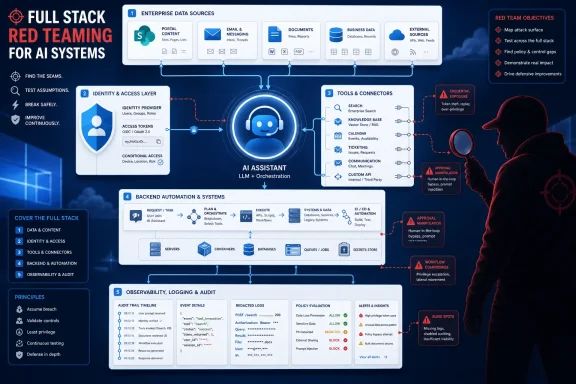
That is why full stack red teaming is not a branding flourish. It is a belated admission that the interesting AI failures now happen at the seams: the retrieval layer that supplies context, the connector that pulls from a sensitive repository, the plugin that has more permission than the user understands, the automation account that can make real changes, and the logging pipeline that may or may not show what happened after the fact.
That difference is enormous. If an AI assistant summarizes a poisoned document and includes false information, the organization has a quality problem. If the same assistant reads the poisoned document, decides it has received valid instructions, and then opens a ticket, changes a configuration, forwards data, updates a record, or runs a script, the organization has an incident.
This is why red teaming cannot stop at the model boundary. The prompt is only the entry point. The real questions are downstream: what tools can the agent call, what credentials do those tools use, what data can they reach, what approvals are required, what happens when the model is uncertain, and whether an operator can reconstruct the chain after something goes wrong.
WindowsForum readers have seen versions of this movie before. Macro malware was not frightening because Word could display text; it was frightening because a document became a pathway into system execution. Browser exploits were not simply about rendering bugs; they mattered because the browser sat between untrusted content and the local machine. Agentic AI carries a similar shape, except the boundary being crossed is often organizational rather than merely local.
The phrase full stack is doing real work here. It means the tester must assume that the attack path may begin in natural language but end in identity abuse, data leakage, lateral movement, unauthorized automation, or policy bypass. The model is part of the chain, but it is not the whole chain.
That does not make the advice wrong. It does mean we should read it with both eyes open. When Microsoft says AI security requires testing data access, credentials, automation, and logs, it is describing real risks while also pointing customers toward the Microsoft stack as the control plane for those risks.
This is the company’s broader AI enterprise pitch: the model matters, but the system around the model matters more. Identity, access control, data classification, monitoring, endpoint management, incident response, and compliance are not decorations added after deployment. They are the structure that determines whether an AI agent is a productivity tool or an unbounded interpreter with a corporate badge.
There is an obvious commercial logic here. If the enterprise AI battleground moves from “whose model is smartest?” to “whose platform governs the model safely?”, Microsoft is well positioned. Entra, Defender, Purview, Sentinel, Azure, GitHub, and Windows already sit in the places where enterprises enforce control. AI gives Microsoft another reason to bind those layers together.
But the security logic stands even if you strip away the sales pitch. A model-agnostic enterprise still has to answer the same questions. If an organization uses OpenAI, Anthropic, Google, Meta models, local models, open weights, custom fine-tunes, or multiple vendors at once, the risk does not disappear. The organization still has to know what the AI can see, what it can do, whose authority it borrows, and how its behavior is observed.
That usefulness is exactly the problem. The AI system becomes valuable because it collapses boundaries between information silos. Security teams spent years building those silos for reasons: least privilege, regulatory separation, departmental confidentiality, merger sensitivity, legal hold, customer privacy, and executive secrecy. A retrieval-augmented AI system can accidentally become the fastest way to discover where those boundaries were only implied.
The risk is not only that a user asks for something they should not see. It is that the system’s retrieval layer may fetch sensitive context to answer an allowed question, that the model may blend restricted and unrestricted information in a response, or that logs may preserve fragments of confidential data in places administrators did not expect. A red team that only attacks the model’s surface behavior may never notice that the dangerous event happened in the context pipeline.
This is where Windows and Microsoft 365 administrators have a particularly unglamorous but central role. Permissions hygiene, stale groups, overshared SharePoint sites, inherited ACLs, service principals, and long-forgotten file shares are not new problems. AI simply makes them newly visible and newly exploitable. If an enterprise search assistant can traverse every overshared corner of a tenant, the model did not create the permission mess, but it may industrialize its consequences.
Full stack red teaming should therefore include boring tests. Can a low-privilege user retrieve snippets from a confidential project? Can a contractor infer sensitive material through summaries? Can the agent combine individually harmless facts into a restricted conclusion? Can poisoned content in an accessible source influence answers about a higher-value workflow? These are not science fiction scenarios. They are the natural result of connecting probabilistic systems to messy enterprise data estates.
That is why Nelson’s reference to backend automation is the most important part of the advice. Many organizations are racing toward agents that do more than answer. They triage alerts, remediate vulnerabilities, create pull requests, reset passwords, modify policies, deploy infrastructure, update records, provision access, and coordinate workflows. These are precisely the use cases that create business value. They are also the use cases that make red-team exercises harder and more consequential.
A chatbot can be wrong in a way that is visible. An agent can be wrong in a way that is operationally embedded. It may create a ticket with the wrong severity, approve an access request based on misread context, disable a control while troubleshooting, rotate the wrong secret, merge a flawed code change, or trigger a remediation playbook that masks evidence.
Traditional application security has tools for some of this. We know about role-based access control, approval gates, transaction logs, separation of duties, and change management. The difference is that AI agents introduce an uncertain reasoning layer before those controls. They may decide which tool to use, which evidence matters, and how to translate a natural-language request into structured action.
That means red teaming must examine not just whether the agent can be tricked, but what happens after it is tricked. A good test should follow the action chain all the way into the system of record. It should ask whether the agent’s tool permissions are scoped tightly enough, whether high-risk actions require deterministic policy checks, whether human approval is meaningful or merely ceremonial, and whether rollback is available when an automated decision proves wrong.
The uncomfortable truth is that many organizations will discover their non-AI automation was already overprivileged. AI will not invent that weakness. It will expose it at conversational speed.
If an agent acts with the user’s delegated permissions, it may preserve familiar access boundaries, but it can also turn every user into a potential conduit for prompt-driven misuse. If it acts with a service account, it may simplify operations, but it risks creating a powerful shared identity that blurs accountability. If it uses elevated privileges for convenience, the organization has built a privileged automation system wrapped in a natural-language interface.
Identity teams should be wary of any AI design that treats credentials as an implementation detail. They are the security model. The agent’s authority determines the blast radius of failure.
This is especially important in Microsoft environments because identity has become the connective tissue of the modern Windows enterprise. Entra ID, conditional access, device compliance, privileged identity management, workload identities, managed identities, OAuth consent, and service principals all shape what a user or application can do. AI agents do not bypass that world; they inhabit it.
Full stack red teaming should therefore include identity abuse cases. What happens if the agent is asked to perform a task that the user cannot perform directly? What happens if a plugin has broader rights than the user? Can an attacker induce the agent to request additional consent? Are tokens exposed in logs, prompts, traces, crash dumps, or developer tools? Can the agent be used to enumerate resources more efficiently than a human could?
The answer should not be “the model is trained not to do that.” Training is not an access control. Polite refusal is not a permission boundary. A secure AI system must fail closed because the underlying identity and policy layers enforce the boundary, not because the model has been asked nicely to remember it.
AI systems need a richer audit trail than conventional web applications because the decision path is less deterministic. A normal app request may map cleanly to a route, controller, database call, and response. An AI agent may involve a user instruction, system prompt, retrieved documents, tool choices, intermediate reasoning or planning artifacts, policy checks, external API calls, generated arguments, tool responses, and final output. If only the final answer is logged, the organization sees the shadow, not the event.
There is a balance to strike. Logging every prompt and retrieved fragment can create a privacy and data-retention hazard. Failing to log enough creates an investigation hazard. The mature answer is not maximal logging; it is purposeful logging with classification, retention rules, access controls, redaction, and incident workflows.
Security teams should be able to answer concrete questions after a suspected AI incident. Which user initiated the session? What data sources were queried? Which documents or records were retrieved? Which tools were invoked? Under whose authority? What policy checks ran? What action was taken? What changed in the target system? Was there human approval? Did the model encounter untrusted instructions in external content?
If those questions cannot be answered, the organization does not have an AI security program. It has an AI hope program.
A full stack red team should therefore be part of a lifecycle. Pre-deployment testing is necessary, but continuous testing is the more realistic goal. When a connector is added, a model is upgraded, a system prompt is modified, a new automation path is enabled, or a high-risk data source is indexed, the threat model has changed.
This has practical implications for engineering teams. AI red-team findings need to feed back into backlog items, policy updates, monitoring rules, test suites, and deployment gates. If the only output is a slide deck, the exercise will become theater. If the output becomes automated regression tests and tighter controls, the program starts to look like real security engineering.
There is also a cultural issue. Red teaming AI systems requires collaboration between people who may not normally share ownership: model developers, application engineers, identity admins, data owners, SOC analysts, privacy counsel, compliance teams, product managers, and business process owners. The agent crosses their boundaries. The testing program has to cross them too.
Microsoft’s own framing reflects that reality. The company’s AI security material increasingly treats red teaming as both technical probing and operational validation. The model can still be attacked with adversarial prompts, but the complete system has to be attacked as a business process.
That changes desktop management. A local agent that can read files, observe user context, call local tools, interact with cloud services, and execute workflows is not just another app. It is an enterprise software component with identity, policy, telemetry, and data-governance implications.
The old endpoint questions still matter. Is the device compliant? Is it patched? Is it protected by Defender or another EDR? Are local admin rights controlled? Are scripts constrained? Are sensitive files protected? But AI adds another layer: what context can the local agent see, what can it send to the cloud, what local actions can it take, and how does policy follow the workflow when execution moves between device and service?
This is where the line between Windows administration and AI governance will blur. The admin who once worried about PowerShell execution policy may now worry about an AI assistant generating and launching commands. The data protection team that once focused on file labels may now worry about labeled content being summarized into unlabeled output. The SOC that once monitored process trees may now need to correlate agent prompts, tool calls, and endpoint events.
None of this means local AI is inherently unsafe. In some cases, local execution may improve privacy and latency. But local does not automatically mean controlled. If anything, local agents may make full stack red teaming more important because the “stack” now includes the endpoint, the user session, OS-enforced boundaries, cloud identity, and enterprise data flows.
Full stack red teaming gives organizations a way to translate fuzzy AI risk into evidence. Instead of claiming that a model is safe, a team can show that it tested data boundaries, tool permissions, approval gates, logging, incident response, and misuse cases. That will matter for sectors such as healthcare, finance, government, education, and critical infrastructure, where AI adoption is attractive but the tolerance for uncontrolled behavior is low.
The compliance risk is not just external. Internal audit teams will increasingly ask whether AI deployments follow the same governance expected of other enterprise systems. Who approved the data sources? Who owns the agent? Who reviews permissions? What change-management process applies to prompts and tools? How are incidents classified? How are third-party model providers assessed? How are outputs retained or deleted?
These questions are uncomfortable because many AI pilots were launched as experiments. Experiments have a way of becoming production systems through popularity rather than governance. A departmental assistant that starts with ten users can become a business-critical interface before security has performed a full review.
That is why the best time to apply full stack red teaming is before success. Once users depend on the system, tightening controls becomes politically harder. Nobody wants to be the person who slows down the AI tool that executives have decided is proof of transformation.
The team needs permission to ask basic questions that product teams may prefer to postpone. Why does the agent need this data? Why can it call this tool? Why does this service identity have write access? Why is this action not behind approval? Why are logs incomplete? Why can untrusted content influence instructions? Why are users able to connect arbitrary repositories? Why is the fallback behavior to proceed rather than stop?
Those questions can be politically inconvenient. They threaten velocity. They expose inherited weaknesses in access control and data governance. They may show that the AI project is merely the shiny front end on top of operational shortcuts the organization has tolerated for years.
But that is precisely the value. Full stack red teaming is not only about catching AI-specific flaws. It is about revealing where AI makes existing weaknesses easier to exploit, harder to detect, or more consequential.
Security leaders should resist turning the exercise into a narrow model evaluation. Attack success rates, jailbreak categories, and adversarial prompt libraries are useful, but they are not sufficient. A low jailbreak rate does not prove that an agent cannot leak data through retrieval. A refusal response does not prove that a tool call was never attempted. A safe answer does not prove that the backend action was safe.
The mature program will combine manual creativity, automated testing, telemetry review, architecture analysis, and post-deployment monitoring. It will treat AI behavior as one layer in a system, not as the system itself.
For Windows and Microsoft-heavy enterprises, that means the familiar security stack is not obsolete. It is more important. Conditional access, least privilege, endpoint management, sensitivity labels, DLP, SIEM correlation, privileged access workflows, and change control are the foundation on which AI safety either stands or collapses.
The catch is that those controls must be tested in the way AI actually uses them. A policy that works for a human clicking through a portal may behave differently when an agent is translating a vague request into an API call. A permission model that looks acceptable in a spreadsheet may become excessive when combined with semantic search. A logging strategy that satisfies ordinary application diagnostics may fail when investigators need to reconstruct an AI-mediated decision.
That is why the red team’s work should start with architecture, not prompts. Draw the system. Map the identities. Label the data sources. List the tools. Identify state-changing actions. Mark human approval points. Follow logs. Then attack the paths where trust crosses boundaries.
 The Model Was Never the Whole Attack Surface
For the first wave of generative AI adoption, “AI security” often meant trying to make a model say something it should not say. Teams tested jailbreaks, prompt injection, toxic outputs, hallucinated claims, and the familiar carnival of adversarial prompts that turned model behavior into a public sport. That work mattered, but it also encouraged a misleading mental model: if the model can be made polite, compliant, and less easily tricked, the system is secure.Nelson’s point cuts through that assumption. He says he is interested in the model, but also in how it connects to additional data and how it executes automation from the back end. That is the sentence security teams should tape to the wall before approving the next internal copilot, support bot, IT helpdesk agent, HR assistant, finance analyst, or developer automation tool.
A model by itself is mostly a text generator. A model attached to enterprise search, SharePoint, email, ticketing, device inventory, CI/CD, cloud consoles, and privileged automation is something else. It becomes an interpreter sitting between human intent and operational systems, translating messy requests into actions that may affect people, money, source code, customer records, infrastructure, or compliance posture.
That is why full stack red teaming is not a branding flourish. It is a belated admission that the interesting AI failures now happen at the seams: the retrieval layer that supplies context, the connector that pulls from a sensitive repository, the plugin that has more permission than the user understands, the automation account that can make real changes, and the logging pipeline that may or may not show what happened after the fact.
Agentic AI Turns Prompt Injection Into an Operations Problem
Prompt injection used to sound like an exotic model problem. An attacker places malicious instructions in a page, email, document, ticket, or record, and the model treats those instructions as part of the task. In the old framing, the failure was that the chatbot might produce a bad answer. In the agentic framing, the failure is that the chatbot might take a bad action.That difference is enormous. If an AI assistant summarizes a poisoned document and includes false information, the organization has a quality problem. If the same assistant reads the poisoned document, decides it has received valid instructions, and then opens a ticket, changes a configuration, forwards data, updates a record, or runs a script, the organization has an incident.
This is why red teaming cannot stop at the model boundary. The prompt is only the entry point. The real questions are downstream: what tools can the agent call, what credentials do those tools use, what data can they reach, what approvals are required, what happens when the model is uncertain, and whether an operator can reconstruct the chain after something goes wrong.
WindowsForum readers have seen versions of this movie before. Macro malware was not frightening because Word could display text; it was frightening because a document became a pathway into system execution. Browser exploits were not simply about rendering bugs; they mattered because the browser sat between untrusted content and the local machine. Agentic AI carries a similar shape, except the boundary being crossed is often organizational rather than merely local.
The phrase full stack is doing real work here. It means the tester must assume that the attack path may begin in natural language but end in identity abuse, data leakage, lateral movement, unauthorized automation, or policy bypass. The model is part of the chain, but it is not the whole chain.
Microsoft’s Advice Is Also a Map of Microsoft’s Product Strategy
Microsoft’s security guidance rarely arrives in a vacuum. The company is pushing AI into Microsoft 365, Windows, Azure, Defender, Purview, Entra, GitHub, developer tooling, and business applications. It is also selling the governance layer that makes that adoption palatable to enterprises.That does not make the advice wrong. It does mean we should read it with both eyes open. When Microsoft says AI security requires testing data access, credentials, automation, and logs, it is describing real risks while also pointing customers toward the Microsoft stack as the control plane for those risks.
This is the company’s broader AI enterprise pitch: the model matters, but the system around the model matters more. Identity, access control, data classification, monitoring, endpoint management, incident response, and compliance are not decorations added after deployment. They are the structure that determines whether an AI agent is a productivity tool or an unbounded interpreter with a corporate badge.
There is an obvious commercial logic here. If the enterprise AI battleground moves from “whose model is smartest?” to “whose platform governs the model safely?”, Microsoft is well positioned. Entra, Defender, Purview, Sentinel, Azure, GitHub, and Windows already sit in the places where enterprises enforce control. AI gives Microsoft another reason to bind those layers together.
But the security logic stands even if you strip away the sales pitch. A model-agnostic enterprise still has to answer the same questions. If an organization uses OpenAI, Anthropic, Google, Meta models, local models, open weights, custom fine-tunes, or multiple vendors at once, the risk does not disappear. The organization still has to know what the AI can see, what it can do, whose authority it borrows, and how its behavior is observed.
Data Connections Are the Quietest Source of AI Risk
Data access is where many AI projects become dangerous without looking dangerous. A team starts with a modest goal: let employees ask natural-language questions over internal documents. Then the prototype grows. It indexes more repositories, plugs into CRM, sees tickets, searches email, reads Teams chats, queries databases, and gains enough context to be useful.That usefulness is exactly the problem. The AI system becomes valuable because it collapses boundaries between information silos. Security teams spent years building those silos for reasons: least privilege, regulatory separation, departmental confidentiality, merger sensitivity, legal hold, customer privacy, and executive secrecy. A retrieval-augmented AI system can accidentally become the fastest way to discover where those boundaries were only implied.
The risk is not only that a user asks for something they should not see. It is that the system’s retrieval layer may fetch sensitive context to answer an allowed question, that the model may blend restricted and unrestricted information in a response, or that logs may preserve fragments of confidential data in places administrators did not expect. A red team that only attacks the model’s surface behavior may never notice that the dangerous event happened in the context pipeline.
This is where Windows and Microsoft 365 administrators have a particularly unglamorous but central role. Permissions hygiene, stale groups, overshared SharePoint sites, inherited ACLs, service principals, and long-forgotten file shares are not new problems. AI simply makes them newly visible and newly exploitable. If an enterprise search assistant can traverse every overshared corner of a tenant, the model did not create the permission mess, but it may industrialize its consequences.
Full stack red teaming should therefore include boring tests. Can a low-privilege user retrieve snippets from a confidential project? Can a contractor infer sensitive material through summaries? Can the agent combine individually harmless facts into a restricted conclusion? Can poisoned content in an accessible source influence answers about a higher-value workflow? These are not science fiction scenarios. They are the natural result of connecting probabilistic systems to messy enterprise data estates.
Backend Automation Is Where AI Risk Becomes Irreversible
Reading data is one class of risk. Acting on systems is another. Once AI is allowed to execute backend automation, mistakes become state changes.That is why Nelson’s reference to backend automation is the most important part of the advice. Many organizations are racing toward agents that do more than answer. They triage alerts, remediate vulnerabilities, create pull requests, reset passwords, modify policies, deploy infrastructure, update records, provision access, and coordinate workflows. These are precisely the use cases that create business value. They are also the use cases that make red-team exercises harder and more consequential.
A chatbot can be wrong in a way that is visible. An agent can be wrong in a way that is operationally embedded. It may create a ticket with the wrong severity, approve an access request based on misread context, disable a control while troubleshooting, rotate the wrong secret, merge a flawed code change, or trigger a remediation playbook that masks evidence.
Traditional application security has tools for some of this. We know about role-based access control, approval gates, transaction logs, separation of duties, and change management. The difference is that AI agents introduce an uncertain reasoning layer before those controls. They may decide which tool to use, which evidence matters, and how to translate a natural-language request into structured action.
That means red teaming must examine not just whether the agent can be tricked, but what happens after it is tricked. A good test should follow the action chain all the way into the system of record. It should ask whether the agent’s tool permissions are scoped tightly enough, whether high-risk actions require deterministic policy checks, whether human approval is meaningful or merely ceremonial, and whether rollback is available when an automated decision proves wrong.
The uncomfortable truth is that many organizations will discover their non-AI automation was already overprivileged. AI will not invent that weakness. It will expose it at conversational speed.
Credentials Are the Identity Layer’s Stress Test
The credential question sounds simple: what security credentials does the AI system require? In practice, it is one of the hardest design choices in enterprise AI.If an agent acts with the user’s delegated permissions, it may preserve familiar access boundaries, but it can also turn every user into a potential conduit for prompt-driven misuse. If it acts with a service account, it may simplify operations, but it risks creating a powerful shared identity that blurs accountability. If it uses elevated privileges for convenience, the organization has built a privileged automation system wrapped in a natural-language interface.
Identity teams should be wary of any AI design that treats credentials as an implementation detail. They are the security model. The agent’s authority determines the blast radius of failure.
This is especially important in Microsoft environments because identity has become the connective tissue of the modern Windows enterprise. Entra ID, conditional access, device compliance, privileged identity management, workload identities, managed identities, OAuth consent, and service principals all shape what a user or application can do. AI agents do not bypass that world; they inhabit it.
Full stack red teaming should therefore include identity abuse cases. What happens if the agent is asked to perform a task that the user cannot perform directly? What happens if a plugin has broader rights than the user? Can an attacker induce the agent to request additional consent? Are tokens exposed in logs, prompts, traces, crash dumps, or developer tools? Can the agent be used to enumerate resources more efficiently than a human could?
The answer should not be “the model is trained not to do that.” Training is not an access control. Polite refusal is not a permission boundary. A secure AI system must fail closed because the underlying identity and policy layers enforce the boundary, not because the model has been asked nicely to remember it.
Logs Are the Difference Between a Weird Answer and an Incident Report
Logging often arrives late in AI projects. Teams want to ship the assistant, reduce friction, and avoid storing sensitive prompts or outputs. Those are reasonable concerns. But Nelson’s callout of logs is a reminder that without observability, organizations cannot understand how the model interacted with backend infrastructure.AI systems need a richer audit trail than conventional web applications because the decision path is less deterministic. A normal app request may map cleanly to a route, controller, database call, and response. An AI agent may involve a user instruction, system prompt, retrieved documents, tool choices, intermediate reasoning or planning artifacts, policy checks, external API calls, generated arguments, tool responses, and final output. If only the final answer is logged, the organization sees the shadow, not the event.
There is a balance to strike. Logging every prompt and retrieved fragment can create a privacy and data-retention hazard. Failing to log enough creates an investigation hazard. The mature answer is not maximal logging; it is purposeful logging with classification, retention rules, access controls, redaction, and incident workflows.
Security teams should be able to answer concrete questions after a suspected AI incident. Which user initiated the session? What data sources were queried? Which documents or records were retrieved? Which tools were invoked? Under whose authority? What policy checks ran? What action was taken? What changed in the target system? Was there human approval? Did the model encounter untrusted instructions in external content?
If those questions cannot be answered, the organization does not have an AI security program. It has an AI hope program.
Red Teaming Must Move From Event to Lifecycle
One danger in the current AI security conversation is the idea that red teaming is a one-time gate before launch. That model made limited sense even for traditional software, but it is especially weak for AI systems. Models change, prompts change, data sources change, plugins change, permissions change, workflows change, and user behavior changes after deployment.A full stack red team should therefore be part of a lifecycle. Pre-deployment testing is necessary, but continuous testing is the more realistic goal. When a connector is added, a model is upgraded, a system prompt is modified, a new automation path is enabled, or a high-risk data source is indexed, the threat model has changed.
This has practical implications for engineering teams. AI red-team findings need to feed back into backlog items, policy updates, monitoring rules, test suites, and deployment gates. If the only output is a slide deck, the exercise will become theater. If the output becomes automated regression tests and tighter controls, the program starts to look like real security engineering.
There is also a cultural issue. Red teaming AI systems requires collaboration between people who may not normally share ownership: model developers, application engineers, identity admins, data owners, SOC analysts, privacy counsel, compliance teams, product managers, and business process owners. The agent crosses their boundaries. The testing program has to cross them too.
Microsoft’s own framing reflects that reality. The company’s AI security material increasingly treats red teaming as both technical probing and operational validation. The model can still be attacked with adversarial prompts, but the complete system has to be attacked as a business process.
Windows Shops Should Treat Local Agents as Enterprise Software
For Windows enthusiasts, the most interesting near-term angle is not only cloud copilots. It is the spread of local and hybrid AI agents across endpoints. As models get smaller, NPUs become standard, and Windows becomes a host for more AI-powered workflows, the endpoint becomes part of the AI control plane.That changes desktop management. A local agent that can read files, observe user context, call local tools, interact with cloud services, and execute workflows is not just another app. It is an enterprise software component with identity, policy, telemetry, and data-governance implications.
The old endpoint questions still matter. Is the device compliant? Is it patched? Is it protected by Defender or another EDR? Are local admin rights controlled? Are scripts constrained? Are sensitive files protected? But AI adds another layer: what context can the local agent see, what can it send to the cloud, what local actions can it take, and how does policy follow the workflow when execution moves between device and service?
This is where the line between Windows administration and AI governance will blur. The admin who once worried about PowerShell execution policy may now worry about an AI assistant generating and launching commands. The data protection team that once focused on file labels may now worry about labeled content being summarized into unlabeled output. The SOC that once monitored process trees may now need to correlate agent prompts, tool calls, and endpoint events.
None of this means local AI is inherently unsafe. In some cases, local execution may improve privacy and latency. But local does not automatically mean controlled. If anything, local agents may make full stack red teaming more important because the “stack” now includes the endpoint, the user session, OS-enforced boundaries, cloud identity, and enterprise data flows.
The Compliance Conversation Is About to Get Less Abstract
Regulators and auditors may not care about the finer points of model architecture, but they do care about access, accountability, privacy, and control. AI systems that touch regulated data or make consequential decisions will be judged on those grounds.Full stack red teaming gives organizations a way to translate fuzzy AI risk into evidence. Instead of claiming that a model is safe, a team can show that it tested data boundaries, tool permissions, approval gates, logging, incident response, and misuse cases. That will matter for sectors such as healthcare, finance, government, education, and critical infrastructure, where AI adoption is attractive but the tolerance for uncontrolled behavior is low.
The compliance risk is not just external. Internal audit teams will increasingly ask whether AI deployments follow the same governance expected of other enterprise systems. Who approved the data sources? Who owns the agent? Who reviews permissions? What change-management process applies to prompts and tools? How are incidents classified? How are third-party model providers assessed? How are outputs retained or deleted?
These questions are uncomfortable because many AI pilots were launched as experiments. Experiments have a way of becoming production systems through popularity rather than governance. A departmental assistant that starts with ten users can become a business-critical interface before security has performed a full review.
That is why the best time to apply full stack red teaming is before success. Once users depend on the system, tightening controls becomes politically harder. Nobody wants to be the person who slows down the AI tool that executives have decided is proof of transformation.
The New Red Team Needs New Permissions to Ask Old Questions
The phrase “red team” can conjure images of elite operators breaking into systems with exotic techniques. AI red teaming includes some of that creativity, but the most valuable exercises may look more like disciplined abuse-case analysis across mundane enterprise workflows.The team needs permission to ask basic questions that product teams may prefer to postpone. Why does the agent need this data? Why can it call this tool? Why does this service identity have write access? Why is this action not behind approval? Why are logs incomplete? Why can untrusted content influence instructions? Why are users able to connect arbitrary repositories? Why is the fallback behavior to proceed rather than stop?
Those questions can be politically inconvenient. They threaten velocity. They expose inherited weaknesses in access control and data governance. They may show that the AI project is merely the shiny front end on top of operational shortcuts the organization has tolerated for years.
But that is precisely the value. Full stack red teaming is not only about catching AI-specific flaws. It is about revealing where AI makes existing weaknesses easier to exploit, harder to detect, or more consequential.
Security leaders should resist turning the exercise into a narrow model evaluation. Attack success rates, jailbreak categories, and adversarial prompt libraries are useful, but they are not sufficient. A low jailbreak rate does not prove that an agent cannot leak data through retrieval. A refusal response does not prove that a tool call was never attempted. A safe answer does not prove that the backend action was safe.
The mature program will combine manual creativity, automated testing, telemetry review, architecture analysis, and post-deployment monitoring. It will treat AI behavior as one layer in a system, not as the system itself.
The CISO’s Checklist Has Become a Systems Diagram
The practical message from Microsoft’s guidance is not that every organization needs a giant specialized AI red team tomorrow. It is that every organization deploying AI needs to expand the unit of analysis. The thing being secured is not a model endpoint. It is a chain of data, identity, policy, tools, automation, user intent, and operational effect.For Windows and Microsoft-heavy enterprises, that means the familiar security stack is not obsolete. It is more important. Conditional access, least privilege, endpoint management, sensitivity labels, DLP, SIEM correlation, privileged access workflows, and change control are the foundation on which AI safety either stands or collapses.
The catch is that those controls must be tested in the way AI actually uses them. A policy that works for a human clicking through a portal may behave differently when an agent is translating a vague request into an API call. A permission model that looks acceptable in a spreadsheet may become excessive when combined with semantic search. A logging strategy that satisfies ordinary application diagnostics may fail when investigators need to reconstruct an AI-mediated decision.
That is why the red team’s work should start with architecture, not prompts. Draw the system. Map the identities. Label the data sources. List the tools. Identify state-changing actions. Mark human approval points. Follow logs. Then attack the paths where trust crosses boundaries.
Where the Real AI Security Work Starts
Microsoft’s full stack framing gives administrators and security teams a more concrete way to cut through AI hype. The useful question is not whether an AI system sounds safe in a demo. The useful question is whether the organization can prove that the system behaves safely when data, identity, automation, and adversarial content collide.- An AI model should be tested together with the data sources, connectors, plugins, and business workflows that make it useful.
- Backend automation deserves the highest scrutiny because it turns model behavior into durable changes in enterprise systems.
- Service accounts, delegated permissions, and workload identities must be treated as core design choices rather than deployment details.
- Logging must capture enough of the prompt, retrieval, tool-call, authorization, and action chain to support real incident response.
- Red teaming should recur whenever models, prompts, connectors, permissions, or automation paths materially change.
- Windows endpoint teams should prepare for local and hybrid agents to become part of the managed enterprise attack surface.
References
- Primary source: Microsoft
Published: 2026-06-04T15:30:19.199890
Microsoft CISO advice: Securing AI with full stack red teaming - Inside Track Blog
Craig Nelson, CVP of red teaming at Microsoft, explains what full stack red teaming is and why it is important for preparing to secure AI systems.www.microsoft.com
