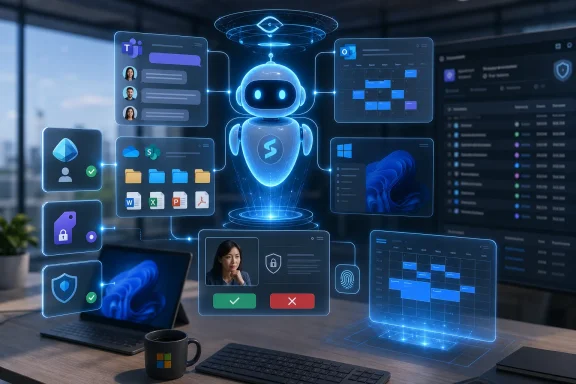
Microsoft announced Scout at Build on Tuesday, June 2, 2026, as an always-on workplace AI agent for Teams, email, calendars, and Microsoft 365 tasks, initially launching with a small customer group and a Frontier-access desktop app tied to GitHub Copilot. That makes Scout less a chatbot than a new kind of office identity: software that can read the room, act between meetings, and represent you while you are away. The pitch is productivity; the consequence is governance. Microsoft is no longer merely putting AI beside work — it is trying to put AI inside the chain of responsibility.

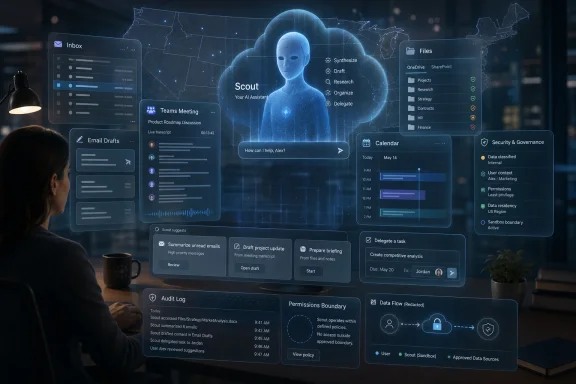
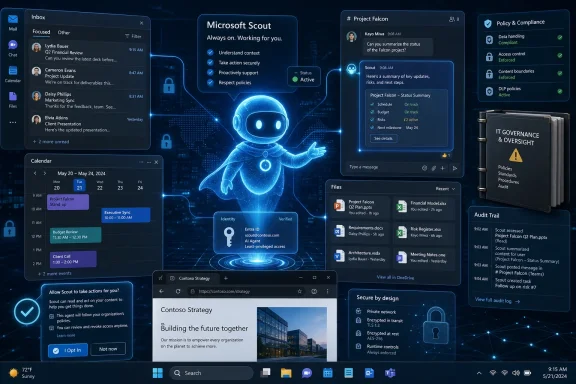
Office laptop display shows an AI assistant “Scout” managing emails, calendar, and tasks amid a city skyline.Microsoft Moves the Assistant From Sidebar to Seatmate​

The last three years of enterprise AI have largely been about summarization, drafting, and search. Copilot could turn a meeting into notes, an email thread into bullet points, or a blank document into first-draft prose. Scout changes the premise because it is not waiting politely in a sidebar for the next prompt.
According to WIRED’s reporting, Scout is meant to operate through Microsoft Teams as if it were a coworker, taking commands, scanning work context, and automating everyday coordination. It can examine messages, calendars, and email inboxes, then act on that information by drafting responses, rescheduling conflicts, or tracking promises across the organization.
That distinction matters. A summarizer is mostly retrospective. An agent that watches for obligations and proposes action is prospective. Microsoft is moving from “help me understand what happened” to “help me make sure the next thing happens.”
For WindowsForum readers, the important part is not the novelty of an AI assistant in Teams. It is the way Microsoft is using Teams as the social surface for automation. The same place where workers already negotiate deadlines, assign tasks, trade context, and make informal commitments is now becoming the place where a nonhuman actor can participate in that workflow.

The Real Product Is Permission​

Microsoft’s public language around workplace AI has increasingly leaned on “agents,” “frontier firms,” and “AI workforce transformation.” Scout fits neatly into that vocabulary, but the product’s practical power comes from something more prosaic: access.
An assistant that cannot see your calendar is a scheduling toy. An assistant that cannot read your email cannot track commitments. An assistant that cannot understand Teams conversations cannot tell the difference between a passing idea and an implied obligation. Scout’s usefulness grows in direct proportion to the sensitivity of the data it can inspect.
That is the bargain Microsoft is asking enterprises to make. The more deeply Scout is embedded in Microsoft 365, the more useful it becomes; the more useful it becomes, the more it must be governed like an identity, not a feature. The old question was whether Copilot had permission to summarize a document. The new question is whether Scout has permission to infer intent from a conversation and start moving work around the board.
This is where Microsoft’s broader Agent 365 strategy becomes relevant. The company has been positioning Agent 365 as a control plane for observing, managing, and securing AI agents across a tenant. Scout is exactly the kind of product that makes such a control plane necessary, because autonomous workplace agents cannot be treated as ordinary plugins once they begin acting across mailboxes, calendars, chats, and business systems.

OpenClaw Gives Scout Its Cultural Shape​

WIRED frames Scout as an enterprise agent built on top of OpenClaw, the agentic tool that reportedly became a fixation among early adopters in San Francisco at the start of 2026. That lineage is revealing, even if Microsoft’s enterprise version will inevitably be more locked down than the hacker-friendly inspiration.
OpenClaw’s appeal was not that it could answer questions. Plenty of models could do that. Its appeal was that it behaved like an always-available operator: persistent, tool-using, and capable of moving across apps and communication channels. In consumer or startup circles, that kind of autonomy looks like magic. In enterprise IT, it looks like a risk register.
Microsoft’s Scout appears to be an attempt to domesticate that energy. Instead of asking knowledge workers to run an agent through a terminal, wire up credentials, and hope for the best, Microsoft is bringing the concept into Teams and Microsoft 365, where administrators already have policies, audit logs, conditional access, retention rules, and compliance tooling.
That does not make the risk disappear. It changes who owns it. A self-hosted OpenClaw experiment is an individual’s problem until it leaks data or sends the wrong thing. A Microsoft 365 agent is the CIO’s problem from day one.

Teams Becomes the Office Floor for Nonhuman Labor​

Microsoft’s decision to make Scout feel like a Teams coworker is more than a user-experience flourish. Teams is the closest thing many organizations have to a digital office floor. It is where formal meetings blend into side-channel coordination, where decisions happen outside the ticketing system, and where “can you handle this?” becomes work without ever becoming a structured workflow.
Putting Scout in that environment makes the agent feel natural. It also makes its presence harder to ignore. A desktop assistant can be minimized. A Teams participant, bot, or agent occupies the same conversational space as people and projects.
That raises a subtle social question. If Scout drafts a response, who is speaking? If it proposes a new meeting time, who is negotiating? If it reminds a colleague that they promised something, is it acting as a polite assistant or a delegated enforcer?
Microsoft will likely answer that with permissions, labels, and audit trails. But organizations will answer it culturally. Some teams will treat Scout as a productivity layer. Others will see it as managerial instrumentation: another system watching who promised what, who followed through, and who is becoming a bottleneck.

The Calendar Example Is Small, but the Precedent Is Huge​

The example WIRED highlights from Omar Shahine is deliberately human: Scout can protect family dinner time by detecting meeting proposals that collide with a user’s preference and suggesting alternatives. It is a good demo because it frames automation as boundary-setting rather than surveillance.
But the same capability can be turned toward different institutional goals. Protecting dinnertime is one policy. Protecting executive review slots, sales follow-up windows, compliance deadlines, incident-response rotations, and customer escalations are others. Once Scout can infer priorities and negotiate schedule changes, the calendar becomes an execution surface.
That is not inherently bad. Calendar chaos is one of the great hidden taxes of modern office work. Anyone who has watched a six-person meeting bounce across a week because no human wants to mediate time zones understands the value of a competent scheduling agent.
The precedent is that software is now making soft decisions in the spaces between hard systems. Traditional workflow tools need a ticket, a due date, or a field. Scout can operate on fuzzier signals: a message, a preference, a recurring habit, a promise made in passing. That is both why it may work and why it will make administrators nervous.

The Commitment Tracker Is the Killer App and the Creepiest Feature​

The most interesting Scout use case in WIRED’s piece is not email drafting or meeting rescheduling. It is Shahine asking Scout to maintain a constantly updated list of promises made to him and promises he made to others. That is a deceptively powerful workplace primitive.
Organizations run on commitments that never reach Jira, Planner, ServiceNow, or Azure DevOps. They live in Teams threads, hallway follow-ups, email replies, and meeting transcripts. A system that can extract those commitments and keep them alive would solve a real coordination problem.
It would also create a new record of accountability. A human colleague forgets, forgives, misremembers, or lets things slide. A persistent agent does not have to. If Scout becomes good at tracking implicit obligations, it could change the texture of work from conversational to contractual.
That may delight managers and frustrate everyone else. The same “open tickets” reminder that helps a conscientious employee follow through could become a soft-surveillance mechanism in a performance culture obsessed with measurable output. The product design challenge is not simply accuracy. It is discretion.

Rough Edges Are Not a Side Note​

Shahine’s reported anecdote about his Scout sending an email as one long run-on sentence is funny because it is familiar. Generative AI can appear sophisticated right up until it does something obviously amateur. In a consumer chatbot, that is irritating. In an enterprise agent that sends mail on your behalf, it is a trust event.
Microsoft will emphasize iteration, previews, limited availability, and human supervision. That is sensible. But the rough edges are not merely cosmetic. Formatting mistakes are visible symptoms of a deeper uncertainty: when should the system be allowed to act, and when should it stop at a draft?
The industry likes to describe this as the “human in the loop” problem, but that phrase often hides the operational burden. If a user has to review every action, Scout becomes a more expensive drafting tool. If the user does not review enough actions, Scout becomes a liability. The commercial promise depends on finding a middle layer where low-risk actions can be delegated and high-risk ones require explicit approval.
That middle layer is hard to define across organizations. Rescheduling a one-on-one may be harmless in one company and politically sensitive in another. Sending a follow-up note may be routine for sales and dangerous for legal. An agent that works across Microsoft 365 must adapt not only to data boundaries but to office norms.

Enterprise IT Will Ask the Questions the Demo Avoids​

A Build-stage demo can show Scout making life easier. A real rollout will start with the questions that demos usually skip. Who can enable it? Which mailboxes, chats, and files can it read? Can administrators limit actions by department, geography, sensitivity label, or role? How are agent actions logged? Can eDiscovery capture what Scout saw, inferred, drafted, and sent?
Those questions are not hostile. They are the minimum requirements for deploying autonomous software inside regulated work. Microsoft has spent years convincing enterprises that Microsoft 365 can be a governed productivity platform rather than a sprawl of apps. Scout must inherit that trust, not assume it.
The GitHub Copilot subscription requirement for the Frontier desktop app is also telling. It suggests Scout is initially aimed at users and organizations already comfortable with agentic tooling, developer-adjacent workflows, or premium AI licensing. Microsoft is not throwing this into every tenant overnight. It is testing appetite and failure modes among customers more likely to tolerate experimentation.
That staged rollout is prudent, but it also creates a familiar Microsoft pattern. Frontier features arrive as opt-in experiments, gain usage inside enthusiastic accounts, become strategic, and then turn into licensing and governance decisions for everyone else. Sysadmins should treat Scout not as a curiosity but as a preview of what Microsoft thinks normal work will look like.

The Copilot Brand Is Becoming an Operating Model​

For much of its life, Copilot has been a brand stretched across too many surfaces: Windows, Edge, Office, GitHub, security, sales, service, and more. Scout points toward a clearer architecture. Copilot becomes the interface, agents become the workers, and Agent 365 becomes the management layer.
That is a stronger story than “AI in every app,” because it acknowledges that work does not happen inside one app. A customer escalation may begin in Outlook, move to Teams, require a CRM update, involve a spreadsheet, and end in a meeting. A useful AI assistant must cross those boundaries.
Microsoft has an obvious advantage here. It owns the productivity substrate for many enterprises: identity, email, calendar, chat, documents, endpoint management, compliance, and increasingly security telemetry. Scout’s promise depends on that substrate. Competing AI vendors can build better models or slicker agents, but they often need to ask Microsoft’s estate for the keys.
That advantage is also why regulators, competitors, and customers will watch closely. If Microsoft makes its own agents more capable, better integrated, or easier to govern than third-party agents, the company will face familiar questions about platform power. The Office bundle once shaped the application market. The agent bundle may shape the automation market.

The Always-On Coworker Changes the Meaning of Availability​

Scout’s most provocative idea is embedded in Shahine’s reported line that the point of a personal assistant is working when you are not. That sounds reasonable until it meets the politics of availability.
If Scout can act while you are away, your absence becomes less absolute. Colleagues may expect your agent to respond. Managers may expect commitments to keep moving after hours. Customers may expect follow-ups overnight. The boundary between “I am working” and “my automation is working” will become increasingly blurry.
Microsoft’s family-dinner example tries to frame Scout as a protector of personal time. It could be. An agent that declines meetings, blocks focus time, and shields users from scheduling chaos might be a rare technology that gives time back instead of absorbing more of it.
But tools that protect boundaries can also normalize work without the worker. If the agent can do enough, why should the workflow pause? Enterprises will need policies that say not only what Scout can access but what colleagues may expect from it. Otherwise, the always-on assistant becomes another step in the long erosion of being offline.

Security Teams Will See a New Kind of Insider​

Traditional enterprise security models divide the world into users, devices, apps, and services. Scout blurs those categories. It acts for a user, runs through Microsoft services, may appear in Teams, and can operate across data sources. That makes it less like a chatbot and more like a delegated insider.
The nightmare scenario is not a science-fiction rogue AI. It is a mundane chain of permissions, prompts, and misplaced trust. An agent reads something it should not. It forwards a summary with sensitive context. It follows an instruction in a compromised message. It drafts a response that creates legal exposure. It reschedules a meeting in a way that reveals confidential priorities.
Microsoft will likely lean on identity, consent, sensitivity labels, audit logs, and admin controls to answer those risks. Those tools matter, but agentic systems add a layer of interpretation between access and action. A user may be allowed to read a file; the agent may be allowed to help the user; the danger comes when the agent combines that file with other context and acts in a way no traditional permission rule anticipated.
Security teams should therefore think of Scout as an identity-adjacent actor. It needs least privilege, action boundaries, monitoring, and revocation. It also needs incident-response playbooks. If an agent sends the wrong message to the wrong group, the response cannot be “the model did it.”

Microsoft Is Selling Relief From the Work It Helped Create​

There is an irony at the center of Scout. Microsoft 365 helped create the modern flood of workplace signals: Teams pings, Outlook threads, calendar collisions, shared documents, meeting recordings, transcripts, task comments, and notification badges. Now Microsoft is selling an agent to survive that flood.
That does not make Scout cynical. The problem is real. Many knowledge workers spend large parts of the day translating between communication systems and action systems. They do not need another chatbot; they need a tireless coordinator that remembers context and nudges work forward.
But Microsoft’s incentive is not simply to reduce overload. It is to make Microsoft 365 the place where more work is captured, interpreted, and automated. The more Scout can help, the more reasons organizations have to keep conversations, files, and workflows inside Microsoft’s cloud. Productivity relief and platform gravity arrive in the same package.
This is why Scout deserves more scrutiny than a clever assistant demo normally gets. It is not just a feature; it is a wedge. If users come to rely on an agent that understands their Microsoft 365 life, switching costs rise from documents and mailboxes to habits, preferences, organizational memory, and delegated routines.

The Office Agent Wars Will Be Fought Over Trust, Not Chat​

Every major AI vendor can claim some version of workplace assistance. The differentiator will not be who can draft the most polished email in a canned demo. It will be who can earn enough trust to act in messy, permissioned, politically sensitive work environments.
Microsoft has a credible path because it already sells trust infrastructure to enterprises. Entra, Purview, Defender, Intune, Teams, Exchange, SharePoint, and compliance tooling give it levers that standalone AI firms do not control. Scout can be pitched as part of a governed estate rather than a rogue automation layer.
Still, trust is not inherited automatically from the tenant. Users will judge Scout by the first time it misreads a message, sends an awkward note, or exposes a preference they thought was private. Administrators will judge it by the clarity of logs, policies, and rollback. Executives will judge it by whether the productivity gains justify another layer of AI licensing.
The agent that wins the office will be the one that understands restraint. Microsoft’s challenge is to make Scout proactive enough to matter and cautious enough not to become infamous.

The First Scout Deployments Will Teach Microsoft More Than Users​

The limited customer launch is not just a cautious rollout; it is a data-gathering phase for workplace behavior. Microsoft needs to learn which tasks users delegate, which ones they reclaim, where approvals are necessary, and how often the agent’s suggestions are accepted or ignored.
This is why the early examples matter. Calendar protection, commitment tracking, reminders, and draft follow-ups are not random conveniences. They are high-frequency, relatively legible forms of office work. Microsoft is starting where the pain is obvious and the value proposition is easy to explain.
Over time, the temptation will be to expand Scout into more consequential workflows. Sales follow-ups lead to CRM updates. Meeting preparation leads to document generation. Commitment tracking leads to performance dashboards. Scheduling assistance leads to resource allocation. Each step may be defensible on its own; together, they redraw the map of office labor.
That progression will force organizations to decide whether Scout is a personal assistant, a team agent, or an enterprise automation worker. Those are different roles. Blurring them may make demos smoother, but it will make governance harder.

The Scout Era Starts With a Policy Memo, Not a Pep Talk​

The practical lesson for IT leaders is to prepare before the feature arrives broadly. Scout may be limited today, but Microsoft’s direction is clear: persistent agents are becoming first-class participants in Microsoft 365. Waiting until users discover them through Frontier access is how shadow automation begins.
Organizations should decide what counts as acceptable delegation. Drafting is different from sending. Suggesting a meeting time is different from moving one. Tracking commitments is different from reporting them upward. Reading a private chat is different from reading a project channel.
The work is not only technical. HR, legal, compliance, security, and line-of-business leaders all have stakes in how an always-on assistant represents employees. If Scout is allowed to act as a user, the company needs to define when that action is attributable to the user, when it is attributable to the organization, and when it should be blocked entirely.
That may sound heavy for a preview product, but the organizations that answer those questions early will have a real advantage. They will be able to use agents deliberately rather than reactively.

The Scout Checklist for Windows Shops​

Scout’s arrival is best understood as a preview of Microsoft’s next workplace operating model: AI agents with memory, access, and delegated action running inside the collaboration fabric. Before that model becomes routine, administrators and power users should separate the useful from the dangerous.
  • Scout is not just another Copilot chat surface; it is designed to act across Teams, email, calendar, and workplace context.
  • The most valuable features will require the most sensitive permissions, especially access to messages, inboxes, calendars, and organizational commitments.
  • Early availability through limited customers and Frontier-style access suggests Microsoft is still testing where autonomy helps and where it creates unacceptable risk.
  • IT teams should treat Scout-like agents as delegated identities that need governance, logging, least privilege, and revocation paths.
  • The cultural impact may be as important as the technical one, because an always-on assistant can quietly change expectations around availability, follow-through, and accountability.
  • The safest deployments will distinguish between drafting, recommending, and acting, rather than granting broad autonomy because the demo looked useful.
Scout is Microsoft’s clearest signal yet that the future of Microsoft 365 is not a smarter search box but a workplace populated by software agents that can observe, infer, and act. That future may remove a great deal of administrative sludge from office life, but only if enterprises resist the fantasy that autonomy is the same thing as judgment. The next phase of Windows and Microsoft 365 administration will be less about installing apps and more about supervising digital coworkers — and the organizations that learn to manage those coworkers early will shape whether this becomes liberation from busywork or just another always-on system demanding trust it has not yet earned.

References​

  1. Primary source: WIRED
    Published: Tue, 02 Jun 2026 18:00:00 GMT
  2. Related coverage: bighatgroup.com
  3. Related coverage: newclawtimes.com
  4. Related coverage: visualstudiomagazine.com
  5. Related coverage: subagentic.ai
  6. Related coverage: techradar.com
  1. Related coverage: winbuzzer.com
  2. Related coverage: wwwhatsnew.com
  3. Related coverage: windowscentral.com
  4. Related coverage: cybernews.com
  5. Related coverage: letsdatascience.com
  6. Official source: microsoft.com
  7. Official source: download.microsoft.com
  8. Official source: blogs.microsoft.com
  9. Official source: adoption.microsoft.com
  10. Official source: techcommunity.microsoft.com
  11. Official source: build.microsoft.com
  12. Official source: developer.microsoft.com
  13. Related coverage: itpro.com
  14. Official source: marketing.partner.microsoft.com
 

Microsoft Scout is a new always-on Microsoft 365 personal assistant entering desktop preview for select US Frontier customers this week, designed to read work context across Outlook, OneDrive, Teams, calendars, transcripts, and email so it can organize tasks and take action for employees. The pitch is simple and unsettling: Copilot answers from inside the app; Scout follows the worker across the day. Microsoft is not just adding another chatbot to the ribbon. It is trying to turn the office suite into a managed delegation layer, with all the productivity promise and security dread that implies.

A man reviews an AI “Scout” assistant dashboard with cloud security and office task panels.Microsoft Moves From Helpful Sidebar to Digital Delegate​

For the last three years, Microsoft’s AI strategy has mostly been about putting Copilot where knowledge workers already stare. Word got drafting help, Excel got analysis help, Outlook got summaries, Teams got meeting recaps, and Windows got a branded assistant that has been redesigned more times than most users can count. Scout belongs to a different category.
The difference is agency. A Copilot pane waits for a prompt, even when it is deeply integrated into the document or mailbox in front of you. Scout is described as a personal assistant that watches the broader pattern of your work, notices what matters, and initiates action or advice without being summoned in the same narrow way.
That is why Microsoft’s “first real personal assistant” framing matters. It is an admission, whether intended or not, that most previous AI assistants were not assistants in the human sense. They were interfaces. Scout is Microsoft saying the next competitive frontier is not a better text box, but a system that can remember, infer, schedule, warn, draft, and occasionally interrupt.
The Verge’s interview with Omar Shahine, corporate vice president of Microsoft Scout, captures the strategic turn neatly: users should expect something more like a phone call from an assistant than a chat session with a model. That is a profound change in posture. Software that calls you because it believes you need to leave for an appointment is no longer a passive tool; it is participating in the rhythm of your day.

The Office Graph Finally Gets a Pair of Hands​

Microsoft has spent more than a decade building connective tissue across its productivity stack. Exchange knows your calendar, Teams knows your meetings, OneDrive and SharePoint know your files, Outlook knows your correspondence, and Microsoft Graph has long promised to make those relationships programmable. Scout is what happens when that data layer is paired with a modern agent runtime.
The examples are deliberately mundane: organizing calendars, filling out expense reports, drafting email, handling travel, completing forms, and keeping track of commitments that are scattered across chats and transcripts. That mundanity is the point. Enterprise AI will not become indispensable because it writes a poem about quarterly planning; it becomes indispensable if it quietly closes the thousand tiny loops that make office work feel like office work.
There is also a reason Microsoft is starting with the Microsoft 365 environment rather than a general consumer assistant. The company already controls the identity layer, the document stores, the collaboration surfaces, the admin centers, and much of the compliance infrastructure. In a consumer setting, an always-on agent must beg for integrations. In Microsoft 365, the agent is being born inside the castle.
That castle, however, is full of crown jewels. Teams transcripts are not casual context; they often contain strategy, personnel issues, customer escalations, pricing debates, legal concerns, and security incidents. Email still carries contracts, credentials, personal data, and the accidental honesty of corporate life. OneDrive and SharePoint can be tidy in theory and chaotic in practice. Scout’s usefulness is directly proportional to its access, which is precisely why it is risky.

OpenClaw Gives Microsoft Speed, and Gives Admins Heartburn​

The surprise in Microsoft’s approach is not that it wants an agentic assistant. Everyone does. The surprise is that Scout is tied to OpenClaw, the open-source personal AI assistant project that became famous because it could actually do things and infamous because “actually doing things” is a security boundary with marketing copy attached.
OpenClaw’s appeal is obvious. It provides an agent framework with skills, plugins, messaging integrations, memory, and the ability to operate across services rather than inside a single application silo. For developers and power users, that is intoxicating. For security teams, it looks like a fast-moving ecosystem of executable delegation running close to sensitive credentials and data.
Microsoft’s reported decision to contribute to the core project rather than simply clone it is strategically clever. It lets Redmond move with the velocity of a community that has already proven demand, while positioning Microsoft as a stabilizing enterprise force rather than a late-arriving imitator. It is also a reputational gamble. The company is now associating its enterprise trust story with a project whose most compelling demonstrations are also the reason cautious administrators flinch.
Shahine’s explanation is that Microsoft treats OpenClaw as untrusted, runs it in a sandboxed cloud environment, and prevents it from directly holding secrets or Microsoft 365 data. That is the right conceptual answer. The more difficult question is whether the system around the sandbox can reliably prevent the messy realities of agentic work: malicious skills, prompt injection, confused-deputy failures, overbroad permissions, and users approving actions because the assistant sounds confident.
This is the old macro problem reborn at cloud scale. Office macros were powerful because they let documents do work; they were dangerous for the same reason. Agents are more sophisticated, more conversational, and potentially more governed, but the fundamental bargain is familiar. Automation becomes valuable when it crosses from suggestion into execution, and that crossing is where attackers start shopping.

Microsoft’s Security Stack Becomes Part of the Product Pitch​

Microsoft knows Scout cannot be sold as a clever assistant alone. The enterprise buyer will ask a harsher set of questions before the first pilot expands beyond a friendly internal group: Who can see what the agent saw? Who approved what the agent did? What happens when an employee leaves? Can the agent be disabled, scoped, audited, investigated, and litigated?
That is where Agent 365, Purview, Defender, and the broader Microsoft security estate become more than adjacent products. They are the answer Microsoft will give when customers ask why they should trust an always-on assistant inside their tenant. Scout is not merely a productivity feature; it is a test case for whether Microsoft’s agent governance story can survive contact with real work.
Agent 365 is especially important because agents create an identity and lifecycle problem. A human employee can be assigned a manager, a department, a license, a retention policy, and conditional access rules. An agent needs an equivalent set of controls, or it becomes a piece of shadow automation with enterprise credentials and no clear owner. Microsoft’s pitch is that agents should be managed with the same seriousness as users, apps, and devices.
Purview matters because Scout’s greatest strength is also its compliance exposure. If an assistant reads transcripts, drafts emails, processes files, and remembers preferences, its outputs and activity may become discoverable business records. Defender matters because agent behavior will need threat detection tuned for the weirdness of AI-driven action: an unusual file access pattern, an unexpected external connector, or a skill attempting something outside its declared purpose.
The hard part is not naming the security products. Microsoft is very good at naming security products. The hard part is making the defaults conservative enough for enterprises without neutering Scout into another demo-friendly assistant that users abandon after two weeks. The agent has to be able to act, but not too freely; personalize, but not creepily; remember, but not hoard; interrupt, but not become Clippy with a badge scanner.

The Preview Strategy Says Microsoft Knows the Blast Radius​

Scout is beginning with a desktop preview for Frontier customers in the United States, with broader but still limited previews planned before the cloud-based always-on version expands. That rollout pattern is not just product caution. It is risk containment.
A desktop preview lets Microsoft learn from real workflows while keeping the deployment relatively bounded. Internal usage by more than 3,000 Microsoft employees is useful, but Microsoft employees are not normal customers. They are unusually AI-literate, unusually tolerant of rough edges, and surrounded by the people who built the product. The real enterprise test begins when Scout enters tenants with legacy permissions, uneven retention policies, unmanaged SharePoint sprawl, and executives who forward confidential documents with subject lines like “FYI.”
The cloud version is the more consequential milestone. An always-on assistant running in the cloud can be more available, more deeply integrated, and more centrally governed. It can also become a persistent actor inside a tenant, not just a local app a user launches. That shift will force customers to decide whether Scout is an employee-level convenience, an enterprise-controlled role, or something in between.
The staged release also gives Microsoft time to learn where users actually want delegation. Calendar management and meeting prep are safer early wins because the cost of error is usually embarrassment or inconvenience. Expense reports, travel booking, and form completion raise the stakes because they touch money, policy, and external systems. Email drafting is useful, but sending on behalf of a user is where “assistant” becomes “representative.”
This is why the product’s success will be measured less by benchmark charts than by incident reports. If Scout saves users hours without creating viral stories about deleted inboxes, leaked documents, or runaway bookings, Microsoft will have room to accelerate. If early deployments produce messy failures, every administrator who warned that agentic AI needed another year will feel vindicated.

Google’s Shadow Makes This an Enterprise Platform Race​

Scout is also a competitive answer to Google’s push around Gemini Spark and Workspace. The two companies are converging on the same thesis: the productivity suite is no longer a bundle of apps but a substrate for agents. Whoever owns the mail, calendar, documents, meetings, files, and identity layer has the best shot at owning the personal assistant of work.
Google has structural advantages in Gmail, Docs, Calendar, and a consumer AI brand that has recovered from its early stumbles. Microsoft has the enterprise distribution advantage, the Windows endpoint, the Office file formats, Teams, Entra ID, and the security stack that large organizations already pay for. The race is not simply which model is smarter. It is which ecosystem can persuade customers to let an AI assistant act across business context with enough control to pass an audit.
The phrase personal assistant of the enterprise sounds contradictory, but that contradiction is the product category. A real assistant must learn the individual: preferences, habits, priorities, routes, family logistics, recurring obligations, and tolerance for interruption. An enterprise assistant must obey the organization: retention rules, data boundaries, role-based access, acceptable-use policies, insider-risk monitoring, and contractual obligations.
That tension will define the next phase of Microsoft 365. If Scout becomes too personal, corporate privacy teams will object. If it becomes too corporate, users will ignore it. The sweet spot is a narrowly miraculous assistant that knows enough to help but not enough to alarm, acts enough to save time but not enough to become a liability, and feels like a worker’s delegate rather than management’s new telemetry layer.
Microsoft has tried to make assistants feel human before, sometimes disastrously. Scout’s difference is that it is arriving after the workplace has already accepted AI summarization and drafting as normal. The cultural barrier is lower now. The operational barrier is much higher.

The Privacy Question Is Not Whether Scout Reads Your Work​

The obvious privacy objection is that Scout reads Teams threads, transcripts, email, and calendar data in the background. But that is not the full issue, because Microsoft 365 already processes that material in countless ways: search indexing, eDiscovery, retention, malware scanning, data loss prevention, audit logs, and Copilot grounding. The sharper question is what Scout infers, remembers, and initiates from that material.
A search index helps you find a document. An assistant may decide that the document means you owe someone a response, that your manager cares about the topic, that a meeting should be rescheduled, or that you tend to ignore a certain category of task. Those inferences are where the personal-assistant metaphor becomes real. They are also where workers may feel that ordinary collaboration has turned into behavioral modeling.
There is a difference between “summarize this meeting” and “monitor my meetings for things I appear to be avoiding.” The latter could be genuinely helpful. It could also become a new form of productivity surveillance if organizations are careless or aggressive. Microsoft will likely stress user control and tenant governance, but the lived experience will depend on defaults, admin settings, licensing incentives, and workplace culture.
The road-traffic example illustrates the boundary problem nicely. To recommend when you should leave for an appointment, Scout needs location context, calendar context, and some understanding of the personal importance of the destination. For a field technician, that may be a business necessity. For a parent juggling school pickup and dinner plans, it is an intimate convenience. The same feature can be either benign or invasive depending on who controls it and who can review its traces.
IT departments should therefore treat Scout not as another app rollout, but as an information governance event. Before enabling an always-on assistant, organizations need to know whether their permissions model is already sane. If users can currently access too much, Scout may make that excess more visible, more actionable, and more dangerous.

The Assistant That Works Too Well Creates New Labor Politics​

There is another layer Microsoft will not emphasize in launch materials: Scout changes the social contract of office work. If every employee can have a virtual assistant that schedules, drafts, follows up, and prepares, the baseline expectation for responsiveness may rise. The time saved by automation often becomes the new minimum.
This has happened before. Email made communication faster and then made constant communication expected. Smartphones made workers reachable and then made delayed replies feel like choices. Collaboration tools promised transparency and then created more channels to monitor. Scout may reduce administrative toil for individuals, but organizations have a habit of converting efficiency into throughput.
That does not make Scout bad. Administrative work is real work, and much of it is tedious, fragmented, and cognitively expensive. A good assistant that catches missed commitments, prepares meeting briefs, and handles paperwork could make many jobs less chaotic. It could especially help workers who are organized in thought but not in inbox hygiene, which is a larger population than most productivity gurus admit.
But enterprise adoption will need norms, not just controls. When is it acceptable for Scout to contact another person? Should an AI-generated follow-up be labeled? Can an employee delegate scheduling negotiations to Scout without annoying colleagues? Does a manager get to require employees to use it? These are not purely technical questions, and Microsoft’s customers will answer them unevenly.
The most successful deployments will probably start with clearly bounded jobs. Meeting preparation, task extraction, travel planning, and document retrieval are easier to normalize than autonomous outbound communication. The danger is that vendors and executives often want the sci-fi version before the boring version is trusted.

The Old Copilot Business Model Meets a New Kind of Dependency​

Microsoft’s Copilot rollout has already taught customers that AI in Microsoft 365 is not a single feature but a licensing strategy. Scout will almost certainly intensify that dynamic, even if preview access begins in a limited program. Agentic capabilities need compute, governance, connectors, logging, and support, all of which map neatly onto premium tiers.
For Microsoft, this is the dream: a high-value assistant that makes Microsoft 365 stickier, increases demand for security and compliance add-ons, and makes rival productivity suites harder to adopt. Once an employee’s assistant learns their habits inside Outlook, Teams, OneDrive, and Microsoft Graph, switching costs become psychological as well as technical. The more useful Scout becomes, the more it binds the user to the ecosystem.
For customers, that dependency is both attractive and dangerous. A deeply integrated assistant can outperform a generic AI tool because it knows the local terrain. But it also concentrates workflow intelligence inside one vendor’s stack. Enterprises that already worry about Microsoft 365 lock-in will see Scout as another layer of gravity.
The OpenClaw angle complicates this. Microsoft can argue that it is not building a sealed proprietary agent from scratch, and that contributing to open-source infrastructure benefits the ecosystem. Yet the managed enterprise value will still live in Microsoft’s cloud, Microsoft’s identity controls, Microsoft’s compliance tooling, and Microsoft’s commercial packaging. Open source may provide the engine; the toll road is still Microsoft 365.
That is not hypocrisy. It is platform strategy. The question is whether customers receive enough transparency and portability to avoid being trapped by their own assistants.

The Test Is Boring Reliability, Not Demo Magic​

The demos will be impressive because agent demos always are. An assistant that reads your schedule, notices traffic, drafts an email, pulls a file, books travel, and reminds you about school pickup feels like the future arriving politely. The real test is the fifth week, not the first five minutes.
Does Scout learn preferences without overfitting to accidents? Does it distinguish a serious Teams commitment from a sarcastic aside? Does it know when not to interrupt? Does it ask for confirmation at the right moments, or does it turn every small action into another approval queue? Does it recover gracefully when a connector fails, a policy blocks access, or a user changes their mind mid-task?
These details decide whether users keep trusting the assistant. A human assistant can ask clarifying questions and read organizational nuance. An AI assistant must approximate that through context, policy, and interaction design. Too little autonomy and it becomes a glorified reminder app. Too much autonomy and it becomes a compliance incident waiting for a postmortem.
Microsoft has an advantage here because it can learn from enormous internal and customer telemetry, assuming privacy and compliance boundaries allow it. It also has the burden of scale. A small startup can survive quirky failures among enthusiasts. Microsoft is selling into banks, hospitals, law firms, manufacturers, schools, governments, and global enterprises where quirky failures become procurement blockers.
The Scout preview, then, should be read as a negotiation with the market. Microsoft is asking customers how much autonomy they will tolerate in exchange for relief from administrative sludge. Customers should answer carefully.

The Scout Era Will Reward Tenants That Cleaned Their House​

The practical lesson for WindowsForum readers is not to panic about Scout, and not to treat it as magic. Treat it as an accelerant. It will amplify whatever state your Microsoft 365 environment is already in.
Organizations with disciplined identity management, least-privilege access, sensitivity labeling, retention policies, device controls, and audit readiness will be better positioned to test Scout safely. Organizations with sprawling SharePoint permissions, abandoned Teams, unlabeled confidential files, and unclear ownership will discover that an agent does not create governance problems so much as make them executable.
That is the part of the story that can get lost in the assistant hype. Scout may be new, but the preparation work is old-fashioned IT hygiene. The enterprises that benefit first will not necessarily be the ones most excited about AI. They will be the ones that know who owns data, who can access it, and what should happen when software acts on behalf of a person.
  • Microsoft Scout marks a shift from Copilot as an in-app helper to an always-on assistant that can monitor context and initiate action across Microsoft 365.
  • The OpenClaw foundation gives Microsoft speed and agentic capability, but it also imports the security anxieties of a fast-moving open-source automation ecosystem.
  • The preview rollout suggests Microsoft understands that a cloud-based personal assistant has a larger blast radius than another chat feature.
  • Agent 365, Purview, Defender, and Entra are not side notes to Scout; they are the trust architecture Microsoft needs in order to sell it to enterprises.
  • Administrators should review permissions, retention, labeling, audit, and agent governance before treating Scout as a routine productivity add-on.
  • The decisive question is not whether Scout can perform impressive tasks, but whether it can do ordinary work reliably without creating extraordinary risk.
Microsoft is betting that the next era of productivity software will be defined by delegation rather than composition, and Scout is the clearest sign yet that the company wants Microsoft 365 to host that delegation before anyone else does. If it works, the assistant will fade into the workday in the way the best infrastructure does: noticed mostly when absent. If it fails, it will fail in precisely the places enterprises fear most — privacy, control, trust, and accountability — which is why this preview is more than another AI launch. It is an early trial of whether the modern workplace is ready to let software stop waiting for instructions and start acting like staff.

References​

  1. Primary source: The Verge
    Published: Tue, 02 Jun 2026 18:00:00 GMT
  2. Related coverage: docs.openclaw.ai
  3. Related coverage: openclaw.ai
  4. Related coverage: openclaw.site
  5. Related coverage: openclaw-ai.net
  6. Related coverage: openclaw.page
  1. Related coverage: myopenclaw.cloud
  2. Related coverage: techradar.com
  3. Related coverage: tomsguide.com
  4. Related coverage: windowscentral.com
  5. Related coverage: arturmarkus.com
  6. Related coverage: labs.cloudsecurityalliance.org
  7. Related coverage: imda.gov.sg
  8. Official source: download.microsoft.com
  9. Official source: microsoft.com
  10. Official source: blogs.microsoft.com
  11. Official source: learn.microsoft.com

  12. Official source: techcommunity.microsoft.com
  13. Official source: news.microsoft.com
  14. Official source: adoption.microsoft.com
  15. Related coverage: winbuzzer.com
  16. Related coverage: secureinseconds.com
  17. Related coverage: itpro.com
  18. Official source: cdn-dynmedia-1.microsoft.com
 

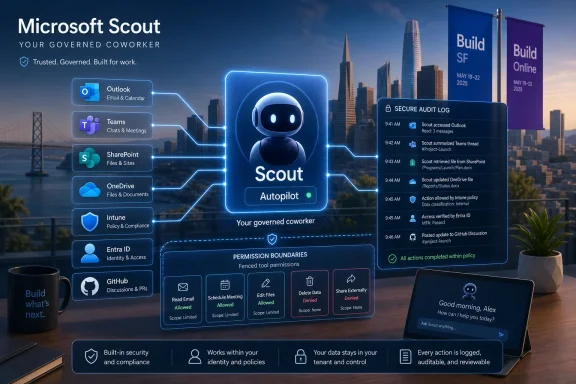
Microsoft announced Scout on June 2, 2026, at its Build developer conference in San Francisco and online, positioning the OpenClaw-powered assistant as an always-on personal work agent for Frontier organizations using Microsoft 365, Intune policy controls, and GitHub Copilot licensing. The interesting part is not that Microsoft has another AI assistant. The interesting part is that Scout is Microsoft’s first serious attempt to turn the personal agent from a chat window into a governed workplace actor. If Copilot was Microsoft’s answer to ChatGPT at work, Scout is its answer to the messier question of what happens when software starts doing work before you ask.

Microsoft Scout “autopilot” dashboard with secure audit log and cloud app links over a city skyline.Microsoft Turns the Assistant Into a Coworker With a Badge​

Scout arrives with the vocabulary of a new category. Microsoft calls it an “Autopilot” agent: always on, able to act autonomously, and designed to operate with its own identity rather than merely replying inside a prompt box. That framing matters because it moves the product out of the familiar chatbot lane and into the much more dangerous territory of delegated action.
The promise is easy to understand. Scout watches the flow of work across Microsoft 365, learns the rhythms of a user’s day, and takes on coordination tasks that usually fall between applications. Microsoft’s examples include monitoring a GitHub discussion, identifying the right feature owners across Microsoft 365 data, opening Teams chats to track status, and setting an out-of-office block after checking the calendar.
That is not magic, and it is not entirely new. Power users have stitched together approximations of this experience for years with Outlook rules, Power Automate, scripts, Zapier-style workflows, and a great deal of resignation. What Scout changes is the interface between intent and execution. Instead of asking users to define every trigger and condition in advance, Microsoft wants a persistent agent to infer more of the workflow from context.
This is the dividing line between “AI feature” and “AI worker.” A feature helps you write a paragraph, summarize a meeting, or draft an email. A worker notices that the email, meeting, document, and person all belong to the same unresolved problem, then starts moving pieces around. For enterprises, that distinction is thrilling right up to the moment it becomes a compliance incident.

OpenClaw Gives Microsoft Both Its Shortcut and Its Headache​

The OpenClaw connection is the headline because it gives Scout cultural momentum Microsoft could not manufacture by itself. OpenClaw became a shorthand for the new wave of personal agents: local, persistent, tool-using, and willing to reach across files, browsers, inboxes, calendars, and web services. It captured the imagination of developers because it felt less like a chatbot and more like a slightly reckless intern with shell access.
That recklessness is also why OpenClaw is such a complicated foundation for an enterprise story. A personal agent with broad local access is useful precisely because it can touch the parts of work that conventional SaaS assistants cannot. But the same reach that lets an agent clear an inbox, schedule travel, modify files, or operate a browser also creates a much larger blast radius when the model misunderstands instructions, follows malicious prompt injections, or acts with credentials it should never have held.
Microsoft appears to understand that the OpenClaw brand brings two messages at once. The first is speed: the open-source world has been iterating on personal agents faster than large vendors can package them. The second is danger: the most capable agent demos often depend on permissions that no competent security team would grant in production without serious isolation, auditing, and identity controls.
Scout is Microsoft’s attempt to domesticate that energy. It borrows the OpenClaw-powered model of a persistent work companion but wraps it in Microsoft’s preferred enterprise language: Entra identity, Intune configuration, tenant governance, auditability, and policy enforcement. That may sound less exciting than an agent that does anything on your laptop. It is also the only version that has a realistic chance of surviving a meeting with a chief information security officer.

The Real Product Is the Trust Layer​

Microsoft’s most important Scout announcement is not the demo. It is the trust model. Scout is supposed to operate under its own governed Entra identity, making its actions attributable to a known actor rather than disappearing into the fog of a shared service account or a user’s ordinary credentials. That design choice is not a detail; it is the basis for making autonomous agents manageable inside a real organization.
Enterprise IT has learned the hard way that automation without attribution becomes archaeology. When a script changes a file, a connector sends data to the wrong place, or a workflow approves something it should not have approved, administrators need to know what acted, under whose authority, with which policy, and from which device or service boundary. Agents intensify that requirement because their behavior is probabilistic, contextual, and often difficult to predict from a static configuration screen.
Scout’s early access requirements reinforce that Microsoft is treating this as a controlled experiment rather than a broad productivity feature. Frontier enrollment, Intune policy configuration, opt-in attestation, and a GitHub Copilot account or license are all friction points by design. They narrow the audience to organizations willing to test unfinished agent behavior under explicit administrative control.
That is the right posture. It also reveals how far the market is from the consumer fantasy of “everyone gets a personal AI employee.” In the enterprise, the first question is not whether Scout can draft a meeting agenda. It is whether the agent can be disabled, scoped, logged, reviewed, and constrained before it touches sensitive data. Microsoft is selling autonomy, but it is really selling autonomy with paperwork.

Copilot Was Reactive; Scout Wants to Be Ambient​

Microsoft has spent the past few years pushing Copilot into Windows, Edge, Office, Teams, GitHub, and security tools. Much of that effort has been about putting a generative assistant close to where people already work. The user still usually starts the exchange: ask, summarize, draft, rewrite, explain, create.
Scout changes the implied rhythm. It is designed to stay active in the background, using Work IQ as a context engine and Microsoft 365 data as the map of a user’s professional world. In Microsoft’s telling, Scout should learn the people, files, calendars, chats, and recurring patterns that define how a user actually gets things done.
That shift is subtle but profound. Reactive assistants compete for attention; ambient agents compete for trust. A chatbot can be wrong in a draft, and the user can discard the draft. An agent that opens conversations, changes schedules, moves files, or triggers follow-up work creates external consequences. It alters the shared environment.
The best version of Scout could reduce the cognitive load that makes modern office work feel like permanent air-traffic control. The worst version could become another source of invisible motion: Teams threads opened too early, status pings sent to the wrong people, calendar blocks created with misplaced confidence, and “helpful” interventions that require human cleanup. The difference will depend less on model cleverness than on restraint.

Microsoft 365 Is the Only Place This Strategy Makes Sense​

Scout also shows why Microsoft’s AI strategy keeps returning to Microsoft 365. The company has an advantage that model labs and open-source projects do not: it already sits inside the productivity graph of millions of organizations. Outlook knows the meeting. Teams knows the conversation. SharePoint and OneDrive know the files. Entra knows the identities. Intune knows the device posture. Purview, Defender, and the rest of Microsoft’s security stack know at least part of the governance story.
A personal agent needs that graph to be useful. Without it, the agent is a clever outsider asking for permissions one integration at a time. With it, Scout can become a native participant in the workplace fabric, assuming Microsoft can avoid turning every action into a licensing puzzle and every workflow into an admin maze.
This is also why Scout is a defensive product. If agents become the next interface to work, Microsoft cannot afford to let them live outside Microsoft 365. A third-party agent that reads Outlook, browses SharePoint, files tickets, writes documents, and schedules meetings becomes a new control plane above Microsoft’s applications. In that world, Word, Teams, and Outlook risk becoming backend services for someone else’s agent.
Scout is Microsoft’s bid to prevent that inversion. It says: the agent should live where the work lives, under the same identity and compliance framework, with Microsoft’s context engine doing the reasoning. That is a persuasive pitch for IT departments. It is also a reminder that the AI assistant war is no longer about who has the friendliest chat UI. It is about who owns the layer where decisions become actions.

The Windows Angle Is Bigger Than It Looks​

Although Scout is primarily a Microsoft 365 story, Windows is quietly central to the strategy. Microsoft says Scout extends through a desktop app to browsers, local resources, and model context protocol servers. That matters because the boundary between cloud work and local work remains porous, especially for developers, analysts, administrators, designers, and anyone whose job depends on files and tools that do not live neatly inside a SaaS pane.
For WindowsForum readers, this is where Scout becomes more than another Microsoft 365 announcement. A governed desktop agent raises practical questions about file system access, browser automation, local credentials, endpoint detection, app control, and device policy. The agentic future will not be confined to the browser tab; it will touch the endpoint.
Microsoft’s broader Build announcements point in the same direction. Windows is being adapted for developers and agents, with more attention to local AI workloads, sandboxing, command-line workflows, and agent execution environments. The old PC was a machine a person operated. The emerging PC is a machine that people and agents may operate together, sometimes concurrently.
That creates a new administrative problem. Endpoint management used to distinguish between user activity, application activity, and system activity. Agents blur all three. When Scout performs a local action on behalf of a user, administrators will need telemetry that says not only what happened but why the agent believed it was authorized to happen. “The user clicked it” was already a fragile assumption. In the agent era, it may become useless.

The Security Model Has to Survive Prompt Injection, Not Just Policy Review​

Microsoft’s emphasis on governed identity and policy configuration is necessary, but it is not sufficient. Agents that read untrusted content and then take action are exposed to a class of risks that traditional automation platforms were not built to handle. A malicious email, document, webpage, issue comment, or chat message can become part of the agent’s instruction environment.
That is the prompt-injection problem in its most practical form. It is not an abstract AI safety debate. It is the possibility that an agent tasked with summarizing a message also interprets hidden or adversarial text as operational instruction. When the agent can send email, edit documents, interact with internal systems, or manipulate local files, that confusion becomes an attack path.
OpenClaw’s popularity made these concerns impossible to ignore because the framework’s appeal was tied to broad capability. Microsoft’s version needs to prove that it can separate user intent, organizational policy, tool permissions, and untrusted content. That is a hard technical problem, and no amount of enterprise branding makes it disappear.
The company’s likely answer is layered control: identity boundaries, tool scoping, admin policy, logging, runtime isolation, human-visible progress, and evaluation frameworks that test agent behavior against rules. That is sensible. But the crucial question for customers is whether those controls are intelligible. If only AI specialists can understand why Scout did something, the product will struggle in the same regulated environments it is designed to court.

Frontier Is a Beta Program With Legal Implications​

Microsoft’s Frontier program has become the staging area for agentic features that are too important to hide and too immature to release broadly. Scout fits that pattern. It is available to Frontier organizations through an early experimental release, not as a general Microsoft 365 feature that every tenant admin must immediately confront.
That helps Microsoft manage expectations, but it does not make the experiment trivial. When a company enables Scout, it is not merely testing a new UI. It is testing a new delegation model. The organization is deciding how much judgment can be embedded in software that watches work, infers priorities, and acts under a governed identity.
The legal and compliance implications will vary by industry, but the common thread is accountability. If Scout sends the wrong information, schedules the wrong meeting, acts on stale data, or triggers a workflow based on a misunderstood policy, who owns the error? The user who configured it? The admin who allowed it? Microsoft? The agent’s audit log may show what happened, but it will not automatically settle responsibility.
This is why early enterprise adoption will likely concentrate among developers, IT teams, and internal productivity groups before expanding into sensitive business processes. Developers tolerate rough edges if the payoff is high. Regulated business units do not. Microsoft knows this, which is why GitHub Copilot licensing and Frontier enrollment make sense as a first filter.

The Agent Store Era Will Test Microsoft’s Governance Promises​

Scout also sits inside a larger Microsoft ambition: agents as a new application model. At Build, Microsoft talked about agent frameworks, hosted agents, evaluation, grounding, policy specifications, and production trust. Scout is the personal face of that strategy, but the infrastructure story is broader.
If Microsoft succeeds, organizations will not deploy one agent. They will deploy many: personal agents, role-specific agents, workflow agents, security agents, developer agents, and line-of-business agents. Some will be built by Microsoft, some by partners, some by internal teams, and some by employees adapting templates to their own work.
That future will strain every governance system Microsoft is now advertising. Admins already struggle with app sprawl, Teams app permissions, OAuth grants, Power Platform connectors, and shadow automation. Agents add memory, tool use, context retrieval, and autonomous execution to the pile. The difference between a useful agent ecosystem and a compliance nightmare will be whether Microsoft can make agent permissions as reviewable as app permissions and as enforceable as device policy.
The product design challenge is equally serious. Users need enough visibility to trust Scout without being forced to approve every trivial action. Administrators need enough control to prevent damage without reducing the agent to a glorified macro. Microsoft has to find the middle ground: autonomy that is meaningful but not opaque, configurable but not unusable, proactive but not presumptuous.

The Productivity Pitch Is Stronger Than the User Experience May Be​

The case for Scout rests on a real pain point. Modern work is fragmented across too many channels, too many notifications, and too many half-finished commitments. People spend an absurd amount of time translating one artifact into another: an email into a task, a meeting into a follow-up, a chat into a decision, a GitHub thread into a status update, a document comment into a Teams conversation.
Scout is aimed squarely at that translation layer. If it can turn ambient context into useful coordination, it could be more valuable than another writing assistant. The average office worker does not need infinite prose generation. They need fewer dropped balls.
But Microsoft should not underestimate how easily “helpful” becomes invasive. Users have spent years fighting notification overload in Teams and Outlook. An always-on agent that opens chats and nudges colleagues may save time for one person while creating work for five others. At scale, agentic productivity can become agentic spam.
That is where organizational norms will matter as much as software controls. Companies will need etiquette for agent behavior: when an agent may contact colleagues, when it must stay silent, when it can schedule meetings, when it should draft rather than send, and when human confirmation is mandatory. The first Scout deployments will not just test Microsoft’s technology. They will test whether workplaces can absorb non-human participants without making collaboration even noisier.

Microsoft’s AI Economics Are Hiding in Plain Sight​

Scout is also a business model story. Microsoft has poured enormous investment into AI infrastructure and has steadily looked for ways to convert Copilot enthusiasm into paid enterprise adoption. A persistent personal agent gives Microsoft a stronger value proposition than a chat assistant that many users treat as optional.
The pricing and access details around Scout suggest a premium trajectory. Requiring a GitHub Copilot account or license for early access places the first wave near developers and power users, where agentic workflows are easier to justify. Frontier enrollment keeps the feature experimental while giving Microsoft customer feedback from organizations already inclined to test advanced AI.
Over time, the natural question is whether Scout becomes part of a higher-tier Microsoft 365 AI bundle, a standalone add-on, or a platform capability that underpins multiple products. Microsoft has been moving toward a world in which organizations manage not just human seats but agent capacity, agent identities, and consumption-based workloads. Scout fits neatly into that commercial architecture.
That may irritate customers who already feel subscription fatigue. Yet the economics of always-on agents are not the economics of spellcheck. Persistent context, tool execution, monitoring, grounding, auditing, and model inference all cost money. Microsoft will argue that Scout saves expensive human time. Customers will ask whether the savings are measurable or merely another promise wrapped in a new SKU.

The Windows Admin’s Job Gets More Interesting and More Annoying​

For sysadmins, Scout is not something to dismiss as a knowledge-worker toy. The agent model will eventually collide with endpoint policy, access reviews, data loss prevention, browser controls, local file permissions, and incident response. Even if Scout begins in a narrow Frontier channel, the pattern it represents is coming to the desktop.
The first administrative task will be inventory. Which users have agents? Which devices can run the desktop component? Which policies govern local resources? Which data sources can the agent query? Which tools can it invoke? If an agent can access a browser, local files, and Microsoft 365 content, the permission model has to be understood before the first pilot expands.
The second task will be monitoring. Security teams will need logs that distinguish between a user action, an application action, and an agent action. They will need to see whether the agent operated within policy, whether it encountered blocked content, whether it attempted a forbidden action, and whether a human approved escalation. Traditional audit logs may not be enough if they do not preserve the agent’s reasoning path in a way humans can review.
The third task will be cultural. Help desks will receive tickets that sound absurd until they become routine: “Scout opened a Teams chat with the wrong owner,” “Scout changed my calendar block,” “Scout keeps surfacing a stale file,” “Scout won’t act because policy blocks it,” or “Scout acted but I can’t tell why.” The agent era will create a new category of support work, and Microsoft’s documentation will need to be much better than the average preview-era admin guide.

The First Scout Pilots Should Be Boring on Purpose​

The smartest organizations will not begin by letting Scout loose on high-stakes workflows. They will begin with low-risk coordination tasks where the benefit is obvious and the downside is contained. Status tracking, meeting prep, internal reminders, document gathering, and developer workflow monitoring are sensible places to start.
A boring pilot is not a failure. It is how enterprises learn the agent’s failure modes. Does Scout over-message colleagues? Does it respect working hours? Does it confuse similarly named projects? Does it surface documents the user should not have seen? Does it make reasonable suggestions but poor autonomous choices? These are not philosophical questions; they are deployment-readiness questions.
Admins should also test revocation from day one. An agent that can be enabled but not cleanly disabled is a liability. A policy that blocks actions but leaves users confused is a support burden. A log that records outcomes but not context is insufficient for incident response. Scout’s value will depend on the mundane controls around it.
Microsoft’s decision to require Intune policy configuration and attestation is therefore encouraging. It indicates that the company is not pretending Scout is just another button in Teams. The real test will come later, when pressure builds to simplify adoption and broaden availability. Microsoft’s worst habit is turning preview caution into general-availability enthusiasm before customers have caught up.

Scout Makes the Future of Work Feel Less Like Chat and More Like Delegation​

The most important thing about Scout is that it reframes the AI assistant conversation around delegation. For three years, vendors have sold generative AI as a way to produce content faster. Scout points toward a different sales pitch: software that carries operational context over time and acts as a semi-independent participant in work.
That future will be uneven. Some users will love having an agent that remembers their quirks and keeps projects moving. Others will resent a tool that watches too much, infers too confidently, or makes the workplace feel even more mediated by Microsoft software. Both reactions will be valid.
The competitive stakes are equally large. Google, OpenAI, Anthropic, startups, and open-source communities are all pushing toward persistent agents. Microsoft’s advantage is not that it has the most charming assistant. Its advantage is distribution, identity, compliance, endpoint management, and the enormous installed base of Microsoft 365. Scout is the product where those advantages start to matter more than chatbot personality.
That is also why Scout deserves scrutiny. If Microsoft succeeds, the company will deepen its role as the operating layer for office work. The agent that knows your calendar, files, colleagues, device, policies, and workflows becomes incredibly useful. It also becomes incredibly hard to leave.

The Scout Pilot Checklist Writes Itself​

The near-term lesson is not that every organization should rush into Scout. It is that the agent transition has moved from speculative demos into tenant-level planning. The companies that treat Scout as a preview of future administration will learn more than the ones that treat it as a novelty.
  • Scout is Microsoft’s first major attempt to package an always-on personal work agent inside Microsoft 365 rather than leaving that category to open-source tools and startups.
  • The OpenClaw foundation gives Scout credibility with developers, but it also forces Microsoft to confront the security concerns that come with local, tool-using agents.
  • The Entra identity and Intune policy model is the heart of the product because autonomous action without attribution is not acceptable in enterprise environments.
  • Early deployments should start with low-risk coordination work so organizations can observe failure modes before agents touch sensitive workflows.
  • Windows administrators should expect agent governance to become part of endpoint management, audit logging, incident response, and user support.
  • The long-term question is whether Scout reduces coordination overhead or merely creates a new layer of automated workplace noise.
Scout is not the end state of Microsoft’s agent strategy; it is the first public shape of a bet that work will move from prompting software to supervising software. If Microsoft can make that shift auditable, restrained, and genuinely useful, Scout may become the product that makes personal agents credible inside the enterprise. If it cannot, Scout will become another reminder that autonomy is easy to demo and hard to govern. Either way, the next phase of Microsoft 365 will be judged less by what its AI can say than by what its agents are allowed to do.

References​

  1. Primary source: Neowin
    Published: Tue, 02 Jun 2026 18:20:00 GMT
  2. Independent coverage: WeRSM
    Published: Tue, 02 Jun 2026 20:14:15 GMT
  3. Independent coverage: 디지털투데이
    Published: Tue, 02 Jun 2026 19:43:03 GMT
  4. Independent coverage: Bitcoin World
    Published: 2026-06-02T19:12:13.339325
  5. Independent coverage: The Tech Buzz
    Published: Tue, 02 Jun 2026 18:34:00 GMT
  6. Independent coverage: thurrott.com
    Published: Tue, 02 Jun 2026 18:31:22 GMT
  1. Independent coverage: Mashable SEA
    Published: Tue, 02 Jun 2026 18:27:21 GMT
  2. Official source: news.microsoft.com
  3. Related coverage: techcrunch.com
  4. Related coverage: visualstudiomagazine.com
  5. Related coverage: bighatgroup.com
  6. Official source: learn.microsoft.com
  7. Related coverage: wwwhatsnew.com
  8. Related coverage: geekwire.com
  9. Related coverage: windowscentral.com
  10. Official source: microsoft.com
  11. Related coverage: winbuzzer.com
  12. Official source: devblogs.microsoft.com

  13. Related coverage: techradar.com
  14. Official source: adoption.microsoft.com
  15. Related coverage: reality-tech.com
  16. Official source: microsoft.github.io
 

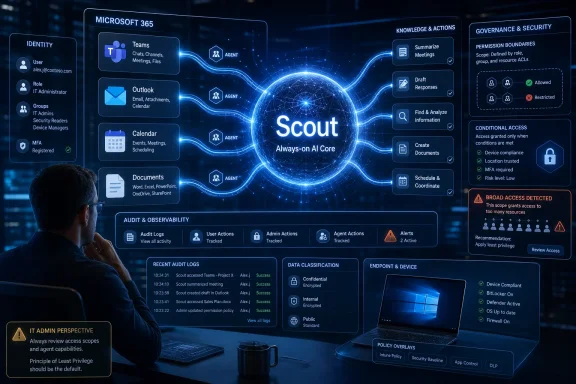
Microsoft launched Scout on June 2, 2026, at its Build developer conference as an always-on personal AI agent for work, built on OpenClaw ideas and designed to operate inside Microsoft 365 services such as Teams, Outlook, and enterprise productivity workflows. It is not another chatbot bolted onto a sidebar. It is Microsoft’s clearest attempt yet to turn Copilot from an assistant that waits for instructions into software that acts before a user asks. That shift is useful, commercially inevitable, and exactly where Windows and Microsoft 365 administrators should start getting nervous.

Tech dashboard showing Microsoft 365 “Scout” AI core with identity, security, governance, and device compliance panels.Microsoft Moves From Copilot as Interface to Scout as Co-Worker​

For the last three years, Microsoft has described Copilot as the new user interface for work. The pitch was simple enough: instead of hunting through menus, users would ask an AI system to summarize, draft, search, and explain. That model made generative AI feel less like a separate product and more like a conversational layer over Office, Windows, Teams, GitHub, Dynamics, and Azure.
Scout changes the shape of the bet. A Copilot-style assistant is mostly reactive; it waits for a prompt, does a bounded task, and hands the output back. Scout, as Microsoft framed it at Build, is meant to be always on, watching the flow of work and taking action across the Microsoft 365 environment.
That is why the “personal assistant” label undersells the announcement. Scout is closer to Microsoft’s attempt to productize the OpenClaw moment for the enterprise: take the thrill of a self-directed agent that can coordinate tasks across apps, then wrap it in Microsoft identity, compliance, security controls, and procurement machinery. If Copilot was Microsoft’s answer to ChatGPT, Scout is its answer to the viral agent frameworks that convinced users a computer could finally do the drudgery rather than merely describe how to do it.
The timing matters. Build is Microsoft’s stage for developers, but Scout is not just a developer story. It is a Windows, Microsoft 365, security, and IT operations story because every useful agent eventually wants permissions, context, memory, and access to things users were previously forced to touch themselves.

OpenClaw Gave Microsoft the Shape of the Future and the Shape of the Risk​

OpenClaw became the reference point for Scout because it did something that normal enterprise assistants rarely do: it made autonomy feel tangible. Users could hand it sprawling errands, connect accounts, give it tools, and watch it attempt multi-step work. It was messy, powerful, and unsettling in the way genuinely new computing paradigms often are.
Microsoft’s reported decision to build Scout on OpenClaw-inspired ideas is therefore unsurprising. Open-source agent systems have been doing in public what large enterprise vendors prefer to do behind governance layers: experimenting with what happens when an AI system is no longer confined to text generation. The lesson was not that the open-source tool itself was ready for every corporate desktop. The lesson was that users immediately understood the value of delegating outcomes rather than commands.
But OpenClaw also exposed the trap. The more useful an agent becomes, the more dangerous its failure modes become. An agent that can read email but not send it is a summarizer. An agent that can read calendars, send messages, reschedule meetings, open documents, call APIs, and act through a browser is a new kind of operational actor inside the business.
That is the line Microsoft is trying to cross without triggering a revolt from CISOs. Scout’s corporate packaging is the story: not merely “AI that can do more,” but AI that can do more while remaining legible to identity systems, audit trails, policy engines, and administrators. Whether that promise holds up under real deployment pressure is the question that matters.

The Microsoft 365 Graph Becomes the Agent’s Operating System​

The most important thing about Scout is not the model. It is the substrate. Microsoft already controls the work graph for millions of organizations: mailboxes, calendars, files, chats, meetings, directory objects, permissions, groups, tasks, documents, SharePoint sites, Teams channels, and compliance labels. Scout’s advantage is not that it can be clever in isolation; it is that it can be plugged into the machinery where work already happens.
That makes it very different from a standalone agent running on a personal machine. A local agent can automate a browser or desktop, but it often has to infer context from messy surfaces. Microsoft can give Scout structured context from Microsoft 365, and that context is the difference between an AI assistant that guesses and one that can make plausible operational decisions.
A meeting-prep agent, for example, does not need magic if it can see the invite, recent email threads, Teams chats, prior documents, and the org chart. A scheduling agent does not need to be superhuman if it can inspect calendars, understand working hours, and know which meetings are movable. A routine task agent does not need artificial general intelligence if the enterprise has already encoded much of its workflow into Microsoft’s cloud.
This is Microsoft’s central advantage over more flamboyant agent startups. The company does not need to invent the workplace from scratch. It needs to make the workplace’s existing digital exhaust actionable.
That is also why Windows users should pay attention, even if Scout’s first life is inside enterprise Microsoft 365. Microsoft has spent years trying to make Windows less of a static operating system and more of an endpoint in a cloud-managed work fabric. Once the agent lives in that fabric, the PC becomes both a tool surface and a policy boundary.

The Enterprise Launch Is a Safety Decision Masquerading as a Market Decision​

Microsoft appears to be starting Scout where it has the most control: enterprise customers, especially those already participating in its frontier-style AI programs. That is not just where the money is. It is where Microsoft can insist on identity, governance, admin consoles, logging, and service boundaries before the product is exposed to the chaos of consumer computing.
A consumer Scout would be a harder proposition. Home users have tangled personal accounts, inconsistent security hygiene, fewer formal policies, and a lower tolerance for billing surprises or embarrassing automation mistakes. Enterprises, by contrast, already accept that software operates through managed identities and audited permissions. They may not love the risk, but they have a vocabulary for it.
That does not mean the enterprise version is safe by default. It means Microsoft can sell Scout as a governable risk. That distinction will matter in the coming months, because agentic AI will test whether existing admin models are sufficient for software that does not merely store data or execute fixed workflows, but interprets intent and chooses actions.
IT departments are used to controlling applications. They are less used to controlling semi-autonomous delegates that may combine email, documents, web content, meeting transcripts, third-party connectors, and internal systems into a single chain of action. Scout will force Microsoft to prove that “enterprise-ready” means more than putting a compliance dashboard next to a probabilistic engine.

Autonomy Turns Permission Hygiene Into Product Strategy​

The old enterprise security model assumes that users are the primary risk-bearing actors. A user opens a file, grants an app access, clicks a link, sends an email, or approves a workflow. Administrators can train the user, restrict the app, classify the data, and investigate the event.
Agentic AI blurs that chain. If Scout acts on behalf of a user, using that user’s permissions, the organization now has to distinguish between a human decision, an AI-recommended decision, and an AI-executed decision. The audit log becomes more important, but also harder to interpret.
This is where least privilege stops being a slogan and becomes the product. A useful Scout needs access, but broad access is precisely what turns an agent from helpful to hazardous. If it can see everything the user can see and act everywhere the user can act, then the agent inherits not only the user’s productivity potential but the user’s over-permissioned reality.
Most enterprises are over-permissioned. Old SharePoint sites linger. Distribution lists sprawl. Teams channels become archives of sensitive decisions. Mailboxes contain contracts, credentials, personal data, and years of context. If Scout is only as safe as the permissions estate beneath it, then many organizations will discover that their AI readiness problem is actually an identity governance problem wearing a new badge.
Microsoft knows this. Its broader agent strategy has increasingly emphasized control planes, governance, and trust. The company’s challenge is that governance is a friction layer, and the whole appeal of Scout is friction removal.

The Windows Angle Is Not a Sidebar​

It is tempting to treat Scout as a Microsoft 365 story and leave Windows out of it. That would be a mistake. Microsoft’s AI strategy is converging across cloud, productivity apps, developer tools, and the client OS, and the desktop remains the place where work becomes visible.
Windows has already been nudged toward an AI-mediated future through Copilot, Recall-style local context concepts, on-device models, neural processing unit marketing, and cloud-linked management. Scout fits that arc even if it starts in the cloud. An agent that understands meetings, files, chats, and tasks will eventually want to interact with the local environment where users edit, browse, authenticate, and approve.
For sysadmins, the practical question is not whether Scout is a Windows feature on day one. It is whether Windows endpoints are ready for an agent that may initiate actions, surface recommendations, and bridge cloud context with local workflows. Endpoint detection, browser isolation, data loss prevention, conditional access, and device compliance policies all become more consequential when an agent can accelerate user behavior.
The irony is that Microsoft has spent decades making Windows manageable because humans were unpredictable. Scout introduces a new kind of unpredictability: software that behaves like a highly motivated junior employee with perfect recall, uneven judgment, and access determined by someone else’s permissions cleanup.
That metaphor is imperfect, but useful. You would not give a new assistant unrestricted access to every mailbox, repository, contract folder, and admin portal on the first day. Yet many organizations routinely grant software and users permissions that amount to the same thing.

Developers Get a Platform, Not Just a Feature​

Build announcements are rarely only about end-user products. Scout also signals where Microsoft wants developers to build: inside an agent ecosystem governed by Microsoft tools, Microsoft identity, Microsoft cloud services, and Microsoft distribution. The pitch is that developers can create agents and extensions that operate safely within the enterprise context rather than improvising their own stack.
That could be genuinely valuable. One of the weaknesses of the current agent boom is fragmentation. Every framework wants tool access, memory, orchestration, connectors, and model choice. Every enterprise then has to ask whether those pieces are secure, observable, compliant, and supportable.
Microsoft can simplify that by offering a sanctioned path. If Scout becomes a trusted host for enterprise actions, developers will chase it the same way they chased Teams apps, Office add-ins, SharePoint integrations, Azure services, and GitHub workflows. The agent becomes a distribution surface.
But this is also classic platform capture. Microsoft is not merely responding to OpenClaw; it is domesticating the idea inside its own commercial environment. The open agent world says users should be able to wire together tools however they want. Microsoft’s enterprise world says organizations will only tolerate that freedom if it is mediated by policy, licensing, and administrative control.
Both sides have a point. Open experimentation produces breakthroughs. Enterprise governance keeps those breakthroughs from becoming incident reports.

Scout Will Succeed or Fail on Boring Work​

The demo version of agentic AI always gravitates toward spectacular autonomy. It books trips, builds slide decks, negotiates calendars, files expenses, updates CRMs, and writes code while the user watches in amazement. The production version will live or die on something less cinematic: whether it can handle boring work without creating more cleanup.
That means Scout does not need to be brilliant everywhere. It needs to be reliably useful in narrow, repetitive, high-friction workflows. Meeting preparation is an obvious example because the inputs are already in Microsoft 365 and the cost of a slightly imperfect summary is manageable. Scheduling conflicts are another because the rules are relatively constrained, though the politics of calendars can be more delicate than software vendors like to admit.
Routine follow-up tasks may be the real proving ground. If Scout can identify obligations from meetings, draft sensible follow-ups, update task trackers, and avoid inventing commitments, it will earn trust. If it sprays plausible but wrong actions across Teams and Outlook, users will retreat to using it as a glorified summarizer.
The uncomfortable truth is that the best agents may initially feel less autonomous than the marketing suggests. They will ask for confirmation. They will operate inside constrained scopes. They will be boring by design. That is not failure; it is how enterprise software earns the right to become more powerful.

The Trust Problem Is Social Before It Is Technical​

Microsoft can solve many technical pieces of the Scout puzzle. It can integrate identity. It can log actions. It can label data. It can expose admin controls. It can restrict connectors. It can build approval flows. It can use models tuned for workplace reasoning and surround them with policy enforcement.
The harder problem is social trust. Users need to know when Scout is acting, why it is acting, what it saw, what it changed, and how to undo it. Managers need to know whether employees are delegating appropriately or simply laundering responsibility through an AI system. Security teams need to know whether an agent’s mistake is a user error, a product flaw, a prompt injection, a malicious connector, or a policy misconfiguration.
This is where agent design becomes organizational design. If Scout quietly does work in the background, it may feel magical until something goes wrong. If it asks permission for every move, it becomes another notification machine. The sweet spot is contextual autonomy: more freedom for low-risk tasks, explicit approval for consequential actions, and clear provenance everywhere.
Microsoft’s long history with enterprise software gives it an advantage here. It understands that corporate customers do not just buy features; they buy defensibility. When something fails, an administrator must be able to explain what happened in language that survives a meeting with legal, compliance, and the executive team.
Scout’s promise will therefore depend on the quality of its explanations as much as the quality of its actions. An agent that cannot explain itself will not survive contact with regulated industries.

The Competitive Field Is Already Crowded​

Scout is not arriving in a vacuum. Every major AI platform company is chasing agents, and every enterprise software vendor is trying to recast workflow automation as AI delegation. OpenAI, Google, Anthropic, Salesforce, ServiceNow, Adobe, Nvidia, and a long tail of startups all want a piece of the agent layer.
Microsoft’s advantage is distribution. It can put Scout in front of the same organizations already paying for Microsoft 365, Entra, Intune, Defender, Purview, Azure, and GitHub. It can bundle, upsell, and integrate in ways that smaller rivals cannot easily match.
Its weakness is expectation. Microsoft has already attached the Copilot name to a wide range of experiences with uneven reception. Some users find Copilot genuinely useful; others see it as expensive, intrusive, or inconsistent. Scout will inherit that skepticism, especially if it is priced as another premium layer on top of already complex licensing.
The company also has to avoid turning Scout into yet another brand in a crowded AI portfolio. Microsoft’s AI naming has often been less clear than its strategy. Copilot, agents, Agent 365, Foundry, Frontier programs, and now Scout all orbit the same promise: AI that can help people and organizations get work done. Customers will want to know which product controls what, which license unlocks which capability, and who is accountable when an agent acts.
If Microsoft cannot make that legible, competitors will attack from both sides. Startups will claim Microsoft is too slow and bureaucratic. Security vendors will claim Microsoft is expanding the blast radius. Rival platform companies will claim their agents are more open, more capable, or less tied to a single productivity suite.

The Real Product Is Governance at the Speed of Delegation​

The phrase “personal AI agent” makes Scout sound individual. In practice, the product will be collective. One employee’s Scout may reschedule meetings involving others, draft messages that affect teams, update shared documents, or trigger downstream workflows. Autonomy is contagious.
That means organizations will need agent policies that go beyond per-user preference. Some departments may allow Scout to draft but not send. Some may allow it to schedule internal meetings but not external ones. Some may permit document summarization but prohibit action on sensitive labels. Some may require human approval before anything leaves the tenant.
Microsoft’s ability to express those rules cleanly will define Scout’s enterprise credibility. Admins do not need another black box. They need a model of control that maps to how work actually happens: by role, data sensitivity, task type, risk level, device state, geography, and business process.
The most interesting future version of Scout may not be the most autonomous one. It may be the one that understands policy well enough to know when not to act. That is a less glamorous benchmark than passing a reasoning test, but it is the benchmark enterprise AI must meet.
There is a broader philosophical shift here. For decades, productivity software has assumed users operate tools. Scout assumes software can operate tools for users. Once that becomes normal, the administrator’s job changes from managing access to managing delegation.

The Cost Case Will Be Harder Than the Demo​

Microsoft’s AI economics are not subtle. Agents require models, orchestration, retrieval, storage, monitoring, security processing, and integration work. The more proactive they become, the more background computation they may consume. Scout will have to justify itself not only as a productivity feature but as a recurring operational expense.
The ROI case will be tempting. If Scout saves knowledge workers even a few hours a month, the numbers can look persuasive at enterprise scale. If it reduces meeting friction, accelerates follow-ups, and keeps projects from slipping through cracks, it becomes more than a convenience.
But measuring that value will be difficult. AI productivity claims often blur time saved, work shifted, work created, and work made more pleasant. A user may feel faster while the organization absorbs new review burdens, security monitoring costs, licensing tiers, and cleanup from occasional errors. The spreadsheet can flatter the agent if it counts every draft as saved time and ignores every verification step as free.
CIOs should demand boring metrics. How many actions did Scout complete without correction? How many required human approval? How many were undone? Which workflows improved cycle time? Which departments disabled it? Which data classes caused the most policy blocks? Which users became more productive, and which simply generated more machine-assisted noise?
The agent era will punish organizations that buy vibes. Scout may be useful, but usefulness must be measured against risk, cost, and the administrative labor needed to keep it safe.

Microsoft’s Biggest Risk Is Moving Faster Than Its Customers Can Govern​

There is an internal tension in every Microsoft AI announcement now. The company wants to move fast enough to satisfy investors, developers, and competitive pressure. Its largest customers want Microsoft to move carefully enough that they can deploy new capabilities without blowing up compliance models built over years.
Scout sits directly on that fault line. If Microsoft makes it too cautious, it becomes another assistant that writes summaries and drafts. If Microsoft makes it too autonomous, it becomes a governance nightmare. If Microsoft makes it too expensive, customers will pilot it endlessly without broad deployment. If Microsoft makes it too cheap and ubiquitous, administrators may feel ambushed.
The best path is probably staged autonomy. Let Scout earn privileges through task categories, admin policy, user trust, and demonstrated reliability. Make its actions inspectable. Make rollback first-class. Make permission boundaries obvious. Make it easier to say “not for this data” than to clean up after a mistake.
That would be less exciting than the dream of an AI assistant that simply runs the workday. It would also be more realistic. Enterprise software rarely wins by being the most magical thing in the room. It wins by becoming dependable enough that people stop thinking about it.

Scout’s First Test Is Whether Admins Can Say No Gracefully​

The near-term lesson from Scout is not that every organization should rush to deploy it. The lesson is that Microsoft has now given the agentic workplace a mainstream enterprise shape, and WindowsForum readers should evaluate it with the same skepticism they would bring to any software that wants broad access and operational authority.
  • Scout is best understood as a proactive Microsoft 365 work agent, not merely as a renamed Copilot chat experience.
  • Its OpenClaw inspiration explains both the excitement and the security anxiety around giving AI systems real tools and permissions.
  • The first practical deployment questions belong to identity, data governance, audit logging, endpoint posture, and least-privilege access.
  • The most valuable early use cases will likely be constrained workflows such as meeting preparation, scheduling triage, task follow-up, and document-grounded coordination.
  • Microsoft’s advantage is its control of the enterprise work graph, but that same advantage raises the stakes when an agent acts across mail, calendars, files, chats, and workflows.
  • Administrators should treat Scout as a new class of delegated actor inside the tenant, not as a harmless productivity add-on.
Microsoft did not launch Scout because the world needed another AI assistant name; it launched Scout because the center of gravity in productivity software is shifting from tools users operate to agents users supervise. If Microsoft can make that supervision secure, visible, and governable, Scout may become one of the most important workplace products it has shipped in years. If it cannot, the agent revolution will arrive less like a co-worker and more like an over-permissioned intern with a company badge, a full calendar, and too much confidence.

References​

  1. Primary source: Mashable
    Published: Tue, 02 Jun 2026 18:27:21 GMT
  2. Independent coverage: TechCrunch
    Published: Tue, 02 Jun 2026 18:02:44 GMT
  3. Independent coverage: The New Stack
    Published: Tue, 02 Jun 2026 17:57:36 GMT
  4. Related coverage: windowscentral.com
  5. Official source: blogs.microsoft.com
  6. Related coverage: computerworld.com
  1. Related coverage: techbuzz.ai
  2. Related coverage: tech.yahoo.com
  3. Official source: news.microsoft.com
  4. Related coverage: pcworld.com
  5. Related coverage: investing.com
  6. Related coverage: numerama.com
  7. Related coverage: techradar.com
  8. Related coverage: tomshardware.com
  9. Related coverage: tomsguide.com
  10. Official source: cdn-dynmedia-1.microsoft.com
  11. Related coverage: 0e190a550a8c4c8c4b93-fcd009c875a5577fd4fe2f5b7e3bf4eb.ssl.cf2.rackcdn.com
  12. Official source: microsoft.com
  13. Official source: adoption.microsoft.com
  14. Related coverage: techxplore.com
 

Microsoft launched Scout on June 2, 2026, as an experimental Microsoft 365 personal AI agent for Frontier customers, bringing an OpenClaw-inspired, always-on assistant into Outlook, Teams, OneDrive, SharePoint, desktop, browser, and cloud workflows. The product is not just another Copilot pane with a better memory. It is Microsoft’s attempt to turn the office suite into a controlled operating environment for autonomous work. That makes Scout both the most interesting Microsoft 365 AI announcement in years and the one that should make IT departments reach for their governance binders before their credit cards.

Futuristic Microsoft Scout dashboard with chat, compliance tools, file tracking, and an AI robot in a secure UI.Microsoft Moves From Helpful Copilot to Persistent Coworker​

The important shift in Scout is not that it can draft an agenda or rearrange a calendar. Microsoft 365 Copilot could already do plenty of clerical magic if the user knew what to ask, where to ask it, and how much context to feed it. Scout changes the posture: instead of waiting inside an app, it is designed to remain active across the workday, watching patterns, accumulating memory, and acting when the system believes it understands the user’s intent.
That is why Microsoft’s language around Scout matters. The company is describing a personal agent for work, not merely an assistant for Office documents. Scout is supposed to learn how a person handles meetings, inbox triage, follow-ups, reminders, project dependencies, and the small rituals that make knowledge work both productive and maddening.
For years, the productivity software industry has sold automation as a set of commands. Rules in Outlook. Macros in Excel. Power Automate flows for the brave. Scout represents a different bargain: give the agent enough access, enough memory, and enough policy scaffolding, and it may eventually infer the routine before the user writes the rule.
That bargain is powerful because the office is full of repeated behavior that nobody bothers to formalize. It is also dangerous because those behaviors often encode exceptions, politics, confidentiality, and judgment. The real test for Scout is not whether it can schedule a meeting; it is whether it can tell the difference between a meeting that should be scheduled automatically and a meeting that requires human hesitation.

OpenClaw Gave Microsoft the Shape of the Problem​

Scout arrives in the long shadow of OpenClaw, the open-source personal assistant framework that became one of the early-2026 obsessions of the agentic AI crowd. OpenClaw’s appeal was easy to understand: it suggested that an AI assistant did not have to be trapped in a chat window. It could connect to email, calendars, files, browsers, developer tools, and outside services, then use those connections to pursue goals over time.
That was intoxicating for builders because it made the personal computer feel programmable again. Instead of teaching a user to move between apps, OpenClaw-style agents promised to operate across the seams. They could clear a backlog, prepare for a meeting, check a deployment, summarize a thread, or marshal a handful of tools into a workflow that would normally require a dozen context switches.
But OpenClaw also exposed the problem Microsoft is now trying to productize around. The more useful an agent becomes, the more privileged it must be. The assistant that can only summarize a document is a feature. The assistant that can read mail, write mail, open files, call APIs, inspect browser state, and take action while the user is away is an identity, an endpoint, and a security boundary.
That is why Scout’s OpenClaw inheritance is not merely a technical footnote. Microsoft is trying to domesticate a style of agent that emerged from hacker energy and personal experimentation, then place it inside the high-friction world of enterprise compliance. The company’s pitch is that Scout can preserve the agency while wrapping it in Microsoft 365 administration, Entra identity, Intune policy, auditability, and tenant-level controls.
The question is whether that conversion can work without killing the thing that made OpenClaw interesting. Personal agents become useful when they are intimate, flexible, and slightly improvisational. Enterprise software becomes survivable when it is bounded, inspectable, and boring. Scout has to be both.

The Assistant With a Memory Is Also a New Records System​

Microsoft’s most consequential promise is that Scout will develop persistent memories and skills. That sounds warm in a demo: the assistant learns how you like agendas formatted, which colleagues need reminders, how you prepare for customer calls, and what recurring tasks you would rather never touch again. In the real world, persistent memory turns an AI assistant into a live map of a worker’s habits, obligations, relationships, and priorities.
That creates value because Microsoft 365 already holds the raw material of office life. Outlook knows who gets ignored. Teams knows where decisions stall. OneDrive and SharePoint know which files matter. Calendars know when work is nominally scheduled, and chat logs know when it actually happens. Scout’s promise is to connect those signals into a working model of a person’s day.
That is also where the privacy and governance questions sharpen. A memory layer is not just a cache. It is a derived dataset, built from sensitive activity and potentially more revealing than the underlying documents. A single email may be innocuous; the pattern of which emails get answered late, which topics trigger follow-ups, and which people are treated as urgent can be far more sensitive.
Enterprises will need to understand where Scout’s memories live, how they are scoped, how they are deleted, how they appear in discovery, and whether users can inspect or correct them. A personal assistant that learns the wrong lesson is annoying. A regulated enterprise agent that learns the wrong lesson and keeps acting on it is an operational risk.
Microsoft knows this, which is why Scout is being introduced through the Frontier program rather than as a broad consumer switch. The company is not simply releasing a clever productivity tool. It is asking customers to pilot a new class of persistent workplace actor, one that may eventually sit somewhere between a user profile, a service account, and an executive assistant.

Security Is the Product, Not the Fine Print​

Scout’s safety architecture is not a side feature. It is the product’s license to exist. Microsoft is emphasizing governed identity, policy conformance, audit trails, Intune configuration, and opt-in attestation because an always-on agent inside Microsoft 365 would be indefensible without them.
The old Copilot security argument was relatively straightforward: Copilot respects the permissions a user already has. That was never the whole story, but it was at least a simple frame. Scout complicates the frame because it is not just answering questions over data the user can access. It is expected to remain active, develop skills, make judgments, and take action on behalf of the user.
That changes the failure mode. A bad answer in a chat session is visible at the moment of use. A bad autonomous action may not be noticed until a meeting has been moved, a response has been sent, a task has been escalated, or a workflow has drifted into a policy violation. The agent does not merely risk hallucination; it risks doing the hallucination.
Microsoft’s answer is to put controls closer to the agent runtime. The company’s Build 2026 security messaging around agent governance, policy-driven evaluation, and runtime control standards fits directly into Scout’s moment. The broader strategy is clear: Microsoft wants to make autonomy palatable by making the agent inspectable, governable, and accountable.
That is the right instinct. It is also not enough by itself. Audit trails are valuable only if they are complete enough to reconstruct decisions, usable enough for administrators, and connected enough to existing incident response processes. If logs become another pile of AI exhaust that nobody reads until something goes wrong, Scout will have reproduced the oldest problem in enterprise security: visibility without operational control.

The Entra Identity Choice Makes Scout an Actor​

One of the more important details in Microsoft’s framing is that agents can act with governed Entra identity. That may sound like plumbing, but it is a philosophical line in the sand. Microsoft is treating agents less like invisible features and more like participants that need identity, permissions, and policy.
That is the only sane direction for enterprise agents. If an assistant can call tools, access files, send messages, and interact with external services, administrators need to know who or what performed the action. “The AI did it” is not an audit category. The organization needs a chain of responsibility: the user, the agent, the policy state, the tool call, the data accessed, the output produced, and the approval model in force at the time.
This will feel familiar to sysadmins who have spent years cleaning up after overprivileged service accounts. The moment a non-human actor becomes useful, someone wants to give it broad access so the workflow stops breaking. The moment it has broad access, it becomes a tempting target and a compliance headache.
Scout’s success may therefore depend less on the charm of the assistant and more on the quality of its permission design. Can an organization give Scout enough access to be useful without turning it into a skeleton key? Can permissions be delegated narrowly, reviewed easily, and revoked cleanly? Can different roles receive different autonomy levels without creating a policy maze?
Those are not theoretical questions. They are the daily questions that decide whether a technology becomes a trusted enterprise platform or a pilot project that never escapes the innovation lab.

Microsoft 365 Is the Only Place This Could Launch First​

Scout also demonstrates Microsoft’s structural advantage in the agent race. Many AI companies can build a better chatbot. Far fewer can place an agent inside the productivity substrate where hundreds of millions of workdays already happen. Microsoft does not have to persuade users to move their lives into a new app; it can attach the agent to Outlook, Teams, OneDrive, SharePoint, Windows, Edge, and the identity layer underneath.
That distribution advantage is enormous. The agent that knows your calendar but not your documents is limited. The agent that knows your documents but not your Teams context is half blind. The agent that sees files, meetings, chats, contacts, tasks, and browser workflows has a plausible claim to understanding work as a system.
It also gives Microsoft a way to answer the lingering Copilot adoption problem. Copilot has been impressive in demos and uneven in day-to-day perceived value, particularly when organizations ask whether the per-user premium translates into measurable productivity. Scout shifts the pitch from “ask better questions of your files” to “let the assistant take over recurring work patterns.”
That pitch may be easier for executives to understand. Reducing meeting friction, chasing stalled decisions, preparing agendas, and coordinating calendars are universal pains. They are also pains that do not require every employee to become a prompt engineer. If Scout works, the user does less explicit AI interaction, not more.
But that cuts both ways. The less visible the interaction, the more trust the system requires. Copilot’s weakness was often that users had to remember to use it. Scout’s risk is that users may forget where it begins and ends.

Frontier Customers Become Microsoft’s Reality Check​

The limited experimental release to Frontier customers is a sensible move, and not only for product polish. Microsoft needs real organizational friction to test Scout. A personal agent that performs beautifully in a controlled demo can fail in a company where calendars are political, permissions are messy, naming conventions are inconsistent, and every department has its own workaround culture.
Enterprise pilots will expose whether Scout’s memories are genuinely helpful or merely confident. They will show whether users want an assistant that adapts over time or whether they become nervous when software starts making inferences about their working style. They will also show whether administrators can manage the thing without creating a new full-time governance burden.
The opt-in attestation requirement is especially revealing. It suggests Microsoft understands that Scout is not the kind of feature that should simply appear after an update. Users and organizations need to acknowledge the new operating model. That acknowledgment may become a pattern for future agents: not just accepting terms of service, but formally recognizing that an autonomous system has been granted a defined role.
There is a deeper adoption issue here. Workers may welcome help with the tasks they hate, but they may resist an assistant that appears to measure or model them too closely. Scout’s personal nature is its selling point. It is also the source of its creep factor.
Microsoft’s challenge is to make the system feel like it works for the user rather than on the user. That will require transparency that goes beyond settings screens. People need to know what Scout has learned, why it acted, and how to correct it without filing a ticket.

Project Solara Shows the Agent Is Escaping the App Window​

Scout should also be read alongside Microsoft’s Project Solara, the company’s Build 2026 effort around agent-first devices and new form factors. Solara is not the same product, but it reveals the same strategic direction. Microsoft is preparing for agents that are not merely sidebars inside applications but ambient software presences that follow users across devices and contexts.
The Solara vision pushes agents toward wearables, desk devices, field tools, and other purpose-built hardware. In that world, the agent is not something you open. It is something available through a badge, a device on a desk, a microphone in a workflow, or a specialized endpoint in a hospital, factory, school, or office.
Scout is the Microsoft 365 expression of that idea. It begins where Microsoft has the richest context and strongest enterprise foothold: work. If Solara is the hardware frontier for agent-first computing, Scout is the workplace memory and action layer that could make those devices worth carrying.
That matters for Windows users because the operating system is gradually being repositioned. Windows is no longer just the place where apps run. It is becoming one of several surfaces through which agents observe, coordinate, and act. The browser, the cloud, Teams, Microsoft 365, and specialized devices are all part of the same agentic fabric.
This does not mean the traditional desktop disappears. It means the desktop becomes less sovereign. The center of gravity moves from the application window to the workflow, and from the workflow to the agent that can operate across windows.

The Browser and Desktop Pieces Raise the Stakes​

Scout’s ability to operate across desktop and browser environments is essential to its usefulness. Modern work does not stay inside Microsoft 365. Even Microsoft-heavy organizations live in SaaS dashboards, line-of-business web apps, ticketing systems, CRMs, cloud consoles, procurement portals, and custom internal tools.
An agent that cannot cross those boundaries becomes a smarter Office assistant but not a true work assistant. An agent that can cross those boundaries becomes dramatically more valuable. It also becomes dramatically harder to secure.
Browser interaction is a particularly thorny area because web apps were designed around human users, not persistent AI delegates. A human can recognize a misleading page, pause before submitting a form, or understand that a workflow has entered an unusual state. An agent may need explicit controls, tool mediation, and confirmation gates to avoid doing exactly the wrong thing with great efficiency.
Desktop access raises similar questions. If Scout can observe or interact with local apps, administrators will want to know how those interactions are constrained, logged, and separated from normal user behavior. Screen-level automation has always been brittle; AI makes it more flexible, but not automatically safer.
This is where Microsoft’s ecosystem approach could help. If Scout’s actions are mediated through structured APIs, identity-aware connectors, and policy-defined tool calls, it can be governed more cleanly than a rogue automation script clicking around a desktop. But the moment the agent falls back to imitating a user in an interface, the old automation risks return in a smarter disguise.

The Productivity Pitch Is Real Because Office Work Is Broken​

It is fashionable to roll eyes at AI assistants that promise to fix meetings. The eye-rolling is deserved. Yet the underlying pain is real. Modern office work is clogged with coordination costs, status rituals, duplicated updates, ambiguous ownership, and communications that exist mainly because systems do not talk to each other.
Scout targets exactly that mess. Calendar management, meeting preparation, agenda drafting, follow-up tracking, and decision-risk detection are not glamorous tasks, but they consume the day in small increments. If an agent can reliably remove even a portion of that burden, users will notice.
The key word is reliably. A mediocre assistant is worse than no assistant when the task involves social judgment. Sending a slightly wrong email, escalating a non-issue, or rescheduling a meeting in a way that violates an unspoken hierarchy can cost more than the time saved. Office work is full of context that is not written down because people assume other people understand it.
That is why Scout’s feedback loop matters. Microsoft is betting that users will teach their agents through correction and repetition, gradually turning personal habits into durable skills. This is more plausible than expecting users to build formal automations from scratch. People are better at saying “not like that” than designing workflow systems.
Still, Microsoft should be careful not to confuse personalization with wisdom. A system can learn what a user usually does without understanding what the user should do. In many workplaces, the assistant may faithfully reproduce bad habits, overwork patterns, and communication dysfunction unless the organization deliberately designs better defaults.

The Governance Burden Moves From Prompting to Management​

The rise of Scout suggests a new administrative discipline: agent management. IT teams already manage users, devices, apps, data loss prevention policies, conditional access, endpoint security, and compliance retention. Now they will need to manage non-human assistants that remember, infer, and act.
That management will not be solved by a single admin toggle. Organizations will need policies for which users can enable personal agents, what data those agents can access, what actions require approval, how long memories persist, how logs are reviewed, and how incidents are handled. They will need a way to distinguish harmless convenience from regulated decision-making.
The challenge is that personal agents sit awkwardly between individual preference and organizational control. A user may want Scout to manage their inbox aggressively. The legal department may want every external communication reviewed. A sales team may want the agent to update CRM records automatically. Security may want all external tool calls blocked until vetted.
The winners in this market will be the vendors that make those conflicts manageable rather than pretending they do not exist. Microsoft has an advantage because it already owns much of the admin plane. But ownership is not the same as clarity. If Scout policies scatter across Entra, Intune, Purview, Teams, Copilot settings, and specialized agent consoles, administrators will see another governance maze.
For Scout to graduate from experiment to platform, Microsoft must make the control story as polished as the demo. The assistant’s memory may delight users, but the admin experience will decide whether enterprises deploy it broadly.

The Scout Bet Comes Down to Trust at Work​

Scout is not a consumer chatbot wearing a suit. It is a test of whether Microsoft can make agentic AI acceptable inside institutions that care about liability, records, identity, and control. The product’s promise and its danger come from the same place: it is meant to know enough about your work to act without being asked every time.
The most concrete implications are already visible.
  • Scout is an experimental Microsoft 365 personal agent, initially aimed at Frontier customers rather than a broad consumer rollout.
  • The OpenClaw influence matters because Scout adopts the always-on, cross-workflow agent model rather than the traditional app-bound assistant model.
  • Persistent memory and custom skills could make Scout more useful over time, but they also create new governance questions around inspection, correction, retention, and deletion.
  • Microsoft’s emphasis on Entra identity, Intune policy, opt-in attestation, policy conformance, and audit trails shows that autonomy is being sold through control, not just capability.
  • The biggest enterprise risk is not that Scout gives a bad answer, but that it takes a bad action quietly enough that nobody notices until the workflow has already moved.
  • Windows and Microsoft 365 users should view Scout as part of a broader shift toward agents that operate across apps, devices, browsers, and cloud services rather than inside a single productivity pane.
Scout may become the first Microsoft 365 AI feature that feels less like a tool and more like a colleague with permissions. That is both the breakthrough and the warning label. If Microsoft gets the balance right, Scout could make the daily machinery of work less brittle and less wasteful; if it gets the balance wrong, enterprises will discover that the only thing harder than managing human workflows is auditing an eager assistant that learned them too well.

References​

  1. Primary source: entARABI
    Published: 2026-06-02T18:12:10.854873
  2. Independent coverage: Let's Data Science
    Published: Tue, 02 Jun 2026 18:02:05 GMT
  3. Related coverage: computerworld.com
  4. Related coverage: remoteopenclaw.com
  5. Official source: commandline.microsoft.com
  6. Related coverage: bighatgroup.com
  1. Related coverage: pcworld.com
  2. Related coverage: geekwire.com
  3. Related coverage: windowscentral.com
  4. Related coverage: numerama.com
  5. Related coverage: tech.yahoo.com
  6. Related coverage: wwwhatsnew.com
  7. Related coverage: openclaw.ai
  8. Related coverage: newsbytesapp.com
  9. Related coverage: techbuzz.ai
  10. Related coverage: techradar.com
  11. Official source: microsoft.com
  12. Official source: adoption.microsoft.com
  13. Official source: devblogs.microsoft.com
  14. Official source: news.microsoft.com
  15. Official source: learn.microsoft.com
  16. Related coverage: windowsforum.com
  17. Related coverage: redmondmag.com
 

On June 2, 2026, at Microsoft Build 2026, Microsoft introduced Scout as an always-on personal work agent for Microsoft 365, positioning it as a governed, enterprise-ready step beyond today’s mostly user-invoked Copilot experiences. The announcement matters because Scout is not being sold as another chat window. It is Microsoft’s argument that the next interface for work is a persistent agent with identity, memory, permissions, and the ability to act across apps. For Windows users and IT departments, that turns “AI assistant” from a productivity feature into an operational surface that must be managed like infrastructure.

Futuristic AI robot in a control room surrounded by cloud apps, security icons, and analytics dashboards.Microsoft Is Moving Copilot From Prompt Box to Work System​

The original Copilot pitch was easy to understand because it borrowed the shape of software people already knew: a text box, a command, and a response. Ask it to summarize a thread, draft a document, rewrite a paragraph, or explain a spreadsheet, and it would return something useful if the data, permissions, model, and prompt all lined up. That model made Copilot feel like a tool inside Office, even when Microsoft insisted it was the beginning of a larger platform shift.
Scout changes the framing. Microsoft describes it as an always-on personal agent that can work autonomously on behalf of a user, connect to Microsoft 365 data, and coordinate actions across Teams, Outlook, OneDrive, SharePoint, browsers, local resources, and model context protocol servers. That is a very different proposition from a chatbot waiting for instructions.
The distinction is not semantic. A chatbot is episodic; an agent is persistent. A chatbot can be ignored; an agent can notice. A chatbot produces output; an agent may decide that the output needs to become a meeting, a document, a calendar block, a reminder, or an escalation.
Microsoft’s chosen language around “Autopilots” is doing a lot of work here. The company is trying to establish a product category before customers have settled on a name for it. The danger, as ever with Microsoft naming, is that the branding can blur rather than clarify the architecture. But the direction is clear enough: Copilot is becoming less like a pane and more like a work operating layer.

Scout Makes the Agent the Unit of Enterprise Software​

The most consequential part of Scout is not that it can schedule meetings or prepare materials. Those are useful demos, but they are not strategically new. The important thing is that Microsoft is treating the agent itself as a managed enterprise object.
That means Scout has its own governed Microsoft Entra identity rather than operating as an anonymous backend process or a loosely scoped service account. It means credentials are supposed to be scoped to the task and protected from logs and diagnostics. It means the agent is expected to respect Microsoft Purview controls, including sensitivity labels and data loss prevention policies.
That is exactly the right problem for Microsoft to emphasize, because the obvious enterprise objection to agentic AI is not whether the models can write a decent meeting brief. It is whether the organization can prove who or what accessed a file, why it did so, what authority it had, what it attempted to send elsewhere, and whether a human approved the action. Agentic AI does not merely raise the stakes of hallucination; it raises the stakes of authorization.
Microsoft’s history gives it an advantage here. The company already owns much of the identity, document, collaboration, endpoint management, compliance, and productivity fabric inside large organizations. Scout is designed to sit directly on top of that fabric. If Microsoft can persuade customers that agents inherit the same administrative model as the rest of Microsoft 365, it has a better enterprise story than startups offering clever agents bolted onto corporate data by way of brittle connectors.
But that advantage also creates a burden. The closer Scout gets to the center of work, the less tolerance customers will have for ambiguity. A vague promise that an agent follows policy will not be enough when the agent can inspect calendars, infer priorities, access files, and take steps that create obligations for other employees.

The Always-On Agent Turns Convenience Into Governance Debt​

Microsoft’s examples for Scout are deliberately mundane: identifying deliverables, flagging stalled decisions, blocking calendar time, preparing materials, and organizing work across messages and documents. That is the right place to start. Enterprise AI will not be adopted first because it writes poetry; it will be adopted because it cleans up the low-grade administrative drag of modern office life.
Yet the mundane examples are also where the real governance questions begin. If Scout notices that a decision is stalled, what counts as evidence? If it blocks time on a calendar, whose priorities does it optimize for? If it prepares materials, which versions of the files does it trust? If it flags risk, does that become discoverable business record, managerial signal, or just another notification in an already noisy system?
There is a temptation to treat agents as smarter automation. That undersells the shift. Traditional automation generally follows a defined workflow: when X happens, do Y. Agentic automation introduces more interpretation into the middle. It can decide that X resembles something important, infer that Y might help, and then ask for permission or act within a predefined boundary.
That boundary is where IT will live. Admins will need to decide which users can run Scout, which connectors are allowed, which data classes are off-limits, which actions require approval, and how long logs should be retained. The introduction of an always-on agent does not remove administrative work. It redistributes it from end users to policy authors, security teams, compliance officers, and endpoint managers.
Microsoft appears to understand this, which is why the private preview requirements matter. Scout access is limited, tied to Frontier enrollment, Intune policy configuration, opt-in attestation, and, for the current experience, a GitHub Copilot license. That is not a consumer-style rollout. It is Microsoft putting Scout behind the same kinds of gates it uses when it knows the product could create organizational risk if deployed casually.

Frontier Customers Are Microsoft’s Real Beta Test​

The phrase “Frontier organization” is one of Microsoft’s more revealing bits of recent enterprise vocabulary. It describes customers willing to reorganize work around AI systems before the rest of the market is ready. In practice, it also gives Microsoft a controlled proving ground for features that are too important, too expensive, or too risky to unleash broadly.
Scout fits that pattern perfectly. Microsoft employees have reportedly been using an early desktop experience, and the company is now extending access to select customers and Frontier organizations. That staging tells us two things. First, Microsoft believes Scout is mature enough to test in real work environments. Second, Microsoft is not yet ready to tell every Microsoft 365 tenant admin to flip a switch.
The controlled rollout is prudent. Persistent agents are only as good as the organizational assumptions they absorb. A company with clean permissions, disciplined file storage, strong data classification, and clear business processes will get a very different agent experience from a company where SharePoint is a landfill, Teams is a shadow archive, and confidential data lives wherever employees happened to drop it.
That is the uncomfortable truth under the agentic AI boom. Agents do not magically fix information architecture. They expose it. If users have access to too much, agents may inherit too much. If documents are mislabeled, agents may treat them incorrectly. If business processes are informal, agents may automate the informal confusion at machine speed.
This is why Scout’s governance story is not a side feature. It is the product. The technical magic of an agent that roams through your workday is only useful if the enterprise can make that roaming legible, limited, and reversible.

OpenClaw Gives Scout a Developer Story and a Risk Surface​

Microsoft’s decision to tie Scout to OpenClaw is strategically interesting because it gives the announcement a broader developer and open-source texture. OpenClaw has been framed as a technology base for agentic systems, and Microsoft says it is contributing policy conformance capabilities upstream. The message is that Scout is not merely a closed Microsoft 365 feature; it is part of a larger agent ecosystem that developers and organizations can inspect, extend, and validate.
That matters at Build, where Microsoft needs every product announcement to speak to developers as well as CIOs. If Scout is only a packaged assistant, it competes with every other assistant. If Scout is a governed runtime pattern for agents, it becomes infrastructure.
Still, open-source adjacency does not automatically solve trust. The components around an agent can be open while the hosted service, telemetry, model routing, policy enforcement, and product behavior remain controlled by Microsoft. Enterprise customers will care less about whether a framework has a public repository than whether they can prove the agent followed their internal rules.
The more compelling part is policy conformance. If organizations running OpenClaw-based systems can validate security and compliance configurations, Microsoft can help normalize the idea that agents need policy tests just as applications need unit tests, identity reviews, and deployment gates. That is the right direction. In an agentic world, “does it work?” is only half the test; “is it allowed to do that?” becomes equally important.
For developers, the Scout story also sits alongside Microsoft’s broader embrace of model context protocol servers and agent-oriented tooling. The agent is not just an app. It is a broker among data sources, tools, models, and policies. That architecture will be powerful, but it will also create new debugging problems when an agent produces an unexpected outcome because one connector, permission, prompt, model, or policy behaved differently than expected.

Microsoft’s MAI Models Are About Leverage, Not Just Independence​

Scout was not the only AI announcement at Build 2026. Microsoft AI also introduced a family of seven new in-house MAI models spanning reasoning, coding, image generation, transcription, and voice. The lineup includes MAI-Thinking-1, MAI-Code-1-Flash, MAI-Image-2.5, MAI-Transcribe-1.5, and MAI-Voice-2, with Microsoft positioning the models for use across its own products and distribution channels such as Azure AI Foundry and partner platforms.
It would be easy to read that as Microsoft trying to distance itself from OpenAI. That is partly true in the narrow sense that Microsoft clearly wants more of its own model stack. But the more important point is leverage. Microsoft does not need every MAI model to beat every frontier model on every benchmark. It needs models that are good enough, fast enough, cheap enough, controllable enough, and tuned tightly enough for Microsoft products.
That is a different optimization problem from building the world’s most dazzling chatbot. A model embedded inside GitHub Copilot, Visual Studio Code, Microsoft 365 Copilot, or Azure AI Foundry has to satisfy product constraints: latency, cost, safety policy, enterprise indemnity, regional availability, compliance posture, and predictable behavior under load. In that context, a “smaller” or more specialized model can be more valuable than a giant general model if it fits the product surface better.
MAI-Code-1-Flash is a good example. A coding model built for agentic development inside GitHub Copilot and Microsoft’s developer stack does not need to be everything to everyone. It needs to complete, repair, explain, and coordinate code work efficiently enough that it can be used repeatedly inside real developer workflows without turning every suggestion into an expensive inference event.
MAI-Thinking-1 plays a different role. As a reasoning model, it gives Microsoft a flagship symbol for the company’s in-house AI ambitions. Whether customers experience it directly or mostly through product layers, it signals that Microsoft wants to own more of the intelligence running under Copilot rather than remaining only the distributor, investor, and infrastructure partner behind another lab’s models.

Frontier Tuning Moves the Training Ground Inside the Business​

Microsoft’s discussion of Frontier Tuning may prove as important as the model list. The company describes private reinforcement learning environments as training grounds where models can learn from the decisions, actions, and workflows that define how work gets done inside an organization. That is a powerful idea, and also one that should make compliance teams sit up straight.
The promise is straightforward. Generic models know language and patterns; tuned models know your business process. They can learn how a support escalation is handled, how a finance approval moves, how a developer triage process works, or how a clinical workflow is structured. Instead of merely answering questions about policy documents, a tuned model could learn the sequence of actions that experienced employees take to get work done.
The risk is equally obvious. Internal workflows often encode shortcuts, informal exceptions, tribal knowledge, and legacy compromises. If a model learns from those patterns without careful supervision, it may reproduce not only the organization’s best practices but also its bad habits. “This is how work gets done here” is not always the same as “this is how work should be done here.”
That is why Microsoft’s health care example with Mayo Clinic is worth watching. A clinical reasoning model co-created with a major medical institution and initially deployed inside that institution’s environment is precisely the kind of high-stakes use case where validation, governance, and domain oversight are not optional. If Microsoft can make that pattern work in health care, it will have a stronger case for regulated industries more broadly.
For WindowsForum readers, the practical implication is that AI customization is moving up the stack. The old enterprise question was which software to deploy. The next question is which organizational behaviors to let the model learn from, and under what controls. That is a much harder conversation than license assignment.

The Copilot Redesign Admits the First Version Was Not Enough​

Microsoft also used the Build window to showcase a redesigned Microsoft 365 Copilot experience, originally announced in late May. The refresh includes a larger prompt surface, a more consistent Copilot entry point across Microsoft 365 apps, task-aware controls, and reported performance improvements: load times reduced by more than half and complex chat prompt response times improved by 10 percent.
Those numbers matter because one of Copilot’s recurring problems has been friction. AI assistants are judged not only by intelligence but by immediacy. If a user has to wait too long, hunt for the right entry point, or wonder whether they are in the right Copilot surface, the spell breaks. At that point, the assistant becomes another feature to manage rather than a natural extension of work.
The redesign also acknowledges a deeper product issue. Microsoft 365 is a constellation of apps with decades of accumulated interface history. Dropping Copilot buttons into Word, Excel, PowerPoint, Outlook, Teams, and the browser was never going to create a coherent AI work platform by itself. A consistent entry point is Microsoft’s attempt to make Copilot feel less like a scattering of features and more like one connected system.
The reported usage gains in Word, Excel, PowerPoint, and Outlook suggest that placement and interface design still matter enormously, even in the age of generative AI. Users do not adopt AI because it exists. They adopt it when it appears at the moment they are already trying to accomplish something. That is mundane product truth, but it is one Microsoft sometimes obscures with sweeping platform language.
Scout extends that same redesign logic into the background. If Copilot becomes the visible interface and Scout becomes the persistent worker, Microsoft will have a two-layer AI experience: one part summoned by users, another part monitoring, preparing, and nudging from behind the scenes. That architecture could be genuinely useful. It could also become exhausting if Microsoft gets the notification and approval model wrong.

Windows Becomes the Quiet Battleground for Agentic Work​

Although Scout is framed around Microsoft 365, Windows inevitably sits underneath the story. The desktop app extends Scout’s reach to browsers, local resources, and external context servers. That makes the Windows endpoint more than a place where users open Teams. It becomes part of the agent’s operating environment.
This is where Microsoft’s agentic strategy meets the messy reality of managed PCs. Enterprises already struggle with endpoint compliance, browser extensions, local file sprawl, shadow IT, and inconsistent device health. An agent that can work across local and cloud contexts will make endpoint posture even more important. If a device is poorly managed, the agent running near it inherits a more dangerous neighborhood.
Intune’s role in Scout access is therefore not incidental. Microsoft wants endpoint management to become one of the control planes for AI agents. That makes sense. If an organization can govern which devices may run Scout, which policies apply, and how the experience is installed and updated, it has a better chance of preventing agentic features from becoming another unmanaged productivity workaround.
For Windows enthusiasts, this may feel like one more step toward an OS that is less about local control and more about cloud-mediated productivity. For sysadmins, the reaction will be more pragmatic. If users are going to demand agents that span email, files, calendars, browsers, and line-of-business systems, the least bad version is one that integrates with existing identity and management tooling.
The unresolved question is how much of this becomes optional. Microsoft has a long habit of introducing enterprise controls while pushing consumer and small-business users toward defaults that favor adoption. Scout is not broadly available today, but the direction of travel is clear. The agentic desktop is coming; the policy surface must arrive before the habit does.

Microsoft’s Biggest Competitor Is the Approval Dialog​

The hardest part of Scout will not be scheduling meetings. It will be calibrating trust. If Scout asks for approval too often, users will ignore it or disable it. If it asks too rarely, admins will fear it. If approvals are vague, they will become rubber stamps. If approvals are too detailed, they will become a second job.
This is the classic automation paradox in a new wrapper. The more capable the system becomes, the more carefully humans must decide when to stay in the loop. A weak agent is annoying because it cannot do enough. A strong agent is worrying because it can do too much. Microsoft has to make Scout useful in the narrow space between those failures.
The company’s enterprise governance language suggests it knows this. Sensitive actions can require human approval. Organizations can define which resources and destinations Scout can access. Credentials are scoped. Purview protections apply. These are necessary claims, and they give Microsoft a credible starting point.
But the user experience will determine whether those controls work in practice. A policy that exists only in an admin portal is not enough. Users need to understand when Scout is acting, what it is acting on, and how to stop or correct it. Admins need logs that explain behavior without drowning them in model gibberish. Security teams need alerts that distinguish meaningful risk from the ordinary churn of work.
This is where agentic AI may collide with the human limits of enterprise software. Organizations already have too many dashboards, too many portals, and too many alerts. Adding agents should reduce coordination overhead, not create a new class of AI supervision labor.

The Real Build 2026 Message Is That Microsoft Wants the Whole Stack​

Taken together, Scout, the MAI models, Frontier Tuning, the Copilot redesign, Azure AI Foundry distribution, GitHub Copilot integration, Entra identity, Purview compliance, Intune policy, and OpenClaw alignment tell a single story. Microsoft wants to own the agentic AI stack from model to app to governance layer. Build 2026 was not just a product launch; it was a map of control points.
That strategy is very Microsoft. The company rarely wins by having the flashiest single product. It wins by making its product the one already connected to the tools customers cannot easily leave. In the 1990s, that was Windows and Office. In the cloud era, it was Azure, Active Directory, and enterprise licensing. In the AI era, Microsoft is trying to make the control plane for work agents look like the Microsoft 365 admin center.
There is a good version of that future. In it, agents reduce the administrative sludge of office work, help users keep track of commitments, surface risks earlier, and let IT govern AI through familiar tools. Developers get specialized models and agent frameworks. Security teams get identities, logs, approvals, and policy conformance. Users get something more helpful than another chat pane.
There is also a bad version. In that future, agents become another layer of opaque Microsoft automation, licensing gets more complex, admins are asked to trust policy claims they cannot fully inspect, and users are nudged by software that has just enough autonomy to be irritating but not enough reliability to be trusted. The distance between those outcomes will be measured less by keynote demos than by defaults, logs, latency, and support tickets.

The Scout Era Will Be Won or Lost in the Admin Console​

Microsoft’s Build 2026 AI announcements are ambitious, but the concrete lessons for WindowsForum’s audience are narrower and more practical. Scout is not broadly available yet, and that gives organizations time to prepare their Microsoft 365 environments before persistent agents become routine.
  • Organizations should treat always-on agents as managed identities with delegated authority, not as productivity toys attached to individual users.
  • Data classification, SharePoint hygiene, Teams retention, and least-privilege access will matter more when agents can traverse work context continuously.
  • Human approval flows must be designed carefully, because excessive prompts will train users to click through and vague prompts will undermine auditability.
  • Microsoft’s in-house MAI models give the company more control over cost, latency, and product tuning, even if OpenAI remains central to the broader ecosystem.
  • The redesigned Microsoft 365 Copilot interface shows that AI adoption still depends on speed, placement, and workflow fit, not just model capability.
  • IT teams should watch Scout’s private preview requirements closely, because Frontier enrollment, Intune policy, and attestation hint at the eventual enterprise deployment model.
The bottom line is not that Microsoft has solved agentic AI. It is that Microsoft has identified where the enterprise battle will be fought: identity, policy, workflow, endpoints, and the user’s daily attention. Scout is still early, but it points toward a version of Microsoft 365 in which the assistant no longer waits politely for a prompt. If Microsoft can make that agent accountable as well as useful, Build 2026 may be remembered as the moment Copilot stopped being a feature and started becoming the operating model for work.

References​

  1. Primary source: Redmond Channel Partner
    Published: 2026-06-03T00:12:09.273852
  2. Related coverage: axios.com
  3. Official source: microsoft.com
  4. Official source: microsoft.ai
  5. Related coverage: techcrunch.com
  6. Official source: blogs.microsoft.com
  1. Related coverage: traictory.com
  2. Related coverage: chatforest.com
  3. Related coverage: aibusinessreview.org
  4. Related coverage: insidermonkey.com
  5. Related coverage: windowscentral.com
  6. Related coverage: tomsguide.com
  7. Related coverage: techradar.com
  8. Official source: news.microsoft.com
  9. Official source: adoption.microsoft.com
 

Back
Top