

Microsoft and Nvidia announced at Computex 2026 that a new class of Windows 11 laptops and compact desktops will use Nvidia’s RTX Spark superchip, led by Microsoft’s Surface Laptop Ultra and backed by OEMs including Dell, HP, Lenovo, Asus, Acer, MSI, and Gigabyte. The pitch is simple enough to fit on a keynote slide: MacBook Pro-class ambition, Windows compatibility, Nvidia graphics, and Arm-era battery life in one machine. The harder truth is that RTX Spark is not just another laptop chip; it is Nvidia’s attempt to turn the premium Windows PC into a local AI workstation before Apple, Intel, AMD, or Qualcomm can define that category alone.
For most of the modern Windows laptop era, Nvidia has been the performance passenger. Intel or AMD supplied the CPU, Microsoft supplied the operating system, and Nvidia supplied the graphics horsepower when the chassis, price, and battery budget could tolerate it. That arrangement made Nvidia essential to gaming laptops and mobile workstations, but it also kept the company one layer removed from the platform itself.
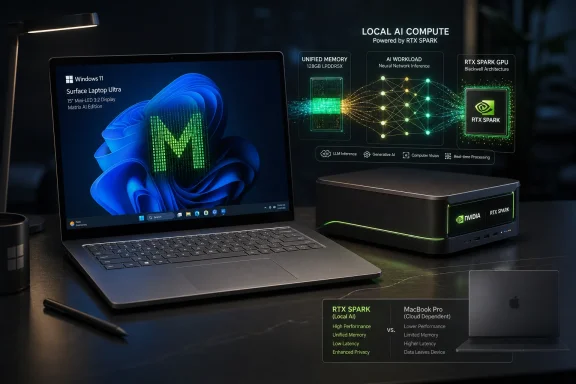
RTX Spark changes the geometry. The chip combines a 20-core Arm CPU, a Blackwell RTX GPU with 6,144 CUDA cores, up to 128GB of unified LPDDR5X memory, and a claimed ceiling of up to one petaflop of AI compute. MediaTek helped with the Arm CPU design, while Nvidia brings the graphics, CUDA software stack, Tensor cores, and AI branding that have become almost gravitational forces in the industry.
That makes this more than a component announcement. Nvidia is effectively saying that the next premium PC should be built around GPU-accelerated local computing from the start, not upgraded into it after the fact. In the old Windows hierarchy, the GPU accelerated a subset of tasks. In Nvidia’s preferred future, the GPU is the reason the machine exists.
The timing is not accidental. Apple has spent five years turning Arm-based Macs from an architectural gamble into a premium-laptop default. Qualcomm has spent the last two trying to persuade Windows buyers that Snapdragon X chips finally make Windows on Arm credible. Intel and AMD are racing to add more neural processing, more integrated graphics, and more efficiency to x86 platforms. Nvidia looked at that scrum and chose the most Nvidia answer possible: build the biggest, most graphics-heavy Arm PC platform in the room.
The Surface Laptop Ultra is designed to make that question less theoretical. Microsoft is positioning it as the most powerful Surface laptop yet, with a 15-inch mini-LED PixelSense Ultra display, Nvidia’s RTX Spark platform, and configurations reportedly reaching 128GB of unified memory. That is not the spec sheet of a secondary device for email and travel. It is a direct appeal to developers, creators, AI experimenters, and Windows professionals who have watched Apple’s high-end laptops become the default recommendation in many performance-per-watt conversations.
It is also a tacit admission that Microsoft could not win the premium creator laptop fight with operating-system polish alone. Windows needed silicon that made a clean argument. Nvidia needed an OEM and platform partner willing to treat its chip as a flagship rather than a curiosity. Surface gives RTX Spark a stage, and RTX Spark gives Surface a reason to exist above the crowded field of competent Windows ultrabooks.
That pairing is significant because Surface has often been more influential as a design signal than as a volume seller. OEMs watch what Microsoft blesses. If the Surface Laptop Ultra works, it gives Dell, HP, Lenovo, Asus, Acer, MSI, and Gigabyte permission to chase the same class of machines without looking like they are taking a strange detour from the mainstream PC roadmap.
Apple’s M-series chips proved that unified memory, Arm efficiency, and tight hardware-software integration could make laptops feel dramatically different. Battery life became less of a compromise. Performance stayed high away from the wall. Fans spun less often. The MacBook Pro became not merely a fast laptop, but a kind of portable desktop replacement that did not punish the user for unplugging it.
RTX Spark borrows from that playbook. Unified memory lets CPU and GPU share a large pool rather than forcing creators and AI developers into the old split between system RAM and discrete VRAM. Arm CPU cores promise efficiency. The integrated package gives OEMs a way to design thinner machines without bolting together a traditional high-end CPU and discrete GPU.
But Nvidia’s bet is sharper than Apple’s in one respect. Apple sells an ecosystem. Nvidia sells acceleration. For a Windows user building local AI agents, fine-tuning models, rendering, compiling, or gaming, the question is not merely whether the machine feels elegant. It is whether the software stack recognizes the hardware and runs fast enough to justify a premium price.
That is where CUDA becomes Nvidia’s most important advantage and its biggest constraint. CUDA is deeply entrenched in AI and GPU computing, and that gives RTX Spark instant credibility for developers who already live in Nvidia’s world. But Windows on Arm still has to prove that the rest of the everyday professional stack runs cleanly, quickly, and without the compatibility caveats that have historically turned Arm Windows into a footnote.
Local AI is memory-hungry in a way that exposes the limits of mainstream PCs. Running large models locally is not just about TOPS figures or synthetic AI benchmarks. It requires enough memory to load the model, enough bandwidth to feed it, and enough GPU acceleration to make the experience tolerable. A 16GB or 32GB laptop can be marketed as an AI PC, but it will hit a wall quickly when the work moves from demos to serious experimentation.
Nvidia knows this because the company’s data-center boom was built on the same lesson at a much larger scale. Memory capacity, bandwidth, and software support decide what is practical. RTX Spark translates that lesson downward into the personal workstation category. It tells developers and creators: you do not have to send every model, asset, or inference job to the cloud.
That message will resonate with more than hobbyists. Enterprises are increasingly interested in local AI for privacy, cost control, latency, and governance. A laptop that can prototype or run substantial models locally may appeal to security-conscious teams that do not want sensitive prompts, documents, source code, or customer data traveling through external services by default.
Still, 128GB of unified memory also raises practical questions. Machines configured at that level will not be cheap. Battery-life claims will need independent testing under real workloads, not just light productivity loops. And the people most likely to exploit that memory are also the people most likely to notice driver issues, thermal throttling, missing native apps, and any gap between keynote math and sustained performance.
That is the opening RTX Spark exploits. Windows is not just a productivity platform; it is the dominant PC gaming platform, a workstation platform, a tinkering platform, and a developer platform. Nvidia’s brand means something in each of those markets. An Arm Windows laptop with Nvidia graphics sounds immediately more plausible to a huge segment of buyers than an Arm Windows laptop asking them to accept a weaker graphics ecosystem.
The presence of Blackwell RTX graphics also gives Microsoft a chance to repair one of Windows on Arm’s persistent image problems. For years, Arm Windows devices were associated with compromise: long battery life in exchange for uncertain compatibility and modest performance. RTX Spark reframes the conversation around excess. It says Arm Windows can be the machine with too much memory, too much GPU, and too much local AI performance.
That may be the psychological break the category needed. High-end buyers are often more forgiving of new architectures when the upside is obvious. Apple learned this with the first M1 Macs, which were not perfect in every edge case but were so clearly better in battery life and performance-per-watt that many users accepted the transition. Microsoft and Nvidia now need their own version of that moment.
But unlike Apple, they do not control the whole stack. Microsoft controls Windows, Nvidia controls much of the silicon and software acceleration layer, MediaTek contributed to the CPU design, and OEMs will design many of the final machines. That is both the strength and weakness of the Windows ecosystem. It can scale quickly across vendors, but it can also fragment quickly across firmware quality, thermals, displays, pricing, and support.
Intel has spent years recovering from Apple’s departure and defending x86 as it moves into tiled architectures, stronger integrated graphics, and more capable NPUs. AMD has used efficient Zen cores and strong integrated graphics to win credibility in laptops that once defaulted to Intel. Qualcomm has invested heavily in making Windows on Arm mainstream. Nvidia is now entering above them with a chip that says the real premium benchmark is not CPU heritage but AI and GPU throughput.
That puts pressure on everyone. Intel and AMD must prove that x86 laptops can match the efficiency and local-AI appeal of these new Arm designs without leaning on discrete GPUs that eat into battery life and chassis space. Qualcomm must prove that its Windows on Arm advantage is not limited to battery-friendly productivity machines. Apple must answer whether its GPU and AI software ecosystem can compete with Nvidia’s developer gravity outside Apple’s own tightly managed world.
The result could be healthy for buyers, at least at the high end. Competition in premium laptops has too often been divided into neat lanes: Macs for battery and creative polish, Windows gaming laptops for raw GPU power, ThinkPads and Latitudes for enterprise, and mobile workstations for people willing to tolerate bulk. RTX Spark tries to collapse those lanes into one category.
Whether it succeeds will depend on price and thermals as much as architecture. A thin laptop with RTX-class performance and all-day battery life is a spectacular promise. A thin laptop that performs brilliantly for five minutes and then settles into compromise would be less revolutionary. The first independent reviews will matter more here than they do for ordinary annual refreshes because Nvidia is not just selling a chip; it is selling a new belief about what Windows laptops can be.
Nvidia can solve part of this problem with its own ecosystem. CUDA, RTX acceleration, Studio tools, AI frameworks, and graphics drivers give RTX Spark an unusually strong software base for a new PC platform. If the tools that matter to AI developers and creators are ready, Nvidia can build momentum among precisely the users most likely to evangelize the hardware.
Microsoft must solve the rest. Windows on Arm cannot simply be “good enough” for web browsing and Office anymore. A Surface Laptop Ultra is a flagship machine, and flagship users expect the operating system to disappear under their work. If they hit compatibility prompts, performance cliffs, or missing drivers, the MacBook Pro comparison will turn from flattering to damaging.
There is also the gaming problem. Nvidia’s RTX brand carries gaming expectations, whether or not the first wave of RTX Spark machines is marketed primarily as AI and creator hardware. Windows gaming on Arm will need native titles, effective translation, driver maturity, and anti-cheat support. A powerful GPU is only useful to gamers if the games actually run.
This is where the announcement’s ambition becomes risky. Nvidia’s presence raises expectations higher than Qualcomm’s did. A Snapdragon laptop can be forgiven for not being a gaming rig. An RTX-branded Windows machine cannot avoid the question. If Microsoft and Nvidia want the halo, they inherit the scrutiny that comes with the badge.
RTX Spark makes the AI PC idea more concrete because it targets workloads people can understand: local model inference, agentic workflows, content generation, software development, video processing, and GPU-accelerated creation. The pitch is not merely that Windows can run a few OS-level AI features. It is that the PC itself can become a serious local compute node.
That distinction matters. Cloud AI is powerful, but it is not always cheap, private, fast, or available. Local AI will not replace cloud-scale models, but it can change how developers prototype, how creators work with media, how enterprises handle sensitive data, and how enthusiasts experiment. A machine with 128GB of unified memory and a large Nvidia GPU is meaningfully different from a thin laptop whose AI features are mostly hidden inside the operating system.
Microsoft’s strategic interest is obvious. Windows cannot afford to become a thin client for AI services running somewhere else, especially while Apple controls the high-end laptop experience and Nvidia controls much of the AI compute ecosystem. By backing RTX Spark in Surface, Microsoft is trying to keep the PC relevant as a place where advanced computing happens locally.
The risk is that the software experience may lag behind the hardware. AI agents remain more promise than settled product category. Local models vary widely in quality and usability. Enterprise adoption will require management tools, security policies, auditability, and support lifecycles. RTX Spark gives the industry a powerful box; the ecosystem still has to prove that users need the box every day.
The troublesome part is just as obvious. New silicon means new deployment images, new driver baselines, new compatibility testing, and new procurement questions. Arm Windows devices may fit neatly into modern management tooling on paper, but enterprise estates are full of legacy assumptions. A single critical VPN client, endpoint security agent, hardware peripheral, or line-of-business app can turn a glamorous flagship into a support exception.
There is also a lifecycle question. Intel and AMD business laptops benefit from years of accumulated enterprise familiarity. Qualcomm has been working to earn that trust in Windows on Arm. Nvidia is entering with enormous credibility in GPUs and AI, but less history as the primary PC platform vendor in managed Windows fleets. IT departments will want guarantees around firmware updates, driver cadence, security response, and long-term platform support.
The Surface brand can help here because Microsoft understands enterprise channels and device management. But Surface alone cannot normalize RTX Spark. The platform will need broad OEM execution, predictable servicing, and clear communication about what runs natively, what runs under emulation, and what does not run acceptably at all.
For some organizations, the first wave will be pilot hardware for developers, data scientists, and creative teams rather than a general-purpose refresh candidate. That is not failure. In fact, it may be the right entry point. RTX Spark’s first job is not to replace every corporate laptop; it is to prove that a premium Windows machine can own the local AI workstation niche before that niche becomes mainstream.
If the Surface Laptop Ultra lands at an extreme premium, it may still succeed as a halo device while limiting RTX Spark’s reach. That would not be unusual for first-generation platform hardware. Apple’s highest-end MacBook Pro configurations are expensive. Mobile workstations are expensive. Developer machines with lots of memory are expensive. The question is whether Nvidia and Microsoft can make the value feel obvious.
The 128GB memory configuration may help justify premium pricing for AI and development users, but mainstream buyers will not pay workstation prices for theoretical future workflows. They will need visible advantages in video editing, coding, multitasking, gaming, battery life, and everyday responsiveness. The machine cannot be merely impressive in a keynote; it has to feel meaningfully better in the hands of people who know what high-end laptops already cost.
OEM variety could soften the blow. A Surface flagship can be expensive and aspirational while Asus, Lenovo, HP, Dell, Acer, MSI, and Gigabyte explore different shapes and price points. Some may build creator laptops. Some may build compact desktops. Some may chase gaming-adjacent designs. That diversity is the Windows ecosystem’s best chance to turn RTX Spark from a single shiny announcement into a real category.
But diversity can also dilute the message. If early systems vary wildly in fan noise, battery life, display quality, driver polish, and pricing, the platform’s reputation will be set by its weakest visible products. Nvidia and Microsoft need the first wave to feel curated, not chaotic.
But Apple should take RTX Spark seriously because it attacks a part of the market where the Mac has looked increasingly comfortable. Many developers and creators tolerate macOS not just because they love it, but because Apple Silicon laptops have delivered a superior balance of performance, battery life, and acoustics. If Windows machines can match that balance while adding Nvidia’s AI and graphics ecosystem, some of those users will reconsider.
The threat is especially acute in AI development. Apple has made progress with its own frameworks and local model story, but Nvidia remains the default mental model for serious AI acceleration. Developers who train, fine-tune, optimize, or deploy models often live in a CUDA-first world. A portable Windows machine that speaks that language natively has a different pull than a Mac trying to persuade the same audience into Apple-specific tooling.
Apple’s response may not be immediate or dramatic. It can continue improving its M-series chips, expand memory options, strengthen local AI frameworks, and lean on battery life and polish. But the MacBook Pro has benefited from Windows laptops failing to offer a clean alternative at the same intersection of power and efficiency. RTX Spark is an attempt to close that gap with force.
The fight, then, is not Mac versus Windows in the old tribal sense. It is a fight over whose silicon assumptions define the next decade of personal computing. Apple believes integration wins. Nvidia believes accelerated compute wins. Microsoft believes Windows can be the stage where every hardware partner competes. RTX Spark is where those theories collide.
 Nvidia Is No Longer Content to Ride Shotgun in the PC
For most of the modern Windows laptop era, Nvidia has been the performance passenger. Intel or AMD supplied the CPU, Microsoft supplied the operating system, and Nvidia supplied the graphics horsepower when the chassis, price, and battery budget could tolerate it. That arrangement made Nvidia essential to gaming laptops and mobile workstations, but it also kept the company one layer removed from the platform itself.RTX Spark changes the geometry. The chip combines a 20-core Arm CPU, a Blackwell RTX GPU with 6,144 CUDA cores, up to 128GB of unified LPDDR5X memory, and a claimed ceiling of up to one petaflop of AI compute. MediaTek helped with the Arm CPU design, while Nvidia brings the graphics, CUDA software stack, Tensor cores, and AI branding that have become almost gravitational forces in the industry.
That makes this more than a component announcement. Nvidia is effectively saying that the next premium PC should be built around GPU-accelerated local computing from the start, not upgraded into it after the fact. In the old Windows hierarchy, the GPU accelerated a subset of tasks. In Nvidia’s preferred future, the GPU is the reason the machine exists.
The timing is not accidental. Apple has spent five years turning Arm-based Macs from an architectural gamble into a premium-laptop default. Qualcomm has spent the last two trying to persuade Windows buyers that Snapdragon X chips finally make Windows on Arm credible. Intel and AMD are racing to add more neural processing, more integrated graphics, and more efficiency to x86 platforms. Nvidia looked at that scrum and chose the most Nvidia answer possible: build the biggest, most graphics-heavy Arm PC platform in the room.
Microsoft Finally Gets the Flagship Windows on Arm Was Missing
The Surface Laptop Ultra matters because Windows on Arm has never lacked a story; it has lacked a halo product that could make the story feel inevitable. Microsoft has tried before with thin, efficient Surface devices, and Qualcomm’s Snapdragon X generation improved the case substantially. But the category has still been dogged by the same question: why should a power user choose Arm Windows over a proven Intel, AMD, or Apple machine?The Surface Laptop Ultra is designed to make that question less theoretical. Microsoft is positioning it as the most powerful Surface laptop yet, with a 15-inch mini-LED PixelSense Ultra display, Nvidia’s RTX Spark platform, and configurations reportedly reaching 128GB of unified memory. That is not the spec sheet of a secondary device for email and travel. It is a direct appeal to developers, creators, AI experimenters, and Windows professionals who have watched Apple’s high-end laptops become the default recommendation in many performance-per-watt conversations.
It is also a tacit admission that Microsoft could not win the premium creator laptop fight with operating-system polish alone. Windows needed silicon that made a clean argument. Nvidia needed an OEM and platform partner willing to treat its chip as a flagship rather than a curiosity. Surface gives RTX Spark a stage, and RTX Spark gives Surface a reason to exist above the crowded field of competent Windows ultrabooks.
That pairing is significant because Surface has often been more influential as a design signal than as a volume seller. OEMs watch what Microsoft blesses. If the Surface Laptop Ultra works, it gives Dell, HP, Lenovo, Asus, Acer, MSI, and Gigabyte permission to chase the same class of machines without looking like they are taking a strange detour from the mainstream PC roadmap.
The MacBook Pro Comparison Is the Hook, Not the Whole Story
The easy headline is that Microsoft and Nvidia are coming for the MacBook Pro. The more interesting story is that they are copying the structural logic of Apple Silicon while trying to beat Apple on the workloads Apple has never fully owned: CUDA-heavy AI, gaming, and workstation-class GPU acceleration.Apple’s M-series chips proved that unified memory, Arm efficiency, and tight hardware-software integration could make laptops feel dramatically different. Battery life became less of a compromise. Performance stayed high away from the wall. Fans spun less often. The MacBook Pro became not merely a fast laptop, but a kind of portable desktop replacement that did not punish the user for unplugging it.
RTX Spark borrows from that playbook. Unified memory lets CPU and GPU share a large pool rather than forcing creators and AI developers into the old split between system RAM and discrete VRAM. Arm CPU cores promise efficiency. The integrated package gives OEMs a way to design thinner machines without bolting together a traditional high-end CPU and discrete GPU.
But Nvidia’s bet is sharper than Apple’s in one respect. Apple sells an ecosystem. Nvidia sells acceleration. For a Windows user building local AI agents, fine-tuning models, rendering, compiling, or gaming, the question is not merely whether the machine feels elegant. It is whether the software stack recognizes the hardware and runs fast enough to justify a premium price.
That is where CUDA becomes Nvidia’s most important advantage and its biggest constraint. CUDA is deeply entrenched in AI and GPU computing, and that gives RTX Spark instant credibility for developers who already live in Nvidia’s world. But Windows on Arm still has to prove that the rest of the everyday professional stack runs cleanly, quickly, and without the compatibility caveats that have historically turned Arm Windows into a footnote.
The 128GB Memory Figure Is the Real Declaration of War
The most provocative number in the RTX Spark announcement is not the CPU core count or even the CUDA core count. It is 128GB of unified memory. That figure is a signal to buyers who have outgrown ordinary laptops but do not want to carry a workstation brick or rent every serious AI workload from the cloud.Local AI is memory-hungry in a way that exposes the limits of mainstream PCs. Running large models locally is not just about TOPS figures or synthetic AI benchmarks. It requires enough memory to load the model, enough bandwidth to feed it, and enough GPU acceleration to make the experience tolerable. A 16GB or 32GB laptop can be marketed as an AI PC, but it will hit a wall quickly when the work moves from demos to serious experimentation.
Nvidia knows this because the company’s data-center boom was built on the same lesson at a much larger scale. Memory capacity, bandwidth, and software support decide what is practical. RTX Spark translates that lesson downward into the personal workstation category. It tells developers and creators: you do not have to send every model, asset, or inference job to the cloud.
That message will resonate with more than hobbyists. Enterprises are increasingly interested in local AI for privacy, cost control, latency, and governance. A laptop that can prototype or run substantial models locally may appeal to security-conscious teams that do not want sensitive prompts, documents, source code, or customer data traveling through external services by default.
Still, 128GB of unified memory also raises practical questions. Machines configured at that level will not be cheap. Battery-life claims will need independent testing under real workloads, not just light productivity loops. And the people most likely to exploit that memory are also the people most likely to notice driver issues, thermal throttling, missing native apps, and any gap between keynote math and sustained performance.
Windows on Arm Gets a GPU Story at Last
Qualcomm’s Snapdragon X chips did something important for Windows: they made Arm PCs feel less like an apology. Battery life improved, responsiveness improved, and Microsoft finally had hardware capable enough to support its Copilot+ PC push. But for the traditional Windows enthusiast, Snapdragon’s integrated GPU story never had the same emotional or professional pull as Nvidia RTX.That is the opening RTX Spark exploits. Windows is not just a productivity platform; it is the dominant PC gaming platform, a workstation platform, a tinkering platform, and a developer platform. Nvidia’s brand means something in each of those markets. An Arm Windows laptop with Nvidia graphics sounds immediately more plausible to a huge segment of buyers than an Arm Windows laptop asking them to accept a weaker graphics ecosystem.
The presence of Blackwell RTX graphics also gives Microsoft a chance to repair one of Windows on Arm’s persistent image problems. For years, Arm Windows devices were associated with compromise: long battery life in exchange for uncertain compatibility and modest performance. RTX Spark reframes the conversation around excess. It says Arm Windows can be the machine with too much memory, too much GPU, and too much local AI performance.
That may be the psychological break the category needed. High-end buyers are often more forgiving of new architectures when the upside is obvious. Apple learned this with the first M1 Macs, which were not perfect in every edge case but were so clearly better in battery life and performance-per-watt that many users accepted the transition. Microsoft and Nvidia now need their own version of that moment.
But unlike Apple, they do not control the whole stack. Microsoft controls Windows, Nvidia controls much of the silicon and software acceleration layer, MediaTek contributed to the CPU design, and OEMs will design many of the final machines. That is both the strength and weakness of the Windows ecosystem. It can scale quickly across vendors, but it can also fragment quickly across firmware quality, thermals, displays, pricing, and support.
Intel, AMD, and Qualcomm Just Got a New Kind of Competitor
RTX Spark does not replace Intel and AMD across the Windows market. It is not aimed at the $699 laptop aisle, the fleet-buy business notebook, or the cheapest gaming machines. Its threat is narrower and more dangerous: it attacks the prestige layer where platform narratives are made.Intel has spent years recovering from Apple’s departure and defending x86 as it moves into tiled architectures, stronger integrated graphics, and more capable NPUs. AMD has used efficient Zen cores and strong integrated graphics to win credibility in laptops that once defaulted to Intel. Qualcomm has invested heavily in making Windows on Arm mainstream. Nvidia is now entering above them with a chip that says the real premium benchmark is not CPU heritage but AI and GPU throughput.
That puts pressure on everyone. Intel and AMD must prove that x86 laptops can match the efficiency and local-AI appeal of these new Arm designs without leaning on discrete GPUs that eat into battery life and chassis space. Qualcomm must prove that its Windows on Arm advantage is not limited to battery-friendly productivity machines. Apple must answer whether its GPU and AI software ecosystem can compete with Nvidia’s developer gravity outside Apple’s own tightly managed world.
The result could be healthy for buyers, at least at the high end. Competition in premium laptops has too often been divided into neat lanes: Macs for battery and creative polish, Windows gaming laptops for raw GPU power, ThinkPads and Latitudes for enterprise, and mobile workstations for people willing to tolerate bulk. RTX Spark tries to collapse those lanes into one category.
Whether it succeeds will depend on price and thermals as much as architecture. A thin laptop with RTX-class performance and all-day battery life is a spectacular promise. A thin laptop that performs brilliantly for five minutes and then settles into compromise would be less revolutionary. The first independent reviews will matter more here than they do for ordinary annual refreshes because Nvidia is not just selling a chip; it is selling a new belief about what Windows laptops can be.
The Software Question Will Decide the Hardware Story
Every Windows on Arm launch eventually runs into the same wall: software compatibility. Microsoft has improved emulation, developers have added native Arm builds, and the overall situation is far better than it was in the early days. But high-end buyers do not live in averages. They live in plug-ins, drivers, command-line tools, anti-cheat systems, virtualization stacks, VPN clients, audio interfaces, CAD packages, and obscure utilities written by vendors who may or may not care about Arm.Nvidia can solve part of this problem with its own ecosystem. CUDA, RTX acceleration, Studio tools, AI frameworks, and graphics drivers give RTX Spark an unusually strong software base for a new PC platform. If the tools that matter to AI developers and creators are ready, Nvidia can build momentum among precisely the users most likely to evangelize the hardware.
Microsoft must solve the rest. Windows on Arm cannot simply be “good enough” for web browsing and Office anymore. A Surface Laptop Ultra is a flagship machine, and flagship users expect the operating system to disappear under their work. If they hit compatibility prompts, performance cliffs, or missing drivers, the MacBook Pro comparison will turn from flattering to damaging.
There is also the gaming problem. Nvidia’s RTX brand carries gaming expectations, whether or not the first wave of RTX Spark machines is marketed primarily as AI and creator hardware. Windows gaming on Arm will need native titles, effective translation, driver maturity, and anti-cheat support. A powerful GPU is only useful to gamers if the games actually run.
This is where the announcement’s ambition becomes risky. Nvidia’s presence raises expectations higher than Qualcomm’s did. A Snapdragon laptop can be forgiven for not being a gaming rig. An RTX-branded Windows machine cannot avoid the question. If Microsoft and Nvidia want the halo, they inherit the scrutiny that comes with the badge.
The AI PC Finally Becomes More Than a Sticker
The phrase AI PC has been abused badly enough to deserve skepticism. For the last couple of years, it has often meant a laptop with an NPU, a Copilot key, and a marketing deck promising future features. Some of those machines are perfectly good PCs, but the AI label has frequently arrived before the use cases.RTX Spark makes the AI PC idea more concrete because it targets workloads people can understand: local model inference, agentic workflows, content generation, software development, video processing, and GPU-accelerated creation. The pitch is not merely that Windows can run a few OS-level AI features. It is that the PC itself can become a serious local compute node.
That distinction matters. Cloud AI is powerful, but it is not always cheap, private, fast, or available. Local AI will not replace cloud-scale models, but it can change how developers prototype, how creators work with media, how enterprises handle sensitive data, and how enthusiasts experiment. A machine with 128GB of unified memory and a large Nvidia GPU is meaningfully different from a thin laptop whose AI features are mostly hidden inside the operating system.
Microsoft’s strategic interest is obvious. Windows cannot afford to become a thin client for AI services running somewhere else, especially while Apple controls the high-end laptop experience and Nvidia controls much of the AI compute ecosystem. By backing RTX Spark in Surface, Microsoft is trying to keep the PC relevant as a place where advanced computing happens locally.
The risk is that the software experience may lag behind the hardware. AI agents remain more promise than settled product category. Local models vary widely in quality and usability. Enterprise adoption will require management tools, security policies, auditability, and support lifecycles. RTX Spark gives the industry a powerful box; the ecosystem still has to prove that users need the box every day.
Enterprise IT Will Admire the Power and Fear the Edge Cases
For sysadmins, the Surface Laptop Ultra and its RTX Spark cousins will look both tempting and troublesome. The tempting part is obvious: a portable Windows machine with serious local AI and graphics capability could reduce dependence on remote workstations, cloud GPU instances, or separate developer hardware. For teams dealing with sensitive code, regulated data, or low-latency workloads, local compute has a real governance appeal.The troublesome part is just as obvious. New silicon means new deployment images, new driver baselines, new compatibility testing, and new procurement questions. Arm Windows devices may fit neatly into modern management tooling on paper, but enterprise estates are full of legacy assumptions. A single critical VPN client, endpoint security agent, hardware peripheral, or line-of-business app can turn a glamorous flagship into a support exception.
There is also a lifecycle question. Intel and AMD business laptops benefit from years of accumulated enterprise familiarity. Qualcomm has been working to earn that trust in Windows on Arm. Nvidia is entering with enormous credibility in GPUs and AI, but less history as the primary PC platform vendor in managed Windows fleets. IT departments will want guarantees around firmware updates, driver cadence, security response, and long-term platform support.
The Surface brand can help here because Microsoft understands enterprise channels and device management. But Surface alone cannot normalize RTX Spark. The platform will need broad OEM execution, predictable servicing, and clear communication about what runs natively, what runs under emulation, and what does not run acceptably at all.
For some organizations, the first wave will be pilot hardware for developers, data scientists, and creative teams rather than a general-purpose refresh candidate. That is not failure. In fact, it may be the right entry point. RTX Spark’s first job is not to replace every corporate laptop; it is to prove that a premium Windows machine can own the local AI workstation niche before that niche becomes mainstream.
Pricing Will Reveal Whether This Is a Platform or a Trophy
The missing number in the announcement is the one buyers care about most: price. None of the RTX Spark machines will be judged in a vacuum. They will be compared against MacBook Pros, high-end Intel and AMD creator laptops, gaming laptops with discrete RTX GPUs, mobile workstations, and cloud GPU subscriptions.If the Surface Laptop Ultra lands at an extreme premium, it may still succeed as a halo device while limiting RTX Spark’s reach. That would not be unusual for first-generation platform hardware. Apple’s highest-end MacBook Pro configurations are expensive. Mobile workstations are expensive. Developer machines with lots of memory are expensive. The question is whether Nvidia and Microsoft can make the value feel obvious.
The 128GB memory configuration may help justify premium pricing for AI and development users, but mainstream buyers will not pay workstation prices for theoretical future workflows. They will need visible advantages in video editing, coding, multitasking, gaming, battery life, and everyday responsiveness. The machine cannot be merely impressive in a keynote; it has to feel meaningfully better in the hands of people who know what high-end laptops already cost.
OEM variety could soften the blow. A Surface flagship can be expensive and aspirational while Asus, Lenovo, HP, Dell, Acer, MSI, and Gigabyte explore different shapes and price points. Some may build creator laptops. Some may build compact desktops. Some may chase gaming-adjacent designs. That diversity is the Windows ecosystem’s best chance to turn RTX Spark from a single shiny announcement into a real category.
But diversity can also dilute the message. If early systems vary wildly in fan noise, battery life, display quality, driver polish, and pricing, the platform’s reputation will be set by its weakest visible products. Nvidia and Microsoft need the first wave to feel curated, not chaotic.
Apple Should Take This Seriously, but Not Panic
The MacBook Pro is not suddenly obsolete because Nvidia and Microsoft announced an ambitious Windows laptop platform. Apple’s advantages remain formidable: tight vertical integration, excellent battery life, polished industrial design, strong creative software support, and a user base that values consistency as much as raw performance. Apple also controls macOS, its silicon roadmap, and the hardware experience in a way Microsoft and Nvidia do not.But Apple should take RTX Spark seriously because it attacks a part of the market where the Mac has looked increasingly comfortable. Many developers and creators tolerate macOS not just because they love it, but because Apple Silicon laptops have delivered a superior balance of performance, battery life, and acoustics. If Windows machines can match that balance while adding Nvidia’s AI and graphics ecosystem, some of those users will reconsider.
The threat is especially acute in AI development. Apple has made progress with its own frameworks and local model story, but Nvidia remains the default mental model for serious AI acceleration. Developers who train, fine-tune, optimize, or deploy models often live in a CUDA-first world. A portable Windows machine that speaks that language natively has a different pull than a Mac trying to persuade the same audience into Apple-specific tooling.
Apple’s response may not be immediate or dramatic. It can continue improving its M-series chips, expand memory options, strengthen local AI frameworks, and lean on battery life and polish. But the MacBook Pro has benefited from Windows laptops failing to offer a clean alternative at the same intersection of power and efficiency. RTX Spark is an attempt to close that gap with force.
The fight, then, is not Mac versus Windows in the old tribal sense. It is a fight over whose silicon assumptions define the next decade of personal computing. Apple believes integration wins. Nvidia believes accelerated compute wins. Microsoft believes Windows can be the stage where every hardware partner competes. RTX Spark is where those theories collide.
The First Spark Machines Will Test More Than Benchmark Charts
The concrete story is straightforward, but the implications are not. RTX Spark gives Windows OEMs a new premium weapon, Surface a more convincing flagship, and Nvidia a path from GPU supplier to PC platform architect.- Microsoft’s Surface Laptop Ultra is the first major signal that RTX Spark is being treated as a flagship Windows platform, not an experimental side project.
- Nvidia’s combination of Arm CPU cores, Blackwell RTX graphics, CUDA support, and up to 128GB of unified memory is aimed squarely at local AI, creator, developer, and workstation workloads.
- The MacBook Pro comparison is useful but incomplete, because RTX Spark’s strongest differentiator is Nvidia’s AI and graphics ecosystem rather than hardware efficiency alone.
- Windows on Arm compatibility remains the largest practical risk, especially for professional tools, drivers, games, plug-ins, and enterprise security software.
- Pricing, sustained performance, battery life, and OEM execution will determine whether RTX Spark becomes a real category or remains an impressive halo product.
References
- Primary source: Daily Express
Published: 2026-06-02T09:15:15.803987
New powerful Windows 11 PCs set to challenge the MacBook Pro
Tech titan Nvidia has announced it is powering the next generation of computers.www.express.co.uk - Related coverage: tomshardware.com
- Related coverage: nvidia.com
NVIDIA RTX Spark — Slim Laptops & Small Desktops
The fusion of NVIDIA AI and RTX graphics in slim laptops and small desktops. For creators, developers, and gamers.www.nvidia.com - Related coverage: arstechnica.com
Nvidia RTX Spark comes to Windows PCs with Arm CPU, RTX GPU, and unified memory - Ars Technica
Nvidia's new chips will power laptop workstations and mini desktop PCs at first.arstechnica.com - Related coverage: techspot.com
Microsoft unveils Surface Laptop Ultra with Nvidia RTX Spark chip and up to 128GB of RAM | TechSpot
The Surface Laptop Ultra features a standard design, without the more experimental elements seen in earlier Surface devices. That means it does not include a removable display...www.techspot.com - Related coverage: investor.nvidia.com
NVIDIA Corporation - NVIDIA and Microsoft Reinvent Windows PCs for the Age of Personal AI
RTX Spark — a 1-Petaflop Superchip, the Full CUDA and RTX Ecosystem, and Windows-Native Agents — a New Beginning for Personal Computers News Summary: NVIDIA RTX Spark powers the world’s first Windows PCs purpose-built for personal agents, featuring 1 petaflop of AI performance, industry-leading...investor.nvidia.com
- Related coverage: notebookcheck.net
Nvidia N1X officially confirmed to arrive as the RTX Spark - Notebookcheck News
Nvidia’s first consumer-grade laptop chip, the RTX Spark, is finally here. It is essentially a modified version of the DGX Spark launched last year, but with Windows support. www.notebookcheck.net
- Related coverage: smartprix.com
Nvidia Enters The Consumer Laptop Market At Computex 2026 With Its RTX Spark Superchip - Smartprix
The RTX Spark is a Windows on Arm superchip with 20 Arm CPU cores, a Blackwell GPU with 6,144 CUDA cores, up to 128GB unified LPDDR5X memory, and 1 petaflop of AI compute. www.smartprix.com
- Related coverage: technobezz.com
Nvidia Announces RTX Spark Processor Family for Laptops and Desktops at Computex 2026 | Technobezz
Nvidia unveils the RTX Spark processor family at Computex 2026, merging Arm CPU and Blackwell GPU cores to redefine laptops and desktops.www.technobezz.com - Related coverage: forbes.com
Nvidia Has Best Trading Day In Months
The new line of Windows laptops and desktops will be the first ever to run solely on an Nvidia-made chip, the RTX Spark, as the AI giant looks to take on rivals Intel and AMD.www.forbes.com - Related coverage: axios.com
Microsoft debuts Nvidia-powered Microsoft Surface Ultra laptop
Microsoft is trying again to redefine the PC for the AI era.www.axios.com
- Related coverage: elpais.com
Nvidia anuncia la reinvención del ordenador personal con un chip de IA con el que reta a Intel y AMD | Economía | EL PAÍS
El gigante crea un procesador diseñado junto a Microsoft. Fabricantes como Dell, HP y Asus se unen al proyectoelpais.com - Related coverage: signal65.com
- Related coverage: nvidianews.nvidia.com
