

Microsoft is adding a Microsoft Teams admin control that can automatically block all identified external bots from joining meetings, with the feature listed as Roadmap ID 566201, created June 22, 2026, and scheduled for general availability in August 2026 worldwide. The change sounds narrow, but it lands in the middle of a much larger argument about who gets to bring software agents into business conversations. Teams is no longer just policing people at the door; it is starting to police non-human participants as a class. That is a meaningful shift for meeting privacy, compliance, and the increasingly awkward etiquette of AI note-taking.
Until now, Microsoft’s emerging Teams controls around external AI bots have mostly centered on visibility and organizer consent. If a third-party meeting assistant tried to join, Teams could detect it, mark it as a bot, and hold it in the lobby until someone admitted it. That model treated the bot as a suspicious guest, but still left the human organizer with the final click.
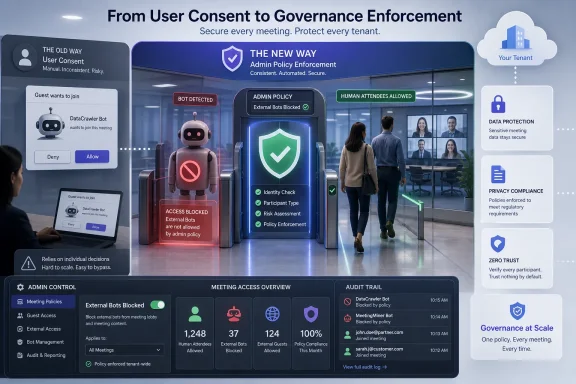
The new roadmap item changes the posture. Instead of asking every organizer to make the call in real time, Microsoft is adding the option for admins to automatically block all identified external bots. The practical difference is substantial: the policy decision moves from the meeting host’s momentary judgment to the tenant administrator’s governance layer.
That matters because the meeting lobby was never a great compliance boundary. It was a user interface boundary, and user interfaces fail under pressure. A distracted organizer may admit a bot because it looks familiar, because a client expects it, or because the meeting has already started and there are twelve people waiting.
By making automatic blocking available, Microsoft is acknowledging what many IT teams already concluded: external AI meeting bots are not merely “participants.” They are data-processing endpoints with uncertain retention policies, uncertain ownership, and uncertain downstream access to transcripts, summaries, audio, and metadata.
That inversion is the core problem. The organization hosting the meeting is responsible for the confidentiality of the discussion, yet an external participant may bring a bot that captures the meeting and sends the output into another company’s vendor stack. The host may have no contract with that vendor, no data processing agreement, no retention controls, and no way to audit who later reads the generated notes.
In ordinary collaboration, external access is already a compromise. Teams has long had to balance open communication with domain restrictions, guest access, anonymous join settings, lobby rules, and meeting policies. AI bots sharpen that compromise because they can convert an ephemeral conversation into a durable, searchable artifact.
That artifact may be more sensitive than the meeting itself. A one-hour conversation about product strategy, legal exposure, hiring plans, customer incidents, or security architecture becomes a clean transcript, a digestible summary, and a set of extracted tasks. In other words, the bot does not just attend the meeting; it industrializes the meeting.
The new automatic block option is more honest about enterprise reality. In regulated environments, awareness is not a substitute for policy. A bank, hospital, government contractor, law firm, or public company may not want meeting organizers improvising case-by-case decisions about third-party recording agents.
Even outside regulated industries, the operational burden is real. If a company hosts hundreds or thousands of external Teams meetings a week, pushing bot admission decisions to individual organizers creates inconsistent outcomes. One team may reject every bot, another may admit them casually, and a third may not understand what the label means.
Automatic blocking gives IT a cleaner line: external bots identified by Teams do not join meetings hosted by the organization. That does not solve every problem, and it does not eliminate the need for policy training, but it replaces a fragile social norm with an enforceable control.
This is not a knock on Microsoft so much as a description of the problem space. Bot detection relies on signals collected during the join process, including infrastructure and behavioral cues. That can be effective against known meeting assistant patterns, but adversarial products have every incentive to look less like bots and more like ordinary external attendees.
That means admins should treat the new block option as a strong control, not a perfect seal. A vendor that joins through a conventional external identity, a human who records with a local device, or a tool that piggybacks on an attendee’s machine may still escape the category Microsoft is trying to enforce. Meeting security remains a layered problem.
The flip side is false positives. If Teams incorrectly labels a legitimate external participant as a bot and the tenant policy blocks all identified bots, that person may be kept out of the meeting without the organizer having an immediate override. For many organizations, that is an acceptable tradeoff. For sales, recruiting, partner management, and customer success teams, it may require careful scoping rather than a blanket rollout on day one.
Teams meetings make this more complicated because they are often cross-organizational by design. A vendor, customer, auditor, consultant, or partner may have its own AI tooling culture. The meeting host may have another. The bot arrives at the fault line between them.
Microsoft’s automatic block option implicitly sides with the host organization. That is the right default. The organization that creates and hosts the meeting should be able to decide whether external automated participants are allowed, especially when the meeting may include confidential information belonging to the host.
This does not mean all bots are bad. Internal, approved, governed assistants can be valuable, and Microsoft has every reason to make Copilot and other managed agents part of the Teams workflow. But that is precisely why external bot controls matter. The issue is not automation in the abstract; it is unmanaged automation entering through someone else’s tenant.
That does not make the feature suspect. In enterprise software, governance and platform strategy often travel together. Microsoft can simultaneously be protecting customers from external data leakage and strengthening the case that AI meeting intelligence should live inside Microsoft 365’s compliance perimeter.
For admins, the distinction is practical rather than philosophical. A Microsoft-controlled AI feature can be evaluated through licensing, audit, retention, eDiscovery, data residency, and policy settings. A random external bot brought by a guest may not fit any of those existing governance models.
The risk is that Microsoft’s “approved inside, blocked outside” posture could become too blunt if customers want to use specialized third-party tools with proper contracts and safeguards. The best version of this feature would eventually support more nuance: block unknown external bots automatically, allow approved vendors, and provide clear audit trails for exceptions.
The right preparation is procedural. Organizations should decide now whether their default stance is to block external AI bots, require approval, or permit them in certain contexts. They should also identify which meetings are most sensitive, which business units rely on external note-taking tools, and which approved internal alternatives exist.
Legal and privacy teams should be in the conversation early. This is not just a Teams setting; it is a records, consent, retention, and vendor-risk issue. If an external bot creates a transcript of a meeting, the transcript may become discoverable, may contain personal data, and may be stored under terms the host organization never accepted.
Security teams should also resist the temptation to frame the problem only as “AI.” A bot that records a meeting is a data exfiltration path whether its summary is generated by a large language model or by a conventional transcription engine. The AI branding makes the issue more visible, but the underlying risk is uncontrolled capture.
That is why communication matters. If an organization enables automatic blocking, it should explain the policy in plain language: external AI meeting assistants are not permitted in meetings hosted by the company unless explicitly approved through a separate process. Users should know what to say when a client asks why their bot cannot join.
Meeting templates and invitations may also need updates. A short notice in sensitive meeting invites can reduce awkwardness: automated recording, transcription, and third-party meeting assistants are not allowed without prior approval. This is less about legal theater than expectation-setting.
There is also an accessibility dimension. Some users rely on transcription or meeting summaries for legitimate reasons. Blocking external bots should not mean blocking accessibility. It should mean providing approved, governed alternatives inside the tenant so that users are not forced to choose between compliance and participation.
Once a meeting becomes structured text, it can be searched, summarized, copied, classified, leaked, subpoenaed, or used to train downstream workflows. The compliance boundary therefore has to move closer to the conversation itself. Teams’ external bot controls are part of that movement.
This is especially relevant for organizations that already invested in Microsoft Purview, retention labels, eDiscovery, DLP, and audit logging. Those controls are only as useful as the systems that contain the data. If a third-party bot captures the meeting and stores the transcript outside the tenant, the host’s compliance architecture may be bypassed at the moment the conversation happens.
Automatic bot blocking is a way to keep meeting-derived data from escaping before governance can attach to it. It is not glamorous, and it will not get the same attention as a new AI assistant demo. But for many IT departments, this kind of control is the difference between AI adoption and AI sprawl.
That is a cultural change as much as a technical one. Many companies have tolerated external bots because the alternative required manual domain blocking, awkward meeting moderation, or unenforceable guidance. Once Teams can automatically block identified external bots, tolerance becomes a deliberate choice rather than an administrative limitation.
The policy should not live in isolation. It belongs alongside meeting lobby rules, presenter permissions, anonymous join settings, external access configuration, recording policies, sensitivity labels, and user education. A bot-blocking toggle cannot compensate for a meeting environment where anyone can admit anyone, presenters are over-permissioned, and sensitive meetings use the same defaults as casual check-ins.
IT teams should also map exceptions before they are needed. If a board meeting, customer workshop, or accessibility accommodation requires an AI transcription tool, the organization should know who can approve it, which vendors are acceptable, and how resulting data is handled. Otherwise, exceptions will be improvised under pressure, which is exactly what governance is supposed to prevent.
 Microsoft Moves the Bot Decision Out of the Lobby
Until now, Microsoft’s emerging Teams controls around external AI bots have mostly centered on visibility and organizer consent. If a third-party meeting assistant tried to join, Teams could detect it, mark it as a bot, and hold it in the lobby until someone admitted it. That model treated the bot as a suspicious guest, but still left the human organizer with the final click.The new roadmap item changes the posture. Instead of asking every organizer to make the call in real time, Microsoft is adding the option for admins to automatically block all identified external bots. The practical difference is substantial: the policy decision moves from the meeting host’s momentary judgment to the tenant administrator’s governance layer.
That matters because the meeting lobby was never a great compliance boundary. It was a user interface boundary, and user interfaces fail under pressure. A distracted organizer may admit a bot because it looks familiar, because a client expects it, or because the meeting has already started and there are twelve people waiting.
By making automatic blocking available, Microsoft is acknowledging what many IT teams already concluded: external AI meeting bots are not merely “participants.” They are data-processing endpoints with uncertain retention policies, uncertain ownership, and uncertain downstream access to transcripts, summaries, audio, and metadata.
The AI Note-Taker Became a Shadow Collaboration Platform
The rise of AI meeting assistants has been fast enough that workplace norms never really caught up. Products that record, transcribe, summarize, assign action items, and sync notes into other systems can be useful, especially for distributed teams that live inside calendars. But when those tools arrive as external bots, they often enter meetings through the preferences of one attendee rather than the governance posture of the host organization.That inversion is the core problem. The organization hosting the meeting is responsible for the confidentiality of the discussion, yet an external participant may bring a bot that captures the meeting and sends the output into another company’s vendor stack. The host may have no contract with that vendor, no data processing agreement, no retention controls, and no way to audit who later reads the generated notes.
In ordinary collaboration, external access is already a compromise. Teams has long had to balance open communication with domain restrictions, guest access, anonymous join settings, lobby rules, and meeting policies. AI bots sharpen that compromise because they can convert an ephemeral conversation into a durable, searchable artifact.
That artifact may be more sensitive than the meeting itself. A one-hour conversation about product strategy, legal exposure, hiring plans, customer incidents, or security architecture becomes a clean transcript, a digestible summary, and a set of extracted tasks. In other words, the bot does not just attend the meeting; it industrializes the meeting.
Admins Finally Get a Default That Matches the Risk
Microsoft’s current external bot controls already include detection and lobby enforcement, with the default behavior requiring approval when a bot is detected. That was a sensible first step because it gave organizers awareness they previously lacked. But it also assumed that awareness was enough.The new automatic block option is more honest about enterprise reality. In regulated environments, awareness is not a substitute for policy. A bank, hospital, government contractor, law firm, or public company may not want meeting organizers improvising case-by-case decisions about third-party recording agents.
Even outside regulated industries, the operational burden is real. If a company hosts hundreds or thousands of external Teams meetings a week, pushing bot admission decisions to individual organizers creates inconsistent outcomes. One team may reject every bot, another may admit them casually, and a third may not understand what the label means.
Automatic blocking gives IT a cleaner line: external bots identified by Teams do not join meetings hosted by the organization. That does not solve every problem, and it does not eliminate the need for policy training, but it replaces a fragile social norm with an enforceable control.
Detection Is Powerful, but It Is Not Omniscience
The key phrase in Microsoft’s roadmap text is “identified bots.” That word does a lot of work. Teams can only automatically block bots it can detect, and Microsoft’s own documentation around external bot management has already acknowledged the possibility that some bots may not be detected and that some humans may occasionally be misclassified.This is not a knock on Microsoft so much as a description of the problem space. Bot detection relies on signals collected during the join process, including infrastructure and behavioral cues. That can be effective against known meeting assistant patterns, but adversarial products have every incentive to look less like bots and more like ordinary external attendees.
That means admins should treat the new block option as a strong control, not a perfect seal. A vendor that joins through a conventional external identity, a human who records with a local device, or a tool that piggybacks on an attendee’s machine may still escape the category Microsoft is trying to enforce. Meeting security remains a layered problem.
The flip side is false positives. If Teams incorrectly labels a legitimate external participant as a bot and the tenant policy blocks all identified bots, that person may be kept out of the meeting without the organizer having an immediate override. For many organizations, that is an acceptable tradeoff. For sales, recruiting, partner management, and customer success teams, it may require careful scoping rather than a blanket rollout on day one.
The Governance Fight Is Really About Consent
AI meeting assistants have exposed a mismatch between personal productivity and collective consent. One attendee may see a bot as an accessibility aid, a memory prosthetic, or a harmless way to avoid taking notes. Another participant may see the same bot as an unauthorized recorder, a third-party data sink, or a compliance violation waiting to happen.Teams meetings make this more complicated because they are often cross-organizational by design. A vendor, customer, auditor, consultant, or partner may have its own AI tooling culture. The meeting host may have another. The bot arrives at the fault line between them.
Microsoft’s automatic block option implicitly sides with the host organization. That is the right default. The organization that creates and hosts the meeting should be able to decide whether external automated participants are allowed, especially when the meeting may include confidential information belonging to the host.
This does not mean all bots are bad. Internal, approved, governed assistants can be valuable, and Microsoft has every reason to make Copilot and other managed agents part of the Teams workflow. But that is precisely why external bot controls matter. The issue is not automation in the abstract; it is unmanaged automation entering through someone else’s tenant.
Microsoft Also Protects Its Own AI Strategy
There is a competitive subtext here that Microsoft will not emphasize in the roadmap blurb. As Microsoft builds Copilot deeper into Teams and Microsoft 365, it has an incentive to distinguish governed, tenant-aware AI from outside tools that scrape meetings through participant-like bots. Security and compliance are the public rationale, and they are legitimate. Platform control is also part of the story.That does not make the feature suspect. In enterprise software, governance and platform strategy often travel together. Microsoft can simultaneously be protecting customers from external data leakage and strengthening the case that AI meeting intelligence should live inside Microsoft 365’s compliance perimeter.
For admins, the distinction is practical rather than philosophical. A Microsoft-controlled AI feature can be evaluated through licensing, audit, retention, eDiscovery, data residency, and policy settings. A random external bot brought by a guest may not fit any of those existing governance models.
The risk is that Microsoft’s “approved inside, blocked outside” posture could become too blunt if customers want to use specialized third-party tools with proper contracts and safeguards. The best version of this feature would eventually support more nuance: block unknown external bots automatically, allow approved vendors, and provide clear audit trails for exceptions.
The Roadmap Date Is a Promise, Not a Deployment Plan
The roadmap entry lists general availability for August 2026 in the Worldwide standard multi-tenant cloud. That gives admins a planning window, but not a reason to wait until the feature appears in the Teams admin center before doing policy work. Roadmap dates can move, and Microsoft 365 features often roll out gradually across tenants even after reaching GA.The right preparation is procedural. Organizations should decide now whether their default stance is to block external AI bots, require approval, or permit them in certain contexts. They should also identify which meetings are most sensitive, which business units rely on external note-taking tools, and which approved internal alternatives exist.
Legal and privacy teams should be in the conversation early. This is not just a Teams setting; it is a records, consent, retention, and vendor-risk issue. If an external bot creates a transcript of a meeting, the transcript may become discoverable, may contain personal data, and may be stored under terms the host organization never accepted.
Security teams should also resist the temptation to frame the problem only as “AI.” A bot that records a meeting is a data exfiltration path whether its summary is generated by a large language model or by a conventional transcription engine. The AI branding makes the issue more visible, but the underlying risk is uncontrolled capture.
The User Experience Will Need More Than a Toggle
Automatic blocking is clean for admins, but it will create moments of friction for users. Some external attendees will expect their AI assistant to join as a matter of course. Some may not even realize their calendar integration is configured to send a bot into every meeting. When the bot is blocked, the human participant may be confused, annoyed, or less prepared.That is why communication matters. If an organization enables automatic blocking, it should explain the policy in plain language: external AI meeting assistants are not permitted in meetings hosted by the company unless explicitly approved through a separate process. Users should know what to say when a client asks why their bot cannot join.
Meeting templates and invitations may also need updates. A short notice in sensitive meeting invites can reduce awkwardness: automated recording, transcription, and third-party meeting assistants are not allowed without prior approval. This is less about legal theater than expectation-setting.
There is also an accessibility dimension. Some users rely on transcription or meeting summaries for legitimate reasons. Blocking external bots should not mean blocking accessibility. It should mean providing approved, governed alternatives inside the tenant so that users are not forced to choose between compliance and participation.
The Compliance Boundary Moves Closer to the Conversation
For years, collaboration security focused heavily on files, mailboxes, identities, and devices. Meetings were treated as live events: important, but fleeting. AI transcription changes that assumption because it turns speech into data at scale.Once a meeting becomes structured text, it can be searched, summarized, copied, classified, leaked, subpoenaed, or used to train downstream workflows. The compliance boundary therefore has to move closer to the conversation itself. Teams’ external bot controls are part of that movement.
This is especially relevant for organizations that already invested in Microsoft Purview, retention labels, eDiscovery, DLP, and audit logging. Those controls are only as useful as the systems that contain the data. If a third-party bot captures the meeting and stores the transcript outside the tenant, the host’s compliance architecture may be bypassed at the moment the conversation happens.
Automatic bot blocking is a way to keep meeting-derived data from escaping before governance can attach to it. It is not glamorous, and it will not get the same attention as a new AI assistant demo. But for many IT departments, this kind of control is the difference between AI adoption and AI sprawl.
Where IT Should Draw the Line Before August
The most important decision is not whether the new control is “good.” It is where the organization wants to put the burden of proof. Should external bots be allowed unless someone objects, or blocked unless someone approves them? Microsoft’s new option makes the second model easier to enforce.That is a cultural change as much as a technical one. Many companies have tolerated external bots because the alternative required manual domain blocking, awkward meeting moderation, or unenforceable guidance. Once Teams can automatically block identified external bots, tolerance becomes a deliberate choice rather than an administrative limitation.
The policy should not live in isolation. It belongs alongside meeting lobby rules, presenter permissions, anonymous join settings, external access configuration, recording policies, sensitivity labels, and user education. A bot-blocking toggle cannot compensate for a meeting environment where anyone can admit anyone, presenters are over-permissioned, and sensitive meetings use the same defaults as casual check-ins.
IT teams should also map exceptions before they are needed. If a board meeting, customer workshop, or accessibility accommodation requires an AI transcription tool, the organization should know who can approve it, which vendors are acceptable, and how resulting data is handled. Otherwise, exceptions will be improvised under pressure, which is exactly what governance is supposed to prevent.
The August Switch Will Reward Tenants That Decide Early
By the time this reaches general availability, the technical decision may be simple. The organizational decision will not be. Admins should use the runway to turn a vague discomfort with AI bots into an explicit meeting policy.- Organizations that host sensitive external meetings should plan to test automatic blocking as soon as it appears in their tenant.
- Teams admins should review who can admit lobby participants, because bot detection is weaker if too many presenters can approve joins.
- Legal, privacy, and compliance teams should define whether third-party meeting transcripts are allowed and under what vendor terms.
- User communications should explain that external AI note-takers are being blocked because they can store meeting data outside the host organization’s controls.
- Approved internal transcription and accessibility options should be documented before external bots are blocked.
- Exception processes should be created for business-critical third-party tools rather than handled through ad hoc organizer decisions.
References
- Primary source: Microsoft 365 Roadmap
Published: 2026-06-22T23:00:47.0315291Z
Microsoft 365 Roadmap | Microsoft 365
The Microsoft 365 Roadmap lists updates that are currently planned for applicable subscribers. Check here for more information on the status of new features and updates.www.microsoft.com
- Official source: learn.microsoft.com
Manage external bots and their access to meetings hosted in your organization - Microsoft Teams | Microsoft Learn
Learn how to configure the access that external bots get to Teams meetings hosted in your organizationlearn.microsoft.com - Official source: support.microsoft.com
Using the lobby in Microsoft Teams meetings | Microsoft Support
In Teams, the meeting lobby keeps participants from joining a meeting until they’re admitted by an organizer, co-organizer, or presenter. When people are in the lobby, organizers, co-organizers, and presenters are notified and can choose when to admit them to the meeting.support.microsoft.com - Related coverage: windowscentral.com
Microsoft Teams will block unwanted bots from meetings | Windows Central
That silent "AI Assistant" in the corner isn't always a company tool. Microsoft is finally giving you a way to lock the door on data-scraping hitchhikers.www.windowscentral.com - Related coverage: bleepingcomputer.com
Microsoft Teams will tag third-party bots trying to join meetings
Microsoft says Teams will soon automatically tag third-party bots in lobbies, allowing organizers to control whether they can join meetings.www.bleepingcomputer.com
- Related coverage: blog.admindroid.com
How to Block AI Assistants in Microsoft Teams Meetings
Microsoft Teams will detect third-party AI meeting bots, and admins can approve or block AI assistants from joining Teams meetings.blog.admindroid.com
- Related coverage: cyberdeutsch.news
Microsoft Teams kennzeichnet künftig fremde Bots im Warteraum — CyberDeutsch Nachrichten
Microsoft Teams soll externe Drittanbieter-Bots ab Mai 2026 im Warteraum sichtbar markieren. Organisatoren müssen ihre Teilnahme dann ausdrücklich freigeben.www.cyberdeutsch.news - Related coverage: blog-en.topedia.com
Meeting Bot Detection in Microsoft Teams | Topedia Blog
Microsoft is rolling out bot detection for Teams Meetings, requiring an additional approval step before external meeting assistant bots can be admitted from the lobby. Administrators can configure a new policy setting to control bot access tenant-wide, including blocking detected bots entirely.blog-en.topedia.com - Related coverage: techriver.com
- Official source: cdn-dynmedia-1.microsoft.com
- Related coverage: panagenda.com
What Powers Your Teams Meetings A Research Driven Breakdown of Microsoft Teams Meeting Applications
PDF documentwww.panagenda.com
