

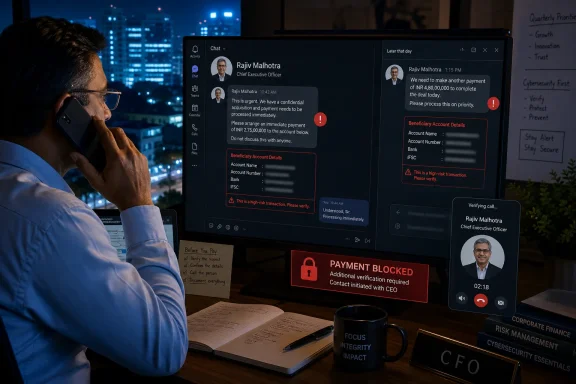
A Pune engineering company’s loss of ₹56 lakh after its chief financial officer acted on a fake Microsoft Teams message is a stark reminder that enterprise collaboration tools have become high-value channels for financial fraud. The July 13 incident reportedly began with a profile carrying the name and photograph of the company’s Italy-based chief executive and escalated into an urgent payment request linked to a supposed government project. The deception worked once, but a second demand for ₹1.5 crore prompted the CFO to telephone the real CEO, preventing a much larger loss and exposing what investigators describe as a “Boss Scam,” CEO fraud, or whale-phishing attack.
Business email compromise has traditionally revolved around forged invoices, spoofed email domains, compromised mailboxes, and last-minute changes to supplier bank details. Attackers study an organisation, identify employees with payment authority, and then manufacture a plausible reason for moving money quickly and discreetly.
The Pune case follows that established playbook but moves the conversation into Microsoft Teams. That change matters because employees increasingly regard collaboration platforms as trusted extensions of the workplace rather than as potentially hostile communication channels.
The CFO completed the requested payments, apparently believing the instruction came from the Italy-based executive. The following morning, another message sought an additional ₹1.5 crore, again under urgent circumstances.
That second request triggered suspicion. The CFO called the chief executive directly and learned that he had not issued either instruction, after which the matter was reported to the Pimpri-Chinchwad Cyber Crime Police.
This sequence illustrates a common pattern in financially motivated social engineering. Criminals may begin with a payment large enough to be profitable but plausible enough to pass, then increase the demand once the victim demonstrates willingness and access.
The victim is often selected because he or she can initiate payments, release payroll information, disclose tax records, purchase gift cards, or modify vendor banking details. CFOs, controllers, finance managers, executive assistants, treasury personnel, and accounts-payable employees are especially attractive targets.
Corporate websites, annual reports, social networks, conference biographies, recruitment advertisements, and public filings can reveal reporting structures. Even a routine post announcing a new CFO, an overseas visit, or a major contract can help an attacker time the approach.
A message inside an application used throughout the working day can feel inherently authenticated. That assumption is dangerous because a familiar interface does not guarantee a familiar identity.
However, the visual identity shown in a conversation is only one piece of evidence. Depending on tenant configuration and the nature of the contact, an external account may attempt to communicate with an internal user while presenting a convincing display name.
Microsoft has introduced warnings and protections intended to flag suspicious external chats and calls. Those controls can reduce risk, but they cannot replace verification of a high-value financial instruction.
Investigators will need to determine whether the communication involved:
The criminal knew—or convincingly guessed—that the recipient had financial authority, that the CEO was based in Italy, and that an urgent cross-border instruction would appear plausible. The choice of two destination accounts may also have been intended to distribute the funds and complicate recovery.
Relevant intelligence can include:
The next-day request for ₹1.5 crore significantly increased the stakes. That may have reflected criminal confidence after the first transfer, but it also broke the illusion by exceeding the victim’s tolerance for unusual instructions.
The second request therefore became both the attacker’s opportunity and mistake. Greed, speed, or concern that the first transaction would soon be detected may have driven the escalation.
Local police have registered numerous whale-phishing cases since 2022. Reported victims have included prominent companies as well as firms whose names received less public attention.
Other Pune-area cases have involved losses running into multiple crores, including attacks on analytics, real-estate, and other corporate organisations. The recurring structure is familiar: a senior executive is impersonated, finance personnel receive an exceptional payment request, and the money is routed through accounts controlled by or accessible to the fraud network.
These cases demonstrate that brand recognition and corporate scale do not guarantee resilience. Large organisations may have advanced endpoint security while still relying on informal human confirmation for urgent payments.
A subsidiary employee may not speak with a foreign CEO every day. That distance can prevent the recipient from recognising subtle differences in phrasing, tone, authority, or procedure that would be obvious to someone working closely with the executive.
Artificial intelligence does not invent executive fraud, but it can lower the cost of producing persuasive content and help criminals scale personalised approaches.
An attacker can also feed public speeches, interviews, emails obtained from a breach, or social posts into a model to approximate an executive’s style. The output may not perfectly imitate the person, but it only needs to appear credible during a short, urgent exchange.
Deepfake video can add another layer, although real-time convincing video remains more operationally demanding than text or short voice clips. Poor lighting, brief calls, alleged connection problems, and pressure to act can hide imperfections.
Organisations should therefore stop treating a familiar voice or face as conclusive proof. For high-risk actions, authentication must depend on controlled procedures rather than biometric familiarity alone.
A mature financial system assumes that people can be deceived, accounts can be compromised, devices can be stolen, and executives can make mistakes. Controls should prevent one persuasive conversation from becoming an irreversible transfer.
Effective controls include:
That is precisely the scenario fraudsters exploit. The more senior the purported requester and the more urgent the demand, the more rigorous verification should become.
Boards and CEOs must reinforce that principle publicly. Employees should know they will never be punished for pausing a payment to validate the instruction through an approved channel.
The correct configuration depends on how the company works with customers, suppliers, consultants, and its international parent. Blocking all external contact may be impractical, but unrestricted communication should not remain the default without a documented business reason.
Users must also understand external-account indicators. Training should show actual screenshots from the organisation’s Teams configuration, because generic advice such as “look for warnings” is less useful than demonstrating exactly where the label appears.
Recommended controls include:
A report button that sends information into an unattended queue creates false confidence. The organisation needs response targets, escalation rules, and the ability to block related accounts or domains quickly.
A practical workflow can remain fast while adding meaningful resistance.
A stronger approach combines multiple factors: an approved system, a known communication path, a second person, transaction context, and risk-based controls. No single phrase should unlock a multimillion-rupee transfer.
The first hours can determine whether banks and police can freeze the funds before they leave reachable accounts.
The investigation should therefore cover identity, endpoints, cloud services, email, Teams, finance platforms, and third-party access. Treating the event as a single bad transaction can leave the original foothold intact.
Employees may also face blame even when weak processes made the fraud possible. A punitive response can discourage future reporting and drive suspicious activity underground.
Training should include realistic scenarios involving:
A secure remote process can be stronger than an informal office process if approvals, callbacks, identity checks, and transaction controls are consistently enforced. Physical proximity should not be treated as a security control.
These warnings elevate the issue from an employee-awareness topic to a governance concern. Boards, audit committees, chief information security officers, and finance leaders should be able to explain how their organisations prevent an executive impersonation from becoming a payment.
A joint response is essential. Security telemetry should inform payment risk, while unusual financial activity should trigger cyber investigation.
Organisations can turn the case into a practical improvement programme.
Several risks deserve immediate attention:
It will also be important to learn whether the attacker merely copied the CEO’s public identity or gained access to internal systems. The answer will determine whether this was primarily external impersonation, an identity compromise, or part of a broader intrusion.
Administrators should verify how protections behave in their own tenants, licensing plans, desktop clients, mobile applications, guest relationships, and cross-tenant configurations. A feature listed as available is useful only if it is enabled, correctly scoped, visible to employees, and connected to response operations.
Defenders must therefore look for the transaction pattern rather than a particular malicious message. New beneficiary, unusual amount, executive urgency, secrecy, and procedural bypass together form a risk signal even if every individual communication appears polished.
The Pune case should be treated not as an unusual failure of judgment but as evidence that corporate identity and financial controls have not fully adapted to modern collaboration. Criminals succeeded in extracting ₹56 lakh because a convincing Teams profile could apparently carry more authority than the company’s verification process; they failed to obtain another ₹1.5 crore only when a direct telephone call restored independent trust. The durable lesson for every Microsoft 365 customer is clear: protect accounts, restrict unnecessary external access, train employees on collaboration-platform impersonation, and design payment systems so that no executive—real, compromised, cloned, or invented—can move substantial funds through urgency alone.
 Background
Business email compromise has traditionally revolved around forged invoices, spoofed email domains, compromised mailboxes, and last-minute changes to supplier bank details. Attackers study an organisation, identify employees with payment authority, and then manufacture a plausible reason for moving money quickly and discreetly.The Pune case follows that established playbook but moves the conversation into Microsoft Teams. That change matters because employees increasingly regard collaboration platforms as trusted extensions of the workplace rather than as potentially hostile communication channels.
What reportedly happened on July 13
According to the First Information Report described in local reporting, the 49-year-old CFO was working from home when she received a Teams message from a profile displaying the CEO’s name and photograph. The alleged sender said he was occupied with an urgent government project and directed her to transfer ₹56 lakh to two specified bank accounts.The CFO completed the requested payments, apparently believing the instruction came from the Italy-based executive. The following morning, another message sought an additional ₹1.5 crore, again under urgent circumstances.
That second request triggered suspicion. The CFO called the chief executive directly and learned that he had not issued either instruction, after which the matter was reported to the Pimpri-Chinchwad Cyber Crime Police.
A loss that could have been much larger
The successful transfer was approximately ₹5.6 million, while the blocked request was ₹15 million. Had both demands been fulfilled, the total exposure would have reached ₹2.06 crore.This sequence illustrates a common pattern in financially motivated social engineering. Criminals may begin with a payment large enough to be profitable but plausible enough to pass, then increase the demand once the victim demonstrates willingness and access.
How a Boss Scam Works
A Boss Scam is not defined by a particular piece of malware or a single communications platform. It is a form of identity-based fraud in which criminals impersonate a senior leader and exploit the authority associated with that person’s role.The victim is often selected because he or she can initiate payments, release payroll information, disclose tax records, purchase gift cards, or modify vendor banking details. CFOs, controllers, finance managers, executive assistants, treasury personnel, and accounts-payable employees are especially attractive targets.
Authority, urgency, and secrecy
Most executive impersonation attacks combine three psychological levers:- Authority discourages challenge. A junior or mid-ranking employee may hesitate to question a CEO, managing director, board member, or overseas group executive.
- Urgency suppresses normal review. The attacker claims that a deadline, acquisition, legal matter, regulatory demand, government project, or confidential negotiation requires immediate action.
- Secrecy isolates the victim. The employee may be told not to involve colleagues because the transaction concerns a sensitive deal or senior-level matter.
- Exceptional circumstances justify exceptional procedures. Remote work, travel, meetings, time-zone differences, or an unavailable executive are used to explain why normal approval channels cannot be followed.
Why senior finance employees are targeted
Whale phishing differs from indiscriminate phishing because the attacker values precision over volume. Instead of sending thousands of generic messages, the criminal may research a small number of employees and construct a scenario around their responsibilities.Corporate websites, annual reports, social networks, conference biographies, recruitment advertisements, and public filings can reveal reporting structures. Even a routine post announcing a new CFO, an overseas visit, or a major contract can help an attacker time the approach.
Why Microsoft Teams Changes the Threat Model
Many organisations have spent years teaching employees to distrust unexpected email. Fewer have built equally mature habits around Teams chats, Slack messages, WhatsApp conversations, Zoom calls, or other collaboration channels.A message inside an application used throughout the working day can feel inherently authenticated. That assumption is dangerous because a familiar interface does not guarantee a familiar identity.
The trust halo around collaboration platforms
Microsoft Teams carries a “trust halo” because employees associate it with authenticated company accounts, scheduled meetings, known colleagues, and centrally managed Microsoft 365 services. A profile photograph and executive display name can reinforce that impression, particularly on a small screen or in a hurried work-from-home environment.However, the visual identity shown in a conversation is only one piece of evidence. Depending on tenant configuration and the nature of the contact, an external account may attempt to communicate with an internal user while presenting a convincing display name.
Microsoft has introduced warnings and protections intended to flag suspicious external chats and calls. Those controls can reduce risk, but they cannot replace verification of a high-value financial instruction.
Impersonation is not necessarily account compromise
The available description says the CEO was impersonated, but it does not establish whether the attacker compromised a genuine Microsoft 365 account. That distinction is technically important.Investigators will need to determine whether the communication involved:
- An external Microsoft or Teams account using the CEO’s name and photograph.
- A guest account admitted into the organisation’s tenant.
- A compromised internal or partner account.
- A stolen session token or authenticated browser session.
- A malicious account with a deceptively similar identity.
- Manipulated screenshots, forwarded messages, or another intermediary technique.
Anatomy of the Pune Attack
The reported incident appears simple: a message arrived, a payment was requested, and the money was sent. In practice, the operation may have required considerable preparation.The criminal knew—or convincingly guessed—that the recipient had financial authority, that the CEO was based in Italy, and that an urgent cross-border instruction would appear plausible. The choice of two destination accounts may also have been intended to distribute the funds and complicate recovery.
Likely reconnaissance
Executive impersonation usually begins before the first message. Attackers collect enough information to make the conversation fit the target’s normal business environment.Relevant intelligence can include:
- The names, photographs, and job titles of senior executives.
- The company’s parent-subsidiary structure and overseas headquarters.
- The identity of the CFO and other payment approvers.
- Current projects, customers, regulators, and geographic markets.
- The wording and tone executives use in public communications.
- Periods when leaders are travelling or employees are working remotely.
- The organisation’s preferred collaboration platform.
The escalation strategy
The sequence suggests a possible “test and expand” approach. The first ₹56 lakh demand established that the CFO could be persuaded to act and that the payment mechanism was available.The next-day request for ₹1.5 crore significantly increased the stakes. That may have reflected criminal confidence after the first transfer, but it also broke the illusion by exceeding the victim’s tolerance for unusual instructions.
The second request therefore became both the attacker’s opportunity and mistake. Greed, speed, or concern that the first transaction would soon be detected may have driven the escalation.
Pune’s History of Whale-Phishing Cases
The incident is not isolated. Pune and Pimpri-Chinchwad, which host major technology, automotive, pharmaceutical, engineering, analytics, and professional-services operations, have repeatedly encountered executive impersonation fraud.Local police have registered numerous whale-phishing cases since 2022. Reported victims have included prominent companies as well as firms whose names received less public attention.
Earlier corporate losses
One of the best-known cases involved the Serum Institute of India in 2022. Fraudsters reportedly posed as a senior executive and induced a company official to transfer approximately ₹1 crore.Other Pune-area cases have involved losses running into multiple crores, including attacks on analytics, real-estate, and other corporate organisations. The recurring structure is familiar: a senior executive is impersonated, finance personnel receive an exceptional payment request, and the money is routed through accounts controlled by or accessible to the fraud network.
These cases demonstrate that brand recognition and corporate scale do not guarantee resilience. Large organisations may have advanced endpoint security while still relying on informal human confirmation for urgent payments.
Why industrial hubs attract attackers
Pune’s concentration of multinational subsidiaries creates a particularly useful environment for this fraud model. Overseas executives, distributed finance teams, cross-border payments, multiple time zones, and remote collaboration can make unusual communications appear normal.A subsidiary employee may not speak with a foreign CEO every day. That distance can prevent the recipient from recognising subtle differences in phrasing, tone, authority, or procedure that would be obvious to someone working closely with the executive.
AI Raises the Quality of Impersonation
The Pune case, as publicly described, centres on text messages and a copied identity. Yet the broader threat is moving toward multimodal impersonation involving text generation, voice cloning, synthetic video, and manipulated communications.Artificial intelligence does not invent executive fraud, but it can lower the cost of producing persuasive content and help criminals scale personalised approaches.
Better language and local context
Generative tools can rewrite awkward messages, translate content, reproduce a formal corporate tone, and adapt a request to a target’s location. This reduces one of the traditional warning signs of phishing: conspicuously poor grammar.An attacker can also feed public speeches, interviews, emails obtained from a breach, or social posts into a model to approximate an executive’s style. The output may not perfectly imitate the person, but it only needs to appear credible during a short, urgent exchange.
Voice clones and deepfake meetings
Voice cloning introduces a more powerful confirmation trap. If an employee questions a chat instruction, the attacker may follow up with a synthetic voice call that appears to validate it.Deepfake video can add another layer, although real-time convincing video remains more operationally demanding than text or short voice clips. Poor lighting, brief calls, alleged connection problems, and pressure to act can hide imperfections.
Organisations should therefore stop treating a familiar voice or face as conclusive proof. For high-risk actions, authentication must depend on controlled procedures rather than biometric familiarity alone.
The Control Failure Was Bigger Than One Click
It would be easy to attribute the loss solely to an employee who trusted the wrong message. That interpretation is incomplete and counterproductive.A mature financial system assumes that people can be deceived, accounts can be compromised, devices can be stolen, and executives can make mistakes. Controls should prevent one persuasive conversation from becoming an irreversible transfer.
Payment approval and segregation of duties
A high-value payment should ordinarily require more than a chat message and a single person’s action. The exact threshold will vary by company, but the control principle remains consistent: initiation, approval, beneficiary creation, and release should not collapse into one unverified workflow.Effective controls include:
- A second authorised approver for payments above a defined threshold.
- Independent confirmation when a new beneficiary is added.
- A cooling-off period for changes to banking details.
- Transaction limits based on role, account, geography, and business purpose.
- Automated alerts for first-time beneficiaries or unusual payment patterns.
- Documented exceptions that cannot be created solely by the requesting executive.
- Treasury callbacks using telephone numbers stored in approved internal records.
The executive exception problem
Some companies have strong rules until a CEO labels something urgent. Employees then interpret seniority as permission to bypass normal controls.That is precisely the scenario fraudsters exploit. The more senior the purported requester and the more urgent the demand, the more rigorous verification should become.
Boards and CEOs must reinforce that principle publicly. Employees should know they will never be punished for pausing a payment to validate the instruction through an approved channel.
Microsoft 365 and Teams Defences
The incident should prompt Microsoft 365 administrators to review the Teams tenant rather than assuming that email security covers collaboration traffic. Teams external access, guest access, federation, meetings, calling, applications, and file sharing each create different exposure.The correct configuration depends on how the company works with customers, suppliers, consultants, and its international parent. Blocking all external contact may be impractical, but unrestricted communication should not remain the default without a documented business reason.
Review external access
Administrators should identify which external domains genuinely require Teams connectivity. Where possible, organisations can use allow lists, block unnecessary domains, restrict communication with unmanaged accounts, and review policies for trial or consumer identities.Users must also understand external-account indicators. Training should show actual screenshots from the organisation’s Teams configuration, because generic advice such as “look for warnings” is less useful than demonstrating exactly where the label appears.
Strengthen identity and session security
If there is any possibility of account compromise, the organisation should examine Microsoft Entra ID sign-in records, risky login events, consent grants, device registrations, session activity, mailbox rules, and authentication changes.Recommended controls include:
- Phishing-resistant multifactor authentication for privileged and financial users.
- Conditional Access policies based on device compliance, location, risk, and application.
- Shorter or risk-sensitive session lifetimes for critical roles.
- Restricted administrative privileges and separate administrator accounts.
- Monitoring for impossible travel, unfamiliar devices, and unusual token activity.
- Rapid revocation of active sessions during an investigation.
- Central logging of Teams, Entra ID, endpoint, and financial-system events.
Use reporting and protection features
Microsoft provides mechanisms for users to report suspicious messages and for Teams to warn about potential spam, phishing, or impersonation in some external-contact scenarios. Security teams should verify that reporting is enabled, monitored, and connected to an incident-response process.A report button that sends information into an unattended queue creates false confidence. The organisation needs response targets, escalation rules, and the ability to block related accounts or domains quickly.
A Safer High-Value Payment Workflow
Companies should redesign payment controls around the assumption that any communication channel can be forged. Email, Teams, WhatsApp, telephone calls, and video meetings should initiate a process, not constitute approval by themselves.A practical workflow can remain fast while adding meaningful resistance.
Five steps before money moves
- Record the request in the authorised financial system. Chat messages and emails may provide context, but the payment must enter a controlled workflow with an audit trail.
- Validate the business purpose and supporting documents. Finance staff should match the request to a contract, purchase order, invoice, tax obligation, or approved project.
- Confirm the requester independently. The employee should use a known telephone number, an existing verified conversation, or an approved internal directory—not contact information supplied in the suspicious message.
- Verify the beneficiary and bank details. New accounts and recently changed instructions require a callback to a known supplier or internal owner.
- Obtain the required second approval. The approver must review the evidence rather than simply clicking through because the purported CEO is waiting.
Code words are not enough
Some organisations use verbal passwords or code phrases for urgent requests. These can help, but they may be exposed in compromised email, recorded meetings, shared documents, or earlier conversations.A stronger approach combines multiple factors: an approved system, a known communication path, a second person, transaction context, and risk-based controls. No single phrase should unlock a multimillion-rupee transfer.
Incident Response and Fund Recovery
Once a fraudulent transfer is discovered, time becomes critical. Money may move through several mule accounts, be withdrawn in cash, converted into digital assets, used for purchases, or sent across jurisdictions.The first hours can determine whether banks and police can freeze the funds before they leave reachable accounts.
Immediate actions after discovery
An affected company should act in parallel rather than waiting for one team to finish before another begins:- Notify the sending bank’s fraud team and request an immediate hold or recall.
- Contact recipient banks through official banking channels.
- Report the incident to the appropriate cybercrime authorities.
- Preserve Teams messages, screenshots, transaction records, device logs, and call details.
- Revoke suspicious sessions and secure potentially affected accounts.
- Inform legal counsel, insurers, senior management, and the board as required.
- Search for related messages sent to other employees.
- Temporarily tighten payment limits and beneficiary controls.
Do not assume the attacker has left
A successful payment may be only one objective. If criminals obtained access to an account or device, they may also have copied files, created forwarding rules, registered applications, stolen tokens, or collected information for a second attack.The investigation should therefore cover identity, endpoints, cloud services, email, Teams, finance platforms, and third-party access. Treating the event as a single bad transaction can leave the original foothold intact.
Consumer and Employee Impact
Although the immediate victim is a company, the consequences can reach employees, customers, and suppliers. A financial loss may affect budgets, insurance costs, compliance obligations, or trust in legitimate executive communications.Employees may also face blame even when weak processes made the fraud possible. A punitive response can discourage future reporting and drive suspicious activity underground.
Building a verification culture
Security awareness should give staff explicit permission to interrupt urgency. Employees need a short, memorable rule: Stop, verify, and use a different trusted channel.Training should include realistic scenarios involving:
- A CEO requesting an emergency transfer through Teams.
- A supplier announcing changed bank details by email.
- An IT technician initiating an unexpected external Teams call.
- A regulator demanding confidential documents through WhatsApp.
- A cloned executive voice approving a payment.
- A message asking the recipient to keep the request secret.
Remote work is context, not the cause
The CFO was reportedly working from home, but remote work itself did not create the fraud. The more relevant issue is that distributed work can normalise digital-only instructions and reduce opportunities for informal confirmation.A secure remote process can be stronger than an informal office process if approvals, callbacks, identity checks, and transaction controls are consistently enforced. Physical proximity should not be treated as a security control.
Enterprise Governance and Regulatory Pressure
The Indian Cyber Crime Coordination Centre has warned about Boss Scams targeting companies and senior officials. The Securities and Exchange Board of India has also cautioned listed companies and regulated entities about CEO and managing-director impersonation fraud.These warnings elevate the issue from an employee-awareness topic to a governance concern. Boards, audit committees, chief information security officers, and finance leaders should be able to explain how their organisations prevent an executive impersonation from becoming a payment.
Questions boards should ask
A useful review should cover more than whether employees received annual phishing training. Directors and audit committees should ask:- Can one employee create and release a high-value payment?
- What happens when the requester claims to be the CEO?
- How are new beneficiaries independently verified?
- Are Teams external chats and calls logged and monitored?
- Which users have payment authority, and are their accounts specially protected?
- Has the company tested a voice-cloning or deepfake scenario?
- How quickly can the bank and police be contacted?
- Are multinational subsidiaries following the same minimum controls?
Cybersecurity and finance must converge
Boss Scams sit between traditional organisational boundaries. IT may secure Teams, finance may control payments, human resources may deliver training, and legal may handle reporting—but the attacker exploits gaps between them.A joint response is essential. Security telemetry should inform payment risk, while unusual financial activity should trigger cyber investigation.
Strengths and Opportunities
The Pune incident contains one encouraging detail: independent verification stopped the second transfer. That proves a simple callback can defeat even a convincing digital impersonation.Organisations can turn the case into a practical improvement programme.
- The attempted second payment provides a clear training example. Employees can see that repeated urgency is a warning sign rather than proof of importance.
- Existing Microsoft 365 controls can be reviewed immediately. Administrators do not need to wait for a major platform migration to tighten external access and identity policies.
- Payment workflows can create durable protection. Dual approval and beneficiary validation defend against fraud across email, Teams, telephone, and messaging applications.
- Executives can model secure behaviour. A CEO who welcomes verification makes it easier for employees to challenge future impostors.
- Incident exercises can connect departments. Finance, IT, legal, communications, and management can rehearse a single coordinated response.
- Banks can become active partners. Prearranged fraud contacts and escalation paths can improve the chance of freezing funds quickly.
Risks and Concerns
The continuing expansion of collaboration tools gives criminals more routes to reach employees. Defensive maturity remains uneven, particularly where organisations apply strict email controls but allow broad external messaging.Several risks deserve immediate attention:
- Display-name familiarity can override warning labels. Users may focus on an executive’s photograph and name while overlooking an external-account indicator.
- AI can make attacks more convincing. Natural language, translated messages, cloned voices, and synthetic video can support one another.
- Compromised accounts can defeat visual checks. A message from a genuine internal identity may still be malicious if the session or account has been stolen.
- Mule-account networks can move funds rapidly. Delayed reporting sharply reduces the chance of recovery.
- Overly punitive investigations can suppress reporting. Employees who fear dismissal may conceal mistakes during the most important recovery window.
- Subsidiaries may have inconsistent controls. A global parent may use strong processes while smaller regional entities retain informal approval practices.
- Alert fatigue can weaken platform warnings. Frequent external contacts may teach users to dismiss labels and prompts automatically.
- Executive pressure can undermine policy. If leaders routinely demand exceptions, criminals need only imitate established bad behaviour.
What to Watch Next
The Pimpri-Chinchwad Cyber Crime Police investigation will need to trace both the digital identity used in Teams and the financial path followed by the ₹56 lakh. The destination accounts, account-opening records, device fingerprints, login history, telephone data, and subsequent fund movements may help identify mule operators and higher-level participants.It will also be important to learn whether the attacker merely copied the CEO’s public identity or gained access to internal systems. The answer will determine whether this was primarily external impersonation, an identity compromise, or part of a broader intrusion.
Platform-level developments
Microsoft is continuing to strengthen Teams protections against suspicious external contacts and impersonation attempts. Enterprises should monitor new controls, but deployment alone will not solve the underlying approval problem.Administrators should verify how protections behave in their own tenants, licensing plans, desktop clients, mobile applications, guest relationships, and cross-tenant configurations. A feature listed as available is useful only if it is enabled, correctly scoped, visible to employees, and connected to response operations.
The next generation of Boss Scams
Future attacks are likely to combine several channels. A forged email may establish context, a Teams message may create urgency, a cloned voice call may provide reassurance, and a fake document may supply banking details.Defenders must therefore look for the transaction pattern rather than a particular malicious message. New beneficiary, unusual amount, executive urgency, secrecy, and procedural bypass together form a risk signal even if every individual communication appears polished.
The Pune case should be treated not as an unusual failure of judgment but as evidence that corporate identity and financial controls have not fully adapted to modern collaboration. Criminals succeeded in extracting ₹56 lakh because a convincing Teams profile could apparently carry more authority than the company’s verification process; they failed to obtain another ₹1.5 crore only when a direct telephone call restored independent trust. The durable lesson for every Microsoft 365 customer is clear: protect accounts, restrict unnecessary external access, train employees on collaboration-platform impersonation, and design payment systems so that no executive—real, compromised, cloned, or invented—can move substantial funds through urgency alone.
References
- Primary source: the420.in
Published: 2026-07-21T05:52:45+00:00
'Boss Scam' Targets Pune Company: Fake Microsoft Teams Message Leads to ₹56 Lakh Fraud, ₹1.5 Crore Transfer Prevented - The420.in
A Pune company lost ₹56 lakh in a Boss Scam after fraudsters impersonated its Italian CEO on Microsoft Teams. A second ₹1.5 crore transfer was prevented.the420.in - Official source: support.microsoft.com
Prevent spam or phishing attempts from external chats in Microsoft Teams | Microsoft Support
Ensure your security from spam, phishing, or impersonation attempts from external chats in Microsoft Teams.support.microsoft.com - Related coverage: business-standard.com
- Related coverage: livelawbiz.com
SEBI Cautions Listed Companies, Regulated Entities Against 'Boss Scam'
The Securities and Exchange Board of India (SEBI) on Friday cautioned regulated entities and listed companies against an emerging cyber fraud known as the \"Boss Scam\" or CEO/Managing Director...www.livelawbiz.com
- Related coverage: ndtv.com
- Related coverage: hindustantimes.com
Pune cops arrest 3 who swindled ₹1 crore posing as Serum CEO | Hindustan Times
Accused had posed as Adar Poonawalla, CEO of SII and had sent a WhatsApp message to one of the directors, asking for moneywww.hindustantimes.com
