
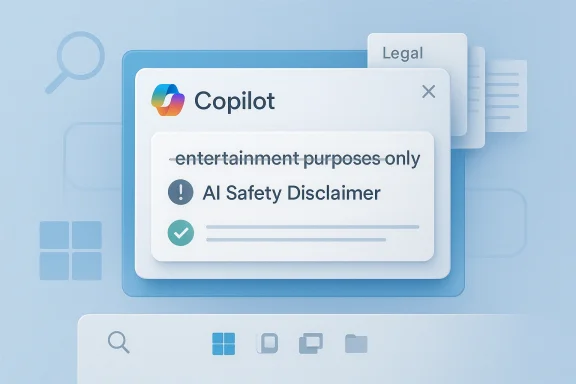
Microsoft’s latest clarification over Copilot’s “entertainment purposes only” wording is more than a branding nitpick. It is a small but telling example of how fast generative AI products have outgrown the legal and editorial language that surrounded them at launch. What users found in older terms-of-use language looked like a disclaimer that undercut Copilot’s seriousness; Microsoft now says it was legacy wording from the Bing Chat era and will be updated in the next revision. The episode matters because it exposes the gap between how a platform is marketed today and how it was first described when the technology was still experimental.
When Microsoft first pushed its chat-based AI into public view, the product was positioned conservatively. Bing Chat arrived as a search companion, not as a general-purpose productivity assistant, and the company’s messaging reflected that caution. The early terms language that later drew attention was part of that phase, when Microsoft wanted to warn users that outputs could be wrong and should not be treated as authoritative.
That caution was not unique to Microsoft. Nearly every AI vendor has had to balance enthusiasm with legal disclaimers, because large language models are probabilistic systems that can hallucinate, omit context, or produce confidently wrong answers. Microsoft’s own current Copilot terms still say the service may make mistakes, may not work as intended, and should not be relied on for important advice. The issue is that “for entertainment purposes only” reads far more dismissively than a normal risk disclaimer.
The public reaction also reflects how Copilot has changed. It is no longer merely a novelty chat box tucked into search; it now appears across Windows, Microsoft 365, mobile apps, web experiences, and enterprise-adjacent workflows. As Copilot’s role expanded, the old phrasing started to sound less like a warning and more like a relic from the product’s experimental youth.
Microsoft’s statement to Windows Latest is therefore best understood as an acknowledgement of product maturity. The company says the phrase came from an earlier stage when Copilot was still tied to Bing Chat, and that the wording will be changed in the next update. That is a subtle but important distinction: Microsoft is not retracting the warning that Copilot can be wrong; it is reclassifying the service from a toy-like experiment to a broader AI platform.
At the same time, the official terms currently visible on Microsoft’s site still retain the disputed language, which means the documentation lag is real. That lag is not unusual in large software ecosystems, but in AI it can create immediate credibility problems. Users tend to read legal text as the company’s true belief, not just a historical artifact.
That perception matters because trust is the central currency of AI adoption. Users can forgive occasional errors if the product is framed as a helpful assistant with known limitations. They are less forgiving when a company’s own terms appear to say the service is essentially a novelty. The wording may have been legally protective, but it was commercially awkward.
For Microsoft, the update is also a reputational repair job. A consumer-facing AI platform cannot afford to look like it is embarrassed by its own usefulness. By promising to update the wording, Microsoft is trying to preserve legal caution while removing language that makes Copilot sound unserious.
Bing Chat originally lived in the context of search augmentation. That context made a stronger entertainment or experimentation framing easier to justify, especially when large language models were still a novelty for mainstream users. Today, Copilot sits closer to the center of Microsoft’s ecosystem strategy, with consumer and enterprise flavors, Windows integration, and multiple specialized experiences.
The company’s current privacy and transparency materials also lean into that more mature framing. Microsoft says it uses conversations for troubleshooting, abuse prevention, diagnostics, and service improvement, and its transparency notes describe operational rules rather than novelty behavior. That style is much closer to a production service than to a toy.
The important distinction is that Microsoft is not promising infallibility. Its current terms still warn that Copilot can make mistakes and may not operate as intended. That means the company is trying to shift the narrative from “don’t take this seriously” to “take it seriously, but verify the output.”
That separation matters because AI users do not read every term-of-use document in full. Instead, they absorb a few memorable phrases, headlines, and screenshots. If one sentence makes the product seem unserious, it can shape public perception far more than pages of careful legal language.
This is especially important in Windows, where Copilot has been part of a broader push to make AI feel native to the operating system. Users do not want a built-in assistant that sounds like a disclaimer generator. They want something that feels integrated, useful, and safe enough to try without constant second-guessing.
The irony is that a strong disclaimer can sometimes hurt safety by driving users away from the guardrails the company wants them to read. A more balanced warning would tell users to verify important outputs while still making Copilot seem like a legitimate tool. Microsoft seems to have realized that the current wording overshot the mark.
Microsoft already draws an important distinction between consumer Copilot experiences and business-grade offerings with different data protections and sign-in behaviors. The company’s documentation notes that some Copilot experiences do not use Entra authentication, while Microsoft 365 Copilot is the entry point for business users. That split shows how seriously Microsoft takes segmentation, even if its wording elsewhere still carries old baggage.
Microsoft’s current transparency and privacy materials already emphasize controls, limits, and acceptable use. Those documents frame Copilot as a governed service, not a novelty. Updating the entertainment language would make the legal ecosystem more consistent with that enterprise posture.
The broader competitive issue is that AI assistants are gradually becoming default interfaces. That means vendors must project both capability and restraint. Microsoft wants Copilot to be viewed as embedded intelligence across its ecosystem, not as a gimmick bolted onto Bing.
There is also a strategic subtext here. Microsoft has invested heavily in making Copilot a cross-product layer, and the company cannot afford its own terms to imply that the layer is only for amusement. In a market where AI features are often copied quickly, identity and trust become differentiators.
Microsoft’s own terms page demonstrates how fast this area is moving. The current Copilot terms are effective October 24, 2025, and the archive shows older Bing-related language that was carried forward from previous versions. That kind of continuity is normal in legal publishing, but it becomes risky when a phrase is easy to isolate and ridicule.
That gap can also magnify skepticism about the technology itself. If the company cannot keep the wording aligned with the current product, users may wonder what else is lagging behind. In that sense, outdated docs are not just a paperwork issue; they are a product confidence issue.
The issue is that safety language works best when it is specific. Telling users to verify facts, be cautious with important decisions, and avoid sensitive disclosures is more useful than telling them a tool is for fun. Microsoft’s own privacy and transparency materials already move in that more precise direction.
In that light, Microsoft’s update is less about softening the warning than about making it credible. The company still needs users to understand that AI is fallible, but it also needs them to believe Copilot is worth using. Those two goals are not in conflict if the wording is careful.
The more interesting question is whether this prompts a wider cleanup of Copilot’s public-facing documentation. Microsoft has a lot of surface area to manage now, from Windows integration to consumer privacy language to enterprise-adjacent controls. In a market that moves this quickly, documentation is strategy.
Source: Mezha Copilot is not just for fun: Microsoft announces update to outdated documentation
 Background
When Microsoft first pushed its chat-based AI into public view, the product was positioned conservatively. Bing Chat arrived as a search companion, not as a general-purpose productivity assistant, and the company’s messaging reflected that caution. The early terms language that later drew attention was part of that phase, when Microsoft wanted to warn users that outputs could be wrong and should not be treated as authoritative.That caution was not unique to Microsoft. Nearly every AI vendor has had to balance enthusiasm with legal disclaimers, because large language models are probabilistic systems that can hallucinate, omit context, or produce confidently wrong answers. Microsoft’s own current Copilot terms still say the service may make mistakes, may not work as intended, and should not be relied on for important advice. The issue is that “for entertainment purposes only” reads far more dismissively than a normal risk disclaimer.
The public reaction also reflects how Copilot has changed. It is no longer merely a novelty chat box tucked into search; it now appears across Windows, Microsoft 365, mobile apps, web experiences, and enterprise-adjacent workflows. As Copilot’s role expanded, the old phrasing started to sound less like a warning and more like a relic from the product’s experimental youth.
Microsoft’s statement to Windows Latest is therefore best understood as an acknowledgement of product maturity. The company says the phrase came from an earlier stage when Copilot was still tied to Bing Chat, and that the wording will be changed in the next update. That is a subtle but important distinction: Microsoft is not retracting the warning that Copilot can be wrong; it is reclassifying the service from a toy-like experiment to a broader AI platform.
At the same time, the official terms currently visible on Microsoft’s site still retain the disputed language, which means the documentation lag is real. That lag is not unusual in large software ecosystems, but in AI it can create immediate credibility problems. Users tend to read legal text as the company’s true belief, not just a historical artifact.
Why the Wording Became a Story
The phrase “entertainment purposes only” became news because it collided with public expectations. People do not want their office assistant, search companion, or Windows-integrated AI tool to sound like a carnival gimmick. In a market where vendors are asking users to trust AI for writing, coding, summarizing, and planning, the phrase suggests a product that cannot be trusted beyond amusement.That perception matters because trust is the central currency of AI adoption. Users can forgive occasional errors if the product is framed as a helpful assistant with known limitations. They are less forgiving when a company’s own terms appear to say the service is essentially a novelty. The wording may have been legally protective, but it was commercially awkward.
Legal caution versus product confidence
There is a genuine tension here. AI companies need firm disclaimers because model behavior is uncertain, but too much caution can sound like a confession that the product is unreliable. Microsoft’s current terms still include multiple warnings about mistakes, possible nonperformance, human review, and limited guarantees, which is standard for AI services. The problem was not the caution itself; it was the tone of one particular sentence.For Microsoft, the update is also a reputational repair job. A consumer-facing AI platform cannot afford to look like it is embarrassed by its own usefulness. By promising to update the wording, Microsoft is trying to preserve legal caution while removing language that makes Copilot sound unserious.
- The phrase was easy to mock because it sounded dismissive rather than protective.
- It risked undermining Microsoft’s broader Copilot positioning across Windows and Microsoft 365.
- The update shows that product language and legal language must now be managed together.
- In AI, trust signals are part of the product, not just the paperwork.
The Bing Chat Legacy Problem
Microsoft’s explanation points to a deeper issue: Copilot still carries visible traces of its Bing Chat ancestry. That legacy is understandable, because products often evolve faster than the websites, legal pages, and help documents that support them. But in AI, old wording can age badly because the public watches these systems closely and treats every disclaimer as a clue to capability.Bing Chat originally lived in the context of search augmentation. That context made a stronger entertainment or experimentation framing easier to justify, especially when large language models were still a novelty for mainstream users. Today, Copilot sits closer to the center of Microsoft’s ecosystem strategy, with consumer and enterprise flavors, Windows integration, and multiple specialized experiences.
From search companion to platform layer
This transition explains why the old disclaimer feels so jarring. Search companions are often tolerated as clever add-ons, while platform layers are expected to be dependable. Microsoft now wants Copilot to function as a general interface to information and action, which means its documentation must sound more like infrastructure and less like a sandbox.The company’s current privacy and transparency materials also lean into that more mature framing. Microsoft says it uses conversations for troubleshooting, abuse prevention, diagnostics, and service improvement, and its transparency notes describe operational rules rather than novelty behavior. That style is much closer to a production service than to a toy.
- Copilot’s origins matter because old wording often survives product rebranding.
- Bing Chat was easier to describe as experimental than today’s Copilot ecosystem.
- The platform now spans search, productivity, and consumer AI entry points.
- Documentation has to catch up to product reality or risk becoming a liability.
What Microsoft Is Really Saying
Microsoft’s public line is simple: the old wording is outdated and will be revised. That sounds like a minor housekeeping move, but it also functions as a corporate boundary marker. Microsoft is saying Copilot is not merely an entertainment device; it is intended for all the use cases the company now supports, even though it still requires user judgment.The important distinction is that Microsoft is not promising infallibility. Its current terms still warn that Copilot can make mistakes and may not operate as intended. That means the company is trying to shift the narrative from “don’t take this seriously” to “take it seriously, but verify the output.”
Messaging, not substance
In practical terms, the change is mostly about framing. A legal disclaimer can be precise without sounding trivial, and Microsoft appears to have recognized that the current phrasing did not achieve that balance. The company is effectively separating risk disclosure from product identity.That separation matters because AI users do not read every term-of-use document in full. Instead, they absorb a few memorable phrases, headlines, and screenshots. If one sentence makes the product seem unserious, it can shape public perception far more than pages of careful legal language.
- Microsoft is attempting to preserve caution without preserving the joke.
- The product is being repositioned as broader than its Bing-era roots.
- The change suggests the company sees documentation as part of brand management.
- The update is likely to matter more in perception than in functionality.
Consumer Impact
For everyday users, the practical meaning of this episode is mostly psychological. If a consumer sees “entertainment purposes only,” they may assume Copilot is not trustworthy for shopping advice, homework help, household planning, or everyday productivity. That impression can suppress adoption even when the actual product is good enough for casual assistance.This is especially important in Windows, where Copilot has been part of a broader push to make AI feel native to the operating system. Users do not want a built-in assistant that sounds like a disclaimer generator. They want something that feels integrated, useful, and safe enough to try without constant second-guessing.
Trust as a consumer feature
Consumer AI products are increasingly sold on convenience and confidence. If the surrounding language says “don’t trust this too much,” users may decide to ignore it entirely. That is a failure of framing, not necessarily of capability.The irony is that a strong disclaimer can sometimes hurt safety by driving users away from the guardrails the company wants them to read. A more balanced warning would tell users to verify important outputs while still making Copilot seem like a legitimate tool. Microsoft seems to have realized that the current wording overshot the mark.
- Consumers read a few memorable phrases and ignore most legal boilerplate.
- The phrase “for fun only” makes an assistant feel disposable.
- Better wording could improve willingness to rely on Copilot for routine tasks.
- A stronger trust posture can increase experimentation without eliminating caution.
Enterprise Impact
Enterprise users will care less about the joke and more about the signal. Companies want AI tools that can assist employees while still being governed by policy, privacy controls, and compliance rules. A consumer disclaimer that sounds flippant can create awkward questions for IT and legal teams evaluating whether a Microsoft AI experience is mature enough for broader deployment.Microsoft already draws an important distinction between consumer Copilot experiences and business-grade offerings with different data protections and sign-in behaviors. The company’s documentation notes that some Copilot experiences do not use Entra authentication, while Microsoft 365 Copilot is the entry point for business users. That split shows how seriously Microsoft takes segmentation, even if its wording elsewhere still carries old baggage.
Governance and procurement
From a procurement standpoint, outdated wording can slow adoption. Enterprises do not like ambiguity, and they especially do not like the appearance that a vendor’s own terms undercut its product claims. Even if the legal risk is unchanged, the optics can affect purchasing decisions and security reviews.Microsoft’s current transparency and privacy materials already emphasize controls, limits, and acceptable use. Those documents frame Copilot as a governed service, not a novelty. Updating the entertainment language would make the legal ecosystem more consistent with that enterprise posture.
- Enterprise buyers want predictability in both product behavior and product language.
- Copilot’s consumer and business versions need clearer differentiation.
- Governance teams may view outdated phrasing as a sign of documentation debt.
- Consistency across legal, privacy, and product pages supports adoption.
Competitive Implications
Microsoft is not alone in dealing with AI disclaimers, but it has more to lose than most if its flagship assistant is seen as unserious. Competitors are racing to make AI feel indispensable, and every awkward phrase is an opening for rivals to claim a more polished experience. In a crowded AI market, tone can become part of the competitive moat.The broader competitive issue is that AI assistants are gradually becoming default interfaces. That means vendors must project both capability and restraint. Microsoft wants Copilot to be viewed as embedded intelligence across its ecosystem, not as a gimmick bolted onto Bing.
Brand coherence in the AI race
Brand coherence matters because users now compare AI systems not only on raw output quality but also on how confidently and consistently they are presented. A service that appears confused about what it is can look weaker than one with a simpler message. Microsoft’s move is an attempt to tighten that message before rivals exploit the mismatch.There is also a strategic subtext here. Microsoft has invested heavily in making Copilot a cross-product layer, and the company cannot afford its own terms to imply that the layer is only for amusement. In a market where AI features are often copied quickly, identity and trust become differentiators.
- Competitive advantage increasingly depends on perceived seriousness.
- AI vendors must align their legal language with their product positioning.
- Legacy branding can weaken a company’s story even when the technology improves.
- Microsoft’s update is partly defensive and partly reputational.
Documentation Debt and Product Maturity
This story is also a reminder that documentation debt can become public debt. A stale page that once felt harmless can suddenly become front-page material when users scrutinize AI services for contradictions. In software, docs are often treated as support material; in AI, they are part of the product itself.Microsoft’s own terms page demonstrates how fast this area is moving. The current Copilot terms are effective October 24, 2025, and the archive shows older Bing-related language that was carried forward from previous versions. That kind of continuity is normal in legal publishing, but it becomes risky when a phrase is easy to isolate and ridicule.
Why stale docs matter more in AI
AI tools create a bigger visibility problem than most software. Their outputs are inherently conversational, so users naturally expect the surrounding documentation to be equally current and human-readable. When the legal language sounds frozen in an earlier era, it creates a credibility gap.That gap can also magnify skepticism about the technology itself. If the company cannot keep the wording aligned with the current product, users may wonder what else is lagging behind. In that sense, outdated docs are not just a paperwork issue; they are a product confidence issue.
- Documentation now shapes user trust almost as much as the product UI.
- Old phrases can become viral symbols of broader uncertainty.
- Legal archives are necessary, but visible old language must be handled carefully.
- In AI, the docs are part of the UX.
Safety, Accuracy, and the Real Warning
The irony of this whole episode is that Microsoft’s warning is directionally correct even if its wording was clumsy. Copilot can be wrong, and users should not blindly trust any AI system for important advice. That remains true whether the service is labeled as entertainment, assistance, or productivity.The issue is that safety language works best when it is specific. Telling users to verify facts, be cautious with important decisions, and avoid sensitive disclosures is more useful than telling them a tool is for fun. Microsoft’s own privacy and transparency materials already move in that more precise direction.
Better guardrails, better trust
A well-written disclaimer should improve behavior, not just reduce liability. It should explain where Copilot is strong, where it can fail, and what users should do when the stakes are high. That is how you turn a warning into a practical safeguard rather than a punchline.In that light, Microsoft’s update is less about softening the warning than about making it credible. The company still needs users to understand that AI is fallible, but it also needs them to believe Copilot is worth using. Those two goals are not in conflict if the wording is careful.
- Safety language should be actionable, not merely alarming.
- Users need to know how to verify outputs, not just that errors are possible.
- Precision in wording can improve trust more than dramatic disclaimers.
- The best AI warnings are the ones people actually understand.
Strengths and Opportunities
Microsoft’s decision to address the outdated language creates a chance to reset the conversation around Copilot. If the company handles the revision well, it can reinforce the idea that Copilot is a serious, evolving platform while still preserving the caution users need around AI-generated content. The opportunity is not just to fix one sentence, but to improve the whole trust narrative.- Cleaner positioning for Copilot as a real productivity and consumer AI tool.
- Better alignment between legal language and product strategy.
- A chance to reduce mockery and improve public perception.
- Stronger support for enterprise adoption by removing unserious phrasing.
- Improved consistency across consumer, Windows, and Microsoft 365 experiences.
- Better user trust if the revised wording is more precise and practical.
- A useful reminder that documentation quality is part of product quality.
Risks and Concerns
The biggest risk is that Microsoft moves too slowly or updates only the visible wording while leaving the underlying messaging inconsistent. If users continue to find contradictory language across archives, support pages, and product surfaces, the credibility problem will persist. There is also a broader concern that legal teams may overcorrect and replace one awkward phrase with another equally opaque one.- Delayed updates can make the company look unresponsive.
- Partial fixes may leave contradictions in archived or related pages.
- Overly sanitized language can become legalese that users still ignore.
- A mismatch between consumer and enterprise wording could create confusion.
- Rivals may use the episode to question Microsoft’s AI maturity.
- Users may remain skeptical if they think the change is cosmetic.
- Documentation drift could recur if product teams and legal teams are not aligned.
Looking Ahead
What happens next will depend on whether Microsoft updates the terms quickly and whether the revised language is materially clearer. If the company replaces the “entertainment purposes only” line with a more standard AI disclaimer, the immediate controversy will likely fade. But if the update is slow or vague, the phrase will keep circulating as a symbol of the tension between AI ambition and legal caution.The more interesting question is whether this prompts a wider cleanup of Copilot’s public-facing documentation. Microsoft has a lot of surface area to manage now, from Windows integration to consumer privacy language to enterprise-adjacent controls. In a market that moves this quickly, documentation is strategy.
- Watch for a revised Copilot terms page with clearer language.
- Watch for matching updates across Bing-era archives and related help pages.
- Watch for Microsoft to sharpen the distinction between consumer Copilot and Microsoft 365 Copilot.
- Watch for any new language that explains AI fallibility without sounding dismissive.
- Watch for competitors to seize on any delay or inconsistency.
Source: Mezha Copilot is not just for fun: Microsoft announces update to outdated documentation
Last edited:
