

Microsoft announced Web IQ at Build 2026 as a set of AI-native grounding APIs that connect enterprise agents to fresh web information, positioning the service as part of its broader Microsoft IQ layer across Copilot, Foundry, and Copilot Studio. The pitch is simple enough: stop making every development team rebuild search, retrieval, ranking, scraping, filtering, and evidence packaging from scratch. The larger bet is more consequential. Microsoft is trying to turn web grounding from an application feature into infrastructure.
For most of the generative AI boom, “grounding” has been the industry’s polite way of admitting that language models are not enough. A model can draft, summarize, classify, and reason across patterns, but it does not automatically know what changed this morning, which source is authoritative, or whether a claim should be supported by a current page rather than by statistical memory. Enterprises discovered this quickly, because the first impressive demo often failed at the first real business question.
Web IQ is Microsoft’s answer to that gap for the public internet. It is not merely a Bing Search API with a more fashionable name, at least in the way Microsoft describes it. The company is framing it as an agent-facing retrieval layer that returns relevant web evidence in forms meant for downstream AI systems, rather than a human-facing results page meant to be clicked.
That distinction matters. Traditional search is optimized around documents, rankings, snippets, links, ads, and user behavior. Agentic retrieval is optimized around what a model needs to construct a defensible answer or take a next step. Those are adjacent problems, but they are not the same problem.
InfoWorld’s report captures the operational appeal: developers have been stitching together search APIs, scraping systems, vector databases, rankers, retrieval-augmented generation pipelines, crawling tools, and orchestration layers just to make an AI application aware of the current web. That architecture works until it doesn’t. It becomes expensive to maintain, brittle under website changes, difficult to govern, and surprisingly easy to overfeed with irrelevant text.
Microsoft’s opportunity is to say: if Copilot and ChatGPT already depend on large-scale web grounding, why should every enterprise developer rebuild a smaller and worse version of the same thing?
That is the quiet economics behind the launch. Inference costs are not just a matter of which model an enterprise chooses; they are also shaped by how much context an application shoves into the model window. A messy retrieval pipeline can turn a simple answer into a large, slow, expensive prompt full of duplicated boilerplate, navigation text, stale pages, and vaguely related passages.
For CIOs, that translates into budget unpredictability. For developers, it translates into latency, token pressure, and debugging pain. For users, it translates into the familiar delay before an AI assistant produces a confidently worded answer that may or may not reflect the sources it supposedly consulted.
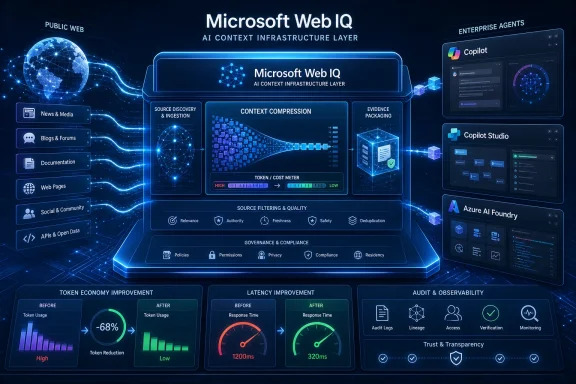
Web IQ is therefore best understood as a context-shaping product. Microsoft is selling retrieval, but the enterprise value lies in ranking, filtering, passage selection, evidence packaging, and integration with the rest of the agent stack. The goal is to hand an agent the parts of the web that matter, in a compact form, before the model burns cycles trying to infer relevance from a wall of text.
This is also why the product belongs in the same conversation as Microsoft IQ, Work IQ, and Fabric IQ. Microsoft’s agent strategy depends on turning context into a managed platform layer. Work IQ gives agents access to enterprise signals and Microsoft 365 knowledge. Fabric IQ aims at business data and operational state. Web IQ adds the outside world.
That triptych reveals the strategy. Microsoft does not want developers to think of grounding as a bag of connectors. It wants them to think of grounding as a Microsoft-managed substrate.
A sales agent that drafts an account brief needs current market news, customer history, pricing terms, internal CRM context, and perhaps public filings. A security agent investigating a vulnerability needs vendor advisories, exploit chatter, product inventory, tenant data, and patch status. A procurement agent comparing suppliers needs web data, contracts, internal spend, risk signals, and policy constraints.
No single model contains that world. No static vector database remains fresh enough for it. No generic search API understands the full intent of an enterprise workflow. This is why the agent boom has turned into a retrieval boom wearing a better suit.
Developers have responded by building elaborate retrieval-augmented generation systems. They scrape pages, chunk documents, embed text, index it, retrieve candidates, re-rank them, trim them, pass them into a model, and hope the final answer cites the right evidence. The method can be powerful, but it pushes application teams into the business of information retrieval, data engineering, security review, and prompt budget management.
Microsoft sees that sprawl and recognizes a familiar platform opportunity. Windows succeeded by abstracting hardware differences behind APIs. Azure succeeded by abstracting infrastructure complexity behind cloud services. Microsoft now wants enterprise AI to rely on abstracted intelligence layers, where a developer asks for grounded context rather than assembling the machinery manually.
There is a legitimate technical argument for that approach. Few organizations can build a web-scale retrieval system that matches Microsoft’s crawling history, ranking infrastructure, abuse detection, and model integration. Even fewer want to maintain one as a side quest. The risk is that the abstraction becomes another dependency that is hard to inspect when something goes wrong.
That pedigree is strategically important. Copilot is no longer just a product family; it is Microsoft’s proving ground for the infrastructure it wants to sell back to developers. If the same retrieval substrate can serve Copilot, ChatGPT, GitHub Copilot-adjacent workflows, Copilot Studio agents, and Foundry applications, Microsoft gains a flywheel that smaller AI infrastructure vendors will struggle to match.
Every Copilot interaction can inform expectations about grounding quality. Every enterprise deployment creates demand for governed context. Every developer who builds on the same layer becomes more likely to stay within Microsoft’s AI ecosystem. Web IQ is not just an API announcement; it is another lock in the larger Copilot architecture.
This is also why the service arrives alongside a broader Build 2026 narrative about agentic systems. Microsoft is trying to make the case that the next phase of AI will not be won by the model alone. It will be won by the system around the model: identity, permissions, grounding, tools, evaluation, orchestration, monitoring, and cost controls.
That is a comfortable argument for Microsoft because it shifts the battleground toward enterprise infrastructure, where the company already has deep leverage. OpenAI, Anthropic, Google, and others can compete on model quality. Microsoft wants to compete on the operating environment in which enterprise agents live.
The DIY web-grounding stack looks attractive at first because it is modular. A team can pick a search API, a crawler, an embedding model, a vector store, a framework, a re-ranker, and a model. The stack can be tuned for a narrow use case, and it avoids committing too early to a single vendor’s worldview.
Then the maintenance bill arrives. Sites change their markup. Search results vary. Crawlers hit access restrictions. Chunking strategies fail on messy pages. Costs rise as teams stuff more context into prompts. Developers add custom heuristics to fix one workflow and break another. Governance teams ask how web evidence is selected, logged, and retained.
Web IQ’s value proposition is that Microsoft can absorb some of that complexity. If developers can request web-grounded evidence through an API designed for agents, they can spend less time maintaining retrieval scaffolding and more time building the workflow around it. That is the pitch behind every managed platform service, and it is not wrong.
But managed complexity is not eliminated complexity. It is relocated. Enterprises still need to understand how Web IQ ranks sources, how it handles freshness, how it filters low-quality pages, how it represents uncertainty, how it behaves under regional constraints, and how administrators can monitor usage. The system may reduce the burden on application developers, but it increases the importance of vendor governance.
For CIOs, the question is not whether Web IQ is easier than building from scratch. It probably is. The question is whether the convenience is worth the opacity.
Copilot in Windows, Microsoft 365 Copilot, Edge for Business, GitHub Copilot, Copilot Studio, and Azure AI Foundry are increasingly parts of the same story. Microsoft wants AI assistance to follow users across documents, browsers, terminals, meetings, code, and business systems. Web IQ gives that assistant a more standardized way to look outward.
That matters for Windows administrators because the browser and desktop are becoming execution environments for agents. The more Microsoft embeds Copilot into everyday workflows, the more web grounding becomes a security, compliance, and reliability issue rather than a novelty. An assistant that can summarize public information is useful. An assistant that blends public information with internal data and then triggers workflow actions is operationally significant.
The line between “searching the web” and “acting on business context” is also getting thinner. A user may ask an agent to compare vendors, draft a response to a customer issue, prepare a patch advisory, or investigate a suspicious domain. In each case, web data is part of the answer, but the impact lands inside enterprise systems.
That is why Web IQ should be read as part of Microsoft’s wider attempt to make agents manageable. The public web is not just a knowledge source; it is an attack surface, a source of misinformation, and a moving target. If agents are going to consume it at scale, administrators will need controls that look more like enterprise policy than consumer search settings.
Yet freshness and trust are not synonyms. A current page can be wrong. A newly published report can be incomplete. A search result can reflect popularity rather than authority. A web page can be adversarially written to influence AI systems. Agents that consume the open web inherit all the problems of the open web, plus the additional problem that their outputs may sound more authoritative than the sources deserve.
This is where Microsoft’s retrieval experience matters, but it is also where enterprise skepticism should remain healthy. A grounding API can improve relevance and reduce token waste, but it cannot magically settle every dispute about source quality. It can rank, filter, and structure evidence. It still needs transparent behavior, administrator controls, and application-level judgment.
The enterprise version of this problem is especially thorny. A financial services firm may want an agent to prefer regulatory filings and official notices over news summaries. A healthcare organization may need stricter source policies. A software company may want vulnerability information from vendors, security researchers, and government advisories, but not from scraped SEO pages recycling the same claims.
If Web IQ becomes a generalized grounding layer, Microsoft will need to support more than generic relevance. It will need to support enterprise-specific notions of authority. Otherwise, developers will still build custom retrieval logic around the managed service, and the promised simplification will be partial.
During the first wave of generative AI, many organizations treated context windows as if they were storage bins. If the model might need a document, paste it in. If the answer might depend on a web page, paste that too. If the system fails, add more context. The result was predictable: slower responses, higher costs, and sometimes worse answers because the model had to sift through irrelevant material.
Web IQ reflects a more mature phase. The question is no longer how much information can be retrieved. The question is how much information must be retrieved for the model to perform the task reliably. That turns retrieval into a cost-control discipline.
This will matter more as agents perform multi-step tasks. A single chat answer may tolerate a bloated prompt. An agent that loops through planning, retrieval, tool use, verification, and final response can multiply retrieval costs quickly. If each step drags along unnecessary web text, latency and spending can balloon.
Microsoft’s claim that Web IQ is designed to minimize token consumption therefore cuts directly into the economics of agentic AI. It is not just about making answers faster. It is about making repeated, grounded reasoning financially plausible at enterprise scale.
That said, token efficiency can introduce its own risk. If a retrieval layer compresses too aggressively, the model may miss important caveats. If it extracts passages without enough surrounding context, the answer may become brittle. If it hides retrieval decisions, developers may struggle to diagnose why an agent reached a flawed conclusion. Efficient grounding is valuable only if it remains inspectable.
A developer building inside Microsoft Foundry, Copilot Studio, or the Microsoft 365 ecosystem may find Web IQ a natural extension of existing workflows. Identity, billing, monitoring, agent orchestration, and enterprise controls can theoretically align under one administrative model. That is appealing in organizations already standardizing on Microsoft’s cloud and productivity stack.
The integration story also helps developers avoid architectural fragmentation. Instead of gluing together one vendor for web search, another for vector search, another for model hosting, another for orchestration, and another for compliance logging, a Microsoft-centric shop can choose a more unified path. For many IT departments, fewer moving parts is a real virtue.
But integration can become dependency. Once an enterprise builds agents around Microsoft IQ layers, switching costs rise. The retrieval behavior, governance model, billing structure, and developer experience become part of the application’s foundation. If the API pricing changes, if quality varies by region, if administrative controls lag behind compliance needs, customers may have fewer easy exits.
There is also a competitive question. Web IQ is model-agnostic in Microsoft’s telling, and Microsoft has an incentive to support heterogeneous enterprise AI environments. But the deeper the grounding layer integrates with Copilot and Microsoft 365, the more Microsoft can shape what “good” agent development looks like. The gravitational pull will be toward its platforms, its terminology, and its management plane.
That does not make Web IQ a trap. It makes it a platform. Platforms create leverage for customers and vendors at the same time.
This is where the agentic web becomes more complicated than ordinary search. If a user reads a bad web page, the damage is usually mediated by human judgment. If an agent ingests a bad web page and uses it to update a ticket, draft a legal-sensitive response, recommend a purchase, or execute a workflow, the failure mode changes. The system has converted web content into enterprise action.
Prompt injection is the obvious concern. Malicious or manipulative web content can be written with AI systems in mind, attempting to override instructions, exfiltrate context, or steer outputs. A strong retrieval layer can help by filtering and structuring evidence, but it cannot be the only defense. The surrounding agent framework must enforce boundaries between data and instructions.
Microsoft knows this, which is why its broader Build messaging emphasizes governance, controls, evaluation, and security integration. The company is not selling Web IQ in isolation. It is selling it as part of a managed environment for agents, with Entra, Purview, Defender, Copilot controls, and related services forming the trust story.
Administrators should still ask hard questions. Can Web IQ results be logged and audited? Can organizations restrict source categories? Can regulated industries impose allowlists or deny rules? Can developers see why a passage was selected? Can security teams detect when web content appears to have influenced a risky action?
Those questions matter because enterprise AI failures will not always look like hallucinated trivia. They may look like bad workflow decisions justified by plausible, retrieved evidence.
But a grounding API does not eliminate application design. Developers still have to decide when to retrieve, how to combine web evidence with enterprise data, how to handle conflicting sources, how to present uncertainty, and when to ask a human for approval. Retrieval is the beginning of the answer, not the whole answer.
Good agent design will increasingly depend on retrieval discipline. Not every prompt needs the web. Not every web result should be treated equally. Not every answer should be generated just because evidence exists. The best applications will likely use Web IQ selectively, combining it with domain rules, internal systems, evaluation harnesses, and workflow-specific guardrails.
This is especially true when web evidence and enterprise evidence disagree. Suppose an internal support policy says one thing and a public product page says another. Suppose a vendor advisory is newer than a cached internal bulletin. Suppose a news report conflicts with a regulatory filing. The agent needs a hierarchy of trust, not just a list of passages.
That hierarchy remains the developer’s responsibility. Microsoft can provide better plumbing, but it cannot know every organization’s policy intent. The shortcut is real. The accountability does not disappear.
Microsoft still cares about models, including its own growing model work. But the company’s commercial advantage is clearer in the layers around them. It can sell the identity system, the management plane, the developer tooling, the productivity integration, the security stack, the data platform, and now the intelligence layers that feed agents context.
This is Microsoft returning to a familiar playbook. It rarely needs to own every breakthrough if it can own the enterprise distribution channel and the platform abstractions that make breakthroughs usable. In the PC era, that meant Windows APIs. In the cloud era, it meant Azure services. In the agent era, it may mean managed context, governed tools, and standardized orchestration.
Web IQ is one brick in that wall. On its own, it is a web-grounding service. In context, it is part of Microsoft’s attempt to define the enterprise agent stack before the market fragments into too many incompatible pieces.
The competitive stakes are obvious. Google has deep search and AI infrastructure. OpenAI has model mindshare and ChatGPT distribution. Anthropic has a strong enterprise safety narrative. Perplexity and others have built products around answer engines and web retrieval. Microsoft is not entering an empty field; it is trying to convert its existing web, cloud, and productivity assets into a default enterprise path.
For customers, that competition is useful. It should pressure vendors to make grounding cheaper, faster, more transparent, and less proprietary. The danger is that each platform will define “agent-ready context” in its own way, leaving enterprises with another generation of integration work under a new vocabulary.
That can be profoundly useful. It can also distance users from the messy provenance of knowledge. A traditional search results page exposes at least some of the contest among sources. An AI answer may flatten that contest into a single paragraph. Evidence objects and citations can help, but only if applications preserve them and users learn to care.
Enterprise users are particularly vulnerable to this flattening because they are often seeking speed. The assistant that produces an immediate answer will be favored over the workflow that requires reading five pages. If the answer is usually right, trust accumulates. If it is occasionally wrong in subtle ways, the cost may not appear until later.
This is why Web IQ’s success should not be measured only by adoption or latency. It should be measured by whether grounded agents become more accountable. Can a user trace an answer back to evidence? Can an administrator reconstruct why an agent made a recommendation? Can a developer reproduce a retrieval result when debugging? Can a compliance officer understand what external information influenced a business process?
The agentic web will need auditability as much as intelligence. Otherwise, enterprises will trade manual search drudgery for automated uncertainty.
Pricing deserves particular attention. A service designed to reduce token consumption can still become costly if priced aggressively or if agents call it too often. Enterprises will need usage controls, budgets, and observability. The same goes for latency: a fast grounding layer in a demo must remain fast when embedded in multi-step workflows.
Transparency is the harder issue. Developers need to know enough about retrieved evidence to build reliable systems without needing to understand every proprietary ranking signal. Microsoft will have to balance trade secrets, abuse prevention, and customer trust. Too little visibility, and Web IQ becomes a black box. Too much raw exposure, and Microsoft loses some of the abstraction it is selling.
There is also the matter of the open web itself. Publishers, search providers, AI companies, and regulators are still arguing over crawling, summarization, attribution, and compensation. An enterprise grounding API sits in the middle of that unresolved fight. Microsoft’s scale gives it leverage, but it does not make the politics disappear.
For now, Web IQ is best read as a serious infrastructure move rather than a finished answer to every grounding problem. It addresses real developer pain. It also raises the stakes for how enterprises govern AI systems that consume the public web.
The most concrete takeaways are narrower than the marketing, but they are important:
 Microsoft Wants the Web to Become an Enterprise Primitive
For most of the generative AI boom, “grounding” has been the industry’s polite way of admitting that language models are not enough. A model can draft, summarize, classify, and reason across patterns, but it does not automatically know what changed this morning, which source is authoritative, or whether a claim should be supported by a current page rather than by statistical memory. Enterprises discovered this quickly, because the first impressive demo often failed at the first real business question.Web IQ is Microsoft’s answer to that gap for the public internet. It is not merely a Bing Search API with a more fashionable name, at least in the way Microsoft describes it. The company is framing it as an agent-facing retrieval layer that returns relevant web evidence in forms meant for downstream AI systems, rather than a human-facing results page meant to be clicked.
That distinction matters. Traditional search is optimized around documents, rankings, snippets, links, ads, and user behavior. Agentic retrieval is optimized around what a model needs to construct a defensible answer or take a next step. Those are adjacent problems, but they are not the same problem.
InfoWorld’s report captures the operational appeal: developers have been stitching together search APIs, scraping systems, vector databases, rankers, retrieval-augmented generation pipelines, crawling tools, and orchestration layers just to make an AI application aware of the current web. That architecture works until it doesn’t. It becomes expensive to maintain, brittle under website changes, difficult to govern, and surprisingly easy to overfeed with irrelevant text.
Microsoft’s opportunity is to say: if Copilot and ChatGPT already depend on large-scale web grounding, why should every enterprise developer rebuild a smaller and worse version of the same thing?
The Real Product Is Not Search, It Is Context Compression
The most interesting claim around Web IQ is not that it can retrieve web information. Everyone in AI tooling claims some version of that now. The more important claim is that it can retrieve less while making the model more accurate.That is the quiet economics behind the launch. Inference costs are not just a matter of which model an enterprise chooses; they are also shaped by how much context an application shoves into the model window. A messy retrieval pipeline can turn a simple answer into a large, slow, expensive prompt full of duplicated boilerplate, navigation text, stale pages, and vaguely related passages.
For CIOs, that translates into budget unpredictability. For developers, it translates into latency, token pressure, and debugging pain. For users, it translates into the familiar delay before an AI assistant produces a confidently worded answer that may or may not reflect the sources it supposedly consulted.
Web IQ is therefore best understood as a context-shaping product. Microsoft is selling retrieval, but the enterprise value lies in ranking, filtering, passage selection, evidence packaging, and integration with the rest of the agent stack. The goal is to hand an agent the parts of the web that matter, in a compact form, before the model burns cycles trying to infer relevance from a wall of text.
This is also why the product belongs in the same conversation as Microsoft IQ, Work IQ, and Fabric IQ. Microsoft’s agent strategy depends on turning context into a managed platform layer. Work IQ gives agents access to enterprise signals and Microsoft 365 knowledge. Fabric IQ aims at business data and operational state. Web IQ adds the outside world.
That triptych reveals the strategy. Microsoft does not want developers to think of grounding as a bag of connectors. It wants them to think of grounding as a Microsoft-managed substrate.
The Agent Boom Has a Plumbing Problem
The industry’s current obsession with agents can make it sound as if autonomy is the hard part. In practice, autonomy is often the demo layer. The harder problem is whether the agent knows enough, knows it at the right time, and can prove why it did what it did.A sales agent that drafts an account brief needs current market news, customer history, pricing terms, internal CRM context, and perhaps public filings. A security agent investigating a vulnerability needs vendor advisories, exploit chatter, product inventory, tenant data, and patch status. A procurement agent comparing suppliers needs web data, contracts, internal spend, risk signals, and policy constraints.
No single model contains that world. No static vector database remains fresh enough for it. No generic search API understands the full intent of an enterprise workflow. This is why the agent boom has turned into a retrieval boom wearing a better suit.
Developers have responded by building elaborate retrieval-augmented generation systems. They scrape pages, chunk documents, embed text, index it, retrieve candidates, re-rank them, trim them, pass them into a model, and hope the final answer cites the right evidence. The method can be powerful, but it pushes application teams into the business of information retrieval, data engineering, security review, and prompt budget management.
Microsoft sees that sprawl and recognizes a familiar platform opportunity. Windows succeeded by abstracting hardware differences behind APIs. Azure succeeded by abstracting infrastructure complexity behind cloud services. Microsoft now wants enterprise AI to rely on abstracted intelligence layers, where a developer asks for grounded context rather than assembling the machinery manually.
There is a legitimate technical argument for that approach. Few organizations can build a web-scale retrieval system that matches Microsoft’s crawling history, ranking infrastructure, abuse detection, and model integration. Even fewer want to maintain one as a side quest. The risk is that the abstraction becomes another dependency that is hard to inspect when something goes wrong.
Web IQ Extends Microsoft’s Copilot Flywheel
Microsoft’s strongest card is not that Web IQ is new. It is that Microsoft can claim the underlying capabilities have already been battle-tested through products people use at scale. The company says Web IQ’s APIs already underpin grounding experiences for Microsoft Copilot and ChatGPT, which is a more persuasive enterprise argument than a standalone developer preview with no production pedigree.That pedigree is strategically important. Copilot is no longer just a product family; it is Microsoft’s proving ground for the infrastructure it wants to sell back to developers. If the same retrieval substrate can serve Copilot, ChatGPT, GitHub Copilot-adjacent workflows, Copilot Studio agents, and Foundry applications, Microsoft gains a flywheel that smaller AI infrastructure vendors will struggle to match.
Every Copilot interaction can inform expectations about grounding quality. Every enterprise deployment creates demand for governed context. Every developer who builds on the same layer becomes more likely to stay within Microsoft’s AI ecosystem. Web IQ is not just an API announcement; it is another lock in the larger Copilot architecture.
This is also why the service arrives alongside a broader Build 2026 narrative about agentic systems. Microsoft is trying to make the case that the next phase of AI will not be won by the model alone. It will be won by the system around the model: identity, permissions, grounding, tools, evaluation, orchestration, monitoring, and cost controls.
That is a comfortable argument for Microsoft because it shifts the battleground toward enterprise infrastructure, where the company already has deep leverage. OpenAI, Anthropic, Google, and others can compete on model quality. Microsoft wants to compete on the operating environment in which enterprise agents live.
The CIO Pitch Is Less Magic and Less Mess
There is a practical reason enterprise buyers may listen. Most organizations do not suffer from a shortage of AI demos. They suffer from a shortage of AI systems that survive contact with policy, audit, cost management, and user expectations.The DIY web-grounding stack looks attractive at first because it is modular. A team can pick a search API, a crawler, an embedding model, a vector store, a framework, a re-ranker, and a model. The stack can be tuned for a narrow use case, and it avoids committing too early to a single vendor’s worldview.
Then the maintenance bill arrives. Sites change their markup. Search results vary. Crawlers hit access restrictions. Chunking strategies fail on messy pages. Costs rise as teams stuff more context into prompts. Developers add custom heuristics to fix one workflow and break another. Governance teams ask how web evidence is selected, logged, and retained.
Web IQ’s value proposition is that Microsoft can absorb some of that complexity. If developers can request web-grounded evidence through an API designed for agents, they can spend less time maintaining retrieval scaffolding and more time building the workflow around it. That is the pitch behind every managed platform service, and it is not wrong.
But managed complexity is not eliminated complexity. It is relocated. Enterprises still need to understand how Web IQ ranks sources, how it handles freshness, how it filters low-quality pages, how it represents uncertainty, how it behaves under regional constraints, and how administrators can monitor usage. The system may reduce the burden on application developers, but it increases the importance of vendor governance.
For CIOs, the question is not whether Web IQ is easier than building from scratch. It probably is. The question is whether the convenience is worth the opacity.
Windows Shops Will See This Through the Copilot Lens
For WindowsForum readers, Web IQ may sound distant from the desktop. It is an API layer, not a Windows feature toggle. But in Microsoft’s current strategy, infrastructure like this rarely stays isolated from end-user surfaces.Copilot in Windows, Microsoft 365 Copilot, Edge for Business, GitHub Copilot, Copilot Studio, and Azure AI Foundry are increasingly parts of the same story. Microsoft wants AI assistance to follow users across documents, browsers, terminals, meetings, code, and business systems. Web IQ gives that assistant a more standardized way to look outward.
That matters for Windows administrators because the browser and desktop are becoming execution environments for agents. The more Microsoft embeds Copilot into everyday workflows, the more web grounding becomes a security, compliance, and reliability issue rather than a novelty. An assistant that can summarize public information is useful. An assistant that blends public information with internal data and then triggers workflow actions is operationally significant.
The line between “searching the web” and “acting on business context” is also getting thinner. A user may ask an agent to compare vendors, draft a response to a customer issue, prepare a patch advisory, or investigate a suspicious domain. In each case, web data is part of the answer, but the impact lands inside enterprise systems.
That is why Web IQ should be read as part of Microsoft’s wider attempt to make agents manageable. The public web is not just a knowledge source; it is an attack surface, a source of misinformation, and a moving target. If agents are going to consume it at scale, administrators will need controls that look more like enterprise policy than consumer search settings.
Freshness Is Necessary, but It Is Not Trust
Microsoft’s framing leans heavily on fresh, real-world intelligence. That is understandable. Stale model knowledge is one of the easiest AI failures for users to spot, and real-time web retrieval is the most obvious remedy.Yet freshness and trust are not synonyms. A current page can be wrong. A newly published report can be incomplete. A search result can reflect popularity rather than authority. A web page can be adversarially written to influence AI systems. Agents that consume the open web inherit all the problems of the open web, plus the additional problem that their outputs may sound more authoritative than the sources deserve.
This is where Microsoft’s retrieval experience matters, but it is also where enterprise skepticism should remain healthy. A grounding API can improve relevance and reduce token waste, but it cannot magically settle every dispute about source quality. It can rank, filter, and structure evidence. It still needs transparent behavior, administrator controls, and application-level judgment.
The enterprise version of this problem is especially thorny. A financial services firm may want an agent to prefer regulatory filings and official notices over news summaries. A healthcare organization may need stricter source policies. A software company may want vulnerability information from vendors, security researchers, and government advisories, but not from scraped SEO pages recycling the same claims.
If Web IQ becomes a generalized grounding layer, Microsoft will need to support more than generic relevance. It will need to support enterprise-specific notions of authority. Otherwise, developers will still build custom retrieval logic around the managed service, and the promised simplification will be partial.
The Token Economy Is Becoming an Architecture Constraint
The InfoWorld report’s emphasis on token consumption is not a minor implementation detail. It is one of the defining constraints of enterprise AI adoption.During the first wave of generative AI, many organizations treated context windows as if they were storage bins. If the model might need a document, paste it in. If the answer might depend on a web page, paste that too. If the system fails, add more context. The result was predictable: slower responses, higher costs, and sometimes worse answers because the model had to sift through irrelevant material.
Web IQ reflects a more mature phase. The question is no longer how much information can be retrieved. The question is how much information must be retrieved for the model to perform the task reliably. That turns retrieval into a cost-control discipline.
This will matter more as agents perform multi-step tasks. A single chat answer may tolerate a bloated prompt. An agent that loops through planning, retrieval, tool use, verification, and final response can multiply retrieval costs quickly. If each step drags along unnecessary web text, latency and spending can balloon.
Microsoft’s claim that Web IQ is designed to minimize token consumption therefore cuts directly into the economics of agentic AI. It is not just about making answers faster. It is about making repeated, grounded reasoning financially plausible at enterprise scale.
That said, token efficiency can introduce its own risk. If a retrieval layer compresses too aggressively, the model may miss important caveats. If it extracts passages without enough surrounding context, the answer may become brittle. If it hides retrieval decisions, developers may struggle to diagnose why an agent reached a flawed conclusion. Efficient grounding is valuable only if it remains inspectable.
Microsoft’s Advantage Is Integration, and Its Liability Is Integration
The strongest reason to adopt Web IQ is also the strongest reason to scrutinize it: Microsoft can connect it to everything else.A developer building inside Microsoft Foundry, Copilot Studio, or the Microsoft 365 ecosystem may find Web IQ a natural extension of existing workflows. Identity, billing, monitoring, agent orchestration, and enterprise controls can theoretically align under one administrative model. That is appealing in organizations already standardizing on Microsoft’s cloud and productivity stack.
The integration story also helps developers avoid architectural fragmentation. Instead of gluing together one vendor for web search, another for vector search, another for model hosting, another for orchestration, and another for compliance logging, a Microsoft-centric shop can choose a more unified path. For many IT departments, fewer moving parts is a real virtue.
But integration can become dependency. Once an enterprise builds agents around Microsoft IQ layers, switching costs rise. The retrieval behavior, governance model, billing structure, and developer experience become part of the application’s foundation. If the API pricing changes, if quality varies by region, if administrative controls lag behind compliance needs, customers may have fewer easy exits.
There is also a competitive question. Web IQ is model-agnostic in Microsoft’s telling, and Microsoft has an incentive to support heterogeneous enterprise AI environments. But the deeper the grounding layer integrates with Copilot and Microsoft 365, the more Microsoft can shape what “good” agent development looks like. The gravitational pull will be toward its platforms, its terminology, and its management plane.
That does not make Web IQ a trap. It makes it a platform. Platforms create leverage for customers and vendors at the same time.
The Security Story Starts After Retrieval
A web-grounded agent is only as safe as the full loop it participates in. Retrieval is one step. The agent still interprets, reasons, decides, and possibly acts.This is where the agentic web becomes more complicated than ordinary search. If a user reads a bad web page, the damage is usually mediated by human judgment. If an agent ingests a bad web page and uses it to update a ticket, draft a legal-sensitive response, recommend a purchase, or execute a workflow, the failure mode changes. The system has converted web content into enterprise action.
Prompt injection is the obvious concern. Malicious or manipulative web content can be written with AI systems in mind, attempting to override instructions, exfiltrate context, or steer outputs. A strong retrieval layer can help by filtering and structuring evidence, but it cannot be the only defense. The surrounding agent framework must enforce boundaries between data and instructions.
Microsoft knows this, which is why its broader Build messaging emphasizes governance, controls, evaluation, and security integration. The company is not selling Web IQ in isolation. It is selling it as part of a managed environment for agents, with Entra, Purview, Defender, Copilot controls, and related services forming the trust story.
Administrators should still ask hard questions. Can Web IQ results be logged and audited? Can organizations restrict source categories? Can regulated industries impose allowlists or deny rules? Can developers see why a passage was selected? Can security teams detect when web content appears to have influenced a risky action?
Those questions matter because enterprise AI failures will not always look like hallucinated trivia. They may look like bad workflow decisions justified by plausible, retrieved evidence.
Developers Get a Shortcut, Not an Escape Hatch
For developers, the immediate appeal of Web IQ is speed. Building a good retrieval system is hard; building one that works reliably across the public web is harder. If Microsoft exposes a production-grade grounding layer through accessible APIs, many teams will reasonably prefer calling it over maintaining their own crawler and ranking stack.But a grounding API does not eliminate application design. Developers still have to decide when to retrieve, how to combine web evidence with enterprise data, how to handle conflicting sources, how to present uncertainty, and when to ask a human for approval. Retrieval is the beginning of the answer, not the whole answer.
Good agent design will increasingly depend on retrieval discipline. Not every prompt needs the web. Not every web result should be treated equally. Not every answer should be generated just because evidence exists. The best applications will likely use Web IQ selectively, combining it with domain rules, internal systems, evaluation harnesses, and workflow-specific guardrails.
This is especially true when web evidence and enterprise evidence disagree. Suppose an internal support policy says one thing and a public product page says another. Suppose a vendor advisory is newer than a cached internal bulletin. Suppose a news report conflicts with a regulatory filing. The agent needs a hierarchy of trust, not just a list of passages.
That hierarchy remains the developer’s responsibility. Microsoft can provide better plumbing, but it cannot know every organization’s policy intent. The shortcut is real. The accountability does not disappear.
The Build 2026 Message Is That Models Are No Longer the Center
Web IQ fits neatly into Microsoft’s larger Build 2026 theme: the model is becoming one component in a broader enterprise AI system. That is a subtle but important shift from the last few years, when model announcements dominated the conversation.Microsoft still cares about models, including its own growing model work. But the company’s commercial advantage is clearer in the layers around them. It can sell the identity system, the management plane, the developer tooling, the productivity integration, the security stack, the data platform, and now the intelligence layers that feed agents context.
This is Microsoft returning to a familiar playbook. It rarely needs to own every breakthrough if it can own the enterprise distribution channel and the platform abstractions that make breakthroughs usable. In the PC era, that meant Windows APIs. In the cloud era, it meant Azure services. In the agent era, it may mean managed context, governed tools, and standardized orchestration.
Web IQ is one brick in that wall. On its own, it is a web-grounding service. In context, it is part of Microsoft’s attempt to define the enterprise agent stack before the market fragments into too many incompatible pieces.
The competitive stakes are obvious. Google has deep search and AI infrastructure. OpenAI has model mindshare and ChatGPT distribution. Anthropic has a strong enterprise safety narrative. Perplexity and others have built products around answer engines and web retrieval. Microsoft is not entering an empty field; it is trying to convert its existing web, cloud, and productivity assets into a default enterprise path.
For customers, that competition is useful. It should pressure vendors to make grounding cheaper, faster, more transparent, and less proprietary. The danger is that each platform will define “agent-ready context” in its own way, leaving enterprises with another generation of integration work under a new vocabulary.
The Web Becomes a Shared Memory With Uneven Edges
There is a philosophical shift hiding inside the product announcement. Web IQ treats the web less as a destination and more as a shared memory layer for software agents. Users do not search, click, read, and synthesize; the agent retrieves, compresses, reasons, and responds.That can be profoundly useful. It can also distance users from the messy provenance of knowledge. A traditional search results page exposes at least some of the contest among sources. An AI answer may flatten that contest into a single paragraph. Evidence objects and citations can help, but only if applications preserve them and users learn to care.
Enterprise users are particularly vulnerable to this flattening because they are often seeking speed. The assistant that produces an immediate answer will be favored over the workflow that requires reading five pages. If the answer is usually right, trust accumulates. If it is occasionally wrong in subtle ways, the cost may not appear until later.
This is why Web IQ’s success should not be measured only by adoption or latency. It should be measured by whether grounded agents become more accountable. Can a user trace an answer back to evidence? Can an administrator reconstruct why an agent made a recommendation? Can a developer reproduce a retrieval result when debugging? Can a compliance officer understand what external information influenced a business process?
The agentic web will need auditability as much as intelligence. Otherwise, enterprises will trade manual search drudgery for automated uncertainty.
The Fine Print Will Decide the Enterprise Value
The announcement gives Microsoft a strong narrative, but the product’s long-term value will depend on details that developers and administrators will discover only through use. API shape, pricing, regional availability, result transparency, source controls, latency under load, and integration with non-Microsoft models will determine whether Web IQ becomes foundational or merely convenient.Pricing deserves particular attention. A service designed to reduce token consumption can still become costly if priced aggressively or if agents call it too often. Enterprises will need usage controls, budgets, and observability. The same goes for latency: a fast grounding layer in a demo must remain fast when embedded in multi-step workflows.
Transparency is the harder issue. Developers need to know enough about retrieved evidence to build reliable systems without needing to understand every proprietary ranking signal. Microsoft will have to balance trade secrets, abuse prevention, and customer trust. Too little visibility, and Web IQ becomes a black box. Too much raw exposure, and Microsoft loses some of the abstraction it is selling.
There is also the matter of the open web itself. Publishers, search providers, AI companies, and regulators are still arguing over crawling, summarization, attribution, and compensation. An enterprise grounding API sits in the middle of that unresolved fight. Microsoft’s scale gives it leverage, but it does not make the politics disappear.
For now, Web IQ is best read as a serious infrastructure move rather than a finished answer to every grounding problem. It addresses real developer pain. It also raises the stakes for how enterprises govern AI systems that consume the public web.
The Practical Reading for WindowsForum’s IT Crowd
For IT pros, the immediate action is not to rip out existing retrieval systems or assume Web IQ will solve every agent problem. The practical move is to watch where Microsoft inserts the service across Copilot, Foundry, Copilot Studio, and Microsoft 365 administration. The more surfaces it reaches, the more it becomes part of the default enterprise AI environment.The most concrete takeaways are narrower than the marketing, but they are important:
- Web IQ is Microsoft’s attempt to make real-time web grounding a managed API layer for enterprise agents rather than a custom stack every developer builds alone.
- The service is positioned as part of Microsoft IQ, alongside Work IQ for Microsoft 365 context and Fabric IQ for business data.
- Its strongest promise is not just fresher answers, but lower token usage, reduced latency, and less retrieval infrastructure for development teams to maintain.
- Administrators should evaluate logging, source controls, policy enforcement, regional behavior, and cost management before treating web-grounded agents as production-safe.
- Developers should still design explicit trust hierarchies, approval paths, and debugging workflows because retrieval quality does not remove application accountability.
- Windows and Microsoft 365 shops should expect Web IQ’s influence to appear through Copilot experiences, agent tooling, and enterprise management controls rather than as a standalone desktop feature.
References
- Primary source: InfoWorld
Published: Thu, 04 Jun 2026 18:14:16 GMT
Microsoft’s Web IQ aims to give enterprise AI agents real-time web intelligence | InfoWorld
The service could make it simpler and cheaper to develop grounded applications by reducing the need for custom web-search infrastructure, analysts say.www.infoworld.com
- Related coverage: tomsguide.com
Biggest Microsoft Build 2026 announcements — agentic AI, RTX Spark Dev Box, GitHub Copilot app, new MAI models, and more | Tom's Guide
All the big news from Microsoft's AI-focused eventwww.tomsguide.com - Official source: microsoft.com
Announcing the new Work IQ APIs | Microsoft 365 Blog
Build enterprise agents with Work IQ APIs for Microsoft 365—bringing business context, tools, and secure, scalable intelligence into every workflow.www.microsoft.com - Official source: learn.microsoft.com
Microsoft Work IQ API | Microsoft Learn
Learn about the Work IQ API for building AI applications that securely reason over workplace intelligence data using REST, A2A, and MCP protocols.learn.microsoft.com - Official source: blogs.microsoft.com
Microsoft Build 2026: Be yourself at work - The Official Microsoft Blog
Platforms shift when developers build. We explore, choose tools, dream, create. This platform shift comes with more information than ever, ready at your fingertips. This shift, it’s about building fast AND THEN: it’s about building, operating, optimizing and observing. Securing your...blogs.microsoft.com - Official source: commandline.microsoft.com
Grounding at scale: Engineering the retrieval system for the agentic web - Command Line
Today at Build, we introduced Web IQ, a new grounding system for the agentic web.commandline.microsoft.com
- Related coverage: searchenginejournal.com
Microsoft Web IQ Gives AI Agents Bing Grounding APIs
Microsoft announced Web IQ, a set of grounding APIs that connect AI agents to Bing's index. Pricing and general availability remain unclear.www.searchenginejournal.com - Official source: news.microsoft.com
Microsoft Build Live
The home for real-time coverage of the news as it is announced from Microsoft Build, June 2-3, 2026.news.microsoft.com - Official source: devblogs.microsoft.com
Work IQ: Production‑ready intelligence for every agent - Microsoft 365 Developer Blog
Work IQ provides a workplace intelligence layer that enables agents to access and reason over organizational data, context, and tools, continuously building a semantic understanding across Microsoft 365 and external systems with built-in, permission-aware governance.devblogs.microsoft.com - Related coverage: windowscentral.com
"Agents are only as good as the context we give them": Microsoft IQ connects AI agents to your workspace data and the web | Windows Central
The newly unveiled Microsoft IQ data stack and Scout assistant turn generic AI into a personalized workplace tool.www.windowscentral.com - Related coverage: its.fsu.edu
- Official source: techcommunity.microsoft.com
- Official source: cdn-dynmedia-1.microsoft.com
