Microsoft Windows 11 Ad Chrome Gaffe Sparks Edge Chrome Debate

  • Thread Author
Two monitors side-by-side display blue Windows wallpaper with glowing keyboards and soft bokeh lights.
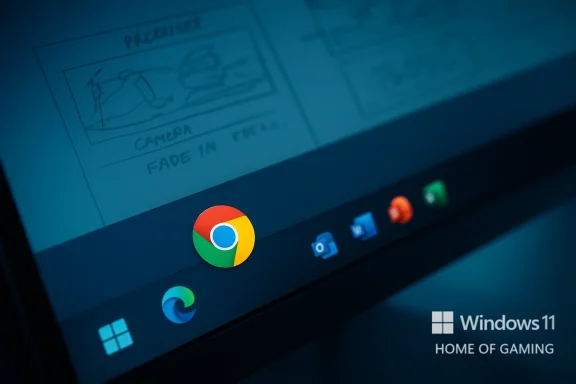
Microsoft’s year‑end gaming spot for Windows 11 briefly became a micro‑scandal when sharp‑eyed viewers spotted Google Chrome pinned to the taskbar — and the story only got stranger when Microsoft quietly replaced the Chrome icon in the same frames with Microsoft apps after the mistake circulated online.

Overview​

A short ad titled “Windows 11: The Home of Gaming” was posted to Microsoft’s YouTube channel late in December 2025. The clip was intended as a holiday push to position Windows 11 as the premier platform for PC gaming. In at least two frames, however, the taskbar showed a pinned Google Chrome icon — an ironic detail given Microsoft’s ongoing efforts to promote Microsoft Edge and Bing inside Windows. The presence of Chrome was first widely reported in early January and, following coverage and social amplification, Microsoft appears to have edited the master ad to remove the Chrome icon and replace it with first‑party icons such as PowerPoint and Edge. The update and the timeline were documented by independent coverage and subsequent follow‑up reporting.

Background: why a single icon matters​

In isolation, a taskbar icon is a tiny production detail — but it sits at the intersection of several larger issues:
  • The browser market is heavily skewed toward Google Chrome, which holds the majority of desktop sessions in late 2025; Microsoft Edge remains a distant second in global desktop share. That market reality explains Microsoft’s motivation to push Edge through in‑product messaging and marketing.
  • Microsoft has been experimenting with UI nudges in Edge that encourage users to stay with Edge rather than download Chrome. These nudges have included inline banners on the Chrome download page that emphasize Edge’s security features and attempt to reframe browser choice as a security decision. Those experiments have attracted media coverage and community discussion.
  • Advertising and brand consistency are core to platform messaging. Big vendors habitually sanitize UI imagery in commercials — curated taskbars and neutral icon sets are normal practice. So when a Microsoft ad inadvertently shows a competitor’s icon in a prominent frame, it reads like either a production oversight or an oddly candid creative choice.
Because Microsoft has actively nudged users toward Edge, the sight of Chrome in a Microsoft spot is more than a visual quirk — it’s a symbolic inconsistency that invites scrutiny.

What exactly happened (verified timeline)​

  1. Microsoft uploaded a short Windows 11 ad titled “Windows 11: The Home of Gaming” to YouTube on or around December 23, 2025. The ad includes desktop and taskbar shots as part of its fast‑cut montage.
  2. Observers noticed Google Chrome’s icon pinned on the taskbar in specific frames. Screenshots and short clips circulated across forums and social platforms beginning in early January 2026.
  3. Windows‑focused outlets reported the anomaly and published preserved copies of the original clip for archival purposes. Coverage pushed the story across mainstream and niche tech outlets.
  4. At some point after the story spread, Microsoft or its advertising partner replaced the original master with an edited version that removed the Chrome icon from the same frames and substituted Microsoft icons (Edge, Office apps, Xbox). The updated video now appears on Microsoft’s YouTube page. Microsoft has not publicly commented on the change, and the company has given no official explanation for the presence of Chrome or for the edit.
The most load‑bearing factual claims above — the upload date and the presence of Chrome in the original frames, the subsequent edit removing Chrome, and the lack of an official Microsoft acknowledgement — are documented in contemporaneous reporting and archived assets.

Production error or deliberate realism? Dissecting the plausible explanations​

The immediate reactions split across three hypotheses, each with implications for marketing, corporate messaging, and internal QA:
  • Production oversight (most likely): Ad campaigns are assembled from multiple sources — staged desktops, compositor files, stock footage — and small UI details can slip through quality control in rapid, social‑first cuts. That someone failed to clean or composite the taskbar correctly is the simplest explanation and fits the absence of a company statement acknowledging an intentional choice.
  • Intentional authenticity: Some ad teams purposefully include “real” cues to make a scene relatable. Showing Chrome would match the lived reality of many Windows users and could be used to signal authenticity rather than corporate sanctimony. That said, this runs starkly counter to Microsoft’s persistent Edge messaging and would be a risky, contradictory creative decision for a brand that explicitly markets its browser alternatives. The available evidence does not support intentionality.
  • Creative pipeline failure: Large campaigns often pass through agencies, contractors, and internal approvals. A downstream compositor or an out‑of‑house contractor could have assembled a final cut from a generic Windows desktop image that contained Chrome. Responsibility in such mishaps is typically diffuse — the ad agency owns the composition, the brand team signs the final cut, and legal/QA should catch third‑party references. The subsequent quiet edit suggests a retrospective cleanup once the oversight became public.
Given the evidence and the rapid replacement of Chrome with Microsoft icons, the weight of probability lies with a production or QA failure followed by a corrective edit rather than an intentional pro‑Chrome creative choice.

Why Microsoft’s public posture matters (brand and regulatory angles)​

Small production details can cascade into larger reputational and regulatory problems in today’s platform politics.
  • Brand credibility: Microsoft has made a prolonged public investment in promoting Edge and Bing. Showing Chrome in a campaign meant to highlight Windows 11 undermines that message and risks feeding narratives that Microsoft’s public claims and internal behaviours are misaligned. The optics of “Microsoft shows Chrome” became a meme precisely because it conflicted with Microsoft’s sustained nudging for Edge.
  • Product messaging vs reality: Consumers evaluate vendors not only on promises but on how coherent those promises are with everyday signals. If an OS maker loudly says “use our browser for safety” yet its own polished ads show Chrome, the messaging loses force and can stoke cynical interpretations of UX nudges as marketing theater.
  • Regulatory scrutiny: The browser and search battles trigger antitrust scrutiny in multiple jurisdictions. Authorities consider whether platform owners use preinstallation, UX placement, or subtle friction to entrench first‑party services. Persistent nudging that materially changes market outcomes attracts regulatory attention; even small public missteps can be seized as evidence in policy debates over default settings, choice screens, and user choice protections. The broader pattern — A/B testing banners in Edge to dissuade Chrome installs and the high‑profile ad gaffe — are narrative fuel for regulators and rivals.

The technical and market context: Chrome vs Edge, explained​

Understanding why this story hit a nerve requires a quick snapshot of browser economics and behavior:
  • Chrome leads the desktop browser market by a wide margin. StatCounter’s December 2025 worldwide desktop figures show Chrome commanding roughly three‑quarters of desktop sessions, with Edge trailing in the single digits to low teens depending on the region and dataset. These numbers explain both Chrome’s ubiquity on Windows desktops and Microsoft’s incentive to defend its browser funnel.
  • Browser choice translates to downstream revenue and telemetry. The default browser determines the default search engine, extensionsn ecosystems, and where users store credentials and sync data — all of which create long‑term business value for the browser owner. The stakes go beyond UX preference; they are about long‑run distribution of search queries, ad revenue, and captive telemetry.
  • Microsoft’s product-level response has been to test UI nudges: inline banners in Edge, security‑focused messaging, and onboarding flows designed to make Edge look like the safer option. These moves are defensible as product positioning — Edge does include security tools — but when implemented as persistent, interruptive prompts they risk being read as coercive rather than persuasive.

PR and advertising lessons: what brands should learn from the gaffe​

This incident is small, but it’s a useful case study in modern advertising governance for platform companies:
  • Rigorous UI sanitization matters. Any showpiece image that touches the UI should be checked against style guides and brand rules. That includes pin order, notification badges, third‑party icons, and visible browser windows.
  • Approvals must be traceable across agencies and contractors. A formal sign‑off log should exist that includes a legal/brand QA step specifically for first‑party vs third‑party assets.
  • When mistakes happen, transparency beats silence. Microsoft’s quiet edit fixed the visual but did not offer public acknowledgement. In many cases a short, clear statement that the edit corrected a production oversight reduces rumor and the perception of cover‑up.
  • Consistency is key to persuasion. If a platform’s product messaging stresses safety and first‑party value, creative executions must not contradict the narrative — at least not visibly.

Risks and edge cases (what we could not verify)​

There are a few items that remain unproven and should be treated cautiously:
  • Intent behind the original inclusion of Chrome: No public statement from Microsoft confirms whether Chrome was intentionally left in the ad to convey authenticity or whether it was an accidental composite. The absence of a Microsoft acknowledgement leaves motivation and responsibility unverified. This is flagged as an unresolved point.
  • Exact timing of the YouTube edit in relation to the first reports: While reporting shows the ad was posted in late December and that a version with Chrome circulated into January, the precise timestamp of Microsoft’s replacement edit is tied to platform timestamps and mirrored archives; reporting indicates the edit followed early January coverage but does not include an official timeline. The sequence is supported by archived assets published by the reporting outlet.
  • Any internal policy or formal decision to change ad‑sanitization rules within Microsoft: There is no public record that Microsoft changed its creative governance as a result. That would be an internal process matter not currently reported externally.
Flagging these as unverifiable preserves journalistic clarity: the visible facts (Chrome appears; Microsoft edited the ad) are verifiable; motivations and internal decisions remain unconfirmed.

How this fits into a broader pattern of platform competition​

The gaffe is a microcosm of a persistent dynamic between platform owners and dominant third‑party incumbents:
  • Platform owners use defaults, preinstalls, and UX placements to protect and promote first‑party services; these levers are powerful precisely because they occur at system level where users expect frictionless choices.
  • Dominant third parties (Google in this case) retain entrenched user habits and ecosystem advantages, meaning platforms must choose between coercive nudges, product improvement, or both.
  • Public missteps — however small — create narrative leverage for rivals and regulators. They can be used to illustrate lack of coherence between policy and practice and to support claims that default mechanics are being used to unfairly advantage first‑party services.
In short, a Chrome icon in a Microsoft ad is not only an advertising problem — it’s evidence of the gap between marketing control and real‑world user behavior.

Practical takeaways for Windows admins and consumers​

  • If you want Chrome on your Windows PC: you can still download and install Chrome. Edge’s experimental banners are persuasive UI elements, not OS‑level locks. If you encounter a persistent block, look for local security policies, antivirus interference, or enterprise Group Policy that might restrict installer execution.
  • For marketers and agencies: include a “UI compliance” checkpoint in every creative approval list for OS or product shots. That checkpoint should verify iconography, pinned states, and visible window titles.
  • For regulators and policy watchers: anecdotal ad inconsistencies are illustrative but are not substitute for telemetry and policy audits. The ad gaffe contributes to narrative but should be weighed alongside other documented practices (defaults, onboarding flows, programmatic nudges) when assessing competitive behavior.

Conclusion​

A single, tiny Chrome icon in a Microsoft Windows 11 gaming ad exploded into a broader conversation precisely because it touched a sensitive fault line: the ongoing browser wars and the tension between platform marketing and authentic usage. The incident appears to be a production oversight that Microsoft corrected quietly, but the episode matters far beyond the frame itself.
It underscores three enduring lessons for platform companies and observers:
  • Visual consistency matters. Small errors scale into large credibility costs when they contradict major platform narratives.
  • UX nudges are powerful and politically charged. Tests that try to steer user choice should be designed and communicated carefully to avoid appearing coercive.
  • Public accountability matters. Quiet edits fix visuals; transparent acknowledgements and stronger internal QA processes fix the larger governance problem.
For Windows users and IT professionals, the practical reality remains unchanged: Chrome is widely used on desktops, Edge continues to be actively promoted by Microsoft, and users who want a particular browser retain the technical ability to choose it. The ad gaffe was a momentary public spectacle — amusing, instructive, and revealing — but it did not alter the technical dynamics of browser choice on Windows.
Source: Windows Latest Microsoft’s Windows 11 ad accidentally promoted Google Chrome, then quietly edited after people noticed it
 

Microsoft’s polished Windows 11 “Home of Gaming” spot briefly included a pinned Google Chrome icon on the taskbar — a tiny production detail that was later removed from the master ad in a quiet edit — and the episode has become a revealing case study in platform messaging, marketing QA, and the political theatre of browser competition. overview
The short, high‑tempo commercial titled “Windows 11: The Home of Gaming” was posted to Microsoft’s official channels during the 2025 holiday period. In early January 2026, observers noticed that a close‑up of a Windows 11 desktop included Google Chrome visibly pinned to the taskbar, despite Microsoft’s long‑running efforts to promote Microsoft Edge as the default browser on Windows. Within days the version hosted by Microsoft’s channels was updated so the Chrome icon no longer appears in the same frames. The visible facts (the ad, the Chrome icon, and a subsequent edit removing it) are documented by independent reporting and archived captures.
This is not merely an amusing production goof. The Microsoft ad collides with a broader, measurable competitive reality: Google Chrome still dominates desktop browser usage, and Microsoft has for years used defaults, taskbar placement, in‑product banners and even rewards to retain or recover browser share. Those strategic moves make a single taskbar icon unexpectedly load‑bearing in public perception.

Chrome icon on Windows 11 taskbar with a Windows 11 Home of Gaming watermark.What happened — the verified timeline​

  • Microsoft published the video ad “Windows 11: The Home of Gaming” around late December 2025.
  • Sharp‑eyed viewers and multiple outlets captured frames showing Google Chrome pinned on the taskbar and circulated screenshots and short clips across social platforms.
  • After the anomaly spread, the copy of the ad available through Microsoft’s channels was replaced with an edited cut that removed the Chrome icon and substituted Microsoft first‑party icons (Edge, Office apps, Xbox). Microsoft provided no public comment acknowledndowslatest.
The visible sequence — original upload, community capture, and a subsequent edit — is consistent across several independent reproductions and reporting threads, even if internal intent and exact timestamps for the edit are not publicly confirmed. That absence of official explanation is important context; it limits conclusions about motive and a single icon matters

Small visual, big signal​

Professional advertising teams almost always sanitize OS screenshots, taskbars and window chrome. A single competing app icon in a polished spot reads like a signal rather than a detail because it contradicts carefully managed brand narratives. When a vendor has been actively using system and browser nudges to promote its own services, seeing a rival’s logo in a hero ad becomes more than a slip — it’s a dissonant data point the media and public will amplify.

Market context: Chrome’s dominance​

StatCounter and multiple independent trackers show Chrome’s desktop share substantially ahead of Edge through late 2025; regionally, Chrome often commands well over half of desktop browser usage. Those figures explain Microsoft’s commercial urgency: browser usage flows into search, extension ecosystems, sync services and monetizable user touchpoints. The numbers themselves have shifted over time, but the pattern — Chrome as the dominant desktop browser and Edge trailing — is persistent.

The product‑messaging mismatch​

Microsoft’s strategy has included more than just marketing. Edge has been the recipient of UX experiments and in‑product banners that intervene when users navigate to Chrome download pages or search for Chrome — in one reported experiment the browser even offered Microsoft Rewards incentives. That product posture amplifies the mismatch created by showing Chrome in a flagship ad: tct behavior tells one story, while a glossy advertisement briefly tells another.

Production and QA: plausibe plausible explanations account for the presence of Chrome in the original frames. Each has different operational and reputational implications.​

  • Production oversight (most likely): large agency jobs pass through many hands and sometimes use repurposed footage or composited desktop captures. A sanitized taskbar step could have been missed in a fast turnaround holiday scheduuthenticity: some creative directors intentionally leave in real‑world artifacts to make scenes feel lived‑in. This is plausible but unlikely here because it contradicts Microsoft’s explicit product messaging. If the authenticity defense were true, it should have been acknowledged publicly to control it.
  • Creative pipeline failure: a contractor or out‑of‑house compositor could have assembled the final cut from a generic, un‑sanitized desktop image. Responsibility in such cases is diffuse: the ad agency, brand approvals, and legal/QA share ownership of final assets. The subsequent quiet edit strongly suggests a corrective cleanup rather than a deliberate creative statement.
These hypotheses are consistent with the public evidence; internal decision‑making remains a Microsoft statement. That limitation is flagged as such: the presence of Chrome and the later edit are documented facts, motive and the precise internal workflow that produced them are not.

The optics and regulatory angles​

Brand credibility​

A small mismatch like this undercuts persuasive messaging. Microsoft has heavily invested in Edge and Bing positioning; an ad that appears to show internal teams or staff using Chrome feeds online jokes and critiques about coherence between public policy and practice. The memetic payoff load Chrome”) is durable because it aligns with longstanding user jokes about browser defaults.

Regulatory storytelling​

Incidents like this are ammunition in policy debates. Regulators probing default settings and antitrust concerns look not just at code but at patterns of behavior and user flows. While an ad gaffe alone is not evidence of anti‑competitive conduct, it becomes part of a dossier of incidents — defaults, nudges, placement and messaging — that can be interpreted in a regulatory review. Narrative fragments add texture to compliance assessments, especially when combined with telemetry and demonstrable UX interventions.

Technical clarification: nudges vs. blocks​

It’s essential to separate UI nudges from system‑level blocks. The Edge behavior that interrupts Chrome download flows is a browser‑level UX experiment — a persuasion interface — not an OS‑level limit that technically blocks Chrome installers. Multiple reproductions and ers can still download and install Chrome after dismissing or bypassing Edge messaging. Treating the Edge experiments as an outright ban would be inaccurate and misleading.

What this means for different audiences​

For Windows admins and IT pros​

  • Browser choice remains a user/IT decision. Edge’s nudges are UI tactics, not mandatory kernel‑level blocks installer behaviour in managed environments, check Group Policy and endpoint protection logs — enterprise policies, not Microsoft’s public UX experiments, are the usual cause of enforced restrictions.

For marketers and agencies​

  • Add an explicit “UI compliance” checkpr OS screenshots and product UI montages. That checkpoint should verify pinned icons, visible window titles, and any other third‑party exposures.
  • If realism is desired, plan for explicit messaging to own that choice; un‑acknowledged realism invites misinterpretation.

For regulation watchers​

  • Anecdotes are illustrative but insufficient; audits should rely on telemetry and documented product tests alongside marketing behavior. Still, small public misalignments are signal events that help form investigative hypotheses.

Strengths and weaknesses​

Strengths​

  • Corrective action: the problematic frame was removed from the public master, which reduces ongoing reputational exposure. Quiet edits can be efficient at stopping further viral spread of an undesirable asset.
ct controls: Microsoft maintains technical and policy levers to manage user flows in Windows and Edge, which it uses to emphasize first‑party services where it sees fit. That control is a product strength when aligned with user choice and transparency.isks
  • Perception of opacity: a silent edit without explanation invites second‑guessing and fuels speculation about intent and authenticity. In the attention economy, silence can be treatn.
  • Strategic incoherence: persistent public nudges combined with a slip in branded content create a cognitive dissonance that erodes persuasive power. If users sense dissonance between claimed policy and practice, marketing messages lose credibility.
  • Regulatory narrative fuel: unattended, these small incidents accumulate into a narrative about control and steering that regulators may find persuasive when assembling a broader case.

Practical takeaways and recommendations​

  • For platform vendors: align creative, product and policy teams. Add UI compliance gates tohecklist and treat system screenshots as audited assets.
  • For advertisers/agencies: maintain locked compositing layers for OS UI in final masters and require cryptographic image provenance for deliverables in high‑sensitivity campaigns.
  • For consumers: browser choice remains available. If you prefer Chrome, you can still download and install it; experimental Edge banners are persuasiblocks.

What we could not verify (and why it matters)​

  • Microsoft’s motive for the original inclusion of Chrome: there is no public Microsoft statement confirming whether Chrome’s presence was a deliberate authenticity move or an accidental oversight. This is an unresolved and material point; without an internal acknowledgement or docum, motive remains speculative.
  • The exact timestamp and rationale behind the edit: reporting and archived copies establish that an edited master exists, but the cod a timeline or explanation connecting the public reaction to the decision to alter the asset. That sequence is highly plausible but not exhaustively documented in primary Microsoft channels.
Flagging these gaps is essential journalism practice: they limit the strengthpreserve clarity between observable facts and inferred motives.

Final analysis — why this small moment is worth watching​

The Chrome icon episode is a compact lesson in modern platform politics. It shows how:
  • Small visual artifacts can scale into reputational events when they intersect with ongoing corporate narratives.
  • Product nudges and marketing must be consistent or the company pays a credibility tax. The story reveals a broader pattern: Microsoft has been actively experimenting with in‑product nudges to favor Easive share gives users reasons to resist.
  • Quiet fixes solve the immediate visual problem, but they do not address systemic governance questions about creative oversight, cross‑team communication, and public transparency — the deeper issues regulators and customers notice.
This is ultimately a teachable moment for large platform vendors: visual consistency and transparent governance matter almost as much as product features. A single icon became a public conversation because it fit an existing narrative about defaults, nudges, and corporate control — and until companies treat those narrative seams as governance problems, similar slips will continue to reverberate beyond their original frame.

Conclusion​

The Windows 11 ad gaffe — Chrome showing on a Microsoft taskbar, followed by a quiet edit that removed it — is an instructive incident that combines production-level oversight with strategic brand and product implications. The visible facts are clear and independently documented: Chrome appeared in the original video asset; an edited master now circulates without Chrome; Microsoft has not publicly explained the change. The broader implications touch marketing discipline, platform governance, and regulatory storytelling. For practitioners, the lesson is simple and pragmatic: small UI details are high‑leverage signals. Treat them as governance issues, not afterthoughts, and be prepared to explain creative choices openly when they collide with platform strategy.
Source: Windows Report https://windowsreport.com/microsoft-quietly-edits-windows-11-ad-after-chrome-appears-on-taskbar/
 

Back
Top