

Microsoft Gaming CEO Asha Sharma said on May 5, 2026, that Microsoft will wind down Copilot on mobile and stop development of Copilot for Xbox consoles, reversing a March plan to bring the gaming AI assistant to current-generation Xbox hardware later this year. That is not just a product cancellation. It is the first clear sign that Sharma understands the difference between Microsoft’s AI strategy and Xbox’s survival strategy. For a platform that has spent years telling players that hardware mattered less and less, the retreat from Copilot is really a retreat from abstraction.
The most important word in Sharma’s announcement was not “Copilot.” It was “friction.” Xbox does not have a shortage of features; it has a shortage of confidence, coherence, and reasons for players to believe the platform is being built around them rather than around Microsoft’s corporate priorities.
Copilot for Gaming was supposed to be the friendly version of Microsoft’s AI push: a contextual assistant that could help players find games, understand systems, troubleshoot, and perhaps guide them through stuck moments. In isolation, that sounds harmless enough. In the Xbox context, it landed differently.
For many Xbox fans, Copilot on console looked like one more sign that Microsoft was trying to solve a trust problem with a technology rollout. The brand had already spent years asking players to accept a moving target: Xbox as a console, Xbox as a service, Xbox as a PC app, Xbox as a cloud endpoint, Xbox as a subscription, Xbox as a publisher on rival platforms. Adding an AI layer on top of that did not clarify the proposition. It made it feel even more mediated.
Sharma’s cancellation therefore matters because it breaks with the logic that has governed much of Microsoft’s consumer strategy: if a product has a screen, a text box, or a workflow, Copilot must eventually appear there. Xbox is not Word, Excel, Windows Search, or Teams. It is a leisure platform whose best moments depend on flow, immersion, identity, and control.
The living room is a bad place to test whether users will tolerate an assistant because the corporate center wants another Copilot endpoint. Players do not turn on a console to be optimized. They turn it on to escape optimization.
That suspicion was not irrational. Microsoft has spent the last several years making Copilot the connective tissue of its product story. In the enterprise, that strategy is easy to explain: summarize meetings, generate drafts, query data, reduce repetitive work. In gaming, the value proposition is much fuzzier, because the “work” players want removed is often the thing designers intentionally placed there.
The irony is that Sharma’s first high-profile Xbox correction is an anti-AI correction. She is not rejecting AI as a technology, and nobody should pretend Microsoft Gaming is suddenly becoming a Luddite shop. But she is drawing a line between AI as infrastructure and AI as a visible consumer feature.
That distinction matters. Developers may use machine learning in tooling, testing, localization, moderation, accessibility, animation, analytics, and support. Players may never object if those systems make games ship cleaner, load faster, or become easier to navigate. What players object to is the sense that the art itself is being routed through a corporate assistant.
Sharma’s earlier reassurance that games remain human-made art was not enough by itself, because every executive in the AI era says some version of that. The Copilot reversal gives the statement operational meaning. It says at least one AI-branded feature can lose an internal argument when it does not fit the platform.
Against that backdrop, Copilot looked like a flourish before the foundation had been repaired. It was the kind of feature that makes sense in a keynote because it demonstrates technological ambition. It makes less sense to a player wondering whether the next Xbox will exist as a serious console, whether their library will remain valuable, and whether Microsoft is still willing to compete in the living room.
The Xbox audience is not anti-technology. This is a community that embraced broadband console gaming, achievements, digital libraries, backward compatibility, cross-play, cloud saves, adaptive controllers, Quick Resume, and PC-console ecosystem links. But those features succeeded because they solved recognizable player problems.
Copilot’s proposed gaming use cases always had a faintly synthetic quality. If a player wants help with a boss fight, they already have YouTube, Discord, Reddit, guides, streams, friends, and search. If a player wants recommendations, Xbox already has a store, Game Pass rails, wishlists, and social signals. If a player needs support, the answer is not necessarily a conversational AI layer; it may be better account tools, clearer refund flows, faster downloads, and a less confusing app ecosystem.
That is why the cancellation has been greeted positively in many corners of the gaming community. Players are not celebrating the absence of intelligence. They are celebrating the possibility that Xbox leadership can distinguish between a platform need and a corporate mandate.
That kind of turnabout can be read two ways. The cynical reading is that Xbox is lurching from one strategy to another without a stable plan. The more charitable reading is that Sharma is moving quickly to kill projects that no longer survive contact with her priorities.
Both interpretations may be true. Xbox has looked strategically overextended for years, and abrupt cancellations are rarely a sign of perfect internal alignment. But in this case, the decision has a clarifying effect. It tells employees, partners, and players that “AI everywhere” is not the governing law of the Xbox business.
The mobile retreat is especially notable. Microsoft’s gaming ambitions on phones have been central to its post-Activision logic, and the company has repeatedly argued that mobile is where global gaming scale lives. If Copilot is being wound down there too, this is not merely a console-specific concession to living-room purists.
It suggests Microsoft may have concluded that the Gaming Copilot product, at least in its visible consumer form, was not pulling its weight. Perhaps usage was thin. Perhaps sentiment was poor. Perhaps the feature duplicated existing behavior without improving it. Or perhaps Sharma simply decided that a new Xbox leadership team cannot ask the community for trust while simultaneously pushing one of the community’s least-requested features.
Whatever the internal reason, the external message is cleaner than most Xbox messaging has been lately: this does not help us get back on track, so it goes.
Xbox needs institutional memory, because the brand’s strongest assets are historical: backward compatibility, long-running franchises, developer relationships, controller design, console engineering, and a community that still remembers when Xbox felt dangerous in the best way. It also needs outside pressure, because nostalgia alone cannot fix a business squeezed by PlayStation’s market strength, Steam’s PC gravity, Nintendo’s durable differentiation, mobile gatekeepers, and Microsoft’s own impatience.
The leadership mix Sharma describes is an attempt to avoid two failures at once. One failure would be letting Xbox become a museum of its best eras, forever promising a return to the original Xbox or Xbox 360 spirit without adapting to the economics of 2026. The other would be letting Microsoft turn Xbox into a generic growth platform with controllers attached.
The cancellation of console Copilot is useful because it gives the reorganization a point of view. It says the new regime is willing to subtract. That matters in a company famous for bundling, layering, integrating, and naming things until the user experience resembles a strategy deck.
Great platform stewardship often begins with subtraction. Remove the thing that confuses the promise. Remove the thing that distracts engineers. Remove the thing that tells users their objections are less important than the company’s internal OKRs.
If Sharma can make that discipline habitual, Xbox may finally become easier to understand.
The old Xbox strategy tried to make the console less central by expanding “Xbox” to every screen. There was logic in that. Console growth is difficult, PC is enormous, mobile is larger still, and Microsoft owns cloud infrastructure that can support play across devices. But the messaging often slid from “you can play Xbox anywhere” into “the Xbox console is optional.”
That may be true in a narrow access sense, but it is poisonous as a platform identity. If customers believe Microsoft itself is ambivalent about the console, they will not invest emotionally or financially in the console. Hardware ecosystems depend on confidence. People buy into libraries, accessories, subscriptions, multiplayer networks, and habits because they believe the platform holder will keep showing up.
Stopping Copilot does not prove Microsoft has fixed that. But it removes one symbol of misplaced attention. Instead of asking how an AI assistant fits into Xbox, Sharma can ask a harder and better question: what must the next Xbox do so well that players stop asking whether Microsoft still cares about consoles?
That answer will not come from a chatbot. It will come from performance, price, compatibility, exclusive or preferential experiences, store openness, developer tools, account reliability, and a first-party calendar that feels less like a rescue plan and more like a rhythm.
Some of that complexity is the price of modern gaming. Some of it is self-inflicted. Developers do not need another branded assistant nearly as much as they need predictable tools, fast certification, clear commercial terms, strong discoverability, useful analytics, and a platform holder that knows what it wants.
If Copilot was consuming product, design, engineering, or executive attention that could be redirected toward those basics, killing it is rational. Not because AI tools cannot help developers, but because the visible consumer feature was not necessarily where the leverage was.
The best Xbox AI story may be invisible. It may be better crash triage for studios. It may be automated compliance checks before submission. It may be localization assistance under human review. It may be moderation tooling that reduces abuse without silencing legitimate speech. It may be accessibility systems that help developers test more scenarios more cheaply.
That is the distinction Xbox has to make. AI in service of developers and players can be valuable. AI as a symbol of Microsoft’s corporate enthusiasm is baggage.
That is politically useful for a new Xbox CEO. Sharma needs credibility with a community that did not choose her, did not know her from gaming, and had every reason to fear she represented a Microsoft-first rather than Xbox-first agenda. One cancellation does not create a mandate, but it can open a channel.
It also changes the emotional framing of her leadership. Instead of being the AI executive sent to inject Copilot into Xbox, she becomes the AI executive willing to pull Copilot out of Xbox. That is a powerful inversion, and it gives her room to argue that her job is not to make Xbox more like Microsoft’s productivity suite.
The danger is that symbolic goodwill decays quickly. Players will applaud the cancellation today and demand results tomorrow. If hardware remains unclear, first-party releases stumble, prices rise again, or Microsoft resumes muddying the console message, nobody will remember Copilot’s demise as a turning point. They will remember it as a small mercy.
Trust in gaming is cumulative, but distrust is compounding. Xbox has spent a long time accumulating the latter.
That means the question is not whether AI returns to Xbox. It almost certainly will, though perhaps under different names, in less visible forms, or as part of developer and platform infrastructure rather than a consumer-facing assistant. The real question is who gets to define the terms.
If Xbox defines AI from the player outward, it may find sensible uses. Accessibility guidance, natural-language search across a large library, parental controls, safety moderation, and account support could all benefit from better machine intelligence if implemented carefully. Even in-game assistance is not inherently offensive if it is opt-in, transparent, respectful of creative intent, and not treated as a substitute for design.
If Microsoft defines AI from the corporate center inward, Xbox will repeat the Copilot mistake. It will start with a strategic requirement and go looking for a player problem. That is how platforms become cluttered with features that users learn to ignore or resent.
The console cancellation suggests Sharma knows the distinction. The next year will show whether she has the authority to enforce it.
Again, none of that is wrong in isolation. The gaming market is too large and fragmented for a console-only strategy to carry Microsoft’s ambitions. But a platform cannot be only distribution. It also has to be a place people feel they belong.
This is where Xbox has lost ground. PlayStation still communicates a premium console identity, even when its games migrate to PC. Nintendo still sells a distinctive hardware-software culture that nobody else can quite imitate. Steam has become the default PC gaming commons by being useful, trusted, and deeply habitual. Xbox, by contrast, has often seemed unsure whether it wants to be a console tribe, a subscription utility, a publisher, a launcher, or a cloud service.
Copilot did not answer that identity problem. It sharpened it. An assistant that follows players around the ecosystem may make sense after the ecosystem feels coherent. Before that, it risks becoming a tour guide for a building whose floor plan keeps changing.
Sharma’s “return of Xbox” language will only work if it means more than sentiment. A return cannot simply be green lighting nostalgia, reviving old slogans, or promising power. It has to mean that Xbox becomes legible again: to players, developers, retailers, partners, and Microsoft itself.
The old Microsoft reflex would have been to ship it, call it preview, make it optional, gather telemetry, and quietly iterate while the community rolled its eyes. The new move is more decisive. Stop development. Wind down mobile. Reallocate attention.
That matters because Xbox cannot afford ornamental strategy right now. It needs to make fewer promises and keep more of them. It needs to stop asking players to decode the difference between Xbox as a brand, Xbox as a console, Xbox Game Studios, Microsoft Gaming, Game Pass, cloud gaming, Play Anywhere, and whatever the next hardware-software hybrid becomes.
The more sprawling the ecosystem becomes, the more important disciplined product choices become. Every feature must answer a simple question: does this make Xbox more compelling to players or easier for developers? If not, it is probably a distraction.
Copilot failed that test, at least for now.
Still, it is a meaningful first move because it aligns with the community’s stated concerns and with the business’s obvious needs. Xbox does not need more ambient intelligence in the dashboard before it needs renewed clarity around hardware, Game Pass, first-party quality, and developer support. Sharma’s decision shows she is willing to spend political capital inside Microsoft to remove something that looked strategically fashionable but platform-weak.
The concrete implications are straightforward:
Source: Game Informer Microsoft Copilot Will No Longer Come To Consoles, Says Xbox CEO
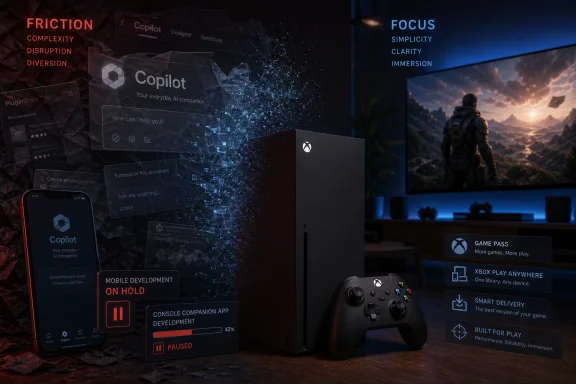 Microsoft Discovers That Not Every Surface Needs an Assistant
The most important word in Sharma’s announcement was not “Copilot.” It was “friction.” Xbox does not have a shortage of features; it has a shortage of confidence, coherence, and reasons for players to believe the platform is being built around them rather than around Microsoft’s corporate priorities.Copilot for Gaming was supposed to be the friendly version of Microsoft’s AI push: a contextual assistant that could help players find games, understand systems, troubleshoot, and perhaps guide them through stuck moments. In isolation, that sounds harmless enough. In the Xbox context, it landed differently.
For many Xbox fans, Copilot on console looked like one more sign that Microsoft was trying to solve a trust problem with a technology rollout. The brand had already spent years asking players to accept a moving target: Xbox as a console, Xbox as a service, Xbox as a PC app, Xbox as a cloud endpoint, Xbox as a subscription, Xbox as a publisher on rival platforms. Adding an AI layer on top of that did not clarify the proposition. It made it feel even more mediated.
Sharma’s cancellation therefore matters because it breaks with the logic that has governed much of Microsoft’s consumer strategy: if a product has a screen, a text box, or a workflow, Copilot must eventually appear there. Xbox is not Word, Excel, Windows Search, or Teams. It is a leisure platform whose best moments depend on flow, immersion, identity, and control.
The living room is a bad place to test whether users will tolerate an assistant because the corporate center wants another Copilot endpoint. Players do not turn on a console to be optimized. They turn it on to escape optimization.
The AI Executive Makes Her First Non-AI Move
Sharma’s appointment was always going to be read through her résumé. Coming from Microsoft’s CoreAI organization, she arrived at Xbox with a burden of suspicion: that Redmond had decided gaming was another channel for AI distribution rather than a troubled entertainment business needing careful repair.That suspicion was not irrational. Microsoft has spent the last several years making Copilot the connective tissue of its product story. In the enterprise, that strategy is easy to explain: summarize meetings, generate drafts, query data, reduce repetitive work. In gaming, the value proposition is much fuzzier, because the “work” players want removed is often the thing designers intentionally placed there.
The irony is that Sharma’s first high-profile Xbox correction is an anti-AI correction. She is not rejecting AI as a technology, and nobody should pretend Microsoft Gaming is suddenly becoming a Luddite shop. But she is drawing a line between AI as infrastructure and AI as a visible consumer feature.
That distinction matters. Developers may use machine learning in tooling, testing, localization, moderation, accessibility, animation, analytics, and support. Players may never object if those systems make games ship cleaner, load faster, or become easier to navigate. What players object to is the sense that the art itself is being routed through a corporate assistant.
Sharma’s earlier reassurance that games remain human-made art was not enough by itself, because every executive in the AI era says some version of that. The Copilot reversal gives the statement operational meaning. It says at least one AI-branded feature can lose an internal argument when it does not fit the platform.
Xbox’s Problem Was Never a Missing Chatbot
The hard truth for Microsoft is that Xbox’s current problems are brutally concrete. Hardware sales have been weak. The console identity has been muddied. Game Pass has gone through strategic whiplash. First-party output has improved in places but still carries the weight of years of delays, studio closures, layoffs, and uneven messaging.Against that backdrop, Copilot looked like a flourish before the foundation had been repaired. It was the kind of feature that makes sense in a keynote because it demonstrates technological ambition. It makes less sense to a player wondering whether the next Xbox will exist as a serious console, whether their library will remain valuable, and whether Microsoft is still willing to compete in the living room.
The Xbox audience is not anti-technology. This is a community that embraced broadband console gaming, achievements, digital libraries, backward compatibility, cross-play, cloud saves, adaptive controllers, Quick Resume, and PC-console ecosystem links. But those features succeeded because they solved recognizable player problems.
Copilot’s proposed gaming use cases always had a faintly synthetic quality. If a player wants help with a boss fight, they already have YouTube, Discord, Reddit, guides, streams, friends, and search. If a player wants recommendations, Xbox already has a store, Game Pass rails, wishlists, and social signals. If a player needs support, the answer is not necessarily a conversational AI layer; it may be better account tools, clearer refund flows, faster downloads, and a less confusing app ecosystem.
That is why the cancellation has been greeted positively in many corners of the gaming community. Players are not celebrating the absence of intelligence. They are celebrating the possibility that Xbox leadership can distinguish between a platform need and a corporate mandate.
The March Promise Became a May Liability
The speed of the reversal is striking. In March, Microsoft was still talking about bringing Gaming Copilot to current-generation consoles in 2026. By May 5, the console work was dead, and the mobile version was being wound down.That kind of turnabout can be read two ways. The cynical reading is that Xbox is lurching from one strategy to another without a stable plan. The more charitable reading is that Sharma is moving quickly to kill projects that no longer survive contact with her priorities.
Both interpretations may be true. Xbox has looked strategically overextended for years, and abrupt cancellations are rarely a sign of perfect internal alignment. But in this case, the decision has a clarifying effect. It tells employees, partners, and players that “AI everywhere” is not the governing law of the Xbox business.
The mobile retreat is especially notable. Microsoft’s gaming ambitions on phones have been central to its post-Activision logic, and the company has repeatedly argued that mobile is where global gaming scale lives. If Copilot is being wound down there too, this is not merely a console-specific concession to living-room purists.
It suggests Microsoft may have concluded that the Gaming Copilot product, at least in its visible consumer form, was not pulling its weight. Perhaps usage was thin. Perhaps sentiment was poor. Perhaps the feature duplicated existing behavior without improving it. Or perhaps Sharma simply decided that a new Xbox leadership team cannot ask the community for trust while simultaneously pushing one of the community’s least-requested features.
Whatever the internal reason, the external message is cleaner than most Xbox messaging has been lately: this does not help us get back on track, so it goes.
Sharma Is Rebuilding More Than a Feature Roadmap
The Copilot decision arrived alongside a leadership shake-up, and that pairing is not incidental. Sharma framed the changes as a mix of promoting leaders who helped build Xbox and bringing in new voices to push the business forward. That is careful executive language, but the underlying tension is obvious.Xbox needs institutional memory, because the brand’s strongest assets are historical: backward compatibility, long-running franchises, developer relationships, controller design, console engineering, and a community that still remembers when Xbox felt dangerous in the best way. It also needs outside pressure, because nostalgia alone cannot fix a business squeezed by PlayStation’s market strength, Steam’s PC gravity, Nintendo’s durable differentiation, mobile gatekeepers, and Microsoft’s own impatience.
The leadership mix Sharma describes is an attempt to avoid two failures at once. One failure would be letting Xbox become a museum of its best eras, forever promising a return to the original Xbox or Xbox 360 spirit without adapting to the economics of 2026. The other would be letting Microsoft turn Xbox into a generic growth platform with controllers attached.
The cancellation of console Copilot is useful because it gives the reorganization a point of view. It says the new regime is willing to subtract. That matters in a company famous for bundling, layering, integrating, and naming things until the user experience resembles a strategy deck.
Great platform stewardship often begins with subtraction. Remove the thing that confuses the promise. Remove the thing that distracts engineers. Remove the thing that tells users their objections are less important than the company’s internal OKRs.
If Sharma can make that discipline habitual, Xbox may finally become easier to understand.
The Console Still Has to Earn Its Place
The next Xbox hardware, reportedly codenamed Project Helix, now carries even more symbolic weight. Sharma has described the future machine in performance-forward terms and emphasized compatibility with Xbox and PC games. That is the pitch Xbox fans have been waiting to hear: not a retreat from hardware, but a sharper argument for why Microsoft hardware should exist.The old Xbox strategy tried to make the console less central by expanding “Xbox” to every screen. There was logic in that. Console growth is difficult, PC is enormous, mobile is larger still, and Microsoft owns cloud infrastructure that can support play across devices. But the messaging often slid from “you can play Xbox anywhere” into “the Xbox console is optional.”
That may be true in a narrow access sense, but it is poisonous as a platform identity. If customers believe Microsoft itself is ambivalent about the console, they will not invest emotionally or financially in the console. Hardware ecosystems depend on confidence. People buy into libraries, accessories, subscriptions, multiplayer networks, and habits because they believe the platform holder will keep showing up.
Stopping Copilot does not prove Microsoft has fixed that. But it removes one symbol of misplaced attention. Instead of asking how an AI assistant fits into Xbox, Sharma can ask a harder and better question: what must the next Xbox do so well that players stop asking whether Microsoft still cares about consoles?
That answer will not come from a chatbot. It will come from performance, price, compatibility, exclusive or preferential experiences, store openness, developer tools, account reliability, and a first-party calendar that feels less like a rescue plan and more like a rhythm.
Developers Needed Less Theater and More Throughput
Sharma’s reference to friction for developers should not be overlooked. The Xbox developer story has become complicated by Microsoft’s many ambitions. A studio making a game for Xbox may be thinking about Series X, Series S, Windows PC, Game Pass, cloud streaming, Play Anywhere, Microsoft Store, Steam, accessibility requirements, certification, cross-save, cross-progression, and now potentially PlayStation and Nintendo versions depending on Microsoft’s publishing posture.Some of that complexity is the price of modern gaming. Some of it is self-inflicted. Developers do not need another branded assistant nearly as much as they need predictable tools, fast certification, clear commercial terms, strong discoverability, useful analytics, and a platform holder that knows what it wants.
If Copilot was consuming product, design, engineering, or executive attention that could be redirected toward those basics, killing it is rational. Not because AI tools cannot help developers, but because the visible consumer feature was not necessarily where the leverage was.
The best Xbox AI story may be invisible. It may be better crash triage for studios. It may be automated compliance checks before submission. It may be localization assistance under human review. It may be moderation tooling that reduces abuse without silencing legitimate speech. It may be accessibility systems that help developers test more scenarios more cheaply.
That is the distinction Xbox has to make. AI in service of developers and players can be valuable. AI as a symbol of Microsoft’s corporate enthusiasm is baggage.
The Community Heard a Rare Word: No
Part of the positive response to Sharma’s announcement comes from how rarely large platform companies say no to themselves in public. Users are accustomed to being told that unwanted features are early, misunderstood, optional, experimental, or part of a journey. They are less accustomed to seeing a company say, in effect, we heard the friction and we are stopping.That is politically useful for a new Xbox CEO. Sharma needs credibility with a community that did not choose her, did not know her from gaming, and had every reason to fear she represented a Microsoft-first rather than Xbox-first agenda. One cancellation does not create a mandate, but it can open a channel.
It also changes the emotional framing of her leadership. Instead of being the AI executive sent to inject Copilot into Xbox, she becomes the AI executive willing to pull Copilot out of Xbox. That is a powerful inversion, and it gives her room to argue that her job is not to make Xbox more like Microsoft’s productivity suite.
The danger is that symbolic goodwill decays quickly. Players will applaud the cancellation today and demand results tomorrow. If hardware remains unclear, first-party releases stumble, prices rise again, or Microsoft resumes muddying the console message, nobody will remember Copilot’s demise as a turning point. They will remember it as a small mercy.
Trust in gaming is cumulative, but distrust is compounding. Xbox has spent a long time accumulating the latter.
Microsoft’s Broader AI Machine Will Not Stop at the Xbox Border
It would be naive to read this as a broad retreat from AI. Microsoft’s investment in Copilot remains central to the company’s enterprise, developer, and Windows strategies. Xbox will continue to live inside a corporation that sees AI as the next operating layer of computing.That means the question is not whether AI returns to Xbox. It almost certainly will, though perhaps under different names, in less visible forms, or as part of developer and platform infrastructure rather than a consumer-facing assistant. The real question is who gets to define the terms.
If Xbox defines AI from the player outward, it may find sensible uses. Accessibility guidance, natural-language search across a large library, parental controls, safety moderation, and account support could all benefit from better machine intelligence if implemented carefully. Even in-game assistance is not inherently offensive if it is opt-in, transparent, respectful of creative intent, and not treated as a substitute for design.
If Microsoft defines AI from the corporate center inward, Xbox will repeat the Copilot mistake. It will start with a strategic requirement and go looking for a player problem. That is how platforms become cluttered with features that users learn to ignore or resent.
The console cancellation suggests Sharma knows the distinction. The next year will show whether she has the authority to enforce it.
The Real Pivot Is From Distribution to Belonging
For years, Microsoft has treated Xbox’s future as a distribution problem. Get the games onto more devices. Put the subscription in more places. Make the brand less dependent on a box. Expand beyond the living room.Again, none of that is wrong in isolation. The gaming market is too large and fragmented for a console-only strategy to carry Microsoft’s ambitions. But a platform cannot be only distribution. It also has to be a place people feel they belong.
This is where Xbox has lost ground. PlayStation still communicates a premium console identity, even when its games migrate to PC. Nintendo still sells a distinctive hardware-software culture that nobody else can quite imitate. Steam has become the default PC gaming commons by being useful, trusted, and deeply habitual. Xbox, by contrast, has often seemed unsure whether it wants to be a console tribe, a subscription utility, a publisher, a launcher, or a cloud service.
Copilot did not answer that identity problem. It sharpened it. An assistant that follows players around the ecosystem may make sense after the ecosystem feels coherent. Before that, it risks becoming a tour guide for a building whose floor plan keeps changing.
Sharma’s “return of Xbox” language will only work if it means more than sentiment. A return cannot simply be green lighting nostalgia, reviving old slogans, or promising power. It has to mean that Xbox becomes legible again: to players, developers, retailers, partners, and Microsoft itself.
A Smaller Xbox Feature Can Signal a Larger Xbox Reset
The importance of this cancellation is not that millions of players were clamoring specifically against Copilot on console. Most probably had not used it, and many may not have known exactly what it would do. Its importance is that it represented a path Xbox did not need to walk.The old Microsoft reflex would have been to ship it, call it preview, make it optional, gather telemetry, and quietly iterate while the community rolled its eyes. The new move is more decisive. Stop development. Wind down mobile. Reallocate attention.
That matters because Xbox cannot afford ornamental strategy right now. It needs to make fewer promises and keep more of them. It needs to stop asking players to decode the difference between Xbox as a brand, Xbox as a console, Xbox Game Studios, Microsoft Gaming, Game Pass, cloud gaming, Play Anywhere, and whatever the next hardware-software hybrid becomes.
The more sprawling the ecosystem becomes, the more important disciplined product choices become. Every feature must answer a simple question: does this make Xbox more compelling to players or easier for developers? If not, it is probably a distraction.
Copilot failed that test, at least for now.
The Copilot Retreat Gives Sharma One Clean Win to Build On
This is the part Xbox should not overplay. Killing an unpopular or poorly timed feature is not the same as building a beloved platform. It is a first move, not a strategy.Still, it is a meaningful first move because it aligns with the community’s stated concerns and with the business’s obvious needs. Xbox does not need more ambient intelligence in the dashboard before it needs renewed clarity around hardware, Game Pass, first-party quality, and developer support. Sharma’s decision shows she is willing to spend political capital inside Microsoft to remove something that looked strategically fashionable but platform-weak.
The concrete implications are straightforward:
- Copilot will not continue toward an Xbox console launch under the plan Microsoft had discussed earlier in 2026.
- Microsoft is also winding down the mobile version, which makes the reversal broader than a living-room-specific retreat.
- Sharma is using the cancellation to frame a larger Xbox reset around speed, community trust, and reduced friction.
- The move helps counter fears that an AI executive would automatically turn Xbox into another Copilot distribution channel.
- The decision does not mean AI is gone from Xbox, but it does suggest visible AI features will need a stronger player-first justification.
- The next Xbox hardware now has to carry the platform argument that Copilot never could.
Source: Game Informer Microsoft Copilot Will No Longer Come To Consoles, Says Xbox CEO
