

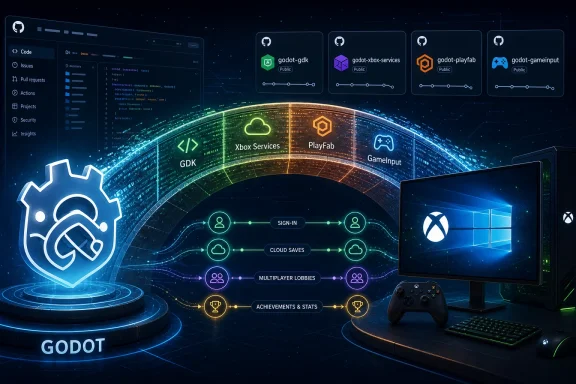
Microsoft released the Xbox Godot Sample on June 4, 2026, as a public, source-only GitHub reference project for building Godot extensions that integrate the Microsoft Game Development Kit, Xbox Services, PlayFab, and GameInput for Xbox-enabled games on PC. That sounds narrow, and in one important sense it is. But the move matters because it shows Microsoft trying to meet independent developers where they already are, instead of forcing them toward the traditional console-development funnel. The result is not a finished bridge from Godot to every Xbox device, but it is a serious plank in that bridge.
The first thing to understand about the Xbox Godot Sample is that it is not a magic “export to Xbox” button. Microsoft is being fairly explicit about that. The sample is a reference implementation, not a commercial product, and it is built specifically around Xbox on PC rather than Xbox Series X|S or Xbox One console deployment.
That distinction matters because the phrase “Xbox development” now covers several overlapping realities. There is Xbox as a console platform, Xbox as a PC gaming ecosystem, Xbox as identity and services, Xbox as Game Pass distribution, and Xbox as a set of cloud-connected backend capabilities. Microsoft’s Godot sample lives mostly in the middle of that map: close enough to Xbox infrastructure to be useful, but not a blanket console-porting solution.
For Godot developers, that still represents a meaningful shift. The hardest part of console-adjacent development is often not rendering sprites or compiling code; it is identity, entitlement, input, saves, multiplayer, certification expectations, and platform services. Microsoft’s sample attacks that connective tissue.
The company says the project demonstrates how a Godot extension can integrate the Microsoft GDK, Xbox Services, PlayFab, and GameInput. In practical terms, that means a Godot team can study working patterns for sign-in, controller support, cloud saves, multiplayer lobbies, matchmaking, party functionality, and other systems that frequently separate a hobby build from a platform-ready game.
This is not Microsoft handing over the keys to the console kingdom. It is Microsoft publishing a map of the service roads.
That culture has always been awkward for console platforms. Console development depends on controlled SDKs, private documentation, certification workflows, partner portals, hardware access, and contractual boundaries. Godot, by contrast, thrives in public repositories, open discussion, and source-level tinkering.
Microsoft’s sample does not erase that tension, but it acknowledges it. Rather than pretending every developer starts in Unreal or Unity, Microsoft is now offering official guidance to teams that have chosen Godot for philosophical, practical, or budgetary reasons. That is a bigger statement than it might look like.
Historically, Xbox development has been far more approachable for studios using dominant commercial engines. Unity and Unreal have mature platform pathways, established middleware relationships, and years of institutional knowledge around console support. Godot developers have often had to rely on community advice, third-party porting specialists, custom engine work, or private conversations with platform holders.
The Xbox Godot Sample is Microsoft saying, in effect, that Godot is no longer a fringe curiosity it can afford to ignore. That is not the same as making Godot a first-class Xbox console engine overnight. But official sample code has a way of changing what developers consider feasible.
That is exactly the part developers usually need most. Documentation can tell you what an API does, and SDK headers can tell you what a function expects, but neither always shows how a real engine integration should be structured. A sample can answer the questions developers only discover once they are knee-deep in build systems, threading assumptions, platform initialization, and engine-specific input abstractions.
In Godot’s case, the integration layer is especially important. Godot’s extension system lets developers connect native code with the engine without maintaining a full engine fork. By demonstrating a GDK and PlayFab bridge through a Godot extension, Microsoft is effectively pointing developers toward a cleaner way to bring Xbox platform features into Godot projects.
GameInput support may be one of the more understated pieces here. Controller handling sounds mundane until it is wrong, at which point it becomes the sort of bug that makes a game feel amateurish before the first menu loads. Bridging GameInput into Godot’s own input and InputMap systems gives developers a model for handling Xbox-style controller behavior without abandoning the engine’s native workflow.
PlayFab integration is another strategic tell. Microsoft does not just want games to run on its platforms; it wants them to use Microsoft’s backend stack for accounts, multiplayer, saves, and live operations. For small studios, that can be useful infrastructure. For Microsoft, it is ecosystem gravity.
That caveat will disappoint anyone hoping for an official Godot-to-Xbox-console pipeline. It also reflects the reality of modern Xbox strategy. Microsoft increasingly treats Windows PC, the Microsoft Store, Game Pass, Xbox identity, and cloud services as part of the Xbox platform, even when no living-room console is involved.
For WindowsForum readers, this is the angle worth watching. Xbox on PC is not a side channel anymore; it is a strategic center of Microsoft’s gaming business. If a Godot project can integrate Xbox identity, PlayFab multiplayer, GameInput, and GDK platform services on Windows, it becomes more aligned with Microsoft’s broader gaming stack even before console hardware enters the conversation.
That does not mean the console gap is irrelevant. For many indie developers, “coming to Xbox” still means appearing on Series X|S in the Microsoft Store, sitting next to other console titles, and reaching players who do not game on Windows PCs. A PC-focused sample helps, but it does not solve certification, packaging, performance, storefront, or console-specific platform requirements.
Microsoft is therefore walking a careful line. It wants credit for openness without promising more than it is ready to support. The sample is a first step, not a destination.
A closed SDK sample locked behind partner access would have helped approved developers, but it would not have sent the same signal. A public repository lets developers inspect the structure, file issues, submit pull requests, and learn from the code before they are deep in a formal platform process. That matters in open-source communities, where trust is earned through visible artifacts rather than platform slogans.
Microsoft also makes clear that the sample has no fixed update cadence. That is both reasonable and risky. It is reasonable because this is a reference project tied to SDKs, licenses, and platform dependencies that cannot all be treated like a typical open-source library. It is risky because abandoned samples can become technical debt in public.
The company says the wrapper layer is MIT-licensed, while GDK and PlayFab dependencies still require their own installations and license acceptance. That split is predictable but important. Microsoft is not open-sourcing the entire Xbox platform stack; it is open-sourcing the glue that shows Godot developers how to interact with parts of it.
For developers, the GitHub model creates a practical path to experimentation. A team can clone the sample, examine the extension approach, evaluate the build requirements, and decide whether the Xbox-on-PC route fits its roadmap. That is a lower-friction starting point than chasing scattered documentation and forum posts.
For Microsoft, the public repo is also a feedback machine. If the sample gets issues, forks, pull requests, and real adoption, Microsoft gains evidence that Godot deserves deeper investment. If it sits untouched, the company can treat it as a low-cost experiment.
Godot’s appeal to indies is obvious: no royalty anxiety, no mandatory launcher ecosystem, no heavy editor overhead, and no single vendor standing between the team and the source code. But those same teams often hit a wall when they want platform features beyond a simple desktop release. The Xbox Godot Sample is designed to chip away at that wall.
The multiplayer pieces are particularly relevant. Modern players expect lobbies, matchmaking, cloud saves, and persistent identity features even in games made by small teams. Implementing those systems from scratch is expensive and brittle. A sample that shows PlayFab Core, PlayFab Services, PlayFab Multiplayer, and PlayFab Game Saves inside a Godot workflow is not glamorous, but it addresses a real production burden.
There is also a psychological effect. When a platform holder publishes an official sample for your engine, it reduces the perceived risk of choosing that engine. A developer deciding between Unity and Godot can now point to Microsoft’s own work and say that Godot is not invisible to Xbox.
That may be the largest near-term impact. The sample will not instantly produce a flood of Godot games in the Xbox ecosystem. But it will make Godot easier to defend in planning meetings.
But platform openness always has boundaries. Xbox is still a curated ecosystem with private requirements, controlled distribution, account systems, service dependencies, and commercial incentives. The Godot sample lives inside those boundaries rather than outside them.
That is not a criticism so much as a warning against overreading the announcement. Microsoft has not turned Xbox into a fully open target. It has made one important integration path more visible, more reusable, and more approachable.
The move also serves Microsoft’s interests. The more engines that can comfortably integrate PlayFab, Xbox identity, GDK services, and GameInput, the more likely developers are to build around Microsoft’s gaming infrastructure. Even if a game begins as a Windows PC release, Microsoft benefits when its services become part of the project’s architecture.
This is the trade every platform company offers developers: less friction in exchange for deeper ecosystem alignment. For many indie studios, that trade may be worth taking. The important thing is to recognize it as a trade, not charity.
That reflects a broader shift in Microsoft gaming. The company’s ecosystem is no longer defined only by a box under the television. Xbox identity, Game Pass, the Microsoft Store, cloud saves, PlayFab, controller APIs, and Windows gaming features together form a wider platform surface.
For Windows developers, this can be useful. A Godot game that adopts Xbox services on PC may be better positioned for Microsoft Store distribution, Game Pass conversations, cloud-connected features, and eventual platform expansion. Even where console support remains separate, the technical groundwork can move a project closer to Microsoft’s expectations.
There is also a tooling advantage. PC development is easier to iterate on than console development, especially for small teams. If developers can prototype Xbox service integrations inside Godot on Windows, they can validate architecture earlier and avoid discovering platform assumptions too late.
Still, nobody should confuse “Xbox on PC” with “Xbox console-ready.” The sample narrows the gap; it does not eliminate it. Microsoft’s own caveat makes that clear, and developers should plan accordingly.
Engine adoption is not won by editor elegance alone. It is won by the boring systems that production teams need when a game leaves the jam build stage. Save systems, crash reporting, platform accounts, input mapping, cloud services, multiplayer, storefront compliance, and SDK updates all matter.
Microsoft’s sample helps with some of that, but it also highlights the gaps. Godot still relies heavily on ecosystem partners, community extensions, and platform-specific work that is less standardized than what developers find in larger commercial engines. That is the cost of openness and independence.
The good news for Godot is that platform holders are beginning to invest around it. The more Microsoft, middleware companies, and service providers publish credible Godot integrations, the less each individual studio has to invent. That can create a flywheel: more production-ready tooling leads to more commercial games, which justifies more tooling.
The Xbox Godot Sample is not proof that Godot has reached parity with Unity or Unreal in console-adjacent workflows. It is proof that the gap is worth narrowing.
 Microsoft Is Lowering the Ramp, Not Opening the Whole Castle
The first thing to understand about the Xbox Godot Sample is that it is not a magic “export to Xbox” button. Microsoft is being fairly explicit about that. The sample is a reference implementation, not a commercial product, and it is built specifically around Xbox on PC rather than Xbox Series X|S or Xbox One console deployment.That distinction matters because the phrase “Xbox development” now covers several overlapping realities. There is Xbox as a console platform, Xbox as a PC gaming ecosystem, Xbox as identity and services, Xbox as Game Pass distribution, and Xbox as a set of cloud-connected backend capabilities. Microsoft’s Godot sample lives mostly in the middle of that map: close enough to Xbox infrastructure to be useful, but not a blanket console-porting solution.
For Godot developers, that still represents a meaningful shift. The hardest part of console-adjacent development is often not rendering sprites or compiling code; it is identity, entitlement, input, saves, multiplayer, certification expectations, and platform services. Microsoft’s sample attacks that connective tissue.
The company says the project demonstrates how a Godot extension can integrate the Microsoft GDK, Xbox Services, PlayFab, and GameInput. In practical terms, that means a Godot team can study working patterns for sign-in, controller support, cloud saves, multiplayer lobbies, matchmaking, party functionality, and other systems that frequently separate a hobby build from a platform-ready game.
This is not Microsoft handing over the keys to the console kingdom. It is Microsoft publishing a map of the service roads.
Godot’s Rise Finally Gets a Platform-Sized Response
Godot has spent years becoming the engine developers recommend when they are tired of engine business drama, heavy tooling, or black-box licensing. It is open source, lightweight, flexible, and increasingly credible for commercial work. The engine’s appeal is not just technical; it is cultural.That culture has always been awkward for console platforms. Console development depends on controlled SDKs, private documentation, certification workflows, partner portals, hardware access, and contractual boundaries. Godot, by contrast, thrives in public repositories, open discussion, and source-level tinkering.
Microsoft’s sample does not erase that tension, but it acknowledges it. Rather than pretending every developer starts in Unreal or Unity, Microsoft is now offering official guidance to teams that have chosen Godot for philosophical, practical, or budgetary reasons. That is a bigger statement than it might look like.
Historically, Xbox development has been far more approachable for studios using dominant commercial engines. Unity and Unreal have mature platform pathways, established middleware relationships, and years of institutional knowledge around console support. Godot developers have often had to rely on community advice, third-party porting specialists, custom engine work, or private conversations with platform holders.
The Xbox Godot Sample is Microsoft saying, in effect, that Godot is no longer a fringe curiosity it can afford to ignore. That is not the same as making Godot a first-class Xbox console engine overnight. But official sample code has a way of changing what developers consider feasible.
The Real Product Is the Integration Pattern
Microsoft calls the project a source-only reference, and that phrasing is doing a lot of work. The sample is not meant to be dropped into every game unchanged. It is meant to show how the pieces fit together.That is exactly the part developers usually need most. Documentation can tell you what an API does, and SDK headers can tell you what a function expects, but neither always shows how a real engine integration should be structured. A sample can answer the questions developers only discover once they are knee-deep in build systems, threading assumptions, platform initialization, and engine-specific input abstractions.
In Godot’s case, the integration layer is especially important. Godot’s extension system lets developers connect native code with the engine without maintaining a full engine fork. By demonstrating a GDK and PlayFab bridge through a Godot extension, Microsoft is effectively pointing developers toward a cleaner way to bring Xbox platform features into Godot projects.
GameInput support may be one of the more understated pieces here. Controller handling sounds mundane until it is wrong, at which point it becomes the sort of bug that makes a game feel amateurish before the first menu loads. Bridging GameInput into Godot’s own input and InputMap systems gives developers a model for handling Xbox-style controller behavior without abandoning the engine’s native workflow.
PlayFab integration is another strategic tell. Microsoft does not just want games to run on its platforms; it wants them to use Microsoft’s backend stack for accounts, multiplayer, saves, and live operations. For small studios, that can be useful infrastructure. For Microsoft, it is ecosystem gravity.
The PC-Only Caveat Is the Story’s Fine Print
The sample’s biggest limitation is also the most important corrective to the hype: it is for Xbox on PC. Microsoft says it does not include support for Xbox Series X|S or Xbox One, and developers already building for those consoles should work through their Xbox representative.That caveat will disappoint anyone hoping for an official Godot-to-Xbox-console pipeline. It also reflects the reality of modern Xbox strategy. Microsoft increasingly treats Windows PC, the Microsoft Store, Game Pass, Xbox identity, and cloud services as part of the Xbox platform, even when no living-room console is involved.
For WindowsForum readers, this is the angle worth watching. Xbox on PC is not a side channel anymore; it is a strategic center of Microsoft’s gaming business. If a Godot project can integrate Xbox identity, PlayFab multiplayer, GameInput, and GDK platform services on Windows, it becomes more aligned with Microsoft’s broader gaming stack even before console hardware enters the conversation.
That does not mean the console gap is irrelevant. For many indie developers, “coming to Xbox” still means appearing on Series X|S in the Microsoft Store, sitting next to other console titles, and reaching players who do not game on Windows PCs. A PC-focused sample helps, but it does not solve certification, packaging, performance, storefront, or console-specific platform requirements.
Microsoft is therefore walking a careful line. It wants credit for openness without promising more than it is ready to support. The sample is a first step, not a destination.
GitHub Changes the Developer Relationship
Publishing the sample on GitHub is not just a distribution choice. It changes the relationship between Microsoft and the Godot community.A closed SDK sample locked behind partner access would have helped approved developers, but it would not have sent the same signal. A public repository lets developers inspect the structure, file issues, submit pull requests, and learn from the code before they are deep in a formal platform process. That matters in open-source communities, where trust is earned through visible artifacts rather than platform slogans.
Microsoft also makes clear that the sample has no fixed update cadence. That is both reasonable and risky. It is reasonable because this is a reference project tied to SDKs, licenses, and platform dependencies that cannot all be treated like a typical open-source library. It is risky because abandoned samples can become technical debt in public.
The company says the wrapper layer is MIT-licensed, while GDK and PlayFab dependencies still require their own installations and license acceptance. That split is predictable but important. Microsoft is not open-sourcing the entire Xbox platform stack; it is open-sourcing the glue that shows Godot developers how to interact with parts of it.
For developers, the GitHub model creates a practical path to experimentation. A team can clone the sample, examine the extension approach, evaluate the build requirements, and decide whether the Xbox-on-PC route fits its roadmap. That is a lower-friction starting point than chasing scattered documentation and forum posts.
For Microsoft, the public repo is also a feedback machine. If the sample gets issues, forks, pull requests, and real adoption, Microsoft gains evidence that Godot deserves deeper investment. If it sits untouched, the company can treat it as a low-cost experiment.
The Indie Pitch Is Stronger Than the Enterprise Pitch
This release is aimed squarely at independent developers and small studios, even if Microsoft does not have to say so in every paragraph. Large studios already have engine teams, platform contacts, middleware contracts, and the budget to solve integration problems the hard way. Smaller teams need shortcuts that do not lock them into a different engine.Godot’s appeal to indies is obvious: no royalty anxiety, no mandatory launcher ecosystem, no heavy editor overhead, and no single vendor standing between the team and the source code. But those same teams often hit a wall when they want platform features beyond a simple desktop release. The Xbox Godot Sample is designed to chip away at that wall.
The multiplayer pieces are particularly relevant. Modern players expect lobbies, matchmaking, cloud saves, and persistent identity features even in games made by small teams. Implementing those systems from scratch is expensive and brittle. A sample that shows PlayFab Core, PlayFab Services, PlayFab Multiplayer, and PlayFab Game Saves inside a Godot workflow is not glamorous, but it addresses a real production burden.
There is also a psychological effect. When a platform holder publishes an official sample for your engine, it reduces the perceived risk of choosing that engine. A developer deciding between Unity and Godot can now point to Microsoft’s own work and say that Godot is not invisible to Xbox.
That may be the largest near-term impact. The sample will not instantly produce a flood of Godot games in the Xbox ecosystem. But it will make Godot easier to defend in planning meetings.
Microsoft’s Open Platform Language Meets Its Platform Reality
Microsoft’s framing around openness is familiar. The company wants to lower barriers, support more engines, and make Xbox development easier regardless of tool choice. That story fits the modern Microsoft brand, especially in developer-facing products.But platform openness always has boundaries. Xbox is still a curated ecosystem with private requirements, controlled distribution, account systems, service dependencies, and commercial incentives. The Godot sample lives inside those boundaries rather than outside them.
That is not a criticism so much as a warning against overreading the announcement. Microsoft has not turned Xbox into a fully open target. It has made one important integration path more visible, more reusable, and more approachable.
The move also serves Microsoft’s interests. The more engines that can comfortably integrate PlayFab, Xbox identity, GDK services, and GameInput, the more likely developers are to build around Microsoft’s gaming infrastructure. Even if a game begins as a Windows PC release, Microsoft benefits when its services become part of the project’s architecture.
This is the trade every platform company offers developers: less friction in exchange for deeper ecosystem alignment. For many indie studios, that trade may be worth taking. The important thing is to recognize it as a trade, not charity.
Windows Is the Quiet Center of This Xbox Story
The console angle will dominate discussion, but Windows is quietly the central character. Microsoft’s sample is about building Xbox-enabled Godot games on PC, and that puts Windows developers directly in the target audience.That reflects a broader shift in Microsoft gaming. The company’s ecosystem is no longer defined only by a box under the television. Xbox identity, Game Pass, the Microsoft Store, cloud saves, PlayFab, controller APIs, and Windows gaming features together form a wider platform surface.
For Windows developers, this can be useful. A Godot game that adopts Xbox services on PC may be better positioned for Microsoft Store distribution, Game Pass conversations, cloud-connected features, and eventual platform expansion. Even where console support remains separate, the technical groundwork can move a project closer to Microsoft’s expectations.
There is also a tooling advantage. PC development is easier to iterate on than console development, especially for small teams. If developers can prototype Xbox service integrations inside Godot on Windows, they can validate architecture earlier and avoid discovering platform assumptions too late.
Still, nobody should confuse “Xbox on PC” with “Xbox console-ready.” The sample narrows the gap; it does not eliminate it. Microsoft’s own caveat makes that clear, and developers should plan accordingly.
The Sample Also Reveals Godot’s Next Challenge
Godot’s challenge is no longer simply proving that it can make good games. It can. The harder challenge is building enough surrounding infrastructure that professional teams can ship, maintain, monetize, localize, certify, patch, and operate games across major platforms.Engine adoption is not won by editor elegance alone. It is won by the boring systems that production teams need when a game leaves the jam build stage. Save systems, crash reporting, platform accounts, input mapping, cloud services, multiplayer, storefront compliance, and SDK updates all matter.
Microsoft’s sample helps with some of that, but it also highlights the gaps. Godot still relies heavily on ecosystem partners, community extensions, and platform-specific work that is less standardized than what developers find in larger commercial engines. That is the cost of openness and independence.
The good news for Godot is that platform holders are beginning to invest around it. The more Microsoft, middleware companies, and service providers publish credible Godot integrations, the less each individual studio has to invent. That can create a flywheel: more production-ready tooling leads to more commercial games, which justifies more tooling.
The Xbox Godot Sample is not proof that Godot has reached parity with Unity or Unreal in console-adjacent workflows. It is proof that the gap is worth narrowing.
The Pieces Developers Should Actually Remember
The announcement is easy to summarize as “Microsoft supports Godot now,” but that is too broad and too generous. The useful reading is narrower: Microsoft has published a public reference project that shows how Godot can talk to important Xbox-on-PC services without pretending the console story is solved.- The Xbox Godot Sample is a public, source-only GitHub reference project rather than a supported commercial product.
- The sample demonstrates integration patterns for Microsoft GDK platform services, Xbox Services, PlayFab, PlayFab Multiplayer, PlayFab Game Saves, and GameInput.
- The project is currently aimed at Xbox on PC, not direct Xbox Series X|S or Xbox One console support.
- The wrapper layer is MIT-licensed, but developers still need to handle the separate GDK and PlayFab dependencies and their license requirements.
- The sample gives Godot developers a more credible starting point for Xbox-adjacent development without requiring them to abandon the engine.
- Microsoft’s real strategic win is making its gaming services easier to adopt inside engines it does not control.
References
- Primary source: thewincentral.com
Published: 2026-06-05T07:45:14.420370
Microsoft Launches Xbox Godot Sample on GitHub - WinCentral
Microsoft's new Xbox Godot Sample helps developers integrate Xbox services and PlayFab into Godot games. - Read in Xbox News on WinCentral thewincentral.com
- Official source: developer.microsoft.com
Building XBOX Games with Godot: A New Sample to Get You Started Faster
The XBOX Godot sample covers a substantial portion of what a Godot game developer needs to build for XBOX on PC.developer.microsoft.com - Official source: learn.microsoft.com
Microsoft Game Development Kit samples - Microsoft Game Development Kit | Microsoft Learn
Describes the Microsoft Game Development Kit (GDK) samples.learn.microsoft.com - Official source: github.com
GitHub - microsoft/Xbox-GDK-Samples: Game development samples published by the Xbox Advanced Technology Group using the Microsoft GDK. · GitHub
Game development samples published by the Xbox Advanced Technology Group using the Microsoft GDK. - microsoft/Xbox-GDK-Samples github.com
- Related coverage: unity.com
Xbox Game Development | Unity
Xbox game development with Unity makes creating, launching, and operating your game collaborative and straightforward. Download Unity to start creating today.unity.com - Related coverage: news.xbox.com
Microsoft Game Dev Blog Archives - XBOX Wire
 news.xbox.com
- Related coverage: github-wiki-see.page
- Official source: news.microsoft.com
Novedades de Xbox en la GDC 2024 – Centro de noticias
 news.microsoft.com
- Related coverage: windowscentral.com
Microsoft cuts Xbox dev onboarding to 30 minutes | Windows Central
At GDC 2026, Microsoft revealed major changes to Xbox development, including faster onboarding, public tools, and free backend services through PlayFab Foundation Mode.www.windowscentral.com - Related coverage: gitee.com
Login - Gitee.com
Gitee.com(码云) 是 OSCHINA.NET 推出的代码托管平台,支持 Git 和 SVN,提供免费的私有仓库托管。目前已有超过 1400万的开发者选择 Gitee。gitee.com
- Related coverage: eaviden.dk
Graphics APIs and Shaders in Game Development Emil Stephansen Draft Nov 2025
PDF documentwww.eaviden.dk
- Related coverage: cdgt.hkust.edu.hk
