

Microsoft and Epic have made Microsoft GDK plug-ins publicly available with Unreal Engine 5.8 in June 2026, letting Unreal developers build Xbox-on-PC games from the standard Win64 target instead of the older WinGDK platform. That sounds like plumbing, because it is. But in game development, plumbing is policy: the platform that is easiest to build for is the platform that gets tested earlier, shipped more often, and blamed less when something breaks. Microsoft’s message is that Xbox on PC should stop feeling like a special case.
For years, “Xbox on PC” has lived in an awkward middle space. It is not a console target in the traditional sense, but it has not always behaved like a normal Windows storefront target either. Developers building Unreal Engine games for the Microsoft Store, the Xbox app, or Game Pass on PC often had to think in terms of GDK-specific packaging, Xbox services, and the WinGDK platform layer.
That distinction mattered because studios rarely build a PC game for just one storefront. A modern PC release may need to support Steam, Epic Games Store, Microsoft Store, direct distribution, publisher launchers, cross-play infrastructure, achievements, cloud saves, multiple input systems, anti-cheat, upscalers, modding assumptions, and the usual thicket of third-party middleware. Any platform target that diverges from the main Windows build becomes another branch in the release tree.
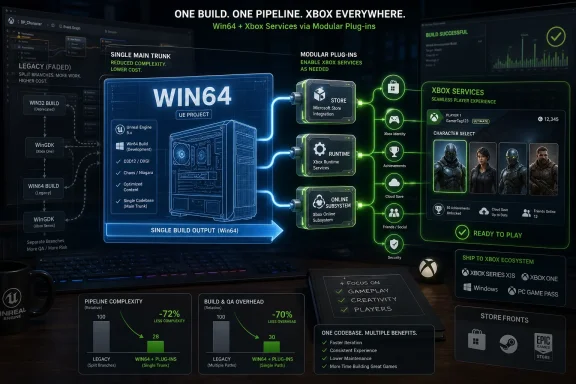
The new Unreal Engine 5.8 plug-in model is Microsoft’s attempt to collapse that branch back into the trunk. Instead of asking developers to move the game into WinGDK for Xbox-on-PC support, Microsoft is moving the relevant Xbox and GDK functionality into plug-ins that live inside the Win64 workflow developers already use.
That is the real story here. The feature is not merely “more plug-ins.” It is Microsoft admitting that Xbox on PC has to compete on integration cost, not just store terms, Game Pass reach, or brand familiarity.
The problem is that a separate platform target creates a separate reality. If a studio’s game builds cleanly as Win64 but needs a WinGDK target for Microsoft’s PC storefront path, then every dependency becomes a question. Does this plug-in know about WinGDK? Does the middleware vendor test it? Does the build system package the right binaries? Does the runtime look for assets and DLLs in the expected platform folder?
Those questions sound minor until a release manager is staring at a calendar. A platform-specific path can turn one game into two operationally distinct PC builds, even when the player sees both as “the Windows version.” That means duplicate cooking, different packaging assumptions, and a larger surface area for bugs that only appear in the Microsoft Store or Xbox app build.
Microsoft’s own framing is unusually direct: the old approach added friction. That word is doing a lot of work. In developer relations, friction means the stuff that causes a studio to delay support, skip a storefront, demand extra funding, or quietly decide that certification is not worth the trouble this quarter.
The Microsoft GDK Store plug-in handles store-facing configuration and package generation, including the
The Microsoft GDK Runtime plug-in exposes runtime functionality such as Xbox-compatible game saves, user selection, and system UI integration. Those are the kinds of features that make a PC game feel native to the Xbox app and Game Pass environment rather than merely installable from it.
Online Subsystem GDK does the familiar Unreal job of hiding platform services behind an abstraction layer. Achievements, friends, presence, and related Xbox services are precisely the areas where studios want predictable interfaces, because online features are expensive to debug and easy to break late in development.
The most strategically interesting piece is the Online Subsystem Selector for PC GDK, new with Unreal Engine 5.8. Its promise is that a studio can ship a single executable across multiple PC storefronts while switching online subsystem behavior at runtime. That is not just a convenience feature. It points toward a future where storefront-specific behavior is treated as configuration and runtime selection, not a forked build identity.
For established console studios, that gating may have been normal bureaucracy. For smaller PC developers, middleware teams, open-source-adjacent engine tinkerers, and studios evaluating store support early, it was a wall. A toolchain that requires approval before experimentation will lose some developers before the first build.
Public availability changes the psychology. A developer can install Unreal Engine 5.8, install the Microsoft GDK, enable plug-ins, and explore the path without first committing to a platform relationship. That matters because support decisions often start informally: an engineer tries a build, a producer asks how hard the Microsoft Store version would be, a technical director checks whether the online stack survives.
The Xbox Developer Program and store submission process still exist. Microsoft has not turned Xbox publishing into a free-for-all. But by moving the technical entry point earlier and making the plug-ins discoverable inside ordinary Unreal Engine distribution channels, Microsoft is making Xbox-on-PC support easier to evaluate before the business decision hardens.
That is how platforms win developer mindshare. Not by promising that everything is possible, but by making the first hour boring.
A single executable does not magically eliminate storefront differences. Steam, Epic, Microsoft, and publisher platforms all have their own SDKs, entitlement flows, overlay expectations, achievement systems, save models, and social graphs. But if Unreal can select the right online subsystem behavior at runtime, the core binary can remain more consistent across distribution channels.
That consistency is especially valuable for live-service games. When the game itself is updated frequently, any platform-specific build divergence becomes a recurring tax. If a security fix, matchmaking change, or crash patch has to be validated across multiple subtly different binaries, the release train slows down.
It also helps with third-party plug-ins. The PC games business is full of dependencies that assume Win64 as the normal Windows target. Graphics technologies, analytics SDKs, accessibility middleware, input libraries, crash reporters, anti-cheat systems, and storefront tools all tend to converge around the standard Windows path first. The farther a platform target drifts from that path, the more likely something falls through the cracks.
Microsoft’s new model is therefore less about making Xbox special inside Unreal and more about making it less special. That is a compliment. On PC, the winning platform integration is often the one that disappears into the developer’s existing workflow.
Developer tooling sits upstream of all of that. If developers have to do extra work to support Microsoft’s PC path, Microsoft’s version may arrive later, miss features, or ship with odd differences. Players do not care whether the cause is packaging, platform abstraction, or a third-party plug-in that dislikes a platform suffix. They just see the Game Pass build as worse.
This is why the Unreal Engine 5.8 change is more consequential than a normal SDK update. Unreal is not a niche tool; it is one of the dominant engines for commercial games, from indies to blockbuster productions. Reducing the cost of Xbox-on-PC support inside Unreal potentially affects a wide band of studios Microsoft wants in the Xbox ecosystem.
It also complements Microsoft’s recent Godot sample work. That earlier effort signaled interest in lowering the barrier for smaller and open-source-leaning developers. The Unreal move addresses a different part of the market: teams using an industrial engine with large pipelines, heavy middleware, and serious certification demands. Together, they suggest Microsoft is trying to make “build for Xbox on PC” less of a bespoke platform exercise across engine communities.
If that is the future, then developer tooling has to be unified before the hardware story fully arrives. You cannot sell developers on a flexible Xbox ecosystem if each endpoint requires a dramatically different build model. The platform has to look like a continuum from the build machine, not just from the marketing slide.
The new Unreal plug-ins fit that logic. They make Xbox-on-PC services available from the standard Windows build path. They reduce the need to treat Microsoft’s PC distribution as a platform fork. They put Xbox identity, saves, store packaging, and online services closer to where Unreal developers already work.
This does not prove any particular hardware plan. But it does show Microsoft preparing the ground for a world where the Xbox value proposition is less about one device and more about a stack: Windows, GDK, Xbox services, Game Pass, Store packaging, input, cloud saves, and identity. In that stack, engine integration is not a side project. It is the foundation.
That distinction is important for sysadmins, developers, and Windows enthusiasts who read “Xbox” and assume console parity. The Unreal Engine 5.8 public plug-ins are primarily about PC distribution through the Xbox ecosystem. They make the Microsoft Store and Xbox app path less painful for Win64 games. They are not an open invitation to publish console builds without the normal developer program and certification process.
The difference is not merely legal. Consoles remain fixed hardware and controlled software environments with strict platform requirements. PC is messier but more open, and Microsoft’s problem on PC is not controlling every variable; it is persuading developers that supporting the Xbox app and Microsoft Store is not an unnecessary burden.
That is why this move should be understood as a PC strategy first. It makes Microsoft’s Windows storefront path behave more like other PC storefront workflows, while still connecting to Xbox services. The console implications are real but indirect.
A storefront that is technically awkward pays an invisible tax. Developers may still ship there if the audience or money is compelling enough, but they will route effort elsewhere first. Bugs discovered late in the platform-specific build will be weighed against expected sales or subscription value. Features that require special implementation may be cut or delayed.
Microsoft knows this because it has lived with the consequences. The Microsoft Store’s reputation among PC gamers has improved over time, but it still carries historical baggage around app packaging, file access, modding, and version differences. Game Pass can bring a huge audience, but if the development path feels expensive, studios will negotiate that cost into schedules and priorities.
By pushing Xbox-on-PC support into the ordinary Win64 Unreal workflow, Microsoft is trying to make the store war less visible to the developer. The ideal outcome for Microsoft is not that engineers spend more time thinking about Xbox. It is that they spend less.
That is a subtle but important inversion. Platform vendors often want developers to adopt their worldview. Here, Microsoft is moving closer to the worldview developers already have: PC is Win64, Unreal is the hub, storefronts are endpoints, and platform services should be modular.
There is also the matter of version lag. Unreal Engine 5.8 is the clean public starting point, but many production games sit on older engine branches for years. A studio deep into development on Unreal Engine 5.3, 5.4, 5.5, or 5.6 is unlikely to upgrade purely for Microsoft Store convenience unless the economics justify the risk. For those teams, the old access and extension story may still matter.
Middleware vendors will also need time to normalize the new path. Microsoft’s strategy works best if third-party plug-ins continue to behave as ordinary Win64 plug-ins while Xbox-specific services sit alongside them. That sounds straightforward, but the PC ecosystem has a long memory for assumptions embedded in build files and platform checks.
Still, these are execution risks, not strategic contradictions. The old problem was that Microsoft’s PC path could feel structurally different. The new problem is whether the less-different path works reliably enough in real production. That is a better class of problem to have.
That makes this announcement unusually relevant to independent developers using Unreal. An indie team may want Game Pass reach or Microsoft Store availability, but it may not have spare months for platform-specific engineering. If Xbox-on-PC support becomes something a technical lead can prototype quickly inside the standard engine install, Microsoft enters the conversation earlier.
The benefit is not just lower cost. It is lower uncertainty. Producers can plan around a workflow they can test. Engineers can evaluate compatibility before committing. Business teams can talk to Microsoft with a clearer sense of technical risk.
That is where Microsoft’s “simple” goal becomes commercially sharp. Simplicity is not a kindness in platform strategy. It is a sales tool.
Windows handhelds expose the awkwardness of treating PC games as if a keyboard and mouse are always nearby. If Microsoft wants Xbox on PC to span traditional desktops, laptops, living-room devices, and handhelds, then system UI, user selection, GameInput, cloud saves, and virtual keyboard behavior become part of the player experience.
This is another reason the Unreal work matters. The Xbox-on-PC target is no longer just “the Microsoft Store version of the Windows build.” It is increasingly tied to Windows devices that behave more like consoles in the hand, while still running PC software underneath. That hybrid category needs games that understand Xbox services without abandoning PC conventions.
A cleaner Win64 plug-in model fits that hybrid future. Developers keep the normal Windows target, but they can wire in Xbox ecosystem features where they improve the experience. That is exactly the balance Microsoft needs if it wants Windows handhelds to feel less like tiny desktops and more like credible Xbox-adjacent devices.
That cuts both ways. Developers lose some excuses for skipping or delaying Microsoft’s PC ecosystem. Microsoft loses some alibis when its PC gaming experience still lags competitors. If the build path is simpler, the quality of the store, Xbox app, packaging, updates, and player-facing services becomes even harder to hide behind developer friction.
This is the right pressure. A platform should compete by making the obvious path the good path. Microsoft is not there yet across all of PC gaming, but this Unreal Engine 5.8 move is a credible step in that direction.
 Microsoft Moves Xbox From a Platform Port to a PC Workflow
For years, “Xbox on PC” has lived in an awkward middle space. It is not a console target in the traditional sense, but it has not always behaved like a normal Windows storefront target either. Developers building Unreal Engine games for the Microsoft Store, the Xbox app, or Game Pass on PC often had to think in terms of GDK-specific packaging, Xbox services, and the WinGDK platform layer.That distinction mattered because studios rarely build a PC game for just one storefront. A modern PC release may need to support Steam, Epic Games Store, Microsoft Store, direct distribution, publisher launchers, cross-play infrastructure, achievements, cloud saves, multiple input systems, anti-cheat, upscalers, modding assumptions, and the usual thicket of third-party middleware. Any platform target that diverges from the main Windows build becomes another branch in the release tree.
The new Unreal Engine 5.8 plug-in model is Microsoft’s attempt to collapse that branch back into the trunk. Instead of asking developers to move the game into WinGDK for Xbox-on-PC support, Microsoft is moving the relevant Xbox and GDK functionality into plug-ins that live inside the Win64 workflow developers already use.
That is the real story here. The feature is not merely “more plug-ins.” It is Microsoft admitting that Xbox on PC has to compete on integration cost, not just store terms, Game Pass reach, or brand familiarity.
WinGDK Was Useful, but It Made Xbox on PC Feel Different
WinGDK existed for a reason. Microsoft’s Game Development Kit has to support capabilities that ordinary Windows games do not necessarily need, including Xbox identity, Xbox-compatible saves, store packaging, system UI hooks, and other platform services. For teams shipping into the Xbox ecosystem, those services are not optional extras; they are part of the contract.The problem is that a separate platform target creates a separate reality. If a studio’s game builds cleanly as Win64 but needs a WinGDK target for Microsoft’s PC storefront path, then every dependency becomes a question. Does this plug-in know about WinGDK? Does the middleware vendor test it? Does the build system package the right binaries? Does the runtime look for assets and DLLs in the expected platform folder?
Those questions sound minor until a release manager is staring at a calendar. A platform-specific path can turn one game into two operationally distinct PC builds, even when the player sees both as “the Windows version.” That means duplicate cooking, different packaging assumptions, and a larger surface area for bugs that only appear in the Microsoft Store or Xbox app build.
Microsoft’s own framing is unusually direct: the old approach added friction. That word is doing a lot of work. In developer relations, friction means the stuff that causes a studio to delay support, skip a storefront, demand extra funding, or quietly decide that certification is not worth the trouble this quarter.
Unreal Engine 5.8 Turns the Xbox PC Path Into a Plug-In Problem
The Unreal Engine 5.8 change moves several key Microsoft GDK components into publicly available plug-ins. The headline is that developers can remain on Win64 while still accessing Xbox-on-PC functionality. That is a different posture from treating Microsoft’s PC ecosystem as a distinct platform target.The Microsoft GDK Store plug-in handles store-facing configuration and package generation, including the
.msixvc packages used for Xbox app submission. In practical terms, this pulls more of the Microsoft packaging path into Unreal’s editor and project settings flow, rather than forcing teams to treat it as a separate packaging universe.The Microsoft GDK Runtime plug-in exposes runtime functionality such as Xbox-compatible game saves, user selection, and system UI integration. Those are the kinds of features that make a PC game feel native to the Xbox app and Game Pass environment rather than merely installable from it.
Online Subsystem GDK does the familiar Unreal job of hiding platform services behind an abstraction layer. Achievements, friends, presence, and related Xbox services are precisely the areas where studios want predictable interfaces, because online features are expensive to debug and easy to break late in development.
The most strategically interesting piece is the Online Subsystem Selector for PC GDK, new with Unreal Engine 5.8. Its promise is that a studio can ship a single executable across multiple PC storefronts while switching online subsystem behavior at runtime. That is not just a convenience feature. It points toward a future where storefront-specific behavior is treated as configuration and runtime selection, not a forked build identity.
Public Availability Is the Quiet Power Move
The other major shift is access. Microsoft’s documentation says the Unreal Engine 5.8 GDK plug-ins are publicly available through the Epic Games Launcher and Epic’s Unreal Engine GitHub source. Earlier versions could require Xbox Developer Program membership and separate access to GDK Platform Extensions, particularly for the private pieces needed around Xbox development.For established console studios, that gating may have been normal bureaucracy. For smaller PC developers, middleware teams, open-source-adjacent engine tinkerers, and studios evaluating store support early, it was a wall. A toolchain that requires approval before experimentation will lose some developers before the first build.
Public availability changes the psychology. A developer can install Unreal Engine 5.8, install the Microsoft GDK, enable plug-ins, and explore the path without first committing to a platform relationship. That matters because support decisions often start informally: an engineer tries a build, a producer asks how hard the Microsoft Store version would be, a technical director checks whether the online stack survives.
The Xbox Developer Program and store submission process still exist. Microsoft has not turned Xbox publishing into a free-for-all. But by moving the technical entry point earlier and making the plug-ins discoverable inside ordinary Unreal Engine distribution channels, Microsoft is making Xbox-on-PC support easier to evaluate before the business decision hardens.
That is how platforms win developer mindshare. Not by promising that everything is possible, but by making the first hour boring.
The Single Executable Is the Prize
The phrase “single executable” will jump out to anyone who has shipped PC games at scale. Every extra executable and platform target multiplies QA work, patch coordination, crash reporting complexity, and support scripts. It also complicates the increasingly common goal of shipping day-and-date across stores.A single executable does not magically eliminate storefront differences. Steam, Epic, Microsoft, and publisher platforms all have their own SDKs, entitlement flows, overlay expectations, achievement systems, save models, and social graphs. But if Unreal can select the right online subsystem behavior at runtime, the core binary can remain more consistent across distribution channels.
That consistency is especially valuable for live-service games. When the game itself is updated frequently, any platform-specific build divergence becomes a recurring tax. If a security fix, matchmaking change, or crash patch has to be validated across multiple subtly different binaries, the release train slows down.
It also helps with third-party plug-ins. The PC games business is full of dependencies that assume Win64 as the normal Windows target. Graphics technologies, analytics SDKs, accessibility middleware, input libraries, crash reporters, anti-cheat systems, and storefront tools all tend to converge around the standard Windows path first. The farther a platform target drifts from that path, the more likely something falls through the cracks.
Microsoft’s new model is therefore less about making Xbox special inside Unreal and more about making it less special. That is a compliment. On PC, the winning platform integration is often the one that disappears into the developer’s existing workflow.
Game Pass Needs the Boring Stuff to Work
Microsoft’s PC gaming strategy has never lacked ambition. Game Pass on PC, the Xbox app, Play Anywhere, cloud saves, cross-device identity, and handheld Windows gaming all point toward a broad ecosystem rather than a single box under the television. But the experience has often been judged by the least glamorous part of the stack: installation, patching, mod access, save behavior, file layout, overlay reliability, and whether the Microsoft Store version behaves like the version players expected.Developer tooling sits upstream of all of that. If developers have to do extra work to support Microsoft’s PC path, Microsoft’s version may arrive later, miss features, or ship with odd differences. Players do not care whether the cause is packaging, platform abstraction, or a third-party plug-in that dislikes a platform suffix. They just see the Game Pass build as worse.
This is why the Unreal Engine 5.8 change is more consequential than a normal SDK update. Unreal is not a niche tool; it is one of the dominant engines for commercial games, from indies to blockbuster productions. Reducing the cost of Xbox-on-PC support inside Unreal potentially affects a wide band of studios Microsoft wants in the Xbox ecosystem.
It also complements Microsoft’s recent Godot sample work. That earlier effort signaled interest in lowering the barrier for smaller and open-source-leaning developers. The Unreal move addresses a different part of the market: teams using an industrial engine with large pipelines, heavy middleware, and serious certification demands. Together, they suggest Microsoft is trying to make “build for Xbox on PC” less of a bespoke platform exercise across engine communities.
This Is Also About the Next Xbox, Even If Microsoft Does Not Say So
The timing invites a broader reading. Microsoft has repeatedly blurred the boundary between Xbox and Windows, and industry reporting has pointed to future Xbox hardware strategies that may lean more heavily on PC-like architecture and Windows compatibility. Even without accepting every rumor, the direction of travel is obvious: Microsoft wants Xbox to be an ecosystem that spans console, PC, cloud, handhelds, and store surfaces.If that is the future, then developer tooling has to be unified before the hardware story fully arrives. You cannot sell developers on a flexible Xbox ecosystem if each endpoint requires a dramatically different build model. The platform has to look like a continuum from the build machine, not just from the marketing slide.
The new Unreal plug-ins fit that logic. They make Xbox-on-PC services available from the standard Windows build path. They reduce the need to treat Microsoft’s PC distribution as a platform fork. They put Xbox identity, saves, store packaging, and online services closer to where Unreal developers already work.
This does not prove any particular hardware plan. But it does show Microsoft preparing the ground for a world where the Xbox value proposition is less about one device and more about a stack: Windows, GDK, Xbox services, Game Pass, Store packaging, input, cloud saves, and identity. In that stack, engine integration is not a side project. It is the foundation.
The Console Boundary Still Matters
There is a trap in overstating this announcement. These plug-ins simplify Xbox on PC development; they do not erase the distinction between PC and console. Microsoft’s documentation still treats Xbox One and Xbox Series X|S development as requiring the relevant GDK Platform Extensions and the gated console development path.That distinction is important for sysadmins, developers, and Windows enthusiasts who read “Xbox” and assume console parity. The Unreal Engine 5.8 public plug-ins are primarily about PC distribution through the Xbox ecosystem. They make the Microsoft Store and Xbox app path less painful for Win64 games. They are not an open invitation to publish console builds without the normal developer program and certification process.
The difference is not merely legal. Consoles remain fixed hardware and controlled software environments with strict platform requirements. PC is messier but more open, and Microsoft’s problem on PC is not controlling every variable; it is persuading developers that supporting the Xbox app and Microsoft Store is not an unnecessary burden.
That is why this move should be understood as a PC strategy first. It makes Microsoft’s Windows storefront path behave more like other PC storefront workflows, while still connecting to Xbox services. The console implications are real but indirect.
The Store War Is Being Fought Inside Build Systems
PC storefront competition is often described in consumer terms: revenue share, exclusives, launcher fatigue, wishlists, subscriptions, refunds, and library lock-in. Those are visible fights. But the quieter battle happens in build scripts, CI pipelines, packaging systems, SDK compatibility matrices, and QA plans.A storefront that is technically awkward pays an invisible tax. Developers may still ship there if the audience or money is compelling enough, but they will route effort elsewhere first. Bugs discovered late in the platform-specific build will be weighed against expected sales or subscription value. Features that require special implementation may be cut or delayed.
Microsoft knows this because it has lived with the consequences. The Microsoft Store’s reputation among PC gamers has improved over time, but it still carries historical baggage around app packaging, file access, modding, and version differences. Game Pass can bring a huge audience, but if the development path feels expensive, studios will negotiate that cost into schedules and priorities.
By pushing Xbox-on-PC support into the ordinary Win64 Unreal workflow, Microsoft is trying to make the store war less visible to the developer. The ideal outcome for Microsoft is not that engineers spend more time thinking about Xbox. It is that they spend less.
That is a subtle but important inversion. Platform vendors often want developers to adopt their worldview. Here, Microsoft is moving closer to the worldview developers already have: PC is Win64, Unreal is the hub, storefronts are endpoints, and platform services should be modular.
The Risks Move From Access to Execution
Lowering the barrier does not guarantee clean adoption. Public plug-ins can still have bugs. Runtime subsystem selection can still expose edge cases. Packaging from the editor can still fail in strange ways when a studio has a custom build farm. And every online subsystem abstraction eventually meets a game whose assumptions do not fit neatly behind the interface.There is also the matter of version lag. Unreal Engine 5.8 is the clean public starting point, but many production games sit on older engine branches for years. A studio deep into development on Unreal Engine 5.3, 5.4, 5.5, or 5.6 is unlikely to upgrade purely for Microsoft Store convenience unless the economics justify the risk. For those teams, the old access and extension story may still matter.
Middleware vendors will also need time to normalize the new path. Microsoft’s strategy works best if third-party plug-ins continue to behave as ordinary Win64 plug-ins while Xbox-specific services sit alongside them. That sounds straightforward, but the PC ecosystem has a long memory for assumptions embedded in build files and platform checks.
Still, these are execution risks, not strategic contradictions. The old problem was that Microsoft’s PC path could feel structurally different. The new problem is whether the less-different path works reliably enough in real production. That is a better class of problem to have.
Smaller Studios May Feel This First
Large studios have platform teams. They can absorb painful SDK work, negotiate support, and assign engineers to build-system weirdness. Smaller teams often cannot. For them, the difference between “available in the engine” and “requires a separate gated platform extension workflow” can decide whether a storefront is supported at launch.That makes this announcement unusually relevant to independent developers using Unreal. An indie team may want Game Pass reach or Microsoft Store availability, but it may not have spare months for platform-specific engineering. If Xbox-on-PC support becomes something a technical lead can prototype quickly inside the standard engine install, Microsoft enters the conversation earlier.
The benefit is not just lower cost. It is lower uncertainty. Producers can plan around a workflow they can test. Engineers can evaluate compatibility before committing. Business teams can talk to Microsoft with a clearer sense of technical risk.
That is where Microsoft’s “simple” goal becomes commercially sharp. Simplicity is not a kindness in platform strategy. It is a sales tool.
Windows Handhelds Make the Virtual Keyboard Suddenly Less Boring
One of the more easily overlooked details in Microsoft’s GDK plug-in documentation is virtual keyboard support. On a desktop tower with a mechanical keyboard, this sounds like trivia. On a handheld gaming PC, it is not.Windows handhelds expose the awkwardness of treating PC games as if a keyboard and mouse are always nearby. If Microsoft wants Xbox on PC to span traditional desktops, laptops, living-room devices, and handhelds, then system UI, user selection, GameInput, cloud saves, and virtual keyboard behavior become part of the player experience.
This is another reason the Unreal work matters. The Xbox-on-PC target is no longer just “the Microsoft Store version of the Windows build.” It is increasingly tied to Windows devices that behave more like consoles in the hand, while still running PC software underneath. That hybrid category needs games that understand Xbox services without abandoning PC conventions.
A cleaner Win64 plug-in model fits that hybrid future. Developers keep the normal Windows target, but they can wire in Xbox ecosystem features where they improve the experience. That is exactly the balance Microsoft needs if it wants Windows handhelds to feel less like tiny desktops and more like credible Xbox-adjacent devices.
Developers Get Fewer Excuses, and Microsoft Gets Fewer Alibis
The practical read is straightforward: Unreal Engine 5.8 makes Xbox-on-PC support easier to start, easier to reason about, and potentially easier to ship alongside other PC storefronts. That does not make it effortless, and it does not mean every game will suddenly treat the Microsoft Store as a first-class PC destination. But it removes one of the more defensible technical objections.That cuts both ways. Developers lose some excuses for skipping or delaying Microsoft’s PC ecosystem. Microsoft loses some alibis when its PC gaming experience still lags competitors. If the build path is simpler, the quality of the store, Xbox app, packaging, updates, and player-facing services becomes even harder to hide behind developer friction.
This is the right pressure. A platform should compete by making the obvious path the good path. Microsoft is not there yet across all of PC gaming, but this Unreal Engine 5.8 move is a credible step in that direction.
The Build Notes That Actually Matter
The announcement is easy to skim as another developer-relations update, but the concrete changes are worth separating from the marketing haze. Microsoft’s move is not a promise that Xbox on PC will automatically win more games. It is a change in the economics of supporting it.- Unreal Engine 5.8 makes Microsoft’s key GDK plug-ins publicly available through normal Unreal distribution channels, rather than keeping the PC path behind a separate access process.
- New Xbox-on-PC Unreal projects are being steered toward Win64 with GDK plug-ins, while WinGDK is now treated as a legacy path for PC work.
- The Microsoft GDK Store and Runtime plug-ins bring packaging, Xbox-compatible saves, user selection, and system UI access into the standard Unreal workflow.
- Online Subsystem GDK and the new Online Subsystem Selector are designed to reduce storefront-specific build divergence, including support for a single executable across multiple PC storefronts.
- Console development remains a separate, gated process, so this is primarily a PC distribution and tooling story rather than an opening of Xbox console publishing.
- The biggest beneficiaries may be smaller Unreal teams and live-service developers, because both groups are especially sensitive to duplicated builds, middleware incompatibility, and late-stage QA risk.
References
- Primary source: Windows Central
Published: 2026-06-21T13:50:15.874647
“Our goal is simple”: Xbox unveils major push to simplify Unreal Engine development | Windows Central
How Xbox is making it simpler than ever for creators to build and ship games on PC.www.windowscentral.com - Official source: developer.microsoft.com
Microsoft GDK Plug-ins for Unreal Engine are Now Available
In partnership with Epic Games, the Microsoft GDK Plug-ins for Unreal Engine streamline bringing your game to the Xbox PC App.developer.microsoft.com - Related coverage: forums.unrealengine.com
Building PC version using GDK for Microsoft / Xbox store - #2 by Patrick_Laflamme - Pipeline & Plugins - Epic Developer Community Forums
Hi, We are looking at building a PC version for the Microsoft store. I have just started looking at building using ‘WinGDK’ but after doing some searching I find that GDK builds under 5.6 are now legacy and you should … forums.unrealengine.com
- Related coverage: generacionxbox.com
Xbox y Unreal Engine 5.8 simplifican el desarrollo de juegos para PC – Generacion Xbox
Microsoft abre los plug-ins GDK para Unreal Engine y elimina varias barreras para los desarrolladores.generacionxbox.com - Related coverage: docs.accelbyte.io
Install the AGS OSS for Unreal Engine | AccelByte Documentation
Installing the AccelByte Gaming Services Online Subsystem for Unreal Enginedocs.accelbyte.io - Related coverage: windowsforum.com
Microsoft Xbox Godot Sample (GitHub): Xbox-on-PC Integration with GDK, PlayFab, GameInput | Windows Forum
Microsoft released the Xbox Godot Sample on June 4, 2026, as a public, source-only GitHub reference project for building Godot extensions that integrate the...windowsforum.com
- Related coverage: unrealstudio.epicgames.com
- Related coverage: cdck-file-uploads-canada1.s3.dualstack.ca-central-1.amazonaws.com
ef625a94e93fec8e5d93bbacdab845635cab6116
PDF documentcdck-file-uploads-canada1.s3.dualstack.ca-central-1.amazonaws.com
