

Epic Games released Unreal Engine 5.8 during Unreal Fest Chicago on June 17, 2026, making it the last planned major Unreal Engine 5 update before the company shifts its engineering center of gravity toward Unreal Engine 6. The headline is not just another graphics bump. UE 5.8 is Epic’s admission that the UE5 era has reached its practical test: beautiful real-time worlds are no longer enough unless they can ship at stable frame rates, on constrained hardware, and inside increasingly networked creator economies. The update is both a cleanup pass and a warning shot, because UE6 is now less a distant engine rewrite than a platform consolidation strategy.
Unreal Engine 5 won the imagination war early. Nanite, Lumen, MetaHuman, and the Matrix-style real-time demos gave developers, publishers, and players a shared vocabulary for “next gen” before many studios had even finished their cross-generation projects. But the years since have been messier: shader stutter, traversal hitching, inconsistent frame pacing, heavy CPU simulation, and games that lean on upscalers as if they were core rendering architecture rather than escape hatches.
UE 5.8 lands directly in that argument. Epic is not framing the release as a revolution in fidelity; it is framing it as a release about production readiness, performance envelopes, and better authoring tools. That is a subtle but important change in emphasis. The pitch is no longer “look what the engine can theoretically render,” but “look what teams may finally be able to ship without apologizing for the performance menu.”
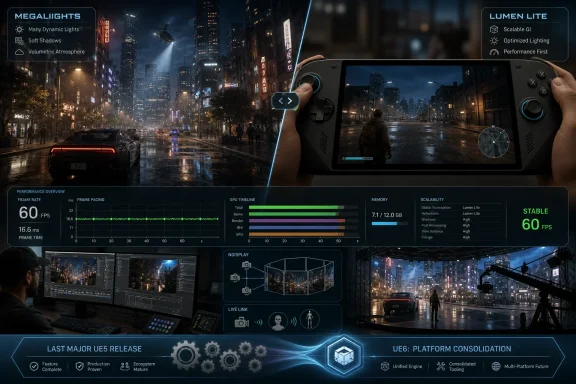
MegaLights becoming production-ready is the clearest example. The technology is meant to let artists place large numbers of dynamic, shadow-casting lights without returning to the old world of painstaking baked-light compromises. In a demo reel, that sounds like another visual feature. In a shipped game, it is an attempt to turn dynamic lighting from a luxury into an everyday production tool.
The 60fps language matters because it speaks to a real credibility problem. Players have spent much of this console generation watching performance modes blur the image, disable expensive lighting features, or oscillate between ambition and compromise. If UE5.8 helps studios deliver richer lighting while holding a console-class frame target, Epic gets to argue that UE5’s biggest problems were not inherent flaws but maturing technology.
That is the optimistic read. The skeptical read is that engines do not ship games; teams do. UE 5.8 can provide better primitives, better profilers, and cheaper lighting paths, but it cannot fix late production, bloated content budgets, or a publisher’s decision to treat day-one optimization as optional. Still, Epic has clearly understood the complaint. UE5.8 is built to answer the charge that Unreal has been too visually ambitious for the machines most players actually own.
MegaLights is Epic’s attempt to make that argument less painful. By making the system production-ready in UE5.8, Epic is telling studios that the “many dynamic lights” future is no longer experimental garnish. It is meant to be something teams can plan around.
The practical attraction is obvious. A level artist can light a city street, sci-fi interior, concert venue, or horror corridor with far more granular control, without every lamp, screen, flashlight, and particle source turning into a budget meeting. For Windows players on powerful GPUs, that promises denser scenes with fewer obvious tricks. For console players, the more important promise is that those scenes might survive the move into a 60fps mode.
But MegaLights will also test studio discipline. When a tool makes expensive things easier, productions often spend the savings immediately. A feature intended to preserve performance can become a feature that raises the baseline cost of every scene. The engine may make many lights feasible, but it will not make unlimited lighting free.
This is where UE5.8’s debugging and optimization tools become as important as the rendering feature itself. Epic is not merely handing artists a bigger brush; it is giving teams instruments to understand where the frame is going. That distinction matters in modern development, because the most dangerous performance bugs are not always spectacular crashes. They are slow, creeping accumulations of content decisions that look harmless until the game is assembled.
MegaLights therefore represents the broader UE5.8 philosophy: democratize high-end rendering, but expose enough diagnostics to keep that democratization from destroying the frame budget. That is a hard balance, and it will vary wildly by studio. A team with strong technical art leadership may turn MegaLights into a visible generational leap. A team without that discipline may simply find a more elegant way to miss 60fps.
Lumen Lite is the most pragmatic feature in UE5.8. It is designed to preserve much of Lumen’s visual impact while cutting GPU cost significantly, using irradiance fields with probe occlusion rather than leaning on the most expensive high-quality path. In plain English, Epic is building a cheaper lighting tier for games that cannot afford the prestige version everywhere.
That matters more than it may sound. The market is not just high-end PCs and fixed living-room consoles anymore. The Nintendo Switch 2, handheld Windows PCs, cloud-streamed sessions, and battery-conscious mobile-class devices all push developers toward scalable rendering. If an Unreal game can keep a recognizable version of its lighting identity across those targets, the business case for using the engine improves.
For Windows enthusiasts, this is also a handheld PC story. Devices from ASUS, Lenovo, MSI, Valve, and others have made “PC gaming” a much broader performance category than desktop GPUs and gaming laptops. A lighter Lumen path gives developers another knob to turn before falling back to blunt compromises like disabling dynamic illumination entirely.
The risk is that “Lite” becomes a marketing fig leaf. Players have become very good at spotting modes that technically preserve a feature but undermine image stability or scene readability. If Lumen Lite produces convincing results, it could become one of UE5.8’s most important additions. If it merely creates a lower-quality checkbox, players will notice.
Still, Epic’s direction is right. The engine needs more graceful degradation. High-end rendering systems are valuable only if they scale down without collapsing into a visibly different game. UE5.8 suggests Epic now sees scalability as a first-class design goal rather than a postscript for porting teams.
The more important message is that UE5.8 becomes the stability platform for a long tail of shipped games. Many titles launching in 2026, 2027, and beyond will still be built on UE5 technology, even as Epic talks about UE6 early access and the next platform model. Developers do not casually rebase production on a new engine generation late in development. They freeze, fork, patch, and pray.
That makes UE5.8 strategically important. If it is stable, performant, and well-supported, it becomes the safe harbor for studios that need UE5 features without UE6 uncertainty. If it is rough, it becomes a painful bridge release that teams adopt reluctantly or skip entirely.
Epic’s UE6 timeline also makes this more than a short-term update. The company has said it is targeting Unreal Engine 6 Early Access near the end of 2027, with a full release 12 to 18 months later. That puts the complete UE6 era somewhere around 2029 if the plan holds. In engine terms, that is close enough for planning decks and far enough away that UE5.8 must carry real production weight.
This is especially true for enterprise, virtual production, simulation, architecture, and broadcast users. Those customers may care less about Fortnite integration and more about whether their pipelines remain stable, whether render farms behave predictably, and whether plugins survive upgrades. For them, UE5.8 is not a stepping stone. It may be the platform they standardize on for years.
Epic’s challenge is to keep serving that installed base while selling a more ambitious future. UE6 may be the narrative, but UE5.8 is the contract with everyone shipping before UE6 is truly ready.
UE5.8’s experimental Mesh Terrain system attacks that limitation. By allowing terrain to be authored as true 3D mesh geometry, Epic is giving world builders a path beyond the 2.5D assumptions of older landscape tools. The promise is not just prettier cliffs. It is a different grammar for level design.
That matters because many modern games no longer separate “terrain” from “structure” cleanly. Open worlds are full of carved interiors, layered traversal paths, underground regions, and set-piece spaces that transition between natural and built environments. A mesh-based terrain workflow can make those spaces feel less like exceptions bolted onto a landscape and more like native parts of the world.
The experimental label is important. Studios should not read Mesh Terrain as an immediate replacement for every established pipeline. Terrain touches streaming, collision, navigation, foliage, physics, world partitioning, and tooling. A new terrain model can improve artistic freedom while creating new complexity elsewhere.
But the direction is telling. UE5’s world-building story has always been about removing old constraints: virtualized geometry through Nanite, dynamic lighting through Lumen, large-scale worlds through World Partition, and procedural placement through PCG. Mesh Terrain extends that philosophy into the ground itself. The question is whether Epic can make the workflow as dependable as it is flexible.
For Windows players, the payoff will be subtle if it works. They will not boot a game and say, “That was clearly authored with mesh terrain.” They will notice worlds that feel less like heightmaps decorated with assets and more like spaces that fold, pierce, and stack naturally. That is the kind of engine feature that disappears into better level design.
MetaHuman Collections are an experimental attempt to let developers populate worlds with large numbers of MetaHuman characters at different scales, from hundreds on mobile-class devices to thousands on higher-end platforms. That is an ambitious claim, and the experimental label deserves respect. But the direction is clear: Epic wants MetaHuman to become not just a hero-character tool but a crowd and population system.
If it works, that could change how teams think about background humans in real-time worlds. Crowds have often been expensive, uncanny, or obviously repetitive. A scalable MetaHuman crowd pipeline could help cities, stadiums, workplaces, simulations, and virtual production scenes feel less empty without every extra becoming a custom character project.
Direct Mesh Controls point to a different bottleneck. By allowing rig controls to be represented directly on regions of a skeletal mesh, Epic is borrowing from high-end animation workflows where artists manipulate character surfaces rather than hunting through abstract control hierarchies. For facial animation, that matters. Faces are not just rigs; they are performances, and the less friction between animator intent and on-screen deformation, the better.
These tools also show how Unreal is continuing to absorb tasks that once lived in specialized external software. That does not mean Maya, Houdini, Blender, or dedicated cloth tools are going away. It means the center of gravity is shifting. More iteration happens inside the engine because the engine is where lighting, materials, animation, simulation, and runtime constraints finally meet.
Dataflow for Chaos Cloth belongs in the same pattern. Non-destructive simulation changes and a panel-based cloth editor bring Unreal closer to professional garment workflows while keeping iteration live. For studios, that can reduce the gap between art direction and runtime feasibility. For players, it may mean better cloth, more varied costumes, and fewer obvious compromises in character-heavy scenes.
The strategic point is that Epic is not only optimizing pixels. It is optimizing decisions. Every faster iteration loop reduces the cost of trying something and the fear of changing it late. That is the kind of improvement that rarely trends on social media but can materially change how games are made.
The redesigned Movie Render Graph workflow gives artists a graph-based way to manage render configuration, including more direct control over complex output settings. Native nDisplay support matters for LED volume and virtual production environments, where rendering is not a single offline export but a synchronized, multi-display, camera-aware system. Light isolation and per-light control add the sort of shot-level flexibility that production teams expect from mature rendering tools.
Live Link Hub’s expanded monitoring and device-control capabilities fit the same trend. Motion-capture stages are messy ecosystems of cameras, suits, timecode, tracking devices, video feeds, and engine clients. Centralizing more of that monitoring and control inside Live Link Hub is not glamorous, but it reduces operational friction. On a stage, friction is money.
For WindowsForum readers, the enterprise angle is worth noting. Unreal’s expansion into production and simulation keeps raising the importance of workstation reliability, driver stability, GPU scheduling, storage throughput, and networked collaboration. A real-time engine used in a broadcast environment or virtual set has very different tolerance for instability than a hobbyist project. Crashes are not just annoying; they can stop a shoot.
This is also where Epic’s engine strategy intersects with Windows hardware in a practical way. High-end Unreal workflows remain deeply tied to NVIDIA, AMD, Intel, storage vendors, capture hardware, and the Windows workstation ecosystem. UE5.8’s non-game tools are therefore part of a broader professional stack. The engine may be cross-platform, but many of its most demanding users still live on Windows machines built like small render farms.
Epic’s challenge is to serve all of these constituencies without turning Unreal into a collection of loosely related toolchains. UE5.8 mostly argues for integration: render graphs, live capture, cloth authoring, terrain, lighting, and AI hooks all moving closer to the editor. That makes Unreal more powerful, but also more complex. The burden now is discoverability and reliability.
That is a profound shift. Traditional Unreal development and Fortnite creation have operated as related but distinct worlds: one aimed at standalone games and professional content, the other at a live creator ecosystem inside Fortnite. UE6 is meant to collapse that distinction. Developers will be able to build for standalone platforms, publish into Fortnite, or support their own interconnected ecosystems.
The upside is obvious. A unified platform could let assets, systems, and gameplay logic move more easily across projects and commercial contexts. A studio could imagine building a conventional game, a Fortnite experience, and a live-service extension with less duplicated work. Creators could potentially graduate from Fortnite experiences into broader Unreal development without abandoning their tools.
The risk is equally obvious. Unreal Engine’s identity has always depended on serving serious developers who want control, ownership, and technical depth. If UE6 feels too strongly shaped by Fortnite’s creator economy, some developers will worry that the engine is drifting from a professional tool into a metaverse operating system with a game engine attached.
Epic knows this tension. The roadmap language emphasizes portability, interoperability, and the ability to deploy into multiple contexts rather than forcing everything into Fortnite. But the gravitational pull is real. Fortnite is Epic’s live laboratory, its marketplace, its social platform, and its proof that user-generated real-time content can operate at massive scale.
For independent developers and studios, the key question will be whether UE6’s convergence lowers barriers or imposes assumptions. A shared Scene Graph and Verse-based framework could simplify cross-product development. It could also force teams to rethink existing C++-heavy workflows and long-established Unreal patterns.
This is why UE5.8 matters as the end of a chapter. It is the last major release of the Unreal generation that began with the promise of cinematic fidelity. UE6 begins with a different promise: portability across games, platforms, and economies. That is a bigger bet, and a more contentious one.
The most grounded part of Epic’s AI pitch is model-assisted workflow automation. If an LLM can understand an Unreal project, inspect assets, generate boilerplate, explain errors, wire editor actions, or help navigate large codebases, that is a practical productivity tool. Developers already use external AI assistants for these tasks. Bringing the engine and project context into the loop makes the assistance more relevant.
The more combustible part is generative content. Epic’s roadmap points toward systems that can use native 3D data as context, style rendered sequences, extract components, or convert segmented 2D layouts into textured 3D objects. That could accelerate prototyping dramatically. It could also flood projects with assets that look plausible but require substantial cleanup, licensing review, and artistic direction.
The lesson from other creative software is that AI rarely removes the need for expertise; it changes where expertise is applied. A generated mesh still needs topology, scale, materials, collision, LODs, naming, ownership clarity, and performance validation. A generated script still needs architecture. A generated scene still needs taste.
For studios, the immediate value may be in narrowing the distance between intent and first draft. Designers can rough out spaces faster. Technical artists can automate repetitive setup. Engineers can query systems that would otherwise require spelunking through documentation and source code. The danger is management mistaking faster drafts for finished work.
Epic also has to navigate trust. Professional teams will want to know what models are used, how project data is handled, what can be disabled, and how generated content is tracked. Enterprises will ask even harder questions about privacy, compliance, and intellectual property. AI inside an engine is not just a feature; it is a governance problem.
UE5.8’s experimental open-standard LLM hooks are therefore best understood as the start of a long negotiation. Epic is opening the door, not settling the debate. UE6 will determine whether AI becomes a useful assistant inside Unreal or another layer of hype that teams must carefully firewall from production reality.
Mobile development setup has historically been one of those tasks that feels more annoying than it should. SDKs, device drivers, build tools, signing requirements, platform dependencies, and workstation configuration can turn “let’s test on Android” into a ritual of version mismatches. Automating more of that prerequisite process helps small teams and new developers, but it also matters to large studios with many machines and contractors.
Sandboxes are more strategically interesting. A safe, isolated environment for experimentation gives developers a way to test assets, features, and changes without immediately polluting the main project branch. In large Unreal projects, where binary assets and source control can become painful, that kind of isolation can be the difference between healthy iteration and organizational paralysis.
The concept also maps to how modern distributed teams actually work. Developers, artists, and designers need to share experimental states without forcing everyone else to absorb instability. If Sandboxes make it easier to package and exchange test environments, Epic is addressing a collaboration problem rather than a rendering problem.
This is part of a broader industry shift. Game engines are no longer judged only by the fidelity of their output. They are judged by build times, merge conflict behavior, onboarding, asset validation, team workflows, and the number of steps between an idea and a playable test. UE5.8’s workflow changes acknowledge that the engine is a production operating system as much as a renderer.
That is especially relevant as projects become more hybrid. A single Unreal production may involve game developers, cinematic artists, outsourcing partners, mocap teams, AI-assisted prototyping, virtual production crews, and platform specialists. The engine has to keep all of them from stepping on each other. Sandboxes are one piece of that larger coordination problem.
The PC audience is particularly unforgiving because hardware diversity exposes weak assumptions. A console has a fixed target. Windows has everything from handheld APUs to high-refresh OLED desktops with GPUs that cost more than entire consoles. Unreal must scale across that range without producing either muddy compromises at the low end or inexplicable stutter at the high end.
UE5.8’s rendering improvements help, but they do not automatically solve the full PC performance problem. Stutter often comes from asset streaming, shader compilation, CPU scheduling, driver behavior, storage patterns, and game-specific systems layered on top of the engine. Epic has improved this area over time, but Windows players have heard enough launch-day promises to remain skeptical.
The 60fps messaging also has a different meaning on PC. Console players often treat 60fps as the target. PC players increasingly treat it as the floor. On high-refresh displays, a game that averages 90fps but stutters every few seconds can feel worse than a locked 60fps title with stable pacing. That is why the quality of optimization tools may matter more than any single rendering feature.
There is also the upscaling dilemma. DLSS, FSR, XeSS, and frame generation have become central to modern PC gaming, and they can produce excellent results when used intelligently. But players resent feeling that reconstruction is being used to conceal poor native performance. UE5.8’s lighter lighting paths are valuable because they may reduce the need to lean so heavily on those crutches.
For WindowsForum’s audience, the most practical stance is cautious optimism. UE5.8 gives developers better options. It does not guarantee better products. The next year of Unreal-powered releases will show whether studios use those options to deliver stable performance or simply spend the savings on more visual complexity.
Those promises can reinforce each other, but they can also collide. Cinematic rendering consumes budgets. Portability demands abstraction. Creator ecosystems reward speed and volume. Professional studios demand control and predictability. UE5.8’s job is to keep the current generation useful while Epic prepares the next one.
The concrete takeaways are less about any single feature than about the direction of travel.
The next phase of Unreal will not be judged by whether Epic can produce another spectacular demo; it has already won that argument many times over. It will be judged by whether ordinary studios can ship extraordinary-looking games that run well, whether professional users can trust the toolchain under deadline pressure, and whether UE6’s unified future expands Unreal’s reach without making the engine feel less like a developer’s instrument and more like Epic’s walled city.
 Epic Turns UE5’s Biggest Criticism Into UE5.8’s Main Selling Point
Unreal Engine 5 won the imagination war early. Nanite, Lumen, MetaHuman, and the Matrix-style real-time demos gave developers, publishers, and players a shared vocabulary for “next gen” before many studios had even finished their cross-generation projects. But the years since have been messier: shader stutter, traversal hitching, inconsistent frame pacing, heavy CPU simulation, and games that lean on upscalers as if they were core rendering architecture rather than escape hatches.UE 5.8 lands directly in that argument. Epic is not framing the release as a revolution in fidelity; it is framing it as a release about production readiness, performance envelopes, and better authoring tools. That is a subtle but important change in emphasis. The pitch is no longer “look what the engine can theoretically render,” but “look what teams may finally be able to ship without apologizing for the performance menu.”
MegaLights becoming production-ready is the clearest example. The technology is meant to let artists place large numbers of dynamic, shadow-casting lights without returning to the old world of painstaking baked-light compromises. In a demo reel, that sounds like another visual feature. In a shipped game, it is an attempt to turn dynamic lighting from a luxury into an everyday production tool.
The 60fps language matters because it speaks to a real credibility problem. Players have spent much of this console generation watching performance modes blur the image, disable expensive lighting features, or oscillate between ambition and compromise. If UE5.8 helps studios deliver richer lighting while holding a console-class frame target, Epic gets to argue that UE5’s biggest problems were not inherent flaws but maturing technology.
That is the optimistic read. The skeptical read is that engines do not ship games; teams do. UE 5.8 can provide better primitives, better profilers, and cheaper lighting paths, but it cannot fix late production, bloated content budgets, or a publisher’s decision to treat day-one optimization as optional. Still, Epic has clearly understood the complaint. UE5.8 is built to answer the charge that Unreal has been too visually ambitious for the machines most players actually own.
MegaLights Is the Feature Artists Wanted and Performance Engineers Feared
Dynamic lighting has always been a negotiation between artistic freedom and rendering cost. The classic production bargain was simple: artists wanted more lights, more shadows, and more local variation; engineers wanted fewer draw calls, fewer expensive passes, and fewer last-minute surprises. Baked lighting helped square that circle, but at the price of iteration speed and realism in changing environments.MegaLights is Epic’s attempt to make that argument less painful. By making the system production-ready in UE5.8, Epic is telling studios that the “many dynamic lights” future is no longer experimental garnish. It is meant to be something teams can plan around.
The practical attraction is obvious. A level artist can light a city street, sci-fi interior, concert venue, or horror corridor with far more granular control, without every lamp, screen, flashlight, and particle source turning into a budget meeting. For Windows players on powerful GPUs, that promises denser scenes with fewer obvious tricks. For console players, the more important promise is that those scenes might survive the move into a 60fps mode.
But MegaLights will also test studio discipline. When a tool makes expensive things easier, productions often spend the savings immediately. A feature intended to preserve performance can become a feature that raises the baseline cost of every scene. The engine may make many lights feasible, but it will not make unlimited lighting free.
This is where UE5.8’s debugging and optimization tools become as important as the rendering feature itself. Epic is not merely handing artists a bigger brush; it is giving teams instruments to understand where the frame is going. That distinction matters in modern development, because the most dangerous performance bugs are not always spectacular crashes. They are slow, creeping accumulations of content decisions that look harmless until the game is assembled.
MegaLights therefore represents the broader UE5.8 philosophy: democratize high-end rendering, but expose enough diagnostics to keep that democratization from destroying the frame budget. That is a hard balance, and it will vary wildly by studio. A team with strong technical art leadership may turn MegaLights into a visible generational leap. A team without that discipline may simply find a more elegant way to miss 60fps.
Lumen Lite Shows Epic Is Finally Designing for the Middle of the Market
Lumen was one of UE5’s signature technologies because dynamic global illumination changes how worlds feel. Light bouncing across a room, color bleeding from surfaces, and believable indirect illumination all make scenes more coherent. The problem is that coherence has a cost, and many games have been forced to choose between Lumen at higher quality and the responsiveness players expect.Lumen Lite is the most pragmatic feature in UE5.8. It is designed to preserve much of Lumen’s visual impact while cutting GPU cost significantly, using irradiance fields with probe occlusion rather than leaning on the most expensive high-quality path. In plain English, Epic is building a cheaper lighting tier for games that cannot afford the prestige version everywhere.
That matters more than it may sound. The market is not just high-end PCs and fixed living-room consoles anymore. The Nintendo Switch 2, handheld Windows PCs, cloud-streamed sessions, and battery-conscious mobile-class devices all push developers toward scalable rendering. If an Unreal game can keep a recognizable version of its lighting identity across those targets, the business case for using the engine improves.
For Windows enthusiasts, this is also a handheld PC story. Devices from ASUS, Lenovo, MSI, Valve, and others have made “PC gaming” a much broader performance category than desktop GPUs and gaming laptops. A lighter Lumen path gives developers another knob to turn before falling back to blunt compromises like disabling dynamic illumination entirely.
The risk is that “Lite” becomes a marketing fig leaf. Players have become very good at spotting modes that technically preserve a feature but undermine image stability or scene readability. If Lumen Lite produces convincing results, it could become one of UE5.8’s most important additions. If it merely creates a lower-quality checkbox, players will notice.
Still, Epic’s direction is right. The engine needs more graceful degradation. High-end rendering systems are valuable only if they scale down without collapsing into a visibly different game. UE5.8 suggests Epic now sees scalability as a first-class design goal rather than a postscript for porting teams.
The Last Planned UE5 Release Is Really a Transition Contract
Epic says UE5.8 is the last planned major Unreal Engine 5 release, while leaving itself room to issue a UE5.9 if needed. That caveat is not corporate hedging so much as engineering realism. Engines this large do not stop evolving cleanly, and studios with multi-year projects cannot pivot to UE6 just because a keynote says the future has arrived.The more important message is that UE5.8 becomes the stability platform for a long tail of shipped games. Many titles launching in 2026, 2027, and beyond will still be built on UE5 technology, even as Epic talks about UE6 early access and the next platform model. Developers do not casually rebase production on a new engine generation late in development. They freeze, fork, patch, and pray.
That makes UE5.8 strategically important. If it is stable, performant, and well-supported, it becomes the safe harbor for studios that need UE5 features without UE6 uncertainty. If it is rough, it becomes a painful bridge release that teams adopt reluctantly or skip entirely.
Epic’s UE6 timeline also makes this more than a short-term update. The company has said it is targeting Unreal Engine 6 Early Access near the end of 2027, with a full release 12 to 18 months later. That puts the complete UE6 era somewhere around 2029 if the plan holds. In engine terms, that is close enough for planning decks and far enough away that UE5.8 must carry real production weight.
This is especially true for enterprise, virtual production, simulation, architecture, and broadcast users. Those customers may care less about Fortnite integration and more about whether their pipelines remain stable, whether render farms behave predictably, and whether plugins survive upgrades. For them, UE5.8 is not a stepping stone. It may be the platform they standardize on for years.
Epic’s challenge is to keep serving that installed base while selling a more ambitious future. UE6 may be the narrative, but UE5.8 is the contract with everyone shipping before UE6 is truly ready.
Mesh Terrain Pushes Unreal Beyond the Old Heightfield World
Terrain systems are rarely glamorous, but they shape what kinds of worlds developers can build. Traditional heightfield terrain is efficient and familiar, but it assumes a world that is mostly a sheet of land displaced upward and downward. That works beautifully for rolling hills, valleys, and open landscapes. It is far less natural for caves, overhangs, floating landmasses, dense verticality, and worlds where architecture and geology intertwine.UE5.8’s experimental Mesh Terrain system attacks that limitation. By allowing terrain to be authored as true 3D mesh geometry, Epic is giving world builders a path beyond the 2.5D assumptions of older landscape tools. The promise is not just prettier cliffs. It is a different grammar for level design.
That matters because many modern games no longer separate “terrain” from “structure” cleanly. Open worlds are full of carved interiors, layered traversal paths, underground regions, and set-piece spaces that transition between natural and built environments. A mesh-based terrain workflow can make those spaces feel less like exceptions bolted onto a landscape and more like native parts of the world.
The experimental label is important. Studios should not read Mesh Terrain as an immediate replacement for every established pipeline. Terrain touches streaming, collision, navigation, foliage, physics, world partitioning, and tooling. A new terrain model can improve artistic freedom while creating new complexity elsewhere.
But the direction is telling. UE5’s world-building story has always been about removing old constraints: virtualized geometry through Nanite, dynamic lighting through Lumen, large-scale worlds through World Partition, and procedural placement through PCG. Mesh Terrain extends that philosophy into the ground itself. The question is whether Epic can make the workflow as dependable as it is flexible.
For Windows players, the payoff will be subtle if it works. They will not boot a game and say, “That was clearly authored with mesh terrain.” They will notice worlds that feel less like heightmaps decorated with assets and more like spaces that fold, pierce, and stack naturally. That is the kind of engine feature that disappears into better level design.
MetaHuman Crowds and Direct Mesh Controls Aim at the Production Bottleneck Nobody Streams
The most expensive parts of game development are not always the ones players talk about. Character variation, facial animation, cloth iteration, and rig manipulation can devour time without producing a single screenshot that looks revolutionary in isolation. UE5.8 spends a surprising amount of energy here, and that may make it more consequential than its rendering headlines suggest.MetaHuman Collections are an experimental attempt to let developers populate worlds with large numbers of MetaHuman characters at different scales, from hundreds on mobile-class devices to thousands on higher-end platforms. That is an ambitious claim, and the experimental label deserves respect. But the direction is clear: Epic wants MetaHuman to become not just a hero-character tool but a crowd and population system.
If it works, that could change how teams think about background humans in real-time worlds. Crowds have often been expensive, uncanny, or obviously repetitive. A scalable MetaHuman crowd pipeline could help cities, stadiums, workplaces, simulations, and virtual production scenes feel less empty without every extra becoming a custom character project.
Direct Mesh Controls point to a different bottleneck. By allowing rig controls to be represented directly on regions of a skeletal mesh, Epic is borrowing from high-end animation workflows where artists manipulate character surfaces rather than hunting through abstract control hierarchies. For facial animation, that matters. Faces are not just rigs; they are performances, and the less friction between animator intent and on-screen deformation, the better.
These tools also show how Unreal is continuing to absorb tasks that once lived in specialized external software. That does not mean Maya, Houdini, Blender, or dedicated cloth tools are going away. It means the center of gravity is shifting. More iteration happens inside the engine because the engine is where lighting, materials, animation, simulation, and runtime constraints finally meet.
Dataflow for Chaos Cloth belongs in the same pattern. Non-destructive simulation changes and a panel-based cloth editor bring Unreal closer to professional garment workflows while keeping iteration live. For studios, that can reduce the gap between art direction and runtime feasibility. For players, it may mean better cloth, more varied costumes, and fewer obvious compromises in character-heavy scenes.
The strategic point is that Epic is not only optimizing pixels. It is optimizing decisions. Every faster iteration loop reduces the cost of trying something and the fear of changing it late. That is the kind of improvement that rarely trends on social media but can materially change how games are made.
Movie Render Graph and Live Link Hub Keep Unreal’s Non-Game Ambitions Intact
Unreal Engine is no longer merely a game engine that happens to be useful elsewhere. Virtual production, motion capture, broadcast graphics, architectural visualization, automotive design, and real-time cinematics are all part of the platform’s identity. UE5.8’s Movie Render Graph and Live Link Hub improvements are reminders that Epic’s customer base now extends well beyond game studios chasing frame rates.The redesigned Movie Render Graph workflow gives artists a graph-based way to manage render configuration, including more direct control over complex output settings. Native nDisplay support matters for LED volume and virtual production environments, where rendering is not a single offline export but a synchronized, multi-display, camera-aware system. Light isolation and per-light control add the sort of shot-level flexibility that production teams expect from mature rendering tools.
Live Link Hub’s expanded monitoring and device-control capabilities fit the same trend. Motion-capture stages are messy ecosystems of cameras, suits, timecode, tracking devices, video feeds, and engine clients. Centralizing more of that monitoring and control inside Live Link Hub is not glamorous, but it reduces operational friction. On a stage, friction is money.
For WindowsForum readers, the enterprise angle is worth noting. Unreal’s expansion into production and simulation keeps raising the importance of workstation reliability, driver stability, GPU scheduling, storage throughput, and networked collaboration. A real-time engine used in a broadcast environment or virtual set has very different tolerance for instability than a hobbyist project. Crashes are not just annoying; they can stop a shoot.
This is also where Epic’s engine strategy intersects with Windows hardware in a practical way. High-end Unreal workflows remain deeply tied to NVIDIA, AMD, Intel, storage vendors, capture hardware, and the Windows workstation ecosystem. UE5.8’s non-game tools are therefore part of a broader professional stack. The engine may be cross-platform, but many of its most demanding users still live on Windows machines built like small render farms.
Epic’s challenge is to serve all of these constituencies without turning Unreal into a collection of loosely related toolchains. UE5.8 mostly argues for integration: render graphs, live capture, cloth authoring, terrain, lighting, and AI hooks all moving closer to the editor. That makes Unreal more powerful, but also more complex. The burden now is discoverability and reliability.
UE6 Is Not Just a New Engine, It Is Epic’s Platform Play
The “Road to UE6” roadmap is where the technical story becomes a business story. Epic is not merely planning a new version of Unreal Engine. It is planning to converge Unreal Engine 5 and Unreal Editor for Fortnite into one cohesive product line, with Verse, Scene Graph, portable content, and model-assisted workflows at the center.That is a profound shift. Traditional Unreal development and Fortnite creation have operated as related but distinct worlds: one aimed at standalone games and professional content, the other at a live creator ecosystem inside Fortnite. UE6 is meant to collapse that distinction. Developers will be able to build for standalone platforms, publish into Fortnite, or support their own interconnected ecosystems.
The upside is obvious. A unified platform could let assets, systems, and gameplay logic move more easily across projects and commercial contexts. A studio could imagine building a conventional game, a Fortnite experience, and a live-service extension with less duplicated work. Creators could potentially graduate from Fortnite experiences into broader Unreal development without abandoning their tools.
The risk is equally obvious. Unreal Engine’s identity has always depended on serving serious developers who want control, ownership, and technical depth. If UE6 feels too strongly shaped by Fortnite’s creator economy, some developers will worry that the engine is drifting from a professional tool into a metaverse operating system with a game engine attached.
Epic knows this tension. The roadmap language emphasizes portability, interoperability, and the ability to deploy into multiple contexts rather than forcing everything into Fortnite. But the gravitational pull is real. Fortnite is Epic’s live laboratory, its marketplace, its social platform, and its proof that user-generated real-time content can operate at massive scale.
For independent developers and studios, the key question will be whether UE6’s convergence lowers barriers or imposes assumptions. A shared Scene Graph and Verse-based framework could simplify cross-product development. It could also force teams to rethink existing C++-heavy workflows and long-established Unreal patterns.
This is why UE5.8 matters as the end of a chapter. It is the last major release of the Unreal generation that began with the promise of cinematic fidelity. UE6 begins with a different promise: portability across games, platforms, and economies. That is a bigger bet, and a more contentious one.
AI Enters Unreal Through the Toolchain Before It Rewrites the Art
Epic’s roadmap includes native integration with large language models and generative AI systems, and that phrasing will predictably split the room. Some developers will see overdue automation for scripting, documentation, asset setup, and repetitive editor tasks. Others will see the next stage of a creative labor fight that has already transformed art, writing, voice, and coding debates.The most grounded part of Epic’s AI pitch is model-assisted workflow automation. If an LLM can understand an Unreal project, inspect assets, generate boilerplate, explain errors, wire editor actions, or help navigate large codebases, that is a practical productivity tool. Developers already use external AI assistants for these tasks. Bringing the engine and project context into the loop makes the assistance more relevant.
The more combustible part is generative content. Epic’s roadmap points toward systems that can use native 3D data as context, style rendered sequences, extract components, or convert segmented 2D layouts into textured 3D objects. That could accelerate prototyping dramatically. It could also flood projects with assets that look plausible but require substantial cleanup, licensing review, and artistic direction.
The lesson from other creative software is that AI rarely removes the need for expertise; it changes where expertise is applied. A generated mesh still needs topology, scale, materials, collision, LODs, naming, ownership clarity, and performance validation. A generated script still needs architecture. A generated scene still needs taste.
For studios, the immediate value may be in narrowing the distance between intent and first draft. Designers can rough out spaces faster. Technical artists can automate repetitive setup. Engineers can query systems that would otherwise require spelunking through documentation and source code. The danger is management mistaking faster drafts for finished work.
Epic also has to navigate trust. Professional teams will want to know what models are used, how project data is handled, what can be disabled, and how generated content is tracked. Enterprises will ask even harder questions about privacy, compliance, and intellectual property. AI inside an engine is not just a feature; it is a governance problem.
UE5.8’s experimental open-standard LLM hooks are therefore best understood as the start of a long negotiation. Epic is opening the door, not settling the debate. UE6 will determine whether AI becomes a useful assistant inside Unreal or another layer of hype that teams must carefully firewall from production reality.
Sandboxes and Android Setup Attack the Unsexy Work That Slows Teams Down
Some of UE5.8’s most valuable changes are easy to miss because they do not fit into a trailer. Automated Android prerequisites and isolated Sandboxes are not as dramatic as new lighting or AI-assisted content generation. But they target two everyday sources of wasted time: environment setup and safe experimentation.Mobile development setup has historically been one of those tasks that feels more annoying than it should. SDKs, device drivers, build tools, signing requirements, platform dependencies, and workstation configuration can turn “let’s test on Android” into a ritual of version mismatches. Automating more of that prerequisite process helps small teams and new developers, but it also matters to large studios with many machines and contractors.
Sandboxes are more strategically interesting. A safe, isolated environment for experimentation gives developers a way to test assets, features, and changes without immediately polluting the main project branch. In large Unreal projects, where binary assets and source control can become painful, that kind of isolation can be the difference between healthy iteration and organizational paralysis.
The concept also maps to how modern distributed teams actually work. Developers, artists, and designers need to share experimental states without forcing everyone else to absorb instability. If Sandboxes make it easier to package and exchange test environments, Epic is addressing a collaboration problem rather than a rendering problem.
This is part of a broader industry shift. Game engines are no longer judged only by the fidelity of their output. They are judged by build times, merge conflict behavior, onboarding, asset validation, team workflows, and the number of steps between an idea and a playable test. UE5.8’s workflow changes acknowledge that the engine is a production operating system as much as a renderer.
That is especially relevant as projects become more hybrid. A single Unreal production may involve game developers, cinematic artists, outsourcing partners, mocap teams, AI-assisted prototyping, virtual production crews, and platform specialists. The engine has to keep all of them from stepping on each other. Sandboxes are one piece of that larger coordination problem.
Windows Players Will Judge UE5.8 by Stutter, Not Slides
For all the discussion of engine architecture, Windows players will judge UE5.8 through a much narrower lens: does the next Unreal game feel smoother? That means shader compilation, traversal hitching, CPU spikes, VRAM behavior, frame pacing, and how well performance modes hold up outside controlled scenes. Epic can deliver better systems, but the proof will arrive in shipping games.The PC audience is particularly unforgiving because hardware diversity exposes weak assumptions. A console has a fixed target. Windows has everything from handheld APUs to high-refresh OLED desktops with GPUs that cost more than entire consoles. Unreal must scale across that range without producing either muddy compromises at the low end or inexplicable stutter at the high end.
UE5.8’s rendering improvements help, but they do not automatically solve the full PC performance problem. Stutter often comes from asset streaming, shader compilation, CPU scheduling, driver behavior, storage patterns, and game-specific systems layered on top of the engine. Epic has improved this area over time, but Windows players have heard enough launch-day promises to remain skeptical.
The 60fps messaging also has a different meaning on PC. Console players often treat 60fps as the target. PC players increasingly treat it as the floor. On high-refresh displays, a game that averages 90fps but stutters every few seconds can feel worse than a locked 60fps title with stable pacing. That is why the quality of optimization tools may matter more than any single rendering feature.
There is also the upscaling dilemma. DLSS, FSR, XeSS, and frame generation have become central to modern PC gaming, and they can produce excellent results when used intelligently. But players resent feeling that reconstruction is being used to conceal poor native performance. UE5.8’s lighter lighting paths are valuable because they may reduce the need to lean so heavily on those crutches.
For WindowsForum’s audience, the most practical stance is cautious optimism. UE5.8 gives developers better options. It does not guarantee better products. The next year of Unreal-powered releases will show whether studios use those options to deliver stable performance or simply spend the savings on more visual complexity.
The Real UE5.8 Story Is the Frame Budget Coming Due
UE5.8 is best understood as the moment Epic tries to reconcile three promises it has made at different times. It promised cinematic real-time rendering. It promised scalable production tools for studios and creators. Now it is promising a path into a unified UE6 ecosystem where content and logic can move across games, Fortnite, and custom platforms.Those promises can reinforce each other, but they can also collide. Cinematic rendering consumes budgets. Portability demands abstraction. Creator ecosystems reward speed and volume. Professional studios demand control and predictability. UE5.8’s job is to keep the current generation useful while Epic prepares the next one.
The concrete takeaways are less about any single feature than about the direction of travel.
- Unreal Engine 5.8 is the last planned major UE5 release, but Epic has left room for a UE5.9 if production realities demand it.
- MegaLights and Lumen Lite show that Epic is prioritizing scalable 60fps rendering rather than simply raising visual ceilings.
- Mesh Terrain, MetaHuman Collections, Direct Mesh Controls, and Dataflow cloth point toward faster in-engine iteration across worlds, characters, and simulation.
- Movie Render Graph and Live Link Hub reinforce Unreal’s role in virtual production, broadcast, and enterprise visualization, not just game development.
- UE6’s convergence with UEFN will be as much a platform and ecosystem shift as a technical engine upgrade.
- Native AI and model-assisted workflows may speed production, but they will also force studios to confront data, authorship, and quality-control questions.
The next phase of Unreal will not be judged by whether Epic can produce another spectacular demo; it has already won that argument many times over. It will be judged by whether ordinary studios can ship extraordinary-looking games that run well, whether professional users can trust the toolchain under deadline pressure, and whether UE6’s unified future expands Unreal’s reach without making the engine feel less like a developer’s instrument and more like Epic’s walled city.
References
- Primary source: Techgenyz
Published: 2026-06-18T12:52:08.092909
Unreal Engine 5.8 Delivers Pivotal 60fps Modes
Unreal Engine 5.8 brings pivotal updates for 2026. Discover new performance features, Lumen Lite mode, and the latest UE6 tech roadmap.techgenyz.com - Related coverage: pcgamer.com
Unreal Engine 5.8 launches with improved terrain and vegetation tools, a Lumen Lite option for faster global illumination, and for the times we now live in, an open standard plugin for LLM systems | PC Gamer
Plus a whole heap more stuff that's genuinely useful for all kinds of devs.www.pcgamer.com - Related coverage: unrealengine.com
Unreal Engine 5.8 is now available - Unreal Engine
Build bigger, better, more differentiated worlds; create and animate high-fidelity characters; and enjoy fast, high-quality lighting and rendering. www.unrealengine.com
- Related coverage: gameenginehub.com
X (Twitter)
Unreal Engine 5.8 shifts the focus away from headline-grabbing visual breakthroughs and toward production stability, performance tuning, and pipeline maturity. As Epic Games gradually prepares the ecosystem for Unreal Engine 6, UE5.8 acts as a key transitional release that strengthens UE5’s...gameenginehub.com
- Related coverage: vgtimes.com
Epic Games Drops Unreal Engine 5.8 — The Final Major Update Before UE6
Epic Games has released Unreal Engine 5.8 – the last big update for the fifth-generation engine before the transition to UE6. This version brings new...vgtimes.com - Related coverage: unreal-university.blog
Unreal Engine 5.8: Every Major New Feature Explained (Mesh Terrain, Metahuman Crowds, Lumen Upgrades & More)
Unreal Engine 5.8 is dropping in June 2026. Here is a full breakdown of every major new feature including Mesh Terrain, Metahuman Crowds and Lumen upgrades. www.unreal-university.blog
- Related coverage: techtimes.com
Unreal Engine 5.8 Previewed at Unreal Fest Chicago: Mesh Terrain, Faster Lumen for Games and Film
Unreal Engine 5.8 debuts at Unreal Fest Chicago this week with Mesh Terrain, a 2x-faster Lumen radiance cache targeting 60fps on PlayStation 5, and Megalights reaching production-ready status. Thewww.techtimes.com - Related coverage: as.com
- Related coverage: pausehardware.com
Unreal Engine 5.8 Mise Sur L’optimisation Avant UE6
Unreal Engine 5.8 introduit Lumen lite, jusqu’à 2x plus rapide, et MegaLights prêt pour la production avant UE6.pausehardware.com - Related coverage: creativebloq.com
Epic's Unreal Engine 6 reveal got a standing ovation, but not everyone's happy | Creative Bloq
Do we need a new game engine already?www.creativebloq.com - Related coverage: rewted.org
