

Microsoft reported fiscal 2025 revenue of $281.7 billion and operating income of $128.5 billion, then followed with an $82.9 billion March 2026 quarter in which Azure, Microsoft Cloud, and its AI business continued to grow sharply despite heavy infrastructure spending. The cleanest reading is not that Microsoft has escaped the AI-capex problem. It is that the company has built one of the few platforms large enough to argue that the problem is financeable.
The market keeps trying to turn Microsoft into a single-variable story: how much it is spending on GPUs, data centers, power, and networking to keep pace with the AI boom. That is understandable, because the numbers are large and the industry has a long history of overbuilding around fashionable platform shifts. But the capex lens, by itself, misses the most important thing about Microsoft’s current position: this is not a pre-revenue AI infrastructure bet looking for a business model later.
Microsoft’s AI cycle is being carried by a commercial machine that already sells identity, productivity, cloud compute, databases, security, analytics, developer tools, enterprise applications, and advertising to the same customers it now wants to sell AI services to. That does not make the investment risk-free. It does make the risk structurally different from the kind borne by companies trying to convert a demo into a durable revenue line.
The strongest argument for Microsoft is still the oldest one: the company has a habit of turning enterprise dependency into financial optionality. Windows once did that for the PC. Office did it for corporate work. Azure and Microsoft 365 now do it for the cloud era. Copilot is being inserted into that estate, not launched as a lonely new product in search of distribution.
That difference matters because AI infrastructure spending has become the defining investor anxiety across Big Tech. The question is no longer whether large language models can generate interest. They plainly can. The question is whether the companies building the compute layer can generate enough durable, high-margin revenue to justify the unprecedented investment in data center capacity.
Microsoft’s answer is unusually concrete. In fiscal 2025, revenue rose 15 percent to $281.7 billion, while operating income climbed 17 percent to $128.5 billion. Azure passed $75 billion in annual revenue, growing 34 percent year over year. Those are not the metrics of a company hoping AI will rescue a weak core business.
The March 2026 quarter reinforced the same pattern. Revenue rose 18 percent to $82.9 billion. Operating income rose 20 percent to $38.4 billion. Net income increased 23 percent to $31.8 billion, and diluted earnings per share rose 23 percent to $4.27. The expensive AI buildout is real, but so far it has not stopped Microsoft from expanding earnings at scale.
That is why the debate around Microsoft cannot be reduced to “capex up, margins down.” The more precise debate is whether the company’s cloud-and-software base can continue to convert that spending into contracted demand, usage growth, and higher revenue per customer. For now, the evidence leans toward yes, though not without caveats.
The March 2026 quarter gave bulls plenty to work with. Azure and other cloud services revenue grew 40 percent, a figure that suggests enterprise demand for cloud and AI workloads remains robust. Microsoft Cloud revenue reached $54.5 billion in the quarter, up 29 percent year over year. That scale gives Microsoft an answer to the charge that AI revenue is still too abstract to measure.
The significance of Azure’s growth is not only the percentage rate. It is the mix. AI workloads consume compute, storage, networking, inference capacity, and model services. They also pull customers deeper into the surrounding platform: data services, security, identity, developer tools, monitoring, and compliance. Azure is therefore not merely hosting AI experiments; it is positioned to capture the sprawl around production deployment.
This is where Microsoft’s enterprise distribution becomes difficult for rivals to dislodge. A CIO already running Microsoft 365, Entra ID, Defender, Purview, Teams, SharePoint, Power Platform, GitHub, and Azure has a lower-friction path to buying Microsoft’s AI services than starting from scratch with another vendor. That does not guarantee lock-in in every case, but it gives Microsoft an enormous installed-base advantage.
The bear case is that Azure’s AI-driven growth may pull in lower-margin infrastructure revenue faster than Microsoft can extract software-like economics from it. Training and inference are capital-intensive. Customers are cost-sensitive. Cloud buyers are increasingly sophisticated about workload portability and vendor pricing. If AI demand grows but pricing power weakens, Azure could become larger without becoming proportionately more profitable.
For now, however, Azure’s numbers suggest demand is still outrunning that concern. The platform is not carrying Microsoft alone, but it is the clearest expression of the company’s AI opportunity. If Microsoft is building an AI toll road, Azure is the asphalt, the booths, and the traffic camera system.
Microsoft 365 is not just a bundle of applications. It is the operating layer of corporate knowledge work: email, documents, spreadsheets, presentations, chat, meetings, storage, identity, and administration. Copilot enters that environment with privileged access to context, permissions, calendars, files, and workflows. That makes it far more interesting than a chatbot bolted onto the side of a browser.
The financial question is whether this context turns into sustained monetization. Microsoft 365 Commercial cloud revenue grew 19 percent in the March 2026 quarter, while Productivity and Business Processes revenue rose 17 percent to $35.0 billion. Those figures do not isolate Copilot’s contribution, but they show that the productivity franchise remains healthy as AI features are layered in.
The practical value proposition is easy to understand but hard to price perfectly. If Copilot can summarize meetings, draft documents, query enterprise data, automate routine workflows, and assist with code or analysis, it may justify a premium for some users. But not every employee will use it equally. Not every workflow benefits from generative AI. And IT departments will eventually scrutinize whether seat expansion is producing measurable productivity gains.
That is why Microsoft’s advantage lies less in a single Copilot SKU and more in the number of surfaces where Copilot can appear. It can be sold into Microsoft 365, GitHub, Dynamics, Security, Windows, Power Platform, and Azure. Some of those products will generate direct incremental revenue. Others may improve retention, increase consumption, or make the broader Microsoft stack harder to replace.
This is the subtle power of the strategy. Microsoft does not need Copilot to behave like a stand-alone startup product with perfect adoption curves. It needs Copilot to become a persuasive upgrade path across products customers already budget for. That is a lower-risk path to AI monetization than acquiring new customers one prompt at a time.
Backlog matters because it complicates the idea that Microsoft is simply building ahead of speculative AI demand. A large contracted base gives the company visibility into future revenue and strengthens the case that its infrastructure expansion is tied to real customer commitments. It also gives management more room to absorb volatility in bookings from large contracts.
That cushion is particularly important in the cloud market, where consumption patterns can be uneven. Enterprise customers may sign large commitments, ramp workloads over time, pause migrations, renegotiate terms, or shift spending between services. A big RPO base does not eliminate those risks, but it lowers the chance that one weak quarter changes the entire story.
The backlog also reflects Microsoft’s ability to package cloud, software, and AI into strategic relationships. Enterprise buyers rarely think in clean product silos. They negotiate broad commercial agreements that cover productivity software, infrastructure, security, data, collaboration, and support. Microsoft benefits because its portfolio gives procurement teams many reasons to stay inside the same orbit.
This is where the company’s breadth becomes a financial weapon. AWS has enormous cloud scale. Google has world-class AI research and a growing cloud business. Salesforce, ServiceNow, Oracle, and others own important enterprise workflows. Microsoft’s distinction is that it can combine infrastructure, applications, operating systems, developer tools, and identity in one account conversation.
That breadth does not make Microsoft beloved by every administrator. Bundling can be frustrating. Licensing can be opaque. Cost management can be maddening. But from an investor’s perspective, the same complexity can translate into durable contracts, broad attach rates, and fewer clean exit points.
That decline matters. AI compute is not magic software margin. It requires chips, servers, cooling, power, land, networking gear, and long lead-time commitments. If customers use AI features heavily, Microsoft must serve that demand. If customers do not use them enough, Microsoft risks underutilized capacity. Either way, the company has more operational complexity than in the days when selling another Office license was nearly pure margin.
Still, the margin decline has to be read alongside operating income growth. In the March 2026 quarter, Microsoft’s operating income rose 20 percent. In other words, the company is absorbing gross margin pressure while still increasing absolute profit. That is the distinction between a margin problem and a business model problem.
The market’s fear is that today’s manageable compression becomes tomorrow’s structural reset. If AI services permanently require much higher capital intensity and lower gross margins, Microsoft’s valuation multiple should reflect that. Investors have paid for a software-like profit engine. A shift toward utility-like economics would be a serious change.
But Microsoft’s counter is that AI infrastructure is not a stand-alone commodity layer. It is connected to higher-level services, subscriptions, security, data governance, developer platforms, and business applications. If those layers carry attractive economics, the company can tolerate lower margins in the infrastructure layer while preserving overall profitability.
That is the central tension. Microsoft is trying to turn a capital-heavy AI buildout into a platform-wide monetization cycle. It does not need every AI workload to be wildly profitable on its own. It needs the full stack to produce enough incremental revenue, retention, and strategic control to justify the spending.
The return of capital says Microsoft is not behaving like a company forced to choose between AI investment and shareholder discipline. It is doing both. That does not mean every dollar of buyback activity is perfectly timed, or that dividends should matter more than cloud growth. But it does signal that Microsoft’s cash engine remains broad enough to fund multiple priorities at once.
This is one of the benefits of Microsoft’s portfolio construction. Productivity software generates recurring cash. Cloud infrastructure generates consumption growth. LinkedIn contributes professional network and advertising revenue. Dynamics expands Microsoft’s presence in business applications. Gaming remains strategically complicated but financially meaningful after Activision Blizzard. No single product line bears the full weight of the AI cycle.
That diversification makes Microsoft different from companies whose AI fortunes depend on one narrow wedge. If Copilot adoption is slower in one segment, Azure consumption may still grow. If cloud margins tighten, Microsoft 365 renewal strength may cushion the blow. If enterprise AI pilots take longer to mature, security and data products may still benefit from the same modernization wave.
There is a risk, of course, that breadth becomes narrative cover. Investors should not let Microsoft hide weak AI unit economics behind consolidated strength forever. At some point, the company will need to show that AI is not merely increasing revenue, but doing so in a way that preserves or enhances long-term returns on invested capital.
For now, the consolidated numbers remain persuasive. Microsoft is spending aggressively, but it is not bleeding. It is investing from a position of strength, not desperation. That is a major distinction in a market full of companies borrowing credibility from the AI label.
The competitive question is not whether Microsoft can win every AI workload. It cannot. The question is whether it can win enough of the enterprise AI transition to preserve Azure growth, increase attach rates, and deepen customer dependence on its stack. The March 2026 numbers suggest it is doing that, but the contest is still early.
Cloud competition is also increasingly political and regulatory. Governments are looking at concentration, switching costs, licensing practices, and the market power of hyperscalers. Microsoft’s bundling instincts, once a familiar antitrust story from the Windows era, are now being replayed in cloud, identity, productivity, and AI. The more successful Copilot becomes, the more scrutiny Microsoft should expect.
For customers, that scrutiny is not abstract. IT departments care about exit costs, data portability, licensing flexibility, and whether AI features are being used to make already-sticky platforms even stickier. Microsoft’s integrated stack may be convenient, but convenience can shade into dependency. Administrators know this because they live with the consequences of procurement decisions for years.
That is why the WindowsForum audience should read Microsoft’s financial strength with both admiration and caution. A richer Microsoft can invest more in security, cloud reliability, developer tools, and AI features. It can also make its ecosystem more complicated, more bundled, and harder to leave.
The company’s financial success is therefore not just a Wall Street story. It shapes the software environment in which businesses operate. When Microsoft decides where to place Copilot, what to bundle, what to meter, and what to make premium, those choices ripple through IT budgets and user workflows.
That shift gives Microsoft more room to experiment with Windows as an endpoint for cloud and AI services. Copilot in Windows, cloud management, endpoint security, identity integration, and subscription-linked features all make more sense when Windows is seen as part of a broader commercial platform. The operating system becomes one more surface for Microsoft’s cloud economics.
This can be good for users when integration reduces friction. It can be frustrating when integration feels like forced promotion. Windows users have already seen Microsoft push cloud accounts, OneDrive prompts, Edge defaults, Copilot branding, and subscription hooks with varying degrees of subtlety. The financial incentive behind those choices is clear: Windows is a distribution channel for higher-value recurring services.
For administrators, the practical challenge is governance. AI features introduce questions about data access, retention, compliance, permissions, auditability, and user training. Microsoft’s advantage is that it can offer those controls inside a familiar enterprise management model. The risk is that organizations may adopt features faster than they update policy.
The broader Microsoft story therefore lands directly on the desktop, even if the revenue growth is elsewhere. The company’s cloud-and-Copilot cash engine will influence what appears in Windows, how aggressively Microsoft promotes AI-assisted workflows, and which capabilities remain included versus upsold. The numbers in Redmond eventually become defaults on the taskbar.
That dependency begins with identity and productivity. It extends into security, compliance, collaboration, device management, databases, application development, analytics, and cloud infrastructure. Once a customer standardizes heavily on Microsoft, removing the stack is not a simple procurement decision. It is a multi-year transformation project with operational risk.
Copilot fits neatly into this structure because it promises to make the existing estate more valuable. It can read the documents, meetings, chats, tickets, code, and data that already live inside Microsoft-controlled systems, subject to permissions and configuration. That gives Microsoft a contextual advantage over AI tools that sit outside the enterprise workflow.
This does not mean customers will accept every price increase or every AI upsell. Large enterprises negotiate hard. They run pilots. They demand compliance guarantees. They compare vendors. They worry about data leakage and hallucinations. Microsoft still has to prove that Copilot and Azure AI create enough value to justify expanded spend.
But the sales motion starts from a privileged place. Microsoft is not knocking on the door; it is already in the tenant. That is the difference between selling AI as a new destination and selling it as a new layer of the existing workplace.
The financial results suggest that this approach is working, at least for now. The commercial backlog is huge, cloud revenue is growing rapidly, and AI revenue has reached a substantial annual run rate. The next test is whether those numbers mature into durable margins rather than merely larger bills for compute.
The market keeps trying to turn Microsoft into a single-variable story: how much it is spending on GPUs, data centers, power, and networking to keep pace with the AI boom. That is understandable, because the numbers are large and the industry has a long history of overbuilding around fashionable platform shifts. But the capex lens, by itself, misses the most important thing about Microsoft’s current position: this is not a pre-revenue AI infrastructure bet looking for a business model later.
Microsoft’s AI cycle is being carried by a commercial machine that already sells identity, productivity, cloud compute, databases, security, analytics, developer tools, enterprise applications, and advertising to the same customers it now wants to sell AI services to. That does not make the investment risk-free. It does make the risk structurally different from the kind borne by companies trying to convert a demo into a durable revenue line.
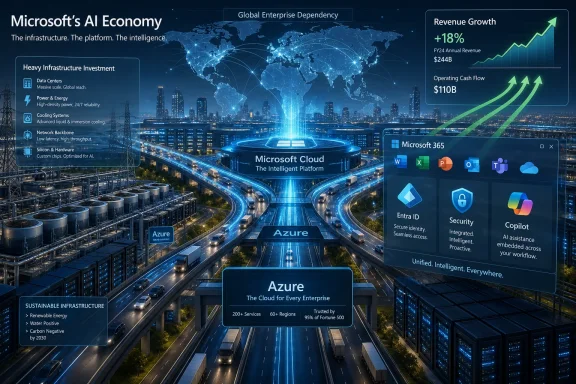 Microsoft Is Spending Like an AI Utility, but Earning Like a Software Monopoly
The strongest argument for Microsoft is still the oldest one: the company has a habit of turning enterprise dependency into financial optionality. Windows once did that for the PC. Office did it for corporate work. Azure and Microsoft 365 now do it for the cloud era. Copilot is being inserted into that estate, not launched as a lonely new product in search of distribution.That difference matters because AI infrastructure spending has become the defining investor anxiety across Big Tech. The question is no longer whether large language models can generate interest. They plainly can. The question is whether the companies building the compute layer can generate enough durable, high-margin revenue to justify the unprecedented investment in data center capacity.
Microsoft’s answer is unusually concrete. In fiscal 2025, revenue rose 15 percent to $281.7 billion, while operating income climbed 17 percent to $128.5 billion. Azure passed $75 billion in annual revenue, growing 34 percent year over year. Those are not the metrics of a company hoping AI will rescue a weak core business.
The March 2026 quarter reinforced the same pattern. Revenue rose 18 percent to $82.9 billion. Operating income rose 20 percent to $38.4 billion. Net income increased 23 percent to $31.8 billion, and diluted earnings per share rose 23 percent to $4.27. The expensive AI buildout is real, but so far it has not stopped Microsoft from expanding earnings at scale.
That is why the debate around Microsoft cannot be reduced to “capex up, margins down.” The more precise debate is whether the company’s cloud-and-software base can continue to convert that spending into contracted demand, usage growth, and higher revenue per customer. For now, the evidence leans toward yes, though not without caveats.
Azure Is No Longer Just the Growth Story; It Is the AI Toll Road
Azure’s role in Microsoft’s investment case has changed. For years, it was the challenger cloud, the strategic counterweight to Amazon Web Services, and the infrastructure proof point that Microsoft had survived the post-PC transition. In the AI era, Azure has become something more consequential: the place where Microsoft’s infrastructure spending either becomes a toll road or becomes an expensive liability.The March 2026 quarter gave bulls plenty to work with. Azure and other cloud services revenue grew 40 percent, a figure that suggests enterprise demand for cloud and AI workloads remains robust. Microsoft Cloud revenue reached $54.5 billion in the quarter, up 29 percent year over year. That scale gives Microsoft an answer to the charge that AI revenue is still too abstract to measure.
The significance of Azure’s growth is not only the percentage rate. It is the mix. AI workloads consume compute, storage, networking, inference capacity, and model services. They also pull customers deeper into the surrounding platform: data services, security, identity, developer tools, monitoring, and compliance. Azure is therefore not merely hosting AI experiments; it is positioned to capture the sprawl around production deployment.
This is where Microsoft’s enterprise distribution becomes difficult for rivals to dislodge. A CIO already running Microsoft 365, Entra ID, Defender, Purview, Teams, SharePoint, Power Platform, GitHub, and Azure has a lower-friction path to buying Microsoft’s AI services than starting from scratch with another vendor. That does not guarantee lock-in in every case, but it gives Microsoft an enormous installed-base advantage.
The bear case is that Azure’s AI-driven growth may pull in lower-margin infrastructure revenue faster than Microsoft can extract software-like economics from it. Training and inference are capital-intensive. Customers are cost-sensitive. Cloud buyers are increasingly sophisticated about workload portability and vendor pricing. If AI demand grows but pricing power weakens, Azure could become larger without becoming proportionately more profitable.
For now, however, Azure’s numbers suggest demand is still outrunning that concern. The platform is not carrying Microsoft alone, but it is the clearest expression of the company’s AI opportunity. If Microsoft is building an AI toll road, Azure is the asphalt, the booths, and the traffic camera system.
Copilot Works Because Microsoft Already Owns the Workday
Copilot is often discussed as though it were a normal software product, judged mainly by seat adoption and monthly price. That framing is too narrow. Copilot’s strategic value is that it gives Microsoft a way to reprice the workday across tools that hundreds of millions of people already use.Microsoft 365 is not just a bundle of applications. It is the operating layer of corporate knowledge work: email, documents, spreadsheets, presentations, chat, meetings, storage, identity, and administration. Copilot enters that environment with privileged access to context, permissions, calendars, files, and workflows. That makes it far more interesting than a chatbot bolted onto the side of a browser.
The financial question is whether this context turns into sustained monetization. Microsoft 365 Commercial cloud revenue grew 19 percent in the March 2026 quarter, while Productivity and Business Processes revenue rose 17 percent to $35.0 billion. Those figures do not isolate Copilot’s contribution, but they show that the productivity franchise remains healthy as AI features are layered in.
The practical value proposition is easy to understand but hard to price perfectly. If Copilot can summarize meetings, draft documents, query enterprise data, automate routine workflows, and assist with code or analysis, it may justify a premium for some users. But not every employee will use it equally. Not every workflow benefits from generative AI. And IT departments will eventually scrutinize whether seat expansion is producing measurable productivity gains.
That is why Microsoft’s advantage lies less in a single Copilot SKU and more in the number of surfaces where Copilot can appear. It can be sold into Microsoft 365, GitHub, Dynamics, Security, Windows, Power Platform, and Azure. Some of those products will generate direct incremental revenue. Others may improve retention, increase consumption, or make the broader Microsoft stack harder to replace.
This is the subtle power of the strategy. Microsoft does not need Copilot to behave like a stand-alone startup product with perfect adoption curves. It needs Copilot to become a persuasive upgrade path across products customers already budget for. That is a lower-risk path to AI monetization than acquiring new customers one prompt at a time.
The Backlog Is the Quiet Counterargument to the Bubble Thesis
The most underappreciated number in Microsoft’s current story may be commercial remaining performance obligation. In the March 2026 quarter, that figure climbed to $627 billion, up sharply from the prior year. RPO is not the same as revenue, and it should not be treated as a perfect predictor of future growth. But it is a useful measure of contracted demand, and Microsoft’s number is immense.Backlog matters because it complicates the idea that Microsoft is simply building ahead of speculative AI demand. A large contracted base gives the company visibility into future revenue and strengthens the case that its infrastructure expansion is tied to real customer commitments. It also gives management more room to absorb volatility in bookings from large contracts.
That cushion is particularly important in the cloud market, where consumption patterns can be uneven. Enterprise customers may sign large commitments, ramp workloads over time, pause migrations, renegotiate terms, or shift spending between services. A big RPO base does not eliminate those risks, but it lowers the chance that one weak quarter changes the entire story.
The backlog also reflects Microsoft’s ability to package cloud, software, and AI into strategic relationships. Enterprise buyers rarely think in clean product silos. They negotiate broad commercial agreements that cover productivity software, infrastructure, security, data, collaboration, and support. Microsoft benefits because its portfolio gives procurement teams many reasons to stay inside the same orbit.
This is where the company’s breadth becomes a financial weapon. AWS has enormous cloud scale. Google has world-class AI research and a growing cloud business. Salesforce, ServiceNow, Oracle, and others own important enterprise workflows. Microsoft’s distinction is that it can combine infrastructure, applications, operating systems, developer tools, and identity in one account conversation.
That breadth does not make Microsoft beloved by every administrator. Bundling can be frustrating. Licensing can be opaque. Cost management can be maddening. But from an investor’s perspective, the same complexity can translate into durable contracts, broad attach rates, and fewer clean exit points.
Margin Compression Is Real, but It Is Not Yet a Thesis Killer
The cleanest bear argument against Microsoft is margin pressure. Microsoft Cloud gross margin was 69 percent in fiscal 2025, then moved down to 67 percent in the December 2025 quarter and 66 percent in the March 2026 quarter. Management has tied that pressure to AI infrastructure investment and growing AI usage, partly offset by efficiency gains in Azure and Microsoft 365 Commercial cloud.That decline matters. AI compute is not magic software margin. It requires chips, servers, cooling, power, land, networking gear, and long lead-time commitments. If customers use AI features heavily, Microsoft must serve that demand. If customers do not use them enough, Microsoft risks underutilized capacity. Either way, the company has more operational complexity than in the days when selling another Office license was nearly pure margin.
Still, the margin decline has to be read alongside operating income growth. In the March 2026 quarter, Microsoft’s operating income rose 20 percent. In other words, the company is absorbing gross margin pressure while still increasing absolute profit. That is the distinction between a margin problem and a business model problem.
The market’s fear is that today’s manageable compression becomes tomorrow’s structural reset. If AI services permanently require much higher capital intensity and lower gross margins, Microsoft’s valuation multiple should reflect that. Investors have paid for a software-like profit engine. A shift toward utility-like economics would be a serious change.
But Microsoft’s counter is that AI infrastructure is not a stand-alone commodity layer. It is connected to higher-level services, subscriptions, security, data governance, developer platforms, and business applications. If those layers carry attractive economics, the company can tolerate lower margins in the infrastructure layer while preserving overall profitability.
That is the central tension. Microsoft is trying to turn a capital-heavy AI buildout into a platform-wide monetization cycle. It does not need every AI workload to be wildly profitable on its own. It needs the full stack to produce enough incremental revenue, retention, and strategic control to justify the spending.
The Shareholder Returns Signal Is More Than Cosmetic
Microsoft returned $10.2 billion to shareholders through dividends and share repurchases in the March 2026 quarter. In a different company, that might be a routine footnote. Here, it is part of the investment argument.The return of capital says Microsoft is not behaving like a company forced to choose between AI investment and shareholder discipline. It is doing both. That does not mean every dollar of buyback activity is perfectly timed, or that dividends should matter more than cloud growth. But it does signal that Microsoft’s cash engine remains broad enough to fund multiple priorities at once.
This is one of the benefits of Microsoft’s portfolio construction. Productivity software generates recurring cash. Cloud infrastructure generates consumption growth. LinkedIn contributes professional network and advertising revenue. Dynamics expands Microsoft’s presence in business applications. Gaming remains strategically complicated but financially meaningful after Activision Blizzard. No single product line bears the full weight of the AI cycle.
That diversification makes Microsoft different from companies whose AI fortunes depend on one narrow wedge. If Copilot adoption is slower in one segment, Azure consumption may still grow. If cloud margins tighten, Microsoft 365 renewal strength may cushion the blow. If enterprise AI pilots take longer to mature, security and data products may still benefit from the same modernization wave.
There is a risk, of course, that breadth becomes narrative cover. Investors should not let Microsoft hide weak AI unit economics behind consolidated strength forever. At some point, the company will need to show that AI is not merely increasing revenue, but doing so in a way that preserves or enhances long-term returns on invested capital.
For now, the consolidated numbers remain persuasive. Microsoft is spending aggressively, but it is not bleeding. It is investing from a position of strength, not desperation. That is a major distinction in a market full of companies borrowing credibility from the AI label.
Competition Is Real, and It Is Getting More Political
Microsoft’s position is powerful, but it is not uncontested. AWS remains the cloud incumbent by scale and operational maturity. Google Cloud brings AI credibility, custom silicon, and deep technical appeal. Oracle has found momentum in high-performance cloud infrastructure deals. Specialized AI infrastructure providers and model companies are also fighting for slices of the workload.The competitive question is not whether Microsoft can win every AI workload. It cannot. The question is whether it can win enough of the enterprise AI transition to preserve Azure growth, increase attach rates, and deepen customer dependence on its stack. The March 2026 numbers suggest it is doing that, but the contest is still early.
Cloud competition is also increasingly political and regulatory. Governments are looking at concentration, switching costs, licensing practices, and the market power of hyperscalers. Microsoft’s bundling instincts, once a familiar antitrust story from the Windows era, are now being replayed in cloud, identity, productivity, and AI. The more successful Copilot becomes, the more scrutiny Microsoft should expect.
For customers, that scrutiny is not abstract. IT departments care about exit costs, data portability, licensing flexibility, and whether AI features are being used to make already-sticky platforms even stickier. Microsoft’s integrated stack may be convenient, but convenience can shade into dependency. Administrators know this because they live with the consequences of procurement decisions for years.
That is why the WindowsForum audience should read Microsoft’s financial strength with both admiration and caution. A richer Microsoft can invest more in security, cloud reliability, developer tools, and AI features. It can also make its ecosystem more complicated, more bundled, and harder to leave.
The company’s financial success is therefore not just a Wall Street story. It shapes the software environment in which businesses operate. When Microsoft decides where to place Copilot, what to bundle, what to meter, and what to make premium, those choices ripple through IT budgets and user workflows.
Windows Is Not the Center of the Story, but It Is Still Part of the Trapdoor
For a Windows-focused audience, the most interesting thing about Microsoft’s current financial profile is how little the investment case depends on Windows alone. The company that once lived or died by the PC upgrade cycle now earns its strategic premium from cloud, productivity, and enterprise services. Windows is still important, but it is no longer the sole gravitational center.That shift gives Microsoft more room to experiment with Windows as an endpoint for cloud and AI services. Copilot in Windows, cloud management, endpoint security, identity integration, and subscription-linked features all make more sense when Windows is seen as part of a broader commercial platform. The operating system becomes one more surface for Microsoft’s cloud economics.
This can be good for users when integration reduces friction. It can be frustrating when integration feels like forced promotion. Windows users have already seen Microsoft push cloud accounts, OneDrive prompts, Edge defaults, Copilot branding, and subscription hooks with varying degrees of subtlety. The financial incentive behind those choices is clear: Windows is a distribution channel for higher-value recurring services.
For administrators, the practical challenge is governance. AI features introduce questions about data access, retention, compliance, permissions, auditability, and user training. Microsoft’s advantage is that it can offer those controls inside a familiar enterprise management model. The risk is that organizations may adopt features faster than they update policy.
The broader Microsoft story therefore lands directly on the desktop, even if the revenue growth is elsewhere. The company’s cloud-and-Copilot cash engine will influence what appears in Windows, how aggressively Microsoft promotes AI-assisted workflows, and which capabilities remain included versus upsold. The numbers in Redmond eventually become defaults on the taskbar.
The Investor Story Is Really an Enterprise Dependency Story
Microsoft’s financial performance is often described in terms of growth rates, margins, and capital expenditure. Those are necessary measures, but they do not fully capture the company’s moat. Microsoft’s moat is enterprise dependency at planetary scale.That dependency begins with identity and productivity. It extends into security, compliance, collaboration, device management, databases, application development, analytics, and cloud infrastructure. Once a customer standardizes heavily on Microsoft, removing the stack is not a simple procurement decision. It is a multi-year transformation project with operational risk.
Copilot fits neatly into this structure because it promises to make the existing estate more valuable. It can read the documents, meetings, chats, tickets, code, and data that already live inside Microsoft-controlled systems, subject to permissions and configuration. That gives Microsoft a contextual advantage over AI tools that sit outside the enterprise workflow.
This does not mean customers will accept every price increase or every AI upsell. Large enterprises negotiate hard. They run pilots. They demand compliance guarantees. They compare vendors. They worry about data leakage and hallucinations. Microsoft still has to prove that Copilot and Azure AI create enough value to justify expanded spend.
But the sales motion starts from a privileged place. Microsoft is not knocking on the door; it is already in the tenant. That is the difference between selling AI as a new destination and selling it as a new layer of the existing workplace.
The financial results suggest that this approach is working, at least for now. The commercial backlog is huge, cloud revenue is growing rapidly, and AI revenue has reached a substantial annual run rate. The next test is whether those numbers mature into durable margins rather than merely larger bills for compute.
The Numbers Say Microsoft Bought Itself Time to Prove the AI Thesis
Microsoft has not settled the AI economics debate, but it has earned the right to keep arguing from strength. The company’s latest results show a business that can fund extraordinary infrastructure spending while still growing revenue, operating income, earnings, and shareholder returns. That is rare, and it is the reason the Microsoft story should not be reduced to a generic AI bubble narrative.- Microsoft’s fiscal 2025 revenue of $281.7 billion and operating income of $128.5 billion show that the AI investment cycle is being funded by an already massive earnings base.
- Azure’s move past $75 billion in annual revenue and its 40 percent growth in the March 2026 quarter make it the core financial bridge between AI infrastructure spending and enterprise demand.
- Copilot’s strongest advantage is not novelty, but distribution across Microsoft 365, Windows, GitHub, Dynamics, Security, Power Platform, and Azure.
- Microsoft Cloud gross margin pressure is real, and the decline to 66 percent in the March 2026 quarter is the clearest sign that AI is making the business more capital-intensive.
- The $627 billion commercial remaining performance obligation gives Microsoft unusual visibility into future demand, but it does not remove the need to prove long-term AI unit economics.
- For Windows users and IT administrators, Microsoft’s financial incentives point toward deeper cloud, identity, subscription, and AI integration across the desktop and enterprise stack.
References
- Primary source: AlphaStreet
Published: 2026-06-25T14:12:07.064230
Microsoft (MSFT) Has a Cloud-and-Copilot Cash Engine Bigger Than the AI-Capex Debate - Alphastreet
Microsoft Corporation (NASDAQ: MSFT) is often discussed through the narrow lens of AI infrastructure spending, but that framing misses what actually supports the company’s earnings power. The better lens is a platform made up of Azure, Microsoft 365, Dynamics, LinkedIn, and a large base of...news.alphastreet.com - Official source: news.microsoft.com
Microsoft Cloud and AI strength fuels fourth quarter results - Source
 news.microsoft.com
- Official source: microsoft.com
Microsoft Fiscal Year 2026 Third Quarter Earnings Conference Call
www.microsoft.com
- Related coverage: sec.gov
- Related coverage: thurrott.com
Microsoft Revenues Jump 18 Percent to $82.9 Billion in FY26Q3 - Thurrott.com
Microsoft announced that it earned a net income of $31.8 billion on revenues of $82.9 billion in the quarter ending March 31, 2026.www.thurrott.com - Related coverage: geekwire.com
Microsoft tops Wall Street expectations, reports accelerating Azure growth and $37B AI run rate – GeekWire
Microsoft's Azure cloud business accelerated in the March quarter, growing 40% and topping the company's own forecast, giving the tech giant a new answer to questions about its ability to translate record capital spending on AI infrastructure into stronger financial results.www.geekwire.com
- Related coverage: finance.yahoo.com
Microsoft reports 23% increase in net income for Q3 FY26 to $31.8bn
Redmond’s revenue for the reported quarter soared to $82.9bn, an 18% rise from $70bn in Q3 FY25.finance.yahoo.com - Related coverage: bignewsnetwork.com
Microsoft Q3 revenue up 18 pct
SAN FRANCISCO, April 29 (Xinhua) -- Microsoft posted on Wednesday its revenue of 82.9 billion U.S. dollars for the third quarter of the 2026 fiscal ye.....www.bignewsnetwork.com
- Related coverage: happening.etoro.app
MSFT · Q3 2026 earnings · Microsoft · Happening
Microsoft reported fiscal Q3 2026 revenue of $82.9B (+18% YoY) and diluted EPS of $4.27, with Microsoft Cloud up 29% and AI revenue run rate above $37B.happening.etoro.app - Related coverage: grafa.com
Microsoft (MSFT) Q3 2026 results: revenue hits $82.9B | Grafa
Microsoft reported Q3 2026 revenue of $82.9 billion and a 23% increase in GAAP net income. Growth was driven by robust performance in Azure and...grafa.com - Related coverage: doolpa.com
Microsoft Q3 FY26: $82.9B Revenue, Azure +40%, AI Hits $37B Run-Rate | Doolpa
Microsoft posted $82.89B Q3 FY26 revenue April 29 2026: Azure +40%, AI run-rate $37B (+123% YoY), capex $31.9B. Shares slipped 3% despite the beat.doolpa.com - Related coverage: stocktitan.net
Microsoft (MSFT) Q3 2026 cloud, AI and profit surge with $82.9B revenue
Microsoft’s Q3 2026 revenue rose 18% to $82.9B and net income climbed 23% to $31.8B, powered by $54.5B Microsoft Cloud sales and surging AI demand.www.stocktitan.net - Related coverage: tomshardware.com
Microsoft follows Nvidia's lead, surpasses $4 trillion market capitalization on soaring demand for cloud services, multi-front AI endeavors | Tom's Hardware
AI and Azure drive Microsoft's market cap.www.tomshardware.com - Related coverage: windowscentral.com
$96.5 million for Nadella | Microsoft's CEO receives record pay in a year that saw 15,000+ layoffs | Windows Central
Business is booming at Microsoft, and its CEO isn't going to go hungry.www.windowscentral.com - Related coverage: annualreports.ai
- Related coverage: techxplore.com
