

Yusuf Mehdi, Microsoft’s executive vice president and consumer chief marketing officer, plans to leave Microsoft after the 2026–27 fiscal year, after spending his final year helping reshape Windows for what the company calls the agentic era. That phrasing matters more than the retirement notice. Microsoft is not simply losing another veteran executive; it is putting a deadline on the next argument over what Windows is supposed to be. Mehdi’s “final season” will be a test of whether Microsoft can sell AI-native Windows as progress rather than intrusion.
Executive departures are usually written as corporate weather: notable, briefly disruptive, then absorbed into the larger climate. Mehdi’s planned exit is different because Microsoft has attached it to a product transformation already straining the patience of Windows users. His memo reportedly says he will work through the next fiscal year to “reimagine Windows for the agentic era,” grow Microsoft 365 services, and bring the “One Copilot” vision to life.
That is a tidy sentence with three enormous implications. Windows is no longer being framed mainly as an operating system release cycle, Microsoft 365 is no longer merely a productivity subscription, and Copilot is no longer just a chatbot pinned to whatever surface Microsoft can find. The company is trying to make the PC itself part of a service-and-agent fabric.
Mehdi has long been one of Microsoft’s most polished consumer narrators. After Panos Panay’s 2023 exit, he became one of the public faces of Windows and Surface at precisely the moment Microsoft decided every consumer product needed to be explained through AI. That makes his final year less a farewell tour than a handoff: he is being asked to help make Microsoft’s most controversial Windows bet legible before someone else inherits the consequences.
The timing is also awkward in the way only Microsoft timing can be. Windows 10 is behind us as the default mainstream story, Windows 11 has spent years fighting perceptions of friction and unnecessary change, and Copilot has gone from novelty to infrastructure faster than many users wanted. Into that environment comes a senior executive saying the next year is full speed ahead.
That is not a trivial extension of Copilot. It is a different theory of the PC. The old Windows bargain was that the operating system mediated hardware, applications, files, identity, and peripherals while the human remained the deliberate actor. The agentic version asks users to let software cross more boundaries because the value comes from crossing them.
For Microsoft, this is strategically irresistible. Windows sits at the junction of local files, enterprise identity, Microsoft 365 data, Edge, Teams, security policy, developer tooling, and OEM hardware. If AI agents are going to become a real computing layer, Microsoft believes Windows should be the layer where they become practical.
The risk is that users hear the same pitch and imagine something less elegant: a system with more background processes, more cloud hooks, more upsell surfaces, more telemetry anxiety, and more features arriving before the old annoyances are fixed. Microsoft says “assistant.” A lot of Windows die-hards hear “tenant with admin privileges.”
That gap is the whole fight. Mehdi’s final-year job, if the memo language is taken seriously, is not merely to market a new feature set. It is to persuade people that agentic Windows is not the final absorption of the personal computer into Microsoft’s subscription machine.
This is why the “reimagine Windows” language can sound tone-deaf to a certain kind of user. Many Windows customers are not asking for the PC to be reimagined. They are asking for it to be made coherent, predictable, fast, respectful, and quiet.
Microsoft appears to know this. The company has spent the past year signaling renewed attention to Windows quality, reducing some Copilot placements, and talking about winning back trust among power users and developers. But the trust problem is not solved by saying the right things in March if the November demo looks like an AI agent rummaging through files.
Windows is a uniquely unforgiving product because it is both consumer software and enterprise infrastructure. A misstep in a photo app is annoying; a misstep in the shell, update system, identity layer, or file permission model can become a week of help-desk tickets. Every new AI surface must pass a higher bar than “it demos well.”
That is where Mehdi’s marketing background cuts both ways. He is good at translating Microsoft strategy into consumer language. But the Windows audience is allergic to translation when it suspects the underlying product tradeoff is bad.
For users, fewer Copilots could be good news. The current experience has often felt like a set of overlapping doors into related but distinct AI systems, each with different permissions, data contexts, branding, and expectations. A cleaner model could make it easier to understand what Copilot can access, what it can do, and how to turn it off.
For administrators, the value depends on governance. One Copilot is appealing only if it maps cleanly to identity, policy, auditing, data boundaries, retention rules, and compliance expectations. A unified assistant that behaves inconsistently across Windows, Office, Edge, and Teams is worse than several narrow assistants whose blast radius is obvious.
For Microsoft, One Copilot is also a business strategy. If Copilot becomes the interface layer across Windows and Microsoft 365, the company deepens the moat around its productivity ecosystem. The operating system becomes less a neutral launcher of apps and more a context engine for Microsoft’s AI services.
That is why the word “one” should make IT pros listen carefully. It can mean coherence. It can also mean fewer places to say no.
Microsoft has tried to frame Windows agentic features as governed, permissioned, and experimental where appropriate. That is necessary but not sufficient. The central question is not whether an agent asks permission once; it is whether users and administrators can understand, constrain, monitor, revoke, and audit what the agent did.
This is where Windows has an advantage if Microsoft uses it properly. The platform already has mature concepts around user accounts, enterprise management, Defender, application control, identity, device compliance, and policy enforcement. An agentic OS could, in theory, make those controls more visible and useful rather than bypassing them.
But Microsoft’s consumer instincts often run ahead of its administrative discipline. The company likes friendly prompts, simplified consent screens, and default-on experiences that optimize adoption. Enterprise IT likes explicit scope, boring logs, tenant-level controls, and the ability to say “not yet” without fighting the product every month.
If Mehdi’s last year is about bringing One Copilot to life, Microsoft must prove that agentic Windows is designed around containment. Otherwise, the story will not be productivity. It will be risk.
The problem is that Windows users have seen what happens when stewardship becomes fragmented. Windows has been reorganized, split, rejoined, deprioritized, elevated, and rebranded often enough that every new “vision” arrives with baggage. Users remember the distance between Microsoft’s keynote language and the thing that shows up on Patch Tuesday.
That history makes Mehdi’s exit symbolically important. He is not the engineering owner of Windows, but he is one of the people Microsoft has relied on to narrate the consumer meaning of Windows. If his final year is dedicated to reimagining the platform, the successor question matters.
Microsoft reportedly has not named a successor. That does not mean there is no plan, but it does mean the public story is incomplete. For a company trying to persuade customers that Windows is entering a new era, visible continuity matters.
There is a version of this transition that works. Mehdi helps define the market-facing story, Windows engineering continues consolidating under leadership focused on quality and platform fundamentals, and the next consumer chief inherits a clearer, less chaotic Copilot strategy. There is also a version where “agentic Windows” becomes another banner waved over a pile of unfinished experiences.
The agentic era changes that bargain. Microsoft is asking users to accept a more interpretive operating system, one that watches more context and performs more actions. That can be powerful, but it also makes Windows feel less like a stable workbench and more like a colleague sitting beside you.
Some people want that. Many office workers would gladly offload repetitive formatting, searching, summarizing, and scheduling. Developers may benefit from local AI APIs, standardized agent interfaces, and tools that understand projects rather than just files. Accessibility scenarios are genuinely promising when voice, vision, and automation are combined thoughtfully.
But the Windows installed base is not a focus group of AI enthusiasts. It includes gamers who want frames, admins who want control, accountants who want the same workflow every day, schools with thin budgets, factories with old peripherals, and home users who never asked their operating system to become conversational.
A successful agentic Windows must therefore be layered, not imposed. It must give users obvious value at the edge while preserving the old expectation that the PC belongs to the person sitting in front of it. That is easy to say and hard to ship.
Windows enthusiasts have become especially sensitive to what might be called consent drift. A feature appears in preview, moves into stable builds, gains a promotional tile, integrates with search, and eventually becomes part of the expected Windows experience. Each step can be defended individually. Together they feel like a ratchet.
Microsoft has already learned this lesson in smaller ways. The company has had to adjust how aggressively it places Copilot in some parts of Windows. It has also heard repeated complaints about recommendations, ads, account prompts, and cloud nudges. Agentic features will amplify that debate because they are not merely visual clutter; they imply capability.
This is why the Mehdi memo language lands with such force. “Full speed ahead” is energizing inside a company. Outside the company, among users who feel they have been drafted into Microsoft’s AI rollout, it can sound like the brakes are still missing.
The smarter play would be confidence through restraint. Microsoft should make agentic Windows impressive enough that users go looking for it, not so unavoidable that they go looking for registry hacks.
That could be a real platform moment. If Windows provides standardized ways for apps to expose actions safely to agents, developers could build software that is more automatable without resorting to brittle screen scraping or accessibility hacks. A mature model could make Windows more programmable for humans and machines alike.
But developers are also among Microsoft’s harshest judges. They notice when platform investments feel half-finished. They remember UWP, Centennial, WinUI promises, Store resets, Windows on Arm false starts, and the recurring gap between Build enthusiasm and long-term follow-through.
The agentic Windows pitch will therefore need more than Copilot branding. It needs durable APIs, documentation, debugging tools, permission models, deployment guidance, and a believable commitment that the platform will not swerve again in two years. Developers can tolerate change; they have less patience for churn disguised as vision.
If Microsoft gets this right, Windows could become the most practical desktop platform for agent-enabled applications. If it gets it wrong, developers will treat the agentic layer as another Microsoft subsystem to cautiously ignore until customers demand it.
An agentic OS touches sensitive boundaries. It may interact with files, applications, browser sessions, email, calendars, Teams messages, and line-of-business systems. That means the product conversation immediately becomes a governance conversation.
The most important enterprise features may be the least glamorous ones. Admins will want policy controls by device group, user role, data classification, app category, and region. Security teams will want event logs that explain not just that an agent acted, but why it acted, under whose authority, with what data, and what changed as a result.
Legal and compliance teams will ask harder questions. If an agent drafts, sends, deletes, or modifies something, who is accountable? If it summarizes regulated data, where is that summary stored? If it uses cloud reasoning over local context, what leaves the device? If a prompt injection manipulates an agent through hostile content, which controls stop it?
Microsoft has answers to parts of this through its broader security and compliance stack. But agentic Windows will force those answers into everyday computing. The moment an AI agent becomes part of the operating system story, governance is no longer an enterprise add-on. It is the adoption gate.
But consumers also punish creepiness, and AI assistants become creepy when they appear to know too much without explaining how. The line between helpful context and invasive context is not fixed; it depends on expectation, interface, trust, and control. Microsoft has often struggled with that line because its business incentives reward account sign-ins, cloud services, and cross-product engagement.
For Mehdi, this is familiar terrain. His career has involved selling Microsoft’s consumer ambitions through moments when the company needed to feel warmer, simpler, and more human than its reputation. The challenge is that AI does not merely need warmth. It needs restraint.
A consumer agentic Windows should probably start with narrow, reversible tasks. It should show its work. It should make permissions painfully clear. It should avoid pretending that every user wants their PC to become a personal assistant. The best consumer AI features disappear into usefulness; the worst announce themselves like a strategy deck.
Windows users have long memories for annoyance. A genuinely helpful Copilot action may be forgotten after it saves five minutes. One unwanted interruption during a game, meeting, exam, or work session will be screenshotted forever.
That will require Microsoft to stop treating backlash as a messaging problem. Some criticism of agentic Windows is reflexive, but much of it is rooted in lived experience with defaults, promotions, inconsistent settings, and features that seem designed around Microsoft’s priorities first. The company cannot win that audience with softer wording alone.
The next year should be judged by shipped behavior. Does Windows get faster and cleaner? Do Copilot features become easier to understand and control? Do agentic capabilities arrive with strong policy surfaces? Does Microsoft remove clutter as aggressively as it adds intelligence? Does the company give local hardware, especially Copilot+ PCs, a reason to exist beyond a logo on the keyboard?
If the answer is yes, Mehdi’s final season could be remembered as the year Microsoft made its AI Windows story credible. If the answer is no, it will look like the year Microsoft doubled down on a vision before earning permission.
 Mehdi’s Exit Turns Windows Strategy Into a Countdown
Executive departures are usually written as corporate weather: notable, briefly disruptive, then absorbed into the larger climate. Mehdi’s planned exit is different because Microsoft has attached it to a product transformation already straining the patience of Windows users. His memo reportedly says he will work through the next fiscal year to “reimagine Windows for the agentic era,” grow Microsoft 365 services, and bring the “One Copilot” vision to life.That is a tidy sentence with three enormous implications. Windows is no longer being framed mainly as an operating system release cycle, Microsoft 365 is no longer merely a productivity subscription, and Copilot is no longer just a chatbot pinned to whatever surface Microsoft can find. The company is trying to make the PC itself part of a service-and-agent fabric.
Mehdi has long been one of Microsoft’s most polished consumer narrators. After Panos Panay’s 2023 exit, he became one of the public faces of Windows and Surface at precisely the moment Microsoft decided every consumer product needed to be explained through AI. That makes his final year less a farewell tour than a handoff: he is being asked to help make Microsoft’s most controversial Windows bet legible before someone else inherits the consequences.
The timing is also awkward in the way only Microsoft timing can be. Windows 10 is behind us as the default mainstream story, Windows 11 has spent years fighting perceptions of friction and unnecessary change, and Copilot has gone from novelty to infrastructure faster than many users wanted. Into that environment comes a senior executive saying the next year is full speed ahead.
The Agentic PC Is Microsoft’s New Grand Unification Theory
Microsoft’s favorite word of the moment, agentic, is doing a lot of work. In plain English, it means software that does not merely answer questions but takes actions: reading context, moving between apps, clicking, typing, summarizing, scheduling, drafting, and executing workflows on behalf of a user. In Microsoft’s ideal version, Windows becomes the place where these agents can see enough, know enough, and do enough to be useful.That is not a trivial extension of Copilot. It is a different theory of the PC. The old Windows bargain was that the operating system mediated hardware, applications, files, identity, and peripherals while the human remained the deliberate actor. The agentic version asks users to let software cross more boundaries because the value comes from crossing them.
For Microsoft, this is strategically irresistible. Windows sits at the junction of local files, enterprise identity, Microsoft 365 data, Edge, Teams, security policy, developer tooling, and OEM hardware. If AI agents are going to become a real computing layer, Microsoft believes Windows should be the layer where they become practical.
The risk is that users hear the same pitch and imagine something less elegant: a system with more background processes, more cloud hooks, more upsell surfaces, more telemetry anxiety, and more features arriving before the old annoyances are fixed. Microsoft says “assistant.” A lot of Windows die-hards hear “tenant with admin privileges.”
That gap is the whole fight. Mehdi’s final-year job, if the memo language is taken seriously, is not merely to market a new feature set. It is to persuade people that agentic Windows is not the final absorption of the personal computer into Microsoft’s subscription machine.
Windows 11 Still Carries the Burden of Unfinished Business
The agentic push lands on top of a Windows 11 reputation problem that Microsoft has never fully escaped. Enthusiasts complain about inconsistent UI, Settings pages that still do not fully replace legacy Control Panel behaviors, Start menu changes, unwanted recommendations, hardware requirements, and a sense that Microsoft keeps adding entry points for services before sanding down everyday rough edges. Some of those complaints are subjective; enough of them are persistent to be strategically relevant.This is why the “reimagine Windows” language can sound tone-deaf to a certain kind of user. Many Windows customers are not asking for the PC to be reimagined. They are asking for it to be made coherent, predictable, fast, respectful, and quiet.
Microsoft appears to know this. The company has spent the past year signaling renewed attention to Windows quality, reducing some Copilot placements, and talking about winning back trust among power users and developers. But the trust problem is not solved by saying the right things in March if the November demo looks like an AI agent rummaging through files.
Windows is a uniquely unforgiving product because it is both consumer software and enterprise infrastructure. A misstep in a photo app is annoying; a misstep in the shell, update system, identity layer, or file permission model can become a week of help-desk tickets. Every new AI surface must pass a higher bar than “it demos well.”
That is where Mehdi’s marketing background cuts both ways. He is good at translating Microsoft strategy into consumer language. But the Windows audience is allergic to translation when it suspects the underlying product tradeoff is bad.
One Copilot Means Fewer Escape Hatches
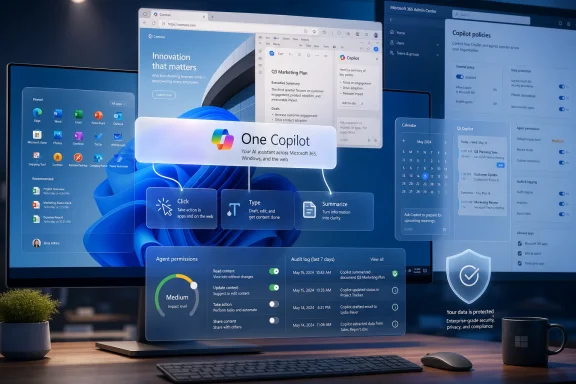
The phrase “One Copilot” is Microsoft’s attempt to impose order on what became, predictably, a sprawl. There has been Copilot in Windows, Copilot in Edge, Copilot in Microsoft 365, Copilot for Security, Copilot Studio, GitHub Copilot, and a consumer Copilot identity that has not always felt aligned with the enterprise product family. A unified Copilot vision promises consistency, but it also implies consolidation of power.For users, fewer Copilots could be good news. The current experience has often felt like a set of overlapping doors into related but distinct AI systems, each with different permissions, data contexts, branding, and expectations. A cleaner model could make it easier to understand what Copilot can access, what it can do, and how to turn it off.
For administrators, the value depends on governance. One Copilot is appealing only if it maps cleanly to identity, policy, auditing, data boundaries, retention rules, and compliance expectations. A unified assistant that behaves inconsistently across Windows, Office, Edge, and Teams is worse than several narrow assistants whose blast radius is obvious.
For Microsoft, One Copilot is also a business strategy. If Copilot becomes the interface layer across Windows and Microsoft 365, the company deepens the moat around its productivity ecosystem. The operating system becomes less a neutral launcher of apps and more a context engine for Microsoft’s AI services.
That is why the word “one” should make IT pros listen carefully. It can mean coherence. It can also mean fewer places to say no.
The Security Model Has to Be the Product, Not the Appendix
Agentic computing changes the security conversation because it gives software more agency inside the user’s environment. A chatbot that gives bad advice is a problem. An agent that misunderstands a command, accesses the wrong folder, sends the wrong file, or automates the wrong workflow is a different class of problem.Microsoft has tried to frame Windows agentic features as governed, permissioned, and experimental where appropriate. That is necessary but not sufficient. The central question is not whether an agent asks permission once; it is whether users and administrators can understand, constrain, monitor, revoke, and audit what the agent did.
This is where Windows has an advantage if Microsoft uses it properly. The platform already has mature concepts around user accounts, enterprise management, Defender, application control, identity, device compliance, and policy enforcement. An agentic OS could, in theory, make those controls more visible and useful rather than bypassing them.
But Microsoft’s consumer instincts often run ahead of its administrative discipline. The company likes friendly prompts, simplified consent screens, and default-on experiences that optimize adoption. Enterprise IT likes explicit scope, boring logs, tenant-level controls, and the ability to say “not yet” without fighting the product every month.
If Mehdi’s last year is about bringing One Copilot to life, Microsoft must prove that agentic Windows is designed around containment. Otherwise, the story will not be productivity. It will be risk.
The Leadership Churn Makes the Product Story Harder to Trust
Mehdi’s planned departure also fits into a broader period of Microsoft leadership change. The company has been reorganizing Windows and Devices, elevating leaders closer to Satya Nadella, and aligning product groups around AI. Some of this is normal succession planning at a company where many senior executives have served for decades. Some of it reflects the pressure of an industry pivot that Microsoft does not want to miss.The problem is that Windows users have seen what happens when stewardship becomes fragmented. Windows has been reorganized, split, rejoined, deprioritized, elevated, and rebranded often enough that every new “vision” arrives with baggage. Users remember the distance between Microsoft’s keynote language and the thing that shows up on Patch Tuesday.
That history makes Mehdi’s exit symbolically important. He is not the engineering owner of Windows, but he is one of the people Microsoft has relied on to narrate the consumer meaning of Windows. If his final year is dedicated to reimagining the platform, the successor question matters.
Microsoft reportedly has not named a successor. That does not mean there is no plan, but it does mean the public story is incomplete. For a company trying to persuade customers that Windows is entering a new era, visible continuity matters.
There is a version of this transition that works. Mehdi helps define the market-facing story, Windows engineering continues consolidating under leadership focused on quality and platform fundamentals, and the next consumer chief inherits a clearer, less chaotic Copilot strategy. There is also a version where “agentic Windows” becomes another banner waved over a pile of unfinished experiences.
The Old Windows Bargain Is Being Renegotiated
For three decades, Windows succeeded because it was the default place where everything ran. It was not always loved, but it was useful, compatible, and economically unavoidable. The user paid in complexity and occasional frustration; Microsoft delivered breadth, backward compatibility, hardware choice, and a huge software ecosystem.The agentic era changes that bargain. Microsoft is asking users to accept a more interpretive operating system, one that watches more context and performs more actions. That can be powerful, but it also makes Windows feel less like a stable workbench and more like a colleague sitting beside you.
Some people want that. Many office workers would gladly offload repetitive formatting, searching, summarizing, and scheduling. Developers may benefit from local AI APIs, standardized agent interfaces, and tools that understand projects rather than just files. Accessibility scenarios are genuinely promising when voice, vision, and automation are combined thoughtfully.
But the Windows installed base is not a focus group of AI enthusiasts. It includes gamers who want frames, admins who want control, accountants who want the same workflow every day, schools with thin budgets, factories with old peripherals, and home users who never asked their operating system to become conversational.
A successful agentic Windows must therefore be layered, not imposed. It must give users obvious value at the edge while preserving the old expectation that the PC belongs to the person sitting in front of it. That is easy to say and hard to ship.
The Windows Community Will Judge the Defaults
The argument over agentic Windows will not be decided by Microsoft’s best demo. It will be decided by defaults. Is Copilot present but unobtrusive, or does it keep appearing in places users did not invite it? Are agents opt-in with clear permissions, or are they framed as inevitable? Can administrators disable features cleanly, or do policies lag behind consumer rollout?Windows enthusiasts have become especially sensitive to what might be called consent drift. A feature appears in preview, moves into stable builds, gains a promotional tile, integrates with search, and eventually becomes part of the expected Windows experience. Each step can be defended individually. Together they feel like a ratchet.
Microsoft has already learned this lesson in smaller ways. The company has had to adjust how aggressively it places Copilot in some parts of Windows. It has also heard repeated complaints about recommendations, ads, account prompts, and cloud nudges. Agentic features will amplify that debate because they are not merely visual clutter; they imply capability.
This is why the Mehdi memo language lands with such force. “Full speed ahead” is energizing inside a company. Outside the company, among users who feel they have been drafted into Microsoft’s AI rollout, it can sound like the brakes are still missing.
The smarter play would be confidence through restraint. Microsoft should make agentic Windows impressive enough that users go looking for it, not so unavoidable that they go looking for registry hacks.
Developers Are the Swing Vote Microsoft Cannot Afford to Lose
The Windows developer story is more important than the consumer marketing story because developers decide whether a platform feels alive. Microsoft knows this, which is why it has been building Windows AI Foundry, local model APIs, Copilot+ PC capabilities, and agent integration points designed to make Windows attractive for AI-era applications. The company does not just want Copilot to use Windows; it wants other software to participate in agentic workflows.That could be a real platform moment. If Windows provides standardized ways for apps to expose actions safely to agents, developers could build software that is more automatable without resorting to brittle screen scraping or accessibility hacks. A mature model could make Windows more programmable for humans and machines alike.
But developers are also among Microsoft’s harshest judges. They notice when platform investments feel half-finished. They remember UWP, Centennial, WinUI promises, Store resets, Windows on Arm false starts, and the recurring gap between Build enthusiasm and long-term follow-through.
The agentic Windows pitch will therefore need more than Copilot branding. It needs durable APIs, documentation, debugging tools, permission models, deployment guidance, and a believable commitment that the platform will not swerve again in two years. Developers can tolerate change; they have less patience for churn disguised as vision.
If Microsoft gets this right, Windows could become the most practical desktop platform for agent-enabled applications. If it gets it wrong, developers will treat the agentic layer as another Microsoft subsystem to cautiously ignore until customers demand it.
Enterprises Will Move at the Speed of Audit Logs
Enterprise customers are not anti-AI. Many are already paying for Microsoft 365 Copilot, experimenting with Copilot Studio, and evaluating agent workflows in departments where measurable time savings are plausible. But the enterprise version of enthusiasm is procurement with conditions.An agentic OS touches sensitive boundaries. It may interact with files, applications, browser sessions, email, calendars, Teams messages, and line-of-business systems. That means the product conversation immediately becomes a governance conversation.
The most important enterprise features may be the least glamorous ones. Admins will want policy controls by device group, user role, data classification, app category, and region. Security teams will want event logs that explain not just that an agent acted, but why it acted, under whose authority, with what data, and what changed as a result.
Legal and compliance teams will ask harder questions. If an agent drafts, sends, deletes, or modifies something, who is accountable? If it summarizes regulated data, where is that summary stored? If it uses cloud reasoning over local context, what leaves the device? If a prompt injection manipulates an agent through hostile content, which controls stop it?
Microsoft has answers to parts of this through its broader security and compliance stack. But agentic Windows will force those answers into everyday computing. The moment an AI agent becomes part of the operating system story, governance is no longer an enterprise add-on. It is the adoption gate.
Consumers Want Magic, But They Punish Creepiness
The consumer side is more emotional and less forgiving in a different way. People do like magic when it works. A PC that can find the right setting, summarize a confusing document, clean up a folder, help troubleshoot a driver, or automate a tedious task could win real affection.But consumers also punish creepiness, and AI assistants become creepy when they appear to know too much without explaining how. The line between helpful context and invasive context is not fixed; it depends on expectation, interface, trust, and control. Microsoft has often struggled with that line because its business incentives reward account sign-ins, cloud services, and cross-product engagement.
For Mehdi, this is familiar terrain. His career has involved selling Microsoft’s consumer ambitions through moments when the company needed to feel warmer, simpler, and more human than its reputation. The challenge is that AI does not merely need warmth. It needs restraint.
A consumer agentic Windows should probably start with narrow, reversible tasks. It should show its work. It should make permissions painfully clear. It should avoid pretending that every user wants their PC to become a personal assistant. The best consumer AI features disappear into usefulness; the worst announce themselves like a strategy deck.
Windows users have long memories for annoyance. A genuinely helpful Copilot action may be forgotten after it saves five minutes. One unwanted interruption during a game, meeting, exam, or work session will be screenshotted forever.
Mehdi’s Final Season Gives Microsoft One Year to Prove the PC Still Belongs to Its User
The concrete story is simple enough: a longtime Microsoft executive is preparing to leave after one more fiscal year. The strategic story is bigger: Microsoft is using that final year to push Windows deeper into the Copilot era. The cultural story is bigger still: the company must convince its most skeptical users that AI agency can coexist with user agency.That will require Microsoft to stop treating backlash as a messaging problem. Some criticism of agentic Windows is reflexive, but much of it is rooted in lived experience with defaults, promotions, inconsistent settings, and features that seem designed around Microsoft’s priorities first. The company cannot win that audience with softer wording alone.
The next year should be judged by shipped behavior. Does Windows get faster and cleaner? Do Copilot features become easier to understand and control? Do agentic capabilities arrive with strong policy surfaces? Does Microsoft remove clutter as aggressively as it adds intelligence? Does the company give local hardware, especially Copilot+ PCs, a reason to exist beyond a logo on the keyboard?
If the answer is yes, Mehdi’s final season could be remembered as the year Microsoft made its AI Windows story credible. If the answer is no, it will look like the year Microsoft doubled down on a vision before earning permission.
The Year Ahead Will Be Measured in Toggles, Policies, and Trust
Microsoft’s next Windows chapter will not succeed because the phrase “agentic OS” becomes fashionable. It will succeed only if users can see practical gains without feeling that control has been quietly transferred from the desktop to the cloud. That makes the mundane details more important than the keynote language.- Microsoft has roughly one fiscal year to turn agentic Windows from a slogan into a set of features users can understand, control, and justify.
- Mehdi’s departure matters because he is being asked to help define the consumer story before a successor has been named publicly.
- One Copilot could reduce confusion across Microsoft products, but only if permissions, data boundaries, and administrative controls become clearer rather than more abstract.
- Windows 11’s existing trust deficit means AI features will be judged against unresolved complaints about quality, clutter, performance, and unwanted prompts.
- Enterprise adoption will depend less on demos than on auditability, policy control, security architecture, and clean disablement options.
- The Windows community will reward agentic features that feel optional and useful, and it will punish anything that feels like another service insertion campaign.
References
- Primary source: Let's Data Science
Published: Fri, 22 May 2026 14:08:13 GMT
Yusuf Mehdi to Reimagine Windows 11 in Final Year | Let's Data Science
Yusuf Mehdi, Microsoft executive vice president and consumer chief marketing officer, announced he will leave Microsoft after the 2026-27 fiscal year following a 35-year tenure, GeekWire reports. In an internal memo obtained by Windows Central, Mehdi wrote, "I will work through the next... letsdatascience.com
- Related coverage: windowscentral.com
Microsoft’s Copilot marketing chief is leaving, but not before defining a radical ‘Agentic’ future for Windows | Windows Central
Yusuf Mehdi will depart Microsoft next year after helping reimagine Windows into its agentic phase.www.windowscentral.com - Related coverage: arstechnica.com
Panos Panay, leader of the Surface and Windows teams, is leaving Microsoft - Ars Technica
Will be replaced by Yusuf Mehdi, who has been leading the way on AI efforts.arstechnica.com - Related coverage: windowslatest.com
Former Microsoft VP says Microsoft missed the AI wave like the internet and mobile, as Copilot scales back in Windows 11
Former Microsoft PM says the company's AI push failed, citing Copilot's dismal 3.3% adoption rate and calling for a massive factory reset. www.windowslatest.com
- Related coverage: windows.gadgethacks.com
Microsoft Executive Departures: Inside the Copilot-First Reorg << Windows Tips :: Gadget Hacks
Microsoft Executive Departures: Inside the Copilot-First Reorg Microsoft chose an AI executive with no gaming experience to run Xbox. The internal heir... windows.gadgethacks.com
- Related coverage: el7.ai
Nadella Dismantles Microsoft Leadership Structure to Accelerate AI Transformation
In a move reflecting the accelerating pace of structural shifts in the tech sector, Microsoft CEO Satya Nadella has begun dismantling the company's traditionalel7.ai
- Official source: microsoft.com
Copilot Vision on Windows with Highlights is now available in the U.S. | Microsoft Copilot Blog
For an optimal mobile viewing experience, use landscape mode. We’re excited to announce that Copilot Vision on Windows with Highlights is now available in the US.www.microsoft.com - Official source: support.microsoft.com
Experimental Agentic Features | Microsoft Support
Experimental Agentic Featuressupport.microsoft.com - Related coverage: dataconomy.com
Microsoft reunites Windows teams for Agentic OS
Microsoft is reuniting its Windows engineering teams into a single organization under Pavan Davuluri, President of Windows and Devices. Thedataconomy.com - Related coverage: techradar.com
Users exploded online after Microsoft claimed Windows will become a smart, AI-driven agentic OS for every device globally | TechRadar
Social media erupts slams Microsoft boasts on agentic Windows featureswww.techradar.com - Official source: blogs.windows.com
Make the most of your time with the new Windows 10 update
We all get the same 24 hours. And now, more than ever, it seems like it’s never enough. People feel more overwhelmed than ever before and pretty much all of us would love more time – not necessarily time to do more, but time to do what we love. At Microsoft, we want to helpblogs.windows.com - Related coverage: tomshardware.com
Microsoft's vision of "AI-native" Windows is becoming real, update introduces agents that pilfer through your files — Latest Windows 11 Insider build includes experimental AI agents toggle that can perform tasks for you in the background | Tom'
Microsoft states that agents read files in an isolated runtimewww.tomshardware.com - Related coverage: pcgamer.com
Apparently Windows 11 becoming 'agentic AI' means letting the bots rummage through some of your files | PC Gamer
Thanks, I guess.www.pcgamer.com - Related coverage: itpro.com
Microsoft is rolling back 'unnecessary' Copilot features on Windows | IT Pro
Microsoft has announced plans to dial back AI features in Windows 11 as the company looks to counter growing customer pushback.www.itpro.com - Related coverage: techxplore.com
