

Columbia Weather Systems’ MicroServer devices have been flagged in a recent advisory as containing multiple firmware weaknesses that, if chained, could allow an attacker to redirect SSH sessions to a malicious host, seize administrative control of the web portal, and gain limited interactive shell access — a set of conditions that make impacted MicroServer units a high-priority item for operators to inventory, isolate, and patch immediately. The vendor has published firmware updates and public notices describing enhanced security features and a firmware update program, while government guidance reiterates the long-standing ICS/OT principle: keep control-system devices off the public internet and behind layered defenses.
Operators must act now to:
Source: CISA Columbia Weather Systems MicroServer | CISA
 Background
What the MicroServer is and why it matters
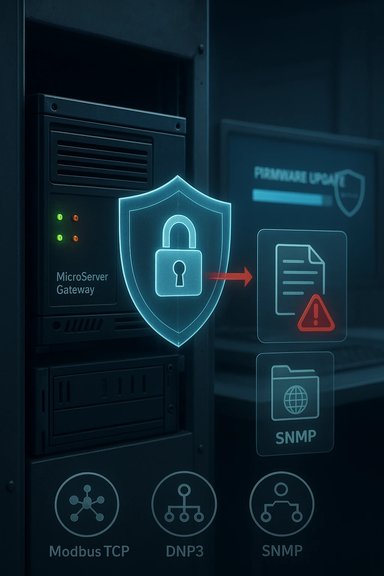
The MicroServer is Columbia Weather Systems’ embedded weather‑data gateway and data‑logger that ships with many of the company’s weather stations. It provides a browser-based UI, protocol bridges (Modbus TCP, DNP3, SNMP, BACnet), SD-card datalogging, and network upload options intended for both operational and integration use. The product is commonly deployed at airports, water utilities, power generation facilities, and other sites where environmental telemetry is integrated into control or safety workflows. Columbia Weather Systems documents the MicroServer’s features and its firmware update program on the company site.Recent advisory summary (what operators were told)
A coordinated advisory describes three related firmware weaknesses in MicroServer devices that were assigned CVE identifiers in the 2025–2026 timeframe and collectively scored in the high severity range under modern CVSS weighting. The advisory’s technical summary lists the core problems as:- Improper restriction of communication channel to intended endpoints (allowing an SSH connection to be redirected to an attacker‑controlled device);
- Cleartext storage in a file or on disk (sensitive credentials or keys stored unencrypted on the device);
- Command shell in an externally accessible directory (a shell or web‑accessible command execution sink left in a public path).
Technical breakdown: what the vulnerabilities mean in practice
1) Improper restriction of communication channel to intended endpoints
At its core, this class of weakness allows network‑level traffic intended for one endpoint to be rebound to a different destination under attacker control. On embedded devices this commonly appears as:- The device performs an SSH connection verification procedure but trusts unvalidated network identifiers, DNS responses, or proxy redirects;
- The device accepts remote configuration that can change the target host for outbound management connections; or
- An in‑band control channel (for example, a web UI action) can be coerced to open an SSH session to an attacker-specified host.
2) Cleartext storage on disk
Cleartext storage is one of the most enduring design failures in embedded firmware. It commonly manifests as:- Unencrypted configuration files containing passwords, API keys, or private keys stored on the SD card or unprotected partitions;
- Log files that inadvertently include authentication tokens or sensitive operational parameters; and
- Hard-coded credentials embedded directly in firmware images or scripts.
3) Command shell in externally accessible directory
This weakness takes several forms but usually boils down to the presence of a script, shell, or webshell located in a filesystem path reachable by the web server or upload functionality. Common root causes:- Debug shells or maintenance scripts accidentally left in /www, /public_html, or equivalent;
- Unconstrained file‑upload endpoints that permit files into a web‑executable directory; and
- Poor path validation that allows uploaded files to be written into service directories.
Real‑world impacts and attack chains
A plausible exploitation chain on an exposed MicroServer looks like this:- Attacker discovers the device on the Internet (or inside a poorly segmented network) and probes the web UI or upload endpoints.
- Using file‑upload or path‑traversal, the attacker places a script or webshell into an externally accessible directory (or finds an existing shell artifact).
- The attacker reads configuration files (cleartext credentials), then uses those credentials to alter device settings — including SSH or remote‑management targets.
- The attacker redirects SSH traffic or causes administrators/management tooling to connect to an attacker‑controlled host, capturing authentication material or forcing a privileged session that can be hijacked.
- With credentials and a shell, the attacker maintains persistence, exfiltrates data, or pivots into adjacent networks.
Vendor and disclosure status — what is confirmed
- Columbia Weather Systems lists MicroServer firmware updates and a security‑related firmware update program on its website; the vendor’s public pages emphasize added HTTPS support and improved authentication in recent firmware streams. Operators are instructed to contact vendor support for firmware distribution and update details.
- CISA has historically published ICS advisories for MicroServer issues (an archived advisory from 2019 documents earlier MicroServer vulnerabilities and their mitigations). The new advisory language circulated to operators follows CISA’s usual pattern: description of impact, affected product set, and recommended mitigations such as network segmentation and removal of Internet exposure. However, at the time of writing, some specific vulnerability identifiers referenced in circulating summaries could not be corroborated by a public NVD/MITRE entry search; operators should confirm the exact CVE labels and affected firmware strings with Columbia Weather Systems and with the authoritative advisory posted by CISA.
Practical mitigation — a prioritized checklist for operators
Operators and IT/OT teams should treat MicroServer devices as high-priority assets until they are verified patched and properly segmented. The following action plan is prescriptive and ordered by practical urgency.Immediate (within hours)
- Inventory every MicroServer and record firmware versions. Note model strings, serial numbers, IP addresses, and management interfaces.
- Isolate from the Internet. If any MicroServer is reachable from the public internet, block inbound access immediately with firewall rules or remove public NAT/port‑forwarding. Presume exposure equals compromise until proven otherwise. This is the single fastest way to reduce risk.
- Block unnecessary management ports (especially web UI, SSH, FTP) at network edges and internal firewalls. If SSH is required, restrict source hosts using ACLs.
- Disable or restrict file‑upload endpoints where possible, or place them behind strong authentication and content‑type enforcement.
Short term (24–72 hours)
- Obtain and apply vendor firmware updates. Contact Columbia Weather Systems support for the authenticated firmware stream and installation guidance; follow staged rollout procedures (test on a non‑production device first).
- Rotate administrative credentials and keys after applying patches. Replace any keys or passwords that may have been stored in cleartext on affected devices.
- Harden management access:
- Use jump hosts or bastion servers for administrative access.
- Enforce MFA on management consoles where supported.
- Prefer certificate‑based SSH authentication and remove password logins when possible.
Medium term (weeks)
- Eliminate cleartext secrets: confirm that firmware and configuration files do not store long‑lived secrets in plaintext. Where possible, enable encryption at rest and move secrets to a secure vault.
- Network segmentation: place MicroServers on a dedicated OT VLAN with strictly limited access to only the systems that need telemetry.
- Logging and monitoring: ensure device logs are collected by a central log server and scanned for suspicious upload attempts, shell execution patterns, and configuration changes.
- Deploy IDS/IPS signatures tuned to detect webshell activity, unusual SSH redirects, and file‑upload abuse.
- Conduct a firmware integrity review: verify vendor-signed firmware where available and maintain checksums for the approved firmware images.
Operational validation (ongoing)
- Hunt for indicators of compromise: check for unknown connections from MicroServers, unexpected cron entries, unusual files in web directories, and any outbound connections to unfamiliar hosts.
- Run configuration audits on a regular cadence and treat MicroServers like any other managed endpoint: enforce change control for firmware and config modifications.
- Plan replacements for MicroServers that are EoL (end‑of‑life) or cannot be upgraded securely.
Detection and incident response considerations
- Assume breach if a device was exposed publicly or had weak credentials. Prioritize log collection and forensic imaging of the device (if allowed by operational constraints).
- Collect: network flows, web server logs, upload logs, SSH logs, and any syslog output saved off‑device.
- If compromise is suspected:
- Isolate the device from the network (physically if necessary).
- Preserve the SD card and filesystem image for forensic analysis — do not attempt a firmware upgrade on a suspected compromised unit until evidence has been collected.
- Work with vendor support to obtain validated firmware and to determine whether the device should be rebuilt or decommissioned.
Strengths and weaknesses in the vendor and advisory response
Notable strengths
- Columbia Weather Systems has published firmware update channels and firmware messaging indicating HTTPS support and enhanced authentication in recent firmware, demonstrating active maintenance and product support.
- The advisory’s mitigation guidance echoes widely accepted ICS hardening principles — isolation, segmentation, and minimal exposure — providing operators an actionable roadmap that aligns with industry standards.
Notable weaknesses and operational risks
- Embedded devices deployed widely in the field have long update lifecycles and may be physically difficult to upgrade at scale; this increases the window of exposure between disclosure and complete remediation.
- Cleartext storage of secrets and the existence of shells or upload points in web directories are design flaws that cannot be fully mitigated with network controls alone; firmware fixes or device replacement may be required.
- Coordination ambiguity and discrepancies in publicly circulated CVE or version numbers can slow remediation. Operators should not rely solely on third‑party summaries; validate release strings and CVE assignments directly with the vendor and authoritative advisory.
Verification status and a caution about attribution of CVE identifiers
The advisory text circulated with operators lists specific CVE identifiers and CVSS calculations. At the time of publication of this article, vendor pages confirm the firmware update program and added HTTPS support, and CISA’s standard ICS advice matches the recommended mitigations. However, a direct search of public CVE registries (NVD/MITRE) did not surface authoritative entries that exactly match the three CVE labels sometimes quoted in circulating summaries. Because CVE assignments, CVSS vectors, and advisory pages can be updated during coordinated disclosure, operators should:- Verify the exact CVE numbers and the specific firmware version strings that fix them with Columbia Weather Systems support before proceeding to mass patching.
- Confirm whether your specific MicroServer SKU (hardware and firmware build) is included in the vendor’s fixed‑release list.
- If public CVE/NVD entries are needed for compliance or inventory systems, request the vendor or CISA to provide the official CVE URL or the vendor’s Canonical Advisory (CNA) entry.
How this matters for Windows/IT administrators and enterprise defenders
- MicroServer compromise is a classic IT/OT convergence risk: a compromised device at the OT edge can be a pivot into Windows jump servers, engineering workstations, domain resources, and corporate management infrastructure.
- Windows‑based management consoles that collect telemetry or host vendor tools (for example, WeatherMaster integrations) should be treated as potential escalation points. Protect those hosts with EDR, principle of least privilege, and strict network segmentation.
- Patch‑management and asset discovery systems should include MicroServer firmware versions in their inventories — treat embedded firmware as part of the same security hygiene process used for Windows patches.
Final assessment and recommendations
The MicroServer advisory is a timely reminder that embedded devices widely deployed in mission‑critical environments can harbor multiple, composable weaknesses that create disproportionate risk. The vendor’s firmware update program and public messaging about improved HTTPS and authentication are positive first steps. However, the presence of cleartext secrets and externally accessible shells in the same product family is a serious design shortcoming that warrants decisive operational action.Operators must act now to:
- Audit and isolate MicroServer instances,
- Apply vendor firmware updates after verifying the exact build strings,
- Rotate credentials and remove Internet exposure,
- And invest in long‑term architectural changes that reduce reliance on edge devices for critical control-plane access.
Source: CISA Columbia Weather Systems MicroServer | CISA
