

Ten years after Windows Central resurfaced Microsoft’s unreleased Moonraker smartwatch on June 12, 2016, the canceled Nokia-designed wearable remains one of the clearest artifacts of the Windows Phone era’s ambition: a Lumia-colored watch that nearly launched before Microsoft shut it down. The device was not merely another prototype from a company famous for prototypes. It was a small, square reminder that Microsoft once had many of the right ingredients for ambient computing and still managed to miss the category. Moonraker’s anniversary matters because it exposes a recurring Microsoft problem: the company can recognize a future early, build toward it stylishly, and then retreat just before the market proves the idea right.
Moonraker entered public memory through leaks, design images, and retrospective reporting, but the interesting part is not that Nokia had a smartwatch. By the middle of the 2010s, every serious mobile platform owner was experimenting with the wrist. The interesting part is that Nokia’s watch looked like it belonged to a coherent Microsoft mobile universe before Microsoft itself decided that universe was no longer worth finishing.
The device, reportedly known internally as Moonraker and identified as model LS-50, carried the visual DNA of Lumia hardware. It had the blocky confidence of Windows Phone, the bright color options that made Nokia phones instantly recognizable, and a user interface that leaned into tiles rather than trying to imitate a miniature iPhone. In an industry that would soon settle into rounded rectangles, fitness rings, and notification mirrors, Moonraker looked like a product with a point of view.
That point of view is what makes the cancellation sting a decade later. Moonraker was not trying to be a generic wearable with Microsoft services sprinkled on top. It appeared to be a Windows Phone accessory in the fullest sense: glanceable, colorful, personal, and tightly coupled to a phone platform that still believed design could be a differentiator.
The reported timing sharpened the missed opportunity. Nokia had been preparing to reveal the watch alongside the Lumia 930, with working prototypes shown privately around Mobile World Congress before Microsoft’s acquisition of Nokia’s devices business changed the calculus. In other words, this was not blue-sky concept art from a design lab. It was close enough to launch that people outside the company had apparently seen it, handled it, or at least been pitched on it.
A smartwatch is not a place for desktop metaphors. It is not even a place for conventional smartphone metaphors. The user has a few seconds, a tiny screen, and an almost physical intolerance for friction. Windows Phone’s Metro design language, for all the ways Microsoft later diluted and renamed it, understood that constraint better than most mobile interfaces of its time.
Moonraker’s rumored interactions fit that philosophy. Lifting the wrist to read a text and lowering it to turn off the display sounds ordinary now because the category absorbed those behaviors. In 2014 and 2015, they were still part of the argument over what a smartwatch should be. Moonraker seems to have answered: not a tiny PC, not a tiny phone, but a notification and action surface with enough personality to feel like an extension of the Lumia.
That is why the watch occupies such an odd place in Microsoft lore. It was less radical than HoloLens, less commercially important than Surface, and less technically ambitious than the later Surface Duo. Yet as a product concept, it may have been more immediately intelligible than all of them. People understood phones. People understood watches. People understood colorful Nokia hardware. Moonraker connected those dots.
The Band’s core bet was that health telemetry would define the wearable category. That was not an absurd bet. Fitness tracking mattered then and matters now, and Microsoft had genuine technical muscle behind cloud services, health data, and cross-platform syncing. The Band worked with Windows Phone, iOS, and Android, which made it more pragmatic than a Lumia-only watch would have been.
But pragmatism can also be a kind of surrender. The Band did not give Windows Phone users a stronger emotional reason to stay in the ecosystem. It did not turn Lumia into a family of devices. It did not make Microsoft’s mobile interface feel inevitable across screens. It was a capable fitness band from a company that seemed unsure whether it wanted to sell hardware, collect health data, court developers, or prove that it could do all of the above.
Moonraker, by contrast, would have been narrower but clearer. It would have said: if you buy into Lumia, this is what your wrist looks like. That was the play Apple made with the Apple Watch, not because the first Apple Watch was perfect, but because it made the iPhone more central. Microsoft’s Band tried to be useful everywhere. Moonraker might have made Windows Phone feel necessary somewhere.
Moonraker appears to have been a casualty of that moment. If the watch overlapped with Microsoft Band, if it depended too heavily on Lumia, or if it complicated a hardware roadmap already under stress, cancellation may have looked sensible inside Redmond. The problem is that product strategy is not only about avoiding overlap. Sometimes overlap is the evidence that a company has found the next layer of its ecosystem.
Apple did not avoid the watch because the iPhone already had notifications. Samsung did not avoid wearables because Android phones already had fitness apps. Google spent years fumbling the category precisely because it lacked a clean story for why Android on the wrist should matter. Microsoft had, at least in Moonraker, the outline of that story and chose not to tell it.
This was the Windows Phone era in miniature. Microsoft often had the pieces: elegant interface work, strong industrial design partners, developer tools, cloud services, Xbox, Office, Skype, and a user base that was smaller than its rivals’ but unusually passionate. What it lacked was the patience and internal alignment to turn those pieces into a compounding platform.
By the time Moonraker would have launched, Windows Phone faced structural problems too large for one accessory to fix. App availability remained a drag. Carrier support was inconsistent. Android had scaled across price tiers with brutal efficiency, and Apple owned the premium phone-and-services loop. Microsoft’s own attention was shifting toward Office everywhere, Azure, and eventually a more platform-agnostic identity.
But products can change the texture of a failure. A Moonraker launch would have shown that Microsoft still believed Windows Phone deserved a surrounding universe. It would have given Lumia loyalists another reason to identify with the platform, another visible object that made the ecosystem feel alive. Even if Windows Phone ultimately lost, it might have gone down looking less abandoned.
That matters because consumer platforms are sustained by confidence as much as capability. Users do not merely ask whether their current device works. They ask whether the company behind it is still building the next thing. Moonraker’s cancellation sent the opposite signal, even if most users did not know it at the time: the future had been prototyped, photographed, and shelved.
Moonraker’s charm is that it came from a different design lineage. Lumia hardware was playful without being unserious. Windows Phone was minimal without being sterile. The combination produced devices that looked approachable in a way today’s premium wearables often do not.
That does not mean Moonraker would have been a design triumph in daily use. Early smartwatch interfaces were frequently awkward, battery life was unforgiving, and third-party developer support was uncertain. A colorful square watch with a Metro interface might have delighted enthusiasts and confused everyone else.
Still, the images endure because they show a company willing to imagine the wrist as something other than a shrunken notification tray. Moonraker had the confidence to look like a Microsoft-Nokia product, not an apology for being one. In retrospect, that confidence was rarer than the hardware itself.
The pattern is familiar. Microsoft can build striking hardware when it has a clear thesis. Surface argued that Windows PCs could be aspirational. Xbox argued that Microsoft belonged in the living room. HoloLens argued that spatial computing would eventually matter. Duo argued that productivity could justify a different kind of phone.
Moonraker’s thesis was simpler: Microsoft’s mobile world should extend to the wrist. That idea now seems obvious because Apple proved it at scale. The Apple Watch did not begin as the fully mature health and safety device it later became. It began as an accessory that made the iPhone ecosystem stickier and more personal. Microsoft had a version of that logic sitting in the Nokia pipeline and declined to operationalize it.
The lesson is not that every canceled prototype should ship. Companies kill products for good reasons, including cost, duplication, weak market signals, and technical readiness. The lesson is that ecosystem products often look optional until a competitor turns them into habit. By the time habit forms elsewhere, catching up requires more than a better spec sheet.
But nostalgia alone is too easy. The sharper reading is that Moonraker reveals how close Microsoft came to understanding the post-PC transition on its own terms. The company did not need to copy Apple’s watch strategy exactly. It needed to believe that Windows Phone users deserved a hardware ecosystem with continuity, rhythm, and visible commitment.
Instead, Microsoft increasingly treated mobile as a place where its services needed to live, not as a platform it needed to own. That was the right business move in many respects. Office on iPhone and Android mattered more to Microsoft’s future than protecting a shrinking phone OS. Azure and Microsoft 365 would become the center of gravity. Shareholders were rewarded handsomely for the pivot.
Yet something was lost in that transition, and Moonraker gives it a shape. Microsoft stopped trying to make the most personal devices feel unmistakably Microsoft. Today, the company’s software is everywhere, but its consumer hardware identity outside Xbox and Surface is far less intimate than it might have been.
For administrators and IT pros, the lesson is less sentimental. Ecosystems matter because they determine support horizons, identity models, app investments, and user expectations. When a vendor kills a device before launch, the immediate blast radius is small. When it kills the strategic thread behind that device, customers learn to discount the next experiment.
That discount still affects Microsoft. Every new hardware category from Redmond arrives with an unspoken question: will this become Surface, or will this become Band? Will Microsoft iterate through the awkward early years, or will it pivot once the internal champion leaves, the market takes longer than expected, or the enterprise use case proves easier than the consumer one?
Moonraker cannot answer those questions, but it explains why they are asked. Microsoft has earned enormous credibility in cloud, productivity, security, and enterprise management. It has also taught consumers to be careful with its more personal hardware dreams. The watch that never shipped is part of that education.
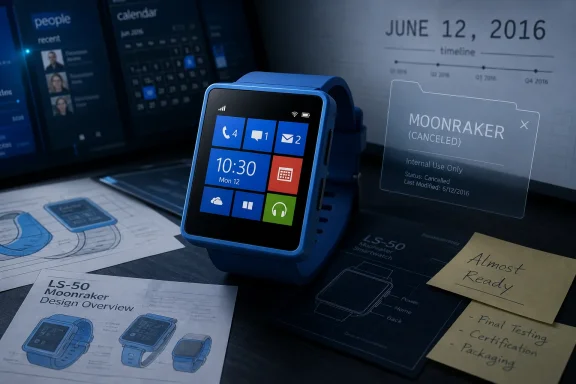 Moonraker Was Not a Rumor So Much as a Strategy Left on the Floor
Moonraker entered public memory through leaks, design images, and retrospective reporting, but the interesting part is not that Nokia had a smartwatch. By the middle of the 2010s, every serious mobile platform owner was experimenting with the wrist. The interesting part is that Nokia’s watch looked like it belonged to a coherent Microsoft mobile universe before Microsoft itself decided that universe was no longer worth finishing.The device, reportedly known internally as Moonraker and identified as model LS-50, carried the visual DNA of Lumia hardware. It had the blocky confidence of Windows Phone, the bright color options that made Nokia phones instantly recognizable, and a user interface that leaned into tiles rather than trying to imitate a miniature iPhone. In an industry that would soon settle into rounded rectangles, fitness rings, and notification mirrors, Moonraker looked like a product with a point of view.
That point of view is what makes the cancellation sting a decade later. Moonraker was not trying to be a generic wearable with Microsoft services sprinkled on top. It appeared to be a Windows Phone accessory in the fullest sense: glanceable, colorful, personal, and tightly coupled to a phone platform that still believed design could be a differentiator.
The reported timing sharpened the missed opportunity. Nokia had been preparing to reveal the watch alongside the Lumia 930, with working prototypes shown privately around Mobile World Congress before Microsoft’s acquisition of Nokia’s devices business changed the calculus. In other words, this was not blue-sky concept art from a design lab. It was close enough to launch that people outside the company had apparently seen it, handled it, or at least been pitched on it.
The Wrist Was Where Windows Phone’s Best Ideas Made Sense
Windows Phone was always better at the glance than at the grind. Its live tiles, typography, deep black backgrounds, and motion language were built around quick recognition rather than app-drawer spelunking. On a phone, that made the platform feel elegant but sometimes constrained; on a watch, it might have been exactly the right instinct.A smartwatch is not a place for desktop metaphors. It is not even a place for conventional smartphone metaphors. The user has a few seconds, a tiny screen, and an almost physical intolerance for friction. Windows Phone’s Metro design language, for all the ways Microsoft later diluted and renamed it, understood that constraint better than most mobile interfaces of its time.
Moonraker’s rumored interactions fit that philosophy. Lifting the wrist to read a text and lowering it to turn off the display sounds ordinary now because the category absorbed those behaviors. In 2014 and 2015, they were still part of the argument over what a smartwatch should be. Moonraker seems to have answered: not a tiny PC, not a tiny phone, but a notification and action surface with enough personality to feel like an extension of the Lumia.
That is why the watch occupies such an odd place in Microsoft lore. It was less radical than HoloLens, less commercially important than Surface, and less technically ambitious than the later Surface Duo. Yet as a product concept, it may have been more immediately intelligible than all of them. People understood phones. People understood watches. People understood colorful Nokia hardware. Moonraker connected those dots.
Microsoft Chose the Band, and the Band Chose Metrics Over Meaning
Microsoft did ship a wearable, of course. The Microsoft Band arrived as a fitness-focused device stuffed with sensors and ambition, and the second-generation Band refined the hardware before the whole line disappeared. In classic Microsoft fashion, the Band was both impressive and somehow not quite the product the market wanted from Microsoft.The Band’s core bet was that health telemetry would define the wearable category. That was not an absurd bet. Fitness tracking mattered then and matters now, and Microsoft had genuine technical muscle behind cloud services, health data, and cross-platform syncing. The Band worked with Windows Phone, iOS, and Android, which made it more pragmatic than a Lumia-only watch would have been.
But pragmatism can also be a kind of surrender. The Band did not give Windows Phone users a stronger emotional reason to stay in the ecosystem. It did not turn Lumia into a family of devices. It did not make Microsoft’s mobile interface feel inevitable across screens. It was a capable fitness band from a company that seemed unsure whether it wanted to sell hardware, collect health data, court developers, or prove that it could do all of the above.
Moonraker, by contrast, would have been narrower but clearer. It would have said: if you buy into Lumia, this is what your wrist looks like. That was the play Apple made with the Apple Watch, not because the first Apple Watch was perfect, but because it made the iPhone more central. Microsoft’s Band tried to be useful everywhere. Moonraker might have made Windows Phone feel necessary somewhere.
The Cancellation Captured Microsoft’s Post-Nokia Confusion
Microsoft’s Nokia acquisition was supposed to give Windows Phone the hardware integration it lacked. Instead, it became a case study in strategic whiplash. The company bought a phone business, inherited a pipeline of devices, and then began deciding which parts of that inherited future still belonged to Microsoft’s new one.Moonraker appears to have been a casualty of that moment. If the watch overlapped with Microsoft Band, if it depended too heavily on Lumia, or if it complicated a hardware roadmap already under stress, cancellation may have looked sensible inside Redmond. The problem is that product strategy is not only about avoiding overlap. Sometimes overlap is the evidence that a company has found the next layer of its ecosystem.
Apple did not avoid the watch because the iPhone already had notifications. Samsung did not avoid wearables because Android phones already had fitness apps. Google spent years fumbling the category precisely because it lacked a clean story for why Android on the wrist should matter. Microsoft had, at least in Moonraker, the outline of that story and chose not to tell it.
This was the Windows Phone era in miniature. Microsoft often had the pieces: elegant interface work, strong industrial design partners, developer tools, cloud services, Xbox, Office, Skype, and a user base that was smaller than its rivals’ but unusually passionate. What it lacked was the patience and internal alignment to turn those pieces into a compounding platform.
A Watch Could Not Have Saved Windows Phone, but It Might Have Changed the Failure
It is tempting to turn Moonraker into a grand alternate history. If Microsoft had shipped the watch, perhaps Lumia would have gained momentum, developers would have paid attention, and Windows Phone might have survived long enough to become the third ecosystem everyone claimed to want. That version is emotionally satisfying and probably wrong.By the time Moonraker would have launched, Windows Phone faced structural problems too large for one accessory to fix. App availability remained a drag. Carrier support was inconsistent. Android had scaled across price tiers with brutal efficiency, and Apple owned the premium phone-and-services loop. Microsoft’s own attention was shifting toward Office everywhere, Azure, and eventually a more platform-agnostic identity.
But products can change the texture of a failure. A Moonraker launch would have shown that Microsoft still believed Windows Phone deserved a surrounding universe. It would have given Lumia loyalists another reason to identify with the platform, another visible object that made the ecosystem feel alive. Even if Windows Phone ultimately lost, it might have gone down looking less abandoned.
That matters because consumer platforms are sustained by confidence as much as capability. Users do not merely ask whether their current device works. They ask whether the company behind it is still building the next thing. Moonraker’s cancellation sent the opposite signal, even if most users did not know it at the time: the future had been prototyped, photographed, and shelved.
The Design Looks Better Now Because Modern Wearables Became So Conservative
A decade of smartwatch evolution has made Moonraker look less quaint than it should. Modern wearables are far more powerful, far more polished, and far more medically capable than anything Nokia was preparing. Yet visually, the category has narrowed. Most watches now orbit the same ideas: app grids, complication-heavy faces, fitness dashboards, and hardware that tries to be either jewelry or a black slab.Moonraker’s charm is that it came from a different design lineage. Lumia hardware was playful without being unserious. Windows Phone was minimal without being sterile. The combination produced devices that looked approachable in a way today’s premium wearables often do not.
That does not mean Moonraker would have been a design triumph in daily use. Early smartwatch interfaces were frequently awkward, battery life was unforgiving, and third-party developer support was uncertain. A colorful square watch with a Metro interface might have delighted enthusiasts and confused everyone else.
Still, the images endure because they show a company willing to imagine the wrist as something other than a shrunken notification tray. Moonraker had the confidence to look like a Microsoft-Nokia product, not an apology for being one. In retrospect, that confidence was rarer than the hardware itself.
The Ghost of Moonraker Still Haunts Microsoft’s Device Ambitions
Microsoft has spent the years since Moonraker trying to define what kind of device company it wants to be. Surface became the successful answer for PCs: premium, opinionated, and influential even when sales were not Apple-scale. Xbox remained its own gravitational field. HoloLens pushed into mixed reality before the market was ready, while Surface Duo revisited mobile with a fascinating dual-screen idea that never found mainstream footing.The pattern is familiar. Microsoft can build striking hardware when it has a clear thesis. Surface argued that Windows PCs could be aspirational. Xbox argued that Microsoft belonged in the living room. HoloLens argued that spatial computing would eventually matter. Duo argued that productivity could justify a different kind of phone.
Moonraker’s thesis was simpler: Microsoft’s mobile world should extend to the wrist. That idea now seems obvious because Apple proved it at scale. The Apple Watch did not begin as the fully mature health and safety device it later became. It began as an accessory that made the iPhone ecosystem stickier and more personal. Microsoft had a version of that logic sitting in the Nokia pipeline and declined to operationalize it.
The lesson is not that every canceled prototype should ship. Companies kill products for good reasons, including cost, duplication, weak market signals, and technical readiness. The lesson is that ecosystem products often look optional until a competitor turns them into habit. By the time habit forms elsewhere, catching up requires more than a better spec sheet.
For Windows Fans, Moonraker Is Nostalgia With Teeth
The Windows Phone community has always been unusually fluent in grief. Its members remember devices that were better than their sales numbers, interfaces that felt fresher than their app stores, and corporate pivots that arrived with the cold inevitability of quarterly strategy. Moonraker fits that emotional archive perfectly because it is both real enough to mourn and unreal enough to idealize.But nostalgia alone is too easy. The sharper reading is that Moonraker reveals how close Microsoft came to understanding the post-PC transition on its own terms. The company did not need to copy Apple’s watch strategy exactly. It needed to believe that Windows Phone users deserved a hardware ecosystem with continuity, rhythm, and visible commitment.
Instead, Microsoft increasingly treated mobile as a place where its services needed to live, not as a platform it needed to own. That was the right business move in many respects. Office on iPhone and Android mattered more to Microsoft’s future than protecting a shrinking phone OS. Azure and Microsoft 365 would become the center of gravity. Shareholders were rewarded handsomely for the pivot.
Yet something was lost in that transition, and Moonraker gives it a shape. Microsoft stopped trying to make the most personal devices feel unmistakably Microsoft. Today, the company’s software is everywhere, but its consumer hardware identity outside Xbox and Surface is far less intimate than it might have been.
The Small Watch That Explains the Big Retreat
Moonraker’s most useful legacy is not as a collectible curiosity. It is a diagnostic object. It helps explain how Microsoft moved from platform maximalism to services realism, and why that shift, however financially successful, left Windows enthusiasts with a lingering sense of unfinished business.For administrators and IT pros, the lesson is less sentimental. Ecosystems matter because they determine support horizons, identity models, app investments, and user expectations. When a vendor kills a device before launch, the immediate blast radius is small. When it kills the strategic thread behind that device, customers learn to discount the next experiment.
That discount still affects Microsoft. Every new hardware category from Redmond arrives with an unspoken question: will this become Surface, or will this become Band? Will Microsoft iterate through the awkward early years, or will it pivot once the internal champion leaves, the market takes longer than expected, or the enterprise use case proves easier than the consumer one?
Moonraker cannot answer those questions, but it explains why they are asked. Microsoft has earned enormous credibility in cloud, productivity, security, and enterprise management. It has also taught consumers to be careful with its more personal hardware dreams. The watch that never shipped is part of that education.
The Anniversary Leaves a Few Hard Lessons on the Table
Moonraker’s tenth anniversary is not just an excuse to admire old Lumia-colored renders. It is a reminder that timing, conviction, and ecosystem design often matter more than whether a prototype was technically ahead of its day.- Moonraker was reportedly close enough to launch that its cancellation should be seen as a strategic decision, not merely routine lab cleanup.
- The watch made more conceptual sense as a Windows Phone companion than Microsoft Band did as a cross-platform fitness device.
- A shipped Moonraker probably would not have saved Windows Phone, but it could have strengthened user confidence at a moment when confidence was collapsing.
- Microsoft’s choice reflected a broader move away from owning consumer mobile experiences and toward placing Microsoft services on rival platforms.
- The device still resonates because it expressed a coherent design language that modern wearables often lack.
- For today’s Microsoft customers, Moonraker remains a cautionary example of how quickly promising hardware ideas can disappear when platform strategy changes.
References
- Primary source: Windows Central
Published: 2026-06-13T18:53:19.376225
On this day: Microsoft’s unreleased Moonraker smartwatch still feels ahead of its time | Windows Central
A decade later, Microsoft’s unreleased Moonraker smartwatch still feels like a glimpse into an alternate timeline.www.windowscentral.com - Related coverage: techspot.com
This is the Nokia Moonraker, a smartwatch killed by Microsoft | TechSpot
Up until the company's acquisition by Microsoft, Nokia was working on a smartwatch known as 'Moonraker', which featured a square display, a Windows Phone-like operating system, and...www.techspot.com - Related coverage: roonby.com
Microsoft Moonraker, the Nokia Smartwatch It was Cancelled – Roonby
According to sources inside Microsoft, Microsoft Moonraker was concept by Nokia to be launched together with the Lumia 930roonby.com
- Related coverage: hardzone.es
Microsoft Moonraker, el smartwatch cancelado de Nokia
Os contamos cómo era el Microsoft Moonraker, un smartwatch fabricado por Nokia que nunca llegó a salir al mercado y que dudamos que lo haga. hardzone.es
- Related coverage: notebookcheck.net
Microsoft "Moonraker" may be a Lumia SmartWatch - Notebookcheck News
Images from Tumblr have appeared with the caption "Microsoft Moonraker" and hints at an upcoming Lumia SmartWatch www.notebookcheck.net
- Related coverage: afterdawn.com
Moonraker was Nokia's take on the smartwatch - AfterDawn
Every company in the mobile space seems to now have it, a smartwatch. You have the Motorola 360, the Samsung Galaxy Gear, the LG Watch Urbane, and of course the Apple Watch. ...www.afterdawn.com
- Related coverage: engadget.com
Microsoft Moonraker is the Nokia smartwatch we almost got
If you were wondering what Nokia's take on a smartwatch would have been, take a look at the Microsoft Moonraker, a cancelled watch that attempted to bring in some of Windows Phone's style. Microsoft nixed it when it acquired Nokia's phone arm, The Verge reports, but now we've got an idea of what...www.engadget.com - Related coverage: androidheadlines.com
Nokia's Scrapped "Moonraker" Smartwatch Leaked Online
New images of Nokia's cancelled Moonraker smartwatch have surfaced on Twitter earlier this month, courtesy of Evan Blass, better known under his user www.androidheadlines.com
- Related coverage: techtimes.com
Microsoft Killed Nokia's Moonraker Smartwatch So That Band May Live
Nokia was working on a smartwatch that took design cues from Microsoft’s Windows 8. The smartwatch was nearing completion, but Microsoft put an end to that.www.techtimes.com - Related coverage: xataka.com
Microsoft Moonraker: así iba a ser el smartwatch de Nokia
Microsoft no ha entrado en el segmento de los relojes inteligentes. Al menos, no lo ha hecho de momento. La compra de Nokia en septiembre de 2013 cambió...www.xataka.com - Related coverage: mobilesyrup.com
Microsoft's shelved 'Moonraker' smartwatch makes an appearance - MobileSyrup
Prior to being purchased by Microsoft, Nokia was developing its own smartwatch that had a codename of "Moonraker."mobilesyrup.com - Related coverage: computeam.co.uk
- Official source: techcommunity.microsoft.com
