

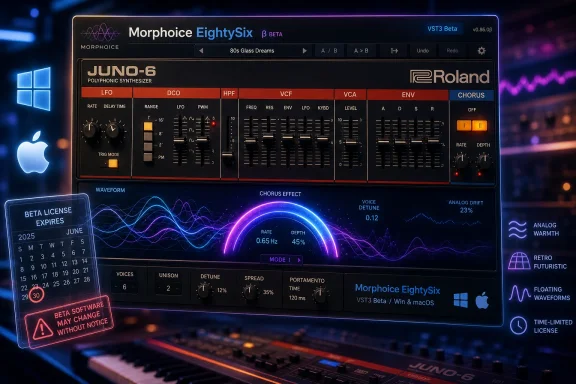
Morphoice released EightySix beta on May 26, 2026, as a free VST3 software emulation of Roland’s Juno-6 synthesizer for Windows 10/11 and macOS systems running either Apple Silicon or Intel hardware. The catch is hiding in plain sight: this is free right now, not necessarily free forever. That makes EightySix less a simple giveaway than a public audition for another entrant in one of music software’s most crowded nostalgia markets. For Windows producers and synth-curious hobbyists, it is also a reminder that “free beta” increasingly means both opportunity and risk.
The pitch for EightySix is immediately familiar: a circuit-modeled recreation of a beloved early-1980s polyphonic analog synth, wrapped in an interface that leans into immediacy rather than menu diving. The Juno-6 has always been an unusually easy instrument to romanticize because its simplicity is part of the myth. One oscillator architecture, a lush chorus, direct controls, and a sound that can move from polite pop pad to melancholic neon haze without requiring the user to become a modular theorist.
Morphoice is not pretending otherwise. The developer describes EightySix as modeled after a restored Juno-6 unit, with saw, pulse, and sub oscillators, the expected resonant low-pass filter, high-pass filtering, pulse-width modulation modes, envelope and LFO behavior matched to the original timings, and the classic two-mode Juno chorus. The package also includes extras that Roland’s early-1980s engineers did not ship, including a dedicated effects page with Morphoice’s DarkStar reverb and delay engine.
That is the practical bargain of almost every modern vintage emulation. Users say they want the exact machine. Developers know they also want recall, automation, stereo effects, modern DAW compatibility, and some latitude to make sounds that the original hardware could not produce on its own. EightySix is trying to sell authenticity and convenience at the same time, which is not a contradiction so much as the entire modern plug-in economy.
The more interesting detail is the licensing posture. Morphoice’s own page says the beta may stop working when the final release arrives. Bedroom Producers Blog also notes that the final version may become paid-only. That does not make the release deceptive, but it does make it different from the old-school freeware bargain where a tool might remain available indefinitely, rough edges and all.
That is why Juno emulations are judged by feel as much as by feature count. A developer can reproduce the panel and still miss the experience. The original instrument’s charm lives in the small behaviors: how pulse-width modulation breathes, how the filter opens under a simple envelope, how the chorus smears motion without collapsing the sound, and how quickly a player can arrive at something usable.
EightySix enters a field that already contains serious competitors. TAL’s U-NO-LX has long been a favorite among producers who want a convincing Juno-60-style plug-in without buying into a larger ecosystem. Arturia, Softube, Roland itself, and others have their own takes on the formula. Some are explicitly polished commercial products; others are bundled into subscription or suite strategies. A free beta from a smaller developer can get attention, but attention is not the same thing as trust.
That matters because the Juno sound is no longer rare in software. The scarcity has shifted from access to confidence. Producers are no longer asking whether they can get a Juno-like pad in a DAW. They are asking whether a particular plug-in is efficient, stable, automatable, supported, and distinctive enough to deserve a place in a template already full of credible alternatives.
The narrower format support is still worth noticing. There is no mention of CLAP, AAX, standalone operation, or legacy VST2. For many bedroom producers, that will not matter. For professional studios, post-production rigs, or users building cross-platform workflows, it may limit where EightySix fits.
The macOS build supports both Apple Silicon and Intel systems, which is also the correct move at this point in the transition cycle. Intel Mac users are still out there, but Apple Silicon native support is increasingly expected rather than praised. A plug-in that launches as Apple Silicon-only would frustrate older studios; one that launches Intel-only would feel behind the curve.
The more consequential platform issue is not compatibility but longevity. If the beta can stop working at final release, users should treat EightySix as a promising instrument to explore rather than a safe dependency for archival sessions. In a world where old DAW projects already break under OS updates, authorization systems, and discontinued plug-ins, a time-limited or version-limited beta should not become the only source of an important sound.
But “circuit-modeled” has also become elastic. It can mean painstaking emulation of nonlinear component behavior. It can mean a hybrid approach that models some elements deeply and approximates others. It can mean the developer is working from a real hardware unit but making pragmatic choices to keep CPU use tolerable. Without detailed technical documentation, the phrase is less a proof than a promise.
The early response described by Bedroom Producers Blog captures that ambiguity well. The plug-in can produce attractive sounds, especially retro-futuristic pads, and it clearly points the ear toward Juno territory. At the same time, the report suggests that some behaviors, particularly around the chorus, do not yet feel instantly familiar compared with other emulations.
That is not fatal in a beta. In fact, it is exactly the kind of criticism a public beta is supposed to surface. But it does define the challenge. A Juno emulation cannot merely sound pleasant. It has to make users stop comparing and start playing.
That creates a problem for developers. Chorus behavior is easy to overstate and hard to nail. Too subtle, and the instrument feels dry and polite. Too wide, and it becomes a caricature. Too clean, and it loses character. Too noisy, and users complain that the emulation is imposing nostalgia rather than enabling music.
EightySix includes the two expected Juno chorus modes, but the early critique that the behavior does not feel immediately familiar is important. It points to a broader truth about emulations: users rarely compare isolated waveforms. They compare muscle memory. If a producer reaches for a Juno-style patch and the chorus does not bloom the way their hands expect, the illusion weakens quickly.
That is where Morphoice’s beta status may be an advantage. A chorus circuit is exactly the sort of feature that can be refined through user feedback, especially from people who own or regularly use real Juno hardware. The danger is that public perception often hardens early. If the first wave of users decides a plug-in is “nice but not quite Juno,” the final release has to work harder to change the story.
But the missing arpeggiator still matters because the Juno-6 was not just a tone generator. It was a performance interface. Its arpeggiator is part of the instrument’s identity, especially for users chasing period-correct lines and simple synchronized motion. Leaving it out of the initial beta reinforces the sense that EightySix is a work in progress rather than a complete replacement.
The irony is that an arpeggiator may be technically less impressive than circuit-modeled filters and chorus behavior, but emotionally more visible to users. A missing menu item can be ignored. A missing hands-on performance behavior changes how someone approaches the instrument in the first five minutes.
This is the kind of gap that can be forgiven in a free beta and criticized in a paid final release. If EightySix eventually asks users for money, the expectation shifts from “promising experiment” to “finished instrument.” At that point, the arpeggiator cannot remain a roadmap item without becoming part of the product’s reputation.
High CPU use can be defensible in an instrument that delivers something exceptional. Producers will freeze tracks, print stems, or reserve a heavyweight plug-in for lead parts if the sound justifies the cost. But a Juno emulation occupies a different role in many arrangements. It is often used for pads, chords, layers, basses, and multiple instances across a project. Efficiency matters because the sound is supposed to be effortless.
This is especially relevant on Windows, where users may be running a wider range of CPUs, audio interfaces, drivers, and DAW configurations than the typical curated Mac development environment. A plug-in that behaves acceptably on a developer’s system can expose rough edges across the Windows ecosystem. Buffer-size sensitivity, denormal issues, graphics overhead, and host-specific quirks can all become part of the user experience.
The tension is familiar: deeper modeling often costs cycles. But the best commercial emulations have trained users to expect both character and practicality. If EightySix remains unusually heavy, it will need either a sound that clearly beats the field or optimization work before a paid release. Otherwise, the free beta will be praised as generous and quietly removed from serious templates.
EightySix benefits from that context. Rough CPU behavior, missing features, and debatable authenticity are all easier to tolerate when the price is zero and the developer is visibly still shaping the product. For a small independent developer, this is also a rational way to compete against entrenched brands with marketing budgets, long product histories, and broader plug-in ecosystems.
But the beta label cannot excuse everything. If the plug-in may stop working at final release, users need to understand what they are installing. If the final release may be paid-only, then the beta is also a promotional channel. That does not make it cynical, but it does place a responsibility on the developer to communicate clearly about expiration, licensing, project compatibility, and upgrade paths.
There is an old freeware culture in music software built on trust, curiosity, and a certain tolerance for roughness. There is also a newer product-launch culture that uses free access to build funnels. EightySix sits somewhere between those worlds. How Morphoice handles the transition from beta to final may matter almost as much as how the filter sounds.
That explains why developers keep returning to this territory. It is not just that the Juno name carries cultural weight. It is that the instrument’s design solves a modern problem. Too many plug-ins are capable in theory and exhausting in practice. A convincing Juno emulation offers a narrower promise: a few controls, a familiar tone, and fast results.
But nostalgia alone is losing power as the software market matures. Users already have access to strong Juno-like instruments. Some are cheap. Some are bundled. Some are backed by companies with long support histories. To stand out, EightySix needs more than a famous reference point and an attractive price.
Its best chance may be personality. If Morphoice can make EightySix feel like a specific restored Juno-6 rather than a generic idealized Juno, the plug-in could earn a place even among users who already own alternatives. The market does not need another competent emulation. It might still have room for one with a point of view.
That does not mean avoiding it. The best time to influence a small developer’s instrument is before the final release locks assumptions into place. If EightySix is too heavy on your system, if the chorus feels off, if automation behaves strangely in your DAW, or if the interface creates friction, now is the moment when feedback can matter.
It also means users should be disciplined. Print audio for important parts. Save installer versions where licensing allows. Note which build was used in a project. Avoid assuming that a beta session will reopen cleanly years from now. Those habits sound boring until they save a track.
For Morphoice, the path forward is clear but demanding. The arpeggiator needs to arrive. CPU use needs scrutiny. The chorus needs to satisfy users who know what they are listening for. The developer also needs to clarify the commercial future before producers start treating the beta as permanent freeware.
If those pieces come together, EightySix could become more than another retro plug-in headline. It could become a credible independent alternative in a category dominated by familiar names. If they do not, it may remain a charming beta that people download, test, praise politely, and replace with the Juno emulation they already trust.
 The Free Synth Is Also a Market Test
The pitch for EightySix is immediately familiar: a circuit-modeled recreation of a beloved early-1980s polyphonic analog synth, wrapped in an interface that leans into immediacy rather than menu diving. The Juno-6 has always been an unusually easy instrument to romanticize because its simplicity is part of the myth. One oscillator architecture, a lush chorus, direct controls, and a sound that can move from polite pop pad to melancholic neon haze without requiring the user to become a modular theorist.Morphoice is not pretending otherwise. The developer describes EightySix as modeled after a restored Juno-6 unit, with saw, pulse, and sub oscillators, the expected resonant low-pass filter, high-pass filtering, pulse-width modulation modes, envelope and LFO behavior matched to the original timings, and the classic two-mode Juno chorus. The package also includes extras that Roland’s early-1980s engineers did not ship, including a dedicated effects page with Morphoice’s DarkStar reverb and delay engine.
That is the practical bargain of almost every modern vintage emulation. Users say they want the exact machine. Developers know they also want recall, automation, stereo effects, modern DAW compatibility, and some latitude to make sounds that the original hardware could not produce on its own. EightySix is trying to sell authenticity and convenience at the same time, which is not a contradiction so much as the entire modern plug-in economy.
The more interesting detail is the licensing posture. Morphoice’s own page says the beta may stop working when the final release arrives. Bedroom Producers Blog also notes that the final version may become paid-only. That does not make the release deceptive, but it does make it different from the old-school freeware bargain where a tool might remain available indefinitely, rough edges and all.
The Juno-6 Is Simple Enough to Copy and Hard Enough to Convince
The Juno-6 is a strange target because, on paper, it looks almost too modest to justify endless reinvention. It lacks patch memory, has a relatively straightforward digitally controlled oscillator design, and does not offer the kind of sprawling modulation matrix that modern soft synths treat as table stakes. Its appeal has always come from the way a few elements interact: stable oscillators, a musical filter, fast hands-on control, and a chorus that can turn restrained material into a record-ready wash.That is why Juno emulations are judged by feel as much as by feature count. A developer can reproduce the panel and still miss the experience. The original instrument’s charm lives in the small behaviors: how pulse-width modulation breathes, how the filter opens under a simple envelope, how the chorus smears motion without collapsing the sound, and how quickly a player can arrive at something usable.
EightySix enters a field that already contains serious competitors. TAL’s U-NO-LX has long been a favorite among producers who want a convincing Juno-60-style plug-in without buying into a larger ecosystem. Arturia, Softube, Roland itself, and others have their own takes on the formula. Some are explicitly polished commercial products; others are bundled into subscription or suite strategies. A free beta from a smaller developer can get attention, but attention is not the same thing as trust.
That matters because the Juno sound is no longer rare in software. The scarcity has shifted from access to confidence. Producers are no longer asking whether they can get a Juno-like pad in a DAW. They are asking whether a particular plug-in is efficient, stable, automatable, supported, and distinctive enough to deserve a place in a template already full of credible alternatives.
Windows Producers Get the Right Format, but Not the Whole Platform Story
For Windows users, the good news is that EightySix arrives in VST3 format for Windows 10 and Windows 11. That is the right baseline in 2026. VST3 is widely supported across major Windows DAWs, and releasing directly into that format avoids the feeling of a macOS-first instrument grudgingly ported later.The narrower format support is still worth noticing. There is no mention of CLAP, AAX, standalone operation, or legacy VST2. For many bedroom producers, that will not matter. For professional studios, post-production rigs, or users building cross-platform workflows, it may limit where EightySix fits.
The macOS build supports both Apple Silicon and Intel systems, which is also the correct move at this point in the transition cycle. Intel Mac users are still out there, but Apple Silicon native support is increasingly expected rather than praised. A plug-in that launches as Apple Silicon-only would frustrate older studios; one that launches Intel-only would feel behind the curve.
The more consequential platform issue is not compatibility but longevity. If the beta can stop working at final release, users should treat EightySix as a promising instrument to explore rather than a safe dependency for archival sessions. In a world where old DAW projects already break under OS updates, authorization systems, and discontinued plug-ins, a time-limited or version-limited beta should not become the only source of an important sound.
Circuit Modeling Has Become a Credibility Claim
Morphoice describes EightySix as circuit-modeled, which is now one of the most powerful phrases in vintage synth marketing. It signals seriousness. It tells users that this is not just a skin over a generic subtractive engine. It implies measurement, component-level behavior, and a developer who listened to the machine rather than simply read the front panel.But “circuit-modeled” has also become elastic. It can mean painstaking emulation of nonlinear component behavior. It can mean a hybrid approach that models some elements deeply and approximates others. It can mean the developer is working from a real hardware unit but making pragmatic choices to keep CPU use tolerable. Without detailed technical documentation, the phrase is less a proof than a promise.
The early response described by Bedroom Producers Blog captures that ambiguity well. The plug-in can produce attractive sounds, especially retro-futuristic pads, and it clearly points the ear toward Juno territory. At the same time, the report suggests that some behaviors, particularly around the chorus, do not yet feel instantly familiar compared with other emulations.
That is not fatal in a beta. In fact, it is exactly the kind of criticism a public beta is supposed to surface. But it does define the challenge. A Juno emulation cannot merely sound pleasant. It has to make users stop comparing and start playing.
The Chorus Is Not an Effect; It Is the Instrument’s Memory
The Juno chorus is one of those circuits that became bigger than the synthesizer it lived inside. It is invoked as a mood, not just a modulation effect. For many listeners, the chorus is the difference between a plain DCO polysynth and the emotionally loaded sound associated with new wave, synth-pop, ambient, vaporwave, and countless film-score imitations of the 1980s.That creates a problem for developers. Chorus behavior is easy to overstate and hard to nail. Too subtle, and the instrument feels dry and polite. Too wide, and it becomes a caricature. Too clean, and it loses character. Too noisy, and users complain that the emulation is imposing nostalgia rather than enabling music.
EightySix includes the two expected Juno chorus modes, but the early critique that the behavior does not feel immediately familiar is important. It points to a broader truth about emulations: users rarely compare isolated waveforms. They compare muscle memory. If a producer reaches for a Juno-style patch and the chorus does not bloom the way their hands expect, the illusion weakens quickly.
That is where Morphoice’s beta status may be an advantage. A chorus circuit is exactly the sort of feature that can be refined through user feedback, especially from people who own or regularly use real Juno hardware. The danger is that public perception often hardens early. If the first wave of users decides a plug-in is “nice but not quite Juno,” the final release has to work harder to change the story.
The Missing Arpeggiator Is a Small Feature With Symbolic Weight
Morphoice says the Juno arpeggiator is coming in a future update. In pure feature terms, that is not disastrous. Many DAWs already include arpeggiators, MIDI effects, pattern tools, and step sequencers that can drive a Juno-style plug-in more flexibly than the original hardware ever could.But the missing arpeggiator still matters because the Juno-6 was not just a tone generator. It was a performance interface. Its arpeggiator is part of the instrument’s identity, especially for users chasing period-correct lines and simple synchronized motion. Leaving it out of the initial beta reinforces the sense that EightySix is a work in progress rather than a complete replacement.
The irony is that an arpeggiator may be technically less impressive than circuit-modeled filters and chorus behavior, but emotionally more visible to users. A missing menu item can be ignored. A missing hands-on performance behavior changes how someone approaches the instrument in the first five minutes.
This is the kind of gap that can be forgiven in a free beta and criticized in a paid final release. If EightySix eventually asks users for money, the expectation shifts from “promising experiment” to “finished instrument.” At that point, the arpeggiator cannot remain a roadmap item without becoming part of the product’s reputation.
CPU Usage Is the Price of Authenticity Until It Becomes the Problem
The Bedroom Producers Blog report flags CPU usage as significantly higher than other circuit-modeled synths the writer uses on a high-spec MacBook. That is the sort of sentence that makes experienced DAW users pay attention. Sound demos sell plug-ins, but CPU meters decide whether they survive in real projects.High CPU use can be defensible in an instrument that delivers something exceptional. Producers will freeze tracks, print stems, or reserve a heavyweight plug-in for lead parts if the sound justifies the cost. But a Juno emulation occupies a different role in many arrangements. It is often used for pads, chords, layers, basses, and multiple instances across a project. Efficiency matters because the sound is supposed to be effortless.
This is especially relevant on Windows, where users may be running a wider range of CPUs, audio interfaces, drivers, and DAW configurations than the typical curated Mac development environment. A plug-in that behaves acceptably on a developer’s system can expose rough edges across the Windows ecosystem. Buffer-size sensitivity, denormal issues, graphics overhead, and host-specific quirks can all become part of the user experience.
The tension is familiar: deeper modeling often costs cycles. But the best commercial emulations have trained users to expect both character and practicality. If EightySix remains unusually heavy, it will need either a sound that clearly beats the field or optimization work before a paid release. Otherwise, the free beta will be praised as generous and quietly removed from serious templates.
The Beta Label Buys Patience, Not Immunity
A beta release is a contract with the public. The developer gets broad testing, user feedback, visibility, and a chance to build a community before launch. Users get early access and, in this case, a free instrument. The exchange works when both sides remember that the software is unfinished.EightySix benefits from that context. Rough CPU behavior, missing features, and debatable authenticity are all easier to tolerate when the price is zero and the developer is visibly still shaping the product. For a small independent developer, this is also a rational way to compete against entrenched brands with marketing budgets, long product histories, and broader plug-in ecosystems.
But the beta label cannot excuse everything. If the plug-in may stop working at final release, users need to understand what they are installing. If the final release may be paid-only, then the beta is also a promotional channel. That does not make it cynical, but it does place a responsibility on the developer to communicate clearly about expiration, licensing, project compatibility, and upgrade paths.
There is an old freeware culture in music software built on trust, curiosity, and a certain tolerance for roughness. There is also a newer product-launch culture that uses free access to build funnels. EightySix sits somewhere between those worlds. How Morphoice handles the transition from beta to final may matter almost as much as how the filter sounds.
Nostalgia Is No Longer Enough in a Crowded Plug-In Folder
The Juno-6 remains a powerful symbol because it represents a version of electronic music production that feels tactile, limited, and immediate. Modern producers often work inside DAWs that can do almost anything, which makes a deliberately constrained instrument feel liberating. A Juno-style synth says: stop browsing and move a slider.That explains why developers keep returning to this territory. It is not just that the Juno name carries cultural weight. It is that the instrument’s design solves a modern problem. Too many plug-ins are capable in theory and exhausting in practice. A convincing Juno emulation offers a narrower promise: a few controls, a familiar tone, and fast results.
But nostalgia alone is losing power as the software market matures. Users already have access to strong Juno-like instruments. Some are cheap. Some are bundled. Some are backed by companies with long support histories. To stand out, EightySix needs more than a famous reference point and an attractive price.
Its best chance may be personality. If Morphoice can make EightySix feel like a specific restored Juno-6 rather than a generic idealized Juno, the plug-in could earn a place even among users who already own alternatives. The market does not need another competent emulation. It might still have room for one with a point of view.
The Free Beta Should Be Treated Like a Borrowed Synth
For WindowsForum readers, the practical advice is simple: download it if the sound interests you, but do not build irreplaceable work around it yet. A free beta from an independent developer is exactly the kind of thing that can make a weekend more interesting. It is not yet the kind of thing that should become a mission-critical production dependency.That does not mean avoiding it. The best time to influence a small developer’s instrument is before the final release locks assumptions into place. If EightySix is too heavy on your system, if the chorus feels off, if automation behaves strangely in your DAW, or if the interface creates friction, now is the moment when feedback can matter.
It also means users should be disciplined. Print audio for important parts. Save installer versions where licensing allows. Note which build was used in a project. Avoid assuming that a beta session will reopen cleanly years from now. Those habits sound boring until they save a track.
The Real Test Will Come After the Download Spike
The first wave of attention around EightySix is almost guaranteed because the ingredients are irresistible: free, Juno, macOS, Windows, beta, circuit-modeled. The harder phase comes later, after users have compared it with TAL, Arturia, Softube, Roland, and the many Juno-adjacent options already in circulation. That is when the conversation shifts from discovery to retention.For Morphoice, the path forward is clear but demanding. The arpeggiator needs to arrive. CPU use needs scrutiny. The chorus needs to satisfy users who know what they are listening for. The developer also needs to clarify the commercial future before producers start treating the beta as permanent freeware.
If those pieces come together, EightySix could become more than another retro plug-in headline. It could become a credible independent alternative in a category dominated by familiar names. If they do not, it may remain a charming beta that people download, test, praise politely, and replace with the Juno emulation they already trust.
Where the Beta’s Fine Print Should Guide the First Weekend
EightySix is worth attention because it arrives at the intersection of three trends: the continued appetite for 1980s synth character, the normalization of circuit-modeling as a marketing and engineering benchmark, and the use of free public betas as launch strategy. The concrete takeaways are less romantic but more useful.- EightySix is currently free, but users should not assume the beta will keep working after a final release arrives.
- The plug-in supports VST3 on Windows 10/11 and macOS, including both Apple Silicon and Intel Macs.
- The feature set covers the core Juno-6 architecture, but the arpeggiator is not yet included.
- The added DarkStar reverb and delay make EightySix more than a strict panel-for-panel recreation.
- Early impressions suggest promising Juno-like tones, especially pads, alongside concerns about CPU use and the exact feel of the chorus.
- Anyone using it in serious work should print important parts to audio until the licensing and final-release path are clearer.
References
- Primary source: Bedroom Producers Blog
Published: Tue, 26 May 2026 15:55:33 GMT
Morphoice releases EightySix (beta), a FREE Juno-6 emulation for macOS and Windows - Bedroom Producers Blog
Developer Morphoice has released the beta version of EightySix, a free Juno-6 emulation for macOS and Windows. EightySix is free right now, but this beta version may stop working when a final release is introduced. The final release may be paid only. Morphoice is a producer, composer, and...bedroomproducersblog.com - Related coverage: morphoice.com
EIGHTYSIX — Roland Juno-6 Emulation VST Synth (Free Download) | Morphoice
A year in the making, circuit modeled after a meticulously restored Roland Juno-6. Lush pads, shimmering choruses, and unmistakable analog warmth. Early beta out now. Free VST3 plugin for Mac and PC.www.morphoice.com - Related coverage: afroplug.com
Afroplug | African Sounds, Beats & Producer Tools
Discover Afrobeats, Amapiano & African sounds. Buy beats, sell loops, collaborate with producers and artists. Join the community shaping African music. afroplug.com
- Related coverage: blog.wavosaur.com
- Related coverage: castor6.nl
- Related coverage: articles.roland.com
Sound Design: Creating JUNO Basses - Roland Articles
The JUNO architecture makes it perfect for thick analog-style bass lines. Learn to create five different bass sounds with the classic synth.articles.roland.com
