

Microsoft’s strategic bet on consumer-facing AI has a new public face: Mustafa Suleyman, the DeepMind co‑founder turned Inflection AI CEO who joined Microsoft in March 2024 to run a newly created Microsoft AI division that consolidates Copilot, consumer research, and product development under one roof.
Microsoft created the Microsoft AI division as a one‑stop organization to accelerate innovation across its consumer products, integrate AI more deeply into Windows, Bing, Edge and Copilot, and to sustain a competitive edge in the fast‑moving AI market. Mustafa Suleyman was tapped to lead this effort and reports directly to CEO Satya Nadella, signaling the company’s intent to pair platform strength with a product‑centric leader who has deep experience building consumer AI experiences. Suleyman’s résumé is notable: co‑founder of DeepMind, an early force in deep reinforcement learning and scientific breakthroughs, and later co‑founder of Inflection AI, which focused on building conversational, “emotionally intelligent” assistants such as Pi. That background frames his approach — marrying research credibility with an obsession for polished user experiences.
For developers and ISVs, it signals investment in new APIs, SDKs and platform hooks that will expose Copilot capabilities and memory models. Enterprises should prepare for integrations where assistants handle sensitive workflows and require auditability, consent, and access controls.
Finally, device makers and OEMs will see renewed opportunities to differentiate with Copilot Plus PCs and hardware‑level optimizations for on‑device inference, though the balance between cloud and edge processing remains an engineering trade‑off.
If Suleyman’s vision succeeds, the result will be an assistant that feels personal and persistent across the Microsoft product family. If governance falters, the outcome could accelerate regulatory constraints and public backlash that slow adoption. Either way, the next 12–24 months will reveal whether Microsoft can keep its dual promises: to innovate boldly and to keep consumers safe.
Source: Business Chief Inside CEO Mustafa Suleyman’s Vision for Microsoft AI
 Background
Microsoft created the Microsoft AI division as a one‑stop organization to accelerate innovation across its consumer products, integrate AI more deeply into Windows, Bing, Edge and Copilot, and to sustain a competitive edge in the fast‑moving AI market. Mustafa Suleyman was tapped to lead this effort and reports directly to CEO Satya Nadella, signaling the company’s intent to pair platform strength with a product‑centric leader who has deep experience building consumer AI experiences. Suleyman’s résumé is notable: co‑founder of DeepMind, an early force in deep reinforcement learning and scientific breakthroughs, and later co‑founder of Inflection AI, which focused on building conversational, “emotionally intelligent” assistants such as Pi. That background frames his approach — marrying research credibility with an obsession for polished user experiences. Suleyman’s product vision: Copilot as a lasting companion
Mustafa Suleyman’s public statements and interviews make one thing clear: he sees Copilot evolving from a transaction‑oriented help tool into a personalized, persistent digital companion with identity, memory and a designed “presence.” He has described ideas such as Copilot “having a room that it lives in,” developing digital patina and even “aging” over time — metaphors for persistent context, long‑term personalization, and visual/behavioral continuity.What that means in practice
- Copilot moves beyond short queries and one‑off assistance to maintain memory and context across sessions, making follow‑up and proactivity more natural.
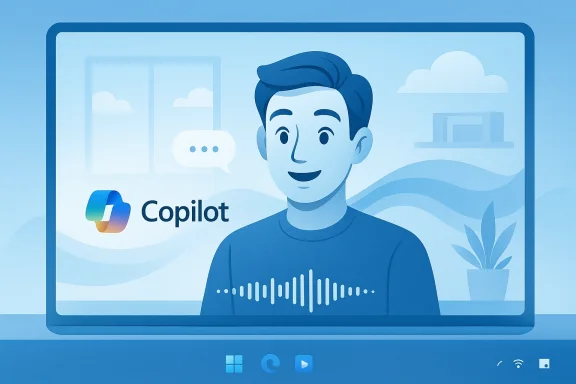
- Visual and expressive embodiments — Microsoft’s Copilot Appearance experiment — provide a face, voice, and real‑time expressions to the assistant, increasing perceived social presence and improving nonverbal affordances in multimodal conversations.
- Design choices such as “room,” “patina,” and “aging” imply attention to continuity: UI surfaces that reflect history, preferences, and gradual personalization rather than ephemeral interactions.
Early rollouts and capabilities
Microsoft has begun previewing Copilot Appearance to a subset of users in the U.S., U.K. and Canada through Copilot Labs, and has integrated Copilot into Windows and Bing in various forms. These initial launches pair voice, vision, and memory capabilities that point toward a broader, more humanized assistant experience. The previewed features include real‑time facial expressions, voice interaction, and conversation memory.Safety and governance: cautious productization
Suleyman’s public remarks demonstrate a clear regard for safety and governance. He has not only spoken about ethics and regulation in the abstract — a consistent theme throughout his career since DeepMind — but has also explicitly signaled that at some point the field may need to consider pausing capability development if safety cannot be assured. That posture sets an unusual tone for a product leader now embedded inside a major platform company.How caution translates to product decisions
- Incremental rollouts and limited previews for features such as Copilot Appearance demonstrate an effort to test affordances and edge cases before broad release.
- Microsoft has emphasized research, internal red‑teaming, and cross‑company safety work as part of the division’s remit — blending forward‑leaning product work with stronger guardrails.
Where the tension remains
The role of a product leader inside a revenue‑driven firm is inherently dual: shipping widely useful features while containing harms. Suleyman’s history of promoting ethics (including establishing DeepMind Ethics & Society) gives credibility to his safety posture, but his new mandate — accelerate consumer AI across a massive product stack — inevitably raises political and regulatory trade‑offs. Observers will watch whether product speed or safety frameworks dominate when the business stakes increase.The Inflection transaction and regulatory scrutiny
Suleyman did not arrive at Microsoft alone. In a high‑profile arrangement in March 2024, Microsoft hired Suleyman and Inflection co‑founder Karén Simonyan and brought onboard the core of Inflection’s team; media reports described the deal as involving roughly $650 million paid to Inflection in a licensing/transaction structure while Microsoft gained use of Inflection models and personnel to power its consumer AI roadmap. Reuters, Bloomberg and several outlets reported the figure and the unusual structure; the U.K.’s Competition and Markets Authority later designated the move a “relevant merger situation” but ultimately cleared the arrangement, while U.S. regulators have scrutinized its contours. Microsoft’s public messaging focused on talent and partnership rather than acquisition.Why the structure mattered
- The deal was framed as licensing and talent hires rather than an outright acquisition, which has implications for merger filings and antitrust review.
- Multiple regulators reviewed the transaction to determine whether Microsoft effectively neutralized a nascent competitor — the CMA reviewed and cleared aspects of the arrangement after analysis. U.S. authorities, including the FTC, have been reported to request information about how the arrangement was structured.
Implications for Microsoft and competitors
For Microsoft, the arrangement delivered an experienced consumer‑AI team and models that could be integrated into Azure and front‑end products quickly. For competitors and regulators, the move raised questions about consolidation of talent and capabilities among a small set of hyperscalers, and whether non‑traditional deal structures could avoid standard antitrust scrutiny. The episode underscores how strategic hiring and licensing can be as consequential as M&A in shaping market power.Technical posture: models, multimodality, and product engineering
Suleyman’s Microsoft AI is not a pure research lab; its charter explicitly spans research and product engineering, with a strong emphasis on consumer readiness. Practically, that means engineering decisions that optimize latency, multimodal capability (text, voice, vision), and long‑term memory while operating within Microsoft’s infrastructure (Azure, client devices).Where engineering challenges concentrate
- Real‑time multimodality: enabling expressive virtual characters with synchronized voice and visual responses requires low‑latency inference pipelines, likely distributed between cloud and device.
- Memory and personalization at scale: durable, privacy‑compliant memory systems that let Copilot “remember” relevant context without creating privacy liabilities.
- Safety filters and content moderation: robust safety pipelines, human review, and runtime controls to prevent harmful outputs while maintaining natural interactions.
- Device integration: optimizations for Windows, Copilot Plus PCs, and Edge require cross‑platform engineering and careful UX work to avoid fragmentation.
What Microsoft brings
Microsoft has strategic advantages: global cloud capacity via Azure, distribution channels through Windows and Office, and existing partnerships (notably with OpenAI) that make integration broadly feasible. Suleyman’s team is expected to leverage those assets while focusing on user‑facing polish.Privacy, personalization, and ethical trade‑offs
Personalized assistants and persistent memory promise convenience, but they also introduce significant privacy and safety trade‑offs. Suleyman’s promise of persistent identity and “patina” will require careful handling of:- Consent and transparency: users must understand what is stored, for how long, and how it’s used.
- Data minimization: balancing useful memory against overcollection.
- Local vs cloud storage: moving some personalization to device can reduce surface area but limit synchronization and intelligence.
- Manipulation risk: personalized assistants that learn and adapt can be used to nudge behaviors in subtle ways.
Reputation and the baggage of past controversies
Suleyman’s track record is not unblemished. During his time at DeepMind he faced scrutiny over management style and internal complaints; he publicly apologized for mistakes and has since been an outspoken voice on ethics and the risks of AI. Those past episodes are part of his public narrative and will shape both internal morale and external perception as he steers Microsoft's consumer AI ambitions.Governance risk
- Internal governance: balancing speed with governance will be a recurring leadership test for Suleyman as teams scale.
- External scrutiny: regulators and civil society will watch how Microsoft implements features such as persistent personalization and expressive avatars.
- Reputational risk: any harmful incident involving Copilot — hallucination, harmful advice, or privacy breach — will reflect on leadership choices and accelerate regulatory backlash.
Competitive landscape and market strategy
Microsoft’s move to centralize consumer AI under a product leader is a direct strategic play against Google, OpenAI, Anthropic and other innovators. The key differentiators Microsoft is pursuing include:- Deep integration into the OS and productivity apps (Windows, Office, Teams).
- Multimodal consumer experiences that blend voice, vision and persistent memory.
- Cloud‑scale model hosting and enterprise continuity via Azure.
What to watch next: milestones and metrics
- Feature rollouts: expansion of Copilot Appearance beyond previews and measurable adoption of persistent memory features.
- Privacy and opt‑in controls: how Microsoft surfaces consent, retention, and deletion controls for memory and personalization.
- Regulatory signals: any formal actions or guidelines from the FTC, CMA, or EU authorities tied to the Inflection arrangement or Copilot features.
- Incident management: the team’s response to any hallucination, bias, or safety incidents will be instructive.
- Desktop evolution: whether Windows receives a substantive redesign to accommodate persistent AI companions or quieter, less distracting workspaces as Suleyman has suggested.
Strengths of Suleyman’s approach
- Product‑first instincts: Suleyman’s Inflection work shows an obsession with the user experience of conversation, which Microsoft needs to convert research advances into mass‑market products.
- Safety credibility: a visible commitment to ethics and a public willingness to consider pauses in development gives weight to governance promises and may attract skeptical partners.
- Talent and speed: bringing a core Inflection team into Microsoft explains the accelerated pace at which Copilot added voice, vision and memory capabilities. The licensing/talent deal gave Microsoft an immediate capability boost.
- Platform reach: Microsoft can deploy assistant experiences at enormous scale via Windows, Office and Azure, giving any successful Copilot experience much greater commercial leverage than a standalone chatbot.
Risks and open questions
- Regulatory and competition risk: the Inflection arrangement invited scrutiny and underscores the risk of regulatory challenge when platform leaders absorb talent and capabilities from smaller labs. Continued regulatory attention could constrain future moves.
- Privacy and consumer trust: long‑term memory and personalization require tight privacy controls; mishandling will erode user trust faster than features can be adopted.
- Safety vs. speed: despite public pronouncements on safety, commercial incentives to ship widely appealing features may create pressure points. How Microsoft prioritizes safety investments versus growth will matter.
- Over‑anthropomorphization: expressive avatars and “aging” assistants can increase engagement but also amplify attachment and manipulation risks, especially for vulnerable users. Thoughtful guardrails and transparency are required.
Practical implications for Windows users and developers
For everyday Windows users, Suleyman’s agenda promises assistants that are more conversational, context‑aware and expressive. That could reshape workflows — from composing emails and summarizing meetings to managing personal tasks and creative collaboration.For developers and ISVs, it signals investment in new APIs, SDKs and platform hooks that will expose Copilot capabilities and memory models. Enterprises should prepare for integrations where assistants handle sensitive workflows and require auditability, consent, and access controls.
Finally, device makers and OEMs will see renewed opportunities to differentiate with Copilot Plus PCs and hardware‑level optimizations for on‑device inference, though the balance between cloud and edge processing remains an engineering trade‑off.
Conclusion
Mustafa Suleyman’s appointment and Microsoft’s reorganization of consumer AI into a single, product‑focused division marks a pivotal moment in the company’s strategy: combine platform scale with product craftsmanship and a stated commitment to safety. Suleyman brings a rare blend of research pedigree and consumer AI product experience — and he’s already influenced Copilot’s trajectory toward a persistent, personality‑aware assistant. That strategy is powerful, but it is not without peril. The Inflection deal illustrates regulatory sensitivity when talent and capability move into hyperscalers; privacy and manipulation risks will grow as assistants become more lifelike; and safety trade‑offs will be tested under commercial pressures. Microsoft’s challenge is to deliver compelling, differentiated user experiences while demonstrating rigorous governance and transparency at scale.If Suleyman’s vision succeeds, the result will be an assistant that feels personal and persistent across the Microsoft product family. If governance falters, the outcome could accelerate regulatory constraints and public backlash that slow adoption. Either way, the next 12–24 months will reveal whether Microsoft can keep its dual promises: to innovate boldly and to keep consumers safe.
Source: Business Chief Inside CEO Mustafa Suleyman’s Vision for Microsoft AI
