

Nebius is trying to turn itself from a GPU-cloud provider into a full-stack AI infrastructure company, backed by an aggressive expansion plan, software acquisitions and a rapidly growing balance sheet. But its ability to join the ranks of true hyperscalers will hinge on executing a buildout measured in gigawatts while converting committed capacity into durable revenue.
As reported by Zacks Investment Research, the company’s strategy rests on four connected areas: expanding data-center capacity, adding platform software, securing customer demand and raising capital. Nebius said its contracted power rose from more than 2 GW at the end of 2025 to more than 3.5 GW in the first quarter of 2026, and it now expects to exceed 4 GW by year-end.
The standout infrastructure announcement is a Pennsylvania site with land and power for up to 1.2 GW. Nebius said in its May first-quarter results that the planned facility would be company-owned, making it its second U.S. gigawatt-scale AI campus. More than 75% of the company’s contracted power is now associated with owned infrastructure, according to management.
Nebius is positioning its platform around the complete AI workload lifecycle: bare-metal systems, multi-tenant cloud, managed inference and agent-oriented services. That is a meaningful distinction from simply leasing GPU instances. Enterprise buyers increasingly want identity controls, observability, network integration, predictable performance and managed model-serving layers alongside raw compute.
There are a couple of corrections to the Zacks framing. Nebius’s relevant platform release was Aether 3.5, announced in March, which added serverless AI capabilities; it was not Aether 3.6. The company has acquired agentic-search provider Tavily and completed its acquisition of Eigen AI in June. Clarifai was not acquired: Nebius brought in Clarifai’s core engineering and research team and licensed its inference and compute-orchestration technology.
Those deals aim to improve the economics of inference, where software optimization can increase throughput per GPU and reduce cost per token. That matters as AI workloads move from training large models to serving them repeatedly in production.
The company raised $6.3 billion during the quarter, including approximately $4.3 billion in convertible securities and a $2 billion strategic investment from Nvidia. Nebius ended the period with $9.3 billion in cash, per its shareholder letter.
That gives Nebius unusually substantial resources for a newer cloud provider, but it does not eliminate the risks. Power availability, construction schedules, GPU deliveries, financing costs and customer concentration can all derail an AI-infrastructure plan. Contracted power is also not the same thing as operational capacity, and booked demand is not the same as realized long-term revenue.
For Windows administrators and IT teams, Nebius is chiefly another potential supplier for AI training and inference workloads rather than a change to the Windows stack itself. Its success would broaden the market for managed Nvidia-based AI capacity, while its failure would underscore how difficult it is to translate enormous power commitments and capital spending into a durable cloud business.
Nebius’s next test is bringing its planned capacity online on schedule and turning it into revenue during 2027.
As reported by Zacks Investment Research, the company’s strategy rests on four connected areas: expanding data-center capacity, adding platform software, securing customer demand and raising capital. Nebius said its contracted power rose from more than 2 GW at the end of 2025 to more than 3.5 GW in the first quarter of 2026, and it now expects to exceed 4 GW by year-end.
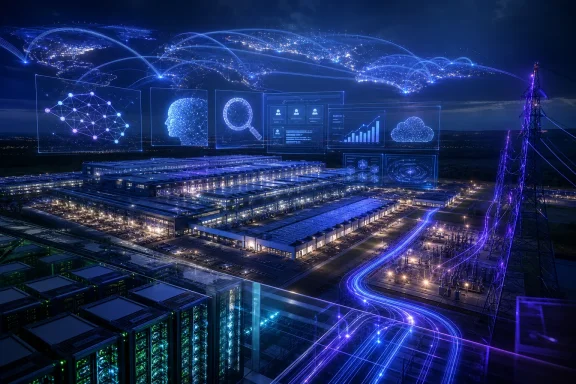
The standout infrastructure announcement is a Pennsylvania site with land and power for up to 1.2 GW. Nebius said in its May first-quarter results that the planned facility would be company-owned, making it its second U.S. gigawatt-scale AI campus. More than 75% of the company’s contracted power is now associated with owned infrastructure, according to management.
 More than rented GPUs
Nebius is positioning its platform around the complete AI workload lifecycle: bare-metal systems, multi-tenant cloud, managed inference and agent-oriented services. That is a meaningful distinction from simply leasing GPU instances. Enterprise buyers increasingly want identity controls, observability, network integration, predictable performance and managed model-serving layers alongside raw compute.There are a couple of corrections to the Zacks framing. Nebius’s relevant platform release was Aether 3.5, announced in March, which added serverless AI capabilities; it was not Aether 3.6. The company has acquired agentic-search provider Tavily and completed its acquisition of Eigen AI in June. Clarifai was not acquired: Nebius brought in Clarifai’s core engineering and research team and licensed its inference and compute-orchestration technology.
Those deals aim to improve the economics of inference, where software optimization can increase throughput per GPU and reduce cost per token. That matters as AI workloads move from training large models to serving them repeatedly in production.
Demand and financing are the hard parts
Nebius reported record pipeline generation in the first quarter, up roughly 3.5 times sequentially, and said newly deployed capacity was fully committed. It also raised 2026 capital-expenditure guidance to $20 billion to $25 billion, with much of that investment expected to begin producing revenue in the first half of 2027.The company raised $6.3 billion during the quarter, including approximately $4.3 billion in convertible securities and a $2 billion strategic investment from Nvidia. Nebius ended the period with $9.3 billion in cash, per its shareholder letter.
That gives Nebius unusually substantial resources for a newer cloud provider, but it does not eliminate the risks. Power availability, construction schedules, GPU deliveries, financing costs and customer concentration can all derail an AI-infrastructure plan. Contracted power is also not the same thing as operational capacity, and booked demand is not the same as realized long-term revenue.
For Windows administrators and IT teams, Nebius is chiefly another potential supplier for AI training and inference workloads rather than a change to the Windows stack itself. Its success would broaden the market for managed Nvidia-based AI capacity, while its failure would underscore how difficult it is to translate enormous power commitments and capital spending into a durable cloud business.
Nebius’s next test is bringing its planned capacity online on schedule and turning it into revenue during 2027.
References
- Primary source: TradingView
Published: 2026-07-14T13:17:00+00:00
Can Nebius' Four-Pronged Strategy Create the Next AI Hyperscaler? — TradingView News
Nebius Group N.V. NBIS is building an AI-native hyperscaler by executing across four strategic dimensions. It is expanding its capacity and scale, enhancing its products and functionality, growing its customer base and demand, and strengthening its capital position.On the capacity front, Nebius is…www.tradingview.com
