

European cloud challenger Nebius this week unveiled a full‑stack “Open AI Platform” — marketed as Nebius Token Factory — positioning the company as a direct, enterprise‑focused alternative to hyperscaler AI services such as Microsoft’s Azure OpenAI and Amazon Bedrock. The platform promises production‑grade inference, integrated fine‑tuning and model lifecycle tools, explicit support for open‑weight models, regional zero‑retention endpoints, and vendor‑neutral APIs designed to ease migration away from proprietary endpoints. The announcement lands amid Nebius’s meteoric rise as a GPU‑infrastructure provider — including a multibillion‑dollar capacity agreement with Microsoft — and raises immediate questions about strategy, sovereignty, and the shape of competition for AI infrastructure.
Nebius traces its roots to the international elements of the Russian search giant Yandex, spun out and rebranded amid regulatory and operational shifts. Since that restructuring the company has focused on building a vertically integrated AI cloud: custom rack and chassis designs, validated NVIDIA GPU stacks, and a software layer aimed squarely at model lifecycle operations. That evolution explains both Nebius’s technical focus and the scrutiny the company attracts on supply chain and governance.
The commercial context is straightforward: enterprises are moving AI from research to mission‑critical production, and production use cases emphasize predictable token costs, consistent latency, regulatory controls and data sovereignty over raw model capability metrics. Hyperscalers still dominate model catalogs and deep cloud integrations, but a growing market niche prefers specialized inference providers that promise cost control, tailored SLAs, and portability. Nebius positions itself in that niche — a so‑called “neocloud” that aims to be both a supplier to hyperscalers and an independent competitor. The company’s recent, high‑profile capacity agreement with Microsoft — initially valued at $17.4 billion with potential to expand further — underlines Nebius’s scale and market relevance. The deal, publicly reported in September 2025, both validates Nebius’s infrastructure and introduces a strategic tension: Nebius will supply the compute that powers some hyperscaler model hosting while offering competing hosted stacks to other customers. That double role is central to the risk profile explored below.
Key takeaways for WindowsForum readers and IT buyers:
Source: varindia.com Nebius Launches Open AI Platform to Rival Microsoft’s
 Background: Nebius, the “neocloud” and why this matters
Nebius traces its roots to the international elements of the Russian search giant Yandex, spun out and rebranded amid regulatory and operational shifts. Since that restructuring the company has focused on building a vertically integrated AI cloud: custom rack and chassis designs, validated NVIDIA GPU stacks, and a software layer aimed squarely at model lifecycle operations. That evolution explains both Nebius’s technical focus and the scrutiny the company attracts on supply chain and governance.The commercial context is straightforward: enterprises are moving AI from research to mission‑critical production, and production use cases emphasize predictable token costs, consistent latency, regulatory controls and data sovereignty over raw model capability metrics. Hyperscalers still dominate model catalogs and deep cloud integrations, but a growing market niche prefers specialized inference providers that promise cost control, tailored SLAs, and portability. Nebius positions itself in that niche — a so‑called “neocloud” that aims to be both a supplier to hyperscalers and an independent competitor. The company’s recent, high‑profile capacity agreement with Microsoft — initially valued at $17.4 billion with potential to expand further — underlines Nebius’s scale and market relevance. The deal, publicly reported in September 2025, both validates Nebius’s infrastructure and introduces a strategic tension: Nebius will supply the compute that powers some hyperscaler model hosting while offering competing hosted stacks to other customers. That double role is central to the risk profile explored below.
What Nebius Token Factory actually is
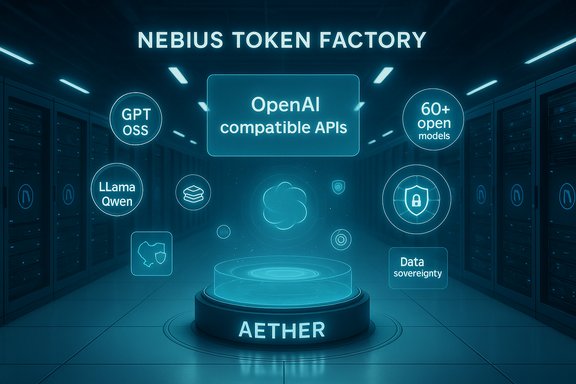
Nebius describes Token Factory as an end‑to‑end production inference platform built on Nebius AI Cloud 3.0 (“Aether”). The product is presented as the successor to Nebius AI Studio and focuses on turning open‑weight and customer models into production endpoints with enterprise governance, predictable economics, and performance SLAs. Key product positioning points from the company’s launch materials are:- Open‑model support — compatibility with major open‑weight families (examples named at launch include DeepSeek, GPT‑OSS, Meta Llama, NVIDIA Nemotron and Qwen), with Nebius claiming support for 60+ open‑source models at launch.
- Production‑grade inference — an “inference‑first” architecture optimized for low tail latency, autoscaling throughput, and dedicated endpoints with a stated 99.9% uptime SLA.
- Model lifecycle tooling — integrated fine‑tuning (LoRA and full‑model), distillation pipelines, one‑click promotion from staging to production, token‑level observability and billing.
- Governance & compliance — team workspaces, SSO, RBAC, audit trails, and EU/US zero‑retention inference endpoints to support data‑residency rules and regulated workloads. Nebius has publicly stated SOC 2 Type II, HIPAA inclusion, ISO 27001 and plans to align with EU regulatory frameworks.
- Open APIs & migration tooling — OpenAI‑compatible endpoints intended to simplify migration from proprietary vendor APIs and enable multi‑cloud portability.
Feature snapshot
- Dedicated, isolated inference endpoints with 99.9% SLA and autoscaling.
- Support for LoRA and full‑model fine‑tuning pipelines.
- Zero‑retention inference options in EU and US datacenters.
- OpenAI‑compatible REST APIs and SDKs for SDK parity.
- Token‑level observability and billing; enterprise workspaces and SSO.
- Marketplace for third‑party models and developer tooling integrations.
Technical claims and verifications
Nebius’s launch materials make several measurable technical claims that can and should be verified by customers in representative workloads:- MLPerf submissions and NVIDIA Exemplar status. Nebius says it posted leading MLPerf® Inference v5.1 results on NVIDIA GB200/HGX B200 systems and has been designated an NVIDIA Exemplar Cloud on select GPU classes. MLPerf submissions are public and vendor‑submitted; Nebius also published blog material and product pages documenting MLPerf results and Exemplar Cloud recognition. NVIDIA’s DGX Cloud announcements list Nebius among Cloud Partners, lending external corroboration to Nebius’s hardware credentials. These are important indicators of synthetic throughput and integration with NVIDIA reference architectures — but synthetic benchmarks are not a substitute for customer‑specific testing. Enterprises should benchmark with real‑world token mixes, prompt lengths, and concurrency profiles before relying on advertised claims.
- Sub‑second latency and 99.9% availability at very high QPS. Nebius asserts sub‑second latency for many workloads and 99.9% availability, including claims to handle workloads that “exceed hundreds of millions of requests per minute.” These are operational assurances rather than pure engineering metrics: delivery in production depends on model size, prompt window, batching strategy, network topology and workload burstiness. Independent press coverage repeats the claims, and Nebius’s own documentation frames these as platform guarantees — but customers must validate latency and SLA details under contractual terms and pilot testing.
- Security & compliance certifications. Nebius public materials state SOC 2 Type II including HIPAA considerations, ISO 27001 and ISO 27799 alignment, plus posture alignment to NIS2 and DORA principles. These certifications and attestations are industry‑standard, and Nebius indicates independent audit trails; procurement teams should request the audit reports and SOC/ISO certificates directly for contractual review.
- Support for 60+ open models and marketplace interoperability. Multiple outlets cite Nebius’s claim of support for dozens of open‐source weights and early collaboration with Hugging Face to improve model access. The list of supported families appears credible and aligns with the broader open‑model ecosystem trend. That said, support can mean a range of things: hosted, optimized, or merely deployable by the user. Precise compatibility (operators, tokenizers, quantization formats, missing layers) should be validated for mission‑critical models.
Strategic analysis: why Nebius thinks it can compete with Microsoft — and where it may fall short
Strengths and strategic advantages
- Open architecture & portability. Token Factory’s OpenAI‑compatible APIs and emphasis on open‑weight models directly target procurement groups worried about vendor lock‑in. For organizations that value exit options, the ability to run the same model weights across Nebius, on‑prem and other clouds is attractive.
- Sovereignty & regional controls. Offering zero‑retention inference in EU and US datacenters, plus a governance layer (SSO, RBAC, audit trails), positions Nebius for regulated industries — finance, healthcare and government — which face data‑sovereignty and privacy requirements. Nebius’s public commitments to SOC/ISO standards reinforce this message.
- Hardware and benchmark pedigree. Public MLPerf submissions and NVIDIA Exemplar status provide independent, technical validation that Nebius can operate Blackwell/HGX‑class clusters at scale. That increases confidence for teams needing high throughput and predictable performance.
- Economics & early adopter wins. Nebius cites early customer outcomes: examples include material cost reductions in pilots (one customer reported up to 26× cost reductions versus proprietary models in press excerpts). If sustained in practice, those economics are a compelling draw for cost‑sensitive teams. However, such numbers require independent validation.
Weaknesses and strategic vulnerabilities
- Hyperscaler integration depth. Microsoft, Amazon and Google own deeply integrated stacks — identity, storage, networking, management tooling and enterprise agreements. Nebius can offer parity on compute and model hosting, but matching the ecosystem reach and single‑pane integration of hyperscalers is a multi‑year effort. Large enterprises often choose convenience and contracting simplicity over narrow feature advantages.
- Supplier/partner tension. The Microsoft capacity agreement illustrates a strategic paradox: Nebius is both a supplier to and a competitor of hyperscalers. That dual role creates commercial and political complexity: hyperscaler customers may be wary of choosing a platform that competes with their own provider, while hyperscalers may be reticent to route premium workloads to a supplier that also sells competitive services. This dynamic creates negotiation leverage for Nebius but also governance and trust questions.
- Geopolitical & provenance concerns. Nebius’s heritage — spun out from Yandex operations — invites geopolitical scrutiny in some markets. For buyers in security‑sensitive sectors or those subject to national security reviews, the company’s origin, board composition and data handling guarantees will be examined closely. Nebius must prove that local controls, contractual audit rights and independent attestations remove risk — not merely claim it.
- Claims vs. real‑world performance. Promises of sub‑second latency and 99.9% SLA are attractive, but real‑world results depend on model architectures and production patterns. Enterprises should demand pilot engagements, clear SLA definitions (RPO/RTO, exception handling, credit regimes) and third‑party validation before committing critical workloads. Nebius’s MLPerf success is encouraging, but synthetic benchmarks are just one part of the story.
Market implications: competition, sovereignty and developer choice
Nebius’s entry as an open‑model, production inference vendor amplifies three market trends:- The open‑model momentum. A surge in open‑weight quality means enterprises have more choices than ever. Platforms that support portability and allow cost/accuracy trade‑offs will accelerate model experimentation and reduce single‑vendor dependency. Nebius is explicitly betting on that momentum.
- A bifurcated market for inference. Hyperscalers will continue to control global reach and enterprise bundles; specialist inference providers (Nebius, CoreWeave, TogetherAI, Fireworks, Baseten and others) will compete on pricing, dedicated SLAs and developer ergonomics. This multi‑vendor approach could produce healthier competition and better procurement leverage for customers.
- Sovereignty as procurement criteria. Governments and regulated enterprises increasingly treat in‑country processing, zero‑retention options and auditable contracts as decision factors. Nebius explicitly targets those procurement levers. If it can pair competitive economics with auditable assurances, it will win non‑trivial share in regulated sectors.
Practical guidance for procurement and engineering teams
Organizations evaluating Token Factory (or similar neocloud offerings) should pursue a structured validation approach:- Run a short, representative pilot that mirrors production prompt patterns, concurrency and token distributions.
- Validate SLA terms in the contract — not in marketing materials — including latency percentiles, uptime windows, and remedies for SLA breaches.
- Request audit artifacts: SOC/ISO certificates, third‑party audit reports and independent penetration testing results.
- Verify model portability: deploy the same model weights locally or in a competitor environment to confirm behavior parity and tokenizer compatibility.
- Review contractual exit options, data deletion proofs, and exporter/importer clauses for cryptographic keys or customer‑controlled encryption.
Risks that need public attention
- Double‑agent supplier risk. The Microsoft–Nebius commercial arrangement introduces an unusual market dynamic. Nebius supplies capacity to a hyperscaler while competing with it on hosted stacks; buyers should seek contractual assurances that their customer data and model artifacts will not be used to benefit other parties absent explicit consent. Public reporting confirms the Microsoft deal but does not replace contractual protections.
- Unverified performance in varied workloads. Nebius’s MLPerf and Exemplar Cloud announcements are meaningful technical signals, but MLPerf workloads are synthetic; they do not necessarily predict latency, tail behavior or cost efficiency for long‑context, high‑concurrency real‑world LLM usage. Customers should push realistic workloads during procurement trials.
- Regulatory and geopolitical scrutiny. Heritage and corporate structure will matter in procurement, especially for public sector and defense contracts. Nebius must continue to shore up independent audits and localized operational controls to meet stringent regulator expectations.
- Ecosystem lock‑in risk in a different form. Ironically, the promise of portability can create a different kind of dependency: highly optimized model‑and‑infrastructure combos (quantized weights, vendor‑specific runtimes, custom optimizations) can be hard to migrate. Vendors can also bake value into observability, billing and governance layers that are costly to replace. Clear exit terms and standardized formats help mitigate this risk.
The competitive playbook: how Microsoft and others might respond
Microsoft and other hyperscalers are unlikely to cede ground quietly. Expected responses include:- Broader open‑model support and pricing adjustments to blunt the economic advantage of specialist inference providers.
- Sovereign and local‑execution product pushes (on‑prem Copilot+ options, Azure Local, in‑country processing) to keep regulated customers within the hyperscaler fold. Evidence of Microsoft’s broader sovereign pushes has been publicly discussed by analysts and reporting.
- Commercial differentiation via integration depth. Hyperscalers will emphasize identity, storage, networking and enterprise support bundles that are hard for smaller providers to replicate quickly. This is where Nebius must prove it can interoperate or provide multi‑vendor tooling that still meets procurement requirements.
Conclusion — pragmatic optimism, with guarded procurement
Nebius’s Token Factory launch is a consequential development for the enterprise AI market: it brings a focused, open‑model, production inference play into a space long dominated by hyperscalers. The combination of MLPerf performance claims, NVIDIA Exemplar status and a multibillion‑dollar capacity agreement with Microsoft makes Nebius a credible alternative for teams prioritizing open architecture, data sovereignty, and cost predictability. At the same time, Nebius’s claims must be validated in context. Synthetic benchmarks do not automatically translate to production parity, provenance and dual supplier roles raise governance questions, and contract‑level details — SLA definitions, audit artifacts, data retention proofs and exit clauses — are essential. For enterprise buyers the sensible path is a structured pilot that tests Token Factory under real workloads and a procurement process that insists on auditable assurances. If Nebius delivers on its promises, Token Factory could accelerate the decentralization of AI infrastructure and create healthier competition — but success depends on rigorous third‑party validation, transparent contracting, and careful operational integration.Key takeaways for WindowsForum readers and IT buyers:
- Nebius Token Factory is available now and targets production inference at scale with OpenAI‑compatible APIs and open‑model support.
- The company claims strong MLPerf results and NVIDIA Exemplar status, but synthetic benchmarks require customer‑specific validation.
- Nebius’s simultaneous supplier/competitor relationship with Microsoft is real and materially affects risk and governance considerations.
- Procurement leaders should require pilot verification, audit evidence, and contractual exit terms before committing regulated or SLA‑critical workloads.
Source: varindia.com Nebius Launches Open AI Platform to Rival Microsoft’s
