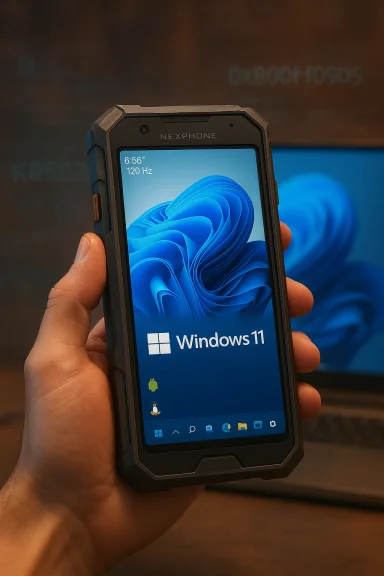
Microsoft’s ecosystem hit and curious pivot this week: a community-fueled revival of the Windows Phone concept via a third‑party device that can run Windows 11, while Microsoft’s flagship desktop OS continues to wrestle with a fresh wave of stability bugs affecting apps and core features. The juxtaposition — nostalgia and reinvention on one side, and a reminder of Windows’ complex update surface on the other — makes this installment of Microsoft Weekly a useful case study in where the platform stands in 2026.
Windows has been on a long arc since the mobile push of the early 2010s faded. Official Windows Phone work stopped years ago, but the idea of a true Pocket PC — a device that runs full Windows on a phone form factor — has persisted among enthusiasts. At the same time, Windows 11’s major updates (notably the 24H2 cycle and ongoing monthly updates) continue to introduce features while also exposing regressions that affect real users, from blue screens to app crashes and licensing/Store issues. The week’s coverage pulled together reports on both fronts: a hardware resurgence (the NexPhone family of devices) and new post‑update instability affecting Windows 11 users. Some of the claims come from investigative coverage and manufacturer announcements; others are confirmed by Microsoft’s own release‑health documentation and the evolving Insider channel rollouts.
For users: back up, validate drivers, and treat major feature updates as planned events rather than automatic installs. For developers and hardware makers: prioritize driver testing and MDM compatibility. And for Microsoft: the challenge remains to deliver ambitious features while preserving the reliability that long‑time Windows users expect.
The next chapters will show whether pocket‑sized Windows devices become a useful niche or remain a hobbyist curiosity — and whether Microsoft’s update cadence can match the platform’s growing ambitions without putting stability at risk.
Source: Neowin https://www.neowin.net/news/microsoft-weekly-windows-phone-is-back-new-windows-11-bugs-and-more/
 Background
Windows has been on a long arc since the mobile push of the early 2010s faded. Official Windows Phone work stopped years ago, but the idea of a true Pocket PC — a device that runs full Windows on a phone form factor — has persisted among enthusiasts. At the same time, Windows 11’s major updates (notably the 24H2 cycle and ongoing monthly updates) continue to introduce features while also exposing regressions that affect real users, from blue screens to app crashes and licensing/Store issues. The week’s coverage pulled together reports on both fronts: a hardware resurgence (the NexPhone family of devices) and new post‑update instability affecting Windows 11 users. Some of the claims come from investigative coverage and manufacturer announcements; others are confirmed by Microsoft’s own release‑health documentation and the evolving Insider channel rollouts. The Windows Phone comeback — what’s actually happening
A modern attempt at “Windows Phone” arrives in hardware form
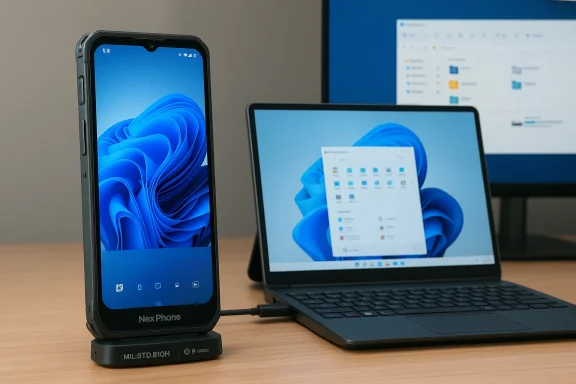
What’s being reported as “Windows Phone is back” is not Microsoft resurrecting the old platform, but rather an independent hardware effort to bring a full Windows experience to a smartphone‑style device. The most visible example is the NexPhone project, announced by Nex Computer/NexDock, which positions the device as a triple‑boot smartphone: Android, Linux, and Windows 11. Media coverage describes the device as a rugged, ARM‑based phone that can run Windows 11 in a mobile enclosure and also act as a pocketable PC when connected to external displays or lapdocks. This approach revives the spirit of Windows Phone — a touch‑first Windows experience on small screens — but relies on modern compatibility techniques and hybrid boot strategies rather than any legacy Windows Phone codebase.Verified specifications and claims (what we can corroborate)
Multiple outlets reporting on the NexPhone have published broadly consistent specifications and positioning details:- Display: roughly a 6.5‑ to 6.6‑inch, 120 Hz panel on the flagship NexPhone models.
- SoC: Qualcomm QCM6490 (a chip used in modern ARM devices).
- Memory and storage: options around 12 GB RAM and 256 GB storage — expandable in some variants.
- Battery and ruggedization: large battery (reported ~5000 mAh), MIL‑STD‑810H claims, and IP68/IP69K water/dust resistance on certain SKUs.
- Boot/OS strategy: triple‑boot capability (Android 16, Debian‑style Linux, and Windows 11), plus a custom launcher/UX layer to make Windows feel more natural on a phone display.
- Pricing and availability claims: initial preorders reported with a $199 deposit and an MSRP example around $549, with expected shipping windows into 2026 in initial reporting. These price and shipping details originate from manufacturer announcements and early press briefings; they’re subject to change and should be treated as provisional until retail channels confirm them.
Why this matters: the practical and symbolic significance
- Symbolically, a device that runs Windows 11 on a phone form factor reopens a conversation about mobile productivity, continuity, and the portability of the Windows desktop. For enthusiasts and power users who want a true pocket PC, the concept is compelling.
- Practically, the NexPhone (and similar attempts) test whether Microsoft’s investments in Windows on ARM and the Windows Subsystem for Android can be leveraged by hardware partners to make a usable hybrid device.
- For enterprise and IT pros, the arrival of such devices raises questions about manageability, security updates, and corporate supportability — especially since these devices aren’t Microsoft‑branded and may not meet corporate procurement standards out of the box.
Windows 11: new bugs, acknowledged issues, and what’s changed
The latest problem set: crashes, app errors and license validation headaches
about Windows 11 focus on several emergent stability problems that are affecting users after recent updates. Coverage consolidated multiple, independently reported issues:- A bug impacting a range of apps (including some built‑ins) that can lead to crashes or error code 0x803f8001, tied to Microsoft Store license validation or account/Store sync anomalies.
- Problems when apps access cloud‑backed storage (OneDrive, Dropbox) after certain updates, with Outlook’s PST handling singled out as particularly affected.
- Ongoing compatibility holds and blue‑screen scenarios previously tied to third‑party drivers (the Voicemeeter audio driver being a notable example), which Microsoft documented and addressed through safeguard holds and recommended driver updates.
Microsoft’s Voicemeeter safeguard: a useful blueprint
The Voicemeeter case is instructive because Microsoft documented it on the Windows release‑health pages. Systems with Voicemeeter installed were blocked from rede due to a MEMORY_MANAGEMENT stop error tied to a Voicemeeter driver incompatibility. Microsoft’s guidance was straightforward:- Update to the latest Voicemeeter version (which includes a fixed driver).
- If the device still shows the compatibility hold after updating drivers, contact the vendor (VB‑Audio) for more information.
- Do not manually bypass the safeguard unless you understand the risk and have tested in a non‑production environment.
Cross‑checking the facts: what independent sources say
- NexPhone / Windows‑on‑phone claims: Windows Central and Tom’s Hardware independently reported the NexPhone announcement and published largely consistent specs and pricing signals about the device’s triple‑boot approach and hardware choices. These independent reports corroborate the essential claim that hobbyist/third‑party devices are attempting to bring Windows 11 back to a phone form factor.
- Voicemeeter blue‑screen and safeguard hold: Microsoft’s own release health page documents the Voicemeeter memory management fault and the safeguard ID applied to affected devices; Neowin and other outlets picked up Microsoft’s owndvisory and relayed the same mitigation steps. That gives us both primary (Microsoft) and secondary (news) confirmation for this widely experienced issue.
- January 2026 app crash/Store license issues: TechRadar and other reporting outlets described a pair of newly surfaced bugs causing app crashes and cloud‑storage access freezes. Microsoft’s ongoing acknowledgement of related problems (and recommended mitigations for affected users) appears where relevant in the Windows support channels; however, a full root‑cause and patch schedule was not universally available at the time of reporting. That gap is reflected across outlets covering the story.
Strengths and opportunities
- Innovation from the ecosystem: Third‑party hardware like the NexPhone demonstrates creativity outside Microsoft’s captive device strategy. It shows there’s still interest in the concept of a pocket PC, and it can push Microsoft and partners to refine Windows on ARM and convergence scenarios.
- Improved transparency around safeguard holds: Microsoft’s use of documented safeguard IDs, KB notices, and public release‑health pages makes it easier for administrators to audit which devices and scenarios are blocked and why. This transparency is valuable for enterprise change management.
- Windows 11 feature depth: The ongoing development of Windows 11 continues to push functionality (improved File Explorer, Jump Lists refinements, Copilot+ features for eligible devices), which keep the platform competitive and adaptable to new workflows. These user‑facing improvements matter to productivity users who invest in the OS.
Risks, unknowns, and areas to watch
- Driver and hardware fragility on non‑standard devices: Running Windows 11 on phone hardware will always risk driver gaps, thermal and battery management issues, and incompatible peripherals — especially for niche ARM device builds. Those risks can make the user experience uneven and pose support challenges for businesses.
- Update volatility: The continued surfacing of significant bugs following large updates underscores the tension between rapid feature delivery and robust QA. Enterprises and cautious consumers should assume that major updates can introduce regressions and plan deployments accordingly.
- Store and licensing fragility: License validation issues that manifest as app crashes (0x803f8001 and related errors) reveal how tightly interwoven the Microsoft Store, account sync, and OS updates are; a problem in one subsystem can cascade. That is a structural risk for users who rely on Store‑delivered apps for business workflows.
- Unverified commercial claims: Manufacturer MSRP, shipping dates, and deposit structures reported in early press coverage should be treated as provisional. Preorder terms often change between announcement and retail launch; until retail availability is confirmed, these are best‑effort indicators rather than fixed commitments.
Practical guidance for Windows users and IT teams
- Before installing major feature updates (like 24H2 or new cumulative updates), create a full system restore point and validate backups.
- Check Microsoft’s release‑health pages and safeguard notices for known holds relevant to your hardware and installed software; these notices are the definitive guidance for high‑risk compatibility scenarios.
- If you run third‑party drivers (audio mixers like Voicemeeter, virtualization tools, or niche hardware), confirm vendor driver versions are certified or updated before attempting big OS upgrades.
- For unexpected app crashes after updates:
- Try Store cache reset and sign‑out/sign‑in of the Microsoft Store.
- Reinstall affected apps and verify license/account sync.
- If necessary, escalate to removing a specific update temporarily (with appropriate security considerations) while awaiting a fix.
- For organizations evaluating novel Windows‑on‑phone devices: treat them as pilot projects. Run dedicated testing workflows, confirm management tool compatibility, and avoid large‑scale rollouts until driver and MDM support are firmly in place.
What this means for Windows’ direction
The dual narratives of the week — a hardware attempt to revive the pocket Windows concept, and renewed evidence that large platform updates can still produce disruptive regressions — are not contradictory. They highlight two truths about the Windows ecosystem:- The platform remains fertile for experimentation. Interest in a Windows pocket PC proves that there’s still demand for converged device form factors and for Windows’ productivity model to be portable.
- The platform’s complexity is its own friction. As Windows stretches to support more hardware states, more cloud integrations, and more app distribution mechanisms, the surface area for regressions grows. Managing that complexity requires continued investment in testing, vendor coordination, and conservative rollout mechanisms.
Conclusion
This week’s headlines are a reminder that Windows is a living platform: enthusiasts and hardware innovators are still pushing its boundaries, while enterprise and everyday users contend with the realities of an OS that must balance progress and stability. The NexPhone and similar devices reignite a familiar dream — Windows on the go — but their success depends on solid driver stacks and practical management strategies. Meanwhile, Microsoft’s public safety mechanisms (safeguard holds, published resolved‑issue guidance) and the community’s quick‑fix workarounds provide tools to survive rocky updates.For users: back up, validate drivers, and treat major feature updates as planned events rather than automatic installs. For developers and hardware makers: prioritize driver testing and MDM compatibility. And for Microsoft: the challenge remains to deliver ambitious features while preserving the reliability that long‑time Windows users expect.
The next chapters will show whether pocket‑sized Windows devices become a useful niche or remain a hobbyist curiosity — and whether Microsoft’s update cadence can match the platform’s growing ambitions without putting stability at risk.
Source: Neowin https://www.neowin.net/news/microsoft-weekly-windows-phone-is-back-new-windows-11-bugs-and-more/