• Thread Author
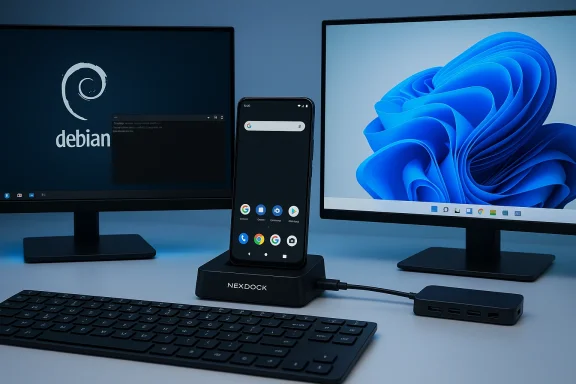
Nex Computer’s NexPhone promises to be the kind of gadget that makes tech enthusiasts grin: a midrange smartphone that’s explicitly engineered to become a full PC — running Android and Linux with desktop modes and, most unusually, able to boot into Windows 11 so it can act as a proper Windows PC when hooked to a monitor.

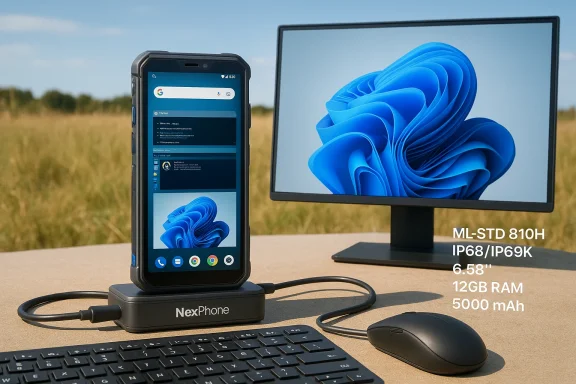
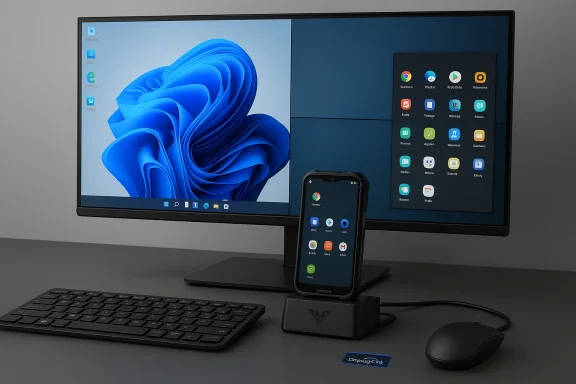
Modern desk setup with a large monitor, wireless phone dock, keyboard, and mouse.Background / Overview​

Nex Computer built its reputation on the NexDock — a laptop shell that turns compatible phones into temporary laptops — and the NexPhone is a logical, if ambitious, next step in that line of thinking. The company says the NexPhone ships with Android and an optional Linux desktop, and can dual-boot into Windows 11, delivering three distinct workflows from a single pocket device. That claim sets up a provocative idea: one device that plays the roles of phone, Linux workstation, and Windows desktop, depending on where and how you plug it in. This is not a small engineering ask. Turning a phone into a useful desktop or laptop replacement requires CPU/platform compatibility, display-out and driver stacks that can address larger monitors and standard peripherals, robust thermals and battery life, and an OS story that makes desktop-grade apps usable. Nex Computer’s choice of platform, Qualcomm’s Dragonwing-family QCM6490, is a deliberate one: that SoC appears on Microsoft’s list of Qualcomm processors qualified for Windows 11 IoT/enterprise usage — an important signal that Windows can at least be targeted for this silicon family.

What the NexPhone claims to be​

Core pitch: a phone that becomes a PC​

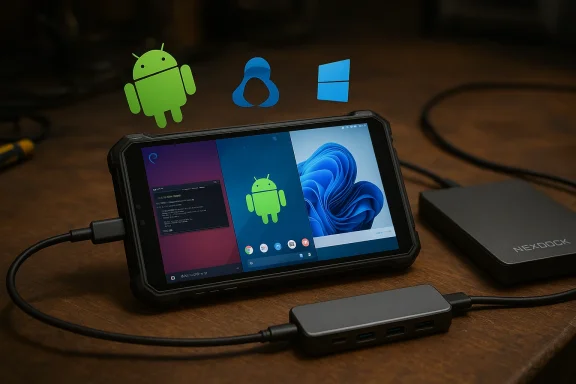
  • Three OS experiences: Android (with a desktop mode for monitors), Linux (runs either as an app or a desktop environment), and a separate Windows 11 boot option for a full Windows experience.
  • Dock-first design lineage: Built by the maker of the NexDock, the NexPhone’s primary use case is to be the compute engine for external displays, keyboards, mice and docking shells.
  • Hardware targets: Nex Computer told reporters it selected the Qualcomm QCM6490 because of its multi‑OS support profile and IoT/enterprise lineage; the phone is claimed to be rugged (MIL‑STD‑810H) with IP68/IP69 ingress resistance, a 5,000 mAh battery, a 64 MP rear camera and wireless charging.

Key selling points Nex Computer is pushing​

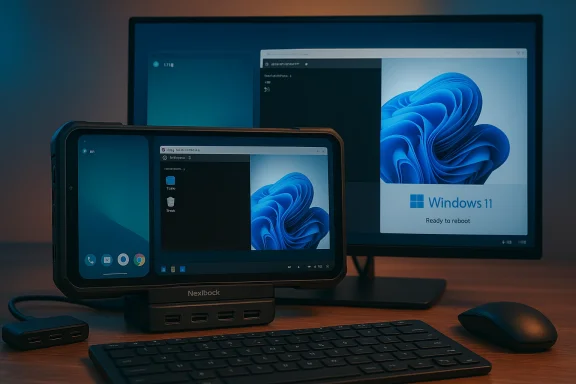
  • Windows 11 dual‑boot: When booted into Windows mode the device purportedly drops you into a standard Windows 11 desktop and can be used as a work PC.
  • Desktop modes for Android and Linux: Desktop UI when connected to a monitor (Android 16’s larger-screen features are an important enabling factor for Android desktop experiences).
  • Ruggedization and long battery life: The stated MIL‑STD and IP ratings and the 5,000 mAh battery are meant to position the phone as a durable daily driver for heavy on-the-go use.

The hardware reality: QCM6490 and the platform choice​

Nex Computer’s platform choice is central to the device’s argument. The QCM6490 (part of Qualcomm’s Dragonwing family) is listed in Microsoft’s Windows 11 supported‑processors list specifically under IoT applicability, which gives OEMs a path to produce Windows images targeting this silicon. That listing is the single most important technical verification that Windows on this class of Qualcomm silicon is feasible from a vendor‑support perspective. Why that matters:
  • Windows 11 on ARM requires platform support (firmware, boot chain, and drivers) and vendor engagement; Microsoft’s published processor compatibility lists are the practical starting point for anyone trying to ship Windows on a non‑x86 SoC.
  • The Dragonwing/QCM family is openly targeted by vendors building rugged and IoT devices that need Windows IoT Enterprise options, so it’s not a speculative silicon choice — it’s used in other Windows‑targeted devices.
Caveats:
  • Microsoft’s processor list shows IoT Enterprise applicability for QCM6490. Shipping a consumer Windows 11 desktop image in a phone form factor still requires signed drivers, validated images, firmware-level work, and — crucially — a practical solution for features Windows expects (TPM, secure boot, UEFI behavior, etc.). Those are solvable but nontrivial engineering tasks.

Software: three operating environments and what they actually mean​

Android: desktop mode and practical limits​

Android 16 has explicit work underway to improve desktop-style behavior on larger screens, which broadens the base of phones that can offer desktop-like experiences similar to Samsung DeX. Running Android in a desktop mode is a reasonably mature idea — Android has long supported external displays and windowed apps, and vendor customizations make desktop UIs polished. For the NexPhone, Android desktop is an expected starting point for phone→monitor workflows. Practical realities:
  • Android desktop is still a mobile app‑centric environment; heavy desktop apps aren’t available without a proper Windows or Linux stack, and some app workflows will remain awkward without native desktop equivalents or responsive UI adjustments.
  • Performance is limited by the phone’s thermal envelope; Android desktop works best for web, Office‑style apps, and lighter productivity tasks.

Linux: “runs as an app” and a novelty with real uses​

Nex Computer says Linux will be available as an option and can run directly on the phone (the Verge report notes it can even run as an app-sized desktop on the phone’s screen). That’s an appealing option for power users who want a traditional Linux environment without carrying a separate laptop. It’s also technically feasible because Android kernel variants and containerized Linux instances are mature patterns on mobile hardware.
Practical realities:
  • Running a full Linux desktop on a small phone screen is novel but not ergonomically ideal; the real value is in docking scenarios where you get a full desktop on an external display.
  • Driver coverage for GPU acceleration, audio, and peripherals depends on vendor support and may require Nex Computer to ship tuned images.

Windows 11: dual‑booting into a full desktop — hype vs. implementation​

The headline claim is that the NexPhone can dual‑boot into Windows 11 and run like a full Windows PC when attached to a display. There are several moving parts here:
  • Platform support: Microsoft explicitly lists QCM6490 as a supported Qualcomm processor for Windows 11 IoT/enterprise, which gives the project technical permission to target Windows on that SoC.
  • Boot and drivers: Windows needs a proper bootloader/UEFI stack, drivers for the phone’s peripherals (display controller, USB controllers, modem if present), and a way to present external displays via USB‑C or DisplayLink.
  • App compatibility: Windows on ARM uses emulation (Prism) and native Arm64 binaries to run traditional Windows apps. Emulation has improved dramatically but remains a caveat for heavy x64 apps or drivers that expect kernel‑level access. Expect pragmatic limits for specialist or driver‑dependent Windows software.
Security and platform expectations:
  • Desktop Windows expects TPM, secure boot, and other platform features in a normal PC image. Phone firmware and vendor boot chains can emulate or provide these functions, but buyers should confirm whether Nex Computer plans to ship Windows with full TPM/secure‑boot support and what edition of Windows will be used (IoT Enterprise vs. consumer Windows 11 SKUs). Microsoft’s device listings show the processor is supported; they do not guarantee that a consumer-grade Windows 11 image will simply “drop in” without vendor work.

I/O and display: DisplayLink, USB‑C and practical docking​

Nex Computer demonstrated the NexPhone connected to a monitor using DisplayLink during press demos, and said it plans to support plain USB‑C display once a driver is completed. DisplayLink is a practical and already‑deployed way to drive external displays over USB with software drivers on host devices, and DisplayLink provides an Android support guide for phone dock scenarios. What this implies for users:
  • DisplayLink is a workable stopgap for many docks and monitors, and it’s widely used by docking vendors; Android support is not universal across all phones, so driver and kernel compatibility matter.
  • Performance and limitations: DisplayLink-based output often adds CPU overhead and may limit color/decode capabilities (HDCP/protected-stream playback has known compatibility issues on some DisplayLink chains). For high‑frame‑rate gaming or HDR/DRM streams, native USB‑C DisplayPort alternate mode is preferable.

Practical UX, performance and battery questions​

Turning a phone into a desktop involves tradeoffs that are easy to understate:
  • Thermals and sustained performance: Phone SoCs are optimized for bursts, not sustained desktop-grade loads. Even if Windows boots and runs, long sessions of heavy CPU/GPU work will trigger thermal throttling — the experience won’t match a laptop with a bigger thermal envelope.
  • Battery life: A 5,000 mAh battery is large for a phone but small relative to a laptop. Expect good phone‑mode endurance, but running Windows and powering external displays will draw major energy and may require active power while docked.
  • Peripherals and drivers: Anything that needs kernel‑level drivers (specialized audio hardware, legacy printers, some anti‑cheat drivers for games) may not work under Windows on ARM unless the vendor supplies Arm64 drivers — a persistent ecosystem friction point.
  • App compatibility: Although Microsoft’s Prism emulation has significantly improved x86/x64 app coverage on Arm devices, emulation still carries performance overhead and occasional incompatibilities for driver‑heavy or very old software. Expect smooth web and Office work, and variable results for heavy creative apps and games.

Where the engineering risks are highest​

  • Drivers and validated Windows image: Microsoft’s supported processor list is a green light, not a turnkey solution. Shipping Windows reliably requires signed drivers and a validated image; missing or buggy drivers can create severe user‑experience problems.
  • Thermal and battery tradeoffs: A phone’s chassis limits sustained performance and long desktop sessions; buyers should calibrate expectations for continuous heavy tasks.
  • Ecosystem compatibility: Many peripherals and niche Windows software rely on kernel drivers that must be ported to Arm64; until those drivers exist, some workflows will break.
  • DRM and content playback over DisplayLink: DisplayLink solutions are convenient but have known DRM and performance limitations for streaming services; users who rely on HDCP‑protected content might encounter issues.
  • Regulatory and certification claims: MIL‑STD and IP claims should be validated with vendor documentation and certification tests; press‑reported spec claims are useful signals, but buyers should ask for the actual test certificates or lab results.

The Windows Phone nostalgia angle — design vs. reality​

Nex Computer reportedly built a lightweight mobile UI for Windows mode using progressive web apps to evoke the look and feel of Windows Phone when the device is used as a handset. This is explicitly a superficial UX decision rather than a full platform revival: Nex Computer had to rely on progressive web apps because Microsoft deprecated its Windows Subsystem for Android (WSA) in early 2025, removing one cross‑platform integration vector. The WSA deprecation is an important ecosystem fact: Microsoft ended official support for WSA (and the Amazon Appstore on Windows) on March 5, 2025, which changes how Android apps can be integrated into Windows and explains why Nex Computer took this web‑app approach.

Pricing, availability and financial footnotes​

Nex Computer told reporters it expects to ship the NexPhone in Q3 2026 and priced it at $549 with refundable reservation deposits of $199 being accepted in preorders. These are vendor claims and, as with any prelaunch hardware program, carry the usual caveats around schedule slippage, final spec changes, and shipping region limitations. Preorders with refundable deposits are common for small OEMs trying to fund production but buyers should treat them like a reservation rather than a final sale.

Who should care and who should wait​

  • Tinkerers, mobile power users, and developers will find the idea irresistible: a single pocket device you can test Linux or Windows images on, or use as a portable dev machine. The NexPhone’s flexibility is precisely its appeal for people who enjoy tinkering with OSes and workflows.
  • Enterprise/IT buyers should wait for validated images, signed drivers, and formal lifecycle/support commitments before considering NexPhone for production rollout — especially where Windows‑only apps or certified peripherals are required.
  • Mainstream users are likely better served by a conventional laptop or a vendor with a longer track record of shipping Windows‑on‑Arm devices, at least until NexPhone ships and independent reviews confirm how well the multipurpose claims hold up in real life.

Strengths: why this matters​

  • Cross‑OS versatility: If Nex Computer pulls this off, the NexPhone would be a unique consumer device that actually executes three real desktop workflows, offering a compelling single‑device story for people who switch contexts constantly.
  • Platform engineering signal: Choosing QCM6490 and demonstrating DisplayLink connectivity shows the makers understand the platform and ecosystem constraints, and are targeting silicon that Microsoft explicitly allows vendors to use for Windows images.
  • Niche but meaningful market fit: For users who already rely on DeX‑style workflows or portable docking shells, a phone that ships with first‑class desktop options on multiple OSes is an elegant consolidation.

Risks and unanswered questions​

  • Driver, firmware and Windows image maturity remain the largest technical unknowns; Microsoft’s supported‑processor list is necessary but not sufficient to guarantee a smooth Windows desktop experience.
  • Long‑term support and updates: Who will maintain Windows and Linux images, provide security updates, and release drivers as the phone ages? Small OEMs sometimes struggle with long‑term driver/firmware maintenance.
  • Real‑world performance: Bench tests of running Windows 11 desktop apps on a phone‑sized Dragonwing device don’t yet exist publicly; sustained workloads, emulation costs, and thermal limits will define the practical ceiling.
  • Certification and claims verification: The device’s MIL‑STD and IP certifications, battery endurance in real use, and camera performance should be validated in independent reviews before buyers commit.

Bottom line​

Nex Computer’s NexPhone is an intentionally bold experiment: it takes a realistic path to achieving multi‑OS versatility by picking a Qualcomm Dragonwing part that Microsoft documents as suitable for Windows targeting, leaning on established technologies like DisplayLink for external displays, and offering Linux as an adventurous alternative to the typical phone software stack. That engineering direction is sound in principle and technically plausible. However, feasibility is not the same as polish. The big hurdles are the usual ones for any attempt to collapse laptop and phone form factors into one product: driver and firmware maturity, thermal and battery engineering, and the day‑to‑day reliability of the Windows experience on an Arm phone chassis. Buyers and IT pros should treat early preorder claims with cautious optimism and wait for independent hands‑on reviews and validated Windows/Linux images before treating the NexPhone as a drop‑in laptop replacement. If the NexPhone ships as promised and the vendor delivers a supported Windows image, signed drivers and a decent dock story, it could be one of the most interesting experiments in mobile computing in years — a genuine first step toward the “phone as your whole dang computer” ideal. Until then, it’s a compelling proof of concept that will live or die on the details.
Source: The Verge This midrange Android phone also runs Windows and Linux
 

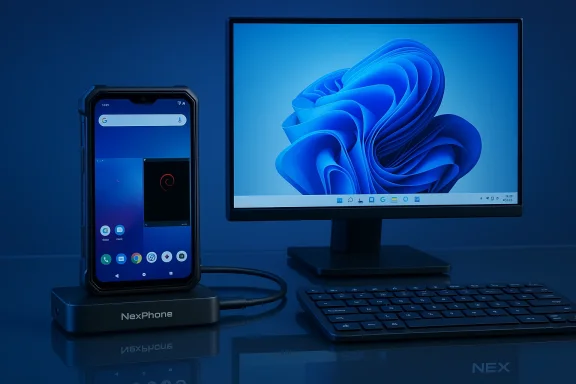
NexPhone arrives promising a simple, radical idea: carry one pocketable handset that behaves as an Android smartphone, a ready-to-run Debian Linux workstation, and — when you need it — reboots into a native Windows 11 on Arm desktop for full Windows app compatibility.

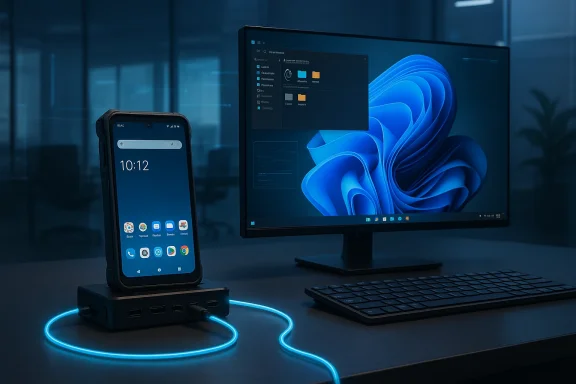
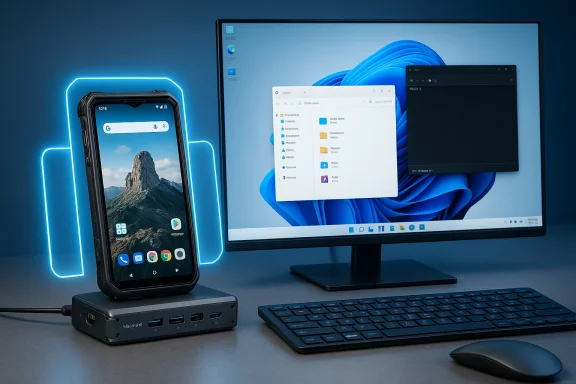
Rugged smartphone on a blue-lit charging dock beside a desktop monitor and keyboard.Background / Overview​

The NexPhone is the latest attempt to realize the long-running “phone-as-PC” dream that vendors from Microsoft to Samsung have chased for more than a decade. Nex Computer — the company behind the NexDock laptop shells that convert phones into laptop-like workstations — says the NexPhone ships with a tri-OS architecture: Android as the default phone experience, a containerized Debian Linux desktop accessible without rebooting, and an optional, separately installed Windows 11 on Arm image that requires a reboot to enter Windows mode. Nex is taking refundable reservations at a $199 deposit to hold an early price of $549, with shipments targeted for Q3 2026.
This is not a concept video: Nex has shown prototype demonstrations and provided detailed spec pages that align with early press coverage. Still, the product’s viability hinges on the mundane engineering tasks that often separate working demos from dependable device drivers, a validated boot chain, consistent Windows updates, and predictable thermal and battery behavior.

What NexPhone claims to be​

Three operating environments, one chassis​

  • Android (default): The phone runs Android (Nex markets a “Nex OS” -on mobile environment that handles telephony, SMS, mobile notifications, and typical smartphone apps. Android also provides the container platform for the Linux environment.
  • Debian Linux (instant desktop): A full Debian desktop runs inside Android as a containerized app, enabling near-instant access to Urowsers, and native Linux utilities without rebooting. This is the most practical “pocket workstation” element for developers and sysadmins who need SSH, compilers, editors, and CLI tools on the go.
  • **Windows 11 on Arm (reboot to is offered as an optional, separate partition that requires a reboot to enter. Nex positions Windows primarily for docked, monitor-based use — the moment when legacy Windows applications matter most — and has built a custom mobile-friendly Windows UI layer to make small-screen use less hostile.

Hardware snapshot (vendor claims cross-checked)​

Nex’s published spec sheet and independent coverage converge on a midrange-but-rugged hardware configuration:
  • 6.58-inch FHD+ (1080 × 2403), 60–120 Hz display
  • Qualcomm QCM6490 (Dragonwing-family) SoC
  • 12 GB RAM, 256 GB UFS storage, microSD expansion (up to 512 GB reported)
  • 64 MP main (Sony IMX787), 13 MP ultrawide, 10 MP front cameras
  • 5,000 mAh battery (some prelaunch reports mention 4,200 mAh — battery specs are inconsistent across early materials)
  • MIL‑STD‑810H, IP68/IP69K ingress protection
  • Bundled 5‑port USB‑C hub (to make docking plug-and-play)
  • Price: $549 early price with $199 refundable reservation; target ship window Q3 2026.
I verified these numbers across the vendor overview and multiple outlets: Nex’s product pages, The Verge and Windows Central report essentially the same headline specs and the same reservation model, providing two independent confirmations of the core claims.

Why the QCM6490 matters (and what it really is)​

The most consequential hardware decision behind NexPhone is the Qualcomm QCM6490 SoC. That chip belongs to Qualcomm’s Dragonwing family — a trial modules targeted at long-life and multi-OS support rather than peak flagship performance. Microsoft’s Windows enablement documentation and vendor enablement worklists include the QCM/QCS 6490 family in its Windows 11 on Arm compatibility matrix, which gives Nex a concrete, platform-level path to producing a native Windows 11 image for that silicon. What this means in practice:
  • The QCM6490 makes Windows feasible on consumer hardware because the chipset has been targeted by Microsoft for device enablement work.
  • The chip trades sustained CPU/GPU peak for longer life and broader OS support. Expect competent everyday performance for Android and light desktop tasks, but don’t expect flagship-level thermal headroom for heavy, long-running desktop jobs.
Nex’s choice is pragmatic: vendors that want to ship multiple operating systems and commit to longer lifecycles often prefer module-class Dragonwing silicon because it simplifies porting and support. That said, the QCM6490 is not a high-end laptop-class SoC, and that trade-off determines t: web-first productivity, terminal work, document editing and occasional native Windows apps — not heavy video encoding or prolonged local builds.

The docking story: why the included hub matters​

Nex bundles a 5‑port USB‑C hub with each phone. That matters because the NexPhone’s tri-OS proposition only delivers real value when external displays and input devices make Windows and Linux usable for desktop work. The hub is marketed as including HDMI (or native display-over-USB-C once drivers are finalized), two USB‑A ports, and extra USB‑C/PD ports so the handset can power, display, and connect keyboard/mouse without extra purchases. Practical benefit: if you already work on external displays or need occasional full-desktop sessions, having a bundled hub removes friction and justifies the pricing model. If you primarily use the handset’s internal display, the appeal is weaker because much of the tri-OS promise is realized only when docked.

The Windows piece: bold promise, open questions​

Windows 11 on Arm is the NexPhone’s headline and highest-risk feature. Nex’s public materials and early demos claim a native Windows 11 on Arm partition that boots after a reboot and supports a desktop UI on external displays and a custom Mobile UI on the phone screen, choreographed by two verifiable facts: Nex’s own documentation and Microsoft’s chipset enablement for QCM6490. But significant practical details are still missing or vendor-provisioned.
Key open questions that will determine real-world usefulness:
  • Installation and licensing: How will Nex handle Windows licensing? Will the Windows image be preinstalled, optional, or provided as an OEM-only image requiring a separate license transfer? Nex’s pages say Windows is “compatible” and “aligned with Microsoft requirements,” but they stop short of clarifying licensing mechanics. This is a practical purchasing and legal question that buyers must have answered before committing.
  • Driver signing and Windows Update: Running Windows reliably requires a complete set of signed drivers (GPU, Wi‑Fi, audio, power management, modem integration when applicable) and a predictable Windows Update story. Demonstrations have used DisplayLink in early previews, while Nex says native USB‑C display drivers are in development — a red flag that driver maturity will be the gating factor for smooth docked desktop use.
  • Storage partitioning and performance: How will storage be split between Android and Windows? What overhead will a full Windows image require, and how will Nex handle storage expansion via microSD when Windows needs significant space? Nex’s product pages state a 256 GB base and microSD expansion, but the usable Windows partition size and I/O impact remain unspecified.
  • Telephony and OS separation: Nex is explicit that telephony is managed by Android and that Windows mode is isolated; booting into Windows will generally suspend Android telephony functions. That changes how you carry and use the device: Windows mode is best thought of as a docked desktop state, not a full replacement for a phone in the pocket.
  • Reboot friction and session continuity: Nex’s model requires a reboot to switch into Windows. No single-source demo yet proves a quick, seamless handoff. What is the real-world reboot time? How are open documents and background tasks preserved or handed off between Android and Windows? Thesee workflow questions are critical to deciding whether the NexPhone is truly convenient reviews will need to measure boot times and app performance in Windows mode.
Until retail hardware and shipping firmware are available for independent testing, buyers should treat the Windows promise as technically plausible but practically unproven. Several outlets replicate Nex’s claims and demos, but the heavy lifting remains: driver maturity, signed firmware, and a clear licensing/installation flow.

Strengths: what NexPhone gets right​

  • Ambitious, sensible architecture: Splitting Windows into a separate partition while keeping Debian containerized inside Android is a pragmatic compromise. It isolates telephony and preserves Android’s strengths while giving developers an instant Linux environment and an on‑demand Windows image.
  • Hardware choices match the pitch: The QCM6490’s industrial/long-life pedigree is an intentional trade-off that simplifies multi-OS enablement and update commitments. For users who value longevity and cross-OS compatibility over bleeding-edge performance, that’s sensible.
  • Dock-first ergonomics: Including a USB‑C hub and focusing on external-display workflows addresses the main friction point that many prior phone-to-desktop approaches suffered: accessory complexity. A bundled hub and a docking-first UX make the product more practical from day oirst features:** The Debian container offers immediate value for developers and sysadmins who need a portable Unix environment with hardware acceleration and shared files — a real productivity boost for remote work and on-site troubleshooting.

Risks and practical limitations​

  • Driver and firmware risk: Building a fully functional Windows 11 on Arm image requires signed drivers for every major subsystem. If Nex cannot ship and maintain those drivers, Windows mode will be a hobbyist curiosity rather than a dependable feature. Early demos used DisplayLink for external display output — workable for demos, but not a long-term substitute for native drivers.
  • Performance trade-offs: The QCM6490 is midrange. Expect competent daily use and light desktop productivity, but not sustained heg compiles, or high-end gaming. Buyers should calibrate expectations: the NexPhone is a portable workstation for many tasks, not a drop-in replacement for a high-end ARM laptop.
  • Reboot friction and telephony split: Requiring a reboot to enter Windows introduces workflow friction. Because telephony remains Android-only, users who expect always-available calls while using Windows will be disappointed. This makes the NexPhone most useful for planned docked sessions rather than spontaneous multitasking between OSes.
  • Spec variance and prelaunch uncertainty: Some core figures differ across prelaunch materials (battery capacity is one visible inconsistency). Treat battery claims and a few other numbuntil independent retail units are tested.
  • Licensing and enterprise readiness: Enterprises and fleet buyers will need clarity on Windows licensing, manageability, driver signing, and long-term SLAs. Without Microsoft and Qualcomm assurances about long-term support, the device may be unsuitable for conservative corporate deployments. Nex’s marketing references longer lifecycle support but independent confirmation from Qualcomm/Microsoft would be required.

Practical buying checklist for early adopters​

  • Confirm the final Windows licensing model before placing a reservation (preinstalled OEM image vs. optional install, and any licensing fees).
  • Ask Nex for a clear driver and Windows Update policy (who signs drivers, cadence of Windows and firmware updates).
  • Verify storage partitioning details: how much of the 256 GB is allocated to Windows vs Android, and what happens with microSD expansion.
  • Request a demo or thing real reboot times and Windows app performance when docked to a monitor.
  • Treat the $199 reservation as a bet on a roadmap — refundable deposits mitigate risk, but independent reviews will be decisive.

Who should consider the NexPhone​

  • Developers and sysadmins who want a single pocket device that delivers fast Linux access and occasional Windows compatibility while docked. The Debian container is the easiest, lowest-friction win for this crowd.
  • Road warriors who value rugged hardware, long battery life and the ability to plug into an office monitor for brief desktop sessions without carrying a laptop. The bundled hub amplifies this value.
  • Enthusiasts who enjoy cutting-edge, cross-OS experimentation and are comfortable accepting prelaunch risk in exchange for a novel workflow. Early adopters will be vital to surfacing driver and update issues.
Avoid the NexPhone if you need a consistently high-performance, fully validated Windows laptop replacement for heavy local workloads — the hardware and thermal envelope simply don’t promise flagship-level sustained performance.

How this compares to past attempts (context)​

Samsung DeX and Motorola Ready For proved that Android-to-desktop flows can be useful, but they stayed inside the Android ecosystem. Microsoft’s Continuum attempted a more integrated phone-to-PC story but never gained traction. NexPhone’s difference is three native environments rather than one desktop layer: Android for mobile, Linux for developer tooling without rebooting, and full Windows as an optional boot target. That increases flexibility but multiplies engineering complexity. The vendor’s roots in NexDock hardware and the industry-acknowledged QCM6490 enablement with Microsoft provide a plausible foundation — but proof of durability will be the results of independent reviews anupport.

Final assessment — practical, promising, but not yet proven​

The NexPhone is the most concrete attempt in years to make a pocketable, multi-OS workstation that includes Windows 11 on Arm as a real runtime rather than a streamed or emulated experience. The vendor’s design choices are thoughtful: a Dragonwing-class SoC for broader OS compatibility, a containerized Debian desktop to avoid reboot friction, and a reboot-to-Windows partition that isolates OSes for stability. The bundled hub and docking-first UX address real accessory pain points, too. However, the success of that engineering work depends on execution. The single biggest open risks are driver maturity and Windows update/driver signing, the practicalities of Windows licensing and installation flow, and the real-world performance envelope when Windows runs heavier workloads on phone-class thermal limits. Until retail units and independent hands-on reviews validate boot times, app performance, battery life and the vendor’s update cadence, the NexPhone should be treated as a compelling prototype and an early-adopter purchase rather than a finished laptop replacement for all users.
For readers who want a single, dockable device that can run mobile apps, Unix tooling and — occasionally — native Windows applications on a monitor, NexPhone is an exciting and credible option to watch. For those who need guaranteed, enterprise-grade Windows performance and support today, the device is an interesting preview of where mobile convergence might go — but not yet a drop-in replacement for a dedicated Windows laptop.

Every major claim in this article was cross-checked against Nex Computer’s product materials and multiple independent outlets reporting on NexPhone’s announcement and demos; the vendor pages and press coverage consistently report the tri‑OS architecture, the QCM6490 platform choice, the $549 early price with a $199 refundable reservation, and the Q3 2026 target ship window — but several implementation details remain vendor-provided promises pending independent verification.
Source: Digital Trends This Android phone with Linux jumps to Windows when you need it
 

The NexPhone arrives as the most concrete — and commercially available — attempt in years to make the oft-repeated “phone that replaces your laptop” idea real: a rugged Android handset that ships with Android 16, offers a full Debian desktoptop that runs as an app under Android, and can reboot into a native Windows 11 (Arm) image with a mobile-optimized UI. This tri‑OS promise is the device’s headline, and it’s paired with a midrange hardware package, an included USB‑C hub for docking, and an early‑bird preorder price that undercuts many ultraportable laptops. The announcement and early spec sheet are already circulating widely, but the facts behind the marketing claims matter — especially the Windows story, the chipset’s long‑life support promise, and the practical trade‑offs buyers must accept.

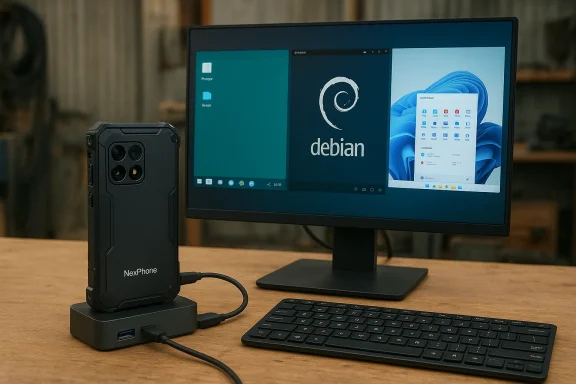
A rugged NexPhone on a charger dock sits beside a monitor displaying Debian Linux.Background / Overview​

The NexPhone is the next logical step from Nex Computer, the small company best known for the NexDock laptop shells that let a phone power an external display, keyboard and trackpad. That heritage explains the product’s core idea: build the compute engine itself — a phone designed to behave like a docking‑first mini PC when paired with a monitor and peripherals. The company frames the NexPhone as a practical evolution of Microsoft’s old Continuum experiments and Samsung’s DeX-style desktop modes, but with one important difference: rather than only layering a desktop UI on top of Android, the NexPhone ships three native environments — Android for everyday use, Debian Linux as an on‑device container, and Windows 11 installed to its own partition and entered after a reboot. Early coverage and the manufacturer’s materials repeat this pitch consistently, while independent analysis warns that delivering a smooth tri‑OS engineering and maintenance.

What’s in the box and the headline specs​

Nex’s marketing and early hands‑on reports consolidate a clear spec list meant to position the phone as a sturdy, dock‑first productivity device rather than a camera or battery flagship. The most important headline numbers are:
  • SoC: Qualcomm QCM6490 (Dragonwing family) — a midrange/enterprise-class platform already used in other long‑life devicesm](]) [*]Memory & storage: **12 G inte...n-and-price"]Fairphone 5 officially announced
  • Battery & charging: A 5,000 mAh battery is respectable but not class‑leading; some contemporary phones exceed 6,000–7,000 mAh. More concerning is the 18 W maximum wired charging: slow charging increases the friction of heavy docked use when the battery is being drawn down and users need rapid top‑ups. For sustained desktolaptop‑style battery life is optimistic. Independent hands‑ons and prelaunch materials flag battery and charging as common weak points for dock‑first phones.
  • Thermals: Phone chassis and SoC thermal limits will be the primary determinant of sustained Windows or Linux workload performance. Nex’s rugged case and MIL‑STD claims arguably help mechanical durability, but they do not increase thermal headroom. Buyers should anticipate performance throttling with sustained CPU/GPU loads.

Software, drivers, updates and the long‑term maintenance problem​

The NexPhone’s biggest engineering and business challenge is not hardware — it’s long‑term software support across three ecosystems:
  • Android: requires regular OS updates and security patches. Nex must either maintain its own Android builds or commit to timely updates delivered to customers.
  • Debian/Linux container: needs GPU acceleration, hardware access and ongoing compatibility patches. Running Linux as an app inside Android is technically easier than shipping a full Linux partition, but it still requires drivers and integration work.
  • Windows 11 on Arm: demands signed, compatible drivers, a validated boot chain and a credible Windows Update strategy. Microsoft’s processor list (which includes QCM6490) is a meaningful enabler, but actual Windows support for the phone depends on Nex and its partners producing modern DCH drivers and a firmware update process that plays well with Windows Update and Microsoft’s signing requirements. This is the most fragile link: if drivers are missing, Windows will run poorly or not at all on critical subsystems (GPU acceleration, audio, modem, cameras).
Nex’s marketing materials and prelaunch documentation answer some questions but leave others open: who signs and maintains the Windows drivers; how Windows Update will deliver firmware and driver patches; what the Windows license situation will be for end users; and whether carriers or regulatory certification for telephony will vary across markets. Early reviewers and community analysts explicitly recommend buyers ask Nex for a clear Windows support statement and an update cadence before placing a preorder. Treat early reservations as supporting an ambitious roadmap, not as a guarantee of full, long‑term parity with laptop Windows experiences.

Cameras, durability and other hardwareims for practicality rather than camera excellence. The nominal camera array (64 MP main, 13 MP ultrawide) places it in the midrange class — fine for snaps and documentation, not a flagship camera contender. The rugged build (IP68/IP69K and MIL‑STD‑810H) is a genuine differentiator for fieldwork or industrial settings where phones take knocks and get wet. The display’s LCD panel and Gorilla Glass 3 protection are somewhat conservative choices and feel older compared to recent AMOLED flagships, but they align with the product’s price and robust design focus.​


Price, preorder model and availability​

Nex opened refundable reservations with a US$199 deposit and advertises an early purchase price of US$549, which includes the bundled USB‑C hub. Shipping, taxes and customs are extra, as the company ships from the U.S. Nex targets Q3 2026 for shipments. That pricing undercuts many ultraportables and puts the NexPhone in a sweet spot for enthusiasts who want a single device for mobile and moderate desktop tasks — provided the tri‑OS implementation works in practice. Preorder models and deposit schemes carry typical startup risks: specification drift, delayed shipments, regional variant differences and final feature changes between the preordeail units. Buyers should be prepared for those realities.

Risks, unknowns and buyer checklist​

The NexPhone is compelling — but the road from demo to daily driver carries clearly identifiable risks. Before reserving or buying, confirm these points:
  • Windows support statement: Ask Nex to detail driver signing policy, Windows update delivery, and the company’s warranty and update obligations for the Windows image. Don’t assume Microsoft‑level update coverage unless Nex proves the process.
  • Driver cthat the Windows partition supports GPU acceleration, audio, modem (telephony), Wi‑Fi, Bluetooth and camera** subsystems in the company’s own compatibility list or in independent hands‑on reviews. Missing drivers break the desktop experience.
  • Thermal and battery performance: Wait for independent tests focusing on sustained workloads (browser with many tabte‑desktop sessions) to see how the QCM6490 behaves over real‑world durations.
  • Update cadence and longevity: Clarify how Android security patchupdates and Windows patches will be provided and for how long. Treat the “support through 2036” language as aspirational until Qualcomm or official roadmap docs confirm it.
  • Regional differences & telecom certification: Confirm band support and carrier certification for the country where you’ll use the phone — cross‑border imports can mean missing bands or unsupported carrier features.
  • Return / refund terms: Preorder deposits are refundable, but confirm the exact refund conditions and timeline in writing before sending funds.

Who should consider the NexPhone — and who should not​

  • The NexPhone is a strong fit for:
  • Developers and IT pros who need a pocketable Linux environment for SSH, builds, and quick tests, and occasional native Windows access.
  • Field workers and technicians who value rugged hardware and docking simplicity for on‑site reporting.
  • Enthusiasts and early adopters who can tolerate prelaunch hiccups and want to help shape the product through feedback.
  • The NexPhone is a poor fit for:
  • Users who need heavy, sustained native Windows desktop performance (video rendering, large local compiles, gaming).
  • Buyers who require guaranteed enterprise‑grade Windows updates and support SLAs without vendor‑level proofsople who want the best cameras or fastest charging for day‑to‑day mobile photo use.

Practical recommendations or prospective buyers​

  • Read the Nex product page and request written answers on Windows driver commitments and firmware update cadence. ([nexphone.com](NexPhone | reviews that test Windows boot behavior, driver coverage, and sustained thermal performance. Independent hands‑ons will reveal whether the tri‑OS dream is a practical reality or a clever prototype.
  • If you reserve, keep the preorder refundable and be ready to cancel if Nex cannot substantiate key support promises.
  • For those who need Windows parity today, consider an ARM laptop or a lightweight Windows machine; the NexPhone is more of an innovations‑first device than a safe, immediate laptop replacement.

Verdict — an ambitious, conditional “yes”​

The NexPhone is one of the most ambitious consumer attempts in recent memory to blur the line between smartphone and PC. The hardware choices — notably the Qualcomm QCM6490 and the inclusion of a UPS/C hub for docking — give the company a credible technical platform, and Microsoft’s own supported‑processor listings remove a key roadblock for Windows on Arm. But the device’s usefulness depends entirely on the tedious engineering work that follows: signed drivers, a robust Windows update and rollback strategy, reliable Debian container performance, and realistic thermal manas: the NexPhone is a promising, experimental pocket workstation that could become a practical daily driver for a focused set of users if Nex delivers on drivers and updates. For cautious buyers, the best course is to watch for retail review units and vendor confirmations about Windows and security support before committing funds. For enthusiasts who understand the risks, the NexPhone is a rare, worthwhile bet on a single‑device future — just not a guaranteed replacement for a mainstream laptop today.
The NexPhone reopens a persistent question in modern computing: can a single pocket gadget replace multiple devices without compromising usability or longevity? The answer will be technical and incremental, not rhetorical. Early promises are solidly engineered in approach and optimistic in scope; the months between preorder and shipping will determine whether Nex’s tri‑OS vision becomes a useful tool for real‑world workflows or a clever footnote in the ongoing search for the “phone that could.”

Source: Digitec https://www.digitec.ch/en/page/linux-and-windows-11-also-run-on-this-android-smartphone-41281/
 

Fourteen years after the last hopeful flagship from Microsoft faded, a small startup has launched a phone that explicitly seeks to finish the job: ship a pocketable device that behaves like a phone, a Linux workstation and—when required—a full Windows 11 PC. The NexPhone is a rugged, dock-first handset from Nex Computer that mixes a clean Android 16 daily experience, a containerized Debian Linux desktop, and an optional reboot-to-Windows 11 on Arm partition—packaged at a sub‑$600 early price and promoted as a practical “PC in your pocket.”)

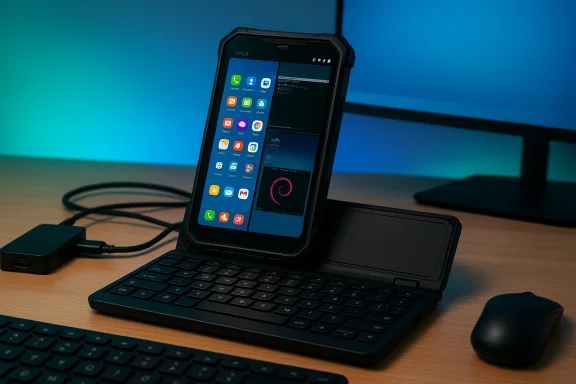
Rugged smartphone docked in a keyboard base on a desk with a monitor and mouse.Background​

The idea that a phone could become a desktop is not new. Microsoft’s Continuum, Samsung DeX and Motorola’s “Ready For” efforts all tried to blur mobile and desktop boundaries. Nex Computer’s pitch is different in one important technical way: it wants to ship a handset capable of running native desktop Windows rather than a limited mobile shell or an Android-based desktop mode. That changes the engineering bar—if the phone can truly boot Windows 11 on Arm and run real .exe applications, the “app gap” that sank Windows Phone becomes irrelevant for many workflows. Early press coverage and the company’s pages confirm the tri‑OS architecture and the headline hardware choices that make the leverage.

Overview: what NexPhone promises​

  • Three operating environments on one device:
  • Android 16 as the everyday phone OS and daily driver.
  • Debian Linux available as a containerized desktop app inside Android (called NexOS Linux), with GPU acceleration.
  • Windows 11 on Arm as an optional, separately installed partition that requires a reboot to enter.
  • Hardware tuned for durability and docking:
  • Qualcomm QCM6490 SoC (Dragonwing family), selected for long‑life support rather than flagship peak performance.
  • 12 GB RAM, 256 GB internal storage with microSD expansion.
  • 6.58‑inch FHD+ 120 Hz LCD, 5,000 mAh battery, rugged polycarbonate body with IP68/IP69K and MIL‑STD‑810H claims.
  • A bundled multiport USB‑C hub intended to make docking to monitors easy.
  • Commercial model:
  • Early price $549 with $199 refundable reservation to lock in the early price; targeted shipping window Q3 2026 (vendor target).
These are the concrete, load‑bearing claims readers will weigh when deciding whether NexPhone is a curiosity or a practical single-device solution.

Hardware deep dive: why the silicon matters​

The QCM6490: a pragmatic, long‑life choice​

NexPhone’s headline technical decision is the Qualcomm QCM6490. That chip isn’t a top‑end flagship aimed at gaming; it’s a Dragonwing‑family part positioned for enterprise and long‑support use cases. Crucially, Microsoft’s Windows 11 supported‑processors list includes the QCM6490, which gives vendors a documented path to produce Windows 11 images for that silicon—provided drivers and the rest of the platform stack are in place. Microsoft’s documentation also emphasizes modern device driver requirements and Windows Hardware Compatibility Program compliance for new Windows 11 devices, underlining that processor listing alone is necessary but not sufficient for a retail, supported Windows experience. Nex’s site calls out Qualcomm “support through 2036” for the QCM/QCS family as part of its long‑life pitch; that’s a vendor‑level support promise worth treatting as a marketing claim until Qualcomm or independent channels confirm lifecycle details. The inclusion of the QCM6490 is a practical compromise: it trades top‑end single‑thread and GPU performance for driver and platform stability, and for the most important outcome here—vendor pathways to Windows 11 on Arm.

Memory, storage and expansion​

The baseline configuration—12 GB RAM and 256 GB storage—is reasonable for a midrange device that will mostly run web‑first productivity and light native apps. Expanded storage via microSD helps for media and Linux containers, but the RAM ceiling is the bigger constraint when you start multitasking heavy Windows desktop apps. Expect performance trade‑offs when running many desktop applications concurrently.

Display, battery and ruggedization​

A 6.58‑inch FHD+ 120 Hz display is a sensible choice for both phone and docked desktop‑mode work. The 5,000 mAh battery figure is what Nex advertises; early materials showed some variance on battery spec across previews, so retail testing will be needed to confirm real‑world endurance—especially when the device is used as a Windows mini‑PC (which will drain battery faster and is usually used while plugged in). Build materials emphasize a utilitarian polycarbonate shell, non‑slippery finish and IP/MIL durability ratings targeting field use rather than fashion.

Software architecture: three distinct environments​

Android 16 — the everyday phone​

NexPhone ships with Android 16 as the default, uncluttered daily experience. That means standard Android telephony, SMS, and app behavior remain intact. Android also serves as the host for the Linux container and for the “always‑on” phone functions while other modes are idle. Nex positions Android as the everyday interface—clean and bloat‑free—so the device remains a solid smartphone independent of the desktop ambitions.

Debian Linux — instant workstation inside Android​

The Linux environment is one of the most practical features for developers and admins. NexOS includes a containerized Debian desktop that you can launch from Android without rebooting, with claimed GPU acceleration for a usable GUI and browser. That model maps onto a proven on‑device workstation pattern: a quick, sandboxed Unix environment for SSH, code editing, local builds and desktop web apps without switching boot partitions. For many technical users this may be the most useful part of the package—easy access to familiar Linux tools while staying connected on Android.

Windows 11 on Arm — real .exe apps in your pocket​

The headline feature is Windows 11 on Arm as a separately installed, rebootable partition. Running full desktop Windows solves the old Windows Phone app gap: you get native desktop applications (Office, Photoshop, legacy business software) rather than mobile‑only apps. Nex has built a Mobile UI wrapper to make Windows 11 more touch‑friendly on small screens and to provide a PWA‑centric approach for frequently used mobile‑style web experiences inside Windows. The key technical enabler is the QCM6490’s listing in Microsoft’s supported processors; the practical enabler is Nex’s ability to deliver drivers and Windows images that meet Microsoft’s compatibility and driver model expectations. Important caveat: switching into Windows requires a reboot. This separation is pragmatic—avoids complex runtime virtualization and keeps each OS isolated—but it also introduces friction if your daily workflow requires instant, back‑and‑forth switching between mobile and Windows modes. Expect real use to involve docking at a desk or lapdock to transition into Windows for heavier tasks, then rebooting back to Android for phone functions.

Docking and accessories: the NexDock line and the bundled hub​

Nex Computer is the maker of the NexDock lapdock family—keyboard/display shells that turn phones into laptop‑like workstations. NexPhone ships with a multiport USB‑C hub to ease docking: HDMI video out, USB‑C PD passthrough, and USB ports for peripherals. The company also promotes pairing the phone with its NexDock hardware for a laptop‑style experience anywhere. This ecosystem approach reduces friction for the device’s target workflow: arrive at a desk, plug the phone into a hub or NexDock, and work on a full desktop.

Pricing and availability: the reservation model and regional caveats​

Nex is selling an early‑bird pitch: $549 retail, lockable with a $199 refundable reservation; shipments are targeted for Q3 2026. The reservation model funds tooling and priority allocation for early backers. Early press reporting and Nex’s product pages align on these commercial terms. Prospective buyers should treat those dates and the deposit model as vendor‑targeted timelines, not immutable guarantees. The region-by-region distribution model is not fully finalized in public materials. Claims about reduced reservation payments for regions without direct shipping—such as a $1 placeholder option pending local reseller approval—appear in some early press summaries but are not broadly documented on official sales pages; these localized pricing or reservation workarounds should be treated as provisional until Nex or an authorized reseller confirms them directly. Potential buyers in Kenya and other markets should verify shipping, taxes, import duties, warranty and reseller status before assuming local availability or special reservation pricing. This geographic detail remains a claimant area to watch and verify with the vendor.

Strengths: where NexPhone truly advances the conversation​

  • Native desktop Windows compatibility. If Nex can deliver a stable Windows 11 on Arm image with complete drivers, the device removes the old Windows Phone obstacle—lack of desktop software—by letting you run full Windows apps when you need them. Microsoft’s processor list showing QCM6490 is a material enabler.
  • Practical Linux support. Shipping a containerized, GPU‑accelerated Debian makes the phone an immediately useful tool for developers and IT staff: SSH, CLI tooling, text editors and web development tools without rebooting.
  • Dock-first ecosystem. Nex’s background with NexDock lapdocks is a real advantage—buyers get hardware and accessory guidance for a plug‑and‑work workflow that many other vendors treat as an afterthought.
  • Durability and port selection. The utilitarian, ruggedized chassis prioritizes ports and resilience for field use, addressing the real needs of travelers and on‑site professionals rather than chasing thinness.
  • Accessible price point for enthusiasts. A $549 entry for a tri‑OS device is compelling for early adopters who value flexibility over flagship benchmarks; the refundable reservation reduces financial risk for early backers.

Risks and unknowns: what could trip this idea up​

  • **Drivers and Windows certificrocessor listing is necessary but not sufficient. Windows on Arm devices must ship with modern device drivers and meet Microsoft’s Hardware Compatibility Program requirements. The real question is whether Nex can secure, integrate and maintain full Windows drivers (GPU, display, modem, audio, camera) and keep them updated across a tri‑OS firmware lifecycle. If drivers are incomplete or rely on partial emulation, the Windows experience will be degraded.
  • Thermals and sustained performance. A phone chassis limits heat dissipation. Running sustained desktop workloads (video rendering, complex builds, prolonged browser tabs) will likely trigger thermal throttling. The QCM6490 is a pragmatic performer but not a laptop‑class CPU; users should expect responsive web‑centric workloads rather than laptop‑grade sustained compute. Independent review units will be necessary to evaluate thermal curves and how aggressively Windows mode is throttled.
  • Battery life under Windows. The 5,000 mAh battery isage, but Windows desktop mode (and docked workloads) will drain batteries quickly if unplugged. Realistic usage as a “desktop” will assume mains power at the dock; battery life claims should be validated under both Android and Windows workloads.
  • Update coordination across three OSes. Maintaining security and feature updates across Android, Linux containersns is nontrivial. Buyers should demand a clear, published update policy and tooling for backups/rollbacks—otherwise a Windows update or Android security patch could destabilize the multi‑boot configuration.
  • Windows licensing, support and warranty realities. The business details of shipping Windows images—licensing, preinstalled drivers, and support commitments—matter. If Windows on the device is an optional, separately installed image the user must add or approve, support windows and warranty boundaries need to be spelled out. Nex’s marketing frames Windows as optional, but buyers should confirm whether Windows will be preinstalled, provided as an image, or requires additional licensing steps.
  • Regional availability, taxes, and resellers. Early reservation models and region‑specific pricing examples in some writeups may not reflect final retail realities. Import duties, reseller margins, and warranty fulfillment differ widely by country—confirmation from Nex or local authorized resellers is essential before committing to international purchases.
  • Repairability and service. Ruggedization is great for field durability, but serviceability (screen replacement, battery swaps) affects total cost of ownership. Buyers should ask about repair partners and spare‑parts policy for their region.

Who should consider buying (and who should wait)​

  • Recommended:
  • Developers and sysadmins who want a single pocket device with quick Linux access and occasional Windows desktop compatibility.
  • Road warriors and consultants who prioritize portability and docking workflows and accept trade‑offs for peak performance.
  • Enthusiasts and early adopters who enjoy tinkering, firmware uposystems.
  • Not recommended (today):
  • Users needing certified, heavy Windows workloads (video editing, large local builds, gaming) where sustained performance and support guarantees matter.
  • Non‑technical buyers who expecly supported, single‑OS experience similar to mainstream flagship phones.
  • **Businesses needing enterprise‑grade support and predictable driverx publishes a clear update and support policy.

Practical buying checklist​

  • Confirm the final, retail spec sheet on Nex’s official pages (processor, RAM, battery) and compare with independent reviews as they appear.
  • Validate the Windows arrangement: is Windows preinstalled, provided as vendor image, or user‑applied? Ask Nex about Windows licensing and driver support for modem, Wi‑Fi, GPU and camera.
  • Ask for clarity on updates: how will Android, Linux container and Windows updates be coordinated? Is there a rollback plan in case a multi‑OS update fails?
  • If buying outside the US/EU, confirm shipping, taxes, warranty and whether the vendor ships directly or through an authorized reseller in your country. Don’t assume local pricing/workarounds seen in early writeups are final.
  • Wait for independent thermal and battery tests in Windows mode—these will determine how practical the device is as a sustained desktop.
  • Use the refundable reservation option if you want priority access but prefer to wait for reviews before paying the balance. Confirm refund terms and timelines.

The broader significance​

NexPhone is far more than a gadget: it’s a useful litmus test for whether the industry’s long experiment in device convergence can yield practical products. The technical stack—Android as host, containerized Linux, and a native Windows 11 partition—maps cleanly to realistic modern workflows: phone for communications, Linux for developer tooling, Windows for legacy and desktop apps. The QCM6490’s inclusion on Microsoft’s supported processors list is a concrete structural change that makes this product plausible in 2026; but plausibility is not the same as perfect execution. If Nex executes software integration, driver maintenance, and support logistics well, the NexPhone could become the template for a new class of “pocket workstation” devices—especially for professionals who travel light and value single‑device simplicity. If they stumble on drivers, updates or thermal limits, the NexPhone will instead be an instructive engineering experiment: interesting, aspirational, and a signpost for where the industry might go next.

Conclusion​

The NexPhone is one of the most ambitious attempts yet to answer the question: can a phone be your only computer? It pairs a pragmatic silicon choice (Qualcomm QCM6490) and a realistic product strategy (Android daily driver, instant Linux, optional Windows 11) with a price point that makes the experiment accessible to enthusiasts. The central strengths—native Windows compatibility, a true containerized Linux desktop and a dock‑first ecosystem—are compelling. The central risks—Windows drivers and certification, thermal and battery limits in a phone chassis, update coordination and regional distribution logistics—are real and measurable. Prospective buyers should treat the current announcement as a promising milestone but wait for independent reviews, driver disclosures and clear regional availability details before replacing a laptop with this phone.

Source: Techish Kenya A new Windows 11 Phone is here - Techish Kenya
 

NexPhone arrives as a provocative re-opening of the long-running “phone-as-PC” idea: a rugged midrange handset that ships as an Android device, can run a full Debian Linux desktop on demand, and — unusually — offers a separately bootable Windows 11 on Arm image so the same pocket computer can act like a Windows desktop when docked.

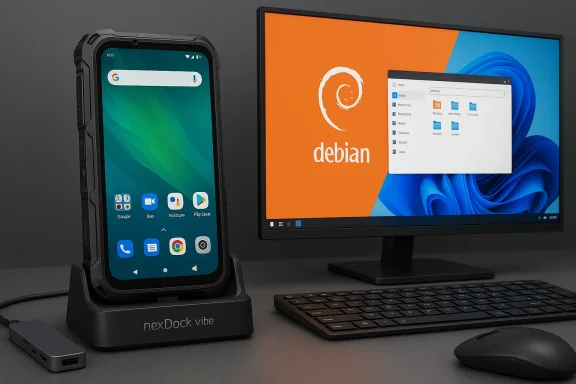
Rugged smartphone docked in a nexDock vibe beside a Debian desktop monitor with keyboard and mouse.Background​

The promise of a single pocket device that becomes a full desktop has resurfaced repeatedly over the past decade, from Microsoft’s Continuum experiments to Samsung DeX and Motorola Ready For. Nex Computer, historically known for the NexDock laptop shells that turn phones into laptop-like workstations, now aims to supply the compute engine as well: the NexPhone. The company says the device is built around Qualcomm’s QCM6490 (Dragonwing family), equipped with 12 GB of RAM and up to 256 GB of internal storage, and tuned from the start to be dock-first and productivity-focused rather than a camera-first flagship.
Nex’s public materials and early press coverage present a consistent product narrative: Android 16 (with a desktop-capable shell) as the daily driver; a containerized Debian Linux desktop accessible from Android without rebooting; and an optional, separately bootable Windows 11 partition that requires a reboot to enter Windows mode. The company is taking refundable $199 reservations toward an early price of $549, with a shipping target in Q3 2026 and a complimentary USB-C hub included in the box.

Overview: What NexPhone claims to deliver​

  • Three native operating environments in one device:
  • Android 16 as the default smartphone environment.
  • A Debian-based Linux desktop available as a containerized app inside Android.
  • A separate, bootable Windows 11 on Arm partition for full Windows desktop use (reboot required).
  • Headline hardware:
  • Qualcomm QCM6490 SoC (Dragonwing family).
  • 12 GB RAM and up to 256 GB storage, microSD expansion supported.
  • 6.58‑inch FHD+ display with up to 120 Hz refresh.
  • 64 MP main camera (Sony IMX787), additional ultrawide and front cameras.
  • Ruggedized chassis with MIL‑STD‑810H and IP68/IP69K ratings; 5,000 mAh battery cited in primary pages (some prelaunch pages varied).
  • Docking and accessory strategy:
  • Bundled USB‑C hub for display and peripherals.
  • Compatibility with prior NexDock shells and standard external keyboards/mice.
  • Commercial terms:
  • Refundable reservation deposit: $199.
  • Early retail price: $549 (balance due at shipping).
  • Target ship window: Q3 2026.
These claims form the load‑bearing promises of the NexPhone pitch; whather the product becomes a practical daily driver depends on firmware, driver support, and real-world resource limits when running desktop-class workloads.

Why the silicon choice matters: QCM6490 and Windows on ARM​

Nex’s selection of the Qualcomm QCM6490 is deliberate and central to the entire multi‑OS strategy. The QCM family (Dragonwing) is marketed more toward industrial, IoT, and long‑lifecycle applications than raw flagship mobile performance. That positioning gives two practical advantages for a tri‑OS phone:
  • Cross‑OS friendliness — the silicon is more readily targeted by vendors who want to build non-standard OS images (including Windows on Arm).
  • Longer maintenance horizons — Qualcomm provides extended lifecycle and platform support for some QCM parts, which helps vendors promise longer driver/firmware support than commodity flagship chips typically provide.
Critically, Microsoft’s public Windows hardware compatibility guidance explicitly lists certain Qualcomm Dragonwing-family processors as qualifying for Windows on Arm builds. That independent Microsoft footprint is the practical foundation that allows a vendor like Nex to claim a native Windows 11 image will run on the NexPhone’s QCM6490 silicon — provided drivers, signed boot chains, and update paths are implemented correctly. This makes the Windows-on-phone claim plausible, not magical.

How the tri‑OS architecture works in practice​

Android: the daily driver and desktop mode​

Android remains the always-on, pocketable environment. Nex ships an Android 16-based experience (sometimes described in early materials as a vendor-tuned build) and leverages Android’s evolving desktop features so users can plug into a monitor and use familiar Android apps in a windowed or larger-screen mode. Android is intended for everyday telephony, notifications, mobile apps, and the quick “docked but still mobile” use cases that mirror Samsung DeX or Motorola Ready For.

Debian Linux: containerized, near-instant desktop​

Nex advertises a Debian-based desktop that runs as a container or app within Android. This approach avoids the friction of rebooting for many developer and Unix-tool workflows while preserving access to native Linux tooling and GUI apps. Because Linux runs inside Android, hardware acceleration for graphics and peripherals is feasible, but full hardware parity with the native Android environment depends on the maturity of vendor drivers and the container integration.

Windows 11 on Arm: full native boot, reboot required​

The Windows environment is intentionally isolated: Windows 11 boots from a separate partition and requires the device to reboot into “Windows mode.” This avoids the complexity of running Windows as an emulation layer atop Android but introduces real-world friction — switching into Windows is not instantaneous, and background mobile workflows (cellular connectivity, push notifications) will stop or behave differently while in the Windows partition. Nex says it has implemented a Windows-friendly mobile UI for small-screen use and expects the platform to be used primarily when attached to an external monitor and input devices.

Strengths: what NexPhone gets right today​

  • A credible technical path for Windows on Arm: By choosing QCM6490 and aligning with Microsoft’s supported processor family, Nex has a plausible route to a native Windows image rather than an experimental emulator. This is a far stronger basis than ad-hoc attempts that relied solely on community ports.
  • Dock-first heritage and accessories: Nex’s experience building NexDock shells gives them a practical perspective on connectors, hubs, and ergonomics. Bundling a USB‑C hub and designing for external monitors reduces the friction of turning the phone into a proper workstation.
  • Pragmatic trade-offs: The focus on a rugged midrange chassis and long-life silicon suggests Nex prioritized cross‑OS compatibility and reliability over raw benchmark leadership — a sensible choice for this niche.
  • Price and positioning: $549 with a refundable $199 reservation positions the device below many ultraportable ARM laptops, making it accessible to enthusiasts and professionals willing to trade some thermal headroom for multimodal flexibility.

Risks and unanswered questions​

  • Driver maturity and signed drivers: Windows 11 on Arm demands device drivers that are signed and compatible with Windows Update and the Windows kernel on Arm. Shipping a stable, updatable Windows experience requires a validated driver stack for GPU, display output, audio, modem, sensors, cameras, and power management. Those are all non-trivial; early demonstrations can run desktop workloads, but long-term stability and Windows Update behavior are open questions until independent reviews test retail units. Treat “Windows works” demos as promising but not definitive evidence of long-term support.
  • Windows licensing and update policy: Running Windows 11 on a non-traditional handset raises licensing and update questions. Microsoft’s licensing for Windows on Arm broadly supports OEMs who ship validated devices, but end-user expectations about updates, telemetry, and long-term servicing should be clarified by Nex. Buyers should insist on written detail about which Windows edition ships, how updates will be delivered, and whether the device will receive security updates through the usual Windows Update channels. Nex’s public materials promise Windows support details, but those remain vendor statements until corroborated by documentation from Microsoft or Qualcomm.
  • Thermals, sustained performance, and use-case limits: Phone chassis and midrange SoCs are not designed for prolonged, thermally heavy desktop workloads. The NexPhone’s QCM6490 can likely handle web-first productivity, Office-style tasks, terminal work, and remote desktop sessions comfortably, but expect throttling under prolonged native compiles, heavy local virtualization, or extended GPU loads. For users who demand sustained native performance, a dedicated laptop will still be superior.
  • OS switching friction: Windows requires a reboot — which is practical for planned docked sessions but poor for workflows that need rapid context switching between mobile and desktop states. This limits the NexPhone’s convenience relative to purely containerized or virtualization approaches.
  • Component and spec variance: Early prelaunch materials showed inconsistent numbers for battery capacity (some pages listed ~4,200 mAh, others 5,000 mAh) and even Android version references (Android 15 vs Android 16). These discrepancies are common in early rollouts, but they matter to buyers who will rely on battery life and OS features. Treat marginal spec claims as provisional until retail units are measured.
  • Carrier, telephony, and SIM behavior in Windows mode: How cellular telephony and SMS behave while booted into the Windows partition is not trivial. If the Windows partition lacks full modem integration or vendor drivers, you may lose native calling or carrier features while in Windows mode; Nex’s documentation should clarify what services remain available and how background connectivity is handled. Early reporting flags this as a point for buyers to confirm.

Practical implications for Windows users and Linux developers​

For people who live in Windows or depend on specific native Windows apps, the NexPhone could be a useful fallback or travel companion: plug into a dock, work with a full Windows UI, and run many legacy Windows apps while away from a full laptop. But the device is most compelling when combined with remote workflows: remote desktop clients, cloud IDEs, browser-based productivity suites, and SSH/terminal sessions. Native heavy-duty workloads — video encoding, large-scale compilation, and GPU-bound engineering tasks — will outstrip the phone’s thermal envelope.
For Linux enthusiasts and developers, the containerized Debian desktop is immediately valuable: the ability to run local Linux tooling, local servers, and GUI apps without rebooting is a real productivity win, especially for field diagnostics, edge development, or when paired with a NexDock shell. But low-level hardware access (e.g., modem control, deep GPU feature exposure) may still be limited compared with a native ARM laptop.

What to verify before you reserve or buy​

Nex’s preorder model and ambitious roadmap are attractive, but buyers should treat reservations as a way to support a vision rather than a guarantee that every claim will appear in retail units. Before handing over a deposit, insist on written answers to the following questions:
  • Which specific Windows 11 edition will ship on NexPhone and how will Windows Update and driver updates be delivered and signed?
  • Will the device receive a clear firmware/driver update cadence and what is Nex’s warranty/rollback policy if Windows updates break functionality?
  • What telephony and SIM behavior is guaranteed while the phone is booted in Windows mode? Will callers reach the device? Are SMS and cellular data available?
  • Are the battery capacity and thermal limits finalized (5000 mAh vs other figures), and can Nex provide measured runtime figures for typical docked Windows use?
  • Does Nex plan to publish driver source / binaries for Linux and Windows, and what level of community or third‑party support is planned for long-tail fixes?
If a vendor can provide clear, concrete written answers to those items and demonstrate retail units undergoing Windows Update cycles in independent labs, confidence in the product rises materially. Until then, the NexPhone is a promising and pragmatic experiment rather than a fully proven laptop replacement.

Who should consider the NexPhone​

  • Enthusiasts and early adopters who enjoy multi‑OS tinkering and can tolerate early‑generation quirks.
  • IT professionals and field workers who value rugged hardware, long support windows, and portable Linux tooling.
  • Frequent travelers who prefer to carry a single device and are prepared to rely on cloud services or remote desktop for heavy compute.
  • Developers who need quick local Linux environments but accept that some hardware features may be less polished than on a full laptop.
People who require uninterrupted telephony in every mode, who need sustained native performance for heavy local workloads, or who demand ironclad vendor guarantees about Windows servicing should be cautious until retail reviews and warranty documents are available.

Short checklist: evaluating NexPhone claims (before and after shipping)​

  • Confirm finalized hardware specs and battery capacity from the product page and invoices.
  • Request written Windows licensing and update policy, including whether Windows Update will be used and how driver signing is handled.
  • Validate modem/telephony behavior while booted into Windows mode with vendor-confirmed test cases.
  • Wait for independent reviews that exercise the Windows partition through update cycles and thermal stress tests.
  • Confirm return/refund and deposit policies for the preorder program.

Conclusion​

NexPhone is one of the most interesting attempts in recent years to turn the phone‑as‑PC dream into a shipping product. The strategy is credible: a pragmatic silicon choice (QCM6490) plus Nex’s dock-first accessory experience give the company a technical route to deliver Android, Linux, and a native Windows 11 on Arm image from the same pocket device. But execution risk is high — driver signing, Windows servicing, modem integration, thermals, and shipping‑spec inconsistencies are real hurdles that will determine whether NexPhone is a clever novelty or a practical single‑device workstation for everyday use. Buyers who value experimentation and the promise of a single device that can be a phone, a Linux machine, and a Windows PC will find NexPhone compelling; those who need ironclad Windows update support, guaranteed telephony while in Windows, or sustained native performance should wait for independent retail reviews and vendor-supplied documentation before committing.

Short practical note: reservations are open with a refundable $199 deposit to lock a $549 early price; the vendor is targeting Q3 2026 for shipments and includes a USB‑C hub with the device. Treat prelaunch materials as vendor targets and verify the final specs and support documents on receipt.

Source: TechSpot This smartphone can run Android, Linux, and even Windows 11
 

NexPhone aims to be the pocket-sized computer many of us have wanted for years: a rugged smartphone that promises to run Android for daily use, launch a full Debian Linux desktop on demand, and even reboot into a native Windows 11 (ARM) installation — all on a single device.

Rugged NexPhone docked beside a monitor in an outdoor workspace.Background / Overview​

The NexPhone is the first commercial attempt to ship a tri‑OS smartphone targeted at people who need a true desktop environment from a device that fits in a pocket. The vendor’s public materials present the device as a rugged, midrange handset built around Qualcomm’s QCM6490 system-on-chip and configured with 12 GB of RAM, 256 GB of storage, a 6.58‑inch 120 Hz display, and a 5,000 mAh battery. It is offered with a $199 refundable reservation deposit toward a $549 retail price, and the company is targeting mass shipments in the third quarter of 2026.
The core selling point is straightforward: when you’re on the go, use the handset as a clean Android 16 phone; when you need a desktop, either launch a GPU‑accelerated Debian instance inside Android or reboot the device into Windows 11 on ARM for a full desktop experience when connected to a monitor, keyboard, and mouse. The vendor also emphasizes rugged durability — MIL‑STD‑810H and dual ingress protection ratings — and bundles a USB‑C hub intended to simplifey docking.
This article consolidates the public technical claims, identifies where the engineering and market risks lie, and offers practical guidance for buyers and IT pros who may consider NexPhone as a single-device solution for mobile and desktop computing.

Why the QCM6490 matters: the silicon at the center of the tri‑OS story​

QCM6490: a different class of SoC​

NexPhone’s multi‑OS capability hinges on the choice of the Qualcomm QCM6490 SoC. That chip is positioned by suppliers as an enterprise/edge variant of Qualcomm’s mobile silicon families: it trades flagship silicon headroom for extended lifecycle availability, industrial certifications, and broad vendor support.
There are three practical consequences to this choice:
  • Windows 11 feasibility — Microsoft’s published Windows hardware documentation lists the QCM6490 among Qualcomm processors that can be supported for Windows 11 in IoT/enterprise contexts. That listing establishes a technical pathway to run a native Windows 11 image on the chip family, which is a necessary condition for NexPhone’s Windows claim.
  • Longevity and updates — QCM/QCS family parts are sold into markets where multi‑year supply and longer maintenance windows matter, which explains why a startup would select the chip for a multi‑OS device intended to remain useful for many years.
  • Performance profile — the QCM6490 is closer to an upper‑midrange smartphone CPU in burst performance than to flagship laptop-class Arm silicon. For everyday tasks and light office work the platform is reasonable; for sustained heavy workloads (large video encodes, multi‑threaded builds, heavy emulation) it will be limited by thermal headroom and raw throughput.

What Microsoft’s processor listing does — and doesn’t — guarantee​

Microsoft’s inclusion of the QCM6490 in its supported processors list is an important independent signal that Windows 11 can be targeted to the platform, but it is not an end‑to‑end guarantee of a flawless Windows experience on a phone:
  • Supported processor status means the architecture and platform are recognized as viable for Windows images, but a device vendor must still deliver a full set of vendorsupplied drivers (display, GPU, power, USB controllers, modem, cameras) and a secure boot chain that integrates with Windows Update and the Windows device ecosystem.
  • The critical work remains with the OEM and driver vendors: shipping a signed, updateable Windows build with modern DCH drivers and ensuring Windows Update can deliver patches and firmware updates reliably are nontrivial engineering problems.
  • Windows on ARM improves compatibility for many desktop apps, but emulation of x64 binaries remains work‑heavy and will expose thermal and single‑thread limits on phone silicon.

What NexPhone claims (spec snapshot)​

The vendor’s public spec sheets and early press materials consistently list the headline hardware and price points. Key claims include:
  • Processor: Qualcomm QCM6490 (Dragonwing family)
  • Memory / Storage: 12 GB RAM, 256 GB internal storage; microSD expansion (vendor pages vary between “up to 512 GB” and “up to 768 GB” — see spec variance below)
  • Display: 6.58‑inch LCD, FHD+ (1,080 × 2,403), 60–120 Hz refresh rate
  • Cameras: 64 MP main (Sony IMX787) + 13 MP ultrawide; 10 MP front camera
  • Battery: 5,000 mAh (advertised "up to ~22 hours video playback"; some early materials have shown differing battery numbers)
  • Connectivity: 5G, Wi‑Fi 6E, Bluetooth 5.x, NFC, USB‑C 3.1 with display output capability
  • Durability: MIL‑STD‑810H, IP68 and IP69K
  • OS and boot: Android 16 as primary OS; Linux (Debian) available as a desktop environment launched as an app with GPU acceleration; Windows 11 on ARM available as an optional dual‑boot configuration requiring a reboot into a separate partition
  • Accessories and pricing: $549 retail, refundable $199 reservation deposit (remaining balance due before shipping), bundle includes a multiport USB‑C hub intended for docking
  • Target shipping window: Q3 2026
These specifications appear consistently across vendor materials and independent hands‑on reports; however, some details differ between public pages and early reviews, as noted below.

How NexPhone actually works: three modes, one device​

1) Android mode — daily phone​

NexPhone is primarily an Android 16 handset. That means standard smartphone functionality (calls, texts, mobile apps) will run in Android by default, with a lean vendor image that the company advertises as “no bloatware.” Android acts as the everyday operating system for mobile connectivity, notifications, and apps.

2) Linux desktop — launchable inside Android​

NexPhone includes a Debian Linux environment that runs as a containerized or app‑launched desktop with hardware acceleration. The vendor positions this environment as a true developer and power‑user tool: a full desktop browser, native Linux apps and CLI tools, and shared file access with Android apps. Because the Linux environment runs inside Android, switching to Linux does not require a reboot — it is intended to be instantly available for development, shell work, and admin tasks.

3) Windows 11 on ARM — reboot into desktop​

Running Windows 11 requires rebooting the phone into a separate partition that hosts a native Windows 11 image. The vendor provides a mobile‑style Windows UI for phone screens and expects most heavy Windows work to be done when the device is docked to an external display, keyboard, and mouse. Windows mode is the most engineering‑heavy portion of the product: it requires signed drivers, a supported firmware/UEFI/secure‑boot chain, and a robust update mechanism to remain secure and usable.

Notable strengths — why NexPhone matters​

  • Single‑device continuity: The core idea — one device that is also a full desktop when you need it — is compelling for road warriors, field engineers, and IT pros who want to carry only one hardware device.
  • Tri‑OS flexibility: Offering Android for mobile, an immediately available Linux desktop, and an optional native Windows partition gives practical flexibility for many workflows that previously required a laptop and a phone.
  • Dock‑first ecosystem: The vendor’s background producing lapdocks and phone-to-laptop shells means there is a mature ecosystem and accessories designed around docking workflows, reducing friction for users who want immediate desktop setups anywhere.
  • Industrial longevity approach: Selecting QCM‑class silicon — an enterprise/edge variant — is a rational move for a multi‑OS product that needs extended driver availability and lifecycle support, at the cost of flagship-level peak performance.
  • Rugged design and port selection: MIL‑STD and IP ratings plus a generous port selection (and a bundled hub) make this more suitable than many consumer phones for field deployments and harsh environments.
  • Accessible price for enthusiasts: A $549 entry point for a device that promises full Windows and Linux capability is an attractive price for early adopters and specialized professional use cases.

Engineering and business risks — why buyers should be cautious​

Driver coverage and Windows Update integration​

Running Windows 11 reliably on phone hardware demands a full stack of signed drivers (GPU, display controller, USB, power management, audio, modem) and firmware that plays nicely with secure boot and Windows Update. Microsoft’s support list for the QCM6490 makes Windows possible in principle, but practical success depends on Nex and component vendors shipping complete driver packages and maintaining them over time. Without that, Windows mode may be functionally limited or unable to receive timely security updates.

Thermals and sustained desktop workloads​

Phone form factors are thermally constrained. While the QCM6490 will provide acceptable single‑thread and light multi‑thread performance, expect throttling under sustained desktop loads. Heavy workloads — long video transcoding, large code builds, or prolonged virtualization/emulation — will run notably slower than on laptop Arm silicon designed for sustained performance.

Cellular and modem behavior outside Android​

Critical unanswered questions for many buyers: will cellular calling and modem features work when the device is in Linux or Windows mode? Historically, modems on mobile SoCs are tightly integrated into vendor Android stacks. Running other OSes natively often eliminates access to the modem or requires extra driver work. Buyers should confirm whether Windows or Linux modes will retain cellular and voice capabilities or whether those will be Android‑exclusive.

Update cadence and long‑term software maintenance​

Maintaining three OS ecosystems across firmware, drivers, security patches, and feature updates is a substantial commitment. The vendor’s marketing references extended Qualcomm support windows for the platform, but buyers should treat calendarized vendor claims with caution and seek clarity about the company’s concrete update commitments and warranty policies.

Spec variance and preproduction ambiguity​

Vendor materials and early press reports show some numeric inconsistencies: battery capacity has been cited differently in early handouts, and microSD expansion limits appear variably stated across pages. This signals that final retail specifications may change; buyers preordering on full specification faith should be prepared for possible adjustments.

Dependency on OEM and partner commitments​

Tri‑OS success requires ongoing collaboration between Nex, Qualcomm, Microsoft, and driver vendors. Any change in those relationships — certification delays, driver supply issues, or shift in platform support policies — could materially affect the Windows and Linux experiences over time.

Claims that need independent confirmation (red flags)​

  • “Qualcomm support through 2036” — The vendor asserts long‑term Qualcomm support ending in 2036 for the QCM/QCS platform. While QCM/QCS families typically enjoy extended availability for enterprise customers, a specific year (2036) is effectively a vendor marketing claim until Qualcomm publishes an explicit lifecycle notice or an OEM agreement is visible. Treat this calendarized promise with caution until confirmed by Qualcomm or an authoritative lifecycle document.
  • Battery capacity / endurance figures — The vendor’s marketing cites long battery life metrics (“up to ~22 hours video playback”), but early public materials have shown conflicting battery numbers. Real‑world endurance will depend on final hardware, software optimizations, and mode (Android vs running Linux vs Windows docked). Independent hands‑on battery tests will be essential.
  • Full modem/cellular operation across modes — It is not yet clear if cellular voice/data will remain available in Windows and Linux modes without Android present. Historically this has been an area where multi‑OS devices require extra engineering or compromises.
  • Driver lifecycle and Windows Update integration — Delivering signed Windows drivers and a stable Windows Update path is challenging. The presence of a supported chipset is necessary but not sufficient. Buyers should seek explicit statements about driver maintenance, Windows Update compatibility, and the Windows SKU (consumer vs IoT/Enterprise) Nex intends to ship.

Practical buyer checklist: what to confirm before reserving or buying​

  • Windows SKU and update plan
  • Ask whether Windows 11 will be a consumer retail SKU or an IoT/Enterprise edition, and how Windows Update will be supported for security patches and driver distribution.
  • Driver and firmware support schedule
  • Request a clear commitment for driver updates (GPU, display, USB controllers, modem, cameras) and how long the company will provide security patches and compatibility updates.
  • Cellular functionality in non‑Android modes
  • Confirm whether voice calls, SMS, MMS, and cellular data work when the device is booted into Linux or Windows. If not, clarify the intended use cases for those modes.
  • Refundable reservation terms and final pricing
  • Read the reservation policy carefully: what conditions allow a refund, and what additional fees (taxes, duties, shipping) will apply at final payment.
  • Final retail specs and measured battery tests
  • Look for detailed retail spec sheets and independent battery/thermals reviews before assuming vendor‑advertised endurance figures.
  • Warranty, repairability, and spare part policy
  • For rugged devices used in the field, check warranty length, repair options, and the availability of spare parts or service centers.
  • Secure boot / TPM and platform security
  • Ask whether the device will present a TPM (or equivalent) to Windows, and whether secure boot is fully implemented for Windows compatibility and enterprise security features.
  • Return policy and trial window
  • Ideally, confirm a trial window or return policy in case the Windows or Linux experiences do not meet expectations.

Use cases where NexPhone makes sense — and where it doesn’t​

Good fit​

  • Mobile professionals who need occasional desktop access for light office tasks and prefer carrying a single device.
  • Field technicians, inspectors, and first responders who need a rugged handset that can also connect to a monitor for reporting and light administrative tasks.
  • Developers and sysadmins who value an always-available Linux desktop for SSH, quick builds, CLI tooling, and on‑site diagnostics.
  • Enthusiasts and early adopters who value experimentation with multi‑OS setups and are comfortable with potential early‑product quirkiness.

Not a great fit​

  • Power users who expect laptop‑class sustained performance for heavy content creation, virtualization, or large build tasks.
  • Users who require guaranteed cellular voice and data in non‑Android modes unless specifically confirmed by the vendor.
  • Enterprises that demand long, contractually guaranteed firmware and OS update windows without reviewing the vendor’s update roadmap and SLAs.
  • Buyers who expect a plug‑and‑play Windows desktop with zero driver or firmware caveats — the Windows experience is promising but depends on driver maturity.

What success looks like — and the downside scenario​

A successful NexPhone launch would deliver a polished, well‑documented Windows image with complete drivers and Windows Update compatibility, a responsive Linux desktop with GPU acceleration, and long‑term vendor support for Android security patches. That outcome would validate the device concept, potentially kickstarting a new category of pocketable pocket PCs that blur the line between phone and desktop.
The downside scenario is equally plausible: Windows mode arrives but with limited driver support (no GPU acceleration or missing modem connectivity), Linux works but lacks performance or integration, and the vendor struggles to keep pace with security updates across three ecosystems. That outcome would leave buyers with a capable Android phone and a partially functional desktop promise — useful, but short of the transformative single‑device proposition being sold.

Final analysis: realistic expectations for an ambitious idea​

NexPhone is one of the most interesting hardware propositions to surface in years because it tackles a persistent pain point: carrying separate devices for mobile and desktop computing. The engineering choices (QCM6490, rugged chassis, bundled hub) show an understanding of the problem space and practical decisions to prioritize longevity and docking utility over peak benchmark scores.
However, the product’s success will hinge on the hard work that follows a spec sheet: delivering signed drivers, integrating with Windows Update, clarifying modem behavior across OSes, and sustaining timely updates for Android, Linux and Windows. Marketing assertions about multi‑year support and exact battery endurance should be treated as vendor promises until corroborated by component vendors or measured in independent reviews.
For IT buyers and enthusiasts considering reserving a unit, the sensible approach is cautious optimism: the device addresses an obvious market need and appears technically plausible, but verify the concrete guarantees and real‑world behavior before committing funds or replacing a laptop in mission‑critical workflows.

NexPhone’s arrival — if the company executes on its promises — could reopen a conversation about what a smartphone can be: not merely a communication device, but a true pocket PC capable of running desktop operating systems when you need them. The idea is as compelling as it is technically demanding; the coming months of driver releases, hands‑on reviews, and real‑world testing will determine whether this concept becomes a practical reality or an interesting, partial success.

Source: Windows Report https://windowsreport.com/nexphone-is-a-rugged-smartphone-that-runs-windows-11-android-and-linux/
 

Rugged handheld PC showing Android and Windows UIs with floating OS logos.
Nex Computer’s new NexPhone is a deliberate oddball in a homogenized smartphone market: a rugged, mid‑range handset that advertises the ability to run three distinct operating systems — Android (default), a hardware‑accelerated Debian Linux desktop, and a separately bootable Windows 11 on Arm — all on a single device built around Qualcomm’s industrial Dragonwing QCM6490 platform.

Background / Overview​

NexPhone revives an old dream: carry one pocket‑sized computer that behaves like a phone on the go but becomes a true desktop PC (or laptop via an optional shell) when docked. Unlike previous efforts that layered a desktop shell atop Android, Nex Computer is positioning a tri‑OS approach as the differentiator: Android for telephony and mobile apps, Debian Linux exposed as a containerized, GPU‑accelerated desktop inside Android, and a bootable Windows 11 on Arm partition that requires a reboot to enter full Windows mode. Early marketing and press previews place the device in the upper midrange hardware bracket: 12 GB RAM, 256 GB UFS storage with microSD expansion, a 6.58‑inch FHD+ 120 Hz LCD, a 5,000 mAh battery, rugged MIL‑STD build, and a $549 MSRP with a refundable $199 reservation deposit.
Nex’s pitch is practical rather than flagship‑driven: pick silicon that prioritizes multi‑OS driver availability and long lifecycle support over maximum benchmark scores. That pragmatic trade‑off underpins both the product’s most attractive promise and its largest engineering risks.

Why the QCM6490 matters (and what it is)​

A chip from the industrial lane, not the flagship race​

The QCM6490 (Dragonwing family) is Qualcomm’s module/embedded variant targeted at long‑life IoT, rugged handhelds, and industrial devices. Architecturally it shares lineage with mid‑range Kryo 670 designs and pairs an Adreno 643‑class GPU with an octa‑core CPU cluster, but it is offered with a different commercial and support model than mainstream Snapdragon consumer SoCs. Nex Computer selected this SoC precisely because it is designed for extended availability and broader OS compatibility — a prerequisite if you intend to ship Windows 11 images alongside Android and Linux on the same hardware. Key platform implications:
  • Longer SKU lifecycles and module availability compared with short‑run flagship silicons.
  • Looser commercial design constraints (module vendors often grant deeper low‑level access), which simplifies multi‑OS porting and driver development.
  • Thermal and GPU characteristics that place sustained Windows desktop workloads within a modest performance envelope — good for productivity, limited for heavy builds or rendering.

Microsoft’s compatibility nod​

Crucially, Microsoft’s public Windows 11 processor compatibility lists include the QCM6490 family under the Qualcomm entries, which gives OEMs a documented path to produce Windows 11 on Arm devices based on that silicon. Inclusion in the Microsoft list is an essential technical foothold; it does not, however, guarantee a full retail‑grade Windows experience without the vendor delivering and maintaining verified drivers, secure boot/UEFI integration, and update channels.

Hardware snapshot — what’s on the spec sheet​

Nex publishes a tangible list of components that support its tri‑OS strategy. The core elements most relevant to buyers:
  • SoC: Qualcomm QCM6490 (Dragonwing) — octa‑core Kryo configuration, Adreno 643 GPU.
  • Memory & Storage: 12 GB RAM, 256 GB UFS internal storage, microSD support (up to 512 GB claimed).
  • Display: 6.58‑inch FHD+ (2403×1080) LCD, 60–120 Hz, Corning Gorilla Glass 3.
  • Battery & Charging: 5,000 mAh battery, 18 W wired charging, wireless charging claimed.
  • Cameras: 64 MP main (Sony IMX787) + 13 MP ultrawide + 10 MP front camera.
  • Durability & Connectivity: MIL‑STD‑810H, IP68/IP69K, 5G (sub‑6), Wi‑Fi 6E, Bluetooth 5.x, NFC, USB‑C with video out.
These are consistent across Nex’s product pages and multiple independent previews, which raises confidence that the company is shipping concrete hardware rather than offering an abstract concept. Still, small spec variances (battery capacity cited at times between 4,200–5,000 mAh in pre‑production reports) suggest buyers should await retail reviews for final performance numbers.

Software architecture — how the three OSes actually live together​

Nex’s approach is explicitly hybrid: keep Android as the always‑on mobile hub, expose Linux as a near‑instant containerized desktop, and treat Windows as a separate, isolated boot partition.

Android (default)​

Android 16 serves as the phone’s default OS and handles telephony, SMS, mobile notifications, camera pipelines, and app access. Nex says Android is “zero‑bloat” and acts as the host for the Linux container and as the handler for device services that Windows mode will not directly manage. That means if you reboot into Windows 11, telephony and some phone‑centric services remain bound to Android unless Nex builds an appropriate handoff mechanism.

Linux (Debian) — the instant desktop​

NexOS bundles a Debian Linux desktop as a GPU‑accelerated application that runs inside Android. The advantage: quick context switches without rebooting, native Unix toolchains, and a real desktop browser or IDE when you need it. For developers and sysadmins who habitually use Linux tooling, this is the NeXT‑level convenience: terminal, package manager, and native Linux apps all available without leaving Android. The implementation model resembles containerized desktop approaches used by some Chromebook/Android hybrids but claims hardware acceleration for a smoother experience.

Windows 11 on Arm — the full reboot option​

Windows 11 is treated as an optional, separately installed OS that you enter after a reboot. Nex points to Microsoft’s processor list as the technical justification for this choice and has designed a custom Mobile UI for small‑screen Windows usage that pays homage to Live Tiles while leaning heavily on progressive web apps for lightweight mobile workflows. When docked to an external screen, Windows 11 becomes a standard desktop environment capable of running traditional Windows apps — subject, naturally, to Arm native or emulated compatibility. Practical consequence: Linux is near‑instant and coexists with Android; Windows is isolated but full‑featured when you need native Windows apps. That trade‑off is pragmatic — it reduces cross‑OS interference at the cost of a reboot when you switch into Windows.

Docking, NexDock, and desktop workflows​

NexPhone supports USB‑C video output and ships with a five‑port USB‑C hub accessory in early orders, enabling immediate connection to an external monitor, keyboard, and mouse. Nex’s existing NexDock laptop shell (sold separately) converts the phone into a laptop‑like setup via a wired connection, preserving power and reducing latency compared with wireless display protocols. The vendor emphasizes that the phone can be a true “PC” on a desk and that Windows mode is intentionally structured to behave like a standard desktop when docked. The docked workflow is where the NexPhone’s value proposition is clearest:
  • Quick mobile use on Android,
  • Instant Linux desktop within Android for development tasks,
  • Full Windows 11 desktop for compatibility with legacy or enterprise apps when a proper keyboard and display are present.

Pricing, preorder model, and timing​

Nex is taking refundable reservations: a $199 deposit to secure an early‑bird price of $549 MSRP, with the remainder due closer to shipment. Nexus targets Q3 2026 for shipping, noting that the schedule depends on manufacturing, firmware readiness, and cross‑OS driver validation. This reservation model and price point position the NexPhone as a paid bet on a unique functionality set rather than a low‑risk mainstream handset purchase.

The tough questions (licensing, certification, and maintenance)​

NexPhone’s most intereststing features raise questions that buyers must weigh carefully.

1) Windows licensing and Microsoft support​

Microsoft’s listing of QCM6490 among supported processors gives Nex a technical path to Windows 11 on Arm, but it is not a guarantee of licensing terms or long‑term Microsoft support for a consumer device. OEMs must still meet Windows Hardware Compatibility Program requirements, deliver modern DCH drivers, and manage updates. The public presence of QCM6490 on Microsoft’s list is encouraging but buyers should confirm whether Nex’s Windows image is an supported Windows SKU or a specialized image provided under different support terms.

2) Google Mobile Services (GMS) and Android certification​

Nex claims Android 16 as the default, but independent verification is needed on whether that Android build is Google‑certified (GMS) or AOSP‑based. If GMS certification is not present, many users will lose out on Play Store access, automatic Google updates, and some app ecosystem integrations. Nex’s marketing materials emphasize a “zero bloat” Android experience but do not always make the GMS status explicit; buyers should confirm this before purchase.

3) Driver completeness and update cadence for three OSes​

Shipping three operating systems dramatically increases the vendor’s maintenance burden. Android security patches, Debian package updates and kernel maintenance, and Windows cumulative updates all follow different timelines and require distinct drivers, secure boot, and validation. Nex’s claim of a long hardware lifecycle is compelling, but the company — a relatively small vendor — must demonstrate the operational capacity to deliver timely updates, security patches, and cross‑OS bug fixes for years. The risk is not hypothetical: multi‑OS devices fail fast in the market if one OS lags behind in critical patches or driver stability.

The 2036 support claim — marketing vs. verifiable commitment​

Nex advertises Qualcomm support “through 2036” for the QCM6490 platform as part of its long‑life pitch. This is a powerful marketing point for customers who prize longevity, but it requires scrutiny:
  • Nex’s site explicitly references Qualcomm support through 2036 as part of a long‑term program claim.
  • Independent module vendors and community projects sometimes refer to 2036 horizons for Dragonwing family availability, reflecting Qualcomm’s longer industrial lifecycles, but public Qualcomm statements explicitly committing to 2036 for every customer/product are not readily available. Where public Qualcomm lifecycle documentation exists, timelines are often vendor‑negotiated and tied to specific commercial agreements rather than blanket public guarantees.
Bottom line: treat the “2036” date as a vendor‑level marketing claim until Qualcomm publishes a clear, device‑agnostic lifecycle commitment or a third party independently confirms the contractual detail. Buyers depending on multi‑year commitments should demand written SLAs or warranty addenda.

Performance expectations — realistic use cases​

The QCM6490 sits in a performance bracket comparable to recent upper‑midrange mobile chips (think Snapdragon 7xx family analogues), which means:
  • Excellent for web productivity, Office suites, email, terminals, and light desktop software.
  • Pleasant Linux desktop for coding, admin work, and local testing, assuming reasonable multitasking discipline.usable for typical productivity workloads (Office, browser tabs, lightweight native apps) but will not match the sustained multi‑core or GPU throughput of modern laptop silicon for heavy compilations, large video renders, or gaming. Thermal constraints in a phone chassis further limit sustained peak performance.
If you expect to replace a full laptop for heavy desktop workloads, the NexPhone will likely disappoint. If you want one device that sometimes acts as a laptop and always as a phone and developer tool, it is a compelling compromise.

Risks and durability concerns​

  • Complex update surface: Three OS codebases equal three independent update streams. Timely security patches are essential; Nex must show a credible roadmap.
  • Windows driver maturity: Windows on Arm requires validated drivers for GPU, display drivers, USB controllers, modems, and TPM/secure boot — a heavy lift for a small OEM. Microsoft’s processor list is necessary but not sufficient.
  • GMS / app ecosystem risk: If Android is AOSP‑only without GMS, app compatibility and convenience suffer. Confirm certification status before buying.
  • Performance ceiling: The QCM6490 favours longevity over raw performance; thermals in a phone chassis constrain sustained desktop workloads.
  • Support reliability: A small vendor must build a support organization to match the device’s unusual complexity. Without clear SLAs, buyers may be taking a long‑term maintenance risk.

Who should consider NexPhone — and who should look elsewhere​

NexPhone is a niche product that fits a narrow but real audience:
  • Power users and developers who value a pocketable Linux environment and a convenient way to run Windows apps while traveling.
  • Field professionals who appreciate rugged MIL‑STD and IP ratings plus a long‑life hardware platform for enterprise deployments.
  • Tinkerers and enthusiasts attracted to true multi‑boot devices and who are comfortable troubleshooting and fed.
This is not a mainstream “one phone for everyone” product. Mainstream buyers seeking the best camera, the highest gaming frame rates, the smoothest flagship experience, or guaranteed Google ecosystem integration should look to established mainstream flagships. For the right buyer profile, however, NexPhone is a remarkably bold and practical attempt to bridge pocket and desktop — provided the company delivers on driver completeness and update management.

Practical buyer checklist (before you reserve)​

  1. Confirm the device’s **Google M certification status.
  2. Ask Nex for Windows licensing and support details — is Windows 11 on Arm provided under standard retail licensing and update channels?
  3. Request written details on update cadence and SLAs for Android security patches, Debian maintenance, and Windows cumulative updates.
  4. Verify the final retail battery capacity and charging specs with the shipping unit; pre‑production numbers have varied.
  5. Consider whether you need warranty service presence in your region; comay require on‑device repairs or firmware reflashes.

Strengths — the good reasons to be excited​

  • Genuinely unusual product positioning: Triple‑OS in a single retail handset is rare and compelling for cross‑platform workflows.
  • Dock‑first practicality: Native USB‑C video out and an included hub make desktop transitions immediate and useful.
  • Rugged build and long‑life silicon: MIL‑STD ratings and an industrially‑marketed SoC make it attractive for field work and enterprise.
  • Developer friendliness: A hardware‑accelerated Debian environment inside Android reduces friction for coding and server admin on the go.

Weaknesses and open risks​

  • Maintenance burden: Shipping and supporting three OSes long term is expensive and operationally complex.
  • Ambiguous lifecycle guarantees: The “support through 2036” claim helps sell the idea but remains a vendor assertion until Qualcomm or independent sources confirm the contractual scope.
  • Performance trade‑offs: The QCM64laptop replacement; heavy desktop workloads will expose thermal and compute limits.
  • Licensing and certification unknowns: Windows licensing, GMS status, and carrier compatibility require confirmation.

Final assessment​

NexPhone is a rare and deliberate experiment: a pocketable, rugged midrange smartphone designed first as a compute hub and only second as a consumer camera device. For the right user — developers, field professionals, and enthusiasts who prize multi‑OS flexibility — it promises genuine convenience: instant Linux, a proper Windows 11 experience when docked, and a supported industrial‑class platform that emphasizes longevity over transient flagship performance. But the product is not risk‑free. The trio of operating systems multiplies the vendor’s obligations: driver signing and validation, timely security updates across three ecosystems, and clear licensing for Windows and Android services. The QCM6490’s presence on Microsoft’s supported list is a necessary technical condition for Windows on Arm; Nex’s “support through 2036” claim is attractive but should be treated as a vendor marketing promise until Qualcomm or an independent party confirms the details. Prospective buyers should verify GMS certification, Windows licensing status, and Nex’s update/repair commitments before committing a deposit. This is a nostalgic, pragmatic creation for hardcore geeks and professionals who want one device to do everything — with the caveat that “everything” in this context comes with carefully managed expectations. For everyone else, NexPhone is fascinating to admire from a distance until retail units and long‑term support practices are proven in the wild.

Source: Mashdigi The NexPhone features three operating systems: Android, Linux, and Windows, and is powered by a Qualcomm industrial-grade processor.
 

Fourteen years after the idea was first teased, Nex Computer’s NexPhone has moved from concept to preorder — a rugged, midrange Android handset that legally and technically promises three distinct operating environments in a single pocket device: a clean Android 16 daily phone, a GPU‑accelerated Debian Linux desktop that runs inside Android, and an optional, separately bootable Windows 11 on Arm installation for full desktop compatibility.

Windows 11 setup with a NexDock tablet dock in front of a larger monitor, keyboard, and mouse.Background / Overview​

The NexPhone is the latest attempt to realize the long-standing “phone‑as‑PC” idea that previous projects like Microsoft Continuum and Samsung DeX explored but never fully delivered as a native multi‑OS experience. Nex Computer, best known for the NexDock lapdock family that turns phones into laptop‑style workstations, positions the NexPhone as the compute engine that can be docked to an external monitor, keyboard and mouse to become a desktop workstation — while still acting as a normal smartphone.
The headline pitch is simple and bold: carry one device that can be a phone, a Linux developer workstation and, when needed, a Windows 11 desktop. The vendor’s materials and multiple independent outlets report the same core claims: Android 16 (NexOS) as the default OS, Debian as a containerized Linux desktop (with GPU acceleration), and an optional Windows 11 on Arm partition that requires a reboot to enter. Early press coverage and the product pages present a consistent feature set and a refundable preorder model: $199 refundable deposit to secure an early price of $549, with shipping in Q3 2026. ([windowscentral.com](It's 2026, and a new Windows phone is coming soon for $549 the NexPhone claims to be (at a glance)
  • Tri‑OS architecture: Android 16 (default) + Debian Linux (containerized) + optional Windows 11 on Arm (reboot path). Qualcomm QCM6490 (Dragonwing family) — a long‑life / industrial‑class variant chosen for cross‑OS compatibility and extended platform support.
  • Memory & storage: 12 GB RAM, 256 GB internal UFS storage, expandable via microSD (vendor lists up to 512 GB or higher in some pages).
  • Display: 6.58‑inch FHD+ LCD, 1080 × 2403, 60–120 Hz.
  • Cameras: 64 MP Sony IMX787 main, 13 MP ultrawide (Samsung S5K3L6XX), 10 MP front.
  • Battery & charging: Vendor materials list a 5,000 mAh battery with 18 W wired charging and wireless charging; some prelaunch coverage shows 4,200 mAh in earlier hands‑on previews (spec variance noted). Treat battery capacity as provisional until retail units are tested.
  • Durability & certification: MIL‑STD‑810H, IP68 and IP69K claimed.
  • Connectivity & ports: Dual‑SIM 5G, Wi‑Fi 6E, Bluetooth 5.2 LE, NFC, GPS, USB‑C 3.1 with video‑out support; Nex bundles a five‑port USB‑C hub to make docking easier.
  • Weight: 256 g (approx. 9.0 oz).
These are the load‑bearing claims that determine whether the NexPhone is a curiosity or a genuinely useful single‑device workstation.

Why the SoC choice matters: the QCM6490 explained​

Nex’s most consequential technical decision is the Qualcomm QCM6490. This chip is not a flagship smartphone processor; i variant of Qualcomm’s midrange Dragonwing family, used in devices that require long product lifecycles and stable driver availability rather than top‑end performance. The QCM6490 is notable because Microsoft’s Windows on Arm qualification lists chips in the Dragonwing/QCM/QCS family, giving OEMs a practical path to ship a Windows 11 on Arm image. That makes Nex’s Windows 11 claim technically plausible in a way that a random consumer SoC might not be. However, choosing a QCM‑class chip trades raw performance for extended support and driver availability. In practical terms this means:
  • The NexPhone is engineered for long‑term compatibility rather than to be a performance champion for sustained desktop workloads.
  • Thermal and battery behavior under desktop‑class loads (Windows 11, heavy multitasking, native Windows apps) is likely to be the limiting factor for real‑world desktop use.
  • The QCM6490 makes it feasible to boot Windows 11 on Arm, but delivering a polished Windows experience requires complete and signed drivers for GPU, modem/telephony, Wi‑Fi, and other subsysteand Nex’s own spec pages confirm the QCM6490 selection, but driver completeness and update policy remain key unknowns until retail units are independently tested.

How Nex says the software works — the multi‑OS details​

There intentionally separates the three environments for safety and practicality:
  • Android (NexOS) — the always‑on mobile environment. It handles telephony, messaging, notifications and the usual Android ecosystem. Nex promotes a bloatware‑free Android 16 build called NexOS that focuses on stability and desktop readiness.
  • Debian (containerized) — a GPU‑accelerated Debian desktop that runs as an app inside Android, intending power users instant access to a full Linux environment without rebooting. This is the NexPhone’s fastest path to “workstation mode” for command‑line tools, editors, local servers and native Linux apps.
  • Windows 11 on Arm (reboot to) — an optional, separately installed Windows 11 partition that requires a reboot to enter. Nex positions Windows as the docked desktop option, intended for large‑screen work with a keyboard and mouse. Nex also supplies a mobile‑friendly Windows shell that borrows tile and grid cues from the old Windows Phone look, implemented largely using progressive web apps (PWAs) for mobile‑style acentral.
This split reduces cross‑OS interference and makes Android the telephony‑capable OS at all times. The downside is friction: switching into Windows is not instant and will interrupt ongoing Android sessions because it requires a full reboot.

Practical strengths — where this makes sense today​

  • Real flexibility for power users: For developers, sysadmins and IT pros who need Unix tooling on the go, the containerized Debian desktop is the most immediately useful feature. Quick access to SSH, Git, editors, compilers and a native desktop environment inside Android is a genuine productivity gain.
  • Dock‑first convenience: Nex bundles a multiport USB‑C hub and leverages the company’s NexDock ecosystem, making it straightforward to plug into an external display and peripherals. For web‑first productivity and remote desktop scenarios, the NexPhone can behave like a compact desktop.
  • Price point for experimentation: The $549 early price undercuts many laptop options and places the NexPhone as an affordable entry into a pocketable desktop workflow. The refundable $199 reservation reduces upfront risk for early adopters.
  • Long‑life silicon: The QCM6490’s industrial pedigree increases the odds of long‑term driver availability — a practical choice for a device that mixes multiple operating systems and expects ongoing firmware work.

Real risks and open questions​

NexPhone’s promise is technically credible, but the success of this product depends on nondramatic, exacting engineering and vendor transparency. Key risks include:
  • **Driver completeness and Windows Update integration 11 on Arm requires a full complement of signed drivers for the GPU, modem, Wi‑Fi, audio, and more. Nex’s marketing highlights compatibility, but independent verification of driver maturity and the update strategy (how Windows Update will be handled, driver signing, and how Nex will deliver ongoing driver updates) is not yet public. Buyers should demand written policies and vendor commitments.
  • Telephony and modem behavior in Windows mode. The company’s architecture treats Android as the always‑on telephony OS. What remains unclear is whether Windows mode supports calls, SMS, and mobile data as seamlessly as Android. If Windows boots into an environment without telephony drivers or if the modem is not supported in Windows mode, users who expect uninterrupted mobile connectivity while in Windows will be disappointed. This is a practical concern for anyone who needs phone capabilities while using the device in desktop mode.
  • Thermals and sustained performance. The QCM6490 is not designed as an Arm laptop SoC. Under sustained Windows desktop or CPU‑intensive workloads, thermal throttling and battery drain could limit the practicality of using NexPhone as a full‑time PC replacement. Real‑world thermal and battery tests from independent reviewers will be decisive.
  • Specification variance and marketing claims. Some prelaunch coverage lists a 5,000 mAh battery, while earlier vendor pages or hands‑on demos showed 4,200 mAh. Nex also uses optimistic phrasing about Qualcomm support timelines (phrases like “through 2036” appear in vendor messaging). These claims should be treated as vendor statements until formally corroborated by Qualcomm or Microsoft. Flag such claims as provisional.
  • Windows licensing and serviceability. Windows 11 on Arm is legitimate on supported hardware, but customers should seek clarity about licensing details (which Windows edition will ship), how Windows Update is integrated, and whether Nex will provide formal SLAs for driver updates. These business and legal details matter especially to enterprise buyers.
  • App ecosystem trade‑offs. Nex’s mobile Windows shell leans on PWAs to fill the mobile app gap; Microsoft’s support for Android apps on Windows has been reduced since 2025. Users expecting native Android app interoperability inside Windows should temper expectations. The practical desktop workloads that will work best are web apps, Office/web‑first productivity tools, remote desktop clients and light native Windows apps.

Who should consider reserving one (and who should wait)​

  • Consider reserving if you:
  • Are an enthusiast, developer, or sysadmin who values the ability to run a full Debian desktop in your pocket and is comfortable with early hardware behavior.
  • Want a rugged, dockable device for light web‑first productivity, remote‑desktop workflows, or occasional native Windows tasks.
  • Appreciate the novelty of a tri‑OS device and can tolerate the possibility that some features may evolve post‑launch.
  • Wait if you:
  • Need guaranteed, certified Windows performance and predictable driver/update SLAs for production workflows.
  • Rely on phone telephony while using a device as a desktop (you should confirm how telephony behaves in Windows mode).
  • Expect to replace a high‑performance laptop for sustained, CPU/GPU‑intensive work.
The preorder model — $199 refundable deposit to secure an early $549 price with balance due at shipment — makes the NexPhone a lower‑risk proposition for early adopters who simply want to support the experiment rather than immediately replace core work hardware.

Technical checklist: what to validate when retail units arrive​

When independent reviews and retail units become available, evaluate these items carefully:
  • Confirm final, invoice‑level hardware specs (battery capacity, storage speed, microSD limits).
  • Test Windows 11 boot: are GPU, Wi‑Fi, audio, touchscreen and modem drivers present and stable? Do Windows updates work without bricking the Windows partition?
  • Verify telephony and mobile data behavior in Windows mode. Can calls and messages be sent/received? Is the modem functional under Windows?
  • Run sustained workloads to assess thermal throttling and battery drain under Windows and Linux desktop sessions.
  • Measure performance of the containerized Debian desktop: GPU acceleration, app compatibility, and responsiveness.
  • Confirm vendor’s support policy: driver update cadence, Windows driver signing approach, and any guarantees from Qualcomm/Microsoft about long‑term support.

The broader impact: why this matters for Windows and Linux on mobile​

NexPhone is not only a device; it’s a bellwether for the industry. If Nex can deliver a stable Windows 11 on Arm experience on a phone chassis with usable telephony and reliable drivers, that would shift expectations for what “mobile hardware” can do. It would also underscore the value of long‑life industrial silicon and tighter cooperation between OS vendors, SoC manufacturers and smaller OEMs.
For the Linux on mobile community, shipping a robust Debian container with GPU acceleration on a mainstream‑priced phone could accelerate acceptance of Linux workloads on handheld hardware. For Windows users, being able to carry a pocketable PC that boots a real Windows 11 environment (even if not suited to heavy workloads) would change how some people think about device consolidation.
But the bar is high: this is the engineering equivalent of threading a needle. Success requires meticulous driver work, a sensible update and support strategy, and transparent vendor documentation. The product’s fate will rest on the hard, unspectacular work that follows launch.

Final assessment — measured optimism, with caveats​

The NexPhone is one of the more credible attempts in ce a true pocketable PC that runs Android, Linux and Windows 11 natively. The company made a sensible strategic choice in the QCM6490 chip, bundled docking hardware and positioned the product as a rugged, dock‑first device rather than a camera‑first flagship. That approach makes the core concept plausible and attractive at a sub‑$600 early price. At the same time, execution risk is real and nontrivial. Driver maturity, Windows Update integration, modem/telephony behavior in Windows, thermal limits under sustained loads and a transparent support policy are the make‑or‑break items that will determine whether NexPhone is a practical mobile workstation or an interesting engineering milestone. Buyers who value experimentation and flexibility will find NexPhone compelling; those who need guaranteed desktop performance and carrier‑grade telephony in every mode should wait for independent retail reviews and vendor documentation before committing.

Quick spec recap (vendor claims)​

  • SoC: Qualcomm QCM6490 (Dragonwing family)
  • RAM / Storage: 12 GB / 256 GB (microSD expansion)
  • Display: 6.58″ LCD, 1080 × 2403, 60–120 Hz
  • Cameras: 64 MP (Sony IMX787) + 13 MP ultrawide + 10 MP front
  • Battery: Vendor cites 5,000 mAh (some early materials showed 4,200 mAh)
  • Durability: MIL‑STD‑810H, IP68, IP69K
  • Ports: USB‑C 3.1 with display output; bundled 5‑port USB‑C hub
  • Price & preorder: $549 early price; $199 refundable reservation; Q3 2026 target ship.

Closing thought​

The NexPhone revives an old dream with a practical, engineering‑driven roadmap: choose long‑life silicon, limit cross‑OS interference, and bundle docking hardware at an accessible price. That makes the product one of the most interesting entrants in the phone‑as‑PC space in years. The next six to nine months — retail reviews, driver validation and real‑world testing — will reveal whether NexPhone is a niche enthusiast play or the first commercially viable step toward truly portable single‑device computing.
Treat the preorder as a bet on evolution, not a guaranteed laptop replacement, and watch for independent testing on Windows driver completeness, modem behavior in Windows mode, and sustained thermal performance before committing mission‑critical workflows to the device.

Source: It's FOSS Not An April Fool's Joke, You Can Run Linux and Windows on This Android Smartphone
 

NexPhone arrives as a practical answer to a longstanding idea: carry one pocketable device that behaves as an Android smartphone, a ready-to-run Debian Linux workstation, and — when you need full desktop apps — reboots into a native Windows 11 (Arm) environment that can drive an external monitor and peripherals.

Rugged phone on a charging dock beside a Windows desktop monitor with neon blue glow.Background​

The concept of a phone that becomes a PC has been attempted many times — Microsoft’s Continuum, Samsung DeX, and Motorola Ready For are the best-known examples — but NexPhone takes a different tack: it ships three distinct, native environments on one device rather than just a desktop shell layered on Android. Nex Computer, the small Los Angeles‑based company behind the NexDock lapdock family, has turned its docking-first experience into a handset engineered as the compute engine. The company opened refundable reservations and is targeting a Q3 2026 ship window with an early price of $549.
This article examines what NexPhone actually offers, verifies the main technical claims against vendor and independent reporting, and provides a critical assessment of where the device is most likely to succeed — and where it’s exposed to real risk.

Overview: what NexPhone claims​

NexPhone’s public materials and early coverage converge on a simple pitch: three operating environments in one chassis.
  • Android 16 is the default mobile OS and runs the phone’s communications, notifications, and everyday apps.
  • Debian Linux is available as a containerized desktop launched inside Android for developer tooling, native Linux apps, and terminal work without rebooting.
  • Windows 11 (Arm) is installed to a separate partition and entered after a reboot to deliver a true Windows desktop experience when the phone is docked to an external display.
Headline hardware claims include a Qualcomm QCM6490 SoC (Dragonwing family), 12 GB RAM, 256 GB of internal UFS storage with microSD expansion, a 6.58‑inch 2403×1080 120 Hz display, a 5,000 mAh battery, and a 64 MP main camera. The company also bundles a USB‑C hub with the phone to simplify docking. Multiple independent outlets have reported the same numbers, lending credibility to the vendor spec sheet — while some early hands‑on and prelaunch materials show minor variances in battery and charging specs that buyers should treat as provisional.

Design and hardware: a rugged midrange pocket mini‑PC​

Key components and why they matter​

NexPhone is engineered around the Qualcomm QCM6490. This is a Dragonwing‑family module for industrial and long‑life devices rather than flagship phones. The QCM6490 gives Nex a pragmatic path to Windows on Arm because Qualcomm’s Dragonwing variants have been targeted by Microsoft’s IoT/enterprise enablement efforts. Choosing this silicon reflects a tradeoff: extended platform support and modular life cycle performance.
The other headline specs that shape the device’s practical use are:
  • 12 GB RAM + 256 GB UFS (microSD expansion) — enough for moderate multitasking in Android and Linux desktop sessions; tighter for sustained Windows multitasking if you run many heavy processes.
  • 6.58” 120 Hz FHD+ LCD — a midrange panel that balances battery life and responsiveness, and is adequate for docked desktop work with an external monitor.
  • 5,000 mAh battery — vendor materials advertise a large-capacity battery to support extended mobile and docked sessions; some prelaunch materials show different battery figures, so treat this as likely but not yet immutable.
  • Durability — marketing claims include IP68/IP69K and MIL‑STD‑810H; independent reporting repeats these, but full third‑party certification paperwork or lab reports have not been published publicly at announcement time. Treat rugged ratings as vendor‑stated until lab verification.

Ports and docking​

A critical piece of NexPhone’s story is out‑of‑the‑box docking convenience. The phone ships with a bundled USB‑C hub to provide DisplayPort/HDMI output, USB A ports, and PD passthrough. Nex also positions the handset to work with its own NexDock lapdock accessory or any externals (monitors, keyboards, mice). Early demos used DisplayLink for initial preview functionality while Nex engineers work toward a native USB‑C display driver for the platform.

Software architecture: three modes, one device​

Android 16 with NexOS​

Android 16 functions as the phone’s always‑available base OS. Nex layers a lightweight shell called NexOS to manage telephony, notifications, and desktop-like Android features when connected to a monitor. Android also hosts the containerized Debian environment and manages secure boot/partition logic that isolates Windows. This arrangement keeps telephony and mobile services always‑available while enabling more powerful desktop experiences when required.

Containerized Debian — “Linux as an app”​

Nex’s Debian offering runs as a containerized desktop inside Android, accessible without rebooting. That’s a practical engineering choice: it lets developers, sysadmins, and power users open a native Unix environment with GPU acceleration and standard toolchains while retaining access to Android apps and the phone’s network stack. The container approach reduces friction compared to a full reboot and simplifies file sharing between Android and Linux. Several previews confirm that this is a bona fide Debian desktop rather than a stripped-down terminal.

Windows 11 on Arm — reboot to a separate partition​

The most eye‑catching claim is that NexPhone can reboot into a native Windows 11 (Arm) installation stored on its own partition. This is not emulation or streaming: it’s a full boot into Windows 11 for Arm that runs on the device’s Qualcomm platform. Nex built a small Mobile UI for the small-screen Windows experience — a tile/grid style that intentionally echoes early Windows Phone aesthetics and leverages progressive web apps to fill mobile-style gaps in the Windows app ecosystem. Vendor documentation and independent reporting corroborate the dual‑boot architecture, but the real-world experience will depend on driver maturity, firmware stability, and Microsoft OEM enablement.

Why the QCM6490 matters (and what it won’t buy you)​

Choosing the QCM6490 is the most consequential engineering decision behind NexPhone.
  • The QCM6490 belongs to Qualcomm’s Dragonwing family — a line designed for embedded, industrial, and long‑life deployments rather than flagship smartphone benchmarks. That family is attractive to a tri‑OS project because it provides a clearer vendor pathway for Windows 11 Arm support and extended lifecycle firmware.
  • However, Dragonwing modules trade raw single‑thread and GPU peak performance for long support windows and modularity. That means NexPhone’s Windows mode will be functionally complete for many productivity tasks (Office, browsers, remote desktop, lightweight native apps), but it is unlikely to match the sustained throughput of dedicated Arm laptops built on flagship silicon.
In short: QCM6490 gives plausibility to the Windows claim, but it defines practical ceilings for heavy local workloads like large native builds, prolonged video encoding, or GPU‑intensive games.

Real‑world workflows and use cases​

NexPhone’s design is optimized for specific user groups and workflows:
  • IT professionals and developers who need a pocketable Unix environment (Debian) for SSH, tooling, and quick edits without carrying a separate laptop.
  • Traveling knowledge workers who can write, run Office/Outlook, and use web apps on an external monitor while carrying one device.
  • Field teams and rugged use where durability, long lifecycle support, and a single-device inventory are more valuable than flagship camera or gaming performance.
  • Users who rely on Windows‑only desktop apps occasionally and want the option to reboot into a native Windows environment rather than rely on cloud streaming.
These scenarios and flexibility rather than heavy local computation; NexPhone appears to be intentionally designed for that sweet spot.

Strengths: where NexPhone looks convincing​

  • Clear engineering rationale. Nex leverages its NexDock experience and ca path toward Windows enablement, which reduces the “science project” feel and improves the odds of shipping a working Windows image.
  • Multi‑OS practicality. Shipping Debian as a container and keeping Windows as a separate partition is a pragmatic architecture: Linux is fast to access; Windows is isolated for stability and licensing clarity.
  • Docking convenience. Including a USB‑C hub and ensuring compatibility with existing lapdocks and monitors makes the device more plug‑and‑play for desktop use.
  • Rugged orientation and long‑life silicon. For industrial and field customers who prioritize longevity and ruggedness, the QCM6490 and claimed certifications are sensible choices.

Risks and open questions​

Despite a credible roadmap, several significant risks remain that buyers should weigh carefully.

1) Windows licensing, activation and driver support​

Running full Windows 11 on a smartphone requires Microsoft OEM engagement for firmware, drivers, and possibly distribution licensing. While Qualcomm’s Dragonwing family provides a technical pathway, the long-term picture for driver updates, Windows feature parity, and application compatibility remains contingent on sustained ecosystem commitment. Independent coverage notes that Microsoft has listed Dragonwing processors for IoT/enterprise enablement, which helps, but that does not guarantee perfect driver parity or performance for all Windows features. Buyers must treat the Windows offer as conditional on Nex delivering and maintaining a mature Windows image.

2) Thermal limits and sustained performance​

A phone chassis is a poor environment for sustained high‑TDP tasks. Even if Windows boots and runs common apps fine, the QCM6490 in a slim phone will throttle under continuous heavy loads (compilation, long video encodes, or heavy virtual machines). For occasional Windows usage and web‑first productivity it’s likely adequate; for continuous heavy desktop work it won’t replace a proper laptop.

3) Update model, security and platform integrity​

A tri‑OS phone complicates the firmware and update story. Nex must deliver secure boot, partition isolation, timely security patches for Android and Linux containers, and coordinated Windows firmware updates. Failing to maintain all three stacks would expose users to security and compatibility problems. The company has acknowledged the complexity publicly, but long‑term update commitments beyond initial shipping are not yet firm.

4) Spec variance and prelaunch uncertainty​

Some prelaunch materials show minor inconsistencies in battery, charging power, or component suppliers (camera sensor variants, for instance). Those differences are common in early announcements but warrant caution osits before retail units and in‑hand reviews appear.

5) Preorder model and small‑manufacturer risk​

Nex is a small company with previous NexDock hardware success but not a large OEM. The reservation model uses a refundable deposit ($199) against a $549 early price, with a target ship window of Q3 2026. Historically, small hardware firms face tooling, component, certification, and logistics challenges that can delay or alter the final product. The refundable deposit mitigates financial risk for some buyers, but timeline and spec changes remain possible.

How NexPhone compares to alternatives​

  • Flagship phones with desktop shells (e.g., Samsung DeX): Those deliver polished Android‑to‑desktop experiences but do not offer native Linux or Windows on-device boots. NexPhone adds native Linux and Windows options at the cost of lower flagship performance.
  • Arm laptops and convertibles: Dedicated Arm PCs (higher‑end Snapdragon/Dragonwing laptop-class or Apple Silicon devices) offer better thermals and sustained performance but are separate devices to carry. NexPhone consolidates hardware but trades headroom.
  • Cloud PC / streaming desktop solutions: Streaming a Windows desktop avoids local driver and thermal concerns but requires reliable high‑bandwidth connectivity; NexPhone gives an offline native Windows environment instead.
NexPhone is not universally superior; it is a deliberate compromise that favors consolidation and flexibility for a well‑defined set of users.

Practical buying guidance​

  • If you’re a developer, sysadmin, or IT pro who values a pocketable Unix environment and occasional native Windows apps, NexPhone is a compelling proposition — but wait for full hands‑on reviews and early firmware update cadence before preordering.
  • If you need a daily primary laptop for heavy local tasks, a conventional laptop or a higher‑end Arm Windows device will reliably outperform NexPhone.
  • If you want the convenience of a single device and are comfortable with some risk, the refundable reservation reduces financial exposure but does not eliminate timeline or spec changes.

Final analysis: ambition with pragmatic engineering — but buyer beware​

NexPhone is one of the most ambitious consumer hardware projects in years because it attempts to collapse three distinct computing modalities into a single pocketable device. The engineering choices — a Dragonwing‑family QCM6490 SoC, containerized Debian, and a separate Windows partition — reflect pragmatic, risk‑aware decisions that increase the project’s chance of producing a working, useful device. Multiple independent outlets and Nex’s own materials corroborate the headline claims, and Nex’s history with NexDock lends contextual credibility.
That said, significant caveats remain. Windows maturity, driver support, update cadence, and sustained performance are open questions that only retail units and long‑term testing will resolve. The device is best framed as a specialized productivity tool — an impressive pocketable mini‑PC for a particular audience — rather than a universal laptop killer.
Buyers who prioritize consolidation, long‑life hardware support, and dock‑first workflows should watch NexPhone closely and consider waiting for third‑party reviews. Those who demand uncompromising performance, thermals, or a fully proven Windows ecosystem will likely prefer more conventional hardware.
NexPhone’s promise is real and technically plausible; whether it becomes a practical daily driver depends on the company’s follow-through in shipping mature Windows drivers, maintaining coordinated updates across three stacks, and delivering on the rugged and battery claims shown in prelaunch materials. For now, it’s a bold, credible experiment that reintroduces the “phone-as-PC” vision with more realism than most past attempts — just not without measurable risk.


Source: Gagadget.com NexPhone: Smartphone with Three Operating Systems and PC Capabilities
 

Nex Computer’s NexPhone has reintroduced a provocative idea to the mainstream: a single pocketable handset that’s engineered not just to run Android, but to act as a full desktop-class Linux workstation and — uniquely for a consumer phone in recent years — reboot into a native Windows 11 on ARM image, staking a claim as the first broadly marketed Windows-capable phone in roughly a decade.

Tech workspace: phone on a NexDock dock between Debian (left) and Windows 11 (right) monitors.Background​

The concept of a phone that “becomes” a PC has been tried before — think Microsoft’s Continuum, Samsung DeX, and Motorola’s Ready For — but those efforts stayed inside an Android-first model, offering projection and a desktop-like UI rather than shipping a true desktop OS on the same hardware. Nex Computer’s pitch is different: deliver three native operating environments on one device — Android for mobile life, a Debian Linux desktop for instant Unix tooling, and an optional, separately installed Windows 11 partition for full Windows app compatibility.
Nex Computer built its name on lapdock hardware (NexDock) that transforms phones into laptop-like shells. The NexPhone is a logical extension of that lineage: instead of relying on third-party phones as compute engines, Nex aims to ship the compute engine itself, tuned for docking, desktop workflows, and cross-platform compatibility. That docking-first DNA is central to Nex’s product story.

What NexPhone claims to be​

At a glance, NexPhone’s public pitch offers a clear, ambitious value proposition:
  • Tri‑OS architecture: Android as the daily driver, a containerized Debian Linux desktop that runs without rebooting, and an optional rebootable Windows 11 on ARM partition for full desktop use.
  • Hardware choices aimed at cross‑platform support: the Qualcomm QCM6490 (Dragonwing family), 12 GB RAM / 256 GB storage baseline, and docking-friendly I/O including USB‑C video out.
  • Dock-first accessory bundle: a bundled USB‑C hub and NexDock compatibility to support keyboard, mouse and external monitors out of the box.
  • Price and availability: an early price around $549 with refundable reservation deposits; Nex has signaled a Q3 shipping target in its announcement materials. Buyers should note that prelaunch documents show some spec variance (battery figures, Android version) between press demos and official pages.
Those headline elements are easy to summarize. The harder questions surround execution: the feasibility of running three operating systems on one phone chassis in a way that satisfies reliability, performance, driver integration, and support expectations for Windows-centric users.

Why the QCM6490 matters: the Windows on ARM technical anchor​

If NexPhone’s single most important technical decision is a silicon choice, it’s the adoption of Qualcomm’s QCM6490 (Dragonwing-class) SoC. Microsoft’s public compatibility lists include Dragonwing-family processors for Windows 11 under IoT/enterprise applicability — a necessary (though not sufficient) technical anchor for any vendor that wants to ship Windows 11 on ARM for a phone. That listing gives Nex a credible path to build a native Windows image for the platform rather than relying on fragile hacks or unsupported community ports.
That said, processor qualification alone doesn’t deliver a finished Windows experience. A usable Windows 11 on ARM device requires:
  • signed, validated drivers for display, audio, cellular, Wi‑Fi, and peripheral bridges;
  • a validated boot chain and robust firmware to support features like secure boot and updates;
  • a Windows Update integration plan so that security patches and driver updates propagate safely to a phone‑class device; and
  • thoughtful thermal and power management to make desktop workloads tolerable across sustained use.
Nex’s QCM6490 choice is the single most important enabler, but it does not guarantee the driver or support commitment that Windows users rely upon. Independent verification of signed drivers and Microsoft’s involvement (if any) will be a key gating factor before the Windows experience can be recommended for mission‑critical workflows.

The multi‑OS mechanics: how the three environments are supposed to work​

Android: the day‑to‑day phone​

Android is the always‑on environment — handling telephony, messaging, notifications and daily mobile apps. Nex positions Android (they reference Android 15/16 variably in press material) as the baseline OS that also hosts the container or runtime used to launch the Debian environment. Android also provides “desktop mode” functionality when the phone is docked, similar in concept to DeX or Ready For but with Nex’s own UX touches intended for dock-first workflows.

Debian Linux: instant desktop inside Android​

The Debian environment is described as a containerized desktop that runs on top of Android. That means Linux tooling, native Unix apps and a conventional desktop interface can be available quickly without rebooting. For developers and sysadmins who spend time in terminals and IDEs, this can be a powerful convenience — Docker and WSL-like workflows port well to this model. But containerized desktops still rely on Android-provided hardware acceleration, compositor bridges and I/O mapping; performance and peripheral compatibility will be influenced by Android’s driver maturity.

Windows 11 on ARM: a reboot into a native desktop​

Nex’s most headline-grabbing claim is an optional Windows 11 partition that requires rebooting the phone into “Windows mode.” When booted into Windows, the device reportedly drops you into a standard Windows 11 desktop suitable for traditional Windows apps, including some x86 emulation scenarios supported by Windows on ARM. Unlike containerized or projection-style desktop modes, this is a full, native boot target — the kind of capability that could, in theory, let you leave desktop work for full Windows productivity. But it also raises substantial questions about driver signing, Windows Update, network and telephony integration while in Windows mode, and how secure storage/TPM-like features are implemented on phone hardware.

Strengths: where NexPhone’s promise is credible​

  • A technically plausible silicon path: Choosing QCM6490 is not an accident. That SoC family appears on Microsoft’s lists for Windows 11 (IoT/enterprise applicability), giving the project a legitimate engineering route to a bootable Windows image. This differentiates Nex from hobbyist community ports and shows Nex has picked hardware compatible with a formal Windows pathway.
  • Dock-aware product lineage: Nex isn’t new to the docking idea. The company’s experience with NexDock means accessory design, UI ergonomics for external displays, and the product positioning of “phone-as-compute” are well understood, reducing the risk of naive docking experiences.
  • Price-to-feature proposition: For an early price cited around $549, Nex is asking a lot less than many ultraportable ARM laptops while promising the convenience of a pocketable device that can often serve as a desktop replacement for light-to-moderate workloads. That price point may attract developers, remote workers, and tinkerers who value portability and cross-platform flexibility.
  • Linux-first practicality: Running Debian as a container inside Android gives immediate utility for a large subset of power users (developers, sysadmins, researchers) who need local Unix tooling and terminal access without rebooting. That’s a practical, not theoretical, benefit.

Risks, open questions, and the hard engineering work ahead​

NexPhone’s promise depends on a long list of technically difficult items that historically derail similar projects. Buyers and WindowsForum readers should weigh these conservatively.

1) Driver completeness and Windows Update integration​

A usable Windows experience requires signed, vendor‑supported drivers for graphics, audio, cellular modem, camera, and more. It also requires a clear firmware and update policy so security patches and driver updates reach Windows and Android partitions consistently. Nex’s announcement materials do not yet demonstrate third‑party verification of driver stacks or Microsoft’s support for Windows Update behavior on a phone device. Until Nex publishes signed driver commitments or Microsoft validates the solution, Windows on NexPhone should be considered a high‑risk, high‑reward feature.

2) Thermal and battery behavior under sustained desktop use​

Phone SoCs and small chassis are optimized for bursty mobile workloads and power efficiency, not long-running desktop compute. Running Windows desktop apps or emulated x86 workloads will increase thermal output and sustained power draw. Nex’s prelaunch materials show inconsistent battery numbers (4,200 mAh vs 5,000 mAh across different documents), which is a red flag that final thermal and battery behavior remains to be independently tested. Expect trade-offs: throttling, shorter battery life in Windows mode, or performance that’s adequate for light productivity but not heavy native compute.

3) Telephony and OS switching friction​

If Windows mode requires a full reboot, what happens to incoming calls and SMS? How seamless is the return to mobile life? Some user scenarios require uninterrupted telephony while working on a docked desktop, and switching OSes by reboot may introduce friction for those workflows. Nex’s documentation needs to clarify whether telephony persists in Windows, or whether Windows includes radio drivers that keep calls active — and how carriers will treat such a device. These are practical, non-technical user-experience questions with real consequences.

4) Enterprise security features and compliance​

Enterprises expect hardware-backed security primitives (TPM-equivalent functionality, BitLocker support, secure boot policies). Phones implement hardware security differently from laptops; Nex must document whether Windows mode exposes hardware-backed attestation, what disk encryption is supported on the Windows partition, and how secure boot is implemented. Without this, enterprise adoption will be limited.

5) Spec variance and prelaunch uncertainty​

Multiple prelaunch reports and Nex’s own materials show spec inconsistencies. Battery capacity, Android version, and some durability claims vary between demo units and official specs. That suggests some details are still in flux and that buyers should treat early reservations as backing an idea rather than buying a fully validated product. Third‑party lab verification of MIL‑STD, IP ratings and battery capacity will be important to confirm prelaunch claims.

Who should be interested — and who should wait​

  • Consider buying (early adopters, developers, Linux-first users): If you’re a developer, Linux enthusiast, or a power user who values portability and experimentation, NexPhone’s Debian runtime and dock-friendly design could be compelling. The $549 early price coupled with NexDock compatibility offers a low-cost entry into a pocketable workstation workflow.
  • Wait for reviews (Windows power users, enterprises): If your workflows depend on guaranteed Windows app behavior, legacy drivers, anti‑cheat systems, or enterprise-grade security features, waiting for independent retail units and full driver/patch documentation is the prudent choice. Enterprises should ask Nex for formal lifecycle and driver commitments before considering procurement.
  • Probably not for flagships and camera-philes: The NexPhone is positioned as a rugged, long‑life work device, not a flagship camera or gaming phone. Expect midrange camera and display performance relative to the price class. Users prioritizing flagship photography or raw GPU power should compare alternatives.

How to evaluate NexPhone if you’re considering a reservation​

If you’re tempted to reserve and want to make an informed bet rather than a speculative purchase, ask Nex (and press review teams) the following concrete questions:
  • Provide a clear Windows driver list and confirm whether drivers are signed and how they will be distributed via Windows Update.
  • Clarify the exact battery capacity and publish third‑party test results for sustained desktop workloads (e.g., video transcode, Office benchmark, and continuous web browsing).
  • Explain the telephony model while in Windows mode: does telephony remain active, and how are SIM and modem drivers handled?
  • Provide documented security features for the Windows partition (TPM-equivalent, disk encryption, secure boot) and any enterprise management support.
  • Publish a lucid update cadence and support timeline for Android, Debian runtime and Windows partitions (how long will each OS receive security updates?).
If Nex can answer these crisply and provide signed drivers and a Windows Update plan, the device moves from “interesting experiment” toward “practical tool” for a broader audience.

Market impact and broader significance​

NexPhone’s arrival matters for reasons beyond one product’s success. The device represents an important experiment in the long-running attempt to collapse mobile and desktop computing into a single, pocketable platform. If Nex can deliver a reliable tri‑OS experience, it could:
  • Pressure chipset vendors and Microsoft to clarify and expand formal Windows 11 on ARM support for mobile-class hardware.
  • Create a new niche for “pocketable workstation” devices aimed at developers, field engineers and remote workers who prefer a single device.
  • Encourage accessory makers (like lapdock and monitor vendors) to design specifically for modular phone-as-PC workflows.
Conversely, if the execution fails — for example, if driver issues and update problems persist — the NexPhone will likely be remembered as an ambitious but premature step in convergence, reinforcing the idea that the quiet engineering work (drivers, certificate chains, update servers) matters more than demo‑day features.

The bottom line: promise with conditions​

NexPhone is one of the most interesting consumer experiments in recent years to seriously pursue a true phone‑as‑PC model. The tri‑OS idea — Android for daily life, Debian for instant Unix tooling, and Windows 11 on ARM for a true desktop — is a rational response to real user needs. Nex’s QCM6490 choice makes Windows 11 technically plausible and the company’s NexDock heritage makes the docking use case natural.
That optimism must be balanced by sober realism: the device’s practical value hinges on driver maturity, a transparent Windows update and driver strategy, verified battery and thermal performance, and clear enterprise‑grade security features. Prelaunch spec inconsistencies and the intrinsic complexity of supporting three OSes on a single chassis mean buyers should treat early reservations as support for an emergent platform rather than as a plug‑and‑play substitute for a Windows laptop today.
For WindowsForum readers who live in the world of Windows, drivers, and deployable machines, the NexPhone is worth watching closely. If Nex follows through on signed drivers, a predictable update cadence, and solid real‑world thermals, the NexPhone could open a useful and long‑lasting lane for pocketable, dockable work devices. Until independent retail reviews validate those core pillars, however, the NexPhone deserves cautious interest: exciting in concept, conditional in practice.

Practical next steps for interested readers​

  • If you’re considering a preorder: place a refundable reservation only after confirming Nex’s stated battery capacity and driver/update commitments.
  • If you manage devices for an organization: request formal lifecycle and driver commitments from Nex — don’t rely on press claims alone.
  • If you’re a reviewer or tester: focus early coverage on driver completeness, Windows Update behavior, sustained thermal profiles in Windows mode, and telephony continuity across OS switches.
The NexPhone is a bold, pragmatic experiment. It may well be the first Windows-capable phone in a new era — but its success will be measured not in press demos or CES show floors, but in the unglamorous metrics of drivers, updates and real-world durability.
Conclusion: watch closely, test thoroughly, and keep expectations grounded — the NexPhone could be the start of something important for pocket computing, or an instructive reminder of how hard cross‑OS engineering really is.

Source: BGR This New Windows Smartphone Does Something Most Android Phones Can't - BGR
Source: BestForAndroid This Phone Took 14 Years to Build, and Runs Android, Linux, and Windows – BestForAndroid
 

Nex Computer's new NexPhone promises to do something almost no modern Android handset can: ship as a pocket-sized smartphone that can natively boot into Windows 11 on Arm, alongside Android and a containerized Debian Linux — and then turn itself into a usable desktop PC when connected to a monitor and accessories.

A rugged NexPhone sits on its charging dock beside a blue-lit monitor and keyboard.Background​

The idea of a phone that becomes a PC is not new. Microsoft’s Continuum and later attempts at mobile-first Windows experiences faded as Windows Phone was sunsetted and smartphone ecosystems consolidated around Android and iOS. For most of the last decade the practical path to “phone-as-PC” has been Android desktop modes (Samsung DeX, Motorola Ready For) or third-party lapdocks that piggyback on a phone’s Android environment. Nex Computer built its reputation on that concept with the NexDock family — laptop-like shells that let a phone drive a full-size display, keyboard, and trackpad — and it has now used that pedigree to pitch a very different experiment: a phone that intentionally supports three operating systems, including a bootable Windows 11 image.
NexPhone’s announcement arrived with midrange hardware numbers (a 6.58-inch 120 Hz FHD+ display, 12 GB RAM, 256 GB storage, and a 5,000 mAh battery) and an equally attention-grabbing software promise: Android 16 as the daily phone OS, a containerized Debian Linux desktop that runs without rebooting, and a separately bootable Windows 11 on Arm partition for a full Windows desktop experience. Early pricing and pre-order details were published at launch: an early-bird price of $549 with a refundable $199 reservation deposit to secure priority access, and a target shipping window around Q3 2026.
That combination — familiar smartphone hardware plus a native Windows image — is the headline. But it’s only the beginning of the technical, practical, and support questions that will determine whether the NexPhone is a niche curiosity, a useful tool for travelers and fieldworkers, or a harbinger of a real Windows mobile comeback.

What the NexPhone actually does — the feature set​

Triple-OS architecture​

  • Android 16 (NexOS variant) — the primary mobile OS that handles telephony, messaging, and daily app use.
  • Debian Linux — offered as a containerized desktop environment inside Android, meant for developers and Linux-savvy users who want an instant, local Unix environment with GUI apps.
  • Windows 11 on Arm — an optional, separately bootable partition that reboots the handset into a native Windows 11 desktop. This is the feature most outlets are highlighting as something almost no other modern smartphone offers.

Docking and desktop use​

  • USB-C video output and a bundled USB-C hub enable connection to external monitors, keyboards, mice, and other peripherals.
  • When booted into Windows 11, the device behaves — in principle — like any other Windows on Arm PC: desktop apps, Office, browsers, and remote-desktop workflows are supported.
  • Nex Computer leans on its lapdock heritage, positioning the phone for “dock-first” productivity: the idea is that you carry one device that becomes your phone on the go and your PC at the desk.

Core hardware highlights​

  • SoC: Qualcomm QCM6490 (Dragonwing family) — a midrange/enterprise-class platform.
  • RAM: 12 GB.
  • Storage: 256 GB UFS, expandable via microSD.
  • Display: 6.58-inch LCD, 1080 × 2403 px, 60–120 Hz.
  • Cameras: 64 MP main + 13 MP ultrawide; 10 MP front camera.
  • Battery: 5,000 mAh (vendor-claimed).
  • Durability: marketed IP68/IP69K and MIL‑STD‑810H ratings.
  • Connectivity: 5G dual-SIM, Wi‑Fi 6E, Bluetooth 5.2, NFC, USB‑C 3.1 with video-out.

Why this is uncommon: why most Android phones can’t do what NexPhone claims​

The crucial barrier to shipping Windows 11 on Arm on a phone is not raw CPU architecture — Arm chips run Windows on Arm — it’s the ecosystem of firmware, signed drivers, and ongoing vendor support required to make Windows work end-to-end on phone hardware. Several specific obstacles explain why the NexPhone’s triple-boot arrangement is unusual:
  • Windows needs signed, vendor-provided drivers for modem, display, GPU, camera ISP, power management, and other peripherals. Those drivers are typically written with PC or embedded device expectations in mind; phone vendors and SoC partners usually focus driver work on Android first.
  • Cellular modem integration on phones is highly specialized. The baseband firmware and the phone’s telephony interfaces are rarely exposed to third-party OSes without explicit driver and firmware support. Historically, community ports of Windows onto phone hardware have hit a hard wall when the modem and telephony stack failed to function.
  • Windows on Arm relies on a platform-level commitment (firmware, boot chain, and BSPs) from the SoC vendor and OEM. A processor merely being Arm-based doesn’t automatically yield a production-ready Windows image.
  • Even where Windows on Arm emulation has improved (Prism updates broaden x64 app compatibility), a phone-sized SoC and chassis impose thermal and power limits that make sustained PC-class workloads challenging compared with full-size Arm-powered laptops.
What makes the NexPhone claim plausible is the platform choice: the Qualcomm QCM6490 (Dragonwing family) is increasingly positioned by vendors as a long‑life, module-class chipset with documented Windows compatibility pathways. Nex’s messaging emphasizes this chipset as a deliberate selection because it appears on Microsoft’s supported processor lists for Windows 11 IoT/enterprise scenarios — giving Nex an engineering route to build a Windows image. That does not, however, remove the nontrivial task of producing and maintaining the driver and firmware stacks Windows needs to behave like a proper desktop.

Verification and provenance: what we checked​

Multiple independent outlets reported and analyzed the NexPhone’s core claims. Their reporting converges on the same headline specs (QCM6490, 12 GB RAM, 256 GB storage, triple-OS angle, $549 price and refundable $199 reservation). In addition, Nex Computer’s own product materials describe a bootable Windows partition and a containerized Debian environment.
Two key technical facts support Nex’s Windows claim:
  • The Qualcomm QCM6490 platform itself is actively used in module/embedded markets and appears in platform lists Microsoft publishes for Windows-on-Arm compatibility, making Windows on this silicon technically feasible as a target.
  • Microsoft’s Prism emulation in Windows has improved materially in recent updates, expanding what x86/x64 apps can run on Arm devices — reducing one layer of friction for desktop application compatibility once Windows is running.
But several points in the vendor materials are provisional or remain engineering promises: the exact nature of Windows drivers for camera, modem, and GPU; the long-term update policy for both Android and Windows partitions; and precise shipping timelines. Those are the durable, practical facts buyers will need to confirm before committing.

Strengths — what makes the NexPhone compelling​

  • True convergence: A single device that can act as a daily Android phone and a native Windows 11 desktop, without needing cloud workarounds or remote clients, is a compelling idea for road-warriors, field technicians, and buyers who prefer carrying one device.
  • Dock-first accessories out of the box: Bundling a USB‑C hub and leaning on NexDock experience reduces friction for buyers who want a laptop-like setup immediately, rather than hunting for compatible docks and cables.
  • Multi-OS flexibility: For developers and power users, a quick Debian container inside Android plus a true Windows desktop for specific apps is highly practical. It gives a local Unix environment for debugging and native Windows access for productivity suites and proprietary Windows-only software.
  • Platform choice for longevity: Choosing a Dragonwing/QCM platform targeted at longer-lifecycle embedded use suggests Nex is thinking about sustained driver and firmware support more than a typical consumer handset vendor — at least on paper.
  • Price point: $549 for an early-bird “PC in your pocket” proposition is accessible relative to buying both a midrange phone and a separate laptop, assuming the device delivers on its desktop promises.

Risks and limitations — what could go wrong, and what buyers should test​

  • Modem and telephony limitations: The most immediate practical risk is cellular functionality in Windows mode. Historically, Windows ports on phone hardware have struggled where modem drivers were absent or incomplete. Nex’s architecture places telephony in Android by default; that means if you boot to Windows, you may lose phone-call and SMS functionality until you reboot back to Android. Buyers should treat Windows mode as a desktop environment rather than a full replacement for phone capabilities.
  • Driver maturity and Windows Update: Windows on Arm requires a maintained driver stack. If Nex cannot reliably deliver signed Windows drivers (GPU, display, camera ISPs, audio, modem), the Windows experience will be degraded. Moreover, Windows Update itself could change expectations; keeping Windows on Arm working over time requires close coordination with Microsoft and Qualcomm.
  • Performance and thermals: The QCM6490 is a midrange, module-focused SoC. While it should handle web productivity, Office, and remote‑desktop duties comfortably, sustained heavy workloads (big video renders, long compilations, GPU-bound games) will hit thermal limits far sooner than a laptop. Buyers who expect laptop-class sustained performance will be disappointed.
  • App compatibility caveats: Although Microsoft’s Prism emulator has improved x64 emulation support, some applications still won’t run or will run poorly. Anti-cheat systems, low-level drivers, and certain legacy enterprise apps are particular pain points on Arm.
  • Reboot friction: Switching into Windows requires a full reboot. That transition time and the inability to share live telephony between OSes is a practical inconvenience for users who want instant context switching.
  • Support and warranty concerns: Nex is a small hardware maker relative to major smartphone brands. Long-term support promises, update cadence, and the company’s ability to provide timely security and driver patches are crucial, especially for enterprise customers. Vendor marketing claims (for example, extended Qualcomm support to a far-future year) should be treated as aspirational until confirmed by Qualcomm or formal support agreements.
  • Preorder risk and timeline slippage: As with any early preorder program, price, specs, and ship dates can change. The $199 reservation deposit locks priority but does not guarantee the product matches early marketing materials once retail units ship.

Practical scenarios: who should buy one, and who should wait​

Good fit​

  • IT professionals and developers who need local Linux tooling and occasional Windows desktop access from a single pocket device.
  • Road warriors who prioritize portability and can accept Windows mode as a docked, non-telephony environment (i.e., they keep Android for calls).
  • Enterprises or field teams that want ruggedized, single-device options with well-defined procurement and support contracts (but only after Nex publishes a clear support SLA).

Not a good fit​

  • Users who expect the phone to be a fully functional Windows handset that handles calls and SMS while running Windows.
  • Buyers who need sustained high-end desktop performance for content creation or heavy compute workloads.
  • Consumers who want the lowest risk and longest support; mainstream buyers should wait for retail reviews and verified update policies.

What to ask Nex (and to verify pre-purchase)​

  • Will Windows 11 on the NexPhone support the full modem/telephony stack (voice, SMS/data) while in Windows, or is telephony available only in Android? Expect Android-only telephony unless Nex can demonstrate a working Windows modem driver and carrier certifications.
  • How will Windows and Android get security updates and drivers? Ask for a clear, written update cadence and commitment for both OSes, including how firmware and signed drivers will be delivered.
  • Which components have Windows drivers already validated (GPU, display controller, camera ISP, Wi‑Fi, Bluetooth, modem)? Demand demonstration videos or technical notes showing these drivers working in the Windows image.
  • What is the exact warranty and refund policy tied to the $199 reservation? Confirm refund timelines, deposit conversion conditions, and shipping commitment windows.
  • How will Windows Update interact with Nex-provided drivers? Will Nex integrate with Windows Update to deliver certified drivers, or will driver delivery be via Nex-specific channels?
  • What is the expected real-world battery life in Windows desktop mode under typical productivity workloads? Ask for independent test numbers (web browsing, Office, video playback) rather than vendor-claimed “up to” figures.

The broader implications for Windows and the industry​

If NexPhone ships as advertised, it will be a noteworthy experiment in convergence: showing a path for Arm phones to serve occasional desktop roles without cloud streaming or tethering. It also highlights an ecosystem reality — Windows on Arm viability is as much a function of vendor collaboration, platform life-cycle support, and driver availability as it is of headline CPU architecture.
For Microsoft, a small OEM shipping Windows 11 on a phone-class device underscores the flexibility of Windows on Arm today: with improved emulation and a suitably chosen chipset, Windows can appear in nontraditional form factors. For Qualcomm and the SoC ecosystem, devices like this validate the push toward module-class platforms with longer guaranteed lifecycles and cross-OS support.
But success will be judged not just by demos, spec sheets, and early preorders; it will be judged by how reliably Windows behaves day-to-day on a pocketable device, how long updates and drivers are supported, and how Nex manages the mundane but critical work of firmware, patching, and carrier certification.

Verdict — cautious optimism, conditional on execution​

The NexPhone is an intriguing, credible attempt to resurrect a true Windows-capable smartphone in the modern age. Its choice of a Dragonwing QCM6490 chipset and realistic midrange hardware makes the engineering case plausible. Nex Computer’s history with lapdocks and mobile desktop accessories makes the docking story convincing in concept.
However, the device’s long-term usefulness depends on the unglamorous details: signed Windows drivers, carrier and modem support under Windows, clear update policies, and measured performance results from retail units. For early adopters who relish experimentation and can live with Android as the phone layer and Windows as a docked desktop, the NexPhone could be a transformative single-device workflow. For mainstream buyers, enterprises, and those requiring full phone functionality inside Windows, the prudent move is to wait for retail reviews, driver documentation, and independent battery and performance tests.
If the NexPhone delivers on its promises and Nex can commit to reliable updates, it will be an important experiment in mobile-desktop convergence and a reminder that hardware choices and vendor cooperation — not just headline OS names — determine whether a pocket PC actually replaces a laptop in daily life.

In short: the NexPhone’s ability to run Windows 11 natively sets it apart from almost every Android handset on the market today, but whether it truly becomes a practical, supported Windows PC in your pocket depends on driver maturity, update commitments, and real-world testing once retail units ship.

Source: AOL.com This New Windows Smartphone Does Something Most Android Phones Can't
 

Back
Top