

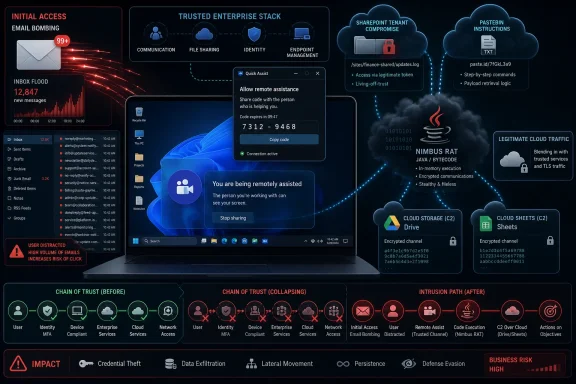
Threat actors in April 2026 used Microsoft Teams voice phishing, Windows Quick Assist, a compromised SharePoint tenant, and cloud-hosted instructions to deliver Nimbus RAT, a Java-based remote access trojan that communicates through Google Drive and Google Sheets on infected Windows endpoints. The campaign matters because it shows how little malware has to look like malware when the attack path is assembled from trusted collaboration platforms. The victim did not click a crude attachment from a throwaway inbox; the victim was socially marched through familiar enterprise tooling. For Windows administrators, that is the uncomfortable lesson: the perimeter now includes every “helpful” SaaS workflow that users have been trained to trust.
Nimbus RAT is not interesting merely because it is written in Java or because it abuses Google APIs. Plenty of commodity and semi-custom malware has hidden behind legitimate infrastructure before. What makes this campaign worth studying is the choreography: the malware arrived only after the attackers had manufactured confusion, offered relief, and used Microsoft’s own remote assistance tooling to bridge the gap between social engineering and endpoint compromise.
The reported intrusion began with email bombing, a tactic that looks noisy and unsophisticated until it is paired with a convincing follow-up. A target’s mailbox is flooded with subscription confirmations, account notices, and other transactional clutter. The flood is not the payload; it is the stage dressing. It creates a problem urgent enough that an unexpected message from “IT support” feels plausible rather than suspicious.
That message came through Microsoft Teams, not ordinary email. This is a subtle but important escalation in attacker tradecraft. Many organizations have spent years hardening mail flow, training users to hover over links, and instrumenting mailboxes for suspicious attachments, only to leave collaboration chat with far looser assumptions about identity, trust, and intent.
The attacker then moved the user into Quick Assist, the built-in Windows support tool designed to let one person help another remotely. From the user’s point of view, this can feel like a normal help desk pattern: the inbox is melting down, someone from IT calls on Teams, and a Microsoft-branded support app appears to solve the problem. From the defender’s point of view, the attack has already crossed a dangerous threshold: the adversary has achieved hands-on-keyboard access without exploiting a vulnerability in the traditional sense.
Bundling OpenJDK also makes the payload more self-contained and portable. The attacker does not need to care whether the user is a developer, whether Java is sanctioned in the enterprise image, or whether the endpoint has the right runtime version. The implant arrives with what it needs to run, which shifts detection away from “why is Java installed?” toward “why is this Java runtime executing here, now, from this path, with this parent process?”
The command-and-control design is the other half of the story. Nimbus RAT uses Google Drive and Google Sheets as part of its command and data channel, meaning the network traffic is wrapped in destinations that many organizations cannot realistically block. A firewall rule that bans unknown command-and-control domains is much less useful when the suspicious traffic appears to be legitimate Google API activity.
That is the broader strategic move. Attackers are not merely hiding in encrypted traffic; they are hiding inside business dependencies. Microsoft Teams, SharePoint, Quick Assist, Pastebin, Google Drive, and Google Sheets are not fringe services. They are either common in enterprise environments or common enough on the public internet that blocking them outright creates business friction.
This is why the campaign should not be read as a “Google Drive malware” story or a “Teams phishing” story in isolation. It is a story about control-plane confusion. The attacker borrows trusted identity surfaces for contact, trusted support software for access, trusted storage for delivery, and trusted cloud APIs for command and control. Each individual step can be explained away. The chain is what turns ordinary software into an intrusion path.
Email bombing may be visible to mail security, but the malicious action does not occur in the email itself. Teams vishing may be visible to collaboration logs, but the user’s decision to accept help unfolds in real time and may not trigger the same scrutiny as a suspicious link. Quick Assist may be a legitimate Windows component, but once launched, it gives the attacker an interactive path that can feel operationally indistinguishable from a support session.
The payload delivery through a compromised SharePoint tenant adds another layer of ambiguity. A download from SharePoint does not carry the same immediate stigma as a random executable from an unknown domain. If the tenant has a plausible name or appears to belong to a real organization, the trust signal becomes stronger still. This is the same pattern defenders have seen with abused OneDrive links, compromised Microsoft 365 tenants, and malicious files staged behind reputable cloud providers.
Pastebin-hosted instructions are similarly mundane. Pastebin has been used by administrators, developers, hobbyists, and criminals for years. In this chain, it reportedly functioned as an instruction sheet rather than the malware host itself, which again fragments the obviousness of the attack. One platform provides chat, another provides remote control, another provides instructions, another hosts the payload, and another receives the implant’s traffic.
That fragmentation is not accidental. It increases the odds that any single control sees only a benign-looking slice. Mail-flow logs see a flood of annoying but legitimate transactional messages. Teams sees external contact. Endpoint telemetry sees Quick Assist and later javaw.exe. Network logs see Google APIs. Only a defender correlating across those planes sees the campaign.
This does not mean Quick Assist is malicious or that every organization should reflexively purge it. But it does mean Quick Assist must be treated as a controlled remote access channel, not a convenience feature floating below the security policy line. If internal support teams do not use it, blocking it is low-regret. If they do use it, the organization needs tight procedures for who may initiate sessions, how users verify support identity, and how sessions are logged and reviewed.
The uncomfortable reality is that many employees have been trained to accept remote assistance as a normal remedy for technical trouble. That training was reasonable in a world where the help desk call came from a known internal channel and remote support tools were governed. It becomes dangerous when external Teams users can impersonate support personas and when the user’s inbox has just been deliberately flooded to create urgency.
The attacker does not need a zero-day when the user can be convinced that the screen-sharing prompt is part of cleanup. This is not a failure of user intelligence; it is a failure of institutional design. If an organization allows any external party to initiate Teams conversations and also permits unmanaged remote assistance, then it has created a workflow in which a stranger can plausibly become “support” in less than a minute.
Microsoft’s own enterprise guidance has increasingly pushed organizations toward more managed remote support models, such as Intune Remote Help, where role-based access, auditing, and tenant-aware controls are stronger. The Nimbus RAT chain illustrates why that direction matters. Remote support is no longer just an IT service function. It is an identity-sensitive, audit-sensitive, abuse-prone control surface.
But the default posture can be dangerously broad. If users can receive chats and calls from external Microsoft 365 organizations without a carefully maintained allow list, attackers can create or compromise tenants that look just legitimate enough to get a foot in the door. A banner that says someone is external is useful, but it is not a security control if users are conditioned to interact with external parties all day.
The eSentire reporting around Nimbus RAT described suspicious Teams activity across many customer environments, with throwaway Microsoft 365 tenants and hosting-provider infrastructure appearing repeatedly. That scale matters. This is not a one-off clever phish; it is a pattern that can be industrialized. Attackers can rotate tenants, reuse scripts, and operationalize the same help desk personas across targets.
Allow-listing external domains is not painless. It creates administrative overhead, and it can frustrate legitimate collaboration when a new partner needs access quickly. Yet that friction is the point: external real-time messaging is powerful enough that it deserves a gate. Organizations that would never allow arbitrary external senders to bypass mail filtering should ask why arbitrary external Teams contact receives a more generous trust model.
There is a particularly sharp lesson here for law firms, consultancies, financial services firms, and managed service providers. These organizations often have legitimate reasons to speak with outsiders constantly, and their employees are accustomed to urgent requests from unfamiliar names. That business reality does not make open Teams federation safer. It makes governance harder and more necessary.
The reported behavior of prompting twice, including after a fake error, is a small but telling detail. Attackers know users mistype passwords, hesitate, or become suspicious when a prompt behaves unexpectedly. Asking twice can both validate the secret and normalize the interaction: if the first attempt “failed,” the second one feels like troubleshooting rather than theft.
This is where the line between malware and social engineering blurs again. A credential prompt displayed after a remote support interaction does not appear in a vacuum. The user has already been primed to believe that IT is fixing a problem. If the attacker is still present in the session or has just guided the user through steps, a Windows-looking credential dialog may be interpreted as part of the support process.
For defenders, this reinforces a lesson that is easy to state and hard to implement: user prompts are not trustworthy simply because they are rendered with native-looking controls. Security awareness training that says “don’t enter your password into suspicious websites” is not enough. Employees need a clearer rule for support scenarios: legitimate IT should not surprise-call you from an unknown external tenant and ask you to enter credentials into prompts they caused to appear.
Endpoint controls also need to look beyond the visual deception. javaw.exe launching from a user-writable or recently extracted directory, Java processes invoking native credential APIs, and nonstandard runtimes appearing alongside freshly downloaded archives are stronger signals than the user’s ability to distinguish a fake dialog from a real one. The machine can see context the human cannot.
A bundled runtime gives attackers consistency. They can ship the same malware with the environment it expects, avoiding dependency failures and reducing support complexity for their own operators. This is the same logic that makes many legitimate desktop applications bundle runtimes: fewer assumptions about the endpoint produce fewer broken installs.
The defensive implication is not “block Java everywhere,” though some organizations can and should restrict it aggressively. The better lesson is that runtime provenance matters. A Java process launched from Program Files as part of a known enterprise application is one thing. A Java runtime unpacked inside a user profile and launched minutes after a Teams call and Quick Assist session is quite another.
Security teams should also reconsider how they inventory runtime execution. Many asset programs track installed software but miss portable runtimes dropped into user-writable paths. If the OpenJDK directory was never installed through the sanctioned software channel, it may not appear where administrators expect to find Java. Yet the endpoint still runs Java code.
Nimbus RAT’s in-memory second-stage capability, as described by researchers, makes that even more important. If an operator can send Java source or code-like tasks for execution without dropping obvious second-stage binaries to disk, file-centric detection becomes less reliable. The runtime becomes the execution platform, and the suspicious behavior may live in process ancestry, command patterns, loaded libraries, API usage, and outbound cloud calls.
That is why Nimbus RAT’s cloud command-and-control is so effective. It moves the defender’s task from domain reputation to behavioral discrimination. The question is not “is this host talking to Google?” but “which process is talking to Google APIs, under which user context, after which preceding events, and with what volume and cadence?”
This is where process-aware network telemetry becomes essential. If Chrome, Edge, or a sanctioned sync client accesses Google Drive, that may be normal. If a newly unpacked javaw.exe process inside a user profile begins polling Google APIs after a remote assistance session, that is a different story. The destination alone is weak evidence. The process lineage is the case.
Organizations that route all SaaS access through broad allow rules without process context are at a disadvantage. CASB, secure web gateway, EDR, and identity logs must be stitched together to distinguish ordinary Google use from malware using Google as a mailbox. That stitching is not glamorous, but it is exactly where this class of intrusion is won or lost.
There is also a governance issue. Many businesses have not decided whether consumer cloud storage is allowed, tolerated, or forbidden. They live in the gray zone where Google Drive may be officially unsanctioned but practically reachable. Attackers thrive in that ambiguity. A clear policy, enforced technically and monitored realistically, is better than a nominal ban nobody measures.
That gives defenders a rare advantage: a pre-intrusion signal. Many detection opportunities arise after execution, after lateral movement, or after credentials have already been stolen. Mailbox flooding can be detected while the attacker is still preparing the social engineering move. A timely alert can trigger a user warning, a temporary collaboration restriction, or a help desk outreach through verified internal channels.
The challenge is tuning. Some users really do receive bursts of legitimate messages, especially shared mailboxes, customer-facing roles, and employees involved in events or campaigns. But the pattern of hundreds of subscription confirmations across many unrelated sender domains is distinctive enough to merit a playbook. It should not sit in a mail dashboard as merely “spam volume.”
A mature response would treat email bombing as a possible precursor to live social engineering. The help desk should know to contact the user through an internal verified channel. The SOC should look for external Teams messages, Quick Assist launches, remote access tooling, and unusual downloads around the same time. The user should be told, plainly, that attackers may call pretending to help with the flood.
This is where the industry’s obsession with malware hashes and indicators can become too narrow. By the time a Nimbus RAT hash is useful, the human has already been maneuvered. The earliest signal is behavioral and operational: the attacker creates chaos, then sells order.
The practical defense starts with Teams external access. Organizations should move away from broad external federation wherever possible and toward explicit allow lists for known partner domains. Where broad access remains necessary, higher-risk groups should get tighter policies, and external contact should be logged and reviewed for suspicious tenant names, newly created domains, and help desk impersonation themes.
Quick Assist deserves an equally concrete decision. If it is not part of the approved support model, block it. If it is part of the support model, formalize how users verify support sessions and consider migrating high-control environments to managed remote support tooling with stronger auditing. A tool that can hand an outsider interactive access to a user’s desktop cannot remain governed by vibes.
Endpoint monitoring should focus on chains, not isolated events. QuickAssist.exe followed by command shell activity, browser visits to paste sites, downloads from unfamiliar SharePoint tenants, registry imports, archive extraction, and javaw.exe execution from odd locations is far more meaningful than any one event alone. The same applies to Google API calls: they become suspicious when tied to an unexpected process and recent social-engineering telemetry.
Identity and credential protections are also crucial. If a user is tricked into typing a password, multifactor authentication, phishing-resistant authentication, conditional access, and rapid token revocation can limit the blast radius. But defenders should not pretend MFA is magic. A remote operator with screen access may be able to guide users through prompts, capture session context, or pivot to other forms of access if policy is weak.
 The New Phishing Email Is a Teams Call From “IT”
Nimbus RAT is not interesting merely because it is written in Java or because it abuses Google APIs. Plenty of commodity and semi-custom malware has hidden behind legitimate infrastructure before. What makes this campaign worth studying is the choreography: the malware arrived only after the attackers had manufactured confusion, offered relief, and used Microsoft’s own remote assistance tooling to bridge the gap between social engineering and endpoint compromise.The reported intrusion began with email bombing, a tactic that looks noisy and unsophisticated until it is paired with a convincing follow-up. A target’s mailbox is flooded with subscription confirmations, account notices, and other transactional clutter. The flood is not the payload; it is the stage dressing. It creates a problem urgent enough that an unexpected message from “IT support” feels plausible rather than suspicious.
That message came through Microsoft Teams, not ordinary email. This is a subtle but important escalation in attacker tradecraft. Many organizations have spent years hardening mail flow, training users to hover over links, and instrumenting mailboxes for suspicious attachments, only to leave collaboration chat with far looser assumptions about identity, trust, and intent.
The attacker then moved the user into Quick Assist, the built-in Windows support tool designed to let one person help another remotely. From the user’s point of view, this can feel like a normal help desk pattern: the inbox is melting down, someone from IT calls on Teams, and a Microsoft-branded support app appears to solve the problem. From the defender’s point of view, the attack has already crossed a dangerous threshold: the adversary has achieved hands-on-keyboard access without exploiting a vulnerability in the traditional sense.
Nimbus RAT Turns Cloud Normalcy Into Cover
The malware itself, tracked as Nimbus RAT, is a Java-based remote access trojan that reportedly bundles its own OpenJDK runtime. That detail deserves attention because it strips away one of the weak assumptions defenders sometimes make about Java malware on Windows endpoints. If the implant brings its own runtime, the absence of a locally installed Java environment is no comfort.Bundling OpenJDK also makes the payload more self-contained and portable. The attacker does not need to care whether the user is a developer, whether Java is sanctioned in the enterprise image, or whether the endpoint has the right runtime version. The implant arrives with what it needs to run, which shifts detection away from “why is Java installed?” toward “why is this Java runtime executing here, now, from this path, with this parent process?”
The command-and-control design is the other half of the story. Nimbus RAT uses Google Drive and Google Sheets as part of its command and data channel, meaning the network traffic is wrapped in destinations that many organizations cannot realistically block. A firewall rule that bans unknown command-and-control domains is much less useful when the suspicious traffic appears to be legitimate Google API activity.
That is the broader strategic move. Attackers are not merely hiding in encrypted traffic; they are hiding inside business dependencies. Microsoft Teams, SharePoint, Quick Assist, Pastebin, Google Drive, and Google Sheets are not fringe services. They are either common in enterprise environments or common enough on the public internet that blocking them outright creates business friction.
This is why the campaign should not be read as a “Google Drive malware” story or a “Teams phishing” story in isolation. It is a story about control-plane confusion. The attacker borrows trusted identity surfaces for contact, trusted support software for access, trusted storage for delivery, and trusted cloud APIs for command and control. Each individual step can be explained away. The chain is what turns ordinary software into an intrusion path.
The Attack Worked Because Every Step Looked Like Somebody Else’s Problem
Security teams often divide responsibility by platform. Messaging policies live with collaboration admins. Endpoint execution belongs to EDR. SaaS access sits with identity and cloud security. Help desk workflows are governed by IT operations. Nimbus RAT exploited the seams between those domains.Email bombing may be visible to mail security, but the malicious action does not occur in the email itself. Teams vishing may be visible to collaboration logs, but the user’s decision to accept help unfolds in real time and may not trigger the same scrutiny as a suspicious link. Quick Assist may be a legitimate Windows component, but once launched, it gives the attacker an interactive path that can feel operationally indistinguishable from a support session.
The payload delivery through a compromised SharePoint tenant adds another layer of ambiguity. A download from SharePoint does not carry the same immediate stigma as a random executable from an unknown domain. If the tenant has a plausible name or appears to belong to a real organization, the trust signal becomes stronger still. This is the same pattern defenders have seen with abused OneDrive links, compromised Microsoft 365 tenants, and malicious files staged behind reputable cloud providers.
Pastebin-hosted instructions are similarly mundane. Pastebin has been used by administrators, developers, hobbyists, and criminals for years. In this chain, it reportedly functioned as an instruction sheet rather than the malware host itself, which again fragments the obviousness of the attack. One platform provides chat, another provides remote control, another provides instructions, another hosts the payload, and another receives the implant’s traffic.
That fragmentation is not accidental. It increases the odds that any single control sees only a benign-looking slice. Mail-flow logs see a flood of annoying but legitimate transactional messages. Teams sees external contact. Endpoint telemetry sees Quick Assist and later javaw.exe. Network logs see Google APIs. Only a defender correlating across those planes sees the campaign.
Quick Assist Has Become a Security Boundary Whether Microsoft Meant It or Not
Quick Assist was built for support, and that is precisely why attackers like it. It provides a socially acceptable path to remote access on Windows machines. It carries Microsoft branding. It does not require the attacker to drop a remote access tool at the first moment of contact. It lets the adversary persuade the user to open the door rather than break it down.This does not mean Quick Assist is malicious or that every organization should reflexively purge it. But it does mean Quick Assist must be treated as a controlled remote access channel, not a convenience feature floating below the security policy line. If internal support teams do not use it, blocking it is low-regret. If they do use it, the organization needs tight procedures for who may initiate sessions, how users verify support identity, and how sessions are logged and reviewed.
The uncomfortable reality is that many employees have been trained to accept remote assistance as a normal remedy for technical trouble. That training was reasonable in a world where the help desk call came from a known internal channel and remote support tools were governed. It becomes dangerous when external Teams users can impersonate support personas and when the user’s inbox has just been deliberately flooded to create urgency.
The attacker does not need a zero-day when the user can be convinced that the screen-sharing prompt is part of cleanup. This is not a failure of user intelligence; it is a failure of institutional design. If an organization allows any external party to initiate Teams conversations and also permits unmanaged remote assistance, then it has created a workflow in which a stranger can plausibly become “support” in less than a minute.
Microsoft’s own enterprise guidance has increasingly pushed organizations toward more managed remote support models, such as Intune Remote Help, where role-based access, auditing, and tenant-aware controls are stronger. The Nimbus RAT chain illustrates why that direction matters. Remote support is no longer just an IT service function. It is an identity-sensitive, audit-sensitive, abuse-prone control surface.
External Teams Access Is the Front Door Many Tenants Forgot to Lock
Microsoft Teams external access exists for good reasons. Modern companies work with vendors, clients, consultants, auditors, recruiters, and partners who live in other tenants. Turning every cross-company conversation into a formal guest-access project would be too slow for many businesses. The result is that external chat often remains open because productivity wins the argument by default.But the default posture can be dangerously broad. If users can receive chats and calls from external Microsoft 365 organizations without a carefully maintained allow list, attackers can create or compromise tenants that look just legitimate enough to get a foot in the door. A banner that says someone is external is useful, but it is not a security control if users are conditioned to interact with external parties all day.
The eSentire reporting around Nimbus RAT described suspicious Teams activity across many customer environments, with throwaway Microsoft 365 tenants and hosting-provider infrastructure appearing repeatedly. That scale matters. This is not a one-off clever phish; it is a pattern that can be industrialized. Attackers can rotate tenants, reuse scripts, and operationalize the same help desk personas across targets.
Allow-listing external domains is not painless. It creates administrative overhead, and it can frustrate legitimate collaboration when a new partner needs access quickly. Yet that friction is the point: external real-time messaging is powerful enough that it deserves a gate. Organizations that would never allow arbitrary external senders to bypass mail filtering should ask why arbitrary external Teams contact receives a more generous trust model.
There is a particularly sharp lesson here for law firms, consultancies, financial services firms, and managed service providers. These organizations often have legitimate reasons to speak with outsiders constantly, and their employees are accustomed to urgent requests from unfamiliar names. That business reality does not make open Teams federation safer. It makes governance harder and more necessary.
The Credential Prompt Is Still the Oldest Trick in a Newer Window
Nimbus RAT reportedly includes two credential theft approaches: a fake Windows security prompt built in Java Swing and a method that invokes the native Windows credential user interface through Java Native Access. The distinction is technical, but the purpose is familiar. The malware wants the user to type secrets into something that looks sufficiently like Windows asking for them.The reported behavior of prompting twice, including after a fake error, is a small but telling detail. Attackers know users mistype passwords, hesitate, or become suspicious when a prompt behaves unexpectedly. Asking twice can both validate the secret and normalize the interaction: if the first attempt “failed,” the second one feels like troubleshooting rather than theft.
This is where the line between malware and social engineering blurs again. A credential prompt displayed after a remote support interaction does not appear in a vacuum. The user has already been primed to believe that IT is fixing a problem. If the attacker is still present in the session or has just guided the user through steps, a Windows-looking credential dialog may be interpreted as part of the support process.
For defenders, this reinforces a lesson that is easy to state and hard to implement: user prompts are not trustworthy simply because they are rendered with native-looking controls. Security awareness training that says “don’t enter your password into suspicious websites” is not enough. Employees need a clearer rule for support scenarios: legitimate IT should not surprise-call you from an unknown external tenant and ask you to enter credentials into prompts they caused to appear.
Endpoint controls also need to look beyond the visual deception. javaw.exe launching from a user-writable or recently extracted directory, Java processes invoking native credential APIs, and nonstandard runtimes appearing alongside freshly downloaded archives are stronger signals than the user’s ability to distinguish a fake dialog from a real one. The machine can see context the human cannot.
Java on Windows Is Not Dead; It Has Just Become Less Visible
It is fashionable to talk about Windows threats in terms of PowerShell, LOLBins, Office macros, MSI abuse, malicious scripts, and signed loaders. Java can feel like yesterday’s enterprise headache, something associated with browser plugins, legacy line-of-business apps, and developer workstations. Nimbus RAT is a reminder that Java remains useful to attackers precisely because defenders may not be looking for it in the right places.A bundled runtime gives attackers consistency. They can ship the same malware with the environment it expects, avoiding dependency failures and reducing support complexity for their own operators. This is the same logic that makes many legitimate desktop applications bundle runtimes: fewer assumptions about the endpoint produce fewer broken installs.
The defensive implication is not “block Java everywhere,” though some organizations can and should restrict it aggressively. The better lesson is that runtime provenance matters. A Java process launched from Program Files as part of a known enterprise application is one thing. A Java runtime unpacked inside a user profile and launched minutes after a Teams call and Quick Assist session is quite another.
Security teams should also reconsider how they inventory runtime execution. Many asset programs track installed software but miss portable runtimes dropped into user-writable paths. If the OpenJDK directory was never installed through the sanctioned software channel, it may not appear where administrators expect to find Java. Yet the endpoint still runs Java code.
Nimbus RAT’s in-memory second-stage capability, as described by researchers, makes that even more important. If an operator can send Java source or code-like tasks for execution without dropping obvious second-stage binaries to disk, file-centric detection becomes less reliable. The runtime becomes the execution platform, and the suspicious behavior may live in process ancestry, command patterns, loaded libraries, API usage, and outbound cloud calls.
Google Drive C2 Is a Policy Problem Masquerading as a Network Problem
The instinctive reaction to malware using Google Drive is to ask whether Google Drive should be blocked. In some environments, especially highly regulated or tightly managed networks, that may be feasible. In many others, it is not. Google services are too deeply embedded in vendor workflows, customer file exchange, education, marketing, analytics, and personal productivity patterns to be treated as an obvious malicious destination.That is why Nimbus RAT’s cloud command-and-control is so effective. It moves the defender’s task from domain reputation to behavioral discrimination. The question is not “is this host talking to Google?” but “which process is talking to Google APIs, under which user context, after which preceding events, and with what volume and cadence?”
This is where process-aware network telemetry becomes essential. If Chrome, Edge, or a sanctioned sync client accesses Google Drive, that may be normal. If a newly unpacked javaw.exe process inside a user profile begins polling Google APIs after a remote assistance session, that is a different story. The destination alone is weak evidence. The process lineage is the case.
Organizations that route all SaaS access through broad allow rules without process context are at a disadvantage. CASB, secure web gateway, EDR, and identity logs must be stitched together to distinguish ordinary Google use from malware using Google as a mailbox. That stitching is not glamorous, but it is exactly where this class of intrusion is won or lost.
There is also a governance issue. Many businesses have not decided whether consumer cloud storage is allowed, tolerated, or forbidden. They live in the gray zone where Google Drive may be officially unsanctioned but practically reachable. Attackers thrive in that ambiguity. A clear policy, enforced technically and monitored realistically, is better than a nominal ban nobody measures.
The Fastest Signal Arrived Before the Malware
The most actionable moment in the Nimbus RAT chain may have occurred before the Teams call and well before javaw.exe executed. Email bombing is noisy, measurable, and difficult to explain as normal user behavior when it arrives in a sudden burst. In the reported case, the victim’s mailbox received hundreds of messages in a short window before the vishing interaction.That gives defenders a rare advantage: a pre-intrusion signal. Many detection opportunities arise after execution, after lateral movement, or after credentials have already been stolen. Mailbox flooding can be detected while the attacker is still preparing the social engineering move. A timely alert can trigger a user warning, a temporary collaboration restriction, or a help desk outreach through verified internal channels.
The challenge is tuning. Some users really do receive bursts of legitimate messages, especially shared mailboxes, customer-facing roles, and employees involved in events or campaigns. But the pattern of hundreds of subscription confirmations across many unrelated sender domains is distinctive enough to merit a playbook. It should not sit in a mail dashboard as merely “spam volume.”
A mature response would treat email bombing as a possible precursor to live social engineering. The help desk should know to contact the user through an internal verified channel. The SOC should look for external Teams messages, Quick Assist launches, remote access tooling, and unusual downloads around the same time. The user should be told, plainly, that attackers may call pretending to help with the flood.
This is where the industry’s obsession with malware hashes and indicators can become too narrow. By the time a Nimbus RAT hash is useful, the human has already been maneuvered. The earliest signal is behavioral and operational: the attacker creates chaos, then sells order.
The Best Mitigation Is Boring, Layered, and Slightly Annoying
There is no single switch that makes this campaign disappear without affecting business workflows. That is what makes it a useful test of enterprise security maturity. If the organization’s only answer is “train users better,” it is underestimating the adversary. If the only answer is “block Google Drive,” it may be ignoring business reality. If the only answer is “EDR will catch the RAT,” it is waiting too long.The practical defense starts with Teams external access. Organizations should move away from broad external federation wherever possible and toward explicit allow lists for known partner domains. Where broad access remains necessary, higher-risk groups should get tighter policies, and external contact should be logged and reviewed for suspicious tenant names, newly created domains, and help desk impersonation themes.
Quick Assist deserves an equally concrete decision. If it is not part of the approved support model, block it. If it is part of the support model, formalize how users verify support sessions and consider migrating high-control environments to managed remote support tooling with stronger auditing. A tool that can hand an outsider interactive access to a user’s desktop cannot remain governed by vibes.
Endpoint monitoring should focus on chains, not isolated events. QuickAssist.exe followed by command shell activity, browser visits to paste sites, downloads from unfamiliar SharePoint tenants, registry imports, archive extraction, and javaw.exe execution from odd locations is far more meaningful than any one event alone. The same applies to Google API calls: they become suspicious when tied to an unexpected process and recent social-engineering telemetry.
Identity and credential protections are also crucial. If a user is tricked into typing a password, multifactor authentication, phishing-resistant authentication, conditional access, and rapid token revocation can limit the blast radius. But defenders should not pretend MFA is magic. A remote operator with screen access may be able to guide users through prompts, capture session context, or pivot to other forms of access if policy is weak.
The Nimbus RAT Lesson Windows Shops Should Actually Keep
The useful conclusion is not that Teams is unsafe, Quick Assist is bad, Java is back, or Google Drive should be banned tomorrow morning. The useful conclusion is that Windows intrusions increasingly arrive through legitimate collaboration paths, and every one of those paths needs a security owner. Nimbus RAT is the payload, but the platform abuse is the playbook.- Organizations should treat sudden email bombing as a live precursor to voice phishing, not merely as spam cleanup.
- Microsoft Teams external access should be restricted to known business partners wherever that is operationally possible.
- Quick Assist should be disabled when it is not required and governed like any other remote access channel when it is required.
- Java execution should be monitored by path, parent process, runtime provenance, and surrounding user activity rather than by installation status alone.
- Google Drive and Google Sheets traffic should be evaluated with process-level context because destination-based blocking will miss too much or break too much.
- Help desk identity verification should be explicit enough that users know an external Teams call is never the start of legitimate internal support.
References
- Primary source: SOC Prime
Published: Fri, 05 Jun 2026 15:31:00 GMT
Nimbus RAT Uses Teams and Google Drive for Java Delivery
Attackers use Teams vishing, Quick Assist, and Google Drive to deploy Nimbus RAT, steal credentials, and persist on Windowssocprime.com
- Related coverage: esentire.com
Nimbus RAT: How Threat Actors Are Abusing Microsoft Teams and Google Drive to Deploy a Java RAT | eSentire
Learn about a sophisticated intrusion campaign using Microsoft Teams vishing and Nimbus RAT malware to compromise targets via social engineering and legitimate cloud services.www.esentire.com
- Related coverage: thesmallbusinesscybersecurityguy.co.uk
PhaaS, Nimbus RAT & Acer Zero-Days UK SMB Jun 2026 | SBCSG | The Small Business Cybersecurity Guy
Phoenix PhaaS has hit 70+ organisations since January 2025. Nimbus RAT is targeting legal firms via Teams vishing. Acer Wave 7 routers have two unpatched max-severity zero-days. thesmallbusinesscybersecurityguy.co.uk
- Related coverage: my.socprime.com
SOC Prime’s Center of Excellence for Microsoft Sentinel SIEM & SOAR
SOC Prime’s Center of Excellence for Microsoft Sentinel SIEM & SOAR yields unparalleled industry expertise to accelerate your threat detection & response capabilities.my.socprime.com
- Related coverage: esentire-dot-com-assets.s3.amazonaws.com
- Related coverage: labs.cloudsecurityalliance.org
Microsoft Teams as Phishing Infrastructure: The A0Backdoor Campaign and the Industrialization of Collaboration-Platform Attacks
PDF documentlabs.cloudsecurityalliance.org

- Related coverage: marketingable.mphasis.com
fin7 hackers using signed malware and fake google ads to evade defenses may 11
PDF documentmarketingable.mphasis.com
- Related coverage: blog-en.topedia.com
Microsoft Defender Tenant Allow/Block List can now block external Teams users and domains | Topedia Blog
Microsoft has enhanced the Defender Tenant Allow/Block List to support blocking external Teams users and domains, centralizing external access controls across Microsoft 365.blog-en.topedia.com - Official source: learn.microsoft.com
IT Admins - Manage external meetings and chat with people and organizations using Microsoft identities - Microsoft Teams | Microsoft Learn
For IT admins - Learn how to configure chat and meetings with people outside your organization who use Microsoft Entra ID, Microsoft Teams Essentials, or Skype.learn.microsoft.com - Official source: techcommunity.microsoft.com

Blocked domain in Teams | Microsoft Community Hub
Hi, We are currently testing restricting access to Teams to specific domains and if I add a domain(for example domain.com) to be on the blocked...
techcommunity.microsoft.com
- Related coverage: thatlazyadmin.com
Microsoft Teams can’t chat with external Domains
 www.thatlazyadmin.com
- Related coverage: support.bemopro.com
Manage external access in Microsoft Teams – BEMO Docs
With Microsoft Teams external access, Teams users from other domains can participate in your chats and calls. You can also allow other...support.bemopro.com - Related coverage: office365itpros.com
Why Microsoft Teams Blocks External Users
Many reasons exist why Teams blocks external users. It could be a policy setting, or a label, or a group setting. Let's look at some of the common faults,office365itpros.com - Related coverage: help.aphex.co
- Official source: support.microsoft.com
Configure external communications | Microsoft Support
This topic applies to Office 365 operated by 21Vianet in China. Control Lync Online access to Lync users in other organizations.support.microsoft.com - Security advisory: cisa.gov
</rdf:Alt> </dc:title> <dc:description> <rdf:Alt> <rdf:li xml:lang="x-default"/> </rdf:Alt> </dc:description> <dc:creator> <rdf:Seq> <rdf:li>KTzamar
</rdf:Alt> </dc:description> <dc:creator> <rdf:Seq> <rdf:li>KTzamariaswww.cisa.gov
- Related coverage: edgile.com
- Related coverage: avidian.com
- Related coverage: content.govdelivery.com

