

NTT DATA said on May 18, 2026, that it has signed a definitive agreement to acquire Santa Clara-based WinWire, a Microsoft partner focused on Azure, data engineering, cloud-native development, and agentic AI, adding more than 1,000 Azure engineers and AI specialists after closing. The deal is not just another services roll-up with AI branding pasted on top. It is a bet that the next phase of enterprise AI will be won less by model demos than by integrators that can rewire data estates, applications, governance, and business workflows around Microsoft’s cloud stack. For WindowsForum readers, the story matters because it shows where Microsoft’s ecosystem is moving: away from isolated Copilot pilots and toward industrialized AI delivery on Azure, Fabric, and Microsoft’s developer platforms.
The easy version of the AI story says companies need better models. The more useful version says they need people who can make models survive contact with production systems.
That is the gap NTT DATA is trying to fill with WinWire. The announcement centers on agentic AI, AI on Azure, data engineering, and cloud-native development, but the strategic phrase is “operationalize AI at scale.” That is where most enterprise AI programs are still bottlenecked: not in the boardroom enthusiasm, and not even in proof-of-concept funding, but in the messy path from a promising demo to a governed, supported, integrated business system.
WinWire gives NTT DATA a more specialized Microsoft bench at a moment when the largest systems integrators are racing to convert AI interest into durable cloud, data, and managed-services revenue. The company brings more than 1,000 Azure engineers and Microsoft specialists, along with delivery centers in India and a headquarters in Santa Clara. That combination matters because Microsoft’s AI platform story is increasingly global, partner-led, and service-heavy.
The acquisition also lands at a convenient time for NTT DATA’s Microsoft narrative. The company has been positioning itself as a major Microsoft global systems integrator and was recognized as Microsoft’s 2025 Global System Integrator Growth Champion Partner of the Year. Buying WinWire turns that recognition into capacity.
NTT DATA’s acquisition pitch leans into the useful version. WinWire’s stated strengths sit around modern applications, data platforms, Azure AI, Microsoft Fabric, and frameworks for deploying autonomous systems into enterprise workflows. That is not accidental. The nearer-term enterprise AI market is less likely to be dominated by companies swapping in one chatbot for another than by organizations that can connect models to existing systems of record without breaking compliance, security, or reliability.
This is where services companies see their opening. The largest enterprises do not usually lack access to Microsoft licenses, Azure subscriptions, or executive briefings about AI strategy. They lack migration plans, reference architectures, data pipelines, observability, identity controls, application modernization roadmaps, and teams that can turn vendor roadmaps into deployable systems.
The cloud era already taught the lesson. The hyperscalers provided the infrastructure, but systems integrators made much of the transformation possible, profitable, or at least survivable. AI is replaying that pattern, only with higher stakes because the technology sits closer to decision-making, customer interaction, software development, and regulated business processes.
WinWire’s Microsoft alignment is central to the deal. The company is described as a Microsoft partner with repeated Partner of the Year recognition, expertise in Azure-based AI and data transformation, and membership in Microsoft’s Agentic Partner Alliance Program. In plain terms, NTT DATA is buying a firm that already speaks Microsoft’s current enterprise AI dialect.
That dialect now includes Fabric for unified data and analytics, Azure AI Foundry for building and managing AI applications and agents, and a growing set of governance and security expectations around responsible AI. None of those platforms lives in isolation. Fabric projects surface data quality and ownership issues. AI agent projects expose identity, permissions, and auditability questions. Cloud-native modernization projects force old application dependencies into the open.
That is why the partner channel is so important to Microsoft. Redmond can sell the platform, but customers still need someone to map it onto industry workflows, legacy estates, and internal politics. NTT DATA is effectively saying that Microsoft’s AI stack is now important enough to justify buying specialist talent rather than simply training existing teams.
WinWire gives NTT DATA a more concrete answer. More than 1,000 Azure engineers and Microsoft specialists is not just a press-release number; it is delivery capacity. For large customers, capacity is often the difference between a strategy deck and a deployment.
The acquisition also strengthens NTT DATA in North America, where Microsoft-centric enterprise transformation remains a lucrative market. WinWire’s Santa Clara base and India delivery footprint give NTT DATA both proximity to U.S. technology buyers and a scalable offshore delivery model. That is a familiar playbook, but in the AI era it may be more valuable because demand is outpacing the supply of experienced cloud and AI engineers.
There is a second layer here: credibility. Enterprises do not merely want AI engineers; they want teams that understand Microsoft’s current implementation path. That means Fabric lakehouses, Azure data architectures, identity integration, application modernization, DevOps practices, monitoring, security controls, and the practical constraints of regulated environments.
NTT DATA already had scale. WinWire adds specialization. The question after closing will be whether the combined company can preserve that specialization rather than flattening it into a generic global delivery machine.
Agents are only as useful as the systems they can safely use and the data they can reliably understand. If enterprise data is fragmented, stale, poorly governed, or trapped behind inconsistent access controls, an AI agent becomes either a toy or a liability. It can summarize the wrong thing faster, automate a broken process more confidently, or expose information to the wrong user with impressive fluency.
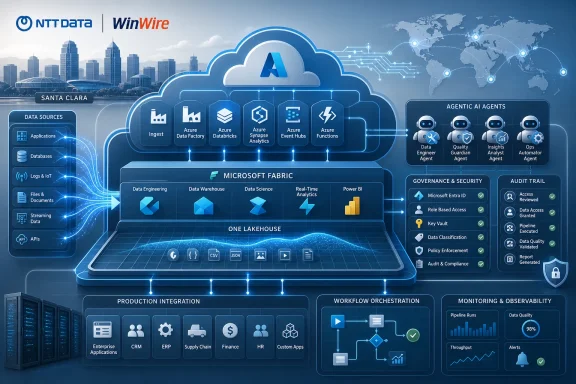
That is why Microsoft Fabric appears in the announcement alongside Azure AI Foundry. Fabric is not a side note in the enterprise AI story; it is part of the substrate Microsoft wants customers to use for analytics, data integration, and AI-ready data estates. For partners, Fabric projects create an opening to modernize data platforms while tying that work directly to AI outcomes.
WinWire’s value to NTT DATA lies in joining those threads. Cloud-native application development gives AI systems somewhere useful to live. Data engineering gives them something trustworthy to use. Agentic frameworks give them a way to act. Managed services give enterprises someone to call when the system starts behaving like critical infrastructure rather than a lab experiment.
NTT DATA’s move follows the logic of both. It expands a global Microsoft practice that the company says already spans more than 50 countries and includes more than 24,000 Microsoft certifications. It also absorbs a specialist firm with a clearer identity in Azure, AI, and modern application development.
This is not unusual in enterprise technology cycles. When a platform wave becomes large enough, services firms acquire talent rather than wait for organic hiring and training. Cloud migration produced years of acquisitions around AWS, Azure, Google Cloud, DevOps, cybersecurity, and data platforms. AI is now producing the same behavior, with the added urgency of executives demanding visible progress.
The irony is that the more automated AI becomes, the more human services capacity the enterprise market seems to require. That is not because AI is failing. It is because the value of AI depends on business process redesign, data readiness, governance, security, and change management — all areas where software alone does not close the loop.
That does not mean customers should treat the deal as a blank check. Large integrator-led transformations can become expensive, slow, and over-scoped if enterprises do not control architecture, data ownership, and business outcomes. AI makes that risk worse because “transformation” can become a container for every unresolved modernization project in the company.
The smartest customers will use this kind of combined offering selectively. They will demand clear deliverables, production milestones, security models, cost controls, and measurable operational impact. They will also keep pressure on vendors to distinguish between genuine agentic automation and workflows that are merely chatbot-assisted.
For Windows-heavy enterprises, the implications are practical. Microsoft 365, Entra ID, Defender, Azure, Fabric, Power Platform, GitHub, and Windows endpoints are increasingly part of one connected AI operating environment. A partner that can work across that environment may be more useful than one that only knows model deployment or only knows infrastructure migration.
NTT DATA will need to keep WinWire’s Microsoft specialization visible. If the acquired team disappears into a broad consulting catalog, the strategic value weakens. Customers looking for deep Azure and AI delivery expertise do not want to be routed through a generic transformation funnel.
There is also the risk of over-promising around agentic AI. Enterprises are interested in autonomous systems, but many are still working through basic questions of data quality, identity, audit trails, prompt security, model evaluation, and human oversight. A responsible AI services provider should sometimes tell a client that the next step is not a fleet of agents, but a data governance cleanup, an application refactor, or a limited workflow automation pilot.
The better version of this acquisition is not “AI everywhere.” It is AI where the foundation can support it. That is a less spectacular slogan, but it is a more durable business.
 NTT DATA Is Buying the Part of AI That Enterprises Actually Lack
The easy version of the AI story says companies need better models. The more useful version says they need people who can make models survive contact with production systems.That is the gap NTT DATA is trying to fill with WinWire. The announcement centers on agentic AI, AI on Azure, data engineering, and cloud-native development, but the strategic phrase is “operationalize AI at scale.” That is where most enterprise AI programs are still bottlenecked: not in the boardroom enthusiasm, and not even in proof-of-concept funding, but in the messy path from a promising demo to a governed, supported, integrated business system.
WinWire gives NTT DATA a more specialized Microsoft bench at a moment when the largest systems integrators are racing to convert AI interest into durable cloud, data, and managed-services revenue. The company brings more than 1,000 Azure engineers and Microsoft specialists, along with delivery centers in India and a headquarters in Santa Clara. That combination matters because Microsoft’s AI platform story is increasingly global, partner-led, and service-heavy.
The acquisition also lands at a convenient time for NTT DATA’s Microsoft narrative. The company has been positioning itself as a major Microsoft global systems integrator and was recognized as Microsoft’s 2025 Global System Integrator Growth Champion Partner of the Year. Buying WinWire turns that recognition into capacity.
The AI Services Market Is Moving From Pilots to Plumbing
The phrase “agentic AI” is now doing a lot of work in enterprise technology marketing. At its most useful, it refers to systems that can plan, call tools, use business data, and complete multi-step tasks inside governed workflows. At its least useful, it is a shiny label for chatbots with slightly better orchestration.NTT DATA’s acquisition pitch leans into the useful version. WinWire’s stated strengths sit around modern applications, data platforms, Azure AI, Microsoft Fabric, and frameworks for deploying autonomous systems into enterprise workflows. That is not accidental. The nearer-term enterprise AI market is less likely to be dominated by companies swapping in one chatbot for another than by organizations that can connect models to existing systems of record without breaking compliance, security, or reliability.
This is where services companies see their opening. The largest enterprises do not usually lack access to Microsoft licenses, Azure subscriptions, or executive briefings about AI strategy. They lack migration plans, reference architectures, data pipelines, observability, identity controls, application modernization roadmaps, and teams that can turn vendor roadmaps into deployable systems.
The cloud era already taught the lesson. The hyperscalers provided the infrastructure, but systems integrators made much of the transformation possible, profitable, or at least survivable. AI is replaying that pattern, only with higher stakes because the technology sits closer to decision-making, customer interaction, software development, and regulated business processes.
Microsoft’s Platform Ambition Needs an Army of Translators
Microsoft has spent the past several years assembling an AI stack that spans Microsoft 365 Copilot, Azure AI services, GitHub, security tooling, Fabric, Power Platform, and the broader Azure application platform. That breadth is Microsoft’s advantage, but it is also its challenge. A platform that touches everything in the enterprise needs partners that can explain what to deploy, what to defer, and what to avoid.WinWire’s Microsoft alignment is central to the deal. The company is described as a Microsoft partner with repeated Partner of the Year recognition, expertise in Azure-based AI and data transformation, and membership in Microsoft’s Agentic Partner Alliance Program. In plain terms, NTT DATA is buying a firm that already speaks Microsoft’s current enterprise AI dialect.
That dialect now includes Fabric for unified data and analytics, Azure AI Foundry for building and managing AI applications and agents, and a growing set of governance and security expectations around responsible AI. None of those platforms lives in isolation. Fabric projects surface data quality and ownership issues. AI agent projects expose identity, permissions, and auditability questions. Cloud-native modernization projects force old application dependencies into the open.
That is why the partner channel is so important to Microsoft. Redmond can sell the platform, but customers still need someone to map it onto industry workflows, legacy estates, and internal politics. NTT DATA is effectively saying that Microsoft’s AI stack is now important enough to justify buying specialist talent rather than simply training existing teams.
WinWire Gives NTT DATA a Sharper Edge in the Azure Partner Race
The big consultancies and IT services firms are all telling a similar AI story. They promise industry accelerators, responsible AI frameworks, data modernization, managed services, and co-innovation with hyperscalers. The problem is that those promises can blur together quickly.WinWire gives NTT DATA a more concrete answer. More than 1,000 Azure engineers and Microsoft specialists is not just a press-release number; it is delivery capacity. For large customers, capacity is often the difference between a strategy deck and a deployment.
The acquisition also strengthens NTT DATA in North America, where Microsoft-centric enterprise transformation remains a lucrative market. WinWire’s Santa Clara base and India delivery footprint give NTT DATA both proximity to U.S. technology buyers and a scalable offshore delivery model. That is a familiar playbook, but in the AI era it may be more valuable because demand is outpacing the supply of experienced cloud and AI engineers.
There is a second layer here: credibility. Enterprises do not merely want AI engineers; they want teams that understand Microsoft’s current implementation path. That means Fabric lakehouses, Azure data architectures, identity integration, application modernization, DevOps practices, monitoring, security controls, and the practical constraints of regulated environments.
NTT DATA already had scale. WinWire adds specialization. The question after closing will be whether the combined company can preserve that specialization rather than flattening it into a generic global delivery machine.
Agentic AI Is the Hook, but Data Engineering Is the Deal
The announcement understandably leads with agentic AI. That is where buyer attention is concentrated, and it is where Microsoft is steering much of its partner ecosystem. But the less glamorous part of the deal may be the more important one: data engineering.Agents are only as useful as the systems they can safely use and the data they can reliably understand. If enterprise data is fragmented, stale, poorly governed, or trapped behind inconsistent access controls, an AI agent becomes either a toy or a liability. It can summarize the wrong thing faster, automate a broken process more confidently, or expose information to the wrong user with impressive fluency.
That is why Microsoft Fabric appears in the announcement alongside Azure AI Foundry. Fabric is not a side note in the enterprise AI story; it is part of the substrate Microsoft wants customers to use for analytics, data integration, and AI-ready data estates. For partners, Fabric projects create an opening to modernize data platforms while tying that work directly to AI outcomes.
WinWire’s value to NTT DATA lies in joining those threads. Cloud-native application development gives AI systems somewhere useful to live. Data engineering gives them something trustworthy to use. Agentic frameworks give them a way to act. Managed services give enterprises someone to call when the system starts behaving like critical infrastructure rather than a lab experiment.
The Deal Shows How Microsoft’s AI Ecosystem Is Consolidating Around Services
Microsoft’s AI push has created a large secondary market for partners that can implement, customize, integrate, and operate its platforms. That market is now consolidating in two directions. Large systems integrators are building global Microsoft practices, while specialized boutiques are becoming acquisition targets.NTT DATA’s move follows the logic of both. It expands a global Microsoft practice that the company says already spans more than 50 countries and includes more than 24,000 Microsoft certifications. It also absorbs a specialist firm with a clearer identity in Azure, AI, and modern application development.
This is not unusual in enterprise technology cycles. When a platform wave becomes large enough, services firms acquire talent rather than wait for organic hiring and training. Cloud migration produced years of acquisitions around AWS, Azure, Google Cloud, DevOps, cybersecurity, and data platforms. AI is now producing the same behavior, with the added urgency of executives demanding visible progress.
The irony is that the more automated AI becomes, the more human services capacity the enterprise market seems to require. That is not because AI is failing. It is because the value of AI depends on business process redesign, data readiness, governance, security, and change management — all areas where software alone does not close the loop.
The Microsoft Customer Now Has More Choices, and Fewer Excuses
For customers already committed to Microsoft, the acquisition should make NTT DATA a more credible option for large-scale AI transformation programs. The combined pitch is straightforward: Microsoft platform depth from WinWire, global delivery scale from NTT DATA, and industry-specific implementation across applications, data, AI, and managed services.That does not mean customers should treat the deal as a blank check. Large integrator-led transformations can become expensive, slow, and over-scoped if enterprises do not control architecture, data ownership, and business outcomes. AI makes that risk worse because “transformation” can become a container for every unresolved modernization project in the company.
The smartest customers will use this kind of combined offering selectively. They will demand clear deliverables, production milestones, security models, cost controls, and measurable operational impact. They will also keep pressure on vendors to distinguish between genuine agentic automation and workflows that are merely chatbot-assisted.
For Windows-heavy enterprises, the implications are practical. Microsoft 365, Entra ID, Defender, Azure, Fabric, Power Platform, GitHub, and Windows endpoints are increasingly part of one connected AI operating environment. A partner that can work across that environment may be more useful than one that only knows model deployment or only knows infrastructure migration.
The Risks Are Integration, Differentiation, and AI Overreach
Acquisitions in services markets often look clean on announcement day and complicated after closing. The assets being bought are people, customer relationships, delivery methods, and partner credibility. Those assets can walk out the door if integration is clumsy.NTT DATA will need to keep WinWire’s Microsoft specialization visible. If the acquired team disappears into a broad consulting catalog, the strategic value weakens. Customers looking for deep Azure and AI delivery expertise do not want to be routed through a generic transformation funnel.
There is also the risk of over-promising around agentic AI. Enterprises are interested in autonomous systems, but many are still working through basic questions of data quality, identity, audit trails, prompt security, model evaluation, and human oversight. A responsible AI services provider should sometimes tell a client that the next step is not a fleet of agents, but a data governance cleanup, an application refactor, or a limited workflow automation pilot.
The better version of this acquisition is not “AI everywhere.” It is AI where the foundation can support it. That is a less spectacular slogan, but it is a more durable business.
The Azure AI Gold Rush Now Has a Bigger Pick-and-Shovel Player
The most concrete lesson from the deal is that enterprise AI adoption is becoming a delivery contest, not just a platform contest. NTT DATA wants to be one of the firms customers call when Microsoft’s AI roadmap turns into a budgeted transformation program.- NTT DATA has signed a definitive agreement to acquire WinWire, with closing still pending rather than completed.
- WinWire is expected to add more than 1,000 Azure engineers and Microsoft specialists to NTT DATA’s Microsoft practice.
- The strategic target is enterprise AI at production scale, especially across Azure, Microsoft Fabric, Azure AI Foundry, data engineering, and cloud-native applications.
- The deal strengthens NTT DATA’s Microsoft services story after its 2025 recognition as Microsoft’s Global System Integrator Growth Champion Partner of the Year.
- The practical challenge for customers will be separating useful agentic AI deployments from expensive modernization projects wrapped in AI language.
- The practical challenge for NTT DATA will be preserving WinWire’s specialist edge while absorbing it into a global services organization.
References
- Primary source: Intelligent CIO
Published: 2026-05-18T09:30:07.685061
- Related coverage: ec.nttdata.com
NTT DATA nombrada Socio del Año 2025 por Microsoft en la categoría GSI Growth Champion | NTT DATA
NTT DATA gana el premio Microsoft Partner of the Year 2025 por su innovación y liderazgo global.ec.nttdata.com - Related coverage: pt.nttdata.com

A NTT DATA foi nomeada Global System Integrator Growth Champion Partner of the Year | NTT DATA
Esta distinção reconhece a excelência dos projetos desenvolvidos pela empresa e a sua capacidade de inovar através da tecnologia e de gerar impacto positivo.pt.nttdata.com - Related coverage: it.nttdata.com
NTT DATA nominata Microsoft 2025 Global GSI Growth Champion | NTT DATA
NTT DATA è stata premiata come Microsoft 2025 Global System Integrator Growth Champion Partner of the Year per innovazione ed eccellenza globale.it.nttdata.com - Related coverage: fr.nttdata.com

NTT DATA remporte le prix Microsoft GSI Growth Champion 2025 | NTT DATA
NTT DATA est nommée Microsoft 2025 Global System Integrator Growth Champion, avec trois autres prix et quatre nominations aux Microsoft Partner Awards.fr.nttdata.com - Related coverage: winwire.com
Microsoft Partner | Azure Partner | Bay Area | WinWire
WinWire is a Microsoft Partner, helping clients accelerate their frontier firm journeywww.winwire.com

- Related coverage: br.nttdata.com
NTT DATA é nomeada Parceira do Ano 2025 pela Microsoft na categoria GSI Growth Champion | NTT DATA
NTT DATA vence o prêmio Microsoft Partner of the Year 2025 por sua inovação e liderança global.br.nttdata.com - Related coverage: services.global.ntt

NTT DATA wins award for converged communications | NTT DATA
NTT DATA has been recognized as Microsoft Partner of the Year in Converged Communications for delivering secure, AI-powered collaboration solutionsservices.global.ntt
- Related coverage: nttdata-solutions.com

NTT DATA als “Microsoft Global System Integrator Growth Champion Partner of the Year 2025” ausgezeichnet
Microsoft Partner of the Year Awards 2025: NTT DATA als “Microsoft Global System Integrator Growth Champion Partner of the Year 2025” ausgezeichnet nttdata-solutions.com
- Related coverage: unite.ai

NTT DATA Acquires WinWire to Expand Agentic AI and Microsoft Azure Enterprise Transformation Capabilities
NTT DATA has announced plans to acquire WinWire, a Santa Clara-based Microsoft partner focused on agentic AI, Azure-native development, cloud modernization, and enterprise data engineering. The deal reflects a broader sh...www.unite.ai
- Related coverage: s21.q4cdn.com
TD SYNNEX Recognized as the Winner of 2025 Microsoft Global Device Partner of the Year 2025
PDF documents21.q4cdn.com
- Related coverage: ltm.com
LTIMindtree Strengthens Relationship with Microsoft to Accelerate Microsoft Azure Adoption and Drive AI-Powered Transformation
</rdf:Alt> </dc:description> <dc:creator> <rdf:Seq> <rdf:li>Erica Stantonwww.ltm.com
- Official source: cdn-dynmedia-1.microsoft.com
The Next Wave of AI Innovation: Microsoft Introduces Azure AI Foundry, A New Unified AI, and GenAI Platform at Ignite 2024
PDF documentcdn-dynmedia-1.microsoft.com
