

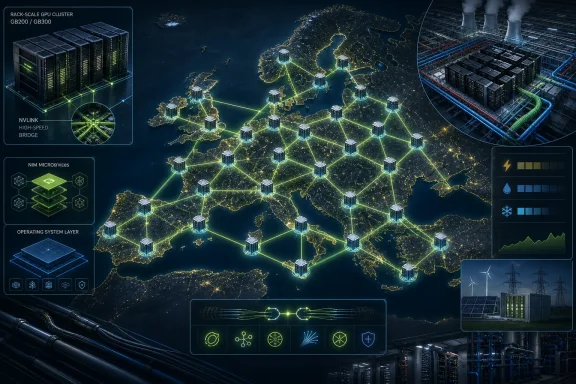
NVIDIA announced at ISC High Performance 2026 in Hamburg on June 22 that 35 NVIDIA-powered AI and HPC supercomputers are in development across 23 European countries, representing up to 800 AI exaflops of deployed or announced capacity. The headline number is enormous, but the real story is not just raw compute. Europe is trying to turn fragmented national research programs into a continent-scale AI infrastructure layer — and NVIDIA is positioning itself as the operating system beneath it. That should excite researchers, worry procurement officers, and sharpen the debate over what technological sovereignty actually means when the silicon, networking, software stack, and developer ecosystem all come from one company.
Europe has spent years talking about digital sovereignty as if it were chiefly a regulatory problem. The AI boom has made that framing look incomplete. Sovereignty in 2026 is not merely the ability to write rules for data, platforms, and model behavior; it is the ability to train, fine-tune, run, audit, and deploy large models without begging for capacity from American cloud providers.
That is why NVIDIA’s announcement matters. The company is not simply shipping accelerators into European labs. It is embedding a full-stack architecture — GPUs, InfiniBand networking, CUDA libraries, AI Enterprise software, NIM microservices, and reference designs — into the continent’s scientific computing backbone.
The deployments span national supercomputing centers, EuroHPC AI factories, universities, and industrial research hubs. NVIDIA says the systems will support more than 3 million researchers, a figure that neatly captures the political sell: this is not just infrastructure for a handful of frontier AI labs, but a shared engine for climate science, medicine, materials research, robotics, public-sector AI, and industry.
That is the optimistic version. The harder version is that Europe is buying sovereignty by standardizing on the most powerful American AI platform available. It is a pragmatic bargain, but not a neutral one.
That distinction is not pedantry. It is the difference between comparing a Formula 1 car by its lap time and comparing it by the peak RPM of its engine. Both measurements tell you something, but only one tells you how it performs on the track you actually care about.
NVIDIA’s phrasing is careful: these are deployed and announced AI exaflops across Europe, spanning systems using Hopper, Blackwell, Blackwell Ultra, and future Rubin-class platforms. The aggregate is a measure of continental AI capacity, not a claim that Europe is installing one monolithic 800-exaflop supercomputer.
For WindowsForum readers used to consumer GPU spec sheets, the same caution applies. Peak FLOPS are architecture marketing’s favorite currency because they compress complex systems into one impressive integer. In practice, useful performance depends on memory capacity, memory bandwidth, interconnect topology, software maturity, power delivery, cooling, data locality, scheduling, and whether the workload can actually exploit the precision mode being advertised.
Still, dismissing the number would be a mistake. Even with the usual caveats, 35 systems across 23 countries is a major infrastructure buildout. Europe is not just adding a few prestige machines; it is trying to build a distributed AI compute fabric.
That framing matters because it changes who the machines are for. Europe’s older HPC investments were already vital for physics, weather, molecular dynamics, and engineering simulation. The AI factory model expands the customer base to include public agencies, hospitals, startups, manufacturers, and software teams that want managed AI capacity without assembling their own stack from scratch.
Barcelona Supercomputing Center’s EuroHPC AI Factory is a good example. Its expansion around NVIDIA GB300 NVL72 and GB200 NVL4 systems is being described in terms of generative AI, climate modeling, health research, biotech, agriculture, energy systems, and government services. That is a very different pitch from “we bought a faster machine.”
Germany’s HammerHAI, Sweden’s Mimer AI Factory, BavariaAI’s Blue Swan, and Italy’s IT4LIA follow the same pattern. The systems are not merely scientific trophies. They are meant to become regional platforms where researchers and industrial users can run sensitive or strategic workloads on European soil.
The Windows analogy is obvious: this is less like buying a faster workstation and more like standardizing an enterprise estate around Active Directory, management tooling, developer frameworks, and support contracts. The hardware is the visible expenditure. The platform lock-in arrives through everything that makes the hardware productive.
That fact is easy to understate in hardware coverage. Blackwell racks, Rubin roadmaps, and InfiniBand fabrics make for better photographs. But the reason governments keep buying NVIDIA is that the researchers, frameworks, libraries, containers, and operational practices already assume NVIDIA underneath.
CUDA-X and CUDA-Q extend that gravitational pull into domain libraries and quantum-adjacent workflows. NIM microservices and AI Enterprise bring the same strategy higher into the deployment layer. The more NVIDIA packages the stack, the less the customer is buying “GPUs” and the more the customer is buying an execution environment.
For European administrators, that is both a relief and a risk. A mature software stack reduces deployment friction, improves supportability, and makes scarce AI infrastructure usable by more teams. It also concentrates strategic dependency in a single vendor whose roadmap, pricing, export constraints, and supply priorities are not set in Brussels, Berlin, Madrid, or Stockholm.
This is where the sovereignty rhetoric becomes uncomfortable. Europe can own the buildings, pay the electricity bills, staff the labs, and host the data. But if the practical ability to run the workloads depends on NVIDIA’s proprietary stack, the sovereignty is partial.
That architectural shift is especially important for AI models whose bottleneck is not just arithmetic, but moving enormous tensors through memory and between accelerators. NVLink, high-bandwidth memory, and InfiniBand or Spectrum-X networking are no longer peripheral details. They are the system.
This is why the European systems are described in rack-scale terms: GB300 NVL72, GB200 NVL4, Quantum-X800 InfiniBand, ConnectX networking, and software layers that assume the hardware fabric beneath them. The data center becomes a computer in the literal sense, not just a room full of computers.
It also raises the practical stakes for facilities teams. These systems are power-dense, cooling-sensitive, and operationally more demanding than the previous generation of general-purpose clusters. Liquid cooling, power distribution, maintenance windows, supply chain spares, and energy contracts become strategic variables.
That will matter for European public institutions. Announcing AI exaflops is easy. Keeping them fed with power, data, jobs, skilled operators, and stable funding over multiple procurement cycles is the real test.
JUPITER also illustrates the blurring boundary between traditional HPC and AI infrastructure. Climate models increasingly use AI surrogates and data assimilation. Biomedical research increasingly depends on foundation models and massive image or sequence datasets. Materials science increasingly uses neural methods to search chemical and physical spaces that brute-force simulation alone cannot cover.
The result is a new procurement logic. A national lab no longer buys an HPC machine over here and AI capacity over there. It buys an accelerated platform and expects it to serve both worlds.
That convergence favors NVIDIA. The company’s platform spans double-precision scientific workloads, AI training, inference, data processing, visualization, and increasingly quantum simulation tooling. Competitors can challenge pieces of that stack, but few can offer the same integrated story to a government agency that wants one accountable supplier.
The political pitch is powerful: Europe gets machines that can simulate the planet, accelerate drug discovery, support domestic language models, and keep strategic data inside European institutions. The uncomfortable reality is that much of this capability still arrives through a U.S. vendor whose market power has become infrastructure-level.
That matters because public-sector supercomputing cycles are long. A system announced today may be installed, accepted, tuned, allocated, and fully utilized over several years. By the time one generation is operational, the next generation is already shaping procurement expectations.
Rubin therefore functions as a roadmap clause. Europe is not just buying the systems NVIDIA can ship now; it is aligning future AI factory planning around NVIDIA’s cadence. That cadence has become unusually aggressive because hyperscalers, model companies, and national governments are all competing for the same accelerators.
For IT planners, this creates a nasty tension. Waiting for the next platform risks paralysis. Buying the current platform risks looking dated before the paint is dry. The only rational response is to design facilities, software, and procurement models that expect accelerated turnover.
That is easier said than done in public infrastructure. Hyperscalers can amortize rapidly, shift capacity globally, and throw elite engineering teams at utilization. Universities and national labs must balance open science, government oversight, energy budgets, procurement law, and long-lived research commitments.
That is not the same as replacing the cloud. Microsoft Azure, Amazon Web Services, Google Cloud, Oracle Cloud, CoreWeave, and others will still dominate much of the commercial AI market because they offer elasticity, managed services, global reach, and a billing model enterprises already understand. A university researcher waiting for an allocation committee cannot pretend that is equivalent to spinning up cloud capacity with a purchase order.
But the public infrastructure model solves a different problem. Some workloads involve sensitive data, long-running scientific campaigns, or national strategic priorities that are poorly served by spot pricing and commercial scarcity. Some research communities need guaranteed access more than they need infinite flexibility.
The strongest version of Europe’s plan is therefore hybrid. Public AI factories handle strategic research, public-sector workloads, and industrial programs that justify sovereign capacity. Commercial clouds handle burst demand, productization, and workloads where managed services matter more than data locality.
That division will not be clean. The same researchers who train on a EuroHPC system may deploy on Azure. The same startup that prototypes on public infrastructure may scale on a hyperscaler. The platform commonality, again, works in NVIDIA’s favor.
AI PCs, local copilots, GPU-backed inference servers, confidential computing, model governance, and data residency policies all depend on where compute lives and who controls it. If Europe’s public AI factories mature, they could become trusted backends for organizations that cannot send every prompt, document, dataset, or model weight to a U.S. hyperscaler.
For sysadmins, the practical questions will look familiar. Who authenticates users? How are jobs isolated? Where are logs stored? How are model artifacts versioned? What happens when a dependency in a container image needs patching? How are GPU resources accounted for, billed, and audited?
The answers will not come from FLOPS charts. They will come from management platforms, identity integration, security baselines, software supply-chain controls, and mundane operational discipline. In other words, the exciting part of AI infrastructure will eventually become normal enterprise plumbing.
That is when WindowsForum’s audience should pay attention. The history of enterprise computing is that exotic infrastructure becomes boring right before it becomes unavoidable.
This does not make the effort hypocritical. Climate research, energy systems modeling, and materials discovery are among the legitimate reasons to build large accelerated systems. But it does mean the public-interest case must be stronger than “AI is strategic, therefore build everything.”
The most credible AI factories will be judged by utilization and outcomes. A system that runs near capacity on high-value science, public services, and industrial innovation is easier to defend than one that becomes a prestige cluster for grant proposals and vendor demos. Capacity alone is not impact.
NVIDIA’s efficiency claims will help, especially when comparing newer platforms with older Hopper-era systems. But efficiency gains in computing often invite more computing rather than less power consumption. Europe will need to show that its AI capacity is governed, scheduled, and evaluated with the seriousness normally reserved for critical infrastructure.
That is the hidden governance problem. The scarce resource may not be GPUs. It may be electricity, cooling, expert operators, and public legitimacy.
The decision may be entirely defensible. NVIDIA has the strongest ecosystem, the broadest developer support, and the most mature full-stack offering for the workloads Europe wants to run now. Betting on a less mature alternative for political symbolism would risk wasting time in a global AI race where access to compute is already a bottleneck.
But Europe should be honest about the trade. A continent that wants AI sovereignty is standardizing much of its sovereign capacity on U.S.-controlled technology. That is not failure; it is dependency management.
The practical response is not to pretend lock-in does not exist. It is to invest in portability where possible, open models where useful, open datasets where lawful, competitive procurement where feasible, and European capability in the layers above and around the accelerators. Sovereignty can be cumulative even when silicon is imported.
For now, NVIDIA has won the infrastructure round because it solved the developer adoption problem before everyone else realized it was the real contest. Europe’s task is to make sure that adoption does not become permanent helplessness.
 Europe’s AI Sovereignty Push Now Runs Through Santa Clara
Europe has spent years talking about digital sovereignty as if it were chiefly a regulatory problem. The AI boom has made that framing look incomplete. Sovereignty in 2026 is not merely the ability to write rules for data, platforms, and model behavior; it is the ability to train, fine-tune, run, audit, and deploy large models without begging for capacity from American cloud providers.That is why NVIDIA’s announcement matters. The company is not simply shipping accelerators into European labs. It is embedding a full-stack architecture — GPUs, InfiniBand networking, CUDA libraries, AI Enterprise software, NIM microservices, and reference designs — into the continent’s scientific computing backbone.
The deployments span national supercomputing centers, EuroHPC AI factories, universities, and industrial research hubs. NVIDIA says the systems will support more than 3 million researchers, a figure that neatly captures the political sell: this is not just infrastructure for a handful of frontier AI labs, but a shared engine for climate science, medicine, materials research, robotics, public-sector AI, and industry.
That is the optimistic version. The harder version is that Europe is buying sovereignty by standardizing on the most powerful American AI platform available. It is a pragmatic bargain, but not a neutral one.
The 800-Exaflop Number Is Both Real and Slippery
The first thing to understand about “800 exaflops” is that it is an AI number, not a traditional supercomputing number. In the classic TOP500 sense, exascale usually refers to high-precision FP64 performance on the Linpack benchmark. AI exaflops typically refer to lower-precision tensor math used for training and inference, where modern accelerators deliver far higher nominal throughput.That distinction is not pedantry. It is the difference between comparing a Formula 1 car by its lap time and comparing it by the peak RPM of its engine. Both measurements tell you something, but only one tells you how it performs on the track you actually care about.
NVIDIA’s phrasing is careful: these are deployed and announced AI exaflops across Europe, spanning systems using Hopper, Blackwell, Blackwell Ultra, and future Rubin-class platforms. The aggregate is a measure of continental AI capacity, not a claim that Europe is installing one monolithic 800-exaflop supercomputer.
For WindowsForum readers used to consumer GPU spec sheets, the same caution applies. Peak FLOPS are architecture marketing’s favorite currency because they compress complex systems into one impressive integer. In practice, useful performance depends on memory capacity, memory bandwidth, interconnect topology, software maturity, power delivery, cooling, data locality, scheduling, and whether the workload can actually exploit the precision mode being advertised.
Still, dismissing the number would be a mistake. Even with the usual caveats, 35 systems across 23 countries is a major infrastructure buildout. Europe is not just adding a few prestige machines; it is trying to build a distributed AI compute fabric.
The AI Factory Becomes Europe’s New Supercomputing Template
NVIDIA’s preferred term for this generation of systems is AI factory, and the phrase is doing important rhetorical work. A conventional supercomputer evokes batch jobs, national labs, climate models, and academic allocation committees. An AI factory suggests continuous production: data in, models out, inference services running, applications deployed.That framing matters because it changes who the machines are for. Europe’s older HPC investments were already vital for physics, weather, molecular dynamics, and engineering simulation. The AI factory model expands the customer base to include public agencies, hospitals, startups, manufacturers, and software teams that want managed AI capacity without assembling their own stack from scratch.
Barcelona Supercomputing Center’s EuroHPC AI Factory is a good example. Its expansion around NVIDIA GB300 NVL72 and GB200 NVL4 systems is being described in terms of generative AI, climate modeling, health research, biotech, agriculture, energy systems, and government services. That is a very different pitch from “we bought a faster machine.”
Germany’s HammerHAI, Sweden’s Mimer AI Factory, BavariaAI’s Blue Swan, and Italy’s IT4LIA follow the same pattern. The systems are not merely scientific trophies. They are meant to become regional platforms where researchers and industrial users can run sensitive or strategic workloads on European soil.
The Windows analogy is obvious: this is less like buying a faster workstation and more like standardizing an enterprise estate around Active Directory, management tooling, developer frameworks, and support contracts. The hardware is the visible expenditure. The platform lock-in arrives through everything that makes the hardware productive.
CUDA Is the Moat Europe Is Choosing Not to Cross
NVIDIA’s strongest product is not any single GPU. It is CUDA, the software ecosystem that turns NVIDIA accelerators into the default target for AI and high-performance computing developers.That fact is easy to understate in hardware coverage. Blackwell racks, Rubin roadmaps, and InfiniBand fabrics make for better photographs. But the reason governments keep buying NVIDIA is that the researchers, frameworks, libraries, containers, and operational practices already assume NVIDIA underneath.
CUDA-X and CUDA-Q extend that gravitational pull into domain libraries and quantum-adjacent workflows. NIM microservices and AI Enterprise bring the same strategy higher into the deployment layer. The more NVIDIA packages the stack, the less the customer is buying “GPUs” and the more the customer is buying an execution environment.
For European administrators, that is both a relief and a risk. A mature software stack reduces deployment friction, improves supportability, and makes scarce AI infrastructure usable by more teams. It also concentrates strategic dependency in a single vendor whose roadmap, pricing, export constraints, and supply priorities are not set in Brussels, Berlin, Madrid, or Stockholm.
This is where the sovereignty rhetoric becomes uncomfortable. Europe can own the buildings, pay the electricity bills, staff the labs, and host the data. But if the practical ability to run the workloads depends on NVIDIA’s proprietary stack, the sovereignty is partial.
Blackwell Makes the Rack the New Unit of Computing
The technical center of gravity has moved from the server to the rack. NVIDIA’s GB200 and GB300 NVL systems are designed around the idea that dozens of GPUs and Grace CPUs should behave less like separate nodes and more like one tightly coupled compute domain.That architectural shift is especially important for AI models whose bottleneck is not just arithmetic, but moving enormous tensors through memory and between accelerators. NVLink, high-bandwidth memory, and InfiniBand or Spectrum-X networking are no longer peripheral details. They are the system.
This is why the European systems are described in rack-scale terms: GB300 NVL72, GB200 NVL4, Quantum-X800 InfiniBand, ConnectX networking, and software layers that assume the hardware fabric beneath them. The data center becomes a computer in the literal sense, not just a room full of computers.
It also raises the practical stakes for facilities teams. These systems are power-dense, cooling-sensitive, and operationally more demanding than the previous generation of general-purpose clusters. Liquid cooling, power distribution, maintenance windows, supply chain spares, and energy contracts become strategic variables.
That will matter for European public institutions. Announcing AI exaflops is easy. Keeping them fed with power, data, jobs, skilled operators, and stable funding over multiple procurement cycles is the real test.
JUPITER Shows Why AI and HPC Are Now Politically Entangled
Europe’s JUPITER system at Forschungszentrum Jülich already gave the continent its first exascale-class flagship. Built around NVIDIA Grace Hopper superchips, it is meant for scientific workloads including climate simulation, brain modeling, quantum simulation, and advanced communications research. It is the sort of system that makes supercomputing politically visible.JUPITER also illustrates the blurring boundary between traditional HPC and AI infrastructure. Climate models increasingly use AI surrogates and data assimilation. Biomedical research increasingly depends on foundation models and massive image or sequence datasets. Materials science increasingly uses neural methods to search chemical and physical spaces that brute-force simulation alone cannot cover.
The result is a new procurement logic. A national lab no longer buys an HPC machine over here and AI capacity over there. It buys an accelerated platform and expects it to serve both worlds.
That convergence favors NVIDIA. The company’s platform spans double-precision scientific workloads, AI training, inference, data processing, visualization, and increasingly quantum simulation tooling. Competitors can challenge pieces of that stack, but few can offer the same integrated story to a government agency that wants one accountable supplier.
The political pitch is powerful: Europe gets machines that can simulate the planet, accelerate drug discovery, support domestic language models, and keep strategic data inside European institutions. The uncomfortable reality is that much of this capability still arrives through a U.S. vendor whose market power has become infrastructure-level.
Rubin Is the Roadmap Clause in the Deal
The Wccftech report also points to European interest in NVIDIA’s next-generation Vera Rubin platform, with deployments such as Blue Lion targeting operation around 2027. Rubin is not just a future GPU brand. It is the next escalation in NVIDIA’s rack-scale strategy, promising much higher density and more compute per installation.That matters because public-sector supercomputing cycles are long. A system announced today may be installed, accepted, tuned, allocated, and fully utilized over several years. By the time one generation is operational, the next generation is already shaping procurement expectations.
Rubin therefore functions as a roadmap clause. Europe is not just buying the systems NVIDIA can ship now; it is aligning future AI factory planning around NVIDIA’s cadence. That cadence has become unusually aggressive because hyperscalers, model companies, and national governments are all competing for the same accelerators.
For IT planners, this creates a nasty tension. Waiting for the next platform risks paralysis. Buying the current platform risks looking dated before the paint is dry. The only rational response is to design facilities, software, and procurement models that expect accelerated turnover.
That is easier said than done in public infrastructure. Hyperscalers can amortize rapidly, shift capacity globally, and throw elite engineering teams at utilization. Universities and national labs must balance open science, government oversight, energy budgets, procurement law, and long-lived research commitments.
The Cloud Has Competition, but Not Replacement
One of the subtler implications of Europe’s AI supercomputer buildout is that it challenges the idea that frontier AI compute must live entirely in hyperscale cloud regions. Public supercomputing centers are trying to offer an alternative: sovereign, research-oriented, professionally operated infrastructure with predictable access rules.That is not the same as replacing the cloud. Microsoft Azure, Amazon Web Services, Google Cloud, Oracle Cloud, CoreWeave, and others will still dominate much of the commercial AI market because they offer elasticity, managed services, global reach, and a billing model enterprises already understand. A university researcher waiting for an allocation committee cannot pretend that is equivalent to spinning up cloud capacity with a purchase order.
But the public infrastructure model solves a different problem. Some workloads involve sensitive data, long-running scientific campaigns, or national strategic priorities that are poorly served by spot pricing and commercial scarcity. Some research communities need guaranteed access more than they need infinite flexibility.
The strongest version of Europe’s plan is therefore hybrid. Public AI factories handle strategic research, public-sector workloads, and industrial programs that justify sovereign capacity. Commercial clouds handle burst demand, productization, and workloads where managed services matter more than data locality.
That division will not be clean. The same researchers who train on a EuroHPC system may deploy on Azure. The same startup that prototypes on public infrastructure may scale on a hyperscaler. The platform commonality, again, works in NVIDIA’s favor.
Windows Shops Should Care Because AI Infrastructure Is Becoming Enterprise Infrastructure
At first glance, 800 AI exaflops in European supercomputing centers sounds remote from the daily life of a Windows administrator. It is not. The same architectural forces reshaping national HPC are moving into enterprise data centers, developer workstations, and managed AI services that Windows-heavy organizations will consume.AI PCs, local copilots, GPU-backed inference servers, confidential computing, model governance, and data residency policies all depend on where compute lives and who controls it. If Europe’s public AI factories mature, they could become trusted backends for organizations that cannot send every prompt, document, dataset, or model weight to a U.S. hyperscaler.
For sysadmins, the practical questions will look familiar. Who authenticates users? How are jobs isolated? Where are logs stored? How are model artifacts versioned? What happens when a dependency in a container image needs patching? How are GPU resources accounted for, billed, and audited?
The answers will not come from FLOPS charts. They will come from management platforms, identity integration, security baselines, software supply-chain controls, and mundane operational discipline. In other words, the exciting part of AI infrastructure will eventually become normal enterprise plumbing.
That is when WindowsForum’s audience should pay attention. The history of enterprise computing is that exotic infrastructure becomes boring right before it becomes unavoidable.
The Energy Bill Is the Shadow Benchmark
Every AI supercomputer announcement carries an invisible second spec sheet: megawatts, cooling water, grid connection capacity, and operating cost. Europe’s buildout arrives in a region with intense energy politics, aggressive climate targets, and uneven power availability across countries.This does not make the effort hypocritical. Climate research, energy systems modeling, and materials discovery are among the legitimate reasons to build large accelerated systems. But it does mean the public-interest case must be stronger than “AI is strategic, therefore build everything.”
The most credible AI factories will be judged by utilization and outcomes. A system that runs near capacity on high-value science, public services, and industrial innovation is easier to defend than one that becomes a prestige cluster for grant proposals and vendor demos. Capacity alone is not impact.
NVIDIA’s efficiency claims will help, especially when comparing newer platforms with older Hopper-era systems. But efficiency gains in computing often invite more computing rather than less power consumption. Europe will need to show that its AI capacity is governed, scheduled, and evaluated with the seriousness normally reserved for critical infrastructure.
That is the hidden governance problem. The scarce resource may not be GPUs. It may be electricity, cooling, expert operators, and public legitimacy.
The Vendor Stack Is Now a Policy Choice
Governments like to separate procurement from policy, but AI infrastructure makes that separation artificial. Choosing NVIDIA at this scale is a policy decision, whether or not it is presented as one.The decision may be entirely defensible. NVIDIA has the strongest ecosystem, the broadest developer support, and the most mature full-stack offering for the workloads Europe wants to run now. Betting on a less mature alternative for political symbolism would risk wasting time in a global AI race where access to compute is already a bottleneck.
But Europe should be honest about the trade. A continent that wants AI sovereignty is standardizing much of its sovereign capacity on U.S.-controlled technology. That is not failure; it is dependency management.
The practical response is not to pretend lock-in does not exist. It is to invest in portability where possible, open models where useful, open datasets where lawful, competitive procurement where feasible, and European capability in the layers above and around the accelerators. Sovereignty can be cumulative even when silicon is imported.
For now, NVIDIA has won the infrastructure round because it solved the developer adoption problem before everyone else realized it was the real contest. Europe’s task is to make sure that adoption does not become permanent helplessness.
The Numbers That Should Survive the Press Release
The announcement is large enough that the headline risks blurring the details. The concrete implications are more useful than the spectacle.- NVIDIA says 35 AI and HPC supercomputers are in development across 23 European countries.
- The systems represent up to 800 AI exaflops of deployed or announced capacity, a lower-precision AI metric rather than a traditional FP64 TOP500 comparison.
- Major deployments include Barcelona’s EuroHPC AI Factory, BavariaAI’s Blue Swan, Italy’s IT4LIA, Germany’s HammerHAI, Sweden’s Mimer AI Factory, and Europe’s JUPITER exascale system.
- The buildout leans heavily on NVIDIA’s full stack, including Blackwell and Hopper systems, InfiniBand networking, CUDA libraries, NIM microservices, and AI Enterprise software.
- Rubin-based systems are already part of the forward roadmap, which means Europe’s AI factory strategy is tied not only to NVIDIA’s current products but also to its next platform cycle.
- The biggest long-term risks are not just cost or availability, but energy demand, operational complexity, software lock-in, and whether public infrastructure can produce measurable scientific and industrial returns.
References
- Primary source: Wccftech
Published: Mon, 22 Jun 2026 15:25:00 GMT
NVIDIA Floods Europe With 35 Supercomputers Spanning 23 Countries, Stacking Up To 800 Exaflops Of AI Compute
NVIDIA's AI prowess is being deployed across Europe with 35 brand new supercomputers offering 800 Exaflops of compute.wccftech.com
- Related coverage: docs.nvidia.com

Overview — NVIDIA NVL72 AI Factory
docs.nvidia.com
- Related coverage: nvidia.com
NVIDIA GB300 NVL72
The NVIDIA GB300 NVL72 features a fully liquid-cooled, rack-scale design that unifies 72 NVIDIA Blackwell Ultra GPUs and 36 Arm based NVIDIA Grace CPUs in a single platform.www.nvidia.com - Related coverage: blogs.nvidia.com
Microsoft Azure Unveils World’s First NVIDIA GB300 NVL72 Supercomputing Cluster for OpenAI | NVIDIA Blog
New state-of-the-art platform enables next-generation AI model development and deployment while furthering American leadership in AI.blogs.nvidia.com - Related coverage: developer.nvidia.com
NVIDIA Blackwell Ultra for the Era of AI Reasoning | NVIDIA Technical Blog
For years, advancements in AI have followed a clear trajectory through pretraining scaling: larger models, more data, and greater computational resources lead…developer.nvidia.com
- Official source: azure.microsoft.com
- Related coverage: es.investing.com
Nvidia anuncia 35 superordenadores de IA en desarrollo en Europa Por Investing.com
Nvidia anuncia 35 superordenadores de IA en desarrollo en Europaes.investing.com - Related coverage: tomshardware.com
Google deploys new Axion CPUs and seventh-gen Ironwood TPU — training and inferencing pods beat Nvidia GB300 and shape 'AI Hypercomputer' model | Tom's Hardware
Chips complete Google's portfolio of custom silicon.www.tomshardware.com - Related coverage: techradar.com
HP announces the most powerful Windows AI PC ever built — Nvidia GB300 workstation can handle one trillion parameters thanks to its 784GB unified memory, but it won't be cheap | TechRadar
Server-grade power, now on your desk.www.techradar.com - Related coverage: nvidianews.nvidia.com
- Related coverage: intuitionlabs.ai
