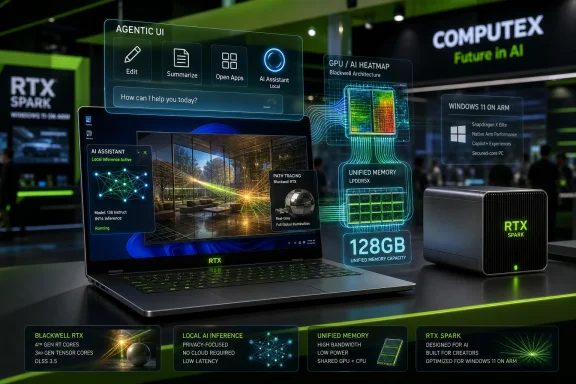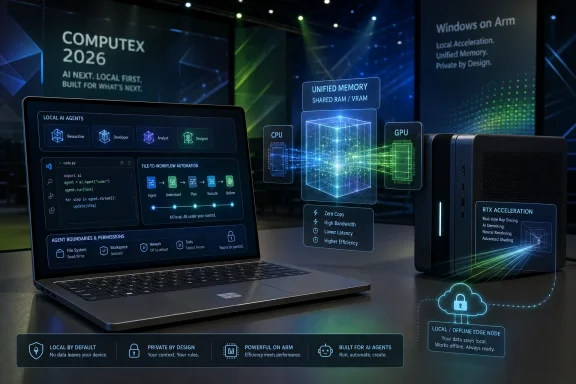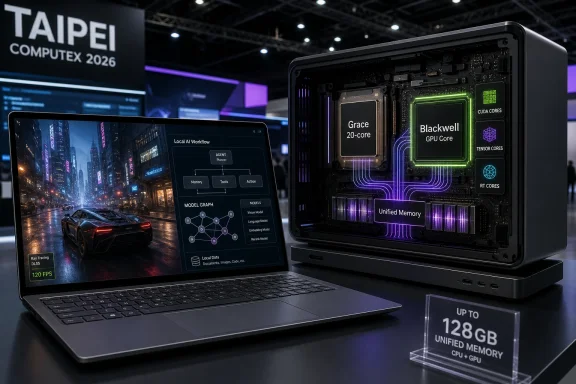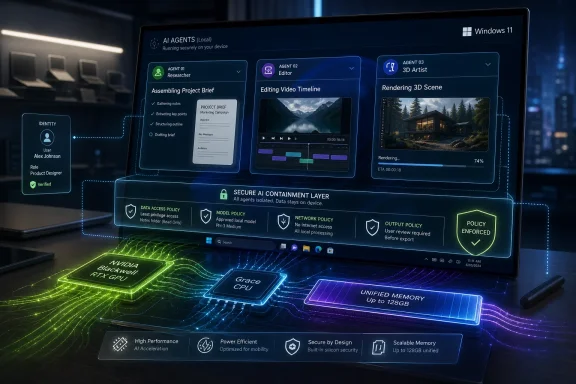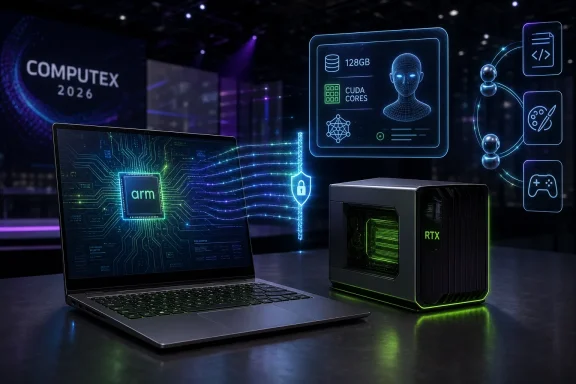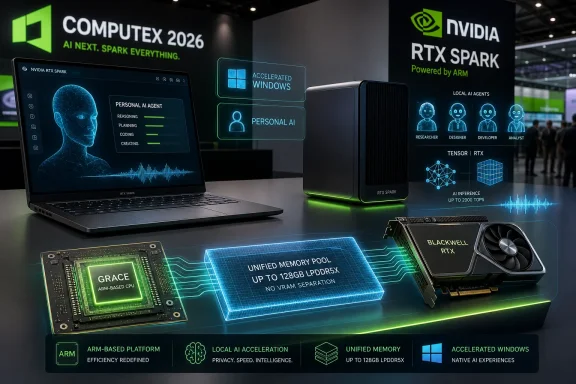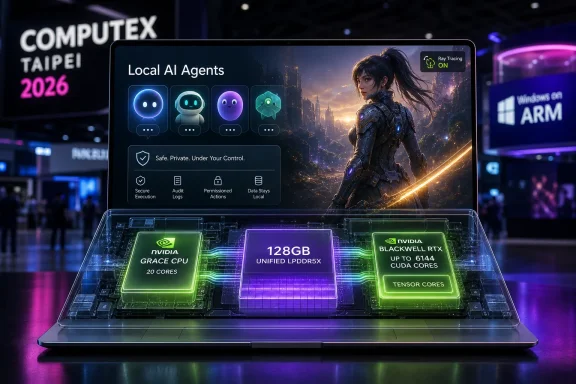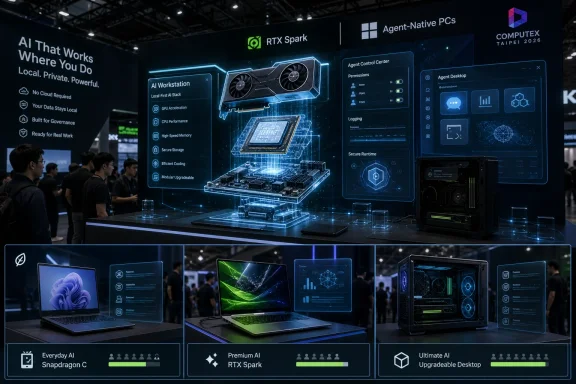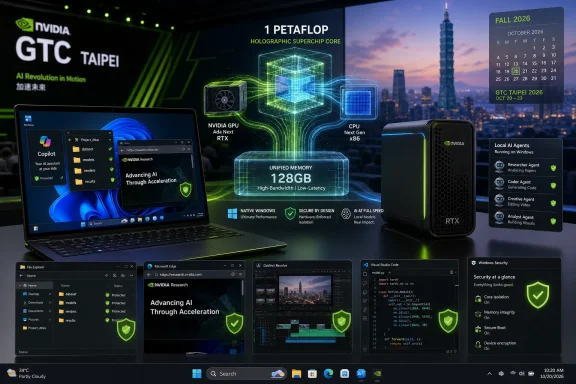
Nvidia and Microsoft introduced RTX Spark at Computex 2026 in Taipei as a new Arm-based Windows PC platform for laptops and compact desktops, pairing Nvidia Blackwell graphics, a 20-core Grace CPU design, and up to 128GB of unified memory for local AI, creation, and gaming. The announcement is being pitched as a reinvention of the Windows PC, but the real story is more specific: Nvidia is trying to make the GPU, not the CPU, the center of personal computing. Microsoft, meanwhile, is betting that Windows on Arm finally gets serious when it is attached to CUDA, RTX, and a developer ecosystem that already dominates AI. If this works, the PC market gets a genuine third axis beyond Intel-versus-AMD and Mac-versus-Windows; if it does not, RTX Spark becomes another impressive silicon demo looking for a daily workflow.
For most of the PC era, Nvidia’s position was powerful but structurally secondary. The company sold the part that made games faster, renders prettier, and AI models practical, but the system still booted around someone else’s CPU platform. RTX Spark is the clearest sign yet that Nvidia wants to move from component supplier to platform owner.
That distinction matters. A GPU vendor can win benchmarks and still depend on Intel, AMD, Qualcomm, Microsoft, OEM thermals, driver politics, and software translation layers to define the actual user experience. A platform vendor gets to write the story from firmware to SDK, from silicon topology to app optimization, from battery behavior to the keynote phrase that tells buyers what the machine is for.
RTX Spark is presented as a “superchip,” not a discrete graphics card with a processor stapled nearby. The top configuration combines a 20-core Arm CPU complex, Blackwell RTX graphics with up to 6,144 CUDA cores, fifth-generation Tensor Cores, and up to 128GB of LPDDR5X unified memory. Nvidia is claiming up to one petaflop of FP4 AI performance, which is a very particular kind of number: spectacular for marketing, genuinely relevant for some inference workloads, and not remotely the same thing as saying every task will behave like a data-center GPU just moved into a backpack.
Still, the architecture is a meaningful break from the Windows norm. The CPU and GPU share a large memory pool, which is the kind of design Apple used to turn “integrated graphics” from a budget compromise into a workstation argument. Nvidia’s version has a different center of gravity. Apple Silicon starts with power efficiency and OS integration; RTX Spark starts with the CUDA and RTX stack and asks Windows to meet it there.
That is why the launch feels larger than a new laptop chip. Nvidia is making a bid to define what a premium Windows PC should be in an AI-heavy decade: not merely a thin machine with a neural processing unit checkbox, but a local inference, graphics, and developer box that happens to run Windows.
That is not necessarily a weakness. Microsoft has spent years trying to make Windows on Arm feel inevitable, first through cautious Qualcomm designs and later through Copilot+ PCs that finally made Arm laptops credible for mainstream battery life and responsiveness. But those systems still lived under the shadow of compatibility caveats, uneven creative app support, and the awkward fact that many high-performance Windows workflows still assumed x86 CPUs and Nvidia GPUs.
RTX Spark changes the emotional pitch. Instead of asking buyers to accept Arm for efficiency, Nvidia and Microsoft are asking them to accept Arm because the GPU-side upside is too large to ignore. That is a much stronger argument for creators, AI developers, and technical enthusiasts than “your laptop sleeps better.”
Microsoft’s official framing leans hard into “personal AI agents,” taskbar integration, and the idea that the PC moves from tool to teammate. That language will excite some people and irritate others. The Windows community has already endured enough AI branding to develop a reflexive allergy to claims that every user secretly wants a chatbot living in the shell.
But beneath the rhetoric is a strategic shift Microsoft badly needs. Windows cannot simply be the operating system that hosts cloud AI subscriptions while the most capable local developer machines are Macs or Linux workstations. If local models, agent frameworks, video generation, code assistants, and creative AI tools become normal workloads, Windows needs hardware that makes those workloads feel native rather than bolted on.
RTX Spark is Microsoft’s attempt to answer that need without pretending it can build the whole stack alone. In that sense, the partnership is pragmatic. Microsoft supplies the installed base, compatibility machinery, and Windows experience; Nvidia supplies the performance story developers already believe.
Yet the viability of RTX Spark will not be decided by whether the top SKU sounds impressive in a keynote. It will be decided by the boring middle: drivers, sleep reliability, thermals, external display behavior, app compatibility, anti-cheat support, firmware updates, Windows servicing, and whether performance stays close to the promise when the laptop is unplugged and sitting on a conference-room table.
Nvidia appears to understand that the historical Windows on Arm problem has never been just silicon. It is ecosystem drag. Photoshop and Premiere being reworked for RTX Spark matters more than another synthetic AI number. Blender, DaVinci Resolve, CapCut, and developer tools such as GitHub Copilot, Claude Code, and Cursor running natively or being optimized matters because buyers do not live inside vendor demos.
Gaming is the even harsher test. Nvidia says RTX features such as DLSS, Reflex, G-SYNC, and ray tracing are coming along for the ride on Arm, and several major games are being discussed for support. But the Windows gaming stack includes anti-cheat systems, launchers, overlays, old dependencies, mod tools, controller layers, and years of assumptions about x86 PCs. One or two blockbuster demos will not settle that.
The most credible version of RTX Spark’s first year is not “every Windows user should buy this.” It is narrower and more interesting: the platform may work best for people whose workloads already orbit Nvidia acceleration. If you edit video, build AI apps, render 3D scenes, test local models, or want a laptop that treats CUDA as a first-class citizen, RTX Spark could feel less like a compatibility compromise and more like the machine Windows on Arm should have been aiming toward all along.
Traditional Windows creator laptops often solve performance with brute force: a powerful x86 CPU, a discrete RTX GPU, dedicated VRAM, aggressive cooling, and a battery that becomes more of a UPS than a true mobile power source under load. That model works, but it has obvious limits. It also creates awkward cliffs when a project exceeds VRAM, when the system must shuttle data across buses, or when performance collapses away from the wall.
RTX Spark’s promise is that CPU and GPU can work against a shared memory pool large enough for workloads usually associated with desktop workstations. That does not automatically make it faster than every discrete GPU laptop. Unified memory has tradeoffs, including bandwidth, latency behavior, thermals, and the reality that shared memory is still finite. But it changes the shape of the problem.
This is where the Apple comparison becomes technically useful again. Apple showed that a large unified memory architecture could make certain pro workflows feel smoother than the raw GPU hierarchy might suggest. Nvidia is now trying to make a similar argument for Windows, except with a much stronger AI and GPU software ecosystem behind it.
For sysadmins and IT buyers, unified memory also complicates procurement. A 128GB RTX Spark laptop is not simply “a laptop with lots of RAM.” It is potentially a portable workstation, a local AI test node, and a creator machine in one asset class. That could simplify some deployments, but it could also create a new premium tier whose value depends heavily on whether the user’s software stack is ready.
That matters because Surface has always been more than unit volume. It is Microsoft’s reference argument. When Surface introduced the kickstand-tablet vision, it told OEMs what Windows hardware could become. When Surface Laptop refined the premium clamshell, it gave Windows a cleaner answer to the MacBook. A Surface Laptop Ultra built around RTX Spark would tell the market that Microsoft sees local AI and high-end Arm performance as central, not experimental.
The risk is that “Ultra” becomes another premium label attached to a machine whose best features are not yet fully usable by ordinary buyers. Microsoft has been here before. Windows history is littered with clever hardware that arrived before the software and developer ecosystem were ready to make it feel obvious.
But Surface also gives Microsoft a way to tune the experience tightly. If Windows taskbar agents, local model workflows, Copilot integration, Prism translation, driver policies, and power management are all supposed to show what RTX Spark can do, Microsoft’s own hardware is the cleanest stage. OEMs can produce variety; Surface can produce intent.
The bigger question is pricing. Nvidia-class silicon, OLED panels, large unified memory pools, and premium industrial design do not point toward bargain laptops. If RTX Spark debuts mainly in expensive creator systems, Microsoft and Nvidia will need to justify the premium with workflows users can understand in minutes, not with keynote abstractions about agentic computing.
That breadth suggests the PC industry sees an opening. Intel and AMD still dominate Windows PCs, but the upper end of the market has become more fluid. Qualcomm made Windows on Arm respectable again. Apple made efficiency and unified memory impossible to ignore. Nvidia has made AI acceleration the most valuable computing story on Earth. OEMs do not want to be caught selling yesterday’s architecture if buyers decide local AI is the next premium differentiator.
But broad OEM support also means the launch cannot hide behind one carefully controlled system. Thermals will vary. Battery life claims will be tested across chassis designs. Display choices, port selections, fan noise, firmware maturity, and memory configurations will shape perception as much as the chip itself. Windows enthusiasts know the difference between a platform that is good in theory and a laptop that is good on a Tuesday afternoon after a BIOS update.
Dell aiming an XPS Creator Edition at video editors sends one message. ASUS ProArt models send another. HP and Lenovo can push broader premium and productivity channels. MSI can lean into flexible and performance-oriented designs. Microsoft can frame the category. That segmentation is healthy, but it also means RTX Spark will not have one launch experience; it will have several, and the weakest early systems may define the online narrative.
The fall 2026 timing gives Nvidia and Microsoft a short runway. Computex hype is cheap compared with shipping season. By the time these machines reach reviewers and enterprise pilots, the questions will be blunt: Does it run the apps? Does it stay fast on battery? Does it sleep properly? Does it game without weird exceptions? Does local AI do anything users will pay for?
Nvidia’s developer ecosystem is the company’s moat. CUDA, TensorRT, RTX acceleration, model tooling, and years of library support have made Nvidia hardware the default target for a huge amount of AI work. Bringing that stack into a Windows Arm laptop with a large unified memory pool creates a different proposition from an NPU-equipped productivity notebook.
Local development is not just about saving cloud costs, though that can matter. It is about latency, privacy, iteration speed, offline work, and the ability to prototype against hardware that resembles the deployment target. If an RTX Spark laptop can run local agents, model experiments, code assistants, retrieval workflows, and GPU-accelerated creative tools with fewer compromises, it becomes a serious machine for a class of users who currently bounce between desktops, cloud GPUs, and MacBooks.
There is also a Windows-specific angle. Many enterprise developers live in Windows environments because their companies do. They use Microsoft 365, Teams, Visual Studio, WSL, corporate endpoint tools, and Windows security policies. A credible local AI workstation that fits that world could be easier to approve than a Linux box under a desk or a cloud GPU account with ambiguous data handling.
But again, the details will decide it. Developers will need stable drivers, container support, good WSL behavior, sane package compatibility, and clear documentation. If the platform makes developers fight architecture mismatches, binary wheels, or obscure acceleration paths, enthusiasm will fade quickly. Nvidia has the credibility to attract developers; Microsoft must ensure Windows does not become the friction point.
But gamers are merciless platform testers. They will not grade RTX Spark on architectural elegance. They will grade it on frame times, shader compilation, driver updates, anti-cheat compatibility, mod support, launcher behavior, and whether their existing libraries work without research projects.
This is where Arm becomes both less important and more important than the marketing suggests. If a game is native, optimized, and GPU-bound, RTX Spark could look excellent. If a game depends on x86 assumptions, kernel-level anti-cheat, older middleware, or launchers that behave badly under translation, the platform could feel inconsistent. PC gaming is not one workload; it is an archaeological dig with a storefront.
Nvidia’s advantage is that it controls much of the GPU-side experience gamers already trust. DLSS adoption is broad, RTX branding is strong, and driver cadence is part of the company’s identity. The challenge is that RTX Spark requires Nvidia to own more of the system experience than it usually does. A discrete GPU driver update cannot fix every Windows on Arm edge case.
Gamers may therefore be the second wave rather than the first. Early RTX Spark buyers are more likely to be creators and developers who can tolerate some software boundary lines in exchange for unique capability. Gamers will arrive when the compatibility matrix feels boring. In PC gaming, boring compatibility is the highest compliment.
The attraction is obvious. Local AI can reduce dependency on cloud inference for sensitive workflows. Engineers, analysts, designers, and developers could run models and agents against local or enterprise-controlled data. Creative teams could get workstation-class workflows in mobile form factors. Security teams could prefer some workloads staying on-device rather than flowing through external services.
The trouble is equally obvious. Local AI agents create governance questions. What data can they access? How are prompts logged? Which models are approved? Can endpoint protection see what it needs to see? How do administrators manage model downloads, GPU drivers, agent permissions, and data retention? A laptop capable of running substantial AI workloads is also a laptop capable of creating new shadow IT habits.
Microsoft’s role will be critical here. If RTX Spark is tied to Windows taskbar agents and Copilot-style experiences, administrators will expect policy controls, auditing, identity integration, and clear separation between consumer and enterprise behaviors. The hardware may be Nvidia’s stage, but the management burden lands in Microsoft’s world.
There is also the procurement issue. RTX Spark systems will likely sit awkwardly between laptop and workstation budgets. IT departments may need new criteria for who gets one. The old labels of “developer laptop,” “creator workstation,” and “executive ultraportable” begin to blur when one machine can plausibly occupy all three roles.
RTX Spark changes the argument because the hardware delta is large enough to be visible. A petaflop-class FP4 claim, Blackwell RTX graphics, large unified memory, and Nvidia’s AI software stack are not subtle changes. They invite real workloads, not just background blur and transcription.
That does not mean the marketing is automatically justified. “Personal AI agents” remains a hazy phrase. Users do not buy agents; they buy time saved, work completed, games played, videos rendered, bugs found, meetings summarized, and projects shipped. If the agent layer cannot produce clear value, the hardware will be judged as a powerful creator and developer platform rather than a new species of computer.
That may be enough. The PC does not need to become a teammate to justify RTX Spark. It needs to become a better local compute device for the workloads that are already growing around AI, media, and real-time graphics. The less Nvidia and Microsoft force the anthropomorphic assistant narrative, the more credible the platform becomes.
The irony is that RTX Spark may succeed most where it sounds least futuristic. Fast local editing, large-memory model testing, better laptop rendering, stronger Windows on Arm graphics, and portable CUDA development are concrete. “The PC does the work” is a slogan. Concrete wins will sell systems; slogans will sell keynotes.
The good news is that Nvidia and Microsoft are attacking the right layers. They are not merely launching silicon and hoping developers show up. They are talking about native creative apps, gaming partnerships, AI developer tools, Windows integration, and OEM systems across familiar premium brands. That is what a platform launch should look like.
The bad news is that Windows has a long memory. Users remember drivers that needed months to mature, Arm apps that arrived late, features that depended on specific hardware revisions, and Microsoft initiatives that changed names before they changed workflows. Enthusiasts may be excited, but they will not grant trust indefinitely.
RTX Spark’s first reviews should therefore focus less on whether the keynote claims can be repeated and more on whether the machine feels coherent. Does the same laptop satisfy a creator in Premiere, a developer in a local model workflow, and a gamer in a demanding title? Or does each use case come with an asterisk big enough to change the buying decision?
That is the bar Nvidia and Microsoft chose by calling this a reinvention. A reinvention is not a faster spec sheet. It is a reduction in the number of compromises users must think about.
Nvidia Is No Longer Content to Live Behind the PCIe Slot
For most of the PC era, Nvidia’s position was powerful but structurally secondary. The company sold the part that made games faster, renders prettier, and AI models practical, but the system still booted around someone else’s CPU platform. RTX Spark is the clearest sign yet that Nvidia wants to move from component supplier to platform owner.That distinction matters. A GPU vendor can win benchmarks and still depend on Intel, AMD, Qualcomm, Microsoft, OEM thermals, driver politics, and software translation layers to define the actual user experience. A platform vendor gets to write the story from firmware to SDK, from silicon topology to app optimization, from battery behavior to the keynote phrase that tells buyers what the machine is for.
RTX Spark is presented as a “superchip,” not a discrete graphics card with a processor stapled nearby. The top configuration combines a 20-core Arm CPU complex, Blackwell RTX graphics with up to 6,144 CUDA cores, fifth-generation Tensor Cores, and up to 128GB of LPDDR5X unified memory. Nvidia is claiming up to one petaflop of FP4 AI performance, which is a very particular kind of number: spectacular for marketing, genuinely relevant for some inference workloads, and not remotely the same thing as saying every task will behave like a data-center GPU just moved into a backpack.
Still, the architecture is a meaningful break from the Windows norm. The CPU and GPU share a large memory pool, which is the kind of design Apple used to turn “integrated graphics” from a budget compromise into a workstation argument. Nvidia’s version has a different center of gravity. Apple Silicon starts with power efficiency and OS integration; RTX Spark starts with the CUDA and RTX stack and asks Windows to meet it there.
That is why the launch feels larger than a new laptop chip. Nvidia is making a bid to define what a premium Windows PC should be in an AI-heavy decade: not merely a thin machine with a neural processing unit checkbox, but a local inference, graphics, and developer box that happens to run Windows.
Microsoft Gets the Apple Silicon Comparison It Has Wanted, But Not on Its Own Terms
The easiest line to write is that RTX Spark is Windows’ Apple Silicon moment. It is also the most dangerous line, because the resemblance is real but incomplete. Apple controlled the chip, operating system, developer tools, translation layer, hardware designs, retail story, and long-term migration plan. Microsoft controls Windows, but RTX Spark’s most important technical gravity comes from Nvidia.That is not necessarily a weakness. Microsoft has spent years trying to make Windows on Arm feel inevitable, first through cautious Qualcomm designs and later through Copilot+ PCs that finally made Arm laptops credible for mainstream battery life and responsiveness. But those systems still lived under the shadow of compatibility caveats, uneven creative app support, and the awkward fact that many high-performance Windows workflows still assumed x86 CPUs and Nvidia GPUs.
RTX Spark changes the emotional pitch. Instead of asking buyers to accept Arm for efficiency, Nvidia and Microsoft are asking them to accept Arm because the GPU-side upside is too large to ignore. That is a much stronger argument for creators, AI developers, and technical enthusiasts than “your laptop sleeps better.”
Microsoft’s official framing leans hard into “personal AI agents,” taskbar integration, and the idea that the PC moves from tool to teammate. That language will excite some people and irritate others. The Windows community has already endured enough AI branding to develop a reflexive allergy to claims that every user secretly wants a chatbot living in the shell.
But beneath the rhetoric is a strategic shift Microsoft badly needs. Windows cannot simply be the operating system that hosts cloud AI subscriptions while the most capable local developer machines are Macs or Linux workstations. If local models, agent frameworks, video generation, code assistants, and creative AI tools become normal workloads, Windows needs hardware that makes those workloads feel native rather than bolted on.
RTX Spark is Microsoft’s attempt to answer that need without pretending it can build the whole stack alone. In that sense, the partnership is pragmatic. Microsoft supplies the installed base, compatibility machinery, and Windows experience; Nvidia supplies the performance story developers already believe.
The Specs Are Loud Because the Software Problem Is Louder
The headline specifications are designed to make RTX Spark sound almost absurd for a thin-and-light PC. Up to 128GB of unified memory is the kind of figure that jumps off a laptop spec sheet, especially when paired with claims around massive 3D scenes, 12K video editing, local AI generation, and gaming with ray tracing. The announced OEM list also gives the launch a sense of scale: ASUS, Dell, HP, Lenovo, Microsoft Surface, and MSI are expected to ship systems, with Acer and GIGABYTE following later.Yet the viability of RTX Spark will not be decided by whether the top SKU sounds impressive in a keynote. It will be decided by the boring middle: drivers, sleep reliability, thermals, external display behavior, app compatibility, anti-cheat support, firmware updates, Windows servicing, and whether performance stays close to the promise when the laptop is unplugged and sitting on a conference-room table.
Nvidia appears to understand that the historical Windows on Arm problem has never been just silicon. It is ecosystem drag. Photoshop and Premiere being reworked for RTX Spark matters more than another synthetic AI number. Blender, DaVinci Resolve, CapCut, and developer tools such as GitHub Copilot, Claude Code, and Cursor running natively or being optimized matters because buyers do not live inside vendor demos.
Gaming is the even harsher test. Nvidia says RTX features such as DLSS, Reflex, G-SYNC, and ray tracing are coming along for the ride on Arm, and several major games are being discussed for support. But the Windows gaming stack includes anti-cheat systems, launchers, overlays, old dependencies, mod tools, controller layers, and years of assumptions about x86 PCs. One or two blockbuster demos will not settle that.
The most credible version of RTX Spark’s first year is not “every Windows user should buy this.” It is narrower and more interesting: the platform may work best for people whose workloads already orbit Nvidia acceleration. If you edit video, build AI apps, render 3D scenes, test local models, or want a laptop that treats CUDA as a first-class citizen, RTX Spark could feel less like a compatibility compromise and more like the machine Windows on Arm should have been aiming toward all along.
Unified Memory Is the Bet That Makes the Machine Different
The unified memory pool is not a footnote. It is the design choice that lets Nvidia and Microsoft claim RTX Spark systems can do tasks that traditional laptop architectures struggle to fit cleanly into CPU RAM plus discrete VRAM boundaries. For large models, heavy scenes, and high-resolution media workflows, capacity and data movement can be as important as raw compute.Traditional Windows creator laptops often solve performance with brute force: a powerful x86 CPU, a discrete RTX GPU, dedicated VRAM, aggressive cooling, and a battery that becomes more of a UPS than a true mobile power source under load. That model works, but it has obvious limits. It also creates awkward cliffs when a project exceeds VRAM, when the system must shuttle data across buses, or when performance collapses away from the wall.
RTX Spark’s promise is that CPU and GPU can work against a shared memory pool large enough for workloads usually associated with desktop workstations. That does not automatically make it faster than every discrete GPU laptop. Unified memory has tradeoffs, including bandwidth, latency behavior, thermals, and the reality that shared memory is still finite. But it changes the shape of the problem.
This is where the Apple comparison becomes technically useful again. Apple showed that a large unified memory architecture could make certain pro workflows feel smoother than the raw GPU hierarchy might suggest. Nvidia is now trying to make a similar argument for Windows, except with a much stronger AI and GPU software ecosystem behind it.
For sysadmins and IT buyers, unified memory also complicates procurement. A 128GB RTX Spark laptop is not simply “a laptop with lots of RAM.” It is potentially a portable workstation, a local AI test node, and a creator machine in one asset class. That could simplify some deployments, but it could also create a new premium tier whose value depends heavily on whether the user’s software stack is ready.
The Surface Laptop Ultra Is Microsoft’s Most Interesting Hardware Signal in Years
The reported Microsoft Surface Laptop Ultra is arguably the symbolic center of the announcement. Surface has spent much of the last decade oscillating between design leadership and strange caution, with Microsoft often letting OEM partners take bigger swings. A first-party RTX Spark machine would be a statement that Microsoft wants to put its own logo on this version of the Windows future.That matters because Surface has always been more than unit volume. It is Microsoft’s reference argument. When Surface introduced the kickstand-tablet vision, it told OEMs what Windows hardware could become. When Surface Laptop refined the premium clamshell, it gave Windows a cleaner answer to the MacBook. A Surface Laptop Ultra built around RTX Spark would tell the market that Microsoft sees local AI and high-end Arm performance as central, not experimental.
The risk is that “Ultra” becomes another premium label attached to a machine whose best features are not yet fully usable by ordinary buyers. Microsoft has been here before. Windows history is littered with clever hardware that arrived before the software and developer ecosystem were ready to make it feel obvious.
But Surface also gives Microsoft a way to tune the experience tightly. If Windows taskbar agents, local model workflows, Copilot integration, Prism translation, driver policies, and power management are all supposed to show what RTX Spark can do, Microsoft’s own hardware is the cleanest stage. OEMs can produce variety; Surface can produce intent.
The bigger question is pricing. Nvidia-class silicon, OLED panels, large unified memory pools, and premium industrial design do not point toward bargain laptops. If RTX Spark debuts mainly in expensive creator systems, Microsoft and Nvidia will need to justify the premium with workflows users can understand in minutes, not with keynote abstractions about agentic computing.
OEM Breadth Gives the Launch Credibility, But It Also Raises Expectations
The partner list is unusually important here. ASUS ProArt, Dell XPS, HP OmniBook, Lenovo Yoga Pro, MSI Prestige, and Microsoft Surface cover several familiar premium lanes: creator notebooks, executive laptops, convertible designs, and performance ultraportables. This is not a single reference device hiding behind a future roadmap.That breadth suggests the PC industry sees an opening. Intel and AMD still dominate Windows PCs, but the upper end of the market has become more fluid. Qualcomm made Windows on Arm respectable again. Apple made efficiency and unified memory impossible to ignore. Nvidia has made AI acceleration the most valuable computing story on Earth. OEMs do not want to be caught selling yesterday’s architecture if buyers decide local AI is the next premium differentiator.
But broad OEM support also means the launch cannot hide behind one carefully controlled system. Thermals will vary. Battery life claims will be tested across chassis designs. Display choices, port selections, fan noise, firmware maturity, and memory configurations will shape perception as much as the chip itself. Windows enthusiasts know the difference between a platform that is good in theory and a laptop that is good on a Tuesday afternoon after a BIOS update.
Dell aiming an XPS Creator Edition at video editors sends one message. ASUS ProArt models send another. HP and Lenovo can push broader premium and productivity channels. MSI can lean into flexible and performance-oriented designs. Microsoft can frame the category. That segmentation is healthy, but it also means RTX Spark will not have one launch experience; it will have several, and the weakest early systems may define the online narrative.
The fall 2026 timing gives Nvidia and Microsoft a short runway. Computex hype is cheap compared with shipping season. By the time these machines reach reviewers and enterprise pilots, the questions will be blunt: Does it run the apps? Does it stay fast on battery? Does it sleep properly? Does it game without weird exceptions? Does local AI do anything users will pay for?
For Developers, CUDA on a Windows Arm Laptop Is the Real Hook
The most serious audience for RTX Spark may not be gamers or casual Copilot users. It may be developers who want a portable Windows machine that can run meaningful local AI workloads without treating the cloud as the default answer. For that group, CUDA matters more than the “AI PC” label.Nvidia’s developer ecosystem is the company’s moat. CUDA, TensorRT, RTX acceleration, model tooling, and years of library support have made Nvidia hardware the default target for a huge amount of AI work. Bringing that stack into a Windows Arm laptop with a large unified memory pool creates a different proposition from an NPU-equipped productivity notebook.
Local development is not just about saving cloud costs, though that can matter. It is about latency, privacy, iteration speed, offline work, and the ability to prototype against hardware that resembles the deployment target. If an RTX Spark laptop can run local agents, model experiments, code assistants, retrieval workflows, and GPU-accelerated creative tools with fewer compromises, it becomes a serious machine for a class of users who currently bounce between desktops, cloud GPUs, and MacBooks.
There is also a Windows-specific angle. Many enterprise developers live in Windows environments because their companies do. They use Microsoft 365, Teams, Visual Studio, WSL, corporate endpoint tools, and Windows security policies. A credible local AI workstation that fits that world could be easier to approve than a Linux box under a desk or a cloud GPU account with ambiguous data handling.
But again, the details will decide it. Developers will need stable drivers, container support, good WSL behavior, sane package compatibility, and clear documentation. If the platform makes developers fight architecture mismatches, binary wheels, or obscure acceleration paths, enthusiasm will fade quickly. Nvidia has the credibility to attract developers; Microsoft must ensure Windows does not become the friction point.
For Gamers, the Promise Is Huge and the Caveats Are Familiar
Nvidia knows how to talk to gamers, and RTX Spark’s gaming pitch is intentionally bold. The idea of a thin Arm-based Windows laptop running modern ray-traced games with DLSS and Reflex is exactly the sort of thing that would have sounded implausible not long ago. If Nvidia can make it real, it gives Windows on Arm the gaming legitimacy Qualcomm has struggled to earn.But gamers are merciless platform testers. They will not grade RTX Spark on architectural elegance. They will grade it on frame times, shader compilation, driver updates, anti-cheat compatibility, mod support, launcher behavior, and whether their existing libraries work without research projects.
This is where Arm becomes both less important and more important than the marketing suggests. If a game is native, optimized, and GPU-bound, RTX Spark could look excellent. If a game depends on x86 assumptions, kernel-level anti-cheat, older middleware, or launchers that behave badly under translation, the platform could feel inconsistent. PC gaming is not one workload; it is an archaeological dig with a storefront.
Nvidia’s advantage is that it controls much of the GPU-side experience gamers already trust. DLSS adoption is broad, RTX branding is strong, and driver cadence is part of the company’s identity. The challenge is that RTX Spark requires Nvidia to own more of the system experience than it usually does. A discrete GPU driver update cannot fix every Windows on Arm edge case.
Gamers may therefore be the second wave rather than the first. Early RTX Spark buyers are more likely to be creators and developers who can tolerate some software boundary lines in exchange for unique capability. Gamers will arrive when the compatibility matrix feels boring. In PC gaming, boring compatibility is the highest compliment.
Enterprise IT Will See a Workstation, a Risk, and a Governance Problem
For enterprise IT, RTX Spark is not merely a shiny laptop. It is a new endpoint class with local AI capacity, a different processor architecture, a high-performance GPU stack, and likely a premium price. That combination is attractive and troublesome in equal measure.The attraction is obvious. Local AI can reduce dependency on cloud inference for sensitive workflows. Engineers, analysts, designers, and developers could run models and agents against local or enterprise-controlled data. Creative teams could get workstation-class workflows in mobile form factors. Security teams could prefer some workloads staying on-device rather than flowing through external services.
The trouble is equally obvious. Local AI agents create governance questions. What data can they access? How are prompts logged? Which models are approved? Can endpoint protection see what it needs to see? How do administrators manage model downloads, GPU drivers, agent permissions, and data retention? A laptop capable of running substantial AI workloads is also a laptop capable of creating new shadow IT habits.
Microsoft’s role will be critical here. If RTX Spark is tied to Windows taskbar agents and Copilot-style experiences, administrators will expect policy controls, auditing, identity integration, and clear separation between consumer and enterprise behaviors. The hardware may be Nvidia’s stage, but the management burden lands in Microsoft’s world.
There is also the procurement issue. RTX Spark systems will likely sit awkwardly between laptop and workstation budgets. IT departments may need new criteria for who gets one. The old labels of “developer laptop,” “creator workstation,” and “executive ultraportable” begin to blur when one machine can plausibly occupy all three roles.
The AI PC Label Finally Has Hardware Worth Arguing About
The phrase “AI PC” has suffered from overuse because too many systems carrying the label have offered modest practical changes. An NPU can be useful, but it does not automatically transform a computer. For many users, the first wave of AI PCs looked like normal laptops with better battery life, a Copilot key, and future promises.RTX Spark changes the argument because the hardware delta is large enough to be visible. A petaflop-class FP4 claim, Blackwell RTX graphics, large unified memory, and Nvidia’s AI software stack are not subtle changes. They invite real workloads, not just background blur and transcription.
That does not mean the marketing is automatically justified. “Personal AI agents” remains a hazy phrase. Users do not buy agents; they buy time saved, work completed, games played, videos rendered, bugs found, meetings summarized, and projects shipped. If the agent layer cannot produce clear value, the hardware will be judged as a powerful creator and developer platform rather than a new species of computer.
That may be enough. The PC does not need to become a teammate to justify RTX Spark. It needs to become a better local compute device for the workloads that are already growing around AI, media, and real-time graphics. The less Nvidia and Microsoft force the anthropomorphic assistant narrative, the more credible the platform becomes.
The irony is that RTX Spark may succeed most where it sounds least futuristic. Fast local editing, large-memory model testing, better laptop rendering, stronger Windows on Arm graphics, and portable CUDA development are concrete. “The PC does the work” is a slogan. Concrete wins will sell systems; slogans will sell keynotes.
The First RTX Spark Generation Will Be Judged by Its Friction
Every ambitious PC platform launch faces the same problem: the announcement measures possibility, while the product measures friction. RTX Spark has plenty of possibility. The friction is still unknown.The good news is that Nvidia and Microsoft are attacking the right layers. They are not merely launching silicon and hoping developers show up. They are talking about native creative apps, gaming partnerships, AI developer tools, Windows integration, and OEM systems across familiar premium brands. That is what a platform launch should look like.
The bad news is that Windows has a long memory. Users remember drivers that needed months to mature, Arm apps that arrived late, features that depended on specific hardware revisions, and Microsoft initiatives that changed names before they changed workflows. Enthusiasts may be excited, but they will not grant trust indefinitely.
RTX Spark’s first reviews should therefore focus less on whether the keynote claims can be repeated and more on whether the machine feels coherent. Does the same laptop satisfy a creator in Premiere, a developer in a local model workflow, and a gamer in a demanding title? Or does each use case come with an asterisk big enough to change the buying decision?
That is the bar Nvidia and Microsoft chose by calling this a reinvention. A reinvention is not a faster spec sheet. It is a reduction in the number of compromises users must think about.
The Fall Launch Will Reveal Whether Spark Is a Platform or a Performance Demo
RTX Spark is a serious announcement because it aligns silicon, software ambition, OEM support, and market timing. It is also an announcement wrapped in the usual AI-era excess, where every new machine is asked to carry the weight of a computing revolution. The useful way to read it is neither cynicism nor hype, but conditional belief.- RTX Spark marks Nvidia’s most direct move into the Windows PC platform business, not just another GPU launch.
- Microsoft gains a more credible high-performance Windows on Arm story, but much of the platform’s gravity comes from Nvidia’s CUDA and RTX ecosystem.
- The unified memory design is the architectural feature most likely to matter for creators, AI developers, and workstation-class mobile workflows.
- Gaming could become a major advantage, but only if native support, translation, anti-cheat compatibility, and driver maturity arrive together.
- Enterprise adoption will depend as much on management, security, and policy controls as on raw local AI performance.
- The first generation should be judged by everyday friction, not by whether a keynote demo makes the future look inevitable.
References
- Primary source: Let's Data Science
Published: Mon, 01 Jun 2026 16:54:03 GMT
Nvidia and Microsoft Introduce RTX Spark PCs
NVIDIA unveiled the **RTX Spark** superchip and a joint Windows stack with Microsoft for running local AI agents, per NVIDIA's May 31 press release and Computex presentations. NVIDIA said RTX Spark delivers **1 petaflop** of AI performance, supports **up to 128GB** of unified memory and can run...
letsdatascience.com
- Independent coverage: iPhone in Canada
Published: 2026-06-01T11:52:08.083451
NVIDIA RTX Spark Unveiled to Reinvent the Windows PC
NVIDIA RTX Spark is here. The new Arm-based chip packs 1 petaflop of AI, 128GB unified memory and desktop-class GPU performance into thin-and-light Windows laptops.
www.iphoneincanada.ca
- Related coverage: tomshardware.com
Nvidia's long-awaited N1/N1X SoC specs leak ahead of Computex launch — N1 to feature up to 20 Arm-based cores, standard N1 equipped with 12- and 10-core configs
The top-end N1X SKU is essentially a rebranded GB10.www.tomshardware.com
- Related coverage: nvidianews.nvidia.com
NVIDIA and Microsoft Reinvent Windows PCs for the Age of Personal AI
NVIDIA today unveiled NVIDIA RTX Spark™, a new superchip that reinvents Windows PCs for the era of personal AI agents — offering a new class of computer that moves from tool to teammate.nvidianews.nvidia.com
- Related coverage: arstechnica.com
Nvidia RTX Spark comes to Windows PCs with Arm CPU, RTX GPU, and unified memory
Nvidia's new chips will power laptop workstations and mini desktop PCs at first.
arstechnica.com
- Related coverage: techspot.com
- Related coverage: adrenaline.com.br
NVIDIA anuncia superchip RTX Spark com CPU Arm e GPU RTX Blackwell - Adrenaline
A linha RTX Spark promete desempenho de ponta e o pontapé inicial da era dos “agentes de inteligência artificial pessoais”.
www.adrenaline.com.br
- Related coverage: windowscentral.com
- Related coverage: timesofindia.indiatimes.com
RTX Spark is Nvidia’s ‘superchip' for Windows PCs with 1 petaflop of AI, 128GB RAM, and RTX 5070-tier graphics
For thirty years, Nvidia made the GPU inside your PC. Now it makes the chip inside it too.
timesofindia.indiatimes.com
- Related coverage: phemex.com
NVIDIA RTX Spark Debuts with 1 Petaflop AI Power | Phemex News
NVIDIA's RTX Spark superchip, unveiled at GTC 2026, delivers 1 petaflop AI performance, redefining AI PCs. Major OEMs to launch devices this fall.phemex.com
- Related coverage: smartprix.com
Nvidia Enters The Consumer Laptop Market At Computex 2026 With Its RTX Spark Superchip - Smartprix
The RTX Spark is a Windows on Arm superchip with 20 Arm CPU cores, a Blackwell GPU with 6,144 CUDA cores, up to 128GB unified LPDDR5X memory, and 1 petaflop of AI compute.
www.smartprix.com
- Related coverage: nvidia.com
NVIDIA DGX Spark: AI Supercomputer on Your Desk
Run autonomous AI agents from your desktop.www.nvidia.com - Related coverage: pcgameshardware.de
Nvidia RTX Spark Superchip: "Eine neue Ära des PCs" beginnt
Nvidia hat im Rahmen der Computex 2026 den RTX Spark Superchip vorgestellt und möchte damit "eine neue Ära des PCs" einläuten.www.pcgameshardware.de
- Related coverage: tecnoblog.net
Nvidia RTX Spark: novo chip combina CPU e GPU, e promete revolucionar o PC • Tecnoblog
RTX Spark é a aposta da Nvidia para brigar com Intel e AMD nos segmentos de laptops e miniPCs de alto desempenho com Windows 11.
tecnoblog.net
- Related coverage: images.nvidia.com
- Related coverage: signal65.com
- Related coverage: axios.com
Microsoft debuts Nvidia-powered Microsoft Surface Ultra laptop
Microsoft is trying again to redefine the PC for the AI era.www.axios.com
- Related coverage: investor.nvidia.com
NVIDIA and Microsoft Reinvent Windows PCs for the Age of Personal AI
RTX Spark — a 1-Petaflop Superchip, the Full CUDA and RTX Ecosystem, and Windows-Native Agents — a New Beginning for Personal Computers News Summary: NVIDIA RTX Spark powers the world’s first Windows PCs purpose-built for personal agents, featuring 1 petaflop of AI performance, industry-leading...investor.nvidia.com
- Official source: blogs.windows.com
Introducing a powerful new chapter for Windows PCs, accelerated by NVIDIA RTX Spark
Today at NVIDIA GTC, Microsoft and NVIDIA announced the world’s most powerful and efficient thin-and-light Windows PCs ever. Accelerated by NVIDIA RTX Spark
blogs.windows.com
- Related coverage: blogs.nvidia.com
NVIDIA Levels Up Local AI Agents Across RTX PCs and DGX Spark
Announced at GTC Taipei at COMPUTEX, NVIDIA OpenShell brings secure agents to Windows with 2x inference performance on llama.cpp — plus, Adobe rebuilds its apps with performance and memory enhancements, and Blender adds NVIDIA DLSS 4.5 Ray Reconstruction for NVIDIA RTX Spark.blogs.nvidia.com - Related coverage: theguardian.com
Nvidia launches ‘superchip’ putting AI power into laptops and PCs
Firm says its RTX Spark PC chip for Microsoft Windows will let AI agents replace the mouse and keyboardwww.theguardian.com
- Related coverage: hp.com
HP Debuts PCs Built for the Next Wave of Windows PC Experiences Powered by NVIDIA RTX Spark™
Today, HP Inc. (NYSE: HPQ) announced its latest devices and solutions, designed to enable developers of all types to create new experiences using AI.www.hp.com
- Official source: blogs.microsoft.com
Microsoft at NVIDIA GTC: New solutions for Microsoft Foundry, Azure AI infrastructure and Physical AI - The Official Microsoft Blog
Microsoft combines accelerated computing with cloud scale engineering to bring advanced AI capabilities to our customers. For years, we’ve worked with NVIDIA to integrate hardware, software and infrastructure to power many of today’s most important AI breakthroughs. What’s new at NVIDIA GTC...
blogs.microsoft.com
- Related coverage: pcworld.com
Nvidia's RTX Spark chip 'reinvents' laptops for agentic AI
Nvidia launched its RTX Spark platform, "purpose-built for personal agents," in advance of Computex Sunday night, pairing an N1X CPU along with its own Blackwell RTX GPU. Does it reinvent the PC for agentic AI, or is it just another gaming laptop?
www.pcworld.com